RevBrasAnestesiol.2014;64(3):201---204
REVISTA
BRASILEIRA
DE
ANESTESIOLOGIA
OfficialPublicationoftheBrazilianSocietyofAnesthesiology www.sba.com.brCLINICAL
INFORMATION
Anesthesia
for
a
patient
with
Fanconi
anemia
for
developmental
dislocation
of
the
hip:
a
case
report
Zafer
Dogan
a,∗,
Huseyin
Yildiz
b,
Ismail
Coskuner
b,
Murat
Uzel
c,
Mesut
Garipardic
daDepartmentofAnesthesiologyandIntensiveCare,BezmialemVakifUniversityMedicalSchool,Istanbul,Turkey
bDepartmentofAnesthesiologyandIntensiveCare,KahramanmarasSutcuImamUniversity,MedicalSchool,Kahramanmaras,
Turkey
cDepartmentofOrthopedicsandTraumatology,KahramanmarasSutcuImamUniversity,MedicalSchool,Kahramanmaras,Turkey dDepartmentofPediatrics,KahramanmarasSutcuImamUniversity,MedicalSchool,Kahramanmaras,Turkey
Received12November2012;accepted19December2012 Availableonline23October2013
KEYWORDS
Fanconianemia; Caudalanesthesia; Developmental dislocationofthehip
Abstract Fanconianemia isarare autosomal recessiveinheritedbonemarrow failure
syn-drome withcongenitalandhematological abnormalities.Literatureregardingtheanesthetic managementinthesepatientsislimited.Amanagementofadevelopmentaldislocationofthe hipwasdescribedinapatientwithfanconianemia.Becauseoftheheterogeneousnature,a patientwithfanconianemiashouldbeestablishedthoroughpreoperativeevaluationinorderto diagnoseonclinicalfeatures.Inconclusion,wepreferredcaudalanesthesiainthispatientwith fanconi anemiawithoutthrombocytopenia, becauseofavoidingfromN2O,reducingamount
ofanesthetic, existing microcephaly, hypothyroidismand elevatedliver enzymes, providing postoperativeanalgesia,andreducingamountofanalgesicusedpostoperatively.
© 2013SociedadeBrasileirade Anestesiologia.Publishedby ElsevierEditoraLtda.Allrights reserved.
Introduction
Fanconianemia(FA)isarareautosomalrecessiveinherited bonemarrowfailuresyndrome,characterizedbyincreased chromosomalfragility,andgenerallyassociatedwith multi-plecongenitalanomalies.1
Literatureregardingtheanestheticmanagementinthese patientsislimited.Amanagementofadevelopmental dis-locationofthehipwasdescribedinapatientwithFA.
∗Correspondingauthor.
E-mail:[email protected](Z.Dogan).
Case
report
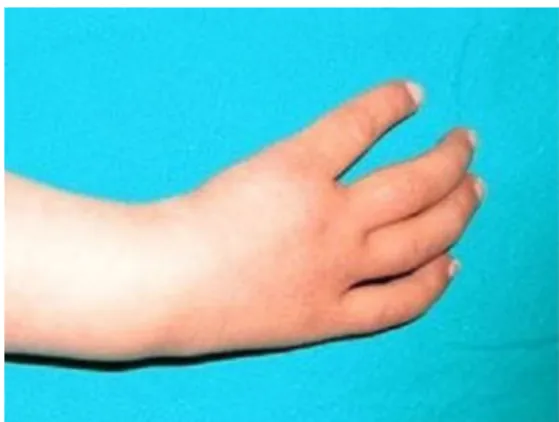
A2.5-year-oldgirl,borntofirstdegreeconsanguineous par-entspresentedwithafailuretowalking.Shewasdelivered by spontaneous vaginal in time and small for gestational age,weighing2.2kgatbirth.Physicalexaminationrevealed retarded growth (5.7kg weight and 68cm height) with absenceof bilateral thumb (Fig. 1),café au lait spots at back,hypopigmentationatabdomen,generalized hyperpig-mentation,andmicrocephaly.
Laboratory investigations did not reveal pancytope-nia; hemoglobin, WBC and platelets were 11.4gdl−1,
7.4×10³dl−1and162×103dl−1respectively.ALP,GGTand
0104-0014/$–seefrontmatter©2013SociedadeBrasileiradeAnestesiologia.PublishedbyElsevierEditoraLtda.Allrightsreserved.
202 Z.Doganetal.
Figure1 Absenceofthethumb.
LDHlevelswereelevatedand564,420and289respectively. Ultrasoundrevealedhypoplastichorseshoekidney.
The patient’s medication included only levothyroxine becauseofhypothyroidism.NomedicationexistrelatedFA. Other investigations including electrolytes, BUN, cre-atinine, bilirubins, AST, ALT, prothrombin time, partial thromboplastintime,ECG, and echocardiogramwere nor-mal.Thepatientwaseuthyroidic.
Evaluation of the airway revealed no abnormalities, exceptmicrocephaly,andvitalsignswerenormal.Adequate bloodandbloodproductsordereddependingonthe proce-dure.
Nomedicationwasadministeredpriortotheprocedure apart from antibiotics. Anesthesia was induced with 8% sevofluranein100%oxygen.Afterperipherali.v.accesswas secured,she wasturnedtothe leftlateral position. Cau-dalblock was performed by using a 22-gauge short-bevel needleunderasepticconditionswithbupivacaine0.25%at 1mlkg−1.Aftercaudalblockadeinhalationanesthesiawas
loweredto0.5---1% in 100%oxygenin ordertoobtain4 or 5point ofRamsay sedationscale. Peripheraloxygen satu-ration(SpO2), heart rate, noninvasiveblood pressureand end-tidalCO2(ETCO2)weremonitoredthroughoutsurgery. Ventilationwasmaintainedviaanoxygenmaskwith2Ldk−1
freshflowspontaneously(Fig.2).
Whole procedure includingopen reductionand putting thelimbinaplastercastfrominductiontorecoverylasted 140minandwasuneventful.Recoverywasfastand unevent-ful.Postoperativeanalgesiawasnotrequiredfortenhours.
Figure2 Thepatientwithfacemaskduringsurgery.
Discussion
Fanconianemiaisan autosomalrecessive disorderinover 99%ofcaseswith25%risktosiblings.1TheincidenceofFAis approximatelythreepermillionandtheheterozygote fre-quencyisestimatedatonein300inEuropeandtheUSA,2 1/100 inAshkenazi JewsandSouthAfricanAfrikaners due to‘‘foundereffect’’.1,3Consanguinityhasbeenimplicated initsincidence.3
Clinical features of FA can be broadly divided into twocategories:congenitalabnormalitiesandhematological abnormalities, which may include altered skin pigmenta-tion and/or café au lait spots, short stature (impaired growth hormone secretion), thumb or thumb and radial anomalies, hip anomalies, vertebral scoliois, rib anoma-lies, male hypogenitalism, mental retardation, anorectal atresia, duodenal atresia, microcephaly, eye anomalies (microphthalmia, strabismus, ptosis, nystagmus), struc-turalrenaldefects,low-birthweight,developmentaldelay, abnormalearsorhearing,andcardiopulmonarydefects.1---3 The most important clinical features of FA are hemato-logical. Pancytopenia is the usual finding and typically presentsbetween theagesof5 and10years,the median age of onset being 7 years.1 Clinically, the affected FA patient may present with bleeding, pallor and/or recur-ring infections.2 The major cause of death in FA is bone marrow failure, followed in frequency by leukemia and solidtumors.Theprojectedmediansurvivalfromallcauses for more than 1000 cases reported in the literature is age 20 years.3 Of patients thirty or forty percent lack obvious physical abnormalities.1---3 There is great clinical heterogeneityevenwithinagenotype(siblingmaybe phe-notypically different).1 The gold-standard screening test for FA is based on the characteristic hypersensitivity of FA cells to the crosslinking agents, such as mitomycin C (MMC) or diepoxybutane (DEB).5 FANCA is the most com-mon complementation group, representing about 70% of cases.1 Androgen therapy (oxymetholone), cytokines (G-CSFand GM-CSF), andsupportive therapies suchasblood and platelet transfusionsform the mainstayof treatment priortoallogeneichematopoieticstemcelltransplantation. Gene therapy is experimental. E-amino caproic acid may be usedfor symptomatic bleeding. Steroids are occasion-ally used.1---3 FA frequently terminates in myelodysplastic syndromeand/orleukemia.1Hematopoieticstemcell trans-plantation (bone marrow, cordblood, or peripheral blood stemcells)maycureaplasticanemiaandprevent myelodys-plasticsyndromeorleukemia.2,3
PatientswithFAmaypresentforproceduressuchas Hick-man catheter insertion for bone marrow transplantation, limb reconstructive surgeries, splenectomy, gastrointesti-nal anomalies, congenital heart defects, trauma or other relatedand/ornon-relatedindications.Theinsufficiencyof literatureregarding anestheticmanagementofthis condi-tion makes it difficult to estimate the real impact of individualanomaliesontheperioperativemanagement.6It is important toemphasize that of patients thirtyor forty percenthavenoabnormalities.1---3
AnesthesiaandFanconianemia 203
and endocrine evaluation for any component of the dis-easeor anycomplicationofthetreatmentof thedisease. For example hyperbilirubinemia and hepatomegaly with fattyinfiltratescouldbeattributedtotherapywith andro-gen.Alltransfusionsandanytransfusionreactionsmustbe documented.6 Adequate blood and blood products should beordered depending on theprocedure. No family mem-ber should be usedas a blood product donor until it has beendeterminedthatatransplantwillnotbeperformed.3 Leukocyte-filteredbloodproductsshouldbeusedtoreduce reactionsandHLAsensitizationincaseoffuturestemcell transplant.Similarly,single-donorplateletsarepreferredto reducethefrequencyofantibodyformation.3
Because thrombocytopenia usually develops initially,4 particularly, thrombocyte count should be evaluated. Repeatedrespiratorytractinfectionsandneutropenic sep-sismaybepresentbecauseofpancytopenia.Childrenwith neutropenicsepsismayhavesubclinicalcoagulopathythat shouldbecorrectedpreoperatively.7Incaseofneutropenia, itismandatorytomaintainstrictasepticprecautionswhile handlingthesepatients.Bacterialandviralfiltersshouldbe usedinthebreathingcircuits.6
Endocrinopathies are a common feature of FA. In a prospective study of 54 FA patients, it was found that hypothyroidism, impaired glucose tolerance, hyper-insulinemia, and subnormal response to growth hormone stimulation.7 A complete endocrine assessment should be madetodetecttheseaspects.Patients,whoareonsteroid therapy,mustbedocumentedregardingreplacement ther-apy, glucose monitoring, edema, hypokalemia, myopathy, infection,andgastricprophylaxia.
Drug therapy for FA may also have anesthetic impli-cations. Some of the serious adverse effects of androgen include hepatomegaly,cholestatic hepatitis, andelevated liverenzymelevels.3Androgensmayincreasethe anticoag-ulanteffectoforalanticoagulants(warfarin)8andmayalso increaseinsulineffects.9AdverseeffectsofG-CSFtreatment relevanttoanestheticmanagementincludepericardialand pleuraleffusionsandgeneralizedcapillaryleaksyndromes, whichmayresultininterstitialpulmonaryedemaand arte-rialhypoxemia.10
Otherdrugsandchemicalscausingacquiredaplastic ane-mia should be avoided during the perioperative period. Medicationsinterferewithplateletfunctionshouldnotbe giventothrombocytopenicpatients.3Theseincludeaspirin, antihistamines,andnonsteroidalanti-inflammatorydrugs.6 Normal fasting regimes and minimal monitoring stan-dards,ifanyindicationexist,moremonitorizations,should be applied throughout the perioperative period. Signifi-cant thrombocytopenia,ifpresent, mayprecluderegional anesthesia.Infectiveendocarditisprophylaxishastobe con-sideredforpatientswithcardiacinvolvement.6
A possible anesthetic consideration may include the avoidance of high inspired oxygen concentrations (FiO2). Thereis sensitivitytooxygen-freeradicalsandtoionizing radiation.1 Clarke et al.suggest that the sensitivityof FA group C cells toapoptosis induced by MMC is becauseof reactiveoxygenspeciesgenerationinthepresenceofhigh oxygenconcentrationsandnotDNAcross-linking.11Low oxy-gentensionorantioxidantsmaybeusedtoimprovegrowth anddecreasespontaneousorinducedchromosomebreaksin FAcells.3
Inthiscasecaudalanesthesiawaspreferredtoavoidfrom N2O,toreduceamountofanestheticagent,toprovide post-operativeanalgesia,andtoreduceamountofnonsteroidal anti-inflammatorydrugsandmorphine.
Caudal epidural blockade is widely used to provide perioperative analgesia in pediatric practice. As a single injection,itoffersareliableandeffectiveblockforpatients undergoingsubumbilicalsurgery.12
Nitrousoxide-inducedbonemarrowdepressionisan addi-tionalconcern.Somestudiessuggestthattheuseofnitrous oxide (N2O) is harmful producing bone marrow suppres-sionasitimpairsmethioninesynthetaseactivity,disturbing folatemetabolismandthus vitaminB12metabolism.13 On theotherhand,wedonothaveanydatainpatientwithFA. In view of the hepatorenal derangement which can occur any time during the course of the disease, it is imperativetoavoid anestheticagents withpotential hep-atorenal toxicity. In this respect, it may be advisable to avoidhalothane,long-actingmusclerelaxants,nonsteroidal anti-inflammatoryagents, and long-acting opioidssuch as morphine and pethidine.6 Postoperative analgesia could be provided by caudal injection perfectly. Thus, amount of analgesic drug, such as nonsteroidal anti-inflammatory agents,morphineandpethidine,couldbereduced.Inthis manner potential hepatorenal toxicity owing to analgesic agentcouldbeavoided.
Inconclusion,wepreferredinthepatientwithFAwithout thrombocytopenia,becauseofavoidingfromN2O,reducing amount of anesthetic, existing microcephaly, hypothy-roidismandelevatedliverenzymes,providingpostoperative analgesia,andreducingamountofanalgesicused postopera-tively.
Conflicts
of
interest
Theauthorsdeclarenoconflictsofinterest.
References
1.LanzkowskyP.Congenitalaplasticanemias.In:LanzkowskyP, editor.Manualofpediatrichematologyandoncology.4thedn. California:ElsevierInc.;2005.p.105---12.
2.TischkowitzMD,HodgsonSV.Fanconi anaemia.JMedGenet. 2003;40:1---10.
3.Alter BP. Inherited bone marrow failure syndromes. In: NathanDG,OrkinSH,GinsburgD,LookAT,editors.Nathanand Oski’shematologyofinfancyandchildhood.6thedn. Philadel-phia:W.B.SaundersCompany;2003.p.280---365.
4.DrorY. Inheretedbone marrowfailuresyndromes.In: Arceci JR,HannM˙I,SmithPO,editors.Pediatrichematology.3rdedn. Massachusetts:BlacwellPublishing;2006.p.32---7.
5.AuerbachAD.Fanconianemiadiagnosisandthediepoxybutane (DEB)test.ExpHematol.1993;21:731---3.
6.JacopR,VenkatesanT.AnesthesiaandFanconianemia.Paediatr Anaesth.2006;16:981---5.
7.CulshawV,YuleM, LawsonR.Considerations foranaesthesia inchildrenwithhaematologicalmalignancy undergoingshort procedures.PaediatrAnaesth.2003;13:375---83.
8.MeeksML,MahaffeyKW,KatzMD.Danazolincreasesthe antico-agulanteffectofwarfarin.AnnPharmacother.1992;26:641---2.
204 Z.Doganetal.
10.TobiasJD, FuemanWL.Anestheticconsiderationsin patients receivingcolony-stimulatingfactors(G-CSFandGM-CSF). Anes-thesiology.1991;75:536---8.
11.Clarke AA, Philpott NJ, Gordon-Smith EC, et al. The sensi-tivity of Fanconi anemia group C cells to apoptosis induced bymitomycinCisduetooxygenradicalgeneration,notDNA crosslinking.BrJHaematol.1997;96:240---7.
12.TsuiBCH,BerdeCB.Caudalanalgesiaandanesthesiatechniques inchildren.CurrOpinAnaesthesiol.2005;18:283---8.