Prognostic Determinants of Patients with Chronic Systolic Heart
Failure Secondary to Systemic Arterial Hypertension
Dalva M.S. Rolande, João Paulo Fantini, Augusto Cardinalli Neto, José A. Cordeiro, Reinaldo B. Bestetti
Hospital de Base São José do Rio Preto, São José do Rio Preto, SP, BrazilAbstract
Background: Systemic arterial hypertension (SAH) is an important cause of chronic systolic heart failure (CHF) in underdeveloped countries. It would be desirable to know predictors of mortality for patients with this condition in order to provide proper scientific treatment.
Objective: To determine risk factors for all-cause mortality in patients with CHF secondary to SAH in the current era of heart failure therapy for left ventricular systolic dysfunction.
Methods: All patients routinely and prospectively followed at the Cardiomyopathy Clinic of our Institution from January, 2000 to April, 2008 with the diagnosis of CHF secondary to SAH were screened for the study. Cox proportional hazards model was used to establish independent predictors of all-cause mortality.
Results: One hundred thirty patients were included; 74 (57%) were male. Thirty one (24%) patients died, 5 (4%) underwent heart transplantation, and 94 (72%) were alive at study end. Survival probability at 12, 24, 36, 48, and 60 months was 96%, 93%, 84%, 79%, and 76%, respectively. Age (Hazard Ratio=1,05, 95% Confidence Interval 95% 1,01 to 1,08, p value=0,01), left ventricular diastolic dimension (Hazard Ratio=1,08; 95% Confidence Interval 1,02 to 1,09; p value=0,003), and B-Blocker therapy (Hazard Ratio=0,41; 95% Confidence Interval 0,19 to 0,86; p value=0,02) were found to be independent predictors of mortality.
Conclusion: Age, left ventricular diastolic dimension and underuse of Beta-Blocker therapy were independent predictors of mortality for patients with CHF secondary to SAH in the population studied. (Arq Bras Cardiol 2012;98(1):76-83)
Keywords: Heart failure, systolic, hypertension, prognosis, ventricular remodeling, survival.
Mailing Address: Reinaldo B. Bestetti •
Rua Jeronimo Panazollo, 434, Ribeirânia – 14036-900 - Ribeirão Preto, SP, Brazil
E-mail: [email protected]
Manuscript received May 01, 2011; revised manuscript received August 04, 2011; accepted on September 01, 2011.
is necessary to rule out concomitant coronary artery disease if one wishes to establish outcome and prognostic determinants for patients with chronic heart failure secondary to systemic arterial hypertension.
The clinical course of chronic systolic heart failure has been established in different types of cardiomyopathy, including Idiopathic Dilated Cardiomyopathy7,8, Ischemic Cardiomyopathy9, and Chagas’ cardiomyopathy10. By contrast, little is known about outcome and predictors of mortality in patients with chronic systolic heart failure secondary to systemic arterial hypertension in the absence of coronary artery disease.
Three previous longitudinal studies11-13 performed in the developed world have addressed this question. Another study carried out in Brazil also examined the clinical course of patients with systolic heart failure and systemic arterial hypertension; however, in that study no patient received B-Blocker therapy14, an essential component of chronic systolic heart failure therapy in hypertensive patients15. Therefore, no previous study has evaluated the clinical course of chronic systolic heart failure secondary to systemic arterial hypertension in underdeveloped countries in the current era of heart failure therapy.
Introduction
It has long been recognized that systemic arterial hypertension is a precursor of chronic heart failure in up to 75% of cases1, mainly when systolic arterial hypertension is present2. In underdeveloped countries, systemic arterial hypertension is the leading cause of chronic heart failure associated to coronary artery disease3. Chronic heart failure associated with systemic arterial hypertension may be due to left ventricular systolic dysfunction or left ventricular diastolic dysfunction4. Chronic left ventricular systolic dysfunction associated with systemic arterial hypertension is still one of the leading causes of chronic heart failure in underdeveloped countries5.
Accordingly, this study aimed at determining noninvasive predictors of all-cause mortality and outcome of patients with chronic systolic heart failure secondary to systemic arterial hypertension in the absence of concomitant coronary artery disease in a single-center Brazilian cohort.
Methods
Patients
All patients routinely and prospectively followed at the Cardiomyopathy Clinic of our Institution from January 2000 to April 2008 diagnosed with chronic systolic heart failure secondary to systemic arterial hypertension were screened for the study. To be included in the study, patients had to have: 1) systolic blood pressure > 140 mmHg or diastolic blood pressure > 90 mmHg on admission; 2) documented medical history of past systemic arterial hypertension if blood pressure was normal at presentation and patients were given antihypertensive medications; 3) previous history and/or treatment of systemic arterial hypertension determined at the time of presentation by investigators on the basis of patient interview when systemic arterial pressure was normal upon physical examination13; 4) left ventricular ejection fraction smaller than or equal to 55% on Doppler-echocardiography or < 50% on Radionuclide Ventriculography; 5) Obstructive Coronary Artery Disease ruled out by either coronary arteriogram or myocardial scintigraphy when patients refused or were unable to undergo the procedure; 6) absence of any other disease which could induce heart disease by itself.
Patients underwent history-taking and physical examination on admission, followed by standard laboratory tests, 12-lead electrocardiogram, and Dopplerechocardiogram. On admission, the severity of Heart Failure was graded according to the New York Heart Association Functional Class, and Systemic Arterial Pressure and Heart Rate were noted.
All patients were given furosemide to alleviate congestive symptoms. Digoxin was given to patients in the New York Heart Association class III or IV and to patients on New York Heart Association Class II with left ventricular ejection fraction < 30%. Spironolactone was given to patients in the New York Heart Association Functional Class III or IV. Angiotensin Converting Enzyme Inhibitors (Captopril: target dose, 75-150 mg/day; Enalapril: target dose: 20 mg/day) or Losartan (target dose: 50 mg/day) were given to all patients. Patients were also given carvedilol (target dose: 50 mg/day) or metoprolol succinate (target dose: 200 mg/day).
Until 2005, patients classified in New York Heart Association Class I/II received angiotensin converting enzyme inhibitors before Beta-Blocker therapy. From 2006 onwards, following the publication of CIBIS III trial16, patients in New York Heart Association Class I/II were given Beta-Blocker therapy before angiotensin converting enzyme inhibitors/angiotensin receptor blocker. Patients in New York Heart Association class III/IV always received
angiotensin converting enzyme inhibitors/angiotensin receptor blockers before B-Blockers.
Statistical Analysis
Parametric data are shown as mean ± standard deviation, whereas nonparametric data are presented as median (25% percentile, 75% percentile).
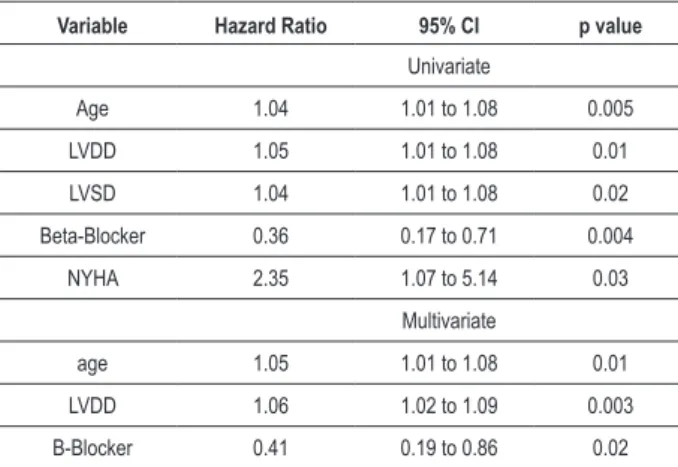
The Cox proportional hazards model was used to establish independent predictors of all-cause mortality. Explanatory variables known to be of prognostic importance for patients with chronic systolic heart failure were entered into the univariate model. The variables entered in this model were as follows: age, sex, New York Heart Association Functional Class, previous hospitalization, concomitant diabetes mellitus, heart rate, systolic blood pressure, diastolic blood pressure, need of inotropic support; atrial fibrillation, artificial pacemaker, Implantable Cardioverter-Defibrillator, left bundle branch block, right bundle branch block, left anterior fascicular block, low QRS complex, ventricular premature contractions on electrocardiography; left ventricular diastolic dimension, left ventricular systolic dimension, left ventricular ejection fraction, right ventricular dimension, and segmental wall motion abnormalities on echocardiography; sodium serum levels, potassium serum levels, creatinine serum levels, hemoglobin; use of diuretics, angiotensin converting enzyme inhibitors/ angiotensin receptor block, Beta-Blockers, spironolactone. Variables with p value <0.05 on univariate analysis were entered into the multivariate stepwise analysis with a forward approach. Continuous variables significant in the univariate analysis were tested for correlation by the Spearman test. Among the correlated variables selected for the multivariate analysis, only that one with the highest Wald coefficient was included. C statistic was used to select the best cut-off point of a continuous variable to predict mortality by constructing a ROC curve. An area under the curve >0.50 was considered statistically significant.
The Kaplan-Meier survival curve was constructed to estimate survival over time. Patients were censored at time of transplantation, death or spontaneous withdrawal from the study. The log-rank sum test was used to compare survival according to dichotomization of variables with independent power to predict mortality. In all circumstances, differences at a p value < 0.05 were considered of statistical significance.
Results
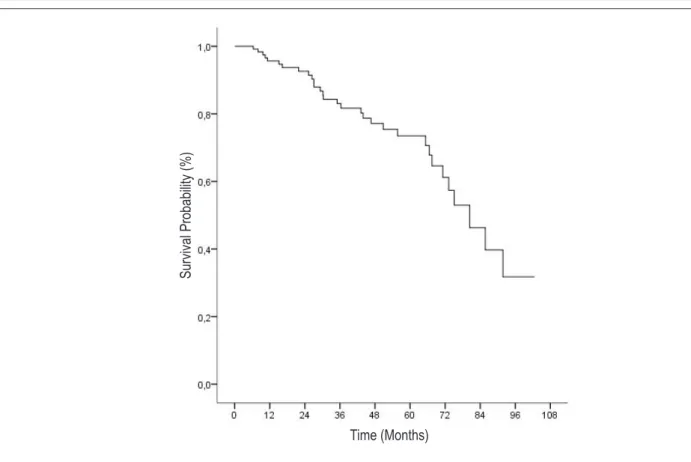
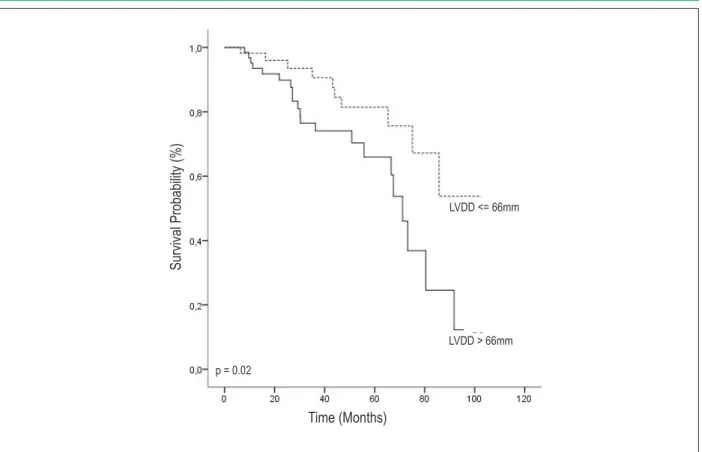
93%, 84%, 79%, and 76%, respectively, as shown in Figure 1. Figure 2 shows survival probability according to age. Figure 3 shows survival probability according to left ventricular diastolic dimension on echocardiography, and Figure 4 shows survival probability according to Beta-Blocker therapy.
Discussion
This study clearly shows that age, left ventricular diastolic dimension on echocardiography, and B-Blocker therapy are independent predictors of mortality of patients with chronic systolic heart failure secondary to systemic arterial hypertension in the absence of obstructive coronary artery disease.
Age was associated with mortality in this investigation. A similar result was observed in the study by Carvalho Frimm et al14. It is well known that age has been associated with left ventricular hypertrophy17 and myocardial fibrosis18 in patients with systemic arterial hypertension and left ventricular systolic dysfunction. This association leads to ventricular remodeling process over time, which is characterized by left ventricular dilatation and thinning of ventricular walls, as detected in the echocardiographic study performed in our patients. Not surprisingly, therefore, age was a prognostic determinant in our study.
Table 1 - Baseline characteristics of study population (n = 130)
Variable Data
Age (years) 59 ± 13
Male 74 (57%)
NYHA Class I/II 92 (69%)
NYHA Class III/IV 40 (31%)
Previous Hospitalization 71 (55%)
Inotropic Support 15 (11%)
Heart Rate (beats per minute) 78 ± 14
Systolic Blood Pressure (mmHg) 130.8 ± 22.5
Diastolic Blood Pressure (mmHg) 83 ± 17,2
Diabetes Mellitus 34 (26%)
Digoxin (0.20 ± 0.01 mg/day) 80 (61%)
Amiodarone (188 ± 33.2 mg/day) 25 (19%)
ACEI/ARB 125 (96%)
Enalapril (19.9± 9.8 mg/day) 34 (26%)
Captopril (114.6 ± 43.3 mg/day) 58 (45%)
Losartan (59.4 ± 30 mg/day) 32 (25%)
Beta-Blockers 96 (74%)
Carvedilol (34.8 ± 19.6 mg/day) 73 (56%)
Metoprolol Succinate (144.3±65.4 mg/day) 23 (18%)
Diuretics 121 (91%)
Furosemide (75 ± 50.1 (mg/day) 108 (83%)
Spironolactone (26.6 ± 8.9 mg/day) 91 (70%) NYHA - New York Heart Association; ACEI - Angiotensin Converting Enzyme Inhibitors; ARB - Angiotensin Receptor Blocker.
Table 2 - Electrocardiographic, echocardiographic, and laboratory tests at baseline of the study population (n = 131)
Variable Data
12-lead ECG parameters
Left Bundle Branch Block 61 (47%)
Premature Ventricular Contractions 24 (18%)
Atrial Fibrillation 23 (18%)
Left Anterior Fascicular Block 20 (15%)
Pacemaker 5 (4%)
Right Bundle Branch Block 3 (2%)
Low voltage of QRS complex 2 (1%)
Echocardiographic parameters
Left ventricular diastolic dimension (mm) 67.4 ± 10.1
Left ventricular systolic dimension (mm) 55.6 ± 10.6
Right ventricular (mm) 22.9 ± 6.3
Left ventricular ejection fraction (%) 35.7 ± 9.7
Segmental wall motion abnormalities 19 (15%)
Laboratory tests
Na (mEq/L) 142.3 ± 4.2
K (mEq/L) 4.4 ± 0.5
Creatinine (mg]dL) 1.3 ± 0.6
Table 3 - Univariate and Multivariate analysis by Cox proportional hazards model
Variable Hazard Ratio 95% CI p value
Univariate
Age 1.04 1.01 to 1.08 0.005
LVDD 1.05 1.01 to 1.08 0.01
LVSD 1.04 1.01 to 1.08 0.02
Beta-Blocker 0.36 0.17 to 0.71 0.004
NYHA 2.35 1.07 to 5.14 0.03
Multivariate
age 1.05 1.01 to 1.08 0.01
LVDD 1.06 1.02 to 1.09 0.003
B-Blocker 0.41 0.19 to 0.86 0.02
LVDD - Left ventricular diastolic dimension; LVSD - Left ventricular systolic dimension; NYHA - New York Heart Association class.
Figure 2 - Probability of survival according to patients’ age dichotomized according to the best cutoff point obtained in a ROC curve.
Figure 1 - Survival probability for a cohort of patients with chronic systolic heart failure secondary to systemic arterial hypertension in the absence of concomitant
obstructive coronary artery disease (n = 130).
S
ur
vi
va
l P
ro
ba
bi
lity
(%)
S
ur
vi
va
l P
ro
ba
bi
lity
(
%)
Time (Months)
Time (Months)
p = 0.01
<= 61 years
Figure 3 - Probability of survival according to left ventricular diastolic dimension dichotomized according to the best cutoff point obtained in a ROC curve.
Figure 4 - Probability of survival according to Beta-Blocker therapy.
LVDD <= 66mm
p = 0.02
p = 0.003
LVDD > 66mm
B-Blocker
No B-Blocker
S
ur
vi
va
l P
ro
ba
bi
lity
(%)
S
ur
vi
va
l P
ro
ba
bi
lity
(
%)
Time (Months)
Frimm et al14 patients had a higher mortality rate. It is conceivable that the determinant of worse prognosis observed in the study by Carvalho Frimm et al14 was the lack of B-blocker therapy in any patient in that study.
It is interesting to note that diabetes mellitus had no impact on outcome of patients with chronic systolic heart failure secondary to systemic arterial hypertension. Diabetes mellitus has been found to be a risk factor for chronic heart failure in patients with systemic arterial hypertension. In fact, Levy et al17 studied a cohort of 5143 patients in a population-based setting during a mean follow-up of 14 years and showed that the presence of diabetes mellitus increased the risk of heart failure appearance in men (hazard ratio=1.78, 95% confidence interval 1.23 to 2.59) and women (hazard ratio=3.57, 95% confidence 2.59 to 4.94) with systemic arterial hypertension. Our study suggests that, following the appearance of chronic systolic heart failure, diabetes mellitus has no impact on outcome of patients with this condition.
Several mechanisms have been proposed to explain the transition of hypertrophy, a hallmark morphological sign of systemic arterial hypertension, to chronic hypertensive systolic dysfunction. Microangiopathy20, imbalanced mass to volume ratio and stress21, impairment in the coronary vasodilator reserve22 and oxidative stress23 have all been implicated. In our study, however, the underlying mechanism leading to chronic systolic dysfunction associated with chronic heart failure in our patients remains unclear because neither endomyocardial biopsies nor post-mortem examination have routinely been performed.
The data obtained in this investigation should be received with caution because it is a prospective longitudinal cohort study improper to evaluate the impact of treatment on outcome. However, it must be pointed out that data were obtained from a cohort of hypertensives with chronic heart failure with no obstructive coronary artery disease as large as the largest previously reported.
In conclusion, age, left ventricular diastolic dimension and underuse of Beta-Blocker therapy are independent predictors of mortality for patients with chronic systolic heart failure secondary to systemic arterial hypertension.
Acknowledgements
João Paulo Fantini was awarded an Undergraduate Research Studies Grant from FAPESP - Research Foundation of São Paulo (process 2009/11310-5).
Potential Conflict of Interest
No potential conflict of interest relevant to this article was reported.
Sources of Funding
There were no external funding sources for this study.
Study Association
This article is part of the thesis of doctoral submitted by Dalva M.S. Rolande, from Faculdade de Medicina de São José do Rio Preto.
ventricular dilatation, as observed in our investigation, may predispose patients to both sudden cardiac death (perhaps due to inadequate activation of the Bezold-Jarisch reflex), as well as irreversible myocardial pump failure secondary to increased oxygen consumption rate leading to ischemia and cell death19.
Another interesting finding of this work was the recognition of underuse of Beta-Blocker therapy as an independent predictor of mortality. Observational studies are not adequate for establishing association of drugs with mortality, such as randomized trials, due to the inherent appearance of selection and detection biases and risk overestimation. However, the results reported here are in accordance with those reported by Herlitz et al15, who specifically studied a subgroup of patients with chronic systolic heart failure secondary to systemic arterial hypertension enrolled in a randomized, double-blinded, placebo-controlled clinical trial (MERIT trial).
It is necessary to point out that the independent predictors of mortality detected in our study are different from those reported by others. Sanchez et al11 observed that only poor control of blood pressure was an independent predictor of death or hospitalization for heart failure. Our study is different from that of Sanchez et al11 in terms of end-point and the fact that our patients had normal pressure values on average at admission, which may explain the differences observed in both studies. Carvalho Frimm et al14 observed that left ventricular ejection fraction was an independent predictor of mortality. However, it must be remembered that left ventricular ejection fraction correlates inversely with left ventricular diastolic dimension. In practice, therefore, both abnormalities have the same prognostic significance.
A key point in this investigation is the low mortality rate of patients with chronic systolic heart failure secondary to systemic arterial hypertension. Sanchez et al11 followed 49 consecutive patients with chronic systolic heart failure secondary to systemic arterial hypertension with a median follow-up of 45 months. Five (10%) patients died. Survival probability at 4-year follow-up was 84%. Survival probability in our investigation was similar to that reported by Sanches et al11. It is conceivable that the similarity of the proper medical treatment has determined the good prognosis observed in both studies.
References
1. McKee PA, Castelli WP, McNamara PM, Kannel WB. The natural history of congestive heart failure: the Framingham study. N Engl J Med. 1971;285(26):1441-6.
2. Kannel WB, Castelli WP, McNamara PM, McKee PA, Feinleib M. Role of blood pressure in the development of congestive heart failure. The Framingham Study. N Engl J Med. 1972;287(16):781-7.
3. Bocchi EA, Marcondes-Braga FG, Ayub-Ferreira SM, Rohde LE, Oliveira WA, Almeida DR et al. III Brazilian Guidelines of Chronic Heart Failure. Arq Bras Cardiol. 2009;93(2 Suppl. I):1-70.
4. Iriarte MM, Perez Olea J, Sagastgoitia D, Molinera E, Murga N. Congestive heart failure due to hypertensive ventricular diastolic dysfunction. Am J Cardiol. 1995;76(13):43D-47D.
5. Bestetti RB, Muccillo G. Clinical course of Chagas’ heart disease: a comparison with dilated cardiomyopathy. Int J Cardiol. 1997;60(2):187-93. 6. Cleland JG. Progression from hypertension to heart failure: mechanisms and
management. Cardiology. 1999;92(Suppl 1): 10-9.
7. Romeo F, Pelliccia F, Cianfrocca C, Gallo P, Barilla F, Cristofani R, et al. Determinants of end-stage idiopathic dilated cardiomyopathy: a multivariate analysis of 104 patients. Clin Cardiol. 1989;12(7):387-92. 8. Sugrue DD, Rodecheffer RJ, Codd MB, Ballard DJ, Fuster V, Gersch BJ. The
clinical course of idiopathic dilated cardiomyopathy: a population-based study. Ann Int Med. 1992;117(2):117-23.
9. Rockman HA, Juneau C, Chatterjee K, Rouleau JL. Long-term predictotrs of sudden and low output death in chronic congestive heart failure secondary to coronary artery disease. Am J Cardiol. 1989;64(19):1344-8.
10. Bestetti RB, Dalbó CM, Freitas OC, Teno LA, Castilho OT, Oliveira JS. Noninvasive predictors of mortality for patients with Chagas’ heart disease: a multivariate stepwise logistic regression study. Cardiology. 1994;84(4-5):261-7.
11. Anquila Sánchez M, Rodríguez Esteban M, Ojeda Pineda S, Ruiz Ortiz M, Romo Peña E, Mesa Rubio D, et al. Clinical outcome and reversibility of systolic dysfunction in patients with dilated cardiomyopathy due to hypertension and chronic heart failure. Rev Esp Cardiol. 2004;57(9):834-41.
12. Szygufa-Jurkiewicz B, Owczarek A, Duszanska A, Sikora J, Lekston A, Pudlo R, et al. Long-term prognosis and risk factors for cardiac adverse events in
patients with chronic systolic heart failure due to hypertension. Pol Arch Med Wewn. 2008;118(5):280-8.
13. Felker GM, Thompson RE, Hare JM, Hruban RH, Clemetson DE, Howard DL, et al. Underlying causes and long-term survival in patients initially unexplained cardiomyopathy. N Engl J Med. 2000;342(15):1077-84. 14. de Carvalho Frimm C, Soufen HN, Koike MK, Pereira VF, Curi M. The
long-term outcome of patients with hypertensive cardiomyopathy. J Hum Hypertens. 2005;19(5):393-400.
15. Herlitz J, Wikstrand J, Denny M, Fenster P, Heywood T, Masszi G, et al. Effects of metoprolol CR/XL on mortality and hospitalizations in patients with heart failure and history of hypertension. J Card Fail. 2002;8(1):8-14. 16. Willenheimer R, van Heldhuisen DJ, Silke B, Erdmann E, Follath
F, Krum H, et al. Effect on survival and hospitalization of initiating treatment for chronic heart failure with bisoprolol followed by enalapril as compared with the opposite sequence: results of the randomized Cardiac Insufficiency Bisoprolol Study (CIBIS) III. Circulation. 2005;112(16):2426-35.
17. Levy D, Larson MG, Varsan RS, Kannel WB, Ho KK. The progression from hypertension to congestive heart failure. JAMA. 1996;275(20):1557-62. 18. Barasch E, Gottdiener JS, Aurigemma G, Kitzman DW, Han J, Kop WJ, et al. Association between elevated fibrosis markers and heart failure in the elderly: the cardiovascular health study. Circ Heart Fail. 2009;2(4):303-10.
19. Lee TH, Hamilton MA, Stevenson LW, Moriguchi JD, Fonarow GC, Child JS, et al. Impact of left ventricular cavity size on survival in advanced heart failure. Am J Cardiol. 1993;72(9):672-6.
20. Vogt M, Strauer BE. Systolic ventricular dysfunction and heart failure due to coronary microangiopathy in hypertensive heart disease. Am J Cardiol. 1993;76(13):48D-53D.
21. Strauer BE. Ventricular function and coronary hemodynamics in hypertensive heart disease. Am J Cardiol. 1979;44(5):999-1006. 22. Schwartzkopff B, Motz W, Strauer BE. Heart failure on the basis of
hypertension. Circulation. 1993;87(5 Suppl):IV66-72.