The Regulation of Monoamine Oxidase A Gene Expression by Distinct
Variable Number Tandem Repeats
Maurizio Manca1,2,3&Veridiana Pessoa1,2&Ana Illera Lopez1&Patrick T. Harrison5&Fabio Miyajima1,4&Helen Sharp2& Andrew Pickles6&Jonathan Hill7&Chris Murgatroyd8&Vivien J. Bubb1&John P. Quinn1
Received: 1 November 2017 / Accepted: 15 February 2018 / Published online: 14 March 2018 #The Author(s) 2018
Abstract
The monoamine oxidase A (MAOA) uVNTR (upstream variable number tandem repeat) is one of the most often cited examples of a gene by environment interaction (GxE) in relation to behavioral traits. However,MAOApossesses a second VNTR, 500 bp upstream of the uVNTR, which is termed d- or distal VNTR. Furthermore, genomic analysis indicates that there are a minimum of two transcriptional start sites (TSSs) forMAOA, one of which encompasses the uVNTR within the 5′untranslated region of one of the isoforms. Through expression analysis in semi-haploid HAP1 cell lines genetically engineered in order to knockout (KO) either the uVNTR, dVNTR, or both VNTRs, we assessed the effect of the twoMAOAVNTRs, either alone or in combination, on gene expression directed from the different TSSs. Complementing our functional analysis, we determined the haplotype variation of these VNTRs in the general population. The expression of the twoMAOAisoforms was differentially modulated by the two VNTRs located in the promoter region. The most extensively studied uVNTR, previously considered a positive regulator of theMAOAgene, did not modulate the expression of what it is considered the canonical isoform, while we found that the dVNTR positively regulated this isoform in our model. In contrast, both the uVNTR and the dVNTR were found to act as negative regulators of the second less abundantMAOAisoform. The haplotype analysis for these two VNTRs demonstrated a bias against the presence of one of the potential variants. The uVNTR and dVNTR differentially affect expression of distinctMAOAisoforms, and thus, their combined profiling offers new insights into gene-regulation, GxE interaction, and ultimatelyMAOA-driven behavior.
Keywords MAOA. Isoforms . VNTR . Gene expression . Transcription . Haplotype
Introduction
Monoamine oxidase A (MAOA), a major regulator of mono-amine neurotransmitters in the brain, is one of the best
characterized and most cited genes in gene × environment in-teraction (GxE) studies, particularly in relation to central
Maurizio Manca and Veridiana Pessoa contributed equally to this work.
Electronic supplementary materialThe online version of this article (https://doi.org/10.1007/s12031-018-1044-z) contains supplementary material, which is available to authorized users.
* John P. Quinn [email protected]
1
Department of Molecular and Clinical Pharmacology, Institute of Translational Medicine, University of Liverpool, Liverpool L69 3BX, UK
2
Institute of Psychology, Health and Society, University of Liverpool, Liverpool, UK
3 Present address: Biomarker Research Laboratory, University of Huddersfield, Queensgate, Huddersfield HD1 3DH, UK
4
Present address: Department of Physiology and Pharmacology, Faculty of Medicine, Drug Development and Research Center, Federal University of Ceara, Fortaleza, Ceara, Brazil
5 Department of Physiology, BioSciences Institute, University College Cork, Cork, Ireland
6
King’s College London, MRC Social Genetic and Developmental Psychiatry Research Centre, Institute of Psychiatry, London, UK 7
School for Psychology and Clinical Language Sciences, University of Reading, Reading, UK
8 School of Healthcare Science, Manchester Metropolitan University, Manchester, UK
nervous system (CNS) disorders (Nikulina et al.2012; Philibert et al.2008; Reif et al.2014; Samochowiec et al.2004) and behavioral traits (Aslund et al.2011; Caspi et al. 2002; Chester et al.2015; Hill et al.2013; Pickles et al.2013). Two coding transcripts for theMAOAgene have been reported, with transcriptional start sites (TSSs) separated by approximately 1.3 kb, resulting in two putative coding isoforms with distinct 5′untranslated regions (5′UTRs). These isoforms vary in length and contain alternative exons and distinct start codons which potentially lead to the translation of two protein isoforms (Fig.1a, b); however, the functional consequences of this have not been discussed in the literature. The regulation of these two TSSs is expected in part to be directed by two distinct variable number tandem repeat (VNTR) domains identified in the MAOApromoter region, which have previously been demon-strated to support gene expression in reporter gene assays (Philibert et al.2011; Sabol et al. 1998). The first, termed uVNTR, is located 1 kb upstream of the TSS for what we will term the primaryMAOAisoform (Fig.1a; Ensembl isoform 201), which is the most abundant mRNA and the TSS most referred to in previous communications analyzing the function of the uVNTR (Edwards et al.2010; Lee and Ham2008; Lung et al.2011; Reif et al.2008; Sabol et al.1998). In this context, the uVNTR is considered a transcriptional regulatory domain up-stream of this major TSS. However, in the second isoform, it is transcribed in the 5′UTR (Fig.1b), which is produced from the more 5′TSS. TheMAOAuVNTR consists of a 30-bp motif that can be repeated 2, 3, 3.5, 4, and 5 times (Sabol et al.1998). The 2, 3, and 5 repeats are generally defined as low expression var-iants (MAOA-L), while the 3.5 and 4 repeat VNTRs have been shown to demonstrate a 2- to 10-fold increase in reporter gene expression and considered high expression variants (MAOA-H) (Sabol et al.1998). We and others have previously reported evidence that specific uVNTR variants act as a moderators of the association observed between certain environmental risk factors and child behavioral problems (Fergusson et al.2012; Hill et al.2013; Pickles et al.2013). However, the majority of the literature refers only to the uVNTR as the major, or sole, mediator ofMAOAexpression and a possible biomarker for stress-related illnesses, with the different alleles implicated in major depressive disorder, addiction, violent behavior (Fan and Sklar2005; Frazzetto et al.2007; Melas et al.2013; Philibert et al.2008; Reif et al.2014), suicide attempts in bipolar females (Ho et al.2000), and depressed males (Du et al.2002). The second VNTR, termed dVNTR, is located approximately 500 bp upstream of the uVNTR and is composed of two differ-ent decamer repeats CCCCTCCCCG (repeat A) and CTCCTCCCCG (repeat B) (Philibert et al.2011). Genotypes of 8, 9, 10, 11, and 12 repeats have been documented, with 9R and 10R being the most common. In reporter gene assays, sim-ilarly to the uVNTR, the 9R and 10R differ in transcriptional efficiency, where the 9R is stronger than the 10R and the other genotypes are intermediate (Philibert et al.2011).
Through analysis of the semi-haploid HAP1 cell line (Carette et al.2011) deleted for either the uVNTR, dVNTR, or both VNTRs, we assessed the effect the two VNTRs, com-bined and individually, onMAOAexpression and specifically on the two distinct TSSs. We also analyzed the variation in the haplotype of theMAOApromoter in the general population to determine common haplotypes that may be used for further stratification of the genetic risk of MAOApolymorphism in psychiatric disorders.
Methods and Materials
Cell Culture
The human neuroblastoma cell line SH-SY5Y (ATCC/CRL-2266) which is near diploid (47 chromosomes) (Spengler et al.2002) was cultured in a 1:1 mix of Dulbecco’s EMEM and Ham’s F12 media supplemented with 10% (v/v) fetal bo-vine serum, 2 mML-glutamine, 1 mM sodium pyruvate, and
penicillin 100 U/ml/streptomycin 0.1 mg/ml. The HAP1 cell lines (Carette et al.2011; Essletzbichler et al.2014) were ob-tained from Horizon Genomics (Cambridge, UK) and cultured in Iscove’s modified Dulbecco’s medium (GIBCO, Paisley, UK), supplemented with 10% (v/v) fetal bovine serum and 100 U/ml penicillin/0.1 mg/ml streptomycin. Cells were cul-tured at 37 °C in a humidified 5% CO2atmosphere to 70–80% confluence with culture media being replaced every other day; reagents unless otherwise stated were from Sigma, Dorset, UK.
Total RNA Preparation and cDNA Synthesis
Total RNA was extracted using Trizol reagent (Invitrogen, Paisley, UK), and 3 μg was reverse-transcribed to cDNA using GoScript® Reverse Transcription System (Promega, Southampton, UK) and random primers following the manu-facturers’instructions.
Genotyping of the
MAOA
Promoter VNTRs
2% agarose gel electrophoresis and by capillary electrophoresis ABI 3130 (Life Technologies, Paisley, UK) in which the geno-types were called using Genemapper V4.0 (Life Technologies) or the QIAxcel Advanced System (Qiagen, Manchester, UK). The results from each method were analyzed blind from each other.
Horizon Genomics Generation of HAP1 VNTR KO Cells
The HAP1 clones were generated by Horizon Discovery (https://www.horizondiscovery.com/gene-editing/crispr)
using the CRISPR/Cas9 deletion system. The KO cell lines were validated by PCR and Sanger sequencing to confirm the presence of the desired mutation at the genomic level (Supplementary Figs.S1–S2).
mRNA Analysis in the HAP1 Cell Line and KO
Derivatives
Reactions containing 10 ng cDNA template, 5 pmol each primer (Eurofins, Ebersberg, Germany), 1× GoTaq® flexi Fig. 1 Monoamine oxidase A (MAOA) isoforms. Graphic representation
of theMAOAgene as reported in UCSC genome browser Hg38 and the most recent version of the Hg19. White rounded boxes represent 5′and 3′ UTRs, and black boxes the translated exons. Curved black arrows indicate the translational start sites. Gray bars are the dVNTR and the uVNTR from left to right respectively.aMajorMAOAisoform; NCBI accession number: BC008064 (Version BC008064.2), Ensembl version 201.bMAOA secondary isoform; NCBI accession number: AK293926 (Version AK293926.1), Ensembl version 204.cUntranslated processed
buffer, 1 mM MgCl2, 0.1 mM each dNTP, 1 M betaine, and 0.625 U GoTaq® DNA polymerase (Promega, Southampton, UK) were employed to analyze the levels of distinct isoforms of mRNA produced using the following primer pairs: (a) total MAOAexpression (i.e., isoforms 201 and 204 combined) ad-dressed by amplification ofMAOAexon III–exon VI fragment Forward 5′-TACGTAGATGTTGGTGGAGCTT-3′, Reverse 5′-AGAATATCCGAGTGGTGCCC-3′; (b) isoform 204 aloneMAOAexon I–exon IIA fragment, Forward primer 5′ -CGGGTATCAAAAGAAGGATCG-3′, Reverse primer 5′ -CCAGGAGCTGCTTTCCTCTGATGC-3′. Cycling condi-tions were 2 min at 95 °C initial denaturation, followed by 35 cycles of 20 s at 95 °C, 20 s at 61 °C and 30 s 72 °C, and final elongation for 5 min at 72 °C.
Amplicons were analyzed using a QIAxcel Advanced System (Qiagen, Manchester, UK,) with the following param-eters: QX DNA screening gel cartridge default 2.0 using the AM420 method. Standard alignment marker of 15–600 bp and QX DNA size marker of 25–500 bp were run simulta-neously allowing a fully automated size separation and quan-tification of each sample. Amplicon properties and concentra-tion were determined by QIAxcel BioCalculator software using a proprietary algorithm supplied by the manufacturer. The clonal cell lines were derived from the same parental background and cultured under identical conditions; thus, MAOAvalues were normalized only to the housekeeping gene β-actin(Forward primer 5′-CACCTTCTACAATGAGCTGC GTGTG-3′ and Reverse primer 5′-ATAGCACAGCCTGG ATAGCAACGTAC-3′) prior to analysis.
Cohort
Genomic DNA was obtained from saliva of 283 children who participated in the Wirral Child Health and Development Study (WCHADS), a longitudinal Medical Research Council (MRC) funded study of child development. Ethical approval for the study was granted by the Cheshire North and West Research Ethics Committee on the June 27, 2006 (ref: 05/Q1506/107).
In Silico Analysis
The University of California Santa Cruz (UCSC) Genome Browser (http://genome.ucsc.edu) was used for genomic positioning and mapping of the selected markers. Genotyped data were subject to quality control examination and gender check. The data was then formatted into a pedigree format file (.PED). MIDAS (Multiallelic Interallelic Disequilibrium Analysis Software) was employed for the LD analysis and construction of the haplotype blocks of the interallelic linkage disequilibrium. The data for both VNTR loci were analyzed following the instructions given by (Gaunt et al. 2006). Common and rare alleles were then imputed based on
the inferred haplotype blocks and analysis conducted sepa-rately for males and females.
Statistical Analysis
The relative gene expression data from the different HAP1 cell lines were analyzed with IBM SPSS Statistics software for Windows, version 24 (IBM Corp., Armonk, NY, USA) through a univariate general lineal model followed by a Bonferroni post hoc test. Data were considered significantly different atp< 0.05.
Results
Bioinformatic Analysis of
MAOA
Structured searches through accredited publicly available ge-nomic resources, including UCSC (https://genome.ucsc.edu/), AceView (http://www.ncbi.nlm.nih.gov/ieb/research/ acembly/), UniProt (http://www.uniprot.org/), and Ensembl (http://www.ensembl.org/) confirmed four mRNA isoforms for the humanMAOAgene (201, 202, 203, and 204); two of them (201 and 204) correspond to coding transcripts that predict at least two distinctMAOAprotein variants (Fig.1).
The primary MAOAisoform (Fig.1a, isoform 201) com-prises a 4015-bp transcript and encodes a full-length protein of 527 amino acids. The 5′UTR of this mRNA isoform was found to extend 124 bp upstream from the first ATG codon with theMAOAuVNTR located approximately 1 kb upstream of the TSS used to generate this isoform (Sabol et al.1998). The secondMAOAisoform (Fig.1b; isoform204) had a longer 5′UTR (~ 1.3 kb), which encompassed the uVNTR within its sequence. This predicted transcript was actually longer than the primary type (5438 versus 4015 bp) and contained an alternative non-coding exon (here termed exon IIA), which would introduce a premature (TGA) stop codon due to a shift in the reading frame. This, in turn, could result in the transla-tional start site shifting to exon IV where the next in-frame methionine codon (ATG) is located, resulting in an amino-terminal truncated version of the MAOA protein (394 AA), exactly 133 residues shorter than the primary isoform as illus-trated in Fig.1b. De Colibus et al. (2005) identified that the MAOAFAD/NAD binding domain comprised residues 13– 88, 220–294, and 400–462 in the primary isoform therefore an N-terminal section of the FAD/NAD binding domain was omitted in this alternative minor isoform, which incidentally largely overlapped with the non-coding isoform 203 (Fig.1c).
Expression of the Two
MAOA
Isoforms in SH-SY5Y Cell
Line
heterozygous for the uVNTR with three and four copies of the repeat element to address expression of the predicted isoform 204 in extant cells. This allowed identification of allele-specific expression when initiated from the more 5′TSS that included the uVNTR in the 5′UTR (Fig.1b, isoform 204). Under basal growth conditions, we detected mRNA corre-sponding to expression from both alleles using the uVNTR length as the distinguishing feature, thus validating the pre-dicted in silico isoform (Fig.2a).
HAP 1 Cell Line Characterization
To address the function of the u- and dVNTRs inMAOAgene expression, we utilized CRISPR/Cas9 deletion to produce HAP1cell line clones with selected distinct VNTR haplotypes. As summarized in Fig.3, four different single KO cell lines were generated from the parental cell line (P) by Horizon Discovery. Two of these had the uVNTR deleted from the MAOApromoter region but still possessed the dVNTR posi-tioned upstream of the gene (clones A and B); similarly, two
single KO lines were generated targeting the dVNTR initially (clones C and D). To generate the double VNTR KO clones a second, de novo, CRISPR/Cas9 deletion was performed on single KO clones B or C to either remove the dVNTR (clones E and F) or the uVNTR (clones G and H).
The VNTR deletions were confirmed by PCR, individually targetingMAOAuVNTR and dVNTR, respectively, as shown in the supplementary Fig.S1. The semi-haploid parental cell line (P) contained the alleles 3R and 10R for the uVNTR and dVNTR, respectively.
MAOA
Gene Expression in HAP1 Cells
The expression of the combined putativeMAOAcoding iso-forms (i.e., 201 and 204) was assessed using the primer set that amplified the region flanking exon III to exon VI of the MAOAgene (Fig.1) which reported a significant difference of expression between the groups F(9,27) = 190.2, p< 0.001. Conversely, amplification from exon I to alternative exon IIA allowed us to determine the expression of the less abun-dantMAOAcoding isoform 204 alone, which spans the more upstream TSS and encompassed the uVNTR in its 5′UTR (Fig.1b), which also reported a significant difference of ex-pression among the groupsF(9,27) = 40.4,p< 0.001.
The concentration of each isoform was measured using the QIAxcel system after normalization using the housekeeping geneβ-actin. It was found that the totalMAOAmRNA (i.e., exon III–exon VI assay) and the alternative isoform 204 alone (i.e., exon I–exon IIA assay) in the parental cell line (P), under basal conditions, had average concentrations of 1.90 and 0.10 ng/μl, respectively (Figs.4and5c, d). This facilitated an estimation of the abundance of the alternative isoform 204 at around 5% of the overallMAOAmRNA produced in the paren-tal cell model. Similarly, when using the uVNTR primer set, we obtained the level of isoform 204 at 8% of the total, with a concentration of 0.13 ng/μl (Fig.5a, b), consistent with the levels obtained with the exon I–IIA assay (Fig.5c, d).
Fig. 2 Monoamine oxidase A (MAOA) expression in SH-SY5Y cell line. aPCR assay using uVNTR primer set demonstrating expression of
MAOAmRNA under basal conditions.bExpression ofβ-Actinin the same SH-SY5Y samples
Deletion of the uVNTR alone from theMAOApromoter region did not significantly alter the totalMAOA expres-sion level when compared to the parental cell line (Fig.4a, clone B). In contrast, deletion of the dVNTR alone (Fig. 4b, clone C) was sufficient to significantly reduce the ex-pression of total MAOA (multiple comparison of Bonferroni post hoc test ***p< 0.01). The expression di-rected by the double KO cell lines in both Fig.4a, b (clones E, F, G, and H) was comparable to that of the single dVNTR KO alone. The expression analysis for each single KO clone for both the uVNTR (clones A and B) and dVNTR (clones C and D), as well as the double KO clones (clones E, F, G and H) are contained in supplementary Figs.S3,S4, andS5, respectively.
We next addressed the regulation of expression of the minor isoform 204 by amplification of exons I–IIA (Fig. 5c, d). The parental cell line (P) expressed only a low level of this isoform (~ 5% of total mRNA); however, in comparison, the clones with single deletions of either the
u- (Fig. S6-B, clones A and B) or dVNTR (Fig. S7-B, clones C and D) had higher levels of expression ~ 3-fold increase and ~ 2-fold increase, respectively. Furthermore, the data derived from the double KOs derived from clone C (clones G and H, i.e., –d then –u) (Fig.5d) was sup-portive of an additive effect on the expression of this MAOA isoform. Although the same trend was observed for clones derived from clone B (clones E and F, i.e.,–u then–d) (Fig.5c), the increment was not statistically sig-nificant compared to their parental clone B. The expres-sion analysis data for this MAOA isoform for the single KO clones for the uVNTR and dVNTR is provided in supplementary Figs.S6 andS7, respectively. These find-ings were replicated using the primer set targeting the uVNTR (F(9,27) = 66.4, p< 0.001) in the 5′UTR of this isoform (Fig. 5a, b), where a similar pattern to that ob-tained with the exon I–exon IIA primer set was observed, namely all comparisons of isoform 204 between the dou-ble KO clones (E, F, G, and H) and the parental cell line Fig. 4 Total monoamine oxidase A (MAOA) expression in HAP1 cell
lines under basal conditions—single deletion clones and related double KO clones. Illustrated at the top is theMAOAgene as reported in UCSC genome browser Hg38 and the most recent version of the Hg19. White boxes represent 5′and 3′untranslated regions (UTRs), black boxes the exons, and black straight arrows show the forward and reverse primer sites, respectively.aP is the parental cell line, B single uVNTR deletion
(P) were found to be significant with an increase in ex-pression (Fig.5a–d).
The Haplotype of Distal and Proximal VNTRs
in the Population
As they have different regulatory properties, analyzing the haplotype block containing the d- and uVNTRs may allow for further stratification and consequently improve genetic associations which otherwise would be solely based on the genotype of the uVNTR. The allele frequencies for each VNTR locus are shown in Fig.6. Further to this and given the multi-allelic nature of these two loci, we tested both markers for Hardy-Weinberg equilibrium (HWE) within the female arm, accounting only for the common alleles in a bi-allelic system (p= 0.82 for dVNTR andp= 0.02 for
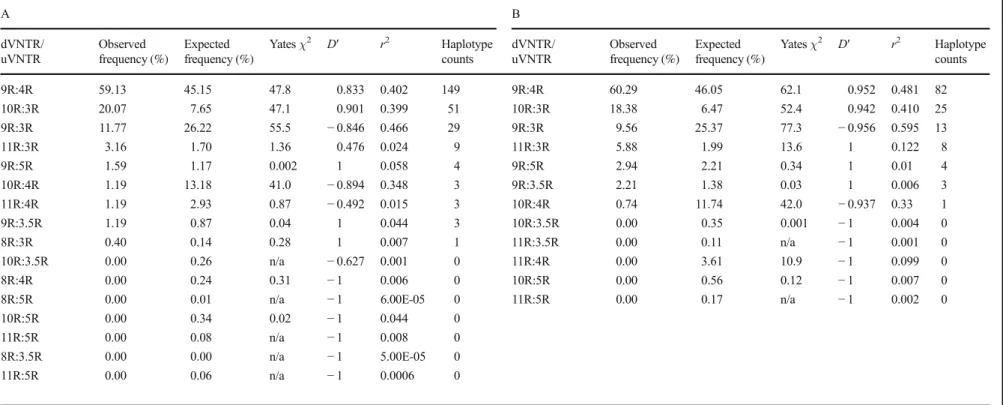
uVNTR) (HWE test was not conducted for males due to the locus hemizygosity). Next, we employed an analysis tool for the construction of the haplotype blocks of the interallelic linkage disequilibrium that accounted for poly-allelic markers (MIDAS, Multiallelic Interallelic Disequilibrium Analysis Software) (Gaunt et al.2006). Common and rare alleles were then imputed based on the inferred haplotype blocks, and separate analysis for males and females was con-ducted. This enabled an assessment of the expected versus the observed frequency of both common and rare VNTR haplotypes assuming independent segregation (Table 1). All the haplotype blocks containing the two common alleles for each locus (i.e., 9R and 10R for dVNTR; and 4R and 3R for uVNTR) significantly deviated from their expected hap-lotype frequencies, and this was highlighted by the signifi-cant adjustedχ2values observed. This extended previous Fig. 5 Monoamine oxidase A (MAOA) minor isoform expression in
HAP1 cell lines under basal condition—single deletion clones and related double KO clones. At the top illustration ofMAOAgene as reported in UCSC genome browser Hg38 and the most recent version of the Hg19. White boxes represent 5′and 3′untranslated regions (UTRs), black boxes the exons. Curved black arrow indicates the translational start site. Black and gray straight arrows show the forward and reverse binding sites for the primers used in analysis. P is the parental cell line, B single uVNTR deletion clone, E(du_B5), and F (du_F3) are theMAOAVNTR double KO clones generated from clone B, C single
dVNTR deletion clone, and G (ud_D8) and H(ud_F3) are theMAOA
work by Philibert et al. (2011), demonstrating the existence of significant linkage disequilibrium (LD) between these two loci, suggests a lack of recombination between them, with the alleles likely to segregate as part of the same block. Indeed, only three of the four possible combination haplotypes were commonly observed, with the haplotype containing the 10R dVNTR and 4R uVNTR alleles being very rare. This is con-sistent with the dVNTR being a more recent polymorphism than the uVNTR and that the minor 10R variant of dVNTR most likely had arose from the same strand containing the minor 3R allele of uVNTR (Supplementary Fig. S8). Therefore, this LD and haplotype analysis allowed us to place the 4R uVNTR with the 9R dVNTR allele and stratify the 3R uVNTR allele with either a 10R, 9R, or, to a lesser extent, the 11R dVNTR. Therefore, in summary, the haplo-type comprising both major alleles (9R-4R) was the most common one (59.13% females, 60.29% males), followed by 10R-3R (20.07% females, 18.38% males) and 9R-3R (11.77% females, 9.56% males), with the observed 10R-4R haplotype frequency at around 1% only (against an expected frequency above 10%). The rare 3.5R and 5R uVNTR alleles were both exclusively linked with the common 9R dVNTR, whereas the 11R dVNTR was more often part of the block containing the variant 3R uVNTR. The 8R allele dVNTR was extremely rare in our samples. Our results demonstrated no significant differences in the distribution of haplotypes between males and females (ttestp> 0.05).
Discussion
Transcriptomic mapping using Hg38 and ENCODE data in-dicated that there are multiple isoforms for theMAOAgene (Fig.1), which was confirmed by mRNA expression data in this study. These two isoforms could be easily distinguished at several levels. The Bcanonical^ MAOA isoform, which we termed the primary isoform (Fig.1, isoform 201), comprised 15 exons with a shorter 5′UTR. Conversely, the alternative isoform (Fig.1, isoform 204) had 16 exons and a longer 5′ UTR, which contained the commonly reported uVNTR (Sabol et al.1998). Our in silico analysis suggested that the extra exon present in this latter isoform, here termed exon IIA, would introduce a TGA stop codon, thus potentially causing a shift in the start codon for protein translation to exon IV (Fig. 1b). Our study investigated the role of two VNTRs in the MAOA promoter in directing expression from each of the TSS. To address this, we exploited the near-haploid cell line HAP1, which was engineered to remove either the uVNTR, the dVNTR, or both from theMAOApromoter sequence. This allowed us to assess, separately or in combination, the expres-sion patterns of the distinctMAOAisoforms in the presence or absence of these two elements.
Under basal growth conditions in vitro, deletion of the uVNTR did not significantly modulate expression of total MAOA mRNA (Fig.4a). Conversely, the dVNTR deletion significantly reduced expression of totalMAOAmRNA (Fig. Fig. 6 Allele frequencies (a,b) and haplotype distribution (c,d) in the
Wirral child health and development study (WCHADS,n= 283). Assuming a multiallelic system for both markers, the haplotype constructs, frequency, and distribution are illustrated above (n= 262). Haplotypes were initially inferred from males and then the Midas
Table 1 Distribution test between observed and expected haplotype frequencies
A B
dVNTR/ uVNTR
Observed frequency (%)
Expected frequency (%)
Yatesχ2 D′ r2 Haplotype counts
dVNTR/ uVNTR
Observed frequency (%)
Expected frequency (%)
Yatesχ2 D′ r2 Haplotype counts
9R:4R 59.13 45.15 47.8 0.833 0.402 149 9R:4R 60.29 46.05 62.1 0.952 0.481 82
10R:3R 20.07 7.65 47.1 0.901 0.399 51 10R:3R 18.38 6.47 52.4 0.942 0.410 25
9R:3R 11.77 26.22 55.5 −0.846 0.466 29 9R:3R 9.56 25.37 77.3 −0.956 0.595 13
11R:3R 3.16 1.70 1.36 0.476 0.024 9 11R:3R 5.88 1.99 13.6 1 0.122 8
9R:5R 1.59 1.17 0.002 1 0.058 4 9R:5R 2.94 2.21 0.34 1 0.01 4
10R:4R 1.19 13.18 41.0 −0.894 0.348 3 9R:3.5R 2.21 1.38 0.03 1 0.006 3
11R:4R 1.19 2.93 0.87 −0.492 0.015 3 10R:4R 0.74 11.74 42.0 −0.937 0.33 1
9R:3.5R 1.19 0.87 0.04 1 0.044 3 10R:3.5R 0.00 0.35 0.001 −1 0.004 0
8R:3R 0.40 0.14 0.28 1 0.007 1 11R:3.5R 0.00 0.11 n/a −1 0.001 0
10R:3.5R 0.00 0.26 n/a −0.627 0.001 0 11R:4R 0.00 3.61 10.9 −1 0.099 0
8R:4R 0.00 0.24 0.31 −1 0.006 0 10R:5R 0.00 0.56 0.12 −1 0.007 0
8R:5R 0.00 0.01 n/a −1 6.00E-05 0 11R:5R 0.00 0.17 n/a −1 0.002 0
10R:5R 0.00 0.34 0.02 −1 0.044 0
11R:5R 0.00 0.08 n/a −1 0.008 0
8R:3.5R 0.00 0.00 n/a −1 5.00E-05 0
11R:5R 0.00 0.06 n/a −1 0.0006 0
(A) Females (2n= 252) and (B) males (n= 126). Assuming a multiallelic system, adjustedχ2values were derived from the observed versus expected frequencies based on the allele frequencies obtained for this study. Frequencies and respectiveD′and correlationr2 values for each haplotype depicted above were calculated using the MIDAS package (Gaunt et al.2006)
n/athere are no observed frequencies for that haplotype in our cohort
l
Ne
ur
o
sc
i
(2
01
8)
64
:4
59
–
470
46
4b), demonstrating that it was a positive regulator of the pri-maryMAOAisoform, which has not been previously reported. Next, we assessed the impact of the double VNTR KOs and found our results to be in line with the mode of action of the single KOs. Specifically, the expression of the primaryMAOA isoform in the double KO cell lines appeared to be significant-ly lower than the parental cell line (Fig.4) with the major mediator being the dVNTR. Indeed, when the expression of the double KO clones was compared to the single dVNTR deletion, we did not find any significant differences (Fig. 4b). Our data therefore support a major role for the dVNTR in driving the expression of the primaryMAOAisoform, fur-ther illustrated by the significant reduction of this isoform seen in the double KOs on the uVNTR KO background (Fig.4a). In contrast, we demonstrated that deletion of either the d- or u-VNTR resulted in increased expression of the minor alterna-tive isoform 204, which contained the uVNTR within its 5′ UTR (Fig.5a–d); therefore, both VNTRs individually ap-peared to act as negative regulators of this isoform. The dou-ble VNTR KOs also substantially increased the expression of this transcript in relation to the parental cell line (P) (Fig.5c, d). These observations were replicated using an independent PCR assay targeting the uVNTR (Fig.5a, b).
Our data indicated that the haplotype of the d- and uVNTRs could account for significant differential regulation ofMAOAexpression. This would be consistent with previous data showing that distinct combinations of the d- and uVNTRs (9R:3R and 9R:4R) supported distinct reporter gene expres-sion patterns (Philibert et al.2011). The DNA sequences of the d-and u-VNTR are quite distinct and are therefore likely to bind a different set of transcription factors and mediate a dif-ferential response to the same challenge as we and others have
demonstrated for the well-characterized regulatory VNTR el-ements in theSLC6A4andSLC6A3genes (Michelhaugh et al. 2001; Vasiliou et al. 2012). Our data indicated that the uVNTR and dVNTR are parts of the same haplotype block; consequently, several CNS disorders and conditions solely attributed to the uVNTR could in fact be mechanistically as-sociated with the dVNTR. However, confirmation of this hy-pothesis will require profiling of well-characterized cohorts larger than the WCHADS cohort we used to address the fre-quency of these VNTRs in the population.
Conclusions
Taken altogether, these results give further insights into the complexity of MAOAregulation, which historically has fo-cused on the uVNTR element to account for variations in the expression of this gene and risk to neuropsychiatric con-ditions. Here we provide evidence that this is only a partial explanation, the dVNTR plays a significant role in MAOA expression, and our work supports mechanistic interactions between these two elements. Indeed, we have confirmed that deletion of both elements did not preclude expression of the gene itself, although the level of mRNA transcripts was sig-nificantly reduced compared to the parental cell line. The dVNTR appeared to be a major positive regulator of the pri-mary transcript isoform, whereas both VNTRs seemed to act in concert to negatively modulate the expression of the minor transcript isoform 204 (Fig.7). Our data pertains to the HAP1 cell line which was chosen as it expressed both isoforms of MAOA and its haploid karyotype facilitated successful CRISPR deletion of regulatory elements. Expression of Fig. 7 Regulation model for
monoamine oxidase A (MAOA) expression by the u- and dVNTRs. Graphic representation of theMAOApromoter region and the regulatory effect exerted by the u- and dVNTRs on the two
MAOAisoforms. White box represent exon I, gray bars representMAOAdVNTR and uVNTR from left to right respectively, and overlapped black boxes represent 5′UTRs of the two isoforms. Curved black lines represent the transcriptional start sites (TSSs) for the two
MAOA will vary in a tissue specific and stimulus inducible manner and regulation in a neuronal context may differ; how-ever, our model supplies a framework to incorporate both VNTRs in MAOA regulation. Both VNTRs are primate spe-cific, which suggests that there are additional key regulatory domains forMAOA expression in mammals as a whole. Furthermore, the uVNTR could have a dual function in both transcription and post-transcriptional regulations of the MAOAgene as it is contained within the 5′UTR of one of the putative coding isoforms. Such a dual function has been demonstrated for a VNTR in the mir137 gene depending on the mRNA isoform that was expressed (Warburton et al. 2016). In conclusion, we believe that our data provides signif-icant insights into the understanding of the regulation of MAOAexpression and its modulation by genetic variants.
Acknowledgments The authors are grateful to the families who partici-pated in the Wirral Child Health and Development Study (WCHADS).Ms. Veridiana Pessoa PhD fees have been supported in part by Francis & Beatrice Anderson Memorial bursary through Dr. Ursula Anderson (USA) and MM fees by IPHS studentship.
Funding information This study was funded by a grant from the UK Medical Research Council, G0400577 (JQ, HS, JH, AP, CM) and Wellcome Trust Grant ref. 109095/Z/15/Z (AL).
Compliance with Ethical Standards
Ethical approval for the study was granted by the Cheshire North and West Research Ethics Committee on the June 27, 2006 (ref: 05/Q1506/107).
Conflict of Interest The authors declare that they have no conflict of interest.
Open AccessThis article is distributed under the terms of the Creative C o m m o n s A t t r i b u t i o n 4 . 0 I n t e r n a t i o n a l L i c e n s e ( h t t p : / / creativecommons.org/licenses/by/4.0/), which permits unrestricted use, distribution, and reproduction in any medium, provided you give appropriate credit to the original author(s) and the source, provide a link to the Creative Commons license, and indicate if changes were made.
References
Aslund C, Nordquist N, Comasco E, Leppert J, Oreland L, Nilsson KW (2011) Maltreatment, MAOA, and delinquency: sex differences in gene-environment interaction in a large population-based cohort of adolescents. Behav Genet 41:262–272
Carette JE, Raaben M, Wong AC, Herbert AS, Obernosterer G, Mulherkar N, Kuehne AI, Kranzusch PJ, Griffin AM, Ruthel G, Dal Cin P, Dye JM, Whelan SP, Chandran K, Brummelkamp TR (2011) Ebola virus entry requires the cholesterol transporter Niemann-Pick C1. Nature 477:340–343
Caspi A, McClay J, Moffitt TE, Mill J, Martin J, Craig IW, Taylor A, Poulton R (2002) Role of genotype in the cycle of violence in maltreated children. Science 297:851–854
Chester DS, Dewall CN, Derefinko KJ, Estus S, Peters JR, Lynam DR, Jiang Y (2015) Monoamine oxidase A (MAOA) genotype predicts
greater aggression through impulsive reactivity to negative affect. Behav Brain Res 283:97–101
De Colibus L, Li M, Binda C, Lustig A, Edmondson DE, Mattevi A (2005) Three-dimensional structure of human monoamine oxidase A (MAO A): relation to the structures of rat MAO A and human MAO B. Proc Natl Acad Sci U S A 102:12684–12689
Du L, Faludi G, Palkovits M, Sotonyi P, Bakish D, Hrdina PD (2002) High activity-related allele of MAO-A gene associated with de-pressed suicide in males. Neuroreport 13:1195–1198
Edwards AC, Dodge KA, Latendresse SJ, Lansford JE, Bates JE, Pettit GS, Budde JP, Goate AM, Dick DM (2010) MAOA-uVNTR and early physical discipline interact to influence delinquent behavior. J Child Psychol Psychiatry 51:679–687
Essletzbichler P, Konopka T, Santoro F, Chen D, Gapp BV, Kralovics R, Brummelkamp TR, Nijman SM, Burckstummer T (2014) Megabase-scale deletion using CRISPR/Cas9 to generate a fully haploid human cell line. Genome Res 24:2059–2065
Fan JB, Sklar P (2005) Meta-analysis reveals association between sero-tonin transporter gene STin2 VNTR polymorphism and schizophre-nia. Mol Psychiatry 10(928–38):891
Fergusson DM, Boden JM, Horwood LJ, Miller A, Kennedy MA (2012) Moderating role of the MAOA genotype in antisocial behaviour. Br J Psychiatry 200:116–123
Frazzetto G, Di Lorenzo G, Carola V, Proietti L, Sokolowska E, Siracusano A, Gross C, Troisi A (2007) Early trauma and increased risk for physical aggression during adulthood: the moderating role of MAOA genotype. PLoS One 2:e486
Gaunt TR, Rodriguez S, Zapata C, Day IN (2006) MIDAS: software for analysis and visualisation of interallelic disequilibrium between multiallelic markers. BMC Bioinformatics 7:227
Hill J, Breen G, Quinn J, Tibu F, Sharp H, Pickles A (2013) Evidence for interplay between genes and maternal stress in utero: monoamine oxidase A polymorphism moderates effects of life events during pregnancy on infant negative emotionality at 5 weeks. Genes Brain Behav 12:388–396
Ho LW, Furlong RA, Rubinsztein JS, Walsh C, Paykel ES, Rubinsztein DC (2000) Genetic associations with clinical characteristics in bipo-lar affective disorder and recurrent unipobipo-lar depressive disorder. Am J Med Genet 96:36–42
Lee BT, Ham BJ (2008) Monoamine oxidase A-uVNTR genotype affects limbic brain activity in response to affective facial stimuli. Neuroreport 19:515–519
Lung FW, Tzeng DS, Huang MF, Lee MB (2011) Association of the MAOA promoter uVNTR polymorphism with suicide attempts in patients with major depressive disorder. BMC Med Genet 12:74 Melas PA, Wei Y, Wong CC, Sjoholm LK, Aberg E, Mill J, Schalling M,
Forsell Y, Lavebratt C (2013) Genetic and epigenetic associations of MAOA and NR3C1 with depression and childhood adversities. Int J Neuropsychopharmacol 16:1513–1528
Michelhaugh SK, Fiskerstrand C, Lovejoy E, Bannon MJ, Quinn JP (2001) The dopamine transporter gene (SLC6A3) variable number of tandem repeats domain enhances transcription in dopamine neu-rons. J Neurochem 79:1033–1038
Nikulina V, Widom CS, Brzustowicz LM (2012) Child abuse and neglect, MAOA, and mental health outcomes: a prospective examination. Biol Psychiatry 71:350–357
Philibert RA, Gunter TD, Beach SR, Brody GH, Madan A (2008) MAOA methylation is associated with nicotine and alcohol depen-dence in women. Am J Med Genet B Neuropsychiatr Genet 147B: 565–570
Philibert RA, Wernett P, Plume J, Packer H, Brody GH, Beach SR (2011) Gene environment interactions with a novel variable monoamine oxidase A transcriptional enhancer are associated with antisocial personality disorder. Biol Psychol 87:366–371
temperament in the first year of life: monoamine oxidase A poly-morphism moderates effects of maternal sensitivity on infant anger proneness. J Child Psychol Psychiatry 54:1308–1317
Reif A, Scarpini E, Venturelli E, Topner T, Fenoglio C, Lesch KP, Galimberti D (2008) The functional MAOA-uVNTR promoter polymorphism in patients with frontotemporal dementia. Eur J Neurol 15:637–639
Reif A, Richter J, Straube B, Hofler M, Lueken U, Gloster AT, Weber H, Domschke K, Fehm L, Strohle A, Jansen A, Gerlach A, Pyka M, Reinhardt I, Konrad C, Wittmann A, Pfleiderer B, Alpers GW, Pauli P, Lang T, Arolt V, Wittchen HU, Hamm A, Kircher T, Deckert J (2014) MAOA and mechanisms of panic disorder revisited: from bench to molecular psychotherapy. Mol Psychiatry 19:122–128 Sabol SZ, Hu S, Hamer D (1998) A functional polymorphism in the
monoamine oxidase a gene promoter. Hum Genet 103:273–279
Samochowiec J, Hajduk A, Samochowiec A, Horodnicki J, Stepien G, Grzywacz A, Kucharska-Mazur J (2004) Association studies of MAO-A, COMT, and 5-HTT genes polymorphisms in patients with anxiety disorders of the phobic spectrum. Psychiatry Res 128:21–26 Spengler BA, Biedler JL, Ross RA (2002) A corrected karyotype for the SH-SY5Y human neuroblastoma cell line. Cancer Genet Cytogenet 138:177–178
Vasiliou SA, Ali FR, Haddley K, Cardoso MC, Bubb VJ, Quinn JP (2012) The SLC6A4 VNTR genotype determines transcription fac-tor binding and epigenetic variation of this gene in response to co-caine in vitro. Addict Biol 17:156–170