BIOLOGICAL CONTROL
Temperature-Dependent Development of the Entomopathogenic Fungus
Nomuraea rileyi
(Farlow) Samson in
Anticarsia gemmatalis
(Hübner)
Larvae (Lepidoptera: Noctuidae)
J
ULIOD. E
DELSTEIN1, E
DUARDOV. T
RUMPER2ANDR
OBERTOE. L
ECUONA31CREAN, Fac. Ciencias Agropecuarias, Univ. Nacional de Córdoba Av Valparaiso s/n (5000) Ciudad Universitaria
Córdoba, Argentina, [email protected]
2EEA INTA Manfredi, Sección Entomología. Ruta Nac. nº 9 km 636 (5988), Córdoba, Argentina
3Lab. Hongos Entomopatógenos, IMYZA, INTA Castelar. CC 25 (1712) Castelar, Buenos Aires, Argentina
Neotropical Entomology 34(4):593-599 (2005)
Desenvolvimento Dependente da Temperatura do Fungo Entomopatogênico Nomuraea rileyi (Farlow) Samson em larvas de Anticarsia gemmatalis (Hübner) (Lepidoptera: Noctuidae)
RESUMO - A influência da temperatura no desenvolvimento do fungo entomopatogênico Nomuraea rileyi (Farlow) Samson foi estudada em larvas no terceiro estágio de desenvolvimento de Anticarsia gemmatalis (Hübner), mantidas sob regime de temperatura constante. Um modelo não-linear foi utilizado para descrever as taxas de crescimento vegetativo e reprodutivo do fungo. A temperatura requerida para obter o maior crescimento vegetativo foi estimada em 25,5ºC, enquanto os limites mínimo e máximo foram estimados em 11ºC e 30ºC, respectivamente. A taxa de conidiação foi estável dos 18ºC aos 26ºC. As temperaturas mínima e máxima estimadas para o desenvolvimento vegetativo coincidem com as condições ambientais de ocorrência natural na Argentina Central. Efeitos não-lineares da temperatura no crescimento vegetativo e reprodutivo, bem como a probabilidade de distribuição in vivo de N. rileyi são descritos.
PALAVRAS-CHAVE: Controle biológico, modelo matemático, dinâmica populacional, inimigo natural
ABSTRACT - The influence of temperature on the development rate of the entomopathogenic fungus Nomuraea rileyi (Farlow) Samson in Anticarsia gemmatalis (Hübner) 3rd-instar larvae was studied under constant temperature regimes. A non linear model was used to describe temperature-dependent vegetative and reproductive development rates of the fungus. The temperature required to reach the highest vegetative development rate was estimated to be 25.5ºC while lower and upper developmental thresholds were 11ºC and 30ºC, respectively. The rate of development for conidia release was stable from 18ºC to 26ºC. The estimated lower and upper thresholds of vegetative development coincide with conditions during the natural epizootics in central Argentina. Non-linear effects of temperature on vegetative and reproductive development rates and probability distributions of N. rileyi under in vivo conditions are described.
KEY WORDS: Biological control, mathematical model, population dynamics, natural enemy
The mitosporic fungus Nomuraea rileyi (Farlow) Samson, represents an important natural control agent of Anticarsia gemmatalis (Hübner) (Lepidoptera: Noctuidae), one of the most damaging soybean pests in the American continent (Ignoffo 1981, Pedigo et al. 1983, Gazzoni et al. 1994, Edelstein 2002). Descriptions of N. rileyi epizootics on A. gemmatalis larvae populations were carried out by a single empirical equation, based on multiple predictive
variables (Kish & Allen 1978), and a posterior update on a mechanistic platform (Sujii et al. 2002).
the speed of vegetative development and sporulation. As with any poikilothermic organism, temperature represents the most important factor governing the speed of development. This is particularly relevant in temperate climate regions where temperature can have considerable daily fluctuations in one season. The velocity of development of the fungus vegetative and reproductive stages within the larval body determines how fast the host stops feeding and becomes infective, respectively. The infectious incubation period is of central importance for epizootics. Indeed, a short or long incubation period could represent the difference between secondary infections occurring or not in the host population. Thus, temperature, as a physical factor regulating developmental rate of the entomopathogen, has epizootiological consequences. In order to make reliable predictions of N. rileyi epizootics in the field, epizootiology models would include temperature. Therefore, the aim of this study was to describe in vivo temperature-dependent vegetative and reproductive development rates, median and probability distribution, of N. rileyi infecting A. gemmatalis larvae. Sporulation process may need other interacting variables such as humidity. However, for the sake of simplicity in understanding the process and performing the bioassays and models, only temperature-dependent development of this stage was studied.
Material and Methods
Third-instar larvae of A. gemmatalis and the N. rileyi isolate (Nr32) were obtained from the collection at the Laboratorio de Hongos Entomopatógenos (IMYZA, INTA Castelar). The fungal isolate was originated from the Manfredi (Córdoba, Argentina) and isolated from an A. gemmatalis larva, with a maximum of two subsequent in vitro passages. Culture media contained potato, maltose, yeast and agar (Edelstein et al. 2004).
Ten groups of five 3rd-instar larvae, were randomly assigned and dipped in 5 ml 0.01% Tween 80 aqueous suspension with 108 conidia/ml and a control suspension. Groups of 50 larvae were placed in individual plastic cages, 3 cm wide, with voile cloth caps, and kept in climatic chambers at constant temperatures of 16, 18, 20, 22, 24, 26, 28, 30 and 34ºC (± 0.5ºC) for each bioassay. The larvae were daily fed ad libitum with a meridic diet. Mortality in each of the treatments was daily recorded, throughout periods of a maximum of 30 days. Survival analysis was performed by Kaplan-Meier statistic and logrank - χ2 test (Altmann 1991). Untreated controls were performed to test the survival of the host in response to each thermal condition and the absence of previous infection in the experimental larvae.
It was assumed that vegetative development was complete at the time of death of the host larvae. The mycosed dead larvae (white cadavers) were immediately placed in individual 5 cm plastic petri dishes, with a small piece of soaking cotton and observed through a maximum of 10 days. The time from death to conidia release was recorded at 16, 18, 20, 22, 26 and 28 ºC (± 0.5ºC). The median of the rates (time-1) were calculated for each temperature treatment and the relationship between the developmental rate (in days-1) and temperature was described by fitting the following model (Briere et al. 1999):
(
T T)
T T Ta ⋅ − ⋅ L −
= 0
R(T) (1)
where R(T) is the developmental rate for a given temperature T, a is a fitting empirical parameter, T0 is the lower temperature developmental threshold and TL is the upper lethal temperature and R(T) = 0 when T is less or equal to T0, or T is higher or equal to TL. The statistical difference from zero of the estimated parameters was evaluated by a t-test.
A non-predetermined function of temperature was fitted to the median reproductive development rates. Least square errors, degrees-of-freedom adjusted coefficient of determination (DOF adj R2) and algebraic simplicity were used as fitting selection criteria from a collection of models (Table Curve 2D v2.02, Jandel Scientific - AISN Software, 1994).
Since vegetative development rates at each unit of time, under determined thermal conditions, are fractions of a total physiological time and ti are the standardized (by the median at each temperature) developmental rates, its accumulation through time is an estimation of the physiological age t. The absolute frequencies with respect to ti were used as a weighting variables in non-linear regression analysis (Curry and Feldman 1987). In order to represent the variability of vegetative and reproductive development rates per cohort, the cumulative relative frequencies of physiological ages (t) for each process was fitted to the following sigmoidal model (Eq. 2):
(
)
⎟⎠ ⎞ ⎜
⎝ ⎛
⎟ ⎠ ⎞ ⎜
⎝ ⎛− τ − +
=1 1 exp a b
Y i
(2) where a and b are fitting parameters.
Results
Survival of infected larvae at the end of the experiments was significantly lower than the mean of the control in all temperatures (P < 0.001; χ2 = 112.48). However, at 30ºC and 34ºC a high mortality of uninfected A. gemmatalis larvae occurred (Fig. 1) and, consequently, no mycoses were observed. The mean survival of the mycosed larvae was 24% of the total population under all the thermal conditions (Fig. 2). In the range of temperatures between 18ºC and 28ºC, 50% of the cohort died after 5 to 10 days of infection. The highest mortalities (66 to 90%) were observed between 10 to 16 days. Distinctively, at 16ºC, the survival of the infected larvae decreased slowly through time reaching a 41% survival at 26 days and 36% at 29 days after infection.
= 0.99, F-ratio(1,18) = 2423; P < 0.001) (Fig. 4).
The effect of temperature on the variation of reproductive development rates was explained by the following function: ⎟ ⎟ ⎠ ⎞ ⎜ ⎜ ⎝ ⎛ ⎟ ⎠ ⎞ ⎜ ⎝ ⎛ − ⋅ − ⋅ = d Esp c b T a
R exp 0.5
(3)
where T represented temperature and a (0.32 ± 0.012), b (22.72 ± 24.44), c (5.14 ± 11.899) and d (19.31 ± 1717.92) were fitting constants (Fig. 3). No conidia release was recorded at 16ºC but, above this limiting condition, this phase required from 3.19 ± 0.19 days at 22ºC to 6.4 ± 0.87 days at 28ºC. Extrapolating from Eq. 3, the upper threshold temperature for reproductive development is approximately 30ºC. The cumulative frequency distribution of conidia Figure 1. Survival of A. gemmatalis uninfected 3rd-instar larvae at several constant temperatures (ºC) (Kaplan-Meier estimator
± standard error). 0 0.2 0.4 0.6 0.8 1
0 2 4 6 8 10 12 14 16 18 20 22 24 26 28 30 Time (days) S u rv iva l pr opor ti on 16ºC 0 0.2 0.4 0.6 0.8 1
0 2 4 6 8 10 12 14 16 18 20 22 24 26 28 30 Time (days) S u rv iv al pr opor ti on 18ºC 0 0.2 0.4 0.6 0.8 1
0 2 4 6 8 10 12 14 16 18 20 22 24 26 28 30 Time (days) S u rv iv al pr o por ti o n 22ºC 0 0.2 0.4 0.6 0.8 1
0 2 4 6 8 10 12 14 16 18 20 22 24 26 28 30 Time (days) S u rv iva l pr o por ti o n 26ºC 0.92 0.94 0.96 0.98 1
0 2 4 6 8 10 12 14 16 18 20 22 24 26 28 30 Time (days) S u rv iva l pr opor ti on 28ºC 0 0.2 0.4 0.6 0.8 1
0 2 4 6 8 10 12 14 16 18 20 22 24 26 28 30 Time (days) S u rv iva l pr opor ti on 30ºC 0 0.2 0.4 0.6 0.8 1
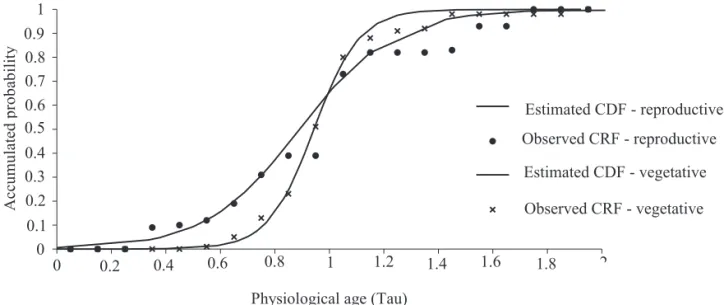
release was significantly represented by Eq. 2 (a = 0.89 ± 0.007, b = 0.17 ± 0.008; R2 = 0.99, F-ratio
(1,18) = 1793.71; P < 0.001) (Fig. 4).
Discussion
Because moisture was not a limiting factor during the observations, our study helps to understand only the thermal
effect on sporulation. However, the sporulation process is clearly also dependent on humidity (Sujii et al. 2002). Thus, future efforts should be focused on testing possible interactions of both temperature and moisture effects. Besides, initial inoculum burden in the field may affect the infection probability making the system less predictable.
Secondary transmissions of entomopathogenic fungi are determined both by the infection processes and conidia Figure 2. Survival of A. gemmatalis 3rd-instar larvae infected by N. rileyi at several constant temperatures (ºC) (Kaplan-Meier
estimator ± standard error).
Survival
proportion
Time (days)
0 0.2 0.4 0.6 0.8 1
0 2 4 6 8 10 12 14 16 18 20 22 24 26 28 30 Time (days)
S
u
rvi
v
al
prop
ort
io
n
16ºC
0 0.2 0.4 0.6 0.8
0 2 4 6 8 10 12 14 16 18 20 22 24 26 28 30 Time (days)
S
u
rv
iv
al
p
ro
p
o
rtio
n
18ºC
0 0.2 0.4 0.6 0.8 1
0 2 4 6 8 10 12 14 16 18 20 22 24 26 28 30 Time (days)
S
u
rvi
v
al
p
ropo
rt
io
n
20ºC
0 0.2 0.4 0.6 0.8 1
0 2 4 6 8 10 12 14 16 18 20 22 24 26 28 30 Time (days)
S
u
rv
iv
al
pr
opo
rt
io
n
22ºC
0 0.2 0.4 0.6 0.8 1
0 2 4 6 8 10 12 14 16 18 20 22 24 26 28 30 Time (days)
S
u
rv
iv
al
pr
opo
rt
io
n
24ºC
0 0.2 0.4 0.6 0.8 1
0 2 4 6 8 10 12 14 16 18 20 22 24 26 28 30 Time (days)
S
u
rv
iv
al
pr
opo
rt
io
n
26ºC
0 0.2 0.4 0.6 0.8 1
0 2 4 6 8 10 12 14 16 18 20 22 24 26 28 30 Time (days)
S
u
rv
iv
al
pr
opo
rt
io
n
Figure 3. Observed and estimated in vivo median development rate of the (a) vegetative and (b) reproductive stage of N. rileyi
mycosis in 3rd-instar A. gemmatalis larvae.
Figure 4. Observed cumulative relative frequencies (ARF) and estimated cumulative distribution functions (CDF) of vegetative and reproductive developmental processes.
release. In the present work it was shown that, although the mycosis incubation, as a fraction of the first process, is strongly affected by temperature, the release of infective bodies is only slightly influenced by thermal conditions. This suggest that a higher number of deaths will happen during temperate days and incubation period is more critical than the sporulation one, at least from the thermal point of view. In contrast, relatively high daily mean temperatures can accelerate development of A. gemmatalis larvae. For example, at 28ºC this pest develops approximately 10% faster than at 26ºC (Johnson et al. 1983), while our results show that at the same temperature, increase reproductive development of N. rileyi would occur at around half its
optimum rate. In such case, the pathogen is likely to release infective bodies when most of the hosts have already moulted into less susceptible stages. Consequently, it seems that mild temperatures would facilitate secondary transmissions.
The developmental rate of the fungus at relatively high temperature conditions can be estimated from Eq. 3; the vegetative development rate at 32.4ºC was estimated as 0.034 day-1.However, at this temperature, host death caused by other factors than N. rileyi infection was very high, so the fungus development rates were difficult to be recorded. On the basis of previous data (Getzin 1961), personal observations (Edelstein et al. 2004) and the present study, the fact that in vivo development rates follow a proportional magnitude of 0
0,05 0,1 0,15 0,2 0,25 0,3 0,35
10 12 14 16 18 20 22 24 26 28 30 32 34
Temperature (ºC)
Development
rate
(time-1)
Median Vegetative Development Rate
Median Reproductive Development Rate
Estimated Reproductive Development Rate
Estimated Vegetative Development Rate
0 0.35
0.3
0.25
0.2
0.15
0.1
0.05
Median vegetative development rate
Median reprodutive development rate
Estimated reprodutive development rate
Estimated vegetative development rate
0 0,1 0,2 0,3 0,4 0,5 0,6 0,7 0,8 0,9 1
0 0,2 0,4 0,6 0,8 1 1,2 1,4 1,6 1,8 2
Physiological age (Tau)
Accu
m
u
lated
p
ro
b
ab
ility
Estimated CDF - Reproductive
Observed CRF - Reproductive
Estimated CDF - Vegetative
Observed CRF - Vegetative
1 0.9 0.8 0.7 0.6 0.5 0.4 0.3 0.2 0.1 0
Estimated CDF - reproductive
Observed CRF - reproductive
Estimated CDF - vegetative
Observed CRF - vegetative
2
approximately one tenth of in vitro development rates can be assumed. If in vitro median radial growth rate of N. rileyi colonies from the same origin was 0.33 mm.day-1 at 32ºC (± 0.5ºC) (R.E. Lecuona, pers. observ.), then, under in vivo conditions the development rate is expected to be 0.033 day-1. Temperature lethal effects depend on time of exposure to the extreme thermal condition. Therefore, the effects of daily variations of temperature on development are relative to the amount of hours or days at this condition.
The sporulation process in vivo was shown to be as thermal sensitive as in vitro to low temperatures. The reproductive development rate was quite constant (0.28 to 0.33 day-1) over the 18ºC to 26ºC range. These temperatures are quite common in temperate regions, like central Argentina where 17.1ºC to 22.1ºC is the range of mean temperatures usually recorded during the February-April period (INTA 2003). During these months N. rileyi epizootics happen on A. gemmatalis larvae populations at these latitudes. According to the present study, reproductive development should not be affected significantly by temperature, with the exception of extreme thermal conditions. Indeed, at 28ºC reproductive development rate drops to 0.13 day-1; thus, conidia release is expected to last around three to four days, but during a period of above average temperature, the vegetative to reproductive development period could be extended to seven or eight days.
Vegetative and reproductive N. rileyi development have similar upper threshold temperatures (ca. 30ºC), which is slightly higher than Manfredi (Córdoba, Argentina) historical average maximum temperature (28.9ºC) in February, the warmest month of the epizootic season (INTA unpubl.). Maximum temperatures would constitute a selection factor for the poikilothermal organisms, such as entomopathogenic fungi. It is possible then that the coincidence in these upper developmental thresholds is a selected trait. This trait allows for developing, killing the host and infecting other individuals throughout the season. According to the present results, minimum temperature is also a limiting condition for the fungus reproductive development and consequently for secondary infections, particularly during March (mean minimum temperature, 14.49ºC) and April (mean minimum temperature, 11.04 ºC; historical records 1960-2002, INTA unpub.). At this time, the soybean crop season is finishing and A. gemmatalis larvae are about to pupate. Therefore, with few or no hosts available for the fungus and limiting temperature conditions, vegetative cadavers would just persist in the field probably as resistant entities for the next year (Madelin 1963).
Our description of the influence of temperature on N. rileyi development rate in infected A. gemmatalis larvae improve the predictive capacity of models designed to describe the insect-entomopathogen dynamics in relation to previous models like those by Kish and Allen (1978), Boucias et al. (1984) and Sujii et al. (2002). The assumption of linearity for temperature-dependent development is acceptable within a narrow range of temperatures. In the present study non-linear temperature-dependent development equations are proposed to be applied on epizootiology models similar to the described by Sujii et al. (2002). Consequently,
they will be likely to yield better descriptions of temporal insect disease dynamics. An argument can be done about a more realist approach on fluctuating environmental temperatures or contemplation of microclimatic conditions. However, very realistic models would confront to simplicity in the experimental design to be tested. Moreover, little differences on thermal requirements could be obtained with a variable temperature method (i.e. re-analyzed from Hagstrum & Milliken 1991). Further compilation of the resulting equations from the present study in a general mechanistic model and its validation on the basis of temporal dynamics of the epizootics under field conditions should be done.
It has been argued that the estimation of temperature-development relationships of natural enemies can substantially contribute to the selection of the most appropriate biocontrol agent to be used under different environmental conditions (Perdikis & Lykouressis 2002). To the best of our knowledge, this is the first study on N. rileyi in which non-linear effect of temperature on vegetative and reproductive development rates and probability distribution under in vivo conditions are described.
Acknowledgments
The authors want to thank Wopke van der Werf for his valuable comments on an early manuscript of the present work. This research was funded by the Agencia Nacional de Promoción Científica y Tecnológica (SETCIP, República Argentina) through a grant (PICT 08-04906) to EVT. JDE had a doctoral scholarship from CONICET to develop the present study as part of the Doctoral Thesis at Universidad Nacional de Córdoba, República Argentina.
Literature Cited
Altmann, D.G. 1991. Practical statistics for medical research. Chapman & Hall, 611p.
Boucias, D.G., D.L. Bradford, & C.S. Barfield. 1984. Susceptibility of the velvetbean catterpillar and soybean looper (Lepidoptera: Noctuidae) to Nomuraea rileyi: Effects of pathotype, dosage, temperature and host age. Environ. Entomol. 77: 247-253.
Briere, J.F., P. Pracros, A.Y. Le Roux & J.S. Pierre. 1999. A novel model of temperature-dependent development for arthropods. Environ. Entomol. 28: 22-29.
Curry, G.L. & R.M. Feldman. 1987. Mathematical foundations of population dynamics. Texas A&M University Press, 246p.
Edelstein, J.D. 2002. Epizootiología de Nomuraea rileyi
(Deuteromycetes) sobre lepidópteros defoliadores en el cultivo de soja (Glycine max (L.) Merril). Tesis Doctoral, F.C.E.F. y N., Universidad Nacional Córdoba, Argentina, 170p.
Selection of culture media and in vitro assessment of temperature-dependent development of Nomuraea rileyi. Neotrop. Entomol. 33: 737-742.
Fargues, J., N.K. Maniania, J.C. Delmas & N. Smits. 1992. Influence de la temperature sur la croissance in vitro d‘hyphomycetes entomopathogens. Agronomie 12: 557-564.
Ferreira, L.J.O. & I.C. Corso. 1994. Insects. In FAO, Tropical Soybean: Improvement and production FAO-UN. Rome, 262p.
Gardner, W.A. 1985. Effects of the temperature on the susceptibility of Heliothis zea larvae to Nomuraea rileyi. J. Invertebr. Pathol. 46: 348-349.
Gazzoni, D.L., D.R. Sosa-Gómez, F. Moscardi, C.B. Hoffman-Campo, B. Spalding Correa & Getzin, L.W. 1961. Spicaria rileyi (Farlow) Charles, an entomogenous fungi of Trichoplusia ni (Hübner). J. Insect Pathol. 3: 2-10. Hagstrum, D.W. & G.A. Milliken. 1991. Modeling differences in insect developmental times between constant and fluctuating temperatures. Ann. Entomol. Soc. Am. 84: 369-379.
Ignoffo, C.M. 1981. The fungus Nomuraea rileyi as a
microbial insecticide, p. 513. In H.D. Burges (ed.), Microbial control of pests and plant diseases: 1970-1980. Academic Press, New York, 949p.
INTA, EEA Manfredi. 2003. Sitios de interés agropecuario. Area de Recursos Naturales, Informe Climático. Temperaturas medias mensuales (período 1953/2002). http://www.inta.gov.ar/manfredi/info/clima/periodo.htm. Johnson, D.W., C.S. Barfield & G.E. Allen. 1983. Temperature dependent model for the velvetbean
caterpillar (Lepidoptera: Noctuidae). Environ. Entomol. 12: 1657-1663.
Kish, L.P. & G.E. Allen. 1978. The biology and ecology of Nomuraea rileyi and a program for predicting its incidence on Anticarsia gemmatalis in soybean. Bulletin 795 (Technical), March 1978. Agric. Exp. St. Institute of Food and Agric. Sc. Univ. Flo., Gainsville. p. 48. Madelin, M.F. (1963). Diseases caused by Hyphomycetous
fungi. p. 255 In E.A. Steinhaus (ed.) Insect pathology, an advanced treatise, vol.2. Academic Press, New York., 689p.
Pedigo, L.P., E.J. Bechinski & R.A. Higgins. 1983. Partial life tables of the green cloverworm (Lepidoptera: Noctuidae) in soybean and a hypothesis of population dynamics in Iowa. Environ. Entomol. 12: 186-195. Perdikis, D.C. & D.P. Lykouressis. 2002. Thermal
requirements for development of the polyphagous predator Macrolophus pygmaeus Rambur (Hemiptera: Miridae). Environ. Entomol. 31: 661-667.
Sujii, E.R., M.S. Tigano & D.R. Sosa-Gomez. 2002. Simulação do impacto do fungo Nomuraea rileyi em populações da lagarta da soja, Anticarsia gemmatalis. Pesq. Agropec. Bras. 37: 1551-1558.
Tang, L.-C. & R.F. Hou. 2001. Effects of environmental factors on virulence of the entomopathogenic fungus, Nomuraea rileyi, against the corn earworm, Helicoverpa armigera (Lep., Noctuidae). J. Appl. Entomol. 125: 243-248.