Rev Saúde Pública 2005;39(4) www.fsp.usp.br/rsp
INTRODUCTION
Pregnancy is a transitional period that is part of the normal course of human development. Important changes take place not only in the woman’s body, but also in terms of wellbeing, with changes both in psy-che and in the woman’s role in family and society.
The literature indicates that pregnancy and puer-perium are the periods of greatest incidence of psy-chic disorders in women, who require special care in order to maintain or recover wellbeing and to prevent future problems for the child. The intensity of these psychological alterations will depend on factors
re-M ultiprofessional care and mental health in
pregnant women
Vanda M afra Falcone, Custódia Virginia de N óbrega M äder, Christianne Freitas Lima N ascimento, Joacira M ota M atos Santos and Fernando José de N óbrega
Centro de Promoção e Atenção à Saúde. Instituto de Ensino e Pesquisa. Hospital Albert Einstein. São Paulo, SP, Brasil
Research developed at the Centro de Promoção e Atenção à Saúde (CPAS) of the Research and Training Institute, Albert Einstein Hospital, in partnership with Nestlé Brasil Ltd.
Received on 27/1/2004. Reviewed on 26/11/2004. Approved on 17/3/2005.
Correspondence to: Vanda Mafra Falcone
Centro de Promoção e Atenção à Saúde Rua Manoel Antonio Pinto, 285 Paraisópolis 05659-000 São Paulo, SP, Brasil
E-mail: [email protected]
Keywords
Pregnant women. Affective symptoms. Depression. Mental health. Pregnancy complications. Patient care team.
Abstract
Objective
To identify non-psychotic affective disorders in pregnant women, to intervene by means of psychoprophylactic groups, and to evaluate possible alterations following intervention.
Methods
One-hundred and three pregnant women (71 adults and 32 adolescents) were seen at a community program in the Paraisópolis neighborhood in the city of Sao Paulo, southeastern Brazil. We used the following instruments: Self Reporting Questionnaire and Beck Depression Inventory. Ten weekly two-hour meetings were held, addressing the link between mother and fetus and subjects related to mother and child, and answering mother’s doubts. We used the chi-squared test (χ2) to compare mental health before and after the intervention, with a significance level of p<0.05. Results
Affective disorders were found in 45 pregnant women (43.7%) before the intervention and in 23 (22.3%) after the intervention. The impact of the intervention on affective disorders was statistically significant (p=0.001). Twenty-one women (20.4%) showed depression before the intervention, and 13 (12.6%) after the intervention, a non-significant difference (p=0.133).
Conclusions
Multiprofessional care can prevent, detect, and treat affective disorders during pregnancy in both adults and adolescents.
lated to family, marital relationship, society, culture, and the mother’s personality.18
Postpartum depression affects about 10-15% of women in a number of countries, and a large body of research is available on this subject.3 Recent
stud-ies suggest that antenatal depression may have been neglected, there being only a few scientific studies aimed at identifying psychological alterations dur-ing pregnancy.13
sug-Rev Saúde Pública 2005;39(4) www.fsp.usp.br/rsp Multiprofessional care for pregnant women
Falcone VM et al
ception or antenatal periods.17 During this period,
healthcare services have the opportunity to work on such factors, seeking to contribute towards the pro-motion of a healthier pregnancy.
The aim of the present study was to identify non-psychotic affective disorders among pregnant women, to intervene by means of psychoprophylac-tic groups, and to evaluate potential alterations fol-lowing intervention.
M ETH O D S
The present study was conducted in Paraisópolis, State of Sao Paulo, in southeastern Brazil, at the Center for Health Promotion and Care (Centro de Promoção e Atenção à Saúde – CPAS), linked to the social as-sistance program of a hospital. Among other activi-ties, this center runs a Pregnancy Care Program (Programa de Atenção à Gestante), based on educa-tional groups, aimed at developing a follow-up sys-tem for low-income pregnant women. The follow-up, conducted by a multiprofessional group composed of nurses, nutritionists, a pedagogue, psychologists, physical therapists, social workers, and community agents, consists of complementing antenatal care with pregnancy monitoring, healthcare humanization, and strengthening of the mother-fetus bond, considering maternal mental health.
The present study included 103 pregnant women -71 adults (≥20 years) and 32 adolescents (<20 years) living in Paraisópolis who sought the CPAS for ante-natal care. All women signed a term of informed con-sent approved by the Hospital Israelita Albert Ein-stein ethics committee.
Evaluations were carried out individually, at the moment of admission and at the end of the woman’s participation in the group, by previously trained psy-chologists and pedagogues.
We employed two instruments for evaluating the mental health of pregnant women. One of them, the Self Reporting Questionnaire (SRQ), identifies non-psychotic disorders in the community.19 We used a
cutoff point of 7/8 for this instrument. The other one, the Portuguese version of the Beck Depression In-ventory (BDI), comprises 21 items, including symp-toms and attitudes, with four sub-items each. These sub-items rate severity, with responses between 16 and 20 characterizing dysphoria, and above 20 char-acterizing depression.2,7 The cutoff point employed
for diagnosing depression was 20 points.
Based on the results obtained in the evaluations, a gestions that psychological factors may lead to
com-plications during pregnancy, delivery, and puerper-ium, as well as for the newborn.12 These factors
in-clude especially psychological stress and anxiety, which act mainly during pregnancy.
Zucchi,23 in a review of the literature on depression
during pregnancy in the last 10 years, found two large groups of studies: those that investigate risk factors for depression during pregnancy, including economi-cal difficulties and the lack of a partner or of family support; and those that attempt to associate depres-sion as a risk factor for obstetrical outcomes, such as preterm birth, low birthweight, irritability of the new-born, or even neonatal mortality.
Recent studies report that tension in pregnant women stimulates the production of certain hormones that cross the placental barrier, reaching the develop-ing fetus, thus potentially alterdevelop-ing placental compo-sition and the fetal environment.6,20
It is well known that mental disorders in pregnant women may also alter the mother-fetus relationship and the future development of the child, which may be perceived in the newborn initially as excessive crying, irritability, or apathy, and may lead to affec-tive disorders in adult age.8-10
Multiprofessional care with pregnant women must encompass the interactions between a range of differ-ent factors. These include personal history, gyneco-logical and obstetrical history, the timing of preg-nancy within the woman’s history, current social, cul-tural, and economic characteristics, and the quality of available care. Integral assistance must be able to provide both woman and child with a satisfactory period of wellbeing, aiming at the strengthening of the mother-fetus bond.17
Professionals working with pregnant women must view these women as human beings, and must attempt to es-tablish interaction mechanisms that reveal the nature and meaning of the woman’s real needs. They must not assume a superior position, regarding pregnant women as helpless, weak, or submissive. If healthcare facility and professionals assume a position of equality, respect, and trust regarding the pregnant woman’s acquired ex-perience and knowledge, the relationship will be one of emotional development and mutual growth.18
There-fore, the fundamental aspect of efficient antenatal care must include care for the pregnant woman considering her biopsychosocial and cultural needs.
pre-con-!
Rev Saúde Pública 2005;39(4) www.fsp.usp.br/rsp
Multiprofessional care for pregnant women Falcone VM et al
specific care plan was designed for the pregnant women. In severe cases, the woman was referred to individual or group care for the treatment of emerg-ing conflicts.
Psychoprophylactic groups took place during 10 weekly two-hour meetings, divided as follows: 40 minutes for addressing the mother-fetus bond, under the coordination of a psychologist and a pedagogue. The subjects addressed for the development and/or strengthening of the mother-child bond were:
• Relaxation – relaxation exercises with specific music, aimed at providing physical and psychic wellbeing and increasing disposition and concentration.
• Self-massaging – the pregnant woman was
oriented to use resources such as a tennis ball and/ or oil and her own hands, caressing her body, massaging her womb, stimulating contact with the fetus and releasing tensions.
• Massaging the baby – based on the Shantalla technique.14 Experience of massaging using a doll,
addressing the importance of this technique to the development of the baby’s health and the proximity between mother and child.
• Lullabies – folk child songs and rimes were sung, stimulating mothers to revive childhood ex-periences. The mothers were given a lullaby book elaborated by professionals to be used during group meetings.
• Dynamics for addressing feelings and doubts that arise during pregnancy – subjects are discussed in the group in order to diminish the mother’s anxiety and anguish towards these feelings. • Mother-fetus relationship – this subject was
addressed through specific techniques favoring the perception and valorization of fetal movements. This leads to an installation in the mother of feelings of personification of the fetus, attributing to him personal characteristics according to the interpretation of there movements.18
• Father’s role – the importance of the paternal role to the fetus/baby and to the pregnant woman/ mother was discussed.
Next, 60 minutes were set aside for the discussion of subjects related with pregnancy, delivery, and mediate postnatal period, with an interdisciplinary team: nutri-tion during pregnancy (nutrinutri-tionist); psychological as-pects of delivery and postpartum (psychologist); breastfeeding (nutritionist); integrated massage method (pedagogue); changes in the mothers body, fetal body and development, preparation for delivery, postpartum care, and basic newborn care (nurse); and being a mother and the role of the father in pregnancy (social worker).
In the 20-minute “question answering” session, a nurse would answer doubts regarding mother and child health.
In order to compare mental health results before and after the intervention, we used the Mantel-Haenszel Chi-square test, with a 5% significance level.1
RESU LTS
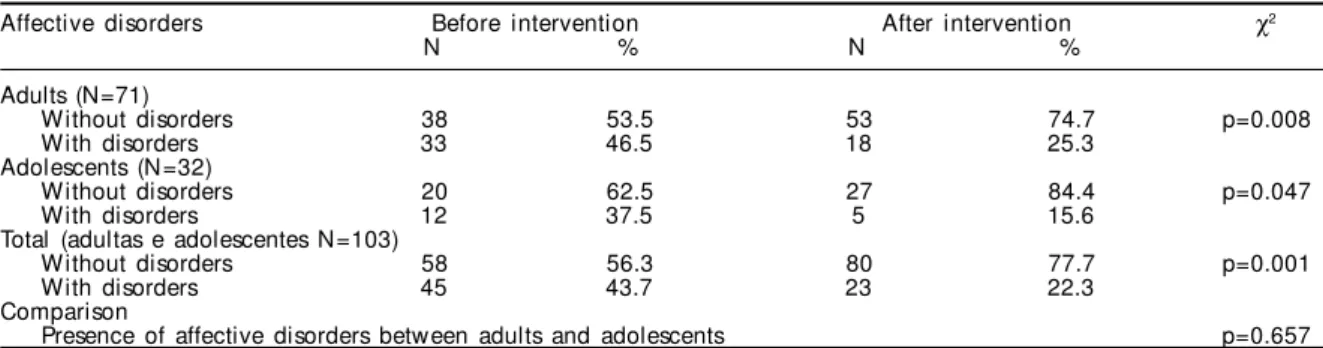
Table 1 shows the high prevalence of affective dis-orders among adult pregnant women (46.5%) and ado-lescents (37.5%) in the initial diagnosis. After multi-professional care, we observed a decrease in the preva-lence of affective disorders: adults (25.3%) and ado-lescents (15.6%), with significant differences before and after the participation of pregnant adults (p≤0.009) and adolescents (p=0.047) in the Pregnancy Care Program. A comparison of the presence of affec-tive disorders between adults and adolescents showed no statistically significant differences (p=0.657).
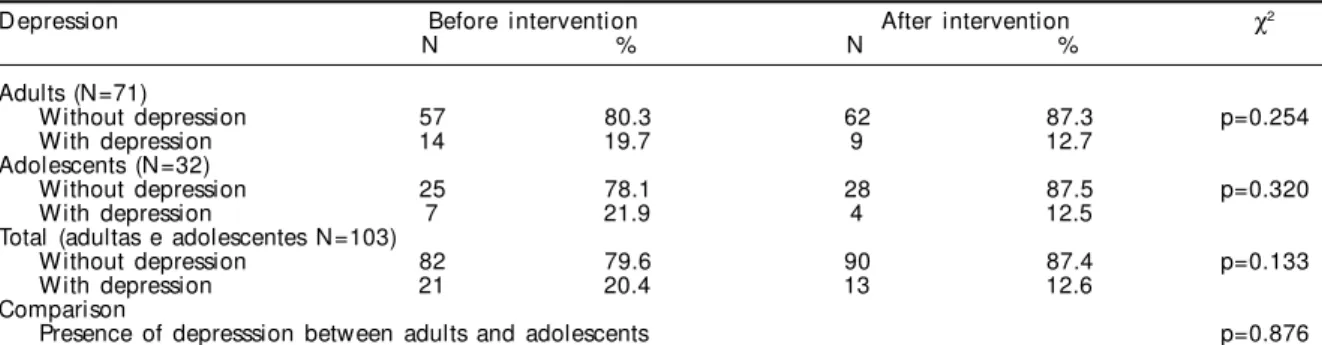
As seen in Table 2, there was a reduction in the prevalence of depression among adult and adoles-cent women after the intervention, although without statistical significance (p=0.254 and p=0.320, respec-tively). A comparison of the presence of depression between adults and adolescents showed no statisti-cally significant differences (p=0.876).
D ISCU SSIO N
Pregnancy may be an additional
anxiety-generat-Table 1 - Evaluation of affective disorders before and after interdisciplinary intervention among adult and adolescent pregnant women, according to the Self Reporting Questionnaire.
Affective disorders Before intervention After intervention χ2
N % N %
Adults (N=71)
Without disorders 38 53.5 53 74.7 p=0.008
With disorders 33 46.5 18 25.3
Adolescents (N=32)
Without disorders 20 62.5 27 84.4 p=0.047
With disorders 12 37.5 5 15.6
Total (adultas e adolescentes N=103)
Without disorders 58 56.3 80 77.7 p=0.001
With disorders 45 43.7 23 22.3
Comparison
" Rev Saúde Pública 2005;39(4) www.fsp.usp.br/rsp Multiprofessional care for pregnant women
Falcone VM et al
ing factor, rendering the woman more vulnerable to the development of emotional disorders.
The literature indicates that, among the problems related to pregnancy, there is a high occurrence of humor disorders, both psychotic and non-psychotic. Studies indicate that psychiatric disorders taking place during pregnancy, delivery, and puerperium are not a homo-geneous entity.12,16 These disorders range from
tran-sient benign clinical presentations to severe situations that may culminate in irreparable damage to the preg-nant woman, the fetus, and, occasionally, even to the partner. Nowadays, as is the case with most healthcare problems, these disorders must be understood within the framework of a multifactorial approach.16
The use, in the present study, of two evaluation in-struments (SRQ and BDI), followed the current prac-tice in mental health epidemiological research. In populational studies, one attempts to reduce, by means of structured instruments, the degree of subjectivity in the collection and interpretation of data.15 The
oppo-site occurs in clinical practice, where the profession-al’s experience and intuition are highly valued.
Using the SRQ, we found that the prevalence of affective disorders in adult and adolescent pregnant women was equivalent to that found in a study con-ducted by Mari19 in three urban primary healthcare
centers among the low-income population of the State of Sao Paulo. This indicates that pregnancy causes humor alterations in women that may result in emo-tional imbalances and possibly hinder the establish-ment of an affective bond between mother and fetus. Thus it prevents the mother from perceiving the de-velopment of the fetus and all its reactions to senso-rial and affective stimuli.
Jadresic et al11 studied prospectively the emotional
disturbances during the pregnancy and puerperium of 108 Chilean women. Using the Cuestionario de Selección de Depresión (CSD-20), these authors found 35.2% prevalence of emotional disorders
dur-ing gestation and 48.1% between two and three months following delivery.
In the present study, after conducting the interdis-ciplinary work, we observed a significant decrease in the prevalence of affective disorders after the moth-er’s participation in the group. The same occurred when adult and adolescent mothers were analyzed in separate. We can thus infer that the participation of both adults and adolescents in the Pregnancy Care Program contributes towards a decrease in affective disorders commonly present during gestation.
Depressive conditions evaluated through BDI show results similar to those of studies carried out in other countries. The prevalence found in the present study was similar to that found by Ortega et al21 in 360
Mexican women aged 20 to 34 years. Using psycho-logical tests – including the Edinburgh Perinatal Depression Scale (EPDS) – the authors found that 21.7% of women in the sample were experiencing a “probable depressive episode.” Another Mexican study22 found a 38.9% prevalence of depression
among 59 pregnant adolescents aged 14 to 19 years using the BDI. This prevalence was greater than that found among the adolescents of the present study, both before and after entry into the program. Although the same instrument was used, this difference may be explained by the cutoff point of 14 or more used in the Mexican study, in contrast to the cutoff of 20 of the present study.
Da-Silva et al,3 using the EPDS, found 37.9%
preva-lence of depression among low-income adult women in the third trimester of pregnancy in Rio de Janeiro. By contrast, Freitas & Botega,5 in a study of 120
preg-nant adolescents from the Programa de Assistência Integral à Saúde da Mulher (Integrated Woman’s Health Care Program) in a city of the State of Sao Paulo, found 20.8% prevalence of depression using a sub-scale from the Hospital Anxiety and Depression (HAD) scale. This prevalence was equivalent to that found in the present study before the intervention.
Table 2 - Evaluation of depression before and after interdisciplinary intervention among adult and adolescent pregnant women, according to the Beck Depression Inventory.
D epression Before intervention After intervention χ2
N % N %
Adults (N=71)
Without depression 57 80.3 62 87.3 p=0.254
With depression 14 19.7 9 12.7
Adolescents (N=32)
Without depression 25 78.1 28 87.5 p=0.320
With depression 7 21.9 4 12.5
Total (adultas e adolescentes N=103)
Without depression 82 79.6 90 87.4 p=0.133
With depression 21 20.4 13 12.6
Comparison
#
Rev Saúde Pública 2005;39(4) www.fsp.usp.br/rsp
Multiprofessional care for pregnant women Falcone VM et al
When evaluating the impact of the psychoprophy-lactic group on gestational depression in the adult and adolescent groups, we found a reduction in preva-lence, but without statistical significance. However, the group helped to maintain the prevalence below the percentage found in other studies. In addition to depression, another affective disorder highly preva-lent during gestation is anxiety. It is perhaps for this reason that we were unable to significantly reduce the percentage of depression but were able to reduce that of affective disorders diagnosed by the SRQ, which includes items on depression and anxiety.
One of the limitations of the present study is the absence of a control group, which could provide more consistent results. However, our team rejected this possibility on ethical grounds. All pregnant women who seek the groups and who fulfill the necessary requisites for enrollment participate in the multiprofessional intervention. This prevents the con-struction of a control group in the institution where the study was carried out. Thus, we proposed to study the subjects before and after the intervention, in or-der to evaluate its effects, in spite of this shortcom-ing. According to Luís & Oliveira,16 pregnancy
disor-ders encompass pathological presentations with dif-ferent symptomatologies. Disorders depend on prior psychiatric morbidities, on association with organic problems, and on the conditions of the pregnancy experience, which itself may cause alterations in humor as a mental function.
The psychoprophylactic method based on the use of an educational process for pregnant women, in addition to offering information, provides relief in terms of the emotional aspect, since it acts as an an-ticipated counseling. This technique is used for in-tervention during crises, with the goal of preparing the person to face a predictable crisis in the healthi-est possible manner, through the cognitive control of the situation and the strengthening of the adaptive mechanisms of the ego. Individuals who are able to openly express their negative feelings seem to do better in mentally elaborating these feelings.18
Groups of pregnant women for counseling purposes must include moments when the woman is able to expose her feelings and concerns, without fear, to the group or during individual interaction with profes-sionals. Pregnant women who become conscious of their rejection of pregnancy begin to take greater care, be it as a consequence of the understanding gained, or of the greater care and interest provided by the family and healthcare team from the moment when she verbalizes her rejection.12 We highlight, once
again, that women during pregnancy are vulnerable,
are exposed to multiple requirements, are experienc-ing a period of corporal, biochemical, hormonal, fam-ily-related, and social adaptation or reorganization, and are susceptible to feelings of guilt and ambiva-lence towards the child.
The availability to listen to the pregnant woman with a welcoming posture is the most important req-uisite for preventive action. Through interaction, the professional is able to detect changes in humor, thinking, and behavior suggestive of potential psy-chiatric disorders.
For Sabino, as cited by Evers,4 a few moments of
relaxation are equivalent to hours of sleep, generat-ing good disposition and vitality. This reposition of energy relieves daily tensions, anxieties, and irrita-bility. In a state of physical relaxation, individuals become consequently open to mental relaxation. The more the pregnant woman concentrates on herself and on her internal processes, the more easily can she overcome her anxieties and become in tune with the baby. The mother that transmits her love to the baby increases her self esteem, makes the baby feel deserv-ing of such love, and able to love intensely. Relaxa-tion and massage help the pregnant woman to over-come, or minimize her anxieties, so that she is able to find the best path to experiencing pregnancy with greater equilibrium and to an uneventful delivery.
Care for the pregnant woman using music helps her discover the changes that have taken place and may ease the anguish, fear, and anxiety generated by the gestational period and the moment of delivery. Ac-cording to Maldonado,18 newborns become calmer
when listening to the mother’s heartbeat or to music played during pregnancy. Singing to the child already during pregnancy is thus an important means of estab-lishing contact. Likewise, rocking movements, con-tact with warm water and light massaging of the baby’s body also evoke pleasant memories of the antenatal environment, leading to intense wellbeing. Pleasant experiences become registered in the fetus’s psyche.
A good mother-child bond constitutes the best pro-tection against the dangers of the outer world, and its effects are not limited to the intrauterine period. This link determined the future of the mother-child rela-tionship, which is important for the reduction of ma-ternal-fetal morbidity and mortality rates and for the child’s development.
experi-$ Rev Saúde Pública 2005;39(4) www.fsp.usp.br/rsp Multiprofessional care for pregnant women
Falcone VM et al
ences that unconsciously interfere with the mainte-nance of mental health.
Antenatal care conducted by a multiprofessional
REFEREN CES
1. Altman DG. Comparing groups-categorical data. In: Altman, DG. Pratical statistics for medical research. New York: Chapman & Hall; 1999. p. 229-76.
2. Alvarado RM, Aldo VC, Monardes J, Rojas M, Olea E, Neves E. El inventario de Depresión de Beck en los cuadros depresivos del embarazo y del posparto. Rev Psiquiatr 1993;10:4-13.
3. Da-Silva VA, Moraes-Santos AR, Carvalho MS, Martins MLP, Teixeira NA. Prenatal and postnatal depression among low income Brazilian women. Braz J Med Biol Res 1998;31:799-804.
4. Evers EC. Vivendo a gravidez em harmonia. Curitiba: Universidade Federal do Paraná; 1999. p. 42.
5. Freitas GVS, Botega NJ. Gravidez na adolescência: prevalência de depressão, ansiedade e ideação suicida. Rev Assoc Med Bras 2002;48:245-9.
6. Glover V. Maternal stress or anxiety in pregnancy and emotional development of the child. Br J Psychiatry 1997;171:105-6.
7. Gorenstein C, Andrade L, Vieira Filho, AHG, Tung TC, Artes A. Psycometric properties of the Portuguese version of the Depression Inventory on Brazilian college students. J Clin Psychol 1999;55:553-62.
8. Harrigton R. Causal processes in development and psychopathology. Br J Psychiatry 2001;179:93-4.
9. Harrigton R. Developmental continuities and discontinuities. Br J Psychiatry 2001;179:189-90.
10. Isohanni M, Jones P, Kemppainen L, Croudace T, Isohanni I, Rasanen S et al. Childhood and adolescent predictors of schizophrenia in the Northern Finland 1966 Birth Cohort - a descriptive life-span model. Eur Arch Psychiatry Clin Neurosci 2000;250:311-9.
11. Jadresic VE, Jara VC, Miranda M, Arrau B, Araya R. Trastornos emocionales en el embarazo y el puerperio: estudio prospectivo de 108 mujeres. Rev Chil Neuropsiquiatr 1992;30:99-106.
12. Kerr-Corrêa F, Fávero RV. Complicações obstétricas: fatores maternos, psicológicos e sociais. Rev ABP-APAL 1991;13:143-51.
13. Kitamura T, Shima S, Sugawara M, Toda MA. Stress and puerperal psychosis. Br J Psyquiatry
1991;158:290-1.
14. Leboyer F. Shantala: uma arte tradicional de massa-gens para bebês. São Paulo: Ground; 1989. p. 11-151.
15. Lewis G, Pelosi AJ, Araya R, Dunn G. Measuring psychiatric disorder in the community: a standardized assessment for use by lay interviewers. Psychol Med 1992;22:465-86.
16. Luis MAV, Oliveira ER. Transtornos mentais na gravidez, parto e puerpério, na região de Ribeirão Preto-SP-Brasil. Rev Esc Enfermagem USP 1998;32:314-24.
17. Mäder CVN, Nascimento CL, Spada PV, Nóbrega FJ. Avaliação e fortalecimento do vínculo materno-fetal. Rev Paul Pediatr 2002;5:236-40.
18. Maldonado MT. Psicologia da gravidez, parto e puerpério. São Paulo: Saraiva; 1997. p. 229.
19. Mari J. Psychiatric morbidity in three primary medical care clinics in the city of São Paulo-issues on the mental health of the urban poor. Soc Psychiatry 1987;22:129-38.
20. O’Connor TG, Heron J, Golding J, Beveridge M, Glover V. Maternal antenatal anxiety and children’s behavioral/emotional problems at 4 years. Report from the Avon Longitudinal Study of Parents and Children. Br J Psychiatry 2002;180:502-8.
21. Ortega L, Lartigue T, Figueroa M E. Prevalência de depresión, através de la Escala de Depresión Perinatal de Edinburgh (EPDS), en una muestra de mujeres mexicanas embarazadas. Perinatol Reprodut Hum 2001;15:11-20.
22. Villanueva LA, Perez Fajardo MM, Iglesias LF. Factores sociodemográficos asociados a depresión en adolescentes embarazadas. Ginecol Obstet M ex 2000;68:143-8.
23. Zucchi, M. Depressão na gravidez e prematuridade. Aspectos espistomológicos da investigação. Cad Saúde Pública 1999;5:89-97.