CLINICAL SCIENCE
Depression during pregnancy in women with a
medical disorder: risk factors and perinatal outcomes
Gla´ucia Rosana Guerra Benute,IRoseli Mieko Yamamoto Nomura,IIJuliana Siracuza Reis,IRene´rio Fraguas Junior,IIIMara Cristina Souza de Lucia,IMarcelo ZugaibII
IDivision of Psychology, Hospital das Clı´nicas, Faculdade de Medicina, Universidade de Sa˜o Paulo, Sa˜o Paulo, Brazil.IIDepartment of Obstetrics and Gynecology, Hospital das Clı´nicas, Faculdade de Medicina, Universidade de Sa˜o Paulo, Sa˜o Paulo, Brazil.IIIDepartment of Psychiatric, Hospital das Clı´nicas, Faculdade de Medicina, Universidade de Sa˜o Paulo, Sa˜o Paulo, Brazil.
BACKGROUND: Approximately one-fifth of women present depression during pregnancy and puerperium, and almost 13% of pregnant women experience a major depressive disorder.
OBJECTIVE:The aim of this study was to identify risk factors for depression among pregnant women with a medical disorder and to evaluate the influence of depression on perinatal outcomes.
METHODS: Three hundred and twenty-six pregnant women with a medical disorder were interviewed. A
semistructured interview was conducted for each participant using a questionnaire that had been developed previously. Major depression was diagnosed using the Portuguese version of the Primary Care Evaluation of Mental Disorders (PRIME-MD). The medical records of the participants were thoroughly reviewed to evaluate the perinatal results.
RESULTS:Major depressive disorder was diagnosed in 29 cases (9.0%). The prevalence of major depression was as follows: 7.1% for preeclampsia or chronic hypertension, 12.1% for cardiac disorder, 7.1% for diabetes mellitus, 6.3% for maternal anemia, 8.3% for collagenosis and 12.5% for a high risk of premature delivery. An univariate analysis showed a significant positive correlation between an average household income below minimum wage and a PRIME-MD diagnosis of major depression. A multiple regression analysis identified unplanned pregnancy as an independent predictor of major depression (86.2% in the group with a diagnosis of major depression by PRIME-MD vs. 68.4% in the group without major depression). A comparison between women who presented major depression and those who did not revealed no significant differences in the perinatal results (i.e., preterm delivery, birth weight and low Apgar scores).
CONCLUSION:In the present study, unplanned pregnancy in women with a medical disorder was identified as a risk factor for major depression during gestation. Major depression during pregnancy in women with a medical disorder should be routinely investigated using specific methods.
KEYWORDS: Depression; Pregnancy; Medical disorder; Perinatal outcome.
Benute GRG, Nomura RMY, Siracuza RJ, Fraguas Jr R, Lucia MCS, Zugaib M. Depression during pregnancy in women with a medical disorder: risk factors and perinatal outcomes. Clinics. 2010;65(11):1127-1131.
Received for publication onJuly 1, 2010;First review completed onJuly 26, 2010;Accepted for publication onAugust 23, 2010 E-mail: [email protected]
Tel.: 55 11 3069-6209
INTRODUCTION
Depression is a significant public health concern. In addition to the suffering that is experienced by patients, there are costs associated with treatment due to a higher frequency of hospitalization and a loss of productivity.1In comparison to
males, females demonstrate a higher incidence rate of major depressive disorder.2 Approximately one-fifth of women
present depression during pregnancy and puerperium,3and
almost 13% of pregnant women experience a major depres-sive disorder.4 The American College of Obstetricians and Gynecologists recommends that women be screened for depression during pregnancy.5 According to the Royal College of Obstetricians and Gynecologists (RCOG), health-care professionals should inquire about the mood of a pregnant woman to identify potential signs of depression during her first encounter with prenatal care services.6
Some symptoms of depression may overlap with those associated with the pregnancy, and therefore, the diagnosis of this disorder is difficult. Although the symptoms of anxiety and depression are often similar to complaints that are expected during pregnancy, a detailed evaluation of the patient would permit an adequate diagnosis of depression and an early intervention.7
The independent risk factors associated with antepartum depressive symptoms include stressful life events, a lack of social support and domestic violence.8According to Lovisi
et al., poverty and violence are risk factors that are often experienced by pregnant women in Brazil and in other developing countries. In addition to pregnancy-specific vulnerability, women are also exposed to marked social inequality in these countries.9–10
Depression during pregnancy is a strong risk factor for postnatal depression, which indicates the need for inter-ventions that are performed prior to childbirth.11 Some studies have demonstrated that depression in pregnant women has negative effects on the birth outcome (e.g., low birth weight, preterm birth and impaired fetal develop-ment),12–13 whereas others have reported that it does not
interfere with the pregnancy.14Consequently, the aim of the present study was to identify risk factors for depression among pregnant women with a medical disorder and to evaluate the influence of depression on perinatal outcomes.
SUBJECTS AND METHODS
This study was conducted between March 2005 and March 2006 at the largest public university hospital in the city of Sa˜o Paulo in Brazil. High-risk pregnant women were referred for prenatal care and delivery. The local research ethics committee approved the study protocol and all of the women provided written informed consent prior to parti-cipating in the interview.
The criteria for inclusion in the study included singleton pregnancies, intact chorioamniotic membranes, an absence of fetal congenital and chromosomal abnormalities and an absence of pregnancy complications due to medical dis-orders. The exclusion criteria included fetal malformations and a lack of postnatal data. The gestational age was determined for all of the women based on the last menstrual period and according to the findings of an ultrasonography that was performed prior to the 20th week of gestation.
Each participant completed in a semistructured interview during which data were collected using a previously designed questionnaire. The women were interviewed either in the waiting rooms during prenatal outpatient visits or during hospitalization. Each interview lasted approximately one hour. The questionnaire consisted of closed-ended questions regarding demographic data such as age, religion (e.g., Catholic, Evangelical), average house-hold income classified relative to the minimum wage, occupational status, relationship status (e.g., married, cohabiting, or unmarried), planned pregnancy, educational background and gestational age at the time of the interview (weeks).
Depression was diagnosed using the Portuguese version of the Primary Care Evaluation of Mental Disorders (PRIME-MD) classification system15. The present study
focused specifically on major depressive disorder.
The medical records of the women were methodically reviewed for verification of the information regarding antenatal care and delivery. The gestational age at birth, type of delivery, birth weight and Apgar score were obtained from these records. Data were analyzed using the Statistica program for Windows (Release 4.3, Statsoft, Inc., 1993) and are reported as the mean and standard deviation. The Student’s t-test was used to compare groups with or without a diagnosis of major depression. Categorical
data were compared using the chi-square test or Fisher’s exact test where appropriate. Multiple regressions were performed using a standard procedure to identify indepen-dent variables that were related to the diagnosis of major depression according to the PRIME-MD. The level of significance was set at p,0.05 for all analyses.
RESULTS
Three hundred and twenty-six pregnant women with a medical disorder participated in the present study. The women were interviewed at a mean gestational age of 28.2 weeks (SD = 10.5). The mean age of the participants was 30.2 years (SD = 7.1). The medical disorders presented by the women included preeclampsia or chronic hypertension (n = 142), heart disease (n = 66), diabetes mellitus (n = 84), anemia (n = 16), collagenosis (n = 24) and risk for preterm delivery (n = 16). Twenty-two (6.8%) women had two associated disorders.
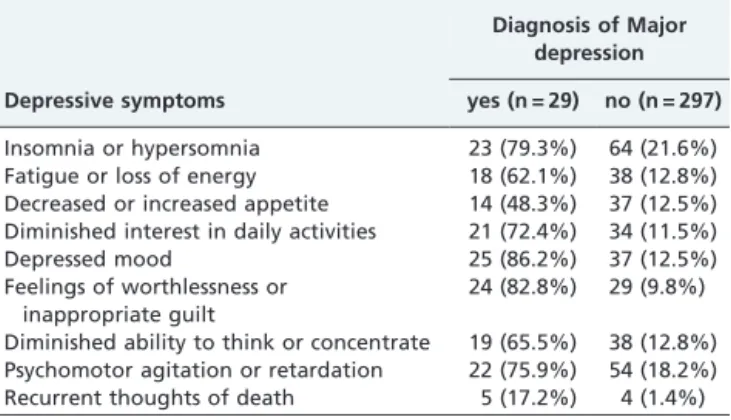
Major depressive disorder was diagnosed in 29 cases (9.0%). None of the participants was taking a psychoactive medication. The prevalence of major depression among the women who were affected by a physical disorder was as follows: preeclampsia or chronic hypertension (7.1%), heart disease (12.1%), diabetes mellitus (7.1%), anemia (6.3%), collagenosis (8.3%) and risk for preterm delivery (12.5%). The symptoms of depression that were reported by the women are shown in Table 1. The most frequently reported symptoms were insomnia or hypersomnia and psychomotor agitation or retardation.
Table 2 shows the sociodemographic data and univariate analysis comparing pregnant women who presented major depression with those who did not. An average household income below minimum wage was positively correlated with a PRIME-MD diagnosis of major depression. Maternal depression was not associated with age, religion, occupa-tional status, marital status, planned pregnancy, or educa-tional level.
Standard multiple regressions were performed to differ-entiate the independent effects of the sociodemographic variables on the occurrence of major depression and to identify planned pregnancy as an independent predictor of major depression (Table 3).
No significant differences were observed with respect to perinatal outcomes between women who presented major
Table 1 -Frequency of depressive symptoms reported by pregnant women with a medical disorder with or without diagnosis of major depression during pregnancy
according to the PRIME-MD.
Diagnosis of Major depression Depressive symptoms yes (n = 29) no (n = 297)
Insomnia or hypersomnia 23 (79.3%) 64 (21.6%) Fatigue or loss of energy 18 (62.1%) 38 (12.8%) Decreased or increased appetite 14 (48.3%) 37 (12.5%) Diminished interest in daily activities 21 (72.4%) 34 (11.5%)
Depressed mood 25 (86.2%) 37 (12.5%)
Feelings of worthlessness or inappropriate guilt
24 (82.8%) 29 (9.8%)
depression during pregnancy and those who did not (Table 4). A nonadjusted univariate analysis revealed no significant association between the antenatal PRIME-MD diagnosis and an adverse neonatal outcome.
DISCUSSION
The findings of the present study suggest that unplanned pregnancy may be an independent risk factor associated with major depression during pregnancy in women with medical disorders. The concomitant occurrence of a medical disorder and an unplanned pregnancy was found to cause stress in the participants, especially those from low-income families. A previous systematic review8 of 57 studies has
concluded that stressful life events, a lack of social support and domestic violence are independently associated with antepartum depressive symptoms according to a multi-variate analysis.
The PRIME-MD classification system was developed to aid primary care physicians in screening, evaluating and diagnosing mental disorders. The agreement between the PRIME-MD diagnosis and that made by independent mental health professionals is excellent and it demonstrates a sensitivity of 83%, specificity of 88%, positive predictive value of 80% and an overall accuracy of 88%.16The PRIME-MD is considered a suitable tool to assess the relevance of psychiatric disorders in an obstetric outpatient setting because it is convenient and easy to use.
Andersson et al. used the PRIME-MD to assess the pre-valence of psychiatric disorders during the second trimester of gestation in a population-based sample of pregnant women. The authors detected psychiatric disorders in 14.1% of the women and major depression in 3.3%. This proportion is lower than that observed in the present study, which only included pregnant women with a medical disorder.
Using the Edinburgh Postnatal Depression Scale (EPDS), Goodman18 found a prevalence of depression of 8.6% in
predominantly well-educated, high-income, married women from the northern United States who were in their third trimester of gestation.
In a study that employed the Spielberger State and Trait Anxiety Inventory and the EPDS, pregnant women with a medical disorder presented significantly higher scores on the state anxiety scale in comparison to those without a medical disorder. In addition, pregnant women with a medical disorder demonstrated a higher score on the EPDS in comparison to healthy controls; 26.7% had a score of 13 or higher (13 serves as the cut-off for probable major depression) compared to only 6.7% of the healthy controls.19
The differences in the proportion of major depression in the study by King et al. compared to the present work may be explained in part by the observation that more than 50% of the women in that study were taking medication.
In a recent study of postpartum depression that was conducted in southern Brazil, both general health ques-tionnaires and postpartum depression rating scales were found to be useful tools for the determination of depressive phenomena in women20. Although general health ques-tionnaires were not used in the present study, this tool should be used in future research investigating depression in pregnant women.
Table 2 -Association of sociodemographic characteristics with a PRIME-MD diagnosis of major depression during pregnancy in women with medical disorders.
Diagnosis of Major depression
Characteristics yes (n = 29) No (n = 297) p
Age (years), mean (SD) 29.4 (7.0) 30.3 (7.2) 0.54 Religion, n (%)
Catholic 19 (65.5) 158 (53.7) 0.53
Evangelical 8 (27.6) 95 (32.3)
Afro-Brazilian 0 (0) 5 (1.7)
Others 2 (6.9) 39 (13.1)
Average household income, n (%)
,1 minimum wage 3 (10.3) 10 (3.4) 0.04
1 to 6 minimum wage 15 (51.8) 211 (70.9)
.7 minimum wage 4 (13.8) 21 (7.2)
No answer 7 (24.1) 55 (18.5)
Employed, n (%)
Yes 11 (38.0) 126 (42.3) 0.79
No 18 (62.0) 171 (57.7)
Relationship status, n (%)
cohabit with a partner 16 (55.2) 170 (57.1) 0.99
single 13 (44.8) 127 (42.9)
Planned pregnancy, n (%)
Yes 4 (13.8) 94 (31.6) 0.07
No 25 (86.2) 203 (68.4)
Educational background, n (%)
No schooling 1 (3.4) 2 (0.7)
Elementary school 8 (27.6) 118 (39.7) 0.15
High school 19 (65.6) 150 (50.5)
College 1 (3.4) 27 (9.2)
Table 3 -Standard multiple regression analysis.
Variable Coefficient
Standard
error t-value p-value
Intercept 1.9626 0.1472 13.3329 0.00
Maternal age 0.00186 0.0024 0.7803 0.44
Relationship status 0.00236 0.0323 0.0714 0.94
Religion 0.03046 0.0221 1.3787 0.17
Planned pregnancy -0.07286 0.0352 -2.0703 0.04 Educational
background
-0.00196 0.0264 -0.0722 0.94
Occupational status -0.00996 0.0336 -0.2961 0.77 Average household
income
-0.0067 0.0192 -0.3473 0.73
Table 4 -Association of perinatal outcomes with a PRIME-MD diagnosis of major depression during pregnancy in women with medical disorders.
Diagnosis of Major depression
Perinatal outcomes yes (n = 29) no (n = 297) p-value
Gestational age at birth (weeks),
mean (SD) 37.2 (1.8) 37.1 (2.6) 0.83
,37, n (%) 16 (55.2) 158 (53.2) 0.99
$37, n (%) 13 (44.8) 139 (46.8)
Birth weight (g)
mean (SD) 2700.7 (623.9) 2764.3 (775.1) 0.67
#2,500, n (%) 6 (20.7) 96 (32.3) 0.28
.2,500, n (%) 23 (79.3) 201 (67.7) 1stminute Apgar score, n (%)
,7 4 (13.8) 46 (15.5) 1.0
$7 25 (86.2) 251 (84.5)
5thminute Apgar score, n (%)
,7 1 ( 3.5) 19 (6.4) 1.0
Prior to this study, major depression in participants was likely to have gone unrecognized by an obstetrician. The high frequency of unrecognized major depression in obstetric patients suggests that the diagnosis of this condition is difficult due to the lack of a standard protocol.16 The utilization of PRIME-MD can facilitate a reliable diagnosis of major depression in pregnant women with a medical disorder. Major depression is associated with substantial patient suffering, disability and loss of productivity.
The results of the present study suggest that perinatal outcomes (i.e., preterm delivery, low birth weight and low Apgar scores) are not related to the presence of major depression during pregnancy that is complicated by a medical disorder, which is consistent with the results reported by Andersson et al.14The samples assessed in these two studies (i.e., the present study and that performed by Andersson et al.) included pregnant women who had access to and frequently attended prenatal care appointments. The DSM-IV research criteria for psychiatric disorders were used to determine a clinical diagnosis of depression. Although the two samples were similar, high-risk pregnant women were enrolled in the present study, whereas Andersson et al. excluded women who presented any pathology.
In the present study, maternal exposure to major depression was not associated with a preterm birth. Nevertheless, a lack of social support constitutes an impor-tant risk factor for adverse effects on pregnancy outcomes,21 and unplanned pregnancies are reported by 43.5% of pregnant women with a low level of social support. In the present study, unplanned pregnancy was found to be inde-pendently associated with a diagnosis of major depression during pregnancy.
Some studies have reported findings for the influence of depression on perinatal outcomes.12,13,22 It is important to highlight the differences between the results reported by these studies and the present work in terms of the methods used, populations studied and the ways in which depres-sion was evaluated. According to Hoffman et al12the score obtained using the Center for Epidemiological Studies Depression Scale indicated that depression was unrelated to fetal growth or the duration of gestation. Nevertheless, analyses of other potentially high-risk subgroups (e.g., women with a lower social class) have shown that a depressive mood may be associated with restricted fetal growth12. The Center for Epidemiological Studies
Depression Scale evaluates depression based on the symp-toms that are reported by the patients and does not distinguish between symptoms of pregnancy and those characteristic of depression. Orr et al. used this scale to evaluate depression in African American women, who are known to present a higher risk for preterm delivery.13Li et al. found that pregnant women with depressive symptoms have an increased risk for preterm delivery; however, this risk seemed to be exacerbated by a low level of education, fertility problems, obesity and stressful events.22
The limitations of the present study included the heterogeneity of the medical disorders and the wide range of medications that were used by the participants. Another limitation was that the psychiatric diagnoses were made on only one occasion during the pregnancy and it was unclear whether the symptoms were transitory. Despite these limitations, we were able to demonstrate that unplanned pregnancy is associated with a diagnosis of antenatal major depression in pregnant women with a medical disorder.
In conclusion, further studies that apply specific tools for the diagnosis of depression (instead of evaluating the presence of a disorder according to patient-reported symptoms) are necessary to clarify the influence of depres-sion in pregnant women on perinatal outcomes. In this study, unplanned pregnancy in women with a medical disorder was identified as a risk factor for major depression during gestation. Thus, major depression during pregnancy in women with a medical disorder should be routinely investigated using specific instruments.
REFERENCES
1. Stewart DE, Gagnon A, Saucier JF, Wahoush O, Dougherty G. Postpartum depression symptoms in newcomers. Can J Psychiatry 2008;53:121-4.
2. Essau CA, Lewinsohn PM, Seeley JR, Sasagawa S. Gender differences in the developmental course of depression. J Affect Disord 2010, in press. 3. Limlomwongse N, Liabsuetrakul T. Cohort study of depressive moods in Thai women during late pregnancy and 6-8 weeks of postpartum using the Edinburgh Postnatal Depression Scale (EPDS). Arch Womens Ment Health. 2006;9:131-8, doi: 10.1007/s00737-005-0115-7.
4. Gaynes BN, Gavin N, Meltzer-Brody S, Lohr KN, Swinson T, Gartlehner G, et al. Perinatal depression: prevalence, screening accuracy, and screening outcomes. Evid Rep Technol Assess. (Summ) 2005;119:1-8. 5. American College of Obstetricians and Gynecologists Committee on
Health Care for Undeserved Women. ACOG Committee Opinion No. 343: psychosocial risk factors: perinatal screening and intervention. Obstet Gynecol. 2006;108:469-77, doi: 10.1097/00006250-200608000-00046.
6. Royal College of Obstetricians and Gynaecologists. Antenatal care. Routine care for the healthy pregnant woman. London: RCOG Press; 2008. 7. American College of Obstetricians and Gynecologists. Committee on Obstetric Practice. Committee opinion no. 453: Screening for depression during and after pregnancy. Obstet Gynecol. 2010;115: 394-5, doi: 10. 1097/AOG.0b013e3181d035aa.
8. Lancaster CA, Gold KJ, Flynn HA, Yoo H, Marcus SM, Davis MM. Risk factors for depressive symptoms during pregnancy: a systematic review. Am J Obstet Gynecol. 2010;202:5-14, doi: 10.1016/j.ajog.2009.09.007. 9. Lovisi GM, Lo´pez JR, Coutinho ES, Patel V. Poverty, violence and
depression during pregnancy: a survey of mothers attending a public hospital in Brazil. Psychol Med. 2005;35:1485-92, doi: 10.1017/ S0033291705005362.
10. Manzolli P, Nunes MA, Schmidt MI, Pinheiro AP, Soares RM, Giacomello A, et al. Violence and depressive symptoms during preg-nancy: a primary care study in Brazil. Soc Psychiatry Psychiatr Epide-miol. 2009, in press.
11. Patel V, Kleinman A. Poverty and common mental disorders in developing countries. Bull World Health Organ. 2003;81:609-15. 12. Hoffman S, Hatch MC. Depressive symptomatology during pregnancy:
evidence for an association with decreased fetal growth in pregnancies of lower social class women. Health Psychol. 2000;19:535-43, doi: 10.1037/ 0278-6133.19.6.535.
13. Orr ST, James SA, Blackmore Prince C. Maternal prenatal depressive symptoms and spontaneous preterm births among African-American women in Baltimore, Maryland. Am J Epidemiol. 2002;156:797-802, doi: 10.1093/aje/kwf131.
14. Andersson L, Sundstro¨m-Poromaa I, Wulff M, Astro¨m M, Bixo M. Neonatal outcome following maternal antenatal depression and anxiety: a population-based study. Am J Epidemiol. 2004;159:872-81, doi: 10. 1093/aje/kwh122.
15. Fraguas R Jr, Henriques SG Jr, De Lucia MS, Iosifescu DV, Schwartz FH, et al. The detection of depression in medical setting: a study with PRIME-MD. J Affect Disord. 2006;91:11-7, doi: 10.1016/j.jad.2005.12.003. 16. Spitzer RL, Williams JB, Kroenke K, Hornyak R, McMurray J. Validity and utility of the PRIME-MD patient health questionnaire in assessment of 3000 obstetric-gynecologic patients: the PRIME-MD Patient Health Questionnaire Obstetrics-Gynecology Study. Am J Obstet Gynecol. 2000;183:759-69, doi: 10.1067/mob.2000.106580.
17. Andersson L, Sundstro¨m-Poromaa I, Bixo M, Wulff M, Bondestam K, Astro¨m M. Point prevalence of psychiatric disorders during the second trimester of pregnancy: a population-based study. Am J Obstet Gynecol. 2003;189:148-54, doi: 10.1067/mob.2003.336.
18. Goodman JH. Women’s attitudes, preferences, and perceived barriers to treatment for perinatal depression. Birth. 2009;36:60-9, doi: 10.1111/j. 1523-536X.2008.00296.x.
20. Zubaran C, Foresti K, Schumacher MV, Amoretti AL, Thorell MR, Mu¨ller LC. The Correlation Between Postpartum Depression and Health Status. Matern Child Health J. 2009, in press.
21. Elsenbruch S, Benson S, Ru¨cke M, Rose M, Dudenhausen J, Pincus-Knackstedt MK, et al. Social support during pregnancy: effects on
maternal depressive symptoms, smoking and pregnancy outcome. Hum Reprod. 2007;22:869-77, doi: 10.1093/humrep/del432.