RESUmo
A inconinência urinária masculina tem sido relacionada a vários fatores, desta -cando-se a hiperplasia prostáica benigna e o tratamento de câncer de próstata. A inconinência urinária gera implicações negaivas tanto para o indivíduo inconi -nente, como para seus familiares e cuida -dores. No presente estudo foi realizada uma revisão integraiva a im de ideniicar o impacto na vida das parceiras de homens inconinentes. A busca dos arigos foi reali -zada nas bases de dados CINAHL, EMBASE, SCOPUS, MEDLINE e PubMed. Foram inclu -ídos arigos na língua portuguesa, inglesa e espanhola, e excluídos os que não citavam esposas. A amostra inal foi composta por 15 arigos, de sete países. Os arigos foram distribuídos nas categorias: Sofrimento Psí -quico, Fadiga, Mudança na Vida Sexual, e Limitação da Vida Social. A categoria Sofri -mento Psíquico esteve presente em todos os arigos e foi avaliada como a mais preju -dicial na vida dessas mulheres.
dEScRiToRES Homens
Inconinência urinária Cônjuges
Qualidade de vida Cuidados de enfermagem
The impact of urinary incontinence of
the lives of wives of men with incontinence:
an integrative review
*C
r
i
ti
C
a
l
r
ev
i
ew
AbSTRAcT
Male urinary inconinence has been relat -ed to several factors, among which benign prostaic hyperplasia and prostate cancer treatment are highlighted. Urinary incon -inence has negaive efects on paients as well as on their relaives and caregivers. In the present study, an integraive review was performed with the purpose to ideni -fy the impact that urinary inconinence has on the lives of the paients’ partners. The aricle survey was performed on the follow -ing databases: CINAHL, EMBASE, SCOPUS, MEDLINE, and PubMed. Aricles were in -cluded if they were writen in Portuguese, English or Spanish, and excluded if they did not menion the paients’ wives. The inal sample was comprised of 15 aricles from seven countries. The aricles were distrib -uted into the following categories: Psycho -logical Distress, Faigue, Change in Sex Life, and Limitaions on Social Life. The category Psychological Distress was present in all aricles and was rated as having the most impact on these women’s lives.
dEScRiPToRS Men
Urinary inconinence Spouses
Quality of life Nursing care
RESUmEn
La inconinencia urinaria masculina ha sido relacionada a varios factores, destacándo -se la hiperplasia prostáica benigna y el tratamiento del cáncer de próstata. La in -coninencia urinaria genera implicaciones negaivas, tanto para el individuo afectado como para sus familiares y cuidadores. En este estudio fue realizada una revisión in -tegraiva, apuntando ideniicar el impacto en la vida de las compañeras de hombres con inconinencia. Búsqueda de arículos realizada en bases de datos CINAHL, EM -BASE, SCOPUS, MEDLINE y PubMed. Fue -ron incluidos arículos en lengua portugue -sa, inglesa y española. Se excluyeron aque -llos que no mencionaban a las esposas. La muestra inal se compuso de 15 arículos, de siete países. Los arículos se distribuye -ron en las categorías: Sufrimiento Psíquico, Faiga, Cambio en la Vida Sexual y Limita -ción de la Vida Social. La categoría Sufri -miento Psíquico estuvo presente en todos los arículos y fue evaluada como la más perjudicial en la vida de dichas mujeres.
dEScRiPToRES Hombres
Inconinencia urinaria Esposos
Calidad de vida Atención de enfermería
mariana bezzon bicalho1, maria Helena baena de moraes Lopes2
Impacto da IncontInêncIa urInárIa na vIda de esposas de homens com IncontInêncIa: revIsão IntegratIva
Impacto de la IncontInencIa urInarIa en la vIda de esposas de hombres con IncontInencIa: revIsIón IntegratIva
*excerpted from the term paper “Impacto da incontinência urinária na vida de esposas de homens com incontinência: uma revisão integrativa”, university of campinas (unIcamp), Faculty of medical sciences, nursing department, 2010. 1rn by the university of campinas (unIcamp), Faculty of medical
sciences. campinas, sp, brazil. [email protected] 2rn. associate professor, university of campinas (unIcamp), Faculty of medical sciences,
inTRodUcTion
Male Urinary Inconinence (UI) has been related to vari
-ous factors. Those considered to be the most important are old age, benign prostaic hyperplasia (BPH), treatment for prostate cancer, physical and mental impairment, and some diseases prevalent among elderly individuals such as stroke and Parkinson’s disease, in addiion to medicaion and sur
-geries potenially capable of causing reduced pelvic muscle tone and/or capable of causing nerve damage(1).
BPH afects about 10% of men above the age of 30 and is observed in 90% of individuals older than 90 years of age(2). Prostate cancer is the most frequent neoplasia among men and afects about 18% of men up to the end of life with obvious negaive implicaions for their lives(2).
Both transurethral resecion for treaing BPH and prostatectomy to treat prostate cancer can cause compli
-caions, among which erecile dysfuncion, urinary incon
-inence and bladder problems stand out. These complicaions can afect the paient’s quality of life (QoL) and funcional condiion, while also potenially afecing the individu
-al’s self-esteem and inimate aspects related to couples. Among the complicaions, UI is the most alicive. In many paients, incon
-inence improves ater some days, weeks or months without intervenion, however, a small number of paients do not experience improvement(3).
The negaive impact of UI includes the emoional, social, and economic spheres both of the inconinent individual and his friends, family members and caregivers. Therefore, it represents a challenge for health workers to seek alternaive forms to approach and treat the problem, which is constantly underesi
-mated, especially in the nursing ield(1). Male urinary symptoms negaively afect
the quality of life of wives. The relaionship between the husband’s symptoms and the interference of these symp
-toms in the lives of women difer in various countries; the impact is inluenced by culture and diferent percepions(4).
Hence, the planning of care to be provided to the cou
-ple should be based not only on scieniic knowledge but also on the characterizaion of their context, focusing on their percepions and experiences. These issues are not addressed in Brazilian studies and are seldom explored in papers published in other countries.
Considering the preceding discussion, an integraive review was conducted to idenify the impact of UI on the lives of partners of inconinent men, that is, repercussions on their physical and mental health, as well as their sexual and social lives, in order to support health workers to de
-velop care planning focused on their needs, and also to guide future invesigaions in the theme.
mETHod
The integraive review is a speciic review method that synthesizes theoreical and empirical literature in order to deepen understanding of a given topic or health prob
-lem(5). The researcher analyzes relevant studies seeking grounding for decision-making and evidence to improve clinical pracice.
The stages recommended by the literature were fol
-lowed in this integraive review(5).
First stage: Ideniicaion of the problem
The following quesions guided the study: What is the impact of UI on the lives of the partners of inconinent men? What are the repercussions for their physical and mental health, and also on their social and sexual lives?
Second stage: Literature review
A bibliographic search was performed with publicaions up to November 2010 through the databases CINAHL, EMBASE, SCOPUS, MEDLINE and the research ser
-vice at the Naional Library of Medicine on the PubMed databases. The descriptors for Medical Subject Headings (MeSH) and the Boolean operator “AND” were used and resulted in the following combinaions: Uri
-nary Inconinence and Male and Spouses and Quality of Life. The descriptors were
used in Portuguese, English and Spanish. Only papers writen in Portuguese, English or Spanish were considered for analysis. Those not including the percepions of the partners of men with UI were excluded from the analysis. The databases were searched using the Electronic Informaion Access Pro
-gram and the Capes Periodicals Portal in the search system of the Electronic Library at the State Uni
-versity of Campinas (UNICAMP).
Third stage: Data evaluaion
The papers were evaluated through reading the full text, which should focus on the report of the spouses concerning the condiion of their husbands and the ex
-tent such a condiion interfered in the partner’s and in the couple’s quality of life.
Fourth stage: Data analysis
The selected studies were analyzed and the problems experienced by the spouses of inconinent men, reported in these papers, were grouped into categories that deine the impact of urinary inconinence on the lives of spouses of inconinent men. The categories were selected accord
-ing to the study’s objecive and the material found in the the negative impact
of uI includes the emotional, social, and economic spheres both of the incontinent individual
and his friends, family members and caregivers. therefore,
it represents a challenge for health
workers to seek alternative forms to approach and treat
papers, aiming to evaluate the impact of urinary inconi
-nence on the wives’ emoional, sexual, physical and social spheres.
Content analysis or a speciic theoreical framework was not used because the informaion present in the pa
-pers did not allow this type of analysis. Hence, the data are discussed based on literature only.
Fity stage: Presentaion
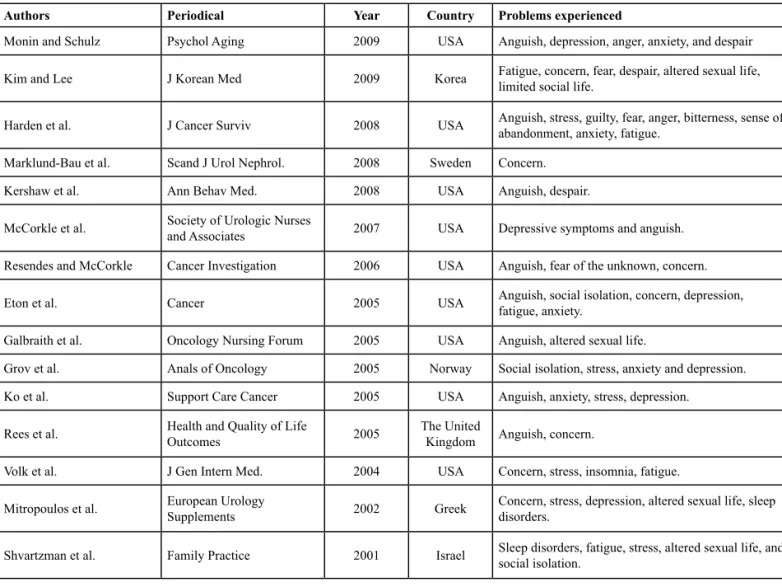
A synthesis of the indings is presented in Table 1 and analysis was based on the established categories.
RESULTS
Forty papers were found in searching the databases. Of these, 25 were excluded for not addressing the spous
-es. Hence, 15 papers were analyzed.
A synthesis of the results is presented in Table 1. The studies were published between 2001 and 2009. At the ime of data collecion, studies addressing the subject were found only in this period.
The studies originated in seven countries: the United States of America, the United Kingdom, Norway, Sweden, Greece, Israel and South Korea, though most studies are from the United States.
Table 1 – Distribution of papers according to authorship, periodical, year of publication, country of origin, and problems experienced by the spouses of incontinent men.
Authors Periodical Year Country Problems experienced
Monin and Schulz Psychol Aging 2009 USA Anguish, depression, anger, anxiety, and despair
Kim and Lee J Korean Med 2009 Korea Fatigue, concern, fear, despair, altered sexual life, limited social life.
Harden et al. J Cancer Surviv 2008 USA Anguish, stress, guilty, fear, anger, bitterness, sense of abandonment, anxiety, fatigue.
Marklund-Bau et al. Scand J Urol Nephrol. 2008 Sweden Concern.
Kershaw et al. Ann Behav Med. 2008 USA Anguish, despair.
McCorkle et al. Society of Urologic Nurses
and Associates 2007 USA Depressive symptoms and anguish.
Resendes and McCorkle Cancer Investigation 2006 USA Anguish, fear of the unknown, concern.
Eton et al. Cancer 2005 USA Anguish, social isolation, concern, depression,
fatigue, anxiety.
Galbraith et al. Oncology Nursing Forum 2005 USA Anguish, altered sexual life.
Grov et al. Anals of Oncology 2005 Norway Social isolation, stress, anxiety and depression.
Ko et al. Support Care Cancer 2005 USA Anguish, anxiety, stress, depression.
Rees et al. Health and Quality of Life
Outcomes 2005
The United
Kingdom Anguish, concern.
Volk et al. J Gen Intern Med. 2004 USA Concern, stress, insomnia, fatigue.
Mitropoulos et al. European Urology
Supplements 2002 Greek
Concern, stress, depression, altered sexual life, sleep disorders.
Shvartzman et al. Family Practice 2001 Israel Sleep disorders, fatigue, stress, altered sexual life, and social isolation.
The problems experienced by spouses of inconinent men and reported in the studies were grouped in the fol
-lowing categories: Psychological distress, Faigue, Altered physical life, Limited social life.
Psychological distress
The spouses of men with urinary symptoms feel more anguish than do their husbands(6-12). The source of such
anguish is lack of informaion, fear of the unknown, fear of the future, concern related to their partner’s treat
-ment(8,10,13-14), and fear of a cancer diagnosis, surgery and its side efects(4,9).
low QoL(16). Uncertainty concerning the disease causes concern (8,10,13-14,16-17) and depression in the wives(7,12,15-18).
Faigue
The spouses felt ired during the day due to sleep dis
-orders (4,17,19). They woke up one or two imes during the night due to the husband’s symptoms of nocturia(4,17,19). Insomnia was menioned in only one paper(14).Faigue was also associated with care provided to husbands and in
-creased responsibiliies were reported to negaively afect these women’s QoL(6,14,16).
Changed sexual life
Urinary symptoms and erecile disorders changed the couple’s sexual life making it unsaisfactory(4,11,17,19).
Limited social life
Couples end up becoming isolated in their social life due to urinary symptoms(4,15-16,19).
diScUSSion
UI ater a prostatectomy is a complicaion that is dif
-icult to treat and causes a deep negaive impact on one’s QoL, triggering psychological problems such as anxiety, in
-somnia, and depression as well as complicaions such as infecions in the urinary tract, dermaiis, and embarrass
-ment, afecing the man’s self esteem(20).
In most of the studied papers, UI was reported to be a result of the prostate cancer treatment, which afected the lives of paients and their spouses, potenially com
-promising the QoL of both.
The wife’s quality of life afects the paient’s quality of life(21-23) in the same way a negaive evaluaion of the disease is associated with the couple’s reduced quality of life(22). The husband’s negaive evaluaion in relaion to the disease is associated with their partner/caregivers’ re
-sponsibiliies that may cause them stress and faigue. For these reasons, women feel physically, mentally and emo
-ionally exhausted(16).
They report that psychological distress expressed by feelings such as guilty, anger, fear, isolaion, depression, abandonment, and anxiety are more harmful to their lives and their daily funcions than the physical demands(6).
Concern over urinary symptoms is milder in men with UI than for their spouses(10). For this reason, as the hus -band’s symptoms become more severe, the worse the spouses’ mental health becomes(9).
The partners experience some kind of morbidity as a consequence of their husbands’ condiion. The most com
-mon are psychological burdens, unsaisfactory sexual life, limited social life, and sleep disorders associated with
the husbands’ urinary loss such as nocturia, urge inconi
-nence, and nocturnal enuresis.
Studies show that the impact on the lives of spouses of inconinent men is inluenced by factors such as age. Older spouses (more than 65 years of age) experience less disrupion in their plans and, therefore, face the care re
-sponsibility less negaively over the years. They feel more saisied with their caregiver role than younger women. However, the physical vulnerability experienced by older spouses exposes them to the risk of physical weakness, worsening health problems and consequent mortality(6). Also, social isolaion, fewer family resources and the ef
-fects of comorbidiies, may cause anguish because these are more frequently observed among elderly wives(16).
This is a paricularly relevant aspect in terms of pub
-lic health, considering that the prevalence of male UI in
-creases with age. That is, with the increased populaion of elderly individuals, there will be more men with UI and more women will sufer addiional harm to their health when their partners become inconinent. Addiionally, the fact that the impact caused by male UI on the health of their partners is an issue neglected by the health services; care is usually focused only on the inconinent individual.
Some men more easily accept UI as a consequence ex
-pected from a prostatectomy, while anxiety experienced by others due to the urinary loss limits social contact(24). Restricted social contact, in turn, leads to the percepion that one’s personal life is out of control due to a reduced number of aciviies(25).
However, despite the adverse efects of UI on one’s quality of life, most men adapt to the adverse conse
-quences because a prostatectomy is essenial to prolong their lives(26). On the other hand, it is important to keep in mind that even though most paients manage to adapt to these consequences, it does not mean that the symp
-toms are not important or can be easily controlled. Hence, treatment for postprostatectomy-related UI should be ini
-iated at the ime surgery is being planned and coninue unil the paient is able to control his inconinence(27). Giv -en the impact of male UI on wives, nursing care should be extended to them and involve them in this care plan.
These indings have clear implicaions for both health
-care delivery and teaching. Given the prevalence and scope of such a condiion, nurses should learn this subject in the beginning of their formal educaion and not only in specializaion programs. If nurses in general were beter prepared to care for inconinent people, the problems ac
-cruing from this condiion could be prevented, improved or controlled, avoiding sufering not only for paients but also for their partners and families.
Psychological distress was ideniied in all 15 papers included in this review, Faigue was ideniied in ive, Al
in percepion, all the papers show that male UI negaively afects the lives of their partner-caregivers.
The papers found in Spanish and Portuguese, originat
-ing from Lain American countries, were excluded because they did not menion spouses, showing the need for further studies in these countries to represent diferent cultures.
One of the limitaions of this study is the databases that were not included in the search, as well as theses, dissertaions and papers published in conference pro
-ceedings. There were also restricions in relaion to the language, since papers were limited to those writen in English, Portuguese and Spanish.
concLUSion
Male UI negaively afects the lives of wives, especially in emoional, sexual and social terms, with the psycho
-logical distress it causes being of paricular note. Based on these indings, intervenions should be proposed and implemented in clinical pracice to help couples cope with such an experience, to minimize these efects in their lives, especially in the rouines of caregivers.
REFEREncES
1. Silva APM, Santos VLCG. Prevalência da inconinência urinária em adultos e idosos hospitalizados. Rev Esc Enferm USP. 2005;39(1):36-45.
2. Srougi M, Ribeiro LA, Piovesan AC, Colombo JR, Nesrallah A. Doenças da próstata. Rev Med (São Paulo). 2008;87(3):166-77.
3. Kubagawa LM, Pellegrini JRF, Lima VP, Moreno AL. A eicácia do
tratamento isioterapêuico da inconinência urinária masculi
-na após prostatectomia. Rev Bras Cancerol. 2006;52(2):179-83.
4. Kim SC, Lee SY. Men’s lower urinary tract symptoms are also mental and physical suferings for their spouses. J Korean Med Sci. 2009;24(3):320-5.
5. Whitemore R, Knal K. The integraive review: updated meth
-odology. J Adv Nurs. 2005; 52(5):546-53.
6. Harden J, Northouse L, Cimprich B, Pohl JM, Liang J, Kershaw T. The inluence of developmental life stage on quality of life in survivors of prostate cancer and their partners. J Cancer Surviv. 2008;2(2):84-94.
7. Ko CM, Malcarne VL, Varni JW, Roesch SC, Banthia R, Green
-bergs HL, et al. Problem-solving and distress in prostate can
-cer paients and their spousal caregivers. Support Care Can
-cer. 2005;13(6):367-74.
8. Resendes LA, McCorkle R. Spousal responses to prostate can
-cer: an integraive review. Cancer Invest. 2006;24(2):192-8.
9. Kershaw TS, Mood DW, Newth G, Ronis DL, Sanda MG, Vaishampayan U, et al. Longitudinal analysis of a model to predict quality of life in prostate cancer paients. Ann Behav Med. 2008;36(2):117-28.
10. Rees J, Clarke MG, Waldron D, O’Boyle C, Ewings P, Mac
-Donagh RP. The measurement of response shit in paients with advanced prostate cancer and their partners. Health Qual Life Outcomes [Internet]. 2005 [cited 2011 Mar 9];3:21. Available from: htp://www.hqlo.com/content/3/1/21
11. Galbraith ME, Arechiga A, Ramirez J, Pedro LW. Prostate
cancer survivors’ and partners’ self-reports of health-re
-lated quality of life, treatment symptoms, and marital sat
-isfacion 2.5–5.5 years ater treatment. Oncol Nurs Forum. 2005;32(2):E30-41.
12. Monin JK, Schulz R. Interpersonal efects of sufering in older adult caregiving relaionships. Psychol Aging. 2009;24(3):681-95.
13. Marklund-Bau H, Edéll-Gustafsson U, Spångberg A. A Swed
-ish version of a quality of life quesionnaire for partners of
men with symptoms suggesive of benign prostaic obstruc
-ion. Scand J Urol Nephrol. 2008;42(2):126-31.
14. Volk RJ, Cantor SB, Cass AR, Spann SJ, Weller SC, Krahn MD.
Preferences of husbands and wives for outcomes of pros
-tate cancer screening and treatment. J Gen Intern Med. 2004;19(4):339-48.
15. Grov EK, Dahl AA, Moun T, Fossa SD. Anxiety, depression, and quality of life in caregivers of paients with cancer in late palliaive phase. Ann Oncol. 2005;16(7):1185-91.
16. Eton DT, Lepore SJ, Helgeson VS. Psychological distress in spouses of men treated for early-stage prostate carcinoma. Cancer. 2005;103(11):2412-18.
17. Mitropoulos D, Anastasiou I, Giannopoulou C, Nikolopoulos P, Alamanis C, Zervas A, et al.. Symptomaic benign prostate
hyperplasia: impact on partners’ quality of life. Eur Urol Sup
-pl. 2002;41(3):227-348.
18. McCorkle R Siefert M, Dowd MF, Robinson JP, Picket M. Ef
-fects of advanced pracice nursing on paient and spouse de
-pressive symptoms, sexual funcion, and marital interacion ater radical prostatectomy. Urol Nurs. 2007;27(1):65-77.
19. Shvartzman P, Borkan JM, Stoliar L, Peleg A, Nakar S, Nir G,
et al. Second-hand prostaism: efects of prostaic symp
20. Kakihara CT, Sens YAS, Ferreira U. Efeito do treinamento fun
-cional do assoalho pélvico associado ou não à eletroesimu
-lação na inconinência urinária após prostatectomia radical. Rev Bras Fisioter (São Carlos). 2007;11(6):481-6.
21. Hedesing O, Sandman P, Tomic R, Widmark A. Living ater external beam radiotherapy of localized prostate cancer. Cancer Nurs. 2005;25(4):263-8.
22. Ward-Smith P, Kapitan D. Quality of life among men treat
-ed with radiaion therapy for prostate cancer. Urol Nurs. 2005;28(4):310-7.
23. Yang BK, Crisci A, Young MD, Silverstein AD, Peterson B, Dahm P. Cross-secional survey of long-term quality of life radical perineal prostatectomy. Urology. 2005;65(1):120-5.
24. Kubagawa LM, Pellegrinin JRF, Lima VP. Eicacy of physical
therapy for male urinary inconinence following prostate re
-moval. Rev Bras Cancerol. 2006;52(2):179-83.
25. Reeve BB, Potosky AL, Willis GB. Should funcion and bother be measures and reported separately for prostate cancer quality-of-life domains? Urology. 2006;68(3):599-603.
26. Sacco E, Prayer-Galei T, Pinto F, Fracalaza S, Beto G, Pa
-gano F, et al. Urinary inconinence ater radical prostatec
-tomy: incidence by deiniion, risk factor and temporal trend in a larger series with a long-term follow-up. BJU Int. 2006;97(6):1234-41.
27. Fowler FJ Jr, Barry MJ, Lu-Yao G, Wasson J, Roman A, Wenn
-berg J. Efect of radical prostatectomy for prostate cancer on
paient quality of life: results from a Medicare survey. Urol