○ ○ ○ ○ ○ ○ ○ ○ ○ ○ ○ ○A BST RAC T○ ○ ○ ○ ○ ○ ○ ○ ○ ○ ○ ○ ○ ○ ○ ○IN T RO D U C T IO N○ ○ ○ ○ ○ ○ ○ ○ ○ ○
Since 1985, DNA has been shown to be a powerful tool in paternity cases, as well as for criminal investigation.1 This is accomplished by extracting D NA from any biological material, such as blood, saliva, skin, muscle, hair, sperm, teeth, bone, etc.2,3,4 Afterwards, comparison of individuals typed at polymorphic DNA regions can be done as "in tandem" repeated sequences. T his kind of comparison can be achieved because one component of each of the 23 pairs of chro-mosomes characteristic of the human being is inherited from the biological father and the other from the biological mother. In the light of this, human identification can be accomplished by DNA comparison between an individual and the alleged biological mother, father or other possible genetically related persons such as grandmothers, grandfathers, brothers, sisters or uncles. In the same way, the DNA profile of biological samples collected at a crime scene can be compared to that from a suspect or his relatives. The scientific knowledge gained in this area has enabled DNA typing of human remains and biological evidence to become a valid technique for human identification.
In this context, polymorphic regions within DNA, called VNTR (variable number of tandem repeats), have been successfully used for DNA typing purposes for more than 10 years.5 However, as the analysis of VNTR loci requires large amounts of DNA, this methodology is not so efficient for typing degraded DNA and samples with very small amounts of DNA, such as the DNA prepared from biological samples
collected from the environment. On the other hand, STR (short tandem repeats) analysis is a simple methodology that works even with poor and degraded DNA. As a disadvantage, it is known that a STR locus is not as polymorphic as a VNTR one.6
In this report, we describe the usefulness of both methodologies for typing samples collected from a four-month-old fetus conceived in a rape case. The victim, a 14-year-old girl with a genetic disorder (Down's Syndrome), was raped in Rio de Janeiro, Brazil, in 1998. The crime was only notified some months later when the pregnancy became evident, and therefore DNA sperm typing was not carried out to identify the rapist from among the suspects. T he victim had obtained judicial authorization for an abortion and, in order to identify the biological father of the fetus, we typed the aborted fetus, its mother (the victim) and four suspects in the rape case. We combined the STR and VNTR analyses to increase the Paternity Index.
○ ○ ○ ○ ○ ○ ○ ○ ○ ○ ○ ○ ○ ○M ET H O D S○ ○ ○ ○ ○ ○
DNA extraction - 50 µL of blood from the victim and suspects, and skin tissue from the fetus (10-20 mm2), were incubated for 15-18 hours in 500 µL lysis buffer (10 mM Tris-Cl pH 7.5; 1 mM EDTA; 50 mM NaTris-Cl; 2% SDS) containing 0.3 mg/ml proteinase K, at 56 ºC. The DNA was extracted using phenol/ chloroform/isoamyl alcohol (25:24:1). Each DNA preparation was resuspended in 20 µL TE buffer (10 mM Tris-Cl, 1 mM EDTA). In order to estimate DNA integrity, 1 µL samples were applied to 0.8% agarose gel, with
elec-• Andréa Carla de Souza G óes
• Dayse Aparecida da Silva
• Cristiane Santana Domingues
• João M arreiro Sobrinho
• Elizeu Fagundes de Carvalho
Identification of a criminal
by DNA typing in a rape
case in Rio de Janeiro, Brazil
DNA Diagnostic Laboratory, Instituto de Biologia, Universidade Estadual
do Rio de Janeiro, Rio de Janeiro, Brazil
O
ri
gi
n
a
l
A
rt
ic
le
CO N TEX T: Human DN A identificatio n is a po werful to o l fo r paternity cases as well as fo r criminal investig atio n, in which bio lo g ical evidence is typed a fter c o llec tio n fro m c rime sc enes a nd fo r the identificatio n o f human remains.
O BJECTIVE: Identificatio n o f a criminal in a rape case with 4 suspects using STR and VN TR DN A analysis.
TYPE O F STUDY: Fo rensic DN A analysis.
SETTIN G: DN A Diag no stic Labo rato ry, Universidade Estadual do Rio de Janeiro , Braz il.
PARTICIPAN TS: Blo o d fro m 4 suspects and the victim, and skin fro m the fetus.
PRO CEDURES: Po lymerase chain reactio n (PCR) and restrictio n frag ment leng th po lymo rphism (RFLP).
RESULTS: Three o f the suspects were excluded and o ne o f them was identified as the bio lo g ical father o f the fe tus a fte r typ ing w ith C TT a nd FFv Multiplexes. Co mplementa ry DN A typing a t 3 VN TR lo ci was also carried o ut.
CO N CLUSIO N S: After typing fo ur suspects using 6 STR lo c i, o ne o f the m w a s id e ntifie d a s the b io lo g ic a l fa the r o f the fe tus. In o rd e r to sig nificantly enhance the Co mbined Paternity Index (PI), co mplementary DN A typing in 3 VN TR lo ci was carried o ut. The included suspect was fo und to be the bio lo g ical father with a PI o f 4 1 2 ,8 6 0 (Pro bability o f Paternity: 9 9 .9 9 9 7 %).
KEY W O RDS: Sexua l a b use. Fo rensic DN A. STR. VN TR. Paternity.
São Paulo M edical Journal - Revista Paulista de M edicina
7 8
trophoresis at 100V for 15 minutes and staining with ethidium bromide (0.5 µg/ml). D NA quantification was carried out by measuring optical densities at 260 nm.
PCR reaction - 6 ST R loci were analyzed using the FFv and CT T Multiplex silver-stained systems from Promega Corporation. To a 25 µL final reaction volume, 5 ng of template DNA, 2.5 µL ST R 10 buffer, 2.5 µL CT T or FFv primer and 0.75 U Taq polymerase were added. T he PCR reactions were performed in a Perkin-Elmer 9600 thermocycler with initial denaturation for 2 min at 96 ºC followed by 10 cycles of 1
min at 94 ºC, 1 min at 60 ºC, 1.5 min at 70 ºC and 20 cycles of 1 min at 90 ºC, 1 min at 60 ºC and 1.5 min at 70 ºC. T he amplification products were analyzed on a 2% agararose gel.
ST R allele analysis - The amplification products were resolved on a 4% polyacry-lamide gel (7 M urea; 4% acrypolyacry-lamide-bis- acrylamide-bis-acrylamide solution; 0.5 TBE), using SA32 Sequencing Gel Electrophoresis Apparatus (Life Technologies). The gel was pre-run for 30 minutes at 1500V, 80W, 40 mA, in 0.5 × TBE buffer prior to sample loading. The PCR products were mixed with loading buffer and
denatured at 95 ºC for 2 min. The gel was run for 90 min under the same conditions as above and with silver staining.7
DNA digestion with restriction enzyme -500 ng of genomic DNA were digested with 1U of Hae III (Gibco-BRL), at 37 ºC for 12-18 hours. T he restriction fragments were precipitated by adding ammonium acetate to 2.5 M final and 2 volumes of ethanol. After incubation at -20 ºC for 2 hours, the DNA was recovered by centrifugation in a microfuge (maximum speed, for 10 minutes) and resuspended in 20 µL loading buffer (10 mM Tris-Cl pH 7.5; 1 mM EDTA; 20% Ficoll; 0.02% BPB; 0.02% XC-FF solution).
Electrophoresis and DNA transfer - The fragments were separated on 0.8% agarose gel with 1 × TBE buffer for 24 hours at 20V. The gel was denatured using alkali treatment and transferred to nylon membrane by the Southern method.8
Hybridization - Sequential hybridization was developed as recommended by the manufacturers, using alkaline-phosphatase chemiluminescence labeled probes AC415, CEB42 and TBQ7.
Statistical analysis - A data bank from the population of the State of Rio de Janeiro was utilized.9,10
○ ○ ○ ○ ○ ○ ○ ○ ○ ○ ○ ○ ○ ○ ○R ESU LT S○ ○ ○ ○ ○
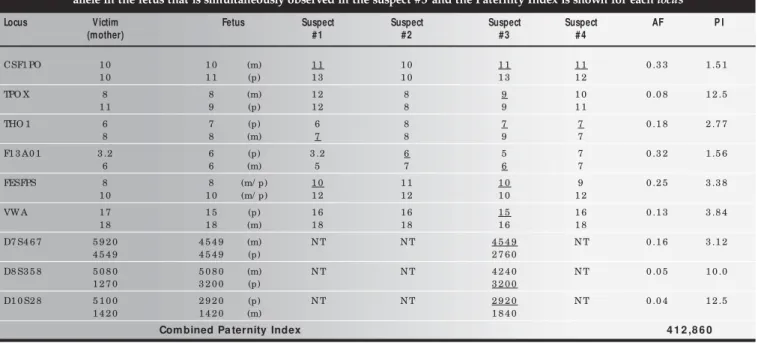
T he silver-stained polyacrylamide gel (Figures 2 and 3) showed that three of the suspects were excluded and only suspect # 3 was included as the biological father of the fetus after typing with CT T and FFv Multi-plexes. T he typed alleles at the 6 ST R loci for each suspect are summarized in Table 1. Suspect # 1 was excluded because of the T POX, F13A01 and vWA loci. Suspect # 2 was excluded because of 5 of the 6 ST R loci, whereas suspect # 4 was excluded because of 4 loci. In addition, in order to increase the PI for suspect # 3, we also typed the victim, fetus and suspect # 3, using 3 VNT R loci. T he results from the VNT R analysis are summarized in Table 1 . A cumulative paternity index of 412,860 was obtained by combining the STR and VNTR analysis. The probability of paternity was 99.9997%.
○ ○ ○ ○ ○ ○ ○ ○ ○ ○ ○ ○ D ISC U SSIO N○ ○ ○ ○ ○ ○ ○ ○
Nowadays, in rape cases, routine vaginal swabs can be taken from the victims to carry out DNA analysis. The genetic profiles and even the number of criminals involved in sexual crimes can be determined from the
Sao Paulo M ed J/ Rev Paul M ed 2 0 0 2 ;1 2 0 (3 ):7 7 -8 0 .
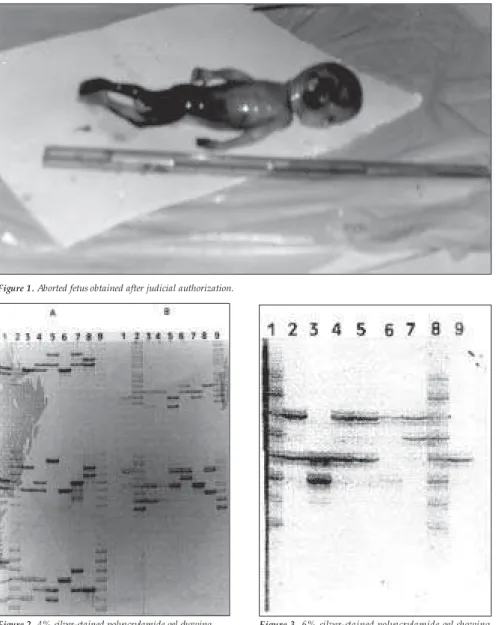
Figure 1. Aborted fetus obtained after judicial authorization.
Figure 2. 4% silver-stained polyacrylamide gel showing CT T, F13A01 and FESFPS typing of victim, fetus and
suspects. PANEL A: CT T (CSF1PO, TPOX and TH01) typing. PANEL B: F13A01 and FESFPS typing. 1- positive
control; 2- ladder; 3- victim (mother); 4- fetus; 5- Suspect # 1; 6- Suspect # 2; 7- Suspect # 3; 8- Suspect # 4; 9- ladder.
Figure 3 . 6% silver-stained polyacrylamide gel showing vWA typing of victim, fetus and suspects. 1- ladder;
2-Suspect # 4; 3- 2-Suspect # 3; 4- 2-Suspect # 2; 5- 2-Suspect # 1; 6- fetus; 7- victim (mother); 8- ladder; 9- positive
São Paulo M edical Journal - Revista Paulista de M edicina
7 9
sperm DNA typing. In this case, the crime was not reported to the authorities immediately after the rape occurred. As sperm was not collected to compare the spermatozoa profile to those of the four suspects, the fetus DNA profile was compared to them. T his procedure would be expected to indicate whether at least one of the suspects was the
Sao Paulo M ed J/ Rev Paul M ed 2 0 02 ;1 2 0 (3 ):7 7 -8 0 .
Table 1. STR genetic profiles of victim, fetus and suspects (CSF1PO, TPOX, TH01, F13A01, FESFPS, vWA) and VNTR genetic profiles of victim, fetus and suspect # 3 (D7S467, D8S358, D10S28). The frequency of the obligatory paternal
allele in the fetus that is simultaneously observed in the suspect #3 and the Paternity Index is shown for each locus
Locus Victim Fetus Suspect Suspect Suspect Suspect AF P I
(mother) # 1 # 2 # 3 # 4
CSF1 PO 1 0 1 0 (m) 1 1 1 0 1 1 1 1 0 .3 3 1 .5 1
1 0 1 1 (p) 1 3 1 0 1 3 1 2
TPO X 8 8 (m) 1 2 8 9 1 0 0 .0 8 1 2 .5
1 1 9 (p) 1 2 8 9 1 1
THO 1 6 7 (p) 6 8 7 7 0 .1 8 2 .7 7
8 8 (m) 7 8 9 7
F1 3 A0 1 3 .2 6 (p) 3 .2 6 5 7 0 .3 2 1 .5 6
6 6 (m) 5 7 6 7
FESFPS 8 8 (m/ p) 1 0 1 1 1 0 9 0 .2 5 3 .3 8
1 0 1 0 (m/ p) 1 2 1 2 1 0 1 2
VW A 1 7 1 5 (p) 1 6 1 6 1 5 1 6 0 .1 3 3 .8 4
1 8 1 8 (m) 1 8 1 8 1 6 1 8
D7 S4 6 7 5 9 2 0 4 5 4 9 (m) N T N T 4 5 4 9 N T 0 .1 6 3 .1 2
4 5 4 9 4 5 4 9 (p) 2 7 6 0
D8 S3 5 8 5 0 8 0 5 0 8 0 (m) N T N T 4 2 4 0 N T 0 .0 5 1 0 .0
1 2 7 0 3 2 0 0 (p) 3 2 0 0
D1 0 S2 8 5 1 0 0 2 9 2 0 (p) N T N T 2 9 2 0 N T 0 .0 4 1 2 .5
1 4 2 0 1 4 2 0 (m) 1 8 4 0
Com bined Pa ternity Index 4 1 2 ,8 6 0
The suspect' s alleles co incident with the o blig ato ry paternal alleles are underlined; AF - Fetus and suspect # 3 co incident allele frequency; PI - Paternity Index; N T - N o t typed; m - maternal allele; p- o blig ato ry paternal allele.
biological father of the fetus. In view of this, all four suspects were tested to identify the biological father of the aborted fetus (Figure 1). We utilized as strategy a combination of VNT R and ST R analysis to carry out the Paternity testing. The paternal alleles of the fetus were found in the genomic material of suspect #3 at all examined loci as would be
expected for a father and his child.
○ ○ ○ ○ ○ ○ ○ ○ ○ ○ ○C O N C LU SIO N S○ ○ ○ ○ ○ ○ ○ ○ ○
Suspect # 3 was found to be the biological father of the fetus with a Combined Paternity Index of 412,860 and a Probability of Paternity of 99.9997%.
1. Jeffreys AJ, Wilson V, Thein SL. Individual Specific Fingerprint of Human DNA. Nature 1985;316:76-9.
2. Boles TC, Snow CC, Stover E. Forensic DNA testing on skeletal remains from mass graves: a pilot project in Guatemala. Journal of Forensic Sciences 1995;3:349-55.
3. Ginther C, Issel A, Tarver L, King MC. Identifying individual by sequencing mitochondrial DNA from teeth. Nature Genetics 1992;135-8.
4. Higuchi R, von Beroldingen CH, Sensabaugh GF, Erlich HA. DNA typing from single hair. Nature 1988;332:543-46.
○ ○ ○ ○ ○ ○ ○ ○ ○ ○ ○ ○ ○ ○ ○ ○ ○ ○ ○ ○ ○ ○ ○ ○ ○ ○ ○ ○ ○ ○ ○ ○ ○ ○ ○ ○ ○ ○ ○ ○ ○ ○ ○ ○ ○ ○ ○ ○ ○ ○ ○ ○ ○ ○ ○ ○ R EFER EN C ES○ ○ ○ ○ ○ ○ ○ ○
5. Jeffreys AJ, Brookfield JFY, Semeonoff R. Positive identification of an immigration test case using human DNA fingerprints. Nature 1985;317:818-19.
6. Lins AM, Sprecher CJ, Puers C, Schumm JW. Multiplex sets for the amplification of polymorphic short tandem repeat loci - silver stain and fluorescence detection. Biotechniques 1996;20:882-9. 7. User Guide of Promega Corporation, revised in 2/98. 8. Southern EM. Detection of specific sequences among DNA
fragments separated by gel electrophoresis. Journal of Molecular Biology 1975;98:520-7.
9. Silva DA, Chakraborty R, Stivers DN, Zhong Y, Carvalho EF, Crouse CA. Validation of CODIS 13 loci and pentanucleotide (Penta E) for three Brazilian populations (Rio black, non-black and Brazilian Central West population), a statistical and comparative study. 10th International Symposium on Human Identification - Orlando, EUA. 1999.
São Paulo M edical Journal - Revista Paulista de M edicina
8 0
Sao Paulo M ed J/ Rev Paul M ed 2 0 0 2 ;1 2 0 (3 ):7 7 -8 0 . CONTEXTO: A identificação humana por DNA
é uma ferramenta poderosa para casos de paternidade, assim como investigação cri-minal pela tipagem de evidências biológicas coletadas em cenas de crime e identificação de restos mortais.
OBJETIVO: Identificação de criminoso em caso de estupro com quatro suspeitos utilizando análise de STR e VNTR no DNA.
TIPO DE ESTUDO: Análise de DNA forense.
LOCAL: Laboratório de Diagnósticos por DNA, Universidade do Estado do Rio de Janeiro, Brasil.
PARTICIPANTES: Sangue de quatro suspeitos e vítima e pele do feto.
PROCEDIMENTOS: Reação em cadeia da polimerase (PCR) e polimorfismo de
tama-○ ○ ○ ○ ○ ○ ○ ○ ○ ○ ○ ○ ○ ○ ○ ○ ○ ○ ○ ○ ○ ○ ○ ○ ○ ○ ○ ○ ○ ○ ○ ○ ○ ○ ○ ○R ESU M O○ ○ ○ ○ ○ ○ Ack now ledgm ents: This wo rk was suppo rted by FAPERJ.
A n d r é a Ca r la d e So u z a G ó e s, M D, M S. DN A Diag no stic Labo rato ry, Instituto de Bio lo g ia, Universidade Estadual do Rio de Janeiro , Rio de Janeiro , Braz il.
Da y se Apa recida da Silva , M D, M S. DN A Diag no stic Labo rato ry,Instituto de Bio lo g ia, Universidade Estadual do Rio de Janeiro , Rio de Janeiro , Braz il.
Cr istia n e Sa n ta n a Do m in g u e s, M D, BS. DN A Diag no stic Labo rato ry, Instituto de Bio lo g ia, Universidade Estadual do Rio de Janeiro , Rio de Janeiro , Braz il.
Joã o M a rreiro Sobrinho, M D, BS. DN A Dia g no stic Labo rato ry, Instituto de Bio lo g ia, Universidade Estadual do Rio de Janeiro , Rio de Janeiro , Braz il.
Eliz eu Fa g und es d e Ca r v a lho, M D, PhD. DN A Dia g no stic La b o ra to ry Dire c to r, Instituto d e Bio lo g ia , Universidade Estadual do Rio de Janeiro , Rio de Janeiro , Braz il.
Sources of funding: suppo rted by FAPERJ (g rant # E-2 6 / 1 7 0 .4 1 2 / 9 9 ) and Universidade Estadual do Rio de Janeiro (UERJ).
Conflict of interest: N o t declared
Da te of first subm ission: 3 0 O cto ber 2 0 0 0
La st received: 2 9 January 2 0 0 2
Accepted: 7 February 2 0 0 2
Address for correspondence
Andréa Carla de So uz a G ó es
Rua 1 9 de Fevereiro , 1 0 0 / 5 0 5 - Bo tafo g o Rio de Janeiro / RJ - Brasil - CEP 2 2 2 8 0 -0 3 0 E-mail: acg o es@ uerj.br
CO PYRIG HT© 2 0 0 2 , Asso ciação Paulista de Medicina ○ ○ Pu b l i sh i n g i n f o r m a t i o n○ ○ ○ ○ ○ ○ ○ ○ ○ ○ ○ ○ ○ ○ ○ ○ ○ ○
nho de fragmentos de restrição (RFLP).
RESULTADOS: Três suspeitos foram excluídos e um suspeito foi incluído como pai biológico do feto após tipagem com os Multiplexes CTT e FFv. Um teste complementar com 3 loci
VNTR também foi realizado.
CONCLUSÃO: Após a tipagem de quatro suspeitos em 6 loci STR, um deles foi incluído como o pai biológico do feto. Com o objetivo de aumentar o Índice de Paternidade Com-binado (PI), um teste complementar com 3
loci VNT R foi realizado. O suspeito foi incluído como pai biológico apresentando Índice de Paternidade de 412.860 (proba-bilidade de paternidade: 99,9997%).