Juvenal Soares Dias da CostaI
Mauri Caldeira ReisII
Claudio Viana Silveira FilhoII
Rogério da Silva LinharesII
Fábio PiccininiII
Everton FantinelII
I Programa de Pós-Graduação em Saúde Coletiva. Universidade do Vale do Rio dos Sinos. São Leopoldo, RS, Brasil
II Programa de Residência em Medicina Social. Faculdade de Medicina da Universidade Federal de Pelotas. Pelotas, RS, Brasil
Correspondence:
Juvenal Soares Dias da Costa Av. Duque de Caxias, 250 96030-002 Pelotas, RS, Brasil E-mail: [email protected] Received: 4/14/2009 Approved: 4/6/2010
Article available from: www.scielo.br/rsp
Prevalence of hospitalization
and associated factors in
Pelotas, Southern Brazil
ABSTRACT
OBJECTIVE: To estimate the prevalence of hospitalizations and to identify characteristics associated with hospital admission.
METHODS: We carried out a population-based cross-sectional study of subjects of both sexes, aged 20-69 years, and who lived in the urban area of Pelotas, Southern Brazil, between 1999 and 2000. Subjects were interviewed using a standardized, pre-coded questionnaire. Analysis was stratifi ed by sex and confounder control was carried out using Poisson regression. Variables analyzed included socioeconomic and demographic characteristics, lifestyle, morbidities, and medical appointments in the last year.
RESULTS: Of the 1,916 subjects interviewed, 146 (7.6%; 95%CI: 6.4;8.8) had been hospitalized in the year preceding the interview. Among men, characteristics associated with hospitalization included age above 50 years, schooling between fi ve and seven years, history of smoking, minor psychiatric disorders, and medical appointments in the last year. For women, hospitalization was more frequent among subjects aged 60-69 years, with fi ve to seven years of schooling, and who had had medical appointments within the last year. Women who consumed under 30g/day of alcohol were less likely to have been hospitalized. Prevalence of hospitalization for primary care-sensitive causes was 13.0% (95%CI: 7.6;18.5).
CONCLUSIONS: Prevalence of hospitalization is similar in men and women. Schooling, but not income, was found to be associated with hospitalization.
DESCRIPTORS: Hospitalization. Risk Factors. Health Inequalities. Cross-Sectional Studies.
INTRODUCTION
Health care planning involves diagnosing the existing problems, adopting measures to solve these problems, and evaluating the impact of these measures after implementation.19
The number of hospitalizations due to ambulatory care-sensitive causes can be an indicator of the quality of primary care for diseases for which early diagnosis and treatment are effective at preventing complications (diabetes, cardiac insuffi ciency), immunopreventable diseases (tetanus, measles), and diseases for which adequate follow-up, management, and control can prevent hospitalization (arterial hypertension, perfo-rated ulcer). The more adequate the primary health care network, the lower the proportion of hospitalizations due to ambulatory care-sensitive conditions.5
Studying the underlying causes of hospitalization may provide evidence for inequities within the realm of primary care (access or management) as well as in access to hospitalization. Another reason for studying hospital-izations is the possibility of identifying factors associated with higher hospitalization frequency, which is in turn related to greater severity and health risks. Identifying potentially modifi able associated factors also allows one to calculate the potential impact of intervention of each factor on hospitalizations frequency reduction.18
The aim of the present study was to estimate the preva-lence of, and to identify characteristics associated with hospital admission.
METHODS
Between December 1999 and April 2000, we carried out a population-based cross-sectional study of subjects of both sexes, aged 20-69 years, living in the urban area of Pelotas, Southern Brazil.
Sample size calculations were based on the prevalence of the different outcomes contemplated in the survey assuming 80% statistical power; an alpha error of 5%; prevalence of the investigated events ranging from 25% to 75%; and a prevalence ratio of 2.0. Sample size was increased by 10% to compensate for losses and refusals, and by a further 15% for confounder control in adjusted analysis. Sample size was estimated at 1,800 subjects.
Sampling was carried out in multiple stages. Initially, we randomly selected 40 clusters (census tracts), and 30 households within each tract. We expected to obtain 1,200 households, with 1.5 person in the 20-29-years age range per household. Within each sector, we randomly selected a street block and an initial house, which was used as a point of departure. After selection, the two following houses were skipped, and the third house was visited.
a Ministério da Saúde. Secretaria de Atenção à Saúde. Portaria nº 221, de 17/04/08. Portaria nº 221, de 17/04/08. Defi ne que a Lista Brasileira de Internações por Condições Sensíveis à Atenção Primária será utilizada como instrumento de avaliação da atenção primária e/ou da utilização da atenção hospitalar, podendo ser aplicada para avaliar o desempenho do sistema de saúde nos âmbitos Nacional, Estadual e Municipal. Diario Ofi cial Uniao. 18 abril 2008;Seção 1:70.
b Associação Nacional de Empresas de Pesquisa. Critério de classifi cação econômica Brasil. São Paulo; 2003. [cited 2005 May 23] Available from: http://www.anep.org.br/
We were able to contact 1,145 (95.4%) of the expected 1,200 families, the remaining 55 (4.5%) being clas-sifi ed as losses. In the contacted families, we were able to locate 2,177 individuals, of which 1,968 were interviewed, losses amounting to 9.6%. We excluded from the analysis 41 women who reported having given birth spontaneously in the 12 months preceding the interview, six who reported caesarian sections, one who reported puerperal infection, and four who reported miscarriages/abortions. We thus included 1,916 subjects in the analysis.
Data was collected using a standardized, pre-coded questionnaire, administered by students from the Universidade Federal de Pelotas. All interviewers were previously trained. Training included standardization of measurements of weight, height, and arterial pressure.
The outcome analyzed was hospital admission in the 12-months preceding the interview.
Women hospitalized for obstetric conditions were excluded from the analysis.
We considered as “ambulatory-care sensitive” all causes of hospitalization included under Classifi cation of Diseases, 10th revision (CID-10)a codes D50 (Iron defi ciency anemia), F10 (Mental and behavioral disor-ders due to use of alcohol), F19 (Mental and behavioral disorders due to multiple drug use and use of other psychoactive substances), F32 (Depressive episode), I10 (Essential hypertension), J03 (Acute tonsillitis), J18 (Pneumonia, organism unspecified), and N72 (Infl ammatory disease of cervix uteri).
Socioeconomic variables considered in the analysis included economic class (based on material assets and schooling),bper capita family income (in minimum wages) and schooling (in years of study).
Demographic variables investigated included sex (male; female), age group (20-29; 30-39; 40-49; 50-59; 60-69 years), observed skin color (white; nonwhite); and marital status (married; domestic partnership; widow(er); separated; single).
(BMI) based on weight (kg) and height (m). Subjects with BMI higher than 25.0 kg/m² were considered as overweight.
Variables related to chronic non-communicable diseases (diabetes mellitus, systemic arterial hyperten-sion, minor psychiatric disorders, and chronic bron-chitis) were investigated. Presence of diabetes mellitus was determined based on self-reported prior medical diagnosis. Systemic arterial hypertension was defi ned as arterial pressure equal to or greater than 160/95 mmHg or as self-reported use of anti-hypertensive drugs. Occurrence of minor psychiatric disorders was established using the Self Report Questionnaire (SRQ-20), with a cutoff point of ≤ 6 for men and ≤ 7 for women.14 Chronic bronchitis was determined based on self-reported presence of productive cough on most days, lasting for at least three months per year, for two consecutive years.20
We also investigated whether the subject had visited a physician in the 12-month period preceding the interview.
Collecting data at the individual level allows us to estimate associations between variables that are not usually present in secondary databases – such as the Brazilian Health Care System’s Hospital Information Database (SIH/SUS) –, including smoking, alcohol intake, and BMI.22
We re-administered a simplifi ed questionnaire to 10% of the sample for quality control purposes.
Data were entered twice using EpiInfo software in order to insure consistency. In crude analyses, we calculated the prevalence ratios (PR) and 95% confi dence intervals (95% CI) and carried out chi-squared and linear trend tests when appropriate.2 SPSS software was used for this analysis.
Since men and women differ in terms of health-related behaviors and health care service usage, both crude and adjusted analyses were stratifi ed by sex.8,21,22
Adjusted analysis was carried out by Poisson regres-sion, using STATA software, based on a hierarchical model for confounder control.23 The fi rst hierarchical level included demographic (age group, skin color, and marital status) and socioeconomic (per capita family income and schooling) variables. The second level included lifestyle variables (alcohol intake, smoking, nutritional status) and morbidities (self-reported diabetes mellitus, arterial hypertension, minor psychiatric disorders, and chronic bronchitis). The third level included presence of medical appointments in the preceding year (Figure). Variables in the fi rst level were controlled for each other, and determined the exposures in the second level. In the second level, the two sets of variables were adjusted, and determined the distal vari-ables. All variables included in the model determined
the outcome. Variables with signifi cance below 25% in crude analysis were introduced in the model.
The study protocol was approved by the Research Ethics Committee of the Faculdade de Medicina, Universidade Federal de Pelotas (Process 040/99, 27/12/1999).
RESULTS
Prevalence of hospitalization in the year preceding the interview was 7.6% (95% CI: 6.4%;8.8%), corre-sponding to 146 subjects. Of these, 36.3% were male and 63.7% were female. Prevalence of hospitalization was 6.3% (95% CI: 4.6;7.9) among men and 8.7% (95% CI: 7.0;10.4) among women. Of the 146 hospitaliza-tions, 13.0% (95% CI: 7.6;18.5) were considered as being due to ambulatory-care sensitive causes.
Of the 1,916 subjects in the survey, 44.2% were men. Of these, 50.6% were aged 40-69 years and 49.3% were aged 20-39 years; 83% had white skin and 66.4% were married or in stable partnerships. Regarding socioeco-nomic variables, 72.4% of men had a per capita family income of less than three minimum wages, 63.3% belonged to social classes C and D, and 49.7% had up to 7 years of schooling. As to behavioral variables, 27.2% of men reported alcohol intake equal to or greater than 30 g/day, 60.9% were current or former smokers, and 51.7% had BMI equal to or greater than 25 kg/ m2. Regarding presence of chronic diseases, 5.1% of men reported suffering from diabetes mellitus, 21.4%, had systemic arterial hypertension, 21.0% had minor psychiatric disorders, and 4.7% had chronic bron-chitis. Prevalence of medical appointments in the year preceding the interview was 58.4% (Table 1).
Table 1. Distribution of male subjects hospitalized in the previous year. City of Pelotas, Southern Brazil, 1999-2000.
Variable n % Hospitalized N % Prevalence ratio 95% CI p-value
Age (years) <0,01
20-29 230 27.2 8 3.5 1 *<0.01
30-39 187 22.1 6 3.2 0.92 0.33;2.61
40-49 181 21.4 8 4.4 1.27 0.49;3.32
50-59 149 17.6 16 10.7 3.09 1.36;7.03
60-69 98 11.6 15 15.3 4.4 1.93;10.40
Skin color 0.45
White 702 83 42 6 1
Nonwhite 144 17 11 7.6 1.28 0.67;2.42
Marital status 0.33
Married 480 56.7 33 6.9 1
Stable partnership 82 9.7 4 4.9 0.71 0.26;1.95
Widow 19 2.2 2 10.5 1.53 0.40;5.92
Separated 33 3.9 4 12.1 1.76 0.66;4.68
Single 232 27.4 10 4.3 0.63 0.31;1.25
Per capita family income (MW) 0.14
> 10.01 46 5.5 1 2.2 1 *0.06
6.01-10 55 6.6 1 1.8 0.84 0.05-;3.01
3.01-6 131 15.6 5 3.8 1.76 0.21;14.64
1.01-3 363 43.3 30 16 8.3 3.8 0.53;27.22
< 1.01 244 29.1 6.6 3.02 0.41;22.19
Social classa
A 50 5.9 1 2 1 0.25
B 219 26 14 6.4 3.2 0.43;23.75 *0.11
C 323 38.4 16 5 2.48 0.34;18.27
D 210 24.9 19 9 4.52 0.62;33.0
E 40 4.8 3 7.5 3.75 0.41;34.69
Schooling (years)
≥ 14 104 12.4 2 1.9 1 <0.05
11-13 166 19.7 6 3.6 1.88 0.39;9.14 *0.01
8-10 155 18.4 10 6.5 3.35 0.75;15.0
5-7 195 23.2 19 9.7 5.07 1.2;21.3
0-4 222 26.4 16 7.2 3.75 0.88;16.0
Alcohol intake 0.09
Does not drink 77 9.1 4 5.2 1 *0.06
< 30g/day 536 63.7 27 5 0.97 0.35;2.7
≥ 30g/day 229 27.2 21 9.2 1.77 0.63;4.98
Smoking <0.01
Nonsmoker 331 39.1 10 3 1
Former smoker 226 26.7 25 11.1 3.66 1.79;7.47
Current smoker 289 34.2 18 6.2 2.06 0.97;4.39
BMI (Kg/m2) 0.04
Normal 405 48.3 17 4.2 1
Overweight 434 51.7 33 7.6 1.81 1.03;3.2
Self-reported diabetes 0.04
No 803 94.9 47 5.9 1
Yes 43 5.1 6 14 2.38 1.08;5.27
As to the 1,070 women surveyed, 47.7% were aged 30-49 years, 57.2%were aged 40-69 years, 83.2% were white, and most women were married or had a stable partner (56.3%). Regarding socioeconomic variables, 72.3% of women had a per capita family income of less than three minimum wages, 68.8% belonged to classes C, D, and E, and 49.7% had up to seven years of schooling. Alcohol intake equal to or greater than 30 g/day was reported by 3.9% of women, and 44.9% of women were current or former smokers. BMI was equal to or higher than 25 kg/m2 in 54.6% of women. Regarding the presence of chronic diseases, 6.4% of women reported suffering from diabetes mellitus, 26.0% had systemic arterial hypertension, 34.2% had minor psychiatric disorders, and 4.0% had chronic bronchitis. In the year preceding the interview, 80.2% of women had had medical appointments (Table 2).
Crude analysis showed a direct association between age and prevalence of hospitalization in the last year also among women, again with a signifi cant linear trend statistic. Higher prevalence of hospitalization was found among women with per capita family income higher than ten minimum wages (10.9%) and among those belonging to class E (13.0%), but differences between groups were not statistically signifi cant. The highest prevalence of hospitalization was found among women with fi ve to seven years of schooling. Regarding behavioral variables, intake of less than 30 g of alcohol per day showed a prevalence ratio of 0.62 (95% CI: 0.41;0.94) when compared to no intake at all. As to morbidities, presence of diabetes, hypertension, and minor psychiatric disorders were associated with the outcome. Presence of chronic bronchitis was associated with higher frequency of hospitalization (PR=2.59; 95% CI: 1.40;4.79). Women who had had medical appointments were 22.24 times more likely to have been hospitalized. Skin color, marital status, smoking,
and nutritional status were not signifi cantly associated with the outcome (Table 2).
Among men, age group, presence of minor psychi-atric disorders, and medical appointments remained associated with the outcome in adjusted analysis. Men aged 50 years or older were more frequently hospital-ized than their younger peers. Those suffering from minor psychiatric disorders or who had had a medical appointment in the last year were also more frequently hospitalized. Schooling and smoking showed border-line associations (p=0.05) with the outcome, but with signifi cant confi dence intervals. Former smokers and subjects with fi ve to seven years of schooling showed higher frequencies of hospitalization. Nutritional status, diabetes, and arterial hypertension lost their association with the income after adjustment (Table 3).
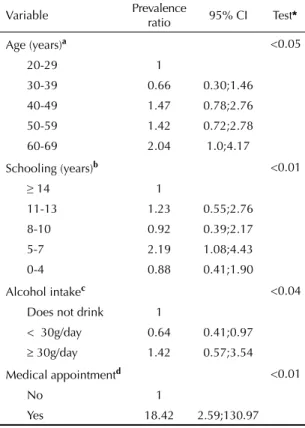
Among women, age group, schooling, alcohol intake, and medical appointments remained associated with the outcome in adjusted analysis. Female subjects aged 60-69 years, with fi ve to seven years of schooling, and who had had a medical appointment in the year preceding the interview were more likely to have been hospitalized. Women ingesting under 30 g/day of alcohol were less likely to have been hospitalized than those who did not drink alcohol or drank more than 30 g/day. After adjustment for age and schooling, the associations with diabetes, arterial hypertension, minor psychiatric disorders, and chronic bronchitis lost statistical signifi cance (Table 4).
DISCUSSION
An unexpected result in the present survey was the lack of an association between income indicators and the occurrence of hospitalization. In Brazil, lower-income populations show greater self-reported morbidity,22
Table 1 continuation
Variable n % Hospitalized N % Prevalence ratio 95% CI p-value
Arterial Hypertension 0.01
No 664 78.6 34 5.1 1
Yes 181 21.4 19 10.5 2.05 1.2;3.51
Minor psychiatric disorders
No 668 79 33 4.9 1 <0.01
Yes 178 21 20 11.2 2.27 1.34;3.87
Chronic bronchitis
No 806 95.3 48 6 1
Yes 40 4.7 5 12.5 2.1 0.88;4.98 0.1
Medical appointment
No 352 41.6 5 1.4 1
Yes 494 58.4 48 9.7 6.84 2.75;17.01 <0.01
Table 2. Distribution of female subjects hospitalized in the previous year. City of Pelotas, Southern Brazil, 1999-2000.
Variable n % Hospitalized N % Prevalence ratio 95% CI p-value
Age (years) < 0,01
20-29 206 19,3 13 6,3 1 *< 0,01
30-39 251 23,5 11 4,4 0,69 0,32;1,52
40-49 259 24,2 26 10 1,59 0,84;3,02
50-59 224 20,9 23 10,3 1,63 0,85;3,13
60-69 130 12,1 23 15,4 2,44 1,26;4,73
Skin color 0,47
White 890 83,2 75 8,4 1
Nonwhite 180 16,8 18 10 1,19 0,73-1,93
Marital status 0,07
Married 531 49,6 44 8,3 1 *0,67
Stable partnership 72 6,7 2 2,8 0,34 0,08;1,35
Widow 113 10,6 16 14,2 1,71 1,00;2,92
Separated 120 11,2 13 10,8 1,31 0,73;2,35
Single 234 21,9 18 7,7 0,93 0,55;1,57
Per capita family income (MW) 0,88
> 10.01 55 5,2 6 10,9 1 *0,42
6.01-10 78 7,3 7 9 0,82 0,29;2,31
3.01-6 162 15,3 14 8,6 0,79 0,32;1,96
1.01-3 432 40,7 40 9,3 0,85 0,38;1,91
< 1.01 335 31,5 25 7,5 0,68 0,29;1,59
Social classa 0,66
A 59 5,6 4 6,8 1 *0,90
B 272 25,6 24 8,8 1,3 0,43;3,61
C 387 36,5 35 9 1,33 0,49;3,62
D 297 28 21 7,1 1,04 0,37;2,93
E 46 4,3 6 13 1,92 0,58;6,42
Schooling (years) 0,01
≥ 14 135 12,7 9 6,7 1 *0,33
11-13 210 19,8 17 8,1 1,21 0,56;2,64
8-10 189 17,8 11 5,8 0,87 0,37;2,05
5-7 245 23,1 34 13,9 2,08 1,03;2,21
0-4 282 26,6 19 6,7 1,01 0,47;2,17
Alcohol intake 0,01
Does not drink 325 30,6 36 48 11,1 1 *0,33
< 30g/day 695 65,5 7 6,9 0,62 0,41;0,94
≥ 30g/day 41 3,9 17,1 1,54 0,73;3,24
Smoking 0,25
Nonsmoker 590 55,1 50 8,5 1 0,85;2,19
Former smoker 190 17,8 22 11,6 1,37 0,52;1,39
Current smoker 290 27,1 21 7,2 0,85
BMI (Kg/m2) 0,12
Normal 474 45,4 34 7,2 1 0,93;2,09
Overweight 571 54,6 57 10 1,39
Self-reported diabetes 0,04
No 1002 94,9 82 8,2 1 1,11;2,53
Yes 68 6,4 11 16,2 1,98
which would justify a greater frequency of hospitaliza-tion among these individuals. On the other hand, Castro9 has shown that socioeconomic differences in hospital utilization are not as noticeable as they are for other types of health care. The reason for these differences could be related to antagonistic mechanisms. Greater equity and quality in primary health care could prevent hospitalizations by means of adequate outpatient care. However, inequity could lower the frequency of hospitalization by limiting access to hospital services. Hospitalization due to ambulatory care-sensitive condi-tions (ACSC) could help reveal this potential inequity in access to hospitalization.24 In the present survey, 13.0% of hospitalized subjects were admitted to a hospital due to an ACSC. Wong et al, in an analysis of hospital admissions taken place in Brazil in 2004, using hospi-talization coeffi cients data from the SUS Informatics Department (DATASUS), found a prevalence of ACSC hospitalizations of 23.7% for all age groups. Based on the data published by Wong,c we calculated a prevalence of ACSC hospitalizations among 15-69-year-olds of 19.6% of all hospitalizations. Therefore, frequency of ACSC hospitalizations was lower in the present survey than in Brazil as a whole. This lends support to the notion of greater equity and/or quality of the primary health care network in Pelotas. The Family Health Strategy (ESF) may have had a positive infl uence on the quality of health care, and especially on the occur-rence of ACSC hospitalizations.16
The present study has two major limitations. The fi rst is related to the validation of the outcome. Studies of health care utilization are subject to error regarding the
quality of the information provided by the subjects. However, the probability of recall bias is likely much lower given the prominent role a hospitalization event would have the subject’s life.12,17
Another limitation is the low frequency of the outcome in our sample. Prevalence of hospitalization in the present survey was 7.6% (95% CI: 6.4;8.8). Cross-sectional studies are known to be less capable of demonstrating associations with rare outcomes.1
However, the design of the survey improved the quality of the information obtained. The age, race, and gender composition of the sample was similar to that found for Pelotas as a whole in the 2000 Census, providing evidence of the representativity of the sample and making our results generalizable to similar populations.
Men and women showed different behaviors with regard to use of hospital services. Even though preva-lences were similar (with superimposed confi dence intervals), the factors associated with hospitalization differed according to gender.
Older men and women were more likely to have been hospitalized than younger subjects. Frequency of hospitalization in the 60 to 69-years group was 4.4-fold and twofold that of 20 to 29-year-olds among men and women, respectively. Hulka & Wheat13 argue that age is naturally associated with hospital utilization as a consequence of its effects on morbidity and mortality. Garbinato et al,11 in a cross-sectional study carried out in 2002-2003 in Canoas, also in Southern Brazil, and which involved 1,945 subjects aged 14 years or older,
Table 2 continuation
Variable n % Hospitalized N % Prevalence ratio 95% CI p-value
Arterial Hypertension <0,01
No 789 74 56 7,1 1 1,27;2,79
Yes 277 26 37 13,4 1,88
Minor psychiatric disorders 0,04
No 703 65,8 52 7,4 1
Yes 366 34,2 41 11,2 1,51 1,03;2,24
Chronic bronchitis <0,01
No 1026 96 83 8,1 1
Yes 43 4 9 20,9 2,59 1,40;4,79
Medical appointment <0,01
No 211 19,8 1 0,5 1
Yes 854 80,2 90 10,5 22,24 3,12;158,67
* linear trend test
a Classifi cação Econômica Brasil
MW: Minimum wages
showed that subjects aged 60 years or older were four times more likely to be hospitalized. Analysis of data from the 1998 National Household Sample Survey (PNAD, 1998) showed that older age was associated with increased hospitalization.8 Castro,9 in analysis of data from PNAD 2003, showed evidence of increased risk of hospitalization with older age. For each year of life (after age 14 years), the odds ratio for hospitaliza-tion increased by a factor of 1.005.
Our data show greater occurrence of hospitalization among subjects with fi ve to seven years of study, a difference that was not observed by either Castro9 or Garbinato.11
In adjusted analysis, smoking was associated with hospitalization only among men, former smokers showing higher frequency of hospitalization. This may Table 3. Hierarchic adjusted analysis by Poisson regression of factors associated to hospitalization in the previous year among males. City of Pelotas, Southern Brazil, 1999–2000.
Variable Prevalence
ratio 95% CI Test*
Age (years) <0.05
20-29 1
30-39 0.92 0.33;2.61
40-49 1.27 0.49;3.31
50-59 3.09 1.35;7.05
60-69 4.4 1.93;10.06
Schooling (years)a 0.05
≥14 1
11-13 1.86 0.38;8.88
8-10 3.23 0.74;14.10
5-7 4.87 1.18;20.03
0-4 2.77 0.64;11.83
Smokingb 0.05
Nonsmoker 1
Former smoker 2.83 1.21;6.61
Current smoker 1.99 0.86;4.56
Minor psychiatric
disordersc < 0.05
No 1
Yes 1.72 1.01;2.95
Medical appointmentd <0.01
No 1
Yes 6.31 2.52;15.76
a Adjusted for age group.
b Adjusted for age group, schooling, alcohol intake, and
body mass index.
c Adjusted for age group, schooling, smoking, diabetes,
hypertension, and chronic bronchitis.
d Adjusted for age group, schooling, smoking, and minor
psychiatric disorders.
* Wald’s test
Table 4. Hierarchic adjusted analysis by Poisson regression of factors associated to hospitalization in the previous year among females. City of Pelotas, Southern Brazil, 1999–2000.
Variable Prevalence
ratio 95% CI Test*
Age (years)a <0.05
20-29 1
30-39 0.66 0.30;1.46
40-49 1.47 0.78;2.76
50-59 1.42 0.72;2.78
60-69 2.04 1.0;4.17
Schooling (years)b <0.01
≥ 14 1
11-13 1.23 0.55;2.76
8-10 0.92 0.39;2.17
5-7 2.19 1.08;4.43
0-4 0.88 0.41;1.90
Alcohol intakec <0.04
Does not drink 1
< 30g/day 0.64 0.41;0.97
≥ 30g/day 1.42 0.57;3.54
Medical appointmentd <0.01
No 1
Yes 18.42 2.59;130.97
a Adjusted for marital status.
b Adjusted for age group.
c Adjusted for age group, schooling, and smoking.
d Adjusted for age group, schooling, and alcohol intake.
*Wald’s test
have been due to reverse causality. Former smokers still suffer from the deleterious effects of tobacco even after quitting. Moreover, quitting smoking may be associated with the presence of comorbidities, such that subjects with other diseases are more strongly advised to quit smoking by health care professionals. Finally, hospi-talization itself could be the triggering factor for the cessation of smoking.
Smoking was not associated to hospitalization among women. However, alcohol ingestion was associated with the outcome. As described above for smoking, reverse causality may explain this association, given that women who reported no intake may have been former users or may have stopped drinking following hospitalization. After adjustment for age and schooling, women who drank 30 g/day or more of alcohol were 2.2 times more likely to have been hospitalized than those who drank less than 30 g/day, though this difference did not reach statistical signifi cance (p=0.07).
that were hospitalized and showed minor psychiatric disorders, fi ve (20%) were hospitalized for psychiatric reasons.
History of medical appointments in the 12 months preceding the interview was strongly associated with hospitalization among both sexes. Garbinato et al11found a similar trend in a population-based study carried out in Canoas. Medical evaluation allows for the detection of health conditions, and may lead to hospitalization.
1. Abramson JH. Cross-sectional studies. In: Detels R, Holand WW, McEwen J. Omenn GS, editors. Oxford textbook of public health. 3.ed. New York: Oxford University Press; 1997. p.517-35.
2. Altman DG. Practical statistics for medical research.
London: Chapman & Hall; 1997.
3. Billings J, Anderson GM, Newman LS. Recent fi ndings
on preventable hospitalizations. Health Aff (Milwood).
1996;15(3):239-49. DOI:10.1377/hlthaff.15.3.239
4. Bindman AB, Grumbach K, Osmond D, Komaromy M, Vranizan K, Lurie N, et al. Preventable hospitalizations
and access to health care. JAMA. 1995;274(4):305-11.
5. Caminal J, Starfi eld B, Sanchez E, Casanova C, Morales M. The role of primary care in preventing ambulatory
care sensitive conditions. Eur J Public Health.
2004;14(3):246-51. DOI:10.1093/eurpub/14.3.246
6. Campbell SM, Roland MO, Buetow SA. Defi ning
quality of care. Soc Sci Med. 2000;51(11):1611-25.
DOI:10.1016/S0277-9536(00)00057-5
7. Castiel LD. Inefetividade e inefi ciência: refl exões sobre a epidemiologia e os serviços de saúde de um estado
de mal-estar social. Cad Saude Publica.
1990;6(1):27-39. DOI:10.1590/S0102-311X1990000100004
8. Castro MSM, Travassos C, Carvalho MS. Fatores
associados às internações hospitalares no Brasil. Cienc
Saude Colet. 2002;7(4):795-811. DOI:10.1590/S1413-81232002000400014
9. Castro MSM. Desigualdades sociais no uso de internações hospitalares no Brasil: o que mudou entre
1998 e 2003. Cienc Saude Colet. 2006;11(4):987-98.
DOI:10.1590/S1413-81232006000400020
10. Costa JSD, Silveira MF, Gazalle FK, Oliveira SS, Hallal PC, Menezes AMB, et al. Consumo abusivo de álcool e fatores associados: estudo de base populacional.
Rev Saude Publica. 2004;38(2):284-91. DOI:10.1590/ S0034-89102004000200019
11. Garbinato LR, Béria JU, Figueiredo ACL, Raymann B, Gigante LP, Palazzo LS, et al. Prevalência de internação hospitalar e fatores associados: um estudo de base populacional em um centro urbano no Sul
do Brasil. Cad Saude Publica. 2007;23(91):217-24.
DOI:10.1590/S0102-311X2007000100023
12. Kroeger A. Health interview surveys in developing
countries: a review of the methods and results. Int
J Epidemiol. 1983;12(4):465-81. DOI:10.1093/ ije/12.4.465
13. Hulka BS, Wheat JR. Patterns of utilization. The
patient perspective. Med Care. 1985;23(5):438-60.
DOI:10.1097/00005650-198505000-00009
14. Mari JJ, Williams P. A validity study of a psychiatric screening questionnaire (SRQ-20) in primary care in
the city of Sao Paulo. Br J Psychiatry. 1986;148:23-6.
DOI:10.1192/bjp.148.1.23
15. Marmot M. Health in an unequal world. Lancet.
2006;368(9552):2081-94. DOI:10.1016/S0140-6736(06)69746-8
16. Nedel FB, Facchini LA, Martin-Mateo M, Vieira LAS, Thumé E. Programa Saúde da Família e condições
sensíveis à atenção primária, Bagé (RS). Rev Saude
Publica. 2008;42(6):1041-52. DOI:, 10.1590/S0034-89102008000600010
17. Nordberg E. Household health surveys in developing countries: could more use be made of them in
planning? Health Policy Plan. 1988;3(1):32-9.
DOI:10.1093/heapol/3.1.32
18. Ricketts TC, Randolph R, Howard HA, Pathman D, Carey T. Hospitalization rates as indicators of access
to primary care. Health Place. 2001;7(1):27-38.
DOI:10.1016/S1353-8292(00)00035-6
19. Santos IS, Victora CG. Serviços de saúde:
epidemiologia, pesquisa e avaliação. Cad Saude
Publica. 2004;20(Suppl 2):S337-41. DOI:10.1590/ S0102-311X2004000800027
20. Tierney LM, Mcphee SJ, Papadakis MA. Current medical diagnosis and treatment. 44.ed. New York: Lange Medical Books/McGraw-Hill; 2005.
21. Travassos C, Viacava F, Pinheiro R, Brito A. Utilização dos serviços de saúde no Brasil: gênero, características
familiares e condição social. Rev Panam Salud
Publica. 2002;11(5-6):365-73. DOI:10.1590/S1020-49892002000500011
22. Theme-Filha MM, Szwarcwald CL, Souza-Júnior PRB. Socio-demographic characteristics, treatment coverage, and self-rated health of individuals who reported six
chronic diseases in Brazil, 2003. Cad Saude Publica.
2005;21(Suppl 1):S43-53. DOI:10.1590/S0102-311X2005000700006
23. Victora CG, Huttly SR, Fuchs SC, Olinto MT. The role of conceptual frameworks in epidemiological
analysis: a hierarchical approach. Int J Epidemiol.
1997;26(1):224-7. DOI:10.1093/ije/26.1.224
24. Yuen EJ. Severity of illness and ambulatory
care-sensitive conditions. Med Care Res Rev.
2004;61(3):376-91. DOI:10.1177/1077558704266853
REFERENCES