Suerda Fortaleza de SouzaI
Fernando Martins CarvalhoII
Tânia Maria de AraújoIII
Lauro Antonio PortoII
I Programa de Pós-Graduação em Saúde, Ambiente e Trabalho. Faculdade de Medicina da Bahia (FMB). Universidade Federal da Bahia (UFBA). Salvador, BA, Brasil
II Departamento de Medicina Preventiva. FMB-UFBA. Salvador, BA, Brasil
III Núcleo de Epidemiologia. Departamento de Saúde. Universidade Estadual de Feira de Santana. Feira de Santana, BA, Brasil
Correspondence:
Fernando Martins Carvalho
Programa de Pós-Graduação em Saúde, Ambiente e Trabalho
Faculdade de Medicina da Bahia
Praça XV de Novembro s/n – Largo do Terreiro de Jesus
40025-010 Salvador, BA, Brasil E-mail: [email protected] Received: 10/27/2009 Approved: 2/7/2010
Article available from: www.scielo.br/rsp
Psychosocial factors of work
and mental disorders in
electricians
ABSTRACT
OBJECTIVE: To identify psychosocial aspects of work associated with common mental disorders in workers who maintain electrical transmission lines and equipment.
METHODS: A cross-sectional study was performed with 158 workers in the maintenance sector of an electric power company, in Northeastern Brazil. The main independent variable were the psychosocial aspects of work, measured according to the demand-control model (passive job, active job, low-strain job, and high-strain job), while the dependent variable was the prevalence of common mental disorders, measured by the Self-Reporting Questionnaire (SRQ-20). The relationships between variables were analyzed in multiple logistic regression models, considering a 5% signifi cance level.
RESULTS: The prevalence of common mental disorders was 20.3%, varying according to the four categories of the demand-control model. The high-strain job group showed a prevalence that was 2.7 times higher than that of the low-strain job group, after adjustment for the “physical activity practice”, “leisure”, “level of education” and “social support” covariables.
CONCLUSIONS: The prevalence of common mental disorders was associated with psychosocial aspects present in the work of electricians, especially high-strain jobs, in addition to high psychological demand and low social support.
DESCRIPTORS: Mental Disorders, epidemiology, Occupational Health. Power Plants. Cross-Sectional Studies.
INTRODUCTION
Work is a determinant of the health-disease process, whose impact on health results from the complex relationship between man and his work, which, due to new forms of organization and management, creates situations that require more of workers.15
Some of the requirements present in the work environment can infl uence workers’ health, as it occurs with psychosocial factors. Psychosocial work factors include aspects such as overload (an excess of tasks, time pressure and repetition); underload (monotony, low demand, lack of creativity); lack of job control (low decision latitude about what do to and how to do it); distancing between management and subordinate groups; social isolation in the work envi-ronment; confl ict of roles; interpersonal confl icts and lack of social support.24
a Bourguignon DR, Milanezi EL, Colli L, Dall’Orto MSC, Paiva MD, Nascimento RN, et al. Perfi l dos eletricistas do setor energético da Região Metropolitana de Vitória-ES: um estudo de base ergonômica [Internet]. Vitória: Centro de Referência em Saúde do Trabalhador; 2003 [cited 2006 Oct 10]. Available from: http://www.saude.es.gov.br/ download/sinergiatrabalhofi nal.doc
becoming physically or mentally ill results from the interaction between two specifi c work characteristics: psychological demand and control. Psychological demand refers to the psychological requirements one has to deal with when performing a task, including time pressure, concentration and interdependence of tasks. Control is understood as the worker’s possibility to use abilities and make decisions about one’s own work. These interactions express four specifi c work situations: active job, passive job, high-strain job and low-strain job. The main model prediction is that the majority of adverse effects on health occurs when the work demand is high and the worker’s control over his job is low.4,14
Aspects associated with work organization may cause mental strain in workers.11 In the context of work of
maintenance of electrical transmission and equip-ment, situations that can affect workers’ mental health are common: living in danger, meeting the formal prescriptions, achieving the required productivity, and being responsible for maintaining the electrical system functioning well.25
There are few studies on factors that can compromise the mental health of workers in the fi eld of electrical maintenance. A study on the effect of privatiza-tion on electrical workers’ mental health identifi ed complaints of insomnia and nervousness caused by situations of tension at work and concluded that the profi le of workers becoming ill is associated with the way the work is organized and performed.24 Other
studies showed that psychosocial factors and the use of alcoholic beverages contributed to reduce the elec-trical workers’ ability to perform,17 in addition to their
being predictive of depressive symptoms.19 Moreover,
another study performed with this category of workers revealed a high percentage of responses that expressed psychosocial factors.a
The present study aimed to identify psychosocial work aspects associated with common mental disorders (CMD) in workers of maintenance of electrical trans-mission lines and equipment.
METHODS
An epidemiological cross-sectional study was performed with male workers, belonging to fi ve sectors of maintenance of electrical transmission lines and equipment of a public company of the electricity sector. A total of four of these sectors are situated in the states of Bahia and Sergipe, Northeastern Brazil, and workers have the same attribution: preventive and repair main-tenance in electrical equipment of 15 sub-stations and three power plants in 57 transmission line sections with
a total extension of 3,276.4 kilometers. All 161 workers who belonged to and regularly performed in these main-tenance sectors were involved in this study.
Of all workers included in this study, 158 (98.2%) participated and fully completed the questionnaire, applied between April and July 2008. All interviews were conducted by a single interviewer, the company’s occupational health doctor. The research objectives were clarifi ed in a meeting with workers from each sector. Participation was voluntary and data were collected through individual interviews, performed during working hours, in the work sector itself, power plants or sub-stations. Only the interviewer and respondent stayed in the interview room. The informed consent form was read by the interviewer and, upon acceptance, the interview would begin. The three losses referred to two refusals to participate and one absence.
A standardized questionnaire was used, including four blocks of questions with general information about socio-demographic and lifestyle characteristics; general infor-mation about work; questions related to psychosocial work factors (measured by the Job Content Questionnaire – JCQ)4,6 and information about general health (including
questions about perception of health status, use of anxi-olytic drugs and previous medical diagnosis of diseases) and mental health aspects (using the Self-Reporting Questionnaire – SRQ-20 to assess CMDs).8,26 The CAGE
questionnaire9,10 was included in the block of questions
about lifestyle to detect alcohol abuse.
The best values of CAGE sensitivity and specifi city were found for a cut-off point ≥1 (sensitivity of 100% and specifi city of 73.7%).10 To achieve greater
speci-fi city (lower number of false positives), the cut-off point of two or more positive responses was used.9
The JCQ measures aspects associated with the social and psychological structure and it can be applied to different types of work,3,5,7 including as a form to relate
work to certain ways individuals become ill.4 A version
that has been translated to Portuguese and recently validated was used.6
b Karasek R. Job content questionnaire and user’s guide: Department of Work environment [Internet]. Lowell: University of Massachusetts; 1995 [cited 2007 Sep 9]. Available from: www.jcqcenter.org.
The demand-control model was expanded to include social relations and support, once high-strain jobs with low decision latitude and low social support are associated with greater vulnerability to diseases. The inclusion of such dimensions in this model reveals the need to consider social relations in the workplace, regardless of the theory that includes psychological demands in this workplace.24
The variables associated were added according to the instructions in the JCQ Center manualb to obtain each
indicator. After this procedure was performed, demand (high and low), decision latitude (high and low) and social support dichotomizations (high and low) were carried out, with the median being adopted as cut-off point. Based on two dichotomized dimensions (demand and decision latitude), four categories of the model were obtained: low-strain job, passive job, active job and high-strain job.4
The SRQ-20, developed to study common mental disorders in primary health care units, was applied to different occupational groups.3,22,26 This questionnaire is
comprised of 20 binary response questions (yes or no), classifi ed in groups of physical symptoms and groups of psycho-emotional disorders (decrease in energy, depres-sive mood and depresdepres-sive thoughts). A high-sensitivity and high-specifi city version of this questionnaire, which was validated in Brazil, was used in this study.16 A value
of 5/6 was established as the cut-off point (common mental disorders were defi ned as six or more positive responses), as adopted in other studies.18
The main independent variable was represented by psychosocial work aspects, comprised by four catego-ries of the demand-control model. The dependent vari-able was represented by the CMDs. Other independent variables, analyzed as potential confounding variables, were as follows: age (categorized into quartiles); level of education (primary education, secondary education and higher education); alcohol use (does not drink/ occasionally drinks/ drinks one or more times a week); physical activity practice (yes or no); leisure activity (yes or no); income (up to R$ 2,500.00/ US$ 1,562.50 and more than R$ 2,500.00/ US$ 1,562.50), length of service in the company (yes or no); living in the capital or in the countryside (yes or no) and social support (low or high social support).
Data were processed in the SPSS statistical software. Multiple logistic regression analysis was used to analyze the association between the demand-control model and the presence of CMD, controlling for other relevant independent variables. Prevalence ratio was the measure of association. As the logistic regression analysis was developed for a case-control study with
results in odds ratios (OR), it was necessary to convert the OR to prevalence ratio (PR) measures, based on the estimate of probabilities of occurrence of the dependent variable, according to each category of independent variable. The respective 95% confi dence interval was defi ned by the delta method.20
Other independent variables were individually pre-selected, adopting the epidemiological relevance and a p value <0.25 as criteria in the verisimilitude ratio test for the coeffi cient of signifi cance.13 Logistic
regres-sion analysis was subsequently applied to the set of pre-selected variables, arriving at the fi nal model using Wald statistic test, with a p value ≤0.20 to include each variable in the model. In the analysis of change of effect, the product terms of the main exposure variable with the potentially modifying variables were excluded one by one, when showing a p value > 0.10 in the Wald statistic test.
The analysis of goodness-of-fi t of the logistic regres-sion model for the analyzed data indicated satisfactory adjustment, with great agreement between the frequen-cies observed and those expected of the dependent variable. The ROC curve shows that the model distin-guished workers with CMD from those without CMD in an excellent way.
This study was approved by the Research Ethics Committee of Maternidade Climério de Oliveira da Universidade Federal da Bahia (Process 026/2008, on Feb. 27th, 2008).
RESULTS
Mean age of workers was 45 years (SD= 8.6 years), with 46.8% of them being in the 41-to-50-year age group. Almost half (49%) had secondary education, 80.4% cohabited and 92.4% had children. Monthly salary varied from R$ 1,001.00 (US$ 625.62) to R$ 2,500.00 (US$ 1,562.50) among 54.4% of the group. Alcohol consumption (occasional or regular) was reported by 86.1% and, of these, 49.5% drank three or more times a week. Physical activity practice (occasional or regular) was reported by 55.1% of interviewers. Smoking was mentioned by 13.3% of workers and 30.4% of them reported having smoked in the past.
who worked or had worked in the company, 25.3% answered positively. Before being hired, 14.6% had already been providing services to the company. The work shift in the company was administrative (from Monday to Friday, eight hours/day), although 86.7% of employees worked under a regimen of previous notice.c With regard to the job assigned, 39.9% worked
in the maintenance of transmission lines; 41.1%, in the maintenance of the sub-station; 15.8%, in the maintenance of the power plant; and 3.2% performed technical-administrative activities.
When asked about their health status, 55.7% considered their health to be good and 1.9% considered it poor. Of all 158 workers, 60.1% reported a medical diagnosis of one or more diseases. The most frequent diagnoses were
arterial hypertension (25.3%), disc hernia (12.0%) and gastritis/gastric or duodenal ulcer (8.9%). Current use of anxiolytic drugs was reported by 3.8% of workers; 11.4% mentioned they had used it in the past. Alcohol abuse was reported by 39.6% of drinkers.
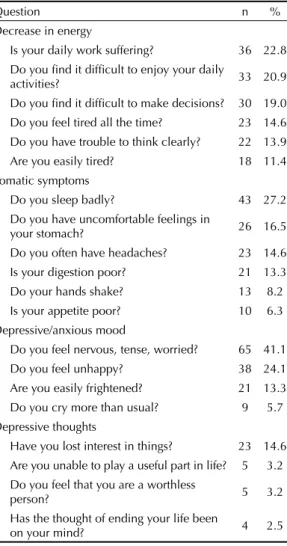
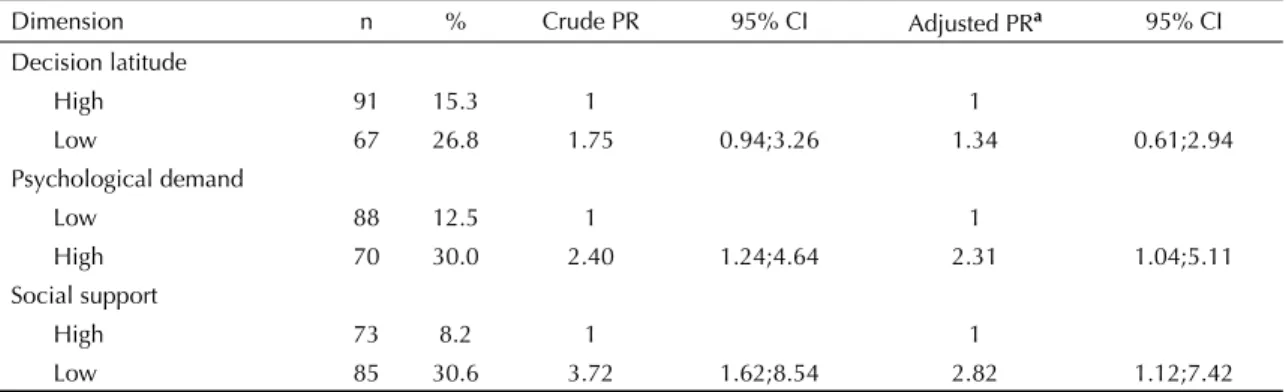
The prevalence of CMDs was 20.3%. SRQ-20 questions with a higher proportion of positive responses were in the group of questions about “decrease in energy”, while those with a lower proportion were in the group of questions about “depressive thoughts” (Table 1). In terms of psychosocial work factors, 44.3% of workers were in the group of high psychological demand; 42.4% had low job control and 53.8% had low social support. Prevalence of CMDs was higher in the groups with low decision latitude (PR=1.34), high psychological demand (PR=2.31) and low social support (PR=2.82), after adjusting for potential confounders (physical activity practice, leisure and length of time in the function). These increases in prevalence of CMDs were statistically signifi cant at the 5% signifi cance level for high psychological demand and low social support (Table 2).
The prevalence of CMDs varied according to quadrants of the demand-control model. Higher prevalences of CMDs were found among workers in high-strain jobs (36.4%), followed by those in active jobs (24.3%), passive jobs (17.6%) and, lastly, low-strain jobs (9.3%). The prevalence of CMDs was signifi cantly higher among workers in the high-strain job group (adjusted PR= 2.70; 95% CI: 1.02;7.18), compared to those in the low-strain job group, after adjusting for the “physical activity”, “lack of leisure”, “level of education” and “low social support” confounders (Table 3).
DISCUSSION
The prevalence of CMDs was signifi cantly associ-ated with high-strain jobs. This association shows that characteristics of the work environment, such as high managerial pressure, required concentration and amount of work, little possibility to make decisions and use one’s abilities are related to the occurrence of CMDs, as predicted by the demand-control model.14
The population studied had a higher mean income and level of education than the general population of the metropolitan area of Salvador, Northeastern Brazil.d
The majority maintained a physical activity practice, although on an irregular basis at times. The population studied participated in a quality of life program for approximately three years, which could have infl uenced the physical activity practice and reduction in the smoking habit. Prevalence of smoking in the general
c A situation when the worker is called in to work in night shifts or on weekends, according to the company’s needs.
d Instituto Brasileiro de Geografi a e Estatística. Indicadores sociais [Internet]. 2008 [cited 2008 Oct 10]. Available from: ftp://ftp.ibge.gov.br/ Indicadores _Sociais/Sintese_de_indicadores_Sociais_2008/Tabelas/
Table 1. Frequency of positive responses to the questions of the Self-Reporting Questionnaire-20 (SRQ-20) in workers of maintenance of electrical transmission lines and equipment. States of Bahia and Sergipe, Northeastern Brazil, 2008. (N=158)
Question n %
Decrease in energy
Is your daily work suffering? 36 22.8 Do you fi nd it diffi cult to enjoy your daily
activities? 33 20.9
Do you fi nd it diffi cult to make decisions? 30 19.0 Do you feel tired all the time? 23 14.6 Do you have trouble to think clearly? 22 13.9 Are you easily tired? 18 11.4 Somatic symptoms
Do you sleep badly? 43 27.2 Do you have uncomfortable feelings in
your stomach? 26 16.5
Do you often have headaches? 23 14.6 Is your digestion poor? 21 13.3 Do your hands shake? 13 8.2 Is your appetite poor? 10 6.3 Depressive/anxious mood
Do you feel nervous, tense, worried? 65 41.1 Do you feel unhappy? 38 24.1 Are you easily frightened? 21 13.3 Do you cry more than usual? 9 5.7 Depressive thoughts
Have you lost interest in things? 23 14.6 Are you unable to play a useful part in life? 5 3.2 Do you feel that you are a worthless
person? 5 3.2
Has the thought of ending your life been
male population of 15 capitals of Brazil varied between 17% and 28%,e whereas such prevalence was 13.3%
in this population. However, this result was similar to that obtained in a previous study, performed in another population of electrical workers.17
Length of service in the company was long, showing the stable situation of this population. The fact that some of the workers provided services before being hired or the presence of close relatives in the same organization suggests the existence of a strong relationship between worker and company. On the other hand, the long length of time in the function refl ects the impossibility of moving up the corporate ladder throughout years of work, as a result of the low frequency of civil service examinations in this
fi eld. Maintenance assistants comprised the highest percentage of workers in operational tasks, having the lowest level of autonomy in the hierarchical scale of maintenance functions in the company.
Although there was a substantial percentage of indi-viduals who reported a medical diagnosis of chronic
disease, the majority considered themselves to be in good health condition. Alcohol use was high in this population (86.1%), when compared to that of other populations.22,f The percentage of 39.6% of
positive CAGE (alcohol abuse) was greater than that found in studies performed with other populations in Salvador.1,3 This high percentage could be associated
with cultural work aspects in this population that need to be further analyzed.
The prevalence of CMDs was high (20.3%), when compared to the prevalence of the general popula-tion of Southern Brazil (12.7%),18 similar to that
found in civil police offi cers (20.2%)27 and lower
than that found in other populations of workers.3,26
Prevalence of CMDs among electrical workers in the metropolitan area of Vitória, Southeastern Brazil, was 18.7%.a Another study with electrical workers, which
used different instruments and methods, also showed changes in the mental health of such workers.16,18,21
However, different characteristics and work situations affect comparisons between studies.
Table 2. Crude and adjusted prevalence ratios and respective confi dence intervals for common mental disorders, according to dimensions of the demand-control model. States of Bahia and Sergipe, Northeastern Brazil, 2008. (N=158)
Dimension n % Crude PR 95% CI Adjusted PRa 95% CI
Decision latitude
High 91 15.3 1 1
Low 67 26.8 1.75 0.94;3.26 1.34 0.61;2.94
Psychological demand
Low 88 12.5 1 1
High 70 30.0 2.40 1.24;4.64 2.31 1.04;5.11
Social support
High 73 8.2 1 1
Low 85 30.6 3.72 1.62;8.54 2.82 1.12;7.42
a Adjusted for physical activity practice, leisure and length of time in the function.
e Instituto Nacional de Câncer. O controle do tabagismo no Brasil [Internet]. 2004 [cited 2008 Oct 10]. Available from: http://www.inca.gov. br/tabagismo/31maio2004/ tabag_br_folheto_04.pdf
f Ministério da Saúde. I Levantamento nacional sobre os padrões de consumo do álcool na população brasileira [Internet]. [cited 2008 Oct 10]. Available from: http://portal.saude.gov.br/portal/arquivos/pdf/relatorio_padroes_ consumo _alcool_ 2007.pdf
Table 3. Crude and adjusted prevalence ratios and respective confi dence intervals for common mental disorders, according to demand-control model categories. States of Bahia and Sergipe, Northeastern Brazil, 2008.
Quadrant of the demand-control model n Prevalence (%) Crude PR 95% CI Adjusted PRa 95% CI
Low-strain job
(low demand + High decision latitude) 54 9.3 1 1 Passive job
(low demand + low decision latitude) 34 17.6 1.91 0.63;5.76 1.34 0.42;4.24 Active job
(high demand + High decision latitude) 37 24.3 2.63 0.96;7.21 1.90 0.67;5.34 High-strain job
(high demand + Low decision latitude) 33 36.4 3.93 1.52;10.15 2.70 1.02;7.18
1. Almeida-Filho N, Lessa I, Magalhães L, Araújo MJ, Aquino E, Kawachi I, et al. Alcohol drinking patterns by gender, ethnicity, and social class in Bahia, Brazil. Rev Saude Publica. 2004;38(1):45-54. DOI:10.1590/ S0034-89102004000100007
2. Amick BC 3rd, Kawachi C, Coakley EH, Lerner D, Levine S, Colditz GA. Relationship of job strain and iso-strain to health status in a cohort of women in the United States. Scand J Work Environ Health. 1998;24(1):54-61.
3. Araújo TM, Aquino E, Menezes G, Oliveira CS, Aguiar L. Aspectos psicossociais do trabalho e distúrbios
psíquicos entre trabalhadoras de enfermagem. Rev Saude Publica. 2003;37(4):424-33. DOI:10.1590/ S0034-89102003000400006
4. Araújo TM, Graça CC, Araujo E. Estress ocupacional e saúde: contribuições do modelo demanda-controle. Cienc Saude Colet. 2003;8(3):991-1003. DOI:10.1590/ S1413-81232003000400021
5. Araújo TM, Godinho TM, Reis EJFB, Almeida MMG. Diferenciais de gênero no trabalho docente e repercussões sobre a saúde. Cienc Saude Colet. 2006;11(4):1117-9. DOI:10.1590/S1413-81232006000400032
REFERENCES
The dimensions of the “high psychological demand and low social support” model revealed statistically signifi cant associations with the prevalence of CMDs. Nonetheless, workers in the high-strain job group (high demand and low decision latitude) showed an even higher prevalence of CMD (36.4%) than that of workers in a situation of high psychological demand (30.0%). This result emphasizes the hypothesis that the combina-tion of high demand and low decision latitude is more harmful to mental health than exclusive high demand. The association between social support and CMDs has been reported in other studies.2,22,23 Support from
coworkers and supervisors can change the effect of work-related stress on health. Workers with a high level of stress in the workplace (high-strain job) and low social support showed a higher risk of becoming ill.2,24
The prevalence of CMDs was higher in the active job category (24.3%) than in the passive job one (17.6%). Workers in active jobs were expected to be less likely to become ill.4,6 Such result could be due to the fact that
the model considers indicators of the demand-control dimension as independent variables. However, it is possible that the work environment with high demand can become greater than the benefi ts of high job control.4
Such possibility emphasizes the hypothesis that, in this population, psychological demand plays a more important role in the occurrence of this effect. In other words, high psychological demand work, although in a situation of high decision latitude, could be harmful to mental health, as pointed out by other authors.4,12
Other factors related to the specifi c activity of the population studied could justify the high prevalence of CMDs in the active job situation. Indicators of control analyze this aspect as the control directly associated with task performance, not considering control factors on the macro level, related to the work organization structure and power relations. In this way, workers’ high level of control over a task will only be perceived in extreme situations of confl icts caused by imposed norms and hierarchical power.3
The cross-sectional design of the study prevents the establishment of the cause-effect relationship between measures of interest of exposure and effect, once they are assessed in the same period of time.
In the present study, the effect of the healthy worker is probably of low magnitude, due to the following reasons: CMDs are aggravations of a chronic nature and rarely fatal; the population studied has good job stability; and loss of cases was minimal. However, the possibility of workers not included in this study becoming mentally ill should be considered, such as those retired, those deceased as a result of other morbidities, or yet those who had already left the company at the time of this study.
Another methodological limitation was the reduced number of individuals in the study, despite the high response rate obtained. Data analysis was hindered by the small number of stratifi ed groups, resulting in excessively broad confi dence intervals, thus reducing the accuracy of estimates.
In addition, the SRQ-20, used to measure the prevalence of CMDs, is not an instrument for diagnosis, despite its wide use in epidemiological studies. Nonetheless, it is possible that the SRQ-20 has underestimated or overestimated the effect studied.
Although the study has a predominantly descriptive purpose, without the intention of testing a hypothesis, the signifi cant association between CMD and high-strain job reaffi rms the assumptions of the demand-control model (high-strain jobs are more harmful to the worker’s health).
Article based on the master’s dissertation by Souza SF, presented to Universidade Federal da Bahia, in 2008. The authors declare that there are no confl icts of interest.
6. Araújo TM, Karasek R. Validity and reliability of the job content questionnaire in formal and informal jobs in Brazil. Scand J Work Environ Health Suppl. 2008;6:52-9.
7. Benevides FG, Gimeno D, Benach J, Martínez JM, Jarque S, Berra A, et al. Descripción de los factores de riesgo psicosocial en cuatro empresas. Gac Sanit. 2002;16(3)222-9. DOI:10.1590/S0213-91112002000300005
8. Beusenberg M, Orley J. A user’s guide to the self reporting questionnaire (SRQ). Geneva: World Health Organization, Division of Mental Health; 1994.
9. Castells MA, Furlanetto LM. Validity of the CAGE questionnaire for screening alcohol-dependent inpatients on hospital wards. Rev Bras Psiquiatria. 2005;27(1):54-7. DOI:10.1590/S1516-44462005000100012
10. Corradi-Webster CM, Laprega MR, Furtado EF. Avaliação do desempenho do CAGE com pacientes psiquiátricos ambulatoriais. Rev Latinoam Enferm. 2005;13(2 Esp):1213-8.
11. Dejours C.Psicodinâmica do trabalho. São Paulo: Atlas; 1994.
12. Delcor NS, Araújo TM, Reis EJFB, Porto LA, Carvalho FM, Silva MO, et al. Condições de trabalho e saúde dos professores da rede particular de ensino de Vitória da Conquista, Bahia, Brasil. Cad Saude Publica. 2004;20(1):187-96. DOI:10.1590/S0102-311X2004000100035
13. Hosmer Jr DW, Lemeshow S. Applied logistic regression. 2.ed. New York: Wiley; 2000.
14. Karasek R, Baker D, Marxer F, Ahlbom A, Theorell T. Job decision latitude, job demands, and cardiovascular disease: a prospective study of swedish men. Am J Public Health. 1981;71(7):694-705. DOI:10.2105/ AJPH.71.7.694
15. Laurell A C, Noriega M. Processo de produção e saúde: trabalho e desgaste operário. São Paulo: Hucitec; 1989.
16. Mari JJ, Iacoponi E, Williams P, Simões O, Silva JBT. Detection of psychiatric morbidity in the primary medical care setting in Brazil. Rev Saude Publica. 1987;21(6):501-7. DOI:10.1590/S0034-89101987000600006
17. Martinez MC, Latorre MRDO. Saúde e capacidade para o trabalho de eletricitários do Estado de São
Paulo. Cienc Saude Colet. 2008;13(3):1061-73. DOI:10.1590/S1413-81232008000300029
18. Mendoza-Sassi RA, Béria JU. Gender differences in self-reported morbidity: evidence from a
population-based study in southern Brazil. Cad Saude Publica. 2007;23(2):341-6. DOI:10.1590/S0102-311X2007000200010
19. Niedhammer I, Goldberg M, Leclerc A, Bugel I, David S. Psychosocial factors at work and subsequent depressive symptoms in the Gazel cohort. Scand J Work Environ Health. 1998;24(3):197-205.
20. Oliveira NF, Santana VS, Lopes AA. Razões de proporções e uso do método delta para intervalos de confi ança em regressão logística. Rev Saude Publica. 1997;31(1):90-9. DOI:10.1590/S0034-89101997000100012
21. Paterniti S, Niedhammer I, Lang T, Consoli
SM. Psychosocial factors at work, personality traits and depressive symptoms. Longitudinal results from the GAZEL Study. Br J Psychiatry. 2002;181:111-7.
22. Porto LA, Carvalho FM, Oliveira NF, Silvany Neto AM, Araújo TM, Reis EJFB, et al. Associação entre distúrbios psíquicos e aspectos psicossociais do trabalho de professores. Rev Saude Publica. 2006;40(5):818-26. DOI:10.1590/S0034-89102006005000001
23. Sanne B, Mykletun A, Dahl AA, Moen BE, Tell GS. Testing the Job demand–control-support model with anxiety and depression as outcomes: the Hordaland Health Study. Occup Med (Lond). 2005;55(6):463-73. DOI:10.1093/occmed/kqi071
24. Sauter S L, Murphi L R, Hurrell JJ, Levi L. Factores psicosociales de organización. In: Stellman JM, directora de edición. Enciclopedia de Salud y Seguridad en el Trabajo. Madrid: Organización Internacional Del Trabajo; 1998. v.2, p.34.1-87.
25. Scopinho RA. Privatização, reestruturação e mudanças nas condições de trabalho: o caso do setor de energia elétrica. Cad Psicol Soc Trab. 2002;5:19-36.
26. Silva MC, Fassa AG, Kriebel D. Minor psychiatric disorders among Brazilian ragpickers: a cross-sectional study. Environ Health. 2006;5:17.