Fisioter. Mov., Curitiba, v. , n. , p. - , out./dez. Licenciado sob uma Licença Creative Commons DO): http://dx.doi.org. . / - . . .AO
[T]
Influence of aquatic exercise training on balance in young adults
[)]
Inl uência do treinamento de exercícios aquáticos
sobre o equilíbrio em adultos jovens
[A]
Luana Mann[a], Julio Francisco Kleinpaul[b], Carlos Bolli Mota[c], Saray Giovana dos Santos[d]
[a] MSc, researcher, Universidade Federal de Santa Catarina, professor, Faculdade São Francisco de Barreiras, Barreiras, BA -
Brazil, e-mail: [email protected]
[b] MSc, professor, Faculdade São Francisco de Barreiras, Barreiras, BA - Brazil, e-mail: [email protected]
[c] PhD, professor, Universidade Federal de Santa Maria, Centro de Educação Física e Desportos, Santa Maria, RS - Brazil,
e-mail: [email protected]
[d] PhD, professor, Universidade Federal de Santa Catarina, Florianópolis, SC - Brazil, e-mail: [email protected]
[R] Abstract
Introduction: Physical exercise programs have been suggested to soften or reverse balance deficits and
pos-tural deviation. Objective: This study investigated the influence of a systematic aquatic exercise program on
body balance. Method: (ealthy young adult volunteers of both genders, aged – years were assessed.
The experimental group EG, n = was subjected to sessions of aquatic exercises of minutes long, performed three times a week, and the control group CG, n = suffered no intervention. A -D force plat-form was used to calculate the center of pressure displacement COP in anteroposterior and mid-lateral di-rections with or without visual information. The individuals were assessed in pre or post-training. Results:
The results demonstrated a decrease in body oscillation in both visual conditions, with post-training values lower than pre-training ones. Visual information was not expressive for EG post-training. Conclusion: )t
was concluded that the program was effective for body balance improvement.
Keywords: Balance. Training. Vision.
574
Resumo
Introdução: Programas de exercícios físicos têm sido propostos para amenizar ou reverter déficits de equi-líbrio e desvios posturais. Objetivo: Neste trabalho investigou-se a influência de um programa de exercícios aquáticos sistemático sobre o equilíbrio corporal. Método: Foram avaliados indivíduos adultos jovens sau-dáveis voluntários de ambos os sexos com idades entre 18 e 30 anos. O grupo experimental (GE, n = 20) foi submetido a 24 sessões de exercícios aquáticos realizados três vezes por semana, com 50 minutos de duração, e o grupo controle (GC, n = 25) não sofreu intervenção. Uma plataforma de força 3-D foi utilizada para calcular o deslocamento do centro de pressão (COP) nas direções anteroposterior e médio-lateral com e sem a inf orma-ção visual. Os indivíduos foram avaliados em pré e pós-treinamento. Resultados: Os resultados demonstraram uma diminuição da oscilação corporal em ambas as condições visuais, com os valores de pós-treinamento sen-do inferiores aos do pré-treinamento. A informação visual não foi significativa no pós-treinamento para o GE.
Conclusão: Conclui-se que o programa foi efetivo para a melhora do equilíbrio corporal. [K]
Palavras-chave: Equilíbrio. Treinamento. Visão.
Introduction
The maintenance and control of body posture during static and dynamic situations are essential during sports and daily activities of human beings. To ensure its proper operation, the Central Nervous System SNC generates muscle activities patterns, necessary to regulate the relationship between the center of body mass and the base of support, through information collected, mainly from senso-rial systems visual, somatosensory and vestibular that act as a way of transmitting specific informa-tion related to body posiinforma-tion in space, falling to the central nervous system the task of organizing the information and controlling both static and dynamic body posture .
(ealth problems caused by balance deficit and/ or falls are some of the main public health problems, making the individual lose their autonomy and, con-sequently, decreasing their life quality. )n Brazil, ca.
% of the elderly fall at least once a year . Falls reflect the incapacity of the postural control system in recovering from a disturbance, i.e., keeping the center of gravity projection CG within stability limits .
From the start of adulthood until intermediate years, sensory and motor changes are small and gradual, almost imperceptible. After the age of , these changes become more distinct, reaching sen-sory systems visual, vestibular and somatosensen-sory and motor capabilities such as strength, flexibility, reaction time, balance and coordination, thus making
the elderly the age group most stricken with balance problems , .
Literature shows evidence that continuous physical exercise can contribute to gain of muscle strength, minimizing existing balance deficits , , , , , . The practice of aquatic physical exercis-es is considered an improvement factor on physical capabilities, increasing coordination, agility, body synesthesia, perception, body schema, action and reaction velocity, and better balance and directional-ity , , , .
Considering the importance of body balance as a component of an autonomous daily life, as well as the scarcity of experimental studies that verify the effectiveness of aquatic exercises on body balance in healthy young individuals, the issue investigated in this study was: Does the practice of aquatic exercises interferes in static body balance with and without manipulation of the visual system?
To be able to answer this question, this study in-tended to analyze the influence of aquatic exercises on static body balance with and without visual ma-nipulation in healthy young adults.
575 Method
This study is characterized as one of experimen-tal nature, with control group design of pre and post-training.
Young adult individuals college students of both genders of the community were assessed. )nitially, individual volunteers of an aquatic initiation project formed the experimental group the one subjected to the aquatic exercises program . The control group CG - the one that didn't suffer intervention was se-lected from individuals that voluntarily offered to participate in this study, in a total of individuals.
To select which of these volunteers would be part of the study, the following inclusion criteria were applied:
EG and CG inclusion criteria:
- To be a college student; - Aged – years;
- Without any kind of musculoskeletal impair-ment or vestibular problem;
- Without lumbar pain;
- Not physically active determined by anamne-sis , in the CG case, they should remain inactive until the post-test. )t was considered inactive those who didn't perform systematical physi-cal exercises with minimal frequency of three times per week;
- Availability to report for data collection.
Specifically for EG:
- Not adapted to liquid environment;
- Availability for program activities with due frequency % minimum ;
- Not practicing any other periodic physi-cal activity.
At the end of this stage individuals were con-sidered fit to participate in this study EG and individuals were selected for the control group CG .
)ndividuals who didn't meet the inclusion criteria, who didn't have a proper program frequency or who didn't attend the data collection were excluded from this study. )n the end, the EG consisted of individu-als, male and female, with average age of . ±
. years, average body stature of . ± . cm and average body weight of . ± . N, and the CG
was composed by individuals who participated in all stages of the test , male and female, with aver-age aver-age of . ± . , averaver-age body stature of . ±
. cm and average body weight of . ± . N. To guarantee the internal and external validity of this study, a control group was used with similar characteristics to the experimental group, such as age group, body weight and stature, and went through the same evaluations that the experimental group was subjected, but without intervention, receiving the same instructions in all data collection stages, performed in laboratory environment, with an acclimatization period. The data collection instrument was the same for both groups, and there were few test repetitions to avoid learning with them. To prevent sampling loss, a relatively large set was used for both groups, so that, at the end of the study, the capacity for comparison be-tween the groups and on the effectiveness or not of the program would be possible. The same researchers who applied the training performed the data collection.
The aquatic exercises training was considered as an independent variable in this study, the static body balance as a dependent variable, the practice of physical exercises previous to the beginning of training as a moderating variable, the existence of an asymptomatic pathology in any sensory systems as an intervening variable, and exercises volume and intensity as control variables.
Body balance biomechanical assessment
After the first contacts with the individuals and preceding the data collection, they signed a Free and )nformed Consent Form, agreeing to participate in the study, which was approved by the )nstitution's ethical committee and developed under the process number . / - , fulfilling the ethical principles included in the Declaration of (elsinki, in addition to complying with the present legislation.
The static body balance was assessed with comput-er stabilography. A three-dimensional force platform
OR - AMT), Advanced Mechanical Technologies, )nc., USA was used to evaluate the center of pressure posi-tion COP during static posture. The COP expresses the soil's reaction force resulting position, indicating the neuromuscular answers for body oscillation due to changes in the center of gravity position .
576
My = moment around the mid-lateral axis; Fx = anteroposterior component of soil's reac-tion force;
Fy = mid-lateral component of soil's reaction force; Fz = vertical component of soil's reaction force; h = surface distance to the geometric center of the force platform.
Throughout the execution of the tests, which were randomly performed, both groups received the same orientations, without receiving visual or auditory stimuli.
Experimental treatment
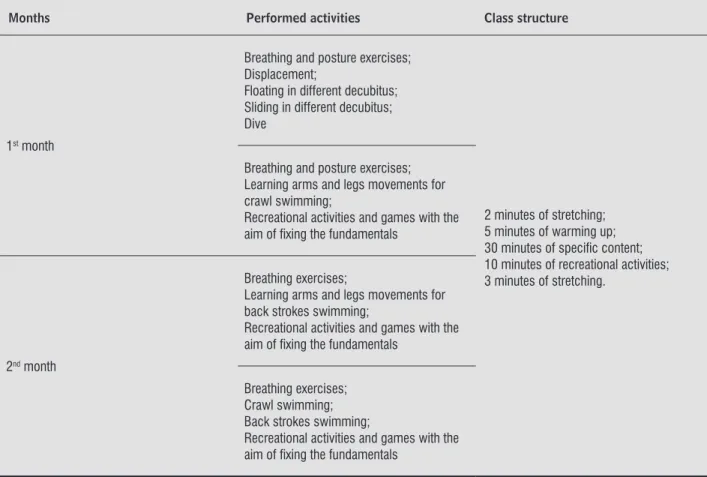
The experimental treatment consisted of aquatic exercises for water environment adaptation and ini-tiation to crawl and back strokes swimming, admin-istered three times a week, with each session lasting
minutes, through eight consecutive weeks, in the evening period, totalizing sessions. The exercises were conducted by two Physical Education teachers, using auditory and visual stimuli explanation and demonstration of movements . The exercises routine was gradually developed, according to the learning of movements Table . During classes, auxiliary mate-rials were used to help with floating, such as boards, pull buoys and pool noodles materials designed to be used in aquatic environments .
The training was executed in a semi-Olympic thermal pool with x . m of dimension and . m of depth at the extremities and . m at the central part , with water temperature between - °C. The training description classes is il-lustrated on Table .
Statistical analysis
All data was organized considering the aver-age and standard deviation for each variable in each group. The Shapiro-Wilk test indicated that the data presented normal distribution, and para-metric statistical tests were performed then for comparison between groups and situations.
One-Way Anova was applied for variable comparison
between groups in pre and post-training situations OE x OE and CE x CE ; intra-group in pre and post-training situations OE x CE ; and intra-group the torso, staring at a reference point placed on the
wall in front at eye level and two meters away from the force platform. The individuals were assessed with their limbs placed at hip width, as shown in Figure , in two conditions: eyes open OE and eyes closed CE . Three attempts were made in each con-dition totalizing six attempts for each individual, pre and post-training. The data acquisition time for each try was of seconds after visual stability of the center of pressure COP , and an acquisition frequency of (z.
Figure 1 - Placement of the feet during data collection
The variables considered as indicators of body balance were COP displacement amplitude in an-teroposterior COPap and mid-lateral directions
COPml . These variables were measured by the force platform and given by the following equations:
( . )/ ]max [( . )/ ]min
[ My h Fx Fz My hFx Fz
COPap= − − −
( . )/ ]max [( . )/ ]min
[ Mx hFy Fz Mx h Fy Fz
COPml= − − −
Of which:
COPap = force center coordinate in
anteroposte-rior direction;
COPml = force center coordinate in mid -later-al direction;
577 in pre and post-training situations OE x OE and
CE x CE , and Tukey's post-hoc (SD test was used to identify the differences. The significance level adopted for all tests was of . . The SSPS statisti-cal package for Windows version was used for these analyses.
Results
The results related to the balance variables COPap and COPml are described in the Figures , and . )n the intra-group assessment conducted during pre-training no variable presented significant statistical difference for both sensory conditions. )n post-train-ing, though, both variables in both sensory condi-tions were found statistically significant Figure . This is an indication that despite the experimental group not showing differences in posture stabil-ity in pre-training when compared to the control group, in the post-training, the routine significantly improved postural control, with the experimental
group presenting posture oscillation inferior to those of the control group.
Figure demonstrates the comparison between the groups in pre and post-training for both variables analyzed COPap and COPml .
The comparison between visual conditions wasn't significant for EG in post-training for both variables COPap and COPml , while in pre-training, visual in-formation was important for both variables Figure . The control group differed in pre and post-training, since visual information was important in both vari-ables. The intra-group comparison revealed signifi-cant statistical differences in pre and post-training only for the experimental group, for both variables analyzed Figure .
Figure presents comparisons between visual conditions OE x CE , in pre and post-training for both groups and for both variables analyzed COPap and COPml .
Figure shows the intra-group comparisons be-tween pre and post-training, for both analyzed vari-ables COPap and COPml .
Table 1 - Description of the experimental training applied to the experimental group in 24 sessions
Months Performed activities Class structure
1st month
Breathing and posture exercises; Displacement;
Floating in different decubitus; Sliding in different decubitus; Dive
2 minutes of stretching; 5 minutes of warming up; 30 minutes of specifi c content; 10 minutes of recreational activities; 3 minutes of stretching.
Breathing and posture exercises; Learning arms and legs movements for crawl swimming;
Recreational activities and games with the aim of fi xing the fundamentals
2nd month
Breathing exercises;
Learning arms and legs movements for back strokes swimming;
Recreational activities and games with the aim of fi xing the fundamentals
Breathing exercises; Crawl swimming; Back strokes swimming;
578
Figure 2 - Results related to the comparison between groups (EG x CG) in pre and post-training, in both visual conditions (OE
and CE), for both variables analyzed (COPap and COPml)
Note: * p < 0.05, statistical difference for comparison between groups in both visual conditions (Tukey).
Figure 3 - Results related to visual comparisons (OE x CE) for both groups (CG and EG), in pre and post-training, for both
variables analyzed (COPap and COPml)
Note: * p < 0.05 statistical difference for intra-group comparison between visual conditions (Tukey).
Figure 4 - Results related to intra-group comparisons between pre and post-training, for both variables analyzed (COPap and
COPml)
Note: * p < 0.05 statistical difference for intra-group comparison between pre and post-training (Tukey).
2 EG CG
Displacement of COP (cm)
Pre Post
COPap OE
COPap CE
COPml OE
COPml CE
COPap OE
COPap CE
COPml OE
COPml CE 1.8
1.6 1.4 1.2 1 0.8 0.6 0.4 0.2 0
2 OE CE
Pre Post Pre Post
COPap COPml COPap COPml
EG CG
COPap COPml COPap COPml
1.8 1.6 1.4 1.2 1 0.8 0.6 0.4 0.2 0
2 Pre
Displacement of COP (cm)
Post
COPap
OE CE OE CE OE CE OE CE
COPap COPml COPml
EG CG
COPap COPap COPml COPml
579 Discussion
The aim of this study was the analysis of the influ-ence of an aquatic exercises program on the static body balance in healthy young adults with and with-out the influence of visual information. The results found suggest that the aquatic exercises program improves static body balance, decreasing the depen-dence on visual information for posture maintenance. Literature is scarce when referring to the ben-efits of physical exercises to enhance posture control in healthy young adults , , . Thus, the data comparison of the current study is restricted to those reported by literature, since their target audience is predominantly the elderly , , , , and/or individuals with pathological conditions , , .
The results of this study corroborate the special-ized literature, which substantiate the improvement in body balance after the practice of exercises in aquatic environment , , , once, in post-training, the COPap and COPml values statistically differed between EG and CG groups, both with open and closed eyes, with GE displaying the lowest oscil-lation values Figure .
Powers and (owley believe that balance im-provement is caused by the water's physical prop-erties that act as aids to joint movement, using the muscles in a more balanced and symmetrical manner, and increasing the variety of body movements.
Similar results to those reported in the current study Figures and regarding the decline in body oscillation after exercises performed in water were found by Mann et al. when demonstrating that the elderly who practice hydrogymnastic keep similar values to sedentary middle-aged adults, and to Alves et al. study that assessed the effects of hydro-gymnastic in pre and post-test, and found a gain in the dynamic balance of the female elderly. An explanation to the reduction in body oscillation reported by these studies is that water exercises require a constant body adjustment as to keep the posture in response to water movement, which results in an improvement in body proprioception and synesthesia that provides a higher body posture independence .
)m provement on postural control balance with the practice of aquatic exercises in relation to the growth in proprioception was reported in Berger et al. study , which compares the body balance of the elderly who performed aquatic and soil exercises training sessions with emphasis in exercises for
superior and inferior limbs and balance exercises . Corroborating Berger et al. , Suomi and Koceja observed that after training sessions exercises practiced in water with prominence on mobility, flexibility and elasticity improvement there was a decrease in body instability. )n open eyed condition there was a reduction of ca % on posture oscilla-tion in the mid-lateral direcoscilla-tion and . % in total area oscillation after the intervention; in closed eyed condition the decline was observed in three variables anteroposterior, mid-lateral and total area oscilla-tion , with reducoscilla-tion of . %, . % and . %, respectively. The control group had similar results in pre and post-test.
A significant decrease in body oscillation with ab-sence of vision was also reported in a Mann et al. study that evaluated the influence of a Isostretching program with emphasis in strengthening different muscular groups that act on the maintenance of body posture in female young adult individuals with lum-bar pain; in Carpes et al. studies after a ses-sions program consisting of exercises to strengthen the torso; and in Mann et al. comparison of young adults with and without lumbar pain. Mann et al. indicate that young adult individuals have the ability of keeping their posture hindered in situations of visual deprivation, illustrating that as well as in the elderly of individuals with pathological conditions, vision is an important tool for posture maintenance, both in anteroposterior and mid-lateral direction, which was also evidenced in Chong et al. study.
The results obtained in this study Figure cor-roborate the findings in Mann et al. , since the pre-test showed that both variables analyzed in both groups were found significant when situations with and without visual information were compared. During post-test the situations with and without vi-sion didn't differ from each other in the experimental group, demonstrating the influence of the training. The control group held similar results in pre and post-training with influence of visual information for posture maintenance Figure .
580
. Spirduso WW, Francis KL, Macrae PG. Motor control, coordinations and skill. )n: Spirduso WW, Francis KL, Macrae PG. Physical dimensions of aging. Cham-paingn: (uman Kinectics; . p. - .
. Amiridis )G, (atzitaki V, Arabatzi F. Age-induced modifications of static postural control in humans. Neurosci Lett. ; : - .
. Bulbulian R, (argan ML. The effect of activity his-tory and current activity on static and dynamic postural balance in older adults. Physiol Behav.
; - : - .
. Barnett A, Smith B, Lord SR, Williams M, Baumand A. Community-based group exercise improves balance and reduces falls in at-risk older people: a random-ized controlled trial. Age Ageing. ; : - . . Arai T, Ob uchi S, )naba Y, Shiba Y, Satake K. The relation-ship between physical condition and change in bal-ance functions on exercise intervention and -month follow-up in Japanese community-dwelling older people. Arch Gerontol Geriatrics. ; : - . Available from: http://dx.doi.org/ . /j.archger.
. .
. Caldwell K , (arrison M, Adams M, Triplett NT. Effect of Pilates and taiji quan training on self-efficacy, sleep quality, mood, and physical performance of col-lege students. J Bodyw Mov Ther. ; : - . Available from: http://dx.doi.o rg/ . /j.jbmt.
. .
. Mann L, Kleinpaul JF, Teixeira C S, Rossi AG, Lopes LFD, Mota CB. )nvestigação do equilíbrio corporal em ido-sos. Rev Bras Geriatr Gerontol. ; : - . . Mann L, Klei npaul JF, Mota CB, Santos SG. Equilíbrio
corporal e exercícios físicos: uma revisão sistemática. Motriz Rev Educ Fis. ; : - .
. Powers SK, (owley ET. Fisiologia do exercício: teoria e aplicação ao condicionamento e ao desempenho.
a. ed. São Paulo: Manole; .
. Suomi R, Koceja DM. Pos tural sway characteristics in women with lower extremity arthritis before and after an aquatic exercise intervention. Arch Phys Med Re-hab. ; : - . Available from: http://dx.doi.
org/ . /S -
-compensated by other sensory systems. This, once again, substantiate the results of the current study regarding healthy individuals, who, with training, became less dependent on vision to keep balance.
The decrease of visual dependency reported by the present study, with the practice of aquatic exer-cises and the decline in COP oscillation as a whole in relation to healthy young adult individuals become particularly important, once the balance of young adult individuals without commitments is usually associated to a healthy life without detriment to their autonomy when performing daily and professional activities, which isn't usually observed with the pres-ence of pathologies such as lumbar pain , , , vestibular problems or aging process , . Thus, the results of this study demonstrate that the use of programs based on the practice of systemic aquatic exercises is a very important intervention tool, especially when its aim is to decrease existing deficits and avoid falls and musculoskeletal data, among other benefits of regular practice of physi-cal exercises.
Conclusion
The results of the present study suggest that sessions of systematic aquatic exercises were efficient in balance improvement on healthy young adults, in relation to amplitude decrease in COP displacement in anteroposterior and mid-lateral directions for both sensory conditions analyzed, with the training reduc-ing vision's importance for balance maintenance.
References
. Tresc h MC. A balanced view of motor control. Nat Neu-rosci. : - . Available from: http://dx.doi. org/ . /nn
-. Perra cini MC, Ramos LR-. Fatores associados a quedas em uma coorte de idosos residentes na comunidade. Rev Saúde Pública. ; : - .
581 . Mann L, Kleinpaul JF, Moro ARP , Mota CB, Carpes FP.
Effect of low back pain on postural stability in younger women: influence of visual deprivation. J Bodyw Mov Ther. ; : - . Available from: http://dx.doi. org/ . /j.jbmt. . .
. Alves RV, Mota J, Costa MC, Alves JGB. Aptidão físi-ca relacionada à saúde de idosos: influência da hi-droginástica. Rev Bras Med Esporte. ; : - . . Ruoti RG, Morris DM, Cole AJ. Reabil itação aquática.
São Paulo: Manole; .
. Chong RKY, Mills B, Dailey L, Lane E, Smith S, Lee K. Specific interference between a cognitive task and sensory organization for stance balance control in healthy young adults: Visuospatial effects. Neuropsy-chologia. ; : - .
. Schmid M, Nardone A, De Nunzio AM, Schmi d M, Schi-eppati M. Equilibrium during static and dynamic tasks in blind subjects: no evidence of cross-modal plas-ticity. Brain. ; : - . Available from: http://dx.doi.org/ . /brain/awm
Received: / /
Recebido: / /
Approved: / /
Aprovado: / /
. Berger L, Klein C, Commandeur M. Evaluation of the immediate and midterm effects of mobilization in hot spa water on static and dynamic balance in el-derly subjects. Ann Méd Phys Réadapt. ; : - . Available from: http://dx.doi.org/ . /j. annrmp. . .
. Winter DA. Biomechanics an d motor control of human movement. New York: Wiley; .
. Kovacs EJ, Birmingham TB , Forwell L, Litchfield RB. Effect of training on postural control in figure skat-ers: a randomized controlled trial of neuromuscular versus basic off-ice training programs. Clin J Sports
Med. ; : - .
. Biec E, Kuczynski MK. Postural control in -year-old soccer players. Eur J Appl Physiol. ; :
- . Available from: http://dx.doi.org/ . /
s - -
-. Clifford AM, (older-Powell (-. Postural control in healthy individuals. Clin Biomech. ; : - . . Teixeira CS. (idroginást ica na reabilitação vestibular
para idosos com queixas de tontura [dissertação]. San-ta Maria: Universidade Federal de SanSan-ta Maria; . Available from: http://jararaca.ufsm.br/websites/ ppgdch/c f ca bfce e a e .htm . Carpes FP, Reinehr FB, Mota CB. Effects of a pro-gram for trunk strength and stability on pain, low back and pelvis kinematics, and body balance: a pilot study. J Bodyw Mov Ther. ; : - . Available from: http://dx.doi.org/ . /j.jbmt. . . . Mann L, Kleinpaul JF, Weber P , Mota CB, Carpes FP.