Fisioter. Mov., Curitiba, v. , n. , p. - , out./dez. Licenciado sob uma Licença Creative Commons DO): http://dx.doi.org. . / - . . .AO
[T]
Effect of the inclination of support in cervical
and upper limb development
[)]
Efeito da inclinação de apoio no desenvolvimento
cervical e de membros superiores
[A]
Ailime Perito Feiber Heck[a], Micheli Martinello[b], Daiane Lazzeri de Medeiros[c], Jerusa Jordão Coelho[d], Lilian Gerdi Kittel Ries[e]
[a] MSc student, Programa de Pós-Graduação em Fisioterapia, Universidade do Estado de Santa Catarina, Florianópolis, SC -
Brazil, e-mail: [email protected]
[b] MSc, Universidade do Estado de Santa Catarina, Florianópolis, SC - Brazil, e-mail: [email protected]
[c] MSc, Universidade do Estado de Santa Catarina, Florianópolis, SC - Brazil, e-mail: [email protected]
[d] Graduated, Universidade do Estado de Santa Catarina, Florianópolis, SC - Brazil, e-mail: [email protected]
[e] PhD, Universidade do Estado de Santa Catarina, Departamento de Fisioterapia, Florianópolis, SC - Brazil, e-mail:
[R]
Abstract
Introduction: )t is expected that a child will acquire control of posture CP of the head and upper limbs in
a gradual, sequential and organized way. (owever, there is still no consensus regarding the best position to achieve this; the evidence suggests that it is prone. Objective: To investigate whether age and inclination of
the supporting surface in the prone position influence the alignment of the head and upper limbs of children with typical motor development TMD and atypical motor development AMD . Methods: The study
in-cluded children aged between one and three months divided according to the Alberta )nfant Motor Scale A)MS into groups with TMD n = and AMD n = . The children were placed in the prone position with three angles of the support surface °, ° and ° . Kinematic analysis was conducted to evaluate the alignment angles of the head and upper limbs. Results: Children with TMD had higher head alignment.
alignment of the head and upper limbs. Conclusions: Among the positions evaluated, the prone position
without inclination of the supporting surface was more appropriate for weight discharge in the upper limbs, favoring the development of postural control of the child.
Keywords: Posture. (ead movements. Upper extremity. Child.
[B] Resumo
Introdução: De forma gradual, sequencial e organizada, espera-se que a criança adquira o controle postural (CP) de cabeça e membros superiores. Contudo, ainda não existe um consenso sobre qual o melhor posicio-namento para aquisição desse; evidências apontam que a postura em decúbito ventral seja mais benéfica. Objetivo: Investigar se a idade e a inclinação da superfície de apoio em decúbito ventral influenciam o ali-nhamento da cabeça e do membro superior de crianças com desenvolvimento motor típico (DMT) e atípico (DMA). Métodos: Participaram do estudo 29 crianças de um a três meses de idade divididos de acordo com escala Alberta )nfant Motor Scale (AIMS) em grupo com DMT (n = 18) e DMA (n = 11). As crianças foram posi-cionadas em decúbito ventral com três ângulos de superfície de apoio (0°, 25° e 45°). A análise cinemática foi utilizada para avaliar os ângulos de alinhamento da cabeça e do membro superior. Resultados: Crianças com DMT apresentaram maior alinhamento da cabeça. Não houve diferença do alinhamento do membro superior entre os grupos com DMT e DMA. No terceiro mês de idade comparado ao primeiro houve maior alinhamento da cabeça e menor alinhamento do membro superior em ambos os grupos. As inclinações da superfície de apoio não influenciaram no alinhamento da cabeça e do membro superior. Conclusões: Entre as posições avaliadas, o decúbito ventral sem inclinação da superfície de apoio foi mais apropriado para descarregar o peso para os membros superiores, favorecendo o desenvolvimento do controle postural da criança. [K]
Palavras-chave: Postura. Movimentos da cabeça. Extremidade superior. Criança.
Introduction
Typical motor development is characterized by the gradual acquisition of postural control . During spontaneous movements, babies learn about the re-lationship between the body and the determination of the optimal ways to make the necessary segment adjustments . Adequate postural control is a pre-requisite for the proper development of voluntary movements, communication and interaction with the environment . From birth, the child is actively able to control the movement of his or her head , .
Cervical control is a motor skill acquired by children, for which the efficient organization of the shoulder, trunk and neck muscles is necessary , as well as visual, vestibular and proprioceptive in-formation . )t is expected that a child will have head control between three and four months, as soon as social interactions and the environment awaken the child’s desire to keep his or her head upright . For this condition to occur, it is necessary for the elbows to be in front of the shoulders and the
weight bearing to be in the region of the elbows and abdomen . (owever, children’s performance does not always occur at the same pace and following the same pattern and may cause the risk of delayed mo-tor development.
Because of the importance and impact of delays in development, it is essential to identify these changes as early as possible, so that interventions can be per-formed in a timely manner . The minimization of changes in engine development promotes greater utilization of brain plasticity . Thus, interventions are important promoters of the development of pos-tural control and the early prevention of its changes. These changes can be influenced by the position or by providing the child with a stimulus for motor de-velopment or not.
603
which evaluates the development from the thirty-eighth gestational week to months corrected age
, .
This scale is based on the approach of integrated spontaneous movements, emphasizing positive as-pects of the motor repertoire, handling as little as possible and evaluating the movements of the child in context and according to his or her age , . Composed of items grouped into subscales prone, supine, sitting and standing , it presents raw scores, percentiles and categorization engine per-formance: normal when greater than %; suspect between % and %; and abnormal if below % , . This study considered a child to have AMD when there was probable motor delay, in other words when the percentile obtained was below %.
)n the kinematics, the following items were used: a a tatami . × . × . m length, width, height ; b rigid wedges at angles of ° and ° of . × . m length, width ; c spherical markers, black in color, . cm diameter, fixed with Micropore® tape;
d an Exilim CAS)O® EX-F( digital camera, with
acquisition rates of (z; e an aluminum tripod
WFWT . m tall , positioned . m from
the tatami; f a CCE® (PS inch TV; g a BAK®
Japan DVD player; h the software Ariel Performance Analysis System® APAS ; and i DVDs and sound and
light toys appropriate for the ages of the participants, from a distance of . m.
Collection procedures
This study was approved by the Ethics Com-mittee on Research involving (uman Subjects of the University of the State of Santa Catarina UDESC , in opinion / . The parents and/or guardians of the selected children, after being in-formed about the study objectives and the evalu-ation to be performed, signed the consent form. The procedure of data collection began with the an-amnesis. Then, the evaluation by the A)MS was per-formed, always by the same investigator. Sequentially, the procedures for kinematic evaluation were started.
Two markers with a fixed distance of cm were placed parallel and adjacent to the ear and three in the pavilion acromion, iliac crest and lateral epicon-dyle of the humerus Figure . The child was po-sitioned prone on the tatami and on the wedges at three surface angles °, ° and ° and filmed, antigravity postures are acquired , , which are
considered important to encourage the development of postural control.
The position of the child during his stay in the prone position can influence his postural control in different segments. (owever, no studies analyzing the postural control of children with different sup-port surface slope angles in the prone position were found. Thus, this study investigated whether age and the different support surfaces in the prone position influence the alignment of the head and upper limbs of children with typical motor development TMD and atypical motor development AMD .
Materials and methods
Subject
A cross-sectional study was conducted with quasi-experimental and comparative delineation. The data included children from to months of age with variance of days, more or less. Children were se-lected according to the following inclusion criteria: gestational age at birth between and weeks; birth weight greater than . kg; and Apgar score greater than at minutes. Children with malfor-mations, neurological disorders, genetic syndromes and systemic or metabolic diseases were excluded. The selected children were divided into groups ac-cording to the percentile obtained from the Alberta )nfant Motor Scale A)MS and a probable motor delay
was considered when it was below % , .
The TMD group was composed of female and male children and the AMD group was composed of
female and male children.
Instruments
Children were assessed by interview and the A)MS; the alignment of the head and upper limbs was verified by kinematics. To characterize the sample, the anamne-sis form was used: personal data of the parents and/or guardians; details of the child, pregnancy history and neonatal complications during the first months of life; and the addition of body mass and body height mea-surement through inelastic tape of mm PS)®.
analyses. )nitially, the mean, standard deviation and confidence interval of the mean were reported as de-scriptive data. For the analysis of the data normality and homoscedasticity, the Shapiro–Wilk and Levene tests were used, respectively.
Analysis of variance was performed to test the effect of the inter-subject fixed factor group TMD and AMD and inter-subject fixed factor age children in their first, second and third month and the interaction of these factors on the dependent variables head alignment and alignment of the upper limbs. Analysis of variance for repeated measures was also used to test the effect of the inter-subject fixed factor group TMD and AMD and intra-subject fixed factor inclination support °, ° and ° and the interaction of these factors on the same dependent variables. )n all the analyses, when a significant effect was observed, the post-hoc Tukey (SD test was employed. For all the procedures, we adopted a significance level of % p < . .
Results
A total of children were evaluated, of whom had TMD and AMD. Among the children with TMD, were evaluated at in the first month, with a
mean age of . . days, body mass of .
. kg and height of . . cm; children were assessed in the second month, with a mean age of . . days, body mass of . . kg and height of . . cm; and children were as-sessed in the third month, with a mean age of .
. days, body mass of . . kg and height of . . cm. Among the children with AMD, were evaluated in the first month, with a mean age of . . days, body weight of . . kg and height of . . cm; in the second month, with a mean age of . . days, body weight of . . days, body mass of . . kg and height of . . inches; and three children in the third month, with a mean age of . . days, body weight of . . kg and height of . . cm. None of the children studied had pregnancy, neonatal or early life complications.
The mean scores standard deviation for chil-dren assessed by the A)MS in the prone and supine postures, the total score and the final score — ac-cording to the chronological age of the child and their development group — were: a TMD first month – . . ; . . ; . . ; . . ; b AMD first with support of the hip at the level of the superior
iliac edge for stability.
Then recording started in the sagittal plane; visual and auditory stimuli for greater head extension were given through appropriate DVDs and toys. Five at-tempts were made for each angle; of these, the three attempts with greater extension, assessed by the in-vestigator, were considered valid for analysis. For the control variables, the following were set: a all the children were evaluated wearing only a disposable diaper; b the environment of all the samples was the same laboratory with controlled temperature and light and restricted movement of people; c the order of the different angles for kinematics was determined by lot, prior to the assessment of each child, in order to limit the effects of the sequence.
Data processing
The kinematic data were calibrated using fixed points of . cm diameter with cm distance and low-pass filtered with a cut-off frequency of (z fil-ter. After scanning the APAS software, visual analysis was performed to determine the period of a second maximum extension of the head, corresponding to frames; of these, the frame always corresponded to the peak head extension. During this period, we calculated the averages of the following parameters: head alignment and alignment of the upper limbs.
The alignment of the head parameter was char-acterized as a segmental angle obtained from the intersection between the two markers positioned adjacent to the pinna, with a horizontal line. When the head was rectified, the angle was considered equal to ° Figure .
The alignment of the upper limbs parameter was calculated using the junction between the markers of the iliac crest, the acromion and the lateral epi-condyle of the humerus. There were positive angle values when the child remained with his or her elbow supported on the tatamis; however, when the child reached from the shoulder, the value was negative
Figure .
Statistical analysis
605
month – . . ; . . ; . . ; . . ;
c TMD second month – . . ; . . ;
. . ; . . ; d AMD second month –
. . ; . . ; . . ; . . ; e
TMD third month – . . ; . . ; . . ; . . ; f AMD third month – . . ; .
. ; . . ; . . .
A
B
Figure 1 - Angles measured in the sagittal plane: A) align-ment of the head; B) alignalign-ment of the upper limb
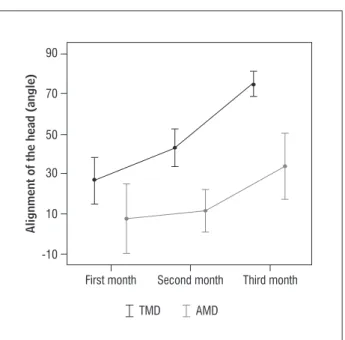
The analysis of variance, in a comparison between the groups and between the ages of the children, showed a statistically significant difference for head alignment between the TMD and the AMD group F = . , p = . . A significant difference was also observed between the ages of children F = . , p = . . The Tukey (SD test showed that the differences were between the first and the third month p = . and between the second and the third month . . (owever, no interaction between groups and ages F = . , p = . Figure was observed. Regarding the alignment of the upper limbs, the same analysis showed no difference between the TMD and the AMD group F = . , p = . . The alignment of the up-per limbs differed between the ages of the children
F = . , p = . . The Tukey (SD test showed that the difference was between the first and the second month p = . Figure ; no interaction between the factors and the age groups F = . , p = . was observed.
Figure 2 - Confidence interval (CI) average 95% values of the alignment of the head during the second maximum straightening of the head in the prone groups with typical motor development (TMD, n = 6 at each age) and atypical motor development (AMD, n = 4 in the first and second months and n = 3 in the third month) at each age
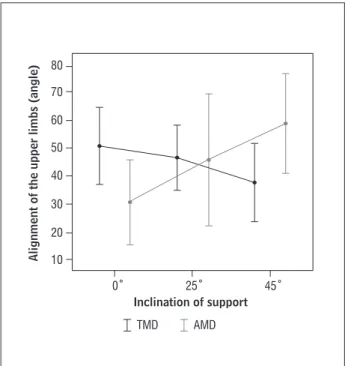
Figure 3 - Confidence interval (CI) average 95% values of the alignment of the upper limbs during the second maximum straightening of the head in the prone groups with typical motor development (TMD, n = 6 at each age) and atypical motor develop-ment (AMD, n = 4 in the first and second months, n = 3 in the third month) at each age
10 30 50 70 90
-10
First month
AMD TMD
Alignment of the head (angle)
Second month Third month
20 40 60 80
0
First month
AMD TMD
Alignment of the upper limbs (angle)
The analysis of variance for repeated measures showed, in a comparison between groups and be-tween the different slopes of support, a statistically significant difference for head alignment between the TMD and the AMD group F = . , p = . . (owever, no significant difference was observed in the head alignment between the slopes of support in the prone position F = . , p = . . )n addition, no interaction between groups and slopes of sup-port F = . , p = . Figure was observed. The same analysis confirmed that the alignment of the upper limbs was not different between the AMD and the TMD group F = . , p = . . There was also no significant difference in the alignment of the upper limbs between the slopes of support in the prone position F = . , p = . . (owever, interac-tion between the factors and the slopes of support
p = . , F = . was observed. Children with TMD and AMD presented respectively decreasing and in-creasing upper limb alignment with inin-creasing incli-nation of the slopes of support Figure .
Discussion
All the children assessed had the same potential for TMD; however, the study showed a large per-centage of children with AMD. The data related to the birth of the children remained within normal percentiles according to the reference curves of the National Center for (ealth Statistics, adopted by the World (ealth Organization , and their gestational, neonatal and first months of life his-tory was uneventful. Nevertheless, the A)MS distin-guished and characterized children with TMD and AMD. Considered to be continuous and sequential, motor development is influenced by several biological and environmental factors . The high prevalence of children with AMD highlights the so-cioeconomic and cultural factors that may interfere with their development.
The first year is highly important in relation to the stimuli given to the child , which are crucial to their development. Especially in the first month, no experience of prone posture for the child usually happens as a result of the maternal circulation due to cervical hypotonia . When this posture is avoided, children take longer to engage in antigravity activities , since the motor skills of children may differ due to the different ways of handling them .
10 30 50 70
-10
0˚
AMD TMD
Inclination of support
Alignment of the head (angle)
25˚ 45˚
Figure 4 - Confidence interval (CI) average 95% values of the alignment of the head during the second maximum straightening of the head in the prone position with inclinations of 0°, 25° and 45° in the groups with typical motor develop-ment (TMD, n = 18) and atypical motor devel-opment (AMD, n = 11)
30 60 70 80
10
0˚
AMD TMD
Inclination of support
Alignment of the upper limbs (angle)
25˚ 45˚
50
40
20
607
postural control was higher, while in the second month the children tended to engage in antigravity activities and in the third and fourth months they acquired improved biomechanical alignment and postural stability. As a child develops head control, the easier it becomes to maintain this head control against gravity and for a longer period of time.
Regarding the alignment of the upper limbs, a significantly lower angle difference was observed between the first and the second month. This differ-ence may have been caused by a more passive pos-ture in the prone position in the first month, allowing greater range; then the effort to stabilize the head in the second month leads to generalized extensor synergy with decreased amplitude of the upper limbs. The results of this study show a trend from the sec-ond month to increase the angle of alignment of the upper limbs. )n the prone position in the first two months, the upper limbs remained behind the line of the shoulders and gradually increased anterior , and an increase in the angle of alignment of this segment occurred. )n this position, scapular stabil-ity occurs during support of the forearms and hands as the head control is being acquired , which is important for the improvement of postural control of the child and the efficient organization of the muscles involved . As the control of the head and trunk improve, the child can release the upper limbs, acquiring new motor skills.
No effect from the support surface slope angles in the alignment of the head and upper limbs was observed. Regarding the alignment of the head, it was observed that the slope angle of ° seemed to facili-tate the rectification of the head; however, this differ-ence was not significant. This slope of the supporting surface would allow greater interaction of the child with the environment. (owever, the initial difficulty provided by supports of larger angles, since the exten-sor muscle development and thus the control posture cannot be completed at the ages studied, mainly in children with AMD, may explain the lack of statistical significance found. Regarding the alignment of the upper limbs, it was found that children with TMD and AMD showed opposite behavior. The increased support surface slope angles negatively influenced the children with TMD and positively influenced the children with AMD. Despite being contradictory, this result can also be found due to the immaturity of the posture control system. The deficit of head control may have caused global extensor synergy in positions Authors consider prone positioning, due to the
higher stimulus activation of the extensor muscles , , to be the most favorable position for the con-trol of posture , . According to Majnemer and Barr , staying in the supine position may cause a delay in the acquisition of motor skills that require greater antigravity control, unlike the prone position, which can be considered a stimulus in the develop-ment of extensor muscle strength of the neck and trunk. The results showed significantly higher values in the angular alignment of the head kinematic vari-able in children with TMD compared with children with AMD. The difference between the groups in the alignment of the head confirmed the categorization of engine performance obtained by the A)MS. (owever, no difference between groups in the alignment of the upper limbs was observed. Greater instability in the postural control group with AMD was also observed for the variability in the alignment of the head and upper limbs in these children.
The influence of the age factor was also observed in the alignment angles of the head and upper limbs. The greater the instability of head control, verified by a larger confidence interval for the alignment of the head, was observed in the first month and in the group with AMD. Children with TMD, in the third month, showed values of the angular alignment of the head very close to the benchmark of , featuring complete rectification, thus providing evidence of the increase in postural control, followed by maturation of the central nervous system and consequent in-crease in head control. As for the children with AMD, they also achieved the same association mentioned above; however, the AMD children had lower values than the TMD children, and a greater confidence interval was observed, which may be related to the greater variability of the group and the small sample size observable for each age. )t is also apparent that the increase in the straightening head was not linear. )n both groups, there was a greater increase in the values of the angular alignment of the head between the second and the third month of age.
most appropriate to perform weight bearing in the upper limbs, favoring the development of the child’s postural control.
References
. Val DC, Limongi SCO, Flabiano FC, Silva KCL. Sistema estomatognático e postura corporal na criança com alterações sensório-motoras. Pró-fono R Atual Cient.
; : - .
. Dusing SC, (arbourne RT. Variability in postural control during infancy: implications for develop-ment, assessdevelop-ment, and intervention. Phys Ther. ;
: - .
. Fits VD, Otten E, Klip AWJ, Eykern V, Algra M(. The development of postural adjustments during reaching in - to -month-old infants. Exp Brain Res. ;
: - .
. Bertenthal B, Von (ofsten C. Eye, head and trunk con-trol: the foundation for manual development. Neuro-sci Biobehav Rev. ; : - .
. Lima CD, Carvalho RP, Barros RML, Tudella E. Dois métodos diferentes para análise cinemática dos movi-mentos de cabeça durante a coordenação viso-cefálica de lactentes. Rev Bras Fisioter. ; : - . . Telles MS, Macedo CS. Relação entre desenvolvimento
motor corporal e aquisição de habilidades orais. Pró-fono R Atual Cient. ; : - .
. Rodrigues EC, )mbiriba LA, Leite GR, Magalhães J, Vol-chan E, Vargas CD. Efeito da estratégia de simulação mental sobre o controle postural. Rev Bras Psiquiatr.
; Supl. : - .
. Bonvincine C, Quibáo EF, Silva PN, Asa SKP, Gaetan ESM. Aquisição do controle de cabeça em lactentes nascidos pré-termo e a termo. Fisioter Pesqui. ;
: - .
. Dimimitrijevic L, Bjelakovic B. Development of cardi-nal motor skills in the first year of life. Acta Fac Med Naiss. ; : - .
. Caon G, Ries LGK. Triagem do desenvolvimento motor nos dois primeiros anos de vida. Pediatr Mod. ;
: - .
with greater support surface slope angles, prevent-ing a greater range of motion in flexion of the upper limbs and difficulty in weight bearing in the upper limbs. )n children with AMD, despite the increased alignment of the upper limbs having been observed, this result did not mean greater control of posture. Compared with the children with TMD, the AMD chil-dren showed less head control and made less effort to support their upper body on the support surface slope angles. )ncreasing the angle of alignment of the upper limbs in children with AMD in relation to the increased support surface slope angles can be influenced by the positioning of the anterior trunk. The support surface facilitates the alignment of the upper member; however, it does not allow adequate weight bearing for this segment.
)t is considered important to develop the capac-ity of weight bearing for the upper limbs of children. )n both groups, the largest gradients of the support surface prevented the unloading of weight for that segment. A limitation of this study was evaluating the support surface slope with three angles. For future studies, it is recommended to evaluate the effect of surface slopes with intermediate support between ° and ° on the CP of the child in the prone position. )t is possible that an inclination of less than ° could enable appropriate support from the upper limbs.
As the child acquires certain motor skills, the de-velopment is characterized by periods of improve-ment and regression in control posture . The posture in the prone position facilitates extensor muscle activity . Furthermore, providing expe-rience of the movement is considered extremely im-portant for gains engines, contributing to the process of motor development of the child . Thus, the opportunity to practice posture in the prone position without support surface slope angles promotes child development in the first three months of life, since it stimulates both the head control and the weight load to the upper limbs.
Conclusion
609
. Dudek-Shriber L, Zelazny S. The effects of prone po-sitioning on the quality and acquisition of develop-mental milestones in four-month old infants. Pediatr Phys Ther. ; : - .
. Syrengelas D, Siahanidou T, Kourlaba G, Kleisiouni P, Bakoula C, Chrousos GP. Standardization of the Alberta infant motor scale in full-term Greek infants: prelimi-nary results. Early (um Dev. ; : - . . Lopes VB, Lima CD, Tudella E. Motor acquisition rate in
Brazilian infants. )nfant Child Dev. ; : - . . Araújo DM, Sande LAPS, Fernandes LFRM, Pereira K.
Comportamento de lactentes em decúbito lateral e a influência da adição de peso no punho. Conscientiae Saúde. ; : - .
. Rocha NACF, Silva FPS, Toledo AM, Tudella E. Variabil-ity in the levels of postural control in – -month-old infants. )nfant Behav Dev. ; : - . . Forssberg ((. Neural control of human motor
de-velopment. Curr Opin Neurobiol. ; : - . . Thelen E, Spencer JP. Postural control during reach-ing in young infants: a dynamic systems approach. Neurosci Biobehav Rev. ; : - .
. (adders-Algra M. Early brain damage and the devel-opment of motor behavior in children: clues for thera-peutic intervention? Neural Plast. ; - : - .
Received: / /
Recebido: / /
Approved: / /
Aprovado: / /
. Reseguel R, Puccini RF, Koga EMS. Fatores de risco as-sociados a alterações no desenvolvimento da criança. Pediatria São Paulo . ; : - .
. Ratliff-Schaub K, (unt CE, Crowell D, Golub (, Smok-Pearsall S, Palmer P, et al. Relationship between infant sleep position and motor development in preterm infants. J Dev Behav Pediatr. ; : - . . Majnemer A, Barr R. The influence of supine sleep
position on early motor milestone acquision. Dev Med Child Neurol. ; : - .
. Barradas J, Fonseca A, Guimaraes CLN, Lima GMS. A re-lação entre o posicionamento do prematuro no Méto-do Mãe-Canguru e desenvolvimento neuropsicomotor precoce. J Pediatr Rio J . ; : - . . Piper MC, Pinnell LE, Darrah J, Maguire T, Byrne PJ.
Construction and validation of the Alberta )nfant Mo-tor Scale A)MS . Can J Public (ealth. ; Suppl
:S - .
. Piper MC, Darrah J. Motor assessment of the develop-ing infant. Philadelphia: Saunders; .
. Campos D, Santos DC, Gonçalves VM, Goto MM, Arias AV, Brianeze AC, et al. Concordância entre es-calas de triagem e diagnóstico do desenvolvimento motor no sexto mês de vida. J Pediatr Rio J . ;
: - .
. Manacero S, Nunes ML. Avaliação do desempenho motor de prematuros nos primeiros meses de vida na Escala Motora )nfantil de Alberta A)MS . J Pediatr
Rio J . ; : - .
. World (ealth Organization [website]. [cited , Aug ]. Available from: http://www.who.int/ countries/bra/es/
. Rocha NACF, Tudella E. Teorias que embasam a aqui-sição das habilidades motoras do bebê. Temas Desen-volv. ; : - .
. Saccani R, Valentini NC. Análise do desenvolvimento motor de crianças de zero a meses de idade: repre-sentatividade dos itens da Alberta )nfant Motor Scale por faixa etária e postura. Rev Bras Crescimento De-senvolv (um. ; : - .