Licenciado sob uma Licença Creative Commons DO): http://dx.doi.org. . / - . . .AO
[T]
Review of the psychometric properties of
lower limb motor coordination tests
[)]
Revisão das propriedades psicométricas de testes de
coordenação motora de membros inferiores
[A]
Marina de Barros Pinheiro[a], Kênia Kiefer Parreiras de Menezes[b], Luci Fuscaldi Teixeira-Salmela[c]
[a] PT, MSc, Universidade Federal de Minas Gerais, Belo (orizonte, Departamento de Fisioterapia, MG - Brazil, e-mail: [email protected]
[b] PT, MSc, Universidade Federal de Minas Gerais, Departamento de Fisioterapia, Belo (orizonte, MG - Brazil, e-mail: [email protected]
[c] PT, PhD, professor, Universidade Federal de Minas Gerais, Departamento de Fisioterapia, Belo (orizonte, Brasil, e-mail: [email protected]; [email protected]
[R] Abstract
542
According to the results of this review, none of the tests had their basic psychometric properties reported, which is necessary to be investigated in future studies. This review may facilitate the search and selection of lower limb MC tests by researchers and clinicians.
Keywords: Validity of tests. Reproducibility of results. Motor skills. Lower extremity.
[B]
Resumo
Introdução: Adequada coordenação motora (CM) dos membros inferiores (MMII) é fundamental para a exe-cução de diversas tarefas motoras e, portanto, a sua avaliação é amplamente empregada na prática clínica e pesquisa. Assim, é importante conhecer as propriedades psicométricas dos testes que avaliam a CM dos MMII, para que os profissionais possam escolher de forma embasada os testes mais adequados a serem utilizados. Objetivos: Investigar as propriedades psicométricas e utilidade clínica de testes que avaliam a CM dos MMII, por meio de uma revisão crítica da literatura. Materiais e métodos: Foi conduzida uma busca em seis bases de dados procurando por estudos metodológicos que avaliaram confiabilidade, validade, sensibilidade à mu-danças ou utilidade clínica de testes que medem a CM dos MMII. Os artigos foram avaliados e os dados das propriedades psicométricas foram extraídos por dois autores, de forma independente. Resultados: A busca retornou 1.361 estudos e 1.356 foram excluídos após análise. Outros quatro artigos elegíveis foram encontra-dos pela busca manual, totalizando nove artigos incluíencontra-dos. Os estuencontra-dos incluíencontra-dos avaliaram as propriedades psicométricas de oito testes, sendo que apenas três são instrumentos específicos para avaliar a CM dos MMII, sendo os demais subitens de escalas que avaliam outros domínios. Nenhum teste apresentou dados para todas as propriedades psicométricas. Considerações finais: Segundo os resultados desta revisão, nenhum dos testes encontrados teve todas as suas propriedades psicométricas básicas avaliadas, o que torna necessária a reali-zação de futuros estudos. Esta revisão poderá facilitar a busca e seleção de testes que avaliam a CM dos MMII por parte dos pesquisadores e clínicos. [K]
Palavras-chave: Validade dos testes. Reprodutibilidade dos testes. Destreza motora. Extremidade inferior.
Introduction
Dexterity or motor coordination MC is defined as the ability to intentionally perform a motor task in an accurate, rapid, and controlled manner, in order to achieve a given environmental demand , . MC can be tested in situations that require temporal and spatial accuracy. )t is suggested that the best way of evaluating MC is by assessing the performance of rapid and alternating movements and the con-sidered criteria should be the speed and quality of the movements , . Within clinical settings, MC evaluation is a common part of the physical thera-pists’ routines .
Lower limb motor coordination LLMC is essen-tial for the performance of most daily motor activi-ties, such as walking, running, ascending/descending stairs, standing from a chair, being the effective per-formance of these tasks critical for an independent life , . According to Ada and Canning , adequate
LLMC significantly contributes to functionality of stroke individuals, being its loss the major contrib-utor to disability in this population. For Capranica et al. , motor tasks performed within different contexts require between-limb coordination, which is essential for an independent and safe life in elderly individuals. Thus, therapeutic approaches aimed at restoring LLMC are of great interest for rehabilita-tion professionals who are involved in research and clinical settings .
, . Therefore, assessment instruments should have adequate psychometric properties, to ensure the effectiveness of the measures - .
LLMC assessment instruments are commonly used within research and clinical contexts and their constant improvements are necessary to allow the enhancement of treatment approaches and to speed up the clinical decision-making process of rehabilita-tion professionals , . )t is believed that some errors in interpreting the clinical information could be more related to the failure of the instruments, than to the lack of efficiency of the investigator . Within research context, when interpreting study findings, the errors arising from the methodological flaws, such as the choice of inadequate instruments, could lead researchers to conclude as false a true hypothesis or accept the one that should be refuted , which may invalidate the results of the study. Professionals should, therefore, carefully select the instruments to be used, align the goals of the study or intervention to the choice of the instruments, and select instruments that show adequate psychometric properties. This selection represents a challenge for the professionals .
)deally, instruments should accurately evaluate what they propose to measure. Additionally, in situ-ations when they are used to measure changes over time, they should have the lowest possible rate of variability and also the ability to detect real changes , . Therefore, to be used within clinical or research contexts, an instrument must be scientifi-cally reliable in terms of three basic psychomet-ric properties: reliability, its ability to accurately measure through the consistency of the results; validity, its ability to accurately measure what the test aims to assess; and sensitivity, its ability to detect changes when they actually exist , , , . )n addition, the clinical utility is another important property and according to (arris and Warren , it comprises several aspects, such as cost, time, levels of difficulty for application, scor-ing, and interpretation of the gathered data. Briefly, clinically useful tools should be short and easy to administer, understand, and score . To facilitate the evaluation of these aspects, Tyson and Connel developed a tool to grade the clinical utility of instruments, using a scale with scores ranging from zero to . This scale considers the time spent to administer the instrument, the cost, the need for specialized equipment and training, and portability.
According to the authors, the instrument must achieve a score ≥ before it can be recommended for its use in clinical practice.
As LLMC is important for the performance of daily activities and several instruments are used to assess it within clinical settings, it is important to know the psychometric properties, clinical utility, and limita-tions of the instruments described in the literature to evaluate LLMC. (ealth professionals can use this information to base their decisions regarding the choice of the most suitable instrument to be used. Therefore, the aim of this study was to summarize the psychometric properties and clinical utility of LLMC instruments, by conducting a critical review of the literature.
Materials and methods
Studies selection
A search was conducted in the following data-bases: AMED OV)D - to April , C)NA(L
EBSCO - to April , L)LACS B)REME - to April , MEDL)NE OV)D - to April , SciELO B)REME - to April and Web of Science Web of Knowledge - to April . Optimized and specific search strategies were used for all databases, using combination of keywords and subject headings, such as psychometric prop-erties, clinical utility, motor coordination, dexterity, lower limb, and assessment tools. (and search was also conducted in all articles included in this review. Studies that used other instruments that were not retrieved in the search, but that are well known and used within clinical practice and research were in-cluded. When the examiners identified some poten-tially useful article that the full text was not available, a copy was requested by e-mail to the main author. No restrictions were applied regarding language and year of publication.
544
Table 1 - Statistical evaluation criteria to examine the disability assessment instruments and outcomes within research context
Psychometric property Level
Reliability
α Cronbach or split-half statistics
Excellent ≥ 0.80
Adequate 0.70-0.79
Poor < 0.70
Test-retest or inter-rater reliability (intra-class correlation coeffi cients [ICC] or kappa)
Excellent ≥ 0.75
Adequate 0.40-0.74
Poor < 0.40
Validity
Construct/convergent and concurrent
Excellent ≥ 0.60
Adequate 0.31-0.59
Poor ≤ 0.30
ROC curve (Receiver operating characteristic analysis) – area under the curve
Excellent ≥ 0.90
Adequate 0.70-0.89
Poor < 0.70
Sensitivity to changes Effect size
Small < 0.5
Moderate 0.5-0.8
Great ≥ 0.8
Ceiling/Floor Effects
Excellent No ceiling/fl oor effects
Adequate ≤ 20% of patients reach the maximum or minimum score
Poor ≥ 20% of patients reach the maximum or minimum score
Inclusion criteria
Participants
Studies that evaluated adults and elderly of both sexes, with or without disability were included.
Instruments
All studies that investigated any test, specific or not, for the evaluation of LLMC were included.
Study design
Methodological studies evaluating at least one of the following properties were included: Validity, test-retest, inter- or intra-rater reliabilities, internal consistency reliability, sensitivity to changes, and ceil-ing and floor effects.
Exclusion criteria
Of the included studies, eight reported some type of reliability, and validity was investigated only by two studies. The studied population in-cluded healthy individuals , elderly , pa-tients with schizophrenia or other psychiatric disorders , patients who had suffered spinal cord injuries , ataxia , , stroke , , , and Parkinson disease . The psychomet-ric properties of eight tests were investigated: Auditory-paced ankle dorsi- and plantar-flexion task, Fugl-Meyer Scale FMS , Foot-tapping test FTT , Lower-extremity motor coordination test LEMOCOT , Multi-joint lower-limb tracking-tra-jectory test tracking-tratracking-tra-jectory test , Rapid alter-nating movement patterns test RAMP test , Scale for the assessment and rating of ataxia SARA , and Standardized neurological examination in schizo-phrenia NSS . Only three instruments were spe-cific for the assessment of LLMC and the other five were sub-items of other instruments.
Specii c tests for the evaluation of LLMC
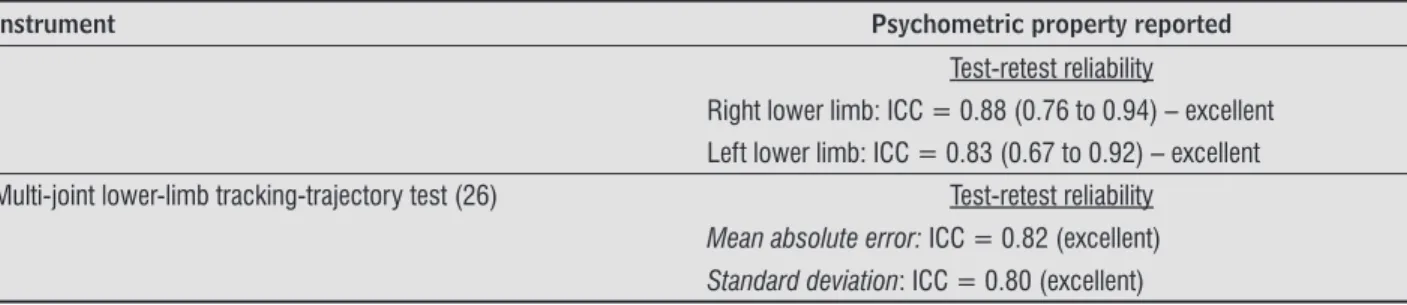
The values found for the psychometric properties of the three specific LLMC tests are summarized in Table .
Description of specii c tests
Foot tapping test
The foot tapping test was designed to assess mo-tor function of the lower limbs. Although it was not reported in the article that the test evaluated MC, it was included in this review because it has been used for this purpose in other studies . Two ways of performing the test were described: Alternate foot tapping foot tapping with two pedals , in which the individual is instructed to tap his foot as quickly as possible in two pedals front and back separated by cm during seconds; Repetitive foot tapping foot tapping with one pedal , in which the individual is instructed to tap his foot as quickly as possible on a pedal for seconds. The score is calculated from the number of the pedal taps. The study was conducted with patients with Parkinson's disease and excellent values for inter and intra-rater reliabilities were found .
psychometric property or if they did not explicitly stated that the instrument was being used to evalu-ate LLMC.
Data extraction
Data were extracted using an adapted standardized form, based upon the Cochrane Collaboration . The information extracted from the studies were: Characteristics of the included participants, such as gender, age; source, and sample size; objectives; evaluated scale/instrument; description of the scale/ instrument; psychometric properties or clinical util-ity; methods used for the assessment of the psycho-metric properties; and statistical results. )n addition, information whether the instrument was specific for the assessment of LLMC or if it was a sub-item of another scale was obtained. )n case of non-specific instruments, only the data for the LLMC item were extracted. The clinical utility was assessed using the Tyson and Connel scale .
Results
The initial search strategy returned a total of , studies. Of these, , were excluded after reading the titles and after analysing the ab-stracts. The final number of articles selected for full text reading was . After this step, only six articles were included in this review according to the estab-lished inclusion and exclusion criteria. One article was excluded because it was not possible to obtain the full text and therefore its eligibility could not be assessed . The hand search returned four articles and all were included. Therefore, the total number of articles included and described in this study was nine.
546
Table 2 - Values of the psychometric properties of the specific tests for the evaluation of lower limb motor coordination, re-ported by the studies included in the review
Instrument Psychometric property reported
Foot tapping (33) Inter-rater reliability: ICC = 0.87 (excellent)
Intra-rater reliability: ICC = 0.84 (excellent)
Lower-extremity motor coordination test (4) Convergent construct validity
Fugl-Meyer assessment: r = 0.79 (excellent)
Berg balance scale: r = 0.67 (excellent)
5-minute walk test: r= 0.67 (excellent)
Walking endurance: r= 0.66 (excellent)
Functional autonomy measurement system (mobility): r = 0.66 (excellent)
Functional autonomy measurement system (total score): r = 0.62 (excellent)
Divergent Construct Validity
Modifi ed mini-mental state examination: r = 0.11 (poor)*
Motor-free visual perceptual test: r = 0.15 (poor)*
Figure 1 - Flowchart of inclusion and exclusion of studies
Not available (n = 1)
Included studies (n = 5)
Included studies (n = 9)
Analysis of the abstracts - excluded (n = 206) Analysis of the title - excluded (n = 1.119)
Studies included by hand search (n = 4) Potentially eligible studies after analysis of
the titles and abstracts (n = 36) MEDLINE (n = 578) LILACS (n = 218) SciELO (n = 30) Cinahl (n = 203) AMED (n = 114) Web of science (n = 218) Total = 1.361
Studies excluded after reading the full text (n = 30) - Did not assess motor coordination.
- Assessed motor coordination in children/adolescents. - Assessed upper limb motor coordination.
- Did not assess psychometric properties.
- Did not report separate data for the motor coordination item in case of non-specific instrument.
Databases searched until April 2012:
Table 2 - Values of the psychometric properties of the specific tests for the evaluation of lower limb motor coordination, re-ported by the studies included in the review
Instrument Psychometric property reported
Test-retest reliability
Right lower limb: ICC = 0.88 (0.76 to 0.94) – excellent Left lower limb: ICC = 0.83 (0.67 to 0.92) – excellent
Multi-joint lower-limb tracking-trajectory test (26) Test-retest reliability
Mean absolute error: ICC = 0.82 (excellent)
Standard deviation: ICC = 0.80 (excellent)
Note: ICC = intraclass correlation coeffi cient. *Once the divergent construct validity was calculated, this value below 0.4 interpreted as "poor" represents a suitable value for this property psychometric.
(Conclusion)
Lower-extremity motor coordination test (LEMOCOT)
The LEMOCOT is a specific test for the evaluation of LLMC. The patients, in the sitting position, are instruct-ed to alternately move their lower limb as quickly as possible and touch with their halluces two red targets with cm in diameter one proximal and one distal , separated by a distance of cm for seconds . During the test, the examiner counts the number of touched targets, and for the final score, the calculation of only the touched targets are considered. The test-re-test reliability and construct validity of the LEMOCOT was established with individuals elderly and post-stroke patients . For the assessment of con-vergent validity, the LEMOCOT was compared to the following instruments: Fugl-Meyer scale FMS scores, Berg balance scale scores, walking speeds -meter walking test , walking endurance -minute walking test , and functional autonomy measurement system. )n this case, it is expected to find significant correla-tions between the selected instruments. For the as-sessment of divergent construct validity, the following instruments were used: Modified mini-mental state examination and motor-free visual perceptual test, and in this case, it is expected to find no or low correlations between the tests. The values found for the construct validity and test-retest reliability for the right and left lower limbs were considered excellent .
Tracking-trajectory test
The tracking-trajectory test is also a specific instru-ment for the assessinstru-ment of LLMC. )t is performed on
the device, commercially known as Leg Press, which is connected to a computer and software that provides analysis of data in real time . The individuals are instructed to perform flexion and extension move-ments with their lower limbs, trying to follow a trajec-tory provided on a video monitor positioned on their eyes’ vision. The test lasts seconds and the indi-vidual is instructed to follow the path with the highest possible precision. Then, the software automatically calculates the mean absolute errors in cm , i.e., the differences between the average actual path trajectory and the established trajectory and the standard devia-tion of the average errors. The test was administered to healthy and physically active women, who were divided into two groups according to the secondary objectives of the study , and the only assessed psy-chometric property was the test-retest reliability. The values of this property were considered excellent for both the mean absolute errors and the standard devia-tion of the average errors .
Non-specii c tests for the evaluation of LLMC
The values found for the psychometric proper-ties of the five non-specific tests for the evaluation of LLMC are summarized in Table .
Description of the non-specii c LLMC tests
Auditory-paced and task dorsi-ankle plantar-l exion
548
Fugl-Meyer Scale (FMS)
The FMS is a sensorimotor measurement scale of patients who have suffered stroke . )t as-sesses six domains: range of motion, pain, sensa-tion, motor function of upper and lower extremity and balance. The sub-item that evaluates the LLMC is the heel to shin test, which is performed with the patients in the supine position, where they take their heels to the opposite leg five times, as quickly as possible. For the test scoring, three cri-teria are considered: the time taken to complete the task with the affected limb, when compared to the non-affected limb dysmetria, and tremor. Each item is scored by a three-point ordinal scale - . The study was conducted with stroke pa-tients and provided specific results of inter- and intra-rater reliabilities for the LLMC sub-item. The values found for both reliabilities were considered excellent .
supine position, is instructed to alternately perform movements of dorsiflexion and plantar flexion foot tapping in pre-set frequencies by a computer with the greatest possible accuracy . These frequen-cies gradually increase . to . (z at intervals of approximately seconds , signalled by a beep sound. For each frequency, the individual should per-form repetitions of dorsiflexion and plantar flexion and change the direction of the movement when a beep is heard. The frequency performed by the par-ticipant was recorded and compared with the target frequency. The study was conducted with two groups spinal cord injured patients and control group . The test-retest reliability values were provided for all fre-quencies, at which the test was performed. The )CC for the frequency of . to . (z could not be calcu-lated due to the low data variability. The )CC values were considered excellent for frequencies from . to . (z, with the exception of the frequencies of . and . (z, which had adequate reliability .
Table 3 - Values of the psychometric properties of the non-specific tests for the evaluation of lower limb motor coordination, reported by the studies included in the review
Instrument Psychometric property reported
Auditory-paced ankle dorsi- and plantar-fl exion task (28)
Test-retest reliability:
Frequency of 1.6 to 3.2 Hz: ICC = 0.55 to 0.88 (adequate to excellent)
Fugl-Meyer scale (31) Inter-rater reliability: ICC = 0.94 to 0.97 (excellent) Intra-rater reliability: ICC = 0.88 to 0.93 (excellent)
Standardized neurological examination (27) Inter-rater reliability: kappa = 0.40 to 0.75 (adequate)
Rapid alternating movement patterns test (32)
Convergent construct validity:
Strength: Non-paretic limb – r = -0.35 (adequate) Paretic limb – r = -0.61 (excellent) Predictive validity:
Function (transference, gait, stairs climbing): Non-paretic limb – r = -0.14 (poor)
Paretic limb – r = -0.51 (adequate) Length of stay in hospital:
Non-paretic limb – r = 0.22 (poor) Paretic limb – r = 0.23 (poor)
Scale of the assessment and rating of ataxia (SARA) (29, 30)
Reliability – internal consistency: α = 0.41 to 0.66 (adequate) (29) Reliability – internal consistency: α = 0.93 (excellent) (30) Inter-rater reliability: Right lower limb: ICC = 0.81 (excellent) (30) Left lower limb: ICC = 0.74 (adequate) (30)
upper and lower limb function , . The sub-item that evaluates the LLMC is the # , the heel to shin test. Unlike the execution procedure shown for the FMS, for the SARA, the heel to shin is also performed in the supine position, but the individual should take the heel to the opposite knee and slide the foot to the heel. This manoeuvre is performed three times and the score is given by an ordinal scale that ranges from zero to four, which considers the execution time and the quality of the movements. Two articles that studied this test were included in this review and both investigated the internal consistency of the LLMC item Q , which was considered adequate to excellent . Only in one study the inter-rater reliability of this sub-item was reported, and the value found for the right leg was considered excellent, while the one found for the left was considered adequate.
Clinical utility
According to the initial purpose of this review, the clinical utility would be assessed by the scale of Tyson and Connell . (owever, this scale re-quires information, which was not reported in all studies. Therefore, to avoid subjectivity in the judg-ment by the examiners, the clinical utility was evalu-ated using the information reported by the authors, and the Tyson and Connell scale was only used as a guide. The tests that reported clinical utility data were FMS, LEMOCOT, NSS, and SARA. According to the authors, the FMS is easily administered, has rela-tively straightforward and simple instructions, and requires no special equipment . The LEMOCOT is simple, inexpensive and quick to apply . The NSS was also considered easily administered at the bedside or in the office . Finally, the SARA is easy to administer and requires less than minutes per application .
Discussion
This review aimed to identify the studies that ex-amined the psychometric properties of LLMC assess-ment tests. The nine articles that were included in this review evaluated the psychometric properties of eight tests. Overall, reliability was the most commonly assessed property and all tests had values considered adequate to excellent.
Standardized Neurological Examination (NSS)
This scale is designed to evaluate gait, MC, integra-tive sensory tasks, and lateral preference of patients with schizophrenia . )t consists of items, the item # evaluates LLMC by observing two simple tasks: Foot tapping: tapping your foot as if you are expecting something impatiently, keeping your heel on the floor and moving only the forefoot times; heel/toe tapping: a foot swinging back and forth, heel and toes for times. The scores range from zero to three, according to the speed of execution. The study was conducted with three groups schizo-phrenia, mood disorder patients, and controls . For the evaluated psychometric properties, only the inter-rater reliability was calculated separately for the item
, which showed to be appropriate .
Rapid alternating movement patterns test (RAMP test)
The RAMP test evaluates MC of the upper and lower limbs in large amplitudes . The sub-item that tests the LLMC is performed in the supine posi-tion with the knees fully extended. The individuals are instructed to flex their knee to be tested to the point where the heel is levelled with the contralateral knee, and then return their leg to the starting position with the knee fully extended. The score is given by the time, in seconds, required to perform repetitions. The time is converted to an ordinal score, following pre-established values. The higher the score on the test, the worse is the MC. The study was conducted with stroke individuals. For the assessment of convergent validity, the RAMP test was compared with strength measures of the lower limbs. For predictive validity, the test was compared with the function measures transferring, walking, and climbing stairs and length of hospital stay. The values for the convergent validity were considered adequate non-paretic limb to excel-lent paretic limb . The predictive validity was poor to adequate. The internal consistency was excellent . to . , but this finding was not reported separately for the lower limbs .
Scale for the assessment and rating of ataxia (SARA)
550
not show adequate values for the three necessary basic psychometric properties reliability, validity, and sensitivity to changes .
The lack of standardization of the execution pro-cedures of the tests is another factor that limits the use of the instruments which were investigated in this review. For instance, the heel to shin and foot tapping tests have distinct scoring methods, applications, and score interpretations in different studies. Moreover, the method of application of foot tapping was not very clearly stated in the studies. Gunzler et al. did not explain whether the subjects should hit their whole foot or just their forefoot on the pedals. Krebs et al. did not report the criteria for grading the speed for hitting the target, since the scores are based upon four distinct situations: - normal speed; - mild retardation; - reduced speed; and - task accom-plished with great difficulty, slowly, or require higher concentration. These factors lead to subjectivity dur-ing the scordur-ing of the test, limit the comparison of the results, and make their use difficult. )n addition, the heel to shin test is performed in the supine position, which is not a functional position to evaluate MC, since the majority of the daily activities that require LLMC is not performed in this position.
None of the studies evaluated sensitivity to chang-es or ceiling and floor effects. Ceiling and floor effects are measured by the percentage of the subjects who achieved the minimum and maximum possible scores in a certain test and are considered present when more than % of individuals reach the highest or lowest possible total scores , . The presence of floor and ceiling effects may affect the sensitiv-ity of the test, since the abilsensitiv-ity of the test to detect real changes may be diminished , . The tests described in this study may, therefore, not be able to detect clinically significant changes, especially when used in patients with mild or severe disabili-ties, which may limit theirs use .
Only the FMS, LEMOCOT, SARA, and tracking-trajectory tests considered both the speed and the quality of movement as scoring criteria. )n other tests, the score calculation takes into consideration only the time that the individuals take to perform the task. This may represent a limitation of these tests, since MC is related to the individual's ability to meet these two apparently opposing demands , and the separation of these criteria for scor-ing the test may not reliably represent the con-struct being rated.
)t is important to note that despite adequate re-liability, the indices reported by these studies do not allow to draw rational conclusions, since high levels of reliability do not ensure the validity of the measurements . Validity refers to the extent to which a test or instrument measures what it is intended to measure and implies that a measure is relatively free of error. Therefore, a valid test must necessarily be reliable , . Although reliability is a pre-requisite for the validity, this relationship is unidirectional. A low reliability index is an automatic evidence of low validity, whereas a high level of reli-ability does not automatically suggest strong validity of a test or measure. )n this review, only the predictive and construct validities were investigated and re-ported only for LEMOCOT and RAMP tests. Therefore, it is extremely necessary to investigate other types of validity for all the tests described in this review.
Only three tests included in this review were spe-cific for the evaluation of LLMC, namely the tracking-trajectory test, the LEMOCOT, and foot tapping. Only test-retest reliability was reported for the tracking-trajectory, only construct validity and test-retest re-liability were reported for the LEMOCOT, and only inter- and intra-rater reliabilities were analysed for the foot tapping. Despite showing some adequate psychometric properties, these tests still need to be further investigated.
)t is important to note that Gunzler et al. did not consider the foot tapping test as a specific test for assessing LLMC, but for the evaluation of lower limb function. (owever, this study was included be-cause the foot tapping is an item of the NSS and has been used is in other studies , with the aim of evaluating the LLMC.
some important studies. )t was not possible to get the full text of an article and, therefore, a potential eligible study may have been missed. Furthermore, it was not possible to apply the scale to assess the clinical utility. (owever, these decisions were made to avoid subjective decisions by the examiners and to ensure the quality of the review.
Final considerations
According to the findings of this review, the psy-chometric properties of the eight LLMC tests showed adequate values for some types of reliability, but in-sufficient data for validity and sensitivity to changes. The LEMOCOT proved to be the most suitable for evaluating LLMC, despite its limitations, such as lack of standardization in the application procedure, and lack of investigation of some psychometric proper-ties, e.g., other types of validity and sensitivity to changes. These findings demonstrated the paucity of studies that evaluated the psychometric properties of LLMC, which may limit the interpretation and use of these tests. Therefore, this study may facilitate the search and selection of LLMC tests by researchers and clinicians, who can quickly and efficiently con-sult the general characteristics of the tests that are described in this review. (owever, it is important to note the need for further studies to investigate other basic psychometric properties and clinical utility of these tests.
References
. Bernstein NA. Dexterity and its development. Mahwah: Lawrence Erlbaum Associates; . . Bourbonnais D, Vanden Noven S, Pelletier R.
)ncoor-dination in patients with hemiparesis. Can J Public (ealth. ; Suppl :S - .
. Ada L, Canning C. Changing the way we view the con-tribution of motor impairments to physical disability after stroke. )n: Refshauge K, Ada L, Ellis E, editors. Science-based rehabilitation: Theories into practice. Sydney: Elsevier; . p. - .
. Desrosiers J, Rochette A, Corriveau (. Validation of a new Lower-Extremity Motor Coordination Test. Arch Phys Med Rehabil. ; : - .
Regarding clinical utility, studies reported that the foot tapping, LEMOCOT, FMS, NSS, RAMP test, and SARA are easy to understand and to apply, have low cost, and are easy to transport. These characteristics explain why these tests are clinically useful .
The FMS, NSS, and SARA assess MC through the foot tapping and heel to shin items, whose psycho-metric properties have been little investigated. The same was observed for the RAMP test, since the stud-ies did not report separate data regarding the reliabil-ity and responsiveness of the LLMC items. Although the foot tapping seems to be clinically useful and has adequate reliability indices, it has not been validated for the assessment of MC, instead it was validated for the evaluation of motor function of the lower limbs. Finally, the tracking-trajectory test and the auditory-paced ankle dorsi- and plantar-flexion task are more complex tests that require specialized equipment, probably of higher costs, and therefore do not have good clinical utility.
The LEMOCOT, among all evaluated tests, ap-peared to be the most suitable for the evaluation of LLMC, since it showed appropriate values of reli-ability and construct validity, as well as good clini-cal utility. Furthermore, other studies reported that the LEMOCOT scores were good predictors of social participation of stroke individuals after six months of rehabilitation , . (owever, among the many studies that used the LEMOCOT - , no stan-dardization procedures regarding the number of repetitions and scoring method were reported. Thus, the establishment of standardized procedures is necessary, as well the investigation of other types of validity.
)t is noteworthy that health professionals from dif-ferent areas applied the tests included in this review. )t is necessary that the examiner be trained in order to know the tests and to acquire skills for the appli-cation procedures for not compromising the results.
552
. Carvalho TB, Relvas PCA, Rosa SF. )nstrumentos de avaliação da função motora para indivíduos com lesão encefálica adquirida. Rev Neurocienc. ;
: - .
. Tyson S, Connell L. The psycometric properties and clinical utility of measures of walking and mobility in neurological conditions: a systematic review. Clin
Rehabil. ; : - .
. Senkiio C(, Kill F, Negreti MR, Oliveira CA, Alves NPF, Souza SRS. A utilização da escala de Fugl-Meyer no estudo do desempenho funcional de membro superior no tratamento de indivíduos hemiparéticos pós-AVE. Fisioter Bras. ; : - .
. Martins GA. Sobre confiabilidade e validade. RBGN. ; : - .
. Ashford S, Slade M, Malaprade F, Turner-Stokes L. Evaluation of functional outcome measures for the hemiparetic upper limb: a systematic review. J Rehabil
Med. ; : - .
. (arris M, Warren J. Patient outcomes: assessment issues for the CNS. Clin Nurse Spec. ; : - . . Andresen EM. Criteria for assessing the tools of dis-ability outcomes research. Arch Phys Med Rehabil.
; Suppl :S - .
. (iggins JPT, Green S. Cochrane handbook for system-atic reviews of interventions. Chichester: John Wiley & Sons; .
. Potvin AR, Tourtellotte WW, Syndulko K, Potvin J. Quantitative methods in assessment of neurologic function. Crit Rev Bioeng. ; : - . . Maffiuletti NA, Bizzini M, Schatt S, Munzinger U.
A multi-joint lower-limb tracking-trajectory test for the assessment of motor coordination. Neurosci Lett.
; - : - .
. Krebs MO, Gut-Fayand A, Bourdel MA, Dischamp J, Olié JP. Validation and factorial structure of a stan-dardized neurological examination assessing neu-rological soft signs in schizophrenia. Schizophr Res.
; : - .
. Wirth B, (edel (, Curt A. Foot control in incomplete SC): distinction between paresis and dexterity. Neuro Res. ; : - .
. Gyntelberg F, Flarup M, Mikkelsen S, Palm T, Ryom C, Suadicani P. Computerized coordination ability test-ing. Acta Neurol Scand. ; : - .
. Carr J, Shepherd R. Reabilitação neurológica: otim-izando o desempenho motor. São Paulo: Manole; . . Capranica L, Tessitore A, Olivieri B, Minganti C, Pesce C. Field evaluation of cycled coupled movements of hand and foot in older individuals. Gerontol. ;
: - .
. Cavaco NS, Alouche SR. )nstrumentos de avaliação da função de membros superiores após acidente vascular encefálico: uma revisão sistemática. Fisioter Pesqui.
; : - .
. Soriano FFS, Baraldi K. Escalas de avaliação funcional aplicáveis a pacientes pós acidente vascular encefáli-co. ConScientiae Saúde. ; : - .
. Lima RCM. Adaptação transcultural do Stroke Specific Quality of Life – SSQOL: um instrumento específico para avaliar a qualidade de vida de hemiplégicos [dis-sertação]. Belo (orizonte: Universidade Federal de Minas Gerais; .
. Gadotti )C, Vieira ER, Magee DJ. )mportance and clari-fication of measurement properties in rehabilitation. Rev Bras Fisioter. ; : - .
. Pilatti LA, Pedroso B, Gutierrez GL. Propriedades Psico-métricas de )nstrumentos de Avaliação: um debate necessário. Rev Bras Ensino Ciênc Tecnol. ;
: - ,
. Maher CG, Latimer J, Costa LOP. The relevance of cross-cultural adaptation and Clinimetrics for physi-cal therapy instruments. Rev Bras Fisioter. ;
: - .
. Eremenco SL, Cella D, Arnold BJ. A comprehensive method for the translation and cross-cultural valida-tion of health status quesvalida-tionnaires. Eval (ealth Prof.
; : - .
. Portney LG, Watkins MP. Foundations of clinical re-search: Applications to practice. rd ed. Upper Saddle River: Pearson/Prentice (all, .
. Desrosiers J, Malouin F, Richards C, Bourbonnais D, Rochette A, Bravo G. Comparison of changes in up-per and lower extremity impairments and disabilities after stroke. )nt J Rehabil Res. ; : - . . Yıldırım Y, Bilge K, Erbayraktar S, Sayhan S.
Assess-ment of lower extremity motor coordination in operat-ed patients. J Musculoskelet Res. ; : - . . Desrosiers J, Rochette A, Noreau L, Bourbonnais D, Bra-vo G, Bourget A. Long-term changes in participation after stroke. Top Stroke Rehabil. ; : - . . Dyer JO, Maupas E, Melo SA, Bourbonnais D, Forget R.
Abnormal coactivation of knee and ankle extensors is related to changes in heteronymous spinal pathways after stroke. J Neuroeng Rehabil. ; : .
. Dyer J-O, Maupas E, Melo SA, Bourbonnais D, Fleury J, Forget R. Transmission in heteronymous spinal path-ways is modified after stroke and related to motor incoordination. PLoS ONE. ; :e .
. Scianni A, Teixeira-Salmela LF, Ada L. Effect of strengthening exercise in addition to task-specific gait training after stroke: a randomised trial. )nt J Stroke.
; : - .
. (ong SJ, Goh EY, Chua SY, Ng SS. Reliability and valid-ity of step test scores in subjects with chronic stroke. Arch Phys Med Rehabil. ; : - .
Received: / / Recebido: / /
Approved: / / Aprovado: / / . Braga-Neto P, Gordeiro-Junior C, Dutra LA, Pedroso JL,
Barsottin OGP. Translation and validation into Bra-zilian version of the Scale of the Assessment and Rating of Ataxia SARA . Arq Neuropsiquiatr. ;
: - .
. Schmitz-(übsch T, Montcel ST, Baliko L, Berciano J, Boesch S, Depondt C, et al. Scale for the assessment and rating of ataxia: Development of a new clinical scale. Neurology. ; : - .
. Maki T, Quagliato EMAB, Cacho EWA, Paz LPS, Nasci-mento N(, )noue MMEA, et al. Estudo de confiabili-dade da aplicação da escala de Fugl-Meyer no Brasil. Rev Bras Fisioter. ; : - .
. Dittiger M, Bohannon RW, Andrews AW. Reliability, responsiveness, and validity of timed, large amplitude, rapid alternating movement patterns among patients with stroke. J Phys Ther Sci. ; : - . . Gunzler SA, Pavel M, Koudelka C, Carlson NE, Nutt JG.
Foot-tapping rate as an objective outcome measure for Parkinson disease clinical trials. Clin
Neurophar-macol. ; : - .
. Ross JL, Stefanatos GA, Kushner (, Bondy C, Nelson L, Zinn A, et al. The effect of genetic differences and ovar-ian failure: )ntact cognitive function in adult women with premature ovarian failure versus Turner syn-drome. J Clin Endocrinol Metab. ; : - . . Katic R, Bonacin D, Padovan M, Blazevic S. Phyloge-netically conditioned possibilities of the realization and of the development of complex movements at the age of Years. Coll Antropol. ; : - . . Desrosiers J, Noreau L, Rochette A, Bravo G, Bou-tin C. Predictors of handicap situations following post-stroke rehabilitation. Disabil Rehabil. ;