Jéssica Diane dos SANTOS Elisabete PIVA
Simone Furgeri Godinho VILELA Antonio Olavo Cardoso JORGE Juliana Campos JUNQUEIRA
(a)Universidade Estadual Paulista – UNESP, Institute of Science and Technology, Department of Biosciences and Oral Diagnosis, São José dos Campos, SP, Brazil.
Mixed biofilms formed by
C. albicans
and non-albicans species: a study of
microbial interactions
Abstract: Most Candida infections are related to microbial bioilms often formed by the association of different species. The objective of this study was to evaluate the interactions between Candida albicans and non-albicans species in bioilms formed in vitro. The non-albicans species studied were: Candida tropicalis, Candida glabrata and Candida krusei. Single and mixed bioilms (formed by clinical isolates of C. albicans and non-albicans species) were developed from standardized suspensions of each strain (107 cells/mL), on
lat-bottom 96-well microtiter plates for 48 hour. These bioilms were analyzed by counting colony-forming units (CFU/mL) in Candida HiChrome agar and by determining cell viability, using the XTT 2,3-bis (2-methoxy-4-nitro-5-sulphophenyl)-5-[(phenylamino) carbonyl]-2H-tetrazolium hydroxide colorimetric assay. The results for both the CFU/mL count and the XTT colorimetric assay showed that all the species studied were capable of forming high levels of in vitro bioilm. The number of CFU/mL and the metabolic activity of C. albicans were reduced in mixed bioilms with non-albicans species, as compared with a single C. albicans bioilm. Among the species tested, C. krusei exerted the highest inhibitory action against C. albicans. In conclusion, C. albicans established antagonistic interactions with non-albicans Candida species in mixed bioilms.
Keywords:Candida albicans; Candida glabrata; Candida tropicalis; Bioilms.
Introduction
Yeasts of the Candida genus are opportunistic pathogens frequently encountered in humans, and can be isolated from 60% of the oral cavities of healthy adults.1 Candida species are responsible for the increasing frequency of infections in immunocompromised patient groups, such as HIV-infected individuals and those being treated with chemotherapy or broad-spectrum antibiotics.2 C. albicans is considered the most prevalent
and pathogenic species of this gender, and is responsible for most of the supericial and systemic fungal infections.1 Candida albicans is the fourth
leading cause of bloodstream infections, and the third most commonly isolated organism from intravascular catheters; moreover, it is associated with the highest incidence of mortality.3
Nevertheless, other Candida species have also emerged as clinically important opportunistic pathogens, such as Candida glabrata, Candida tropicalis Declaration of Interests: The authors
certify that they have no commercial or associative interest that represents a conflict of interest in connection with the manuscript.
Corresponding Author: Jéssica Diane dos Santos
E-mail: [email protected]
DOI: 10.1590/1807-3107BOR-2016.vol30.0023
Submitted: Oct 25, 2014
and Candida krusei.4 For many years, C. glabrata was considered a relatively non-pathogenic saprophyte of the normal lora of healthy humans. However, C. glabrata can disseminate rapidly throughout the body, and infection caused by this species is associated with a high mortality rate.5C. tropicalis is another non-albicans species considered an important opportunistic pathogen. It is most frequently isolated from candidiasis, mainly in patients conined to intensive care units, and has been associated with luconazole resistance.6C. krusei is an
emerging pathogen, described as a systemic pathogen in patients with compromised host resistance, such as those with acquired immunodeiciency syndrome (AIDS).7
A major attribute of the Candida genus virulence is its ability to form surface-attached microbial communities known as bioilms.8,9 In general, bioilm development
evolves according to four sequential steps: irst, adhesion of microorganisms to a surface; second, discrete colony formation and organization of cells; third, secretion of extracellular polysaccharides (EPS) and maturation into a three-dimensional structure; and, fourth, dissemination of progeny bioilm cells.10 The
extracellular matrix of the bioilm can protect the cells from phagocytosis, maintain the integrity of the bioilm, and limit the diffusion of substances.11 It has
been estimated that over 60% of microbial infections are involved with biofilm.1 The high resistance of bioilms to antimicrobials (compared to their planktonic counterparts) is of major clinical relevance.12
Biofilm infections may be caused by a single microbial species or by a mixture of different species.13 The complex structure of bioilms allows stratiication into spatially organized populations of mixed-species communities.14 Microorganisms have evolved complex mechanisms to promote their survival, defending themselves not only against adverse environmental and nutritional conditions, but also against competing organisms.15 Polymicrobial bioilms are found in nearly every niche in the human body.16 These mixtures of species make the therapeutic management of infectious diseases extremely dificult.12 The heterogeneity of
species within mixed bioilms has made it dificult to assess the relevance and contribution of each individual species to pathogenesis and disease.3
Bacteria are commonly associated with Candida in the polymicrobial bioilms found in medical devices.8
Harriot and Noverr17 studied the interactions in polymicrobial bioilms formed by C. albicans and Staphylococcus aureus in an in vitro model, and observed a synergistic relationship between the two species. On the other hand, Tampakakis et al.18 analyzed an in vivo interaction between the species C. albicans and the Gram-negative Salmonella typhimurium. After observing that C. albicans ilamentation was inhibited by the bacteria, they concluded that it was an antagonistic interaction.
However, most existing studies on mixed bioilm development involving Candida albicans have focused on bacterial-fungal infections, whereas there are only few that deal with interactions among fungi in mixed bioilms.Kirkpatrick et al.4 and Thein et al.19 found that C. albicans established a competitive interaction with C. dubliniensis and C. krusei, respectively, in mixed bioilms formed in vitro. However, Pereira-Cenci et al.20 did not ind competitive interactions in dual-species biofilms of C. albicans and C. glabrata grown on different dental materials. Recently, our laboratory developed an in vitro and in vivo study21 to evaluate the interactions of C. albicans (ATCC 18804) with C. krusei (ATCC 6258) and C. glabrata (ATCC 9030). We demonstrated that C. albicans was able to establish competitive interactions with non-albicans species during bioilm formation and infection development processes in animal models.
Thus, the purpose of this study was to investigate the interactions between Candida albicans and non-albicans species in mixed biofilms formed in vitro, using clinical strains of C. albicans, C. tropicalis, C. glabrata and C. krusei, isolated from oropharyngeal candidiasis lesions of HIV-positive patients.
Methodology
Microorganisms
This study was approved by the Human Research Ethics Committee of the Institute of Science and Technology of São José dos Campos, Universidade Estadual Paulista - UNESP (017/2011-PH/CEP).
the Department of Biosciences and Oral Diagnosis (UNESP, São José dos Campos, SP, Brazil), after isolation from oropharyngeal candidiasis lesions of HIV-positive patients.22
Preparation of Candida spp. suspension
Standard suspensions containing 107 cells/mL were
prepared for each strain. The strains were seeded on Sabouraud dextrose agar (Difco, Detroit, USA) and incubated at 37°C for 24 hour. Next, a loopful of growth was inoculated in Yeast Nitrogen Base (YNB) broth (Difco, Detroit, USA) supplemented with 100 mM glucose (Vetec, Rio de Janeiro, Brazil) and incubated at 37°C for 16 hour. The broth with the microbial growth was centrifuged at 2000 x g for 10 min (MPW Med. Instruments, Warsaw, Poland), after which the growth was washed twice with 5 mL of sterile physiological solution (PBS) (Laborclin, Pinhais, Brazil), resuspended in YNB medium supplemented with 100 mL glucose, and standardized to 107 cells/mL
in a Neubauer counting chamber (Laboroptik GmbH, Bad Homburg, Germany).
In vitro formation of simple and mixed biofilms
Thebioilm formation of Candida was performed as described by Seneviratne et al.,10 with some modiications. Candida albicans bioilm was formed by adding 200 µL from a standardized suspension (107 cells/mL) to each well of flat-bottom 96-well
microtiter plates (Corning Corporation, Corning, USA). The mixed bioilms (composed by C. albicans and non-albicans species) were formed by adding 100 µL aliquots of standardized suspensions of each species to each well of a lat-bottom 96-well microtiter plate. The plates were incubated for 1.5 h (adhesion phase) at 37°C at 75 rpm in an orbital shaker (Quimis, Diadema, Brazil). After the adhesion phase, the cell suspensions were aspirated, and each well was washed twice with 200 µL of phosphate buffered saline (PBS) to remove any planktonic cells. Then, 200 µL of YNB with 100 mM glucose was added to each washed well, and the plates were incubated for 48 h at 37°C at 75 rpm in an orbital shaker. The growth medium was replenished daily.
Analysis of biofilm by counting colony forming units (CFU/mL)
After formation of the bioilms, each well was washed twice with 200 µL of PBS to remove loosely adhered cells. Then, 200 µL of PBS was added to each well, and the bioilm cells were scraped off of the well using a sterile toothpick. A 100 µL aliquot was transferred to a Falcon tube (J Prolab, São José dos Pinhais, Brazil) containing 6 mL of sterile physiological solution, and an ultrasonic homogenizer (Sonoplus HD 2200, output power of 50 W) (Bandelin Electronic, Berlin, Germany) was used for 30 s to disrupt the bioilms. The homogenized solution was used for serial dilutions of the bioilm suspension, and 100 µL aliquots of each dilution were seeded on plates containing Candida HiChrome agar (Himedia, Mumbai, India) and incubated for 48 h at 37°C. After incubation, the CFU/mL values were determined. Candida species from the mixed bioilms were differentiated by the color of the colonies on Candida HiChrome agar: light green for C. albicans, blue for C. tropicalis, cream for C. glabrata and purple for C. krusei.
Analysis of biofilm cell viability using the XTT colorimetric assay
The bioilms formed were evaluated by a metabolic assay based on the reduction of XTT, a tetrazolium salt (Sigma–Aldrich, São Paulo, Brazil). The methodology described by Jin et al.2 was used for the XTT assay. In brief,
XTT salt was dissolved in PBS at a inal concentration of 1 mg/mL. The solution was ilter-sterilized using a 0.22 µm-pore-size ilter (MFS, Dublin, Ireland) and stored frozen at -80°C. Immediately before each assay, a menadione (Sigma–Aldrich, São Paulo, Brazil) solution was prepared at a inal concentration of 0.4 mM and ilter-sterilized. The XTT solution was thawed prior to each assay, and mixed with the menadione solution at a ratio of 20:1 (v:v).
using a microtiter plate reader (Tp Reader; Thermo Plate, Shenzhen, China) at 490 nm.
Statistical analysis
Ten assays were carried out per experimental group. For analysis purposes, CFU/mL values were transformed into logarithm values (log10). The
CFU/mL count in monotypic and heterotypic bioilms was submitted to the Student ttest for each species studied. The results obtained from the XTT assay were evaluated by analysis of variance (ANOVA) and the Tukey test.A signiicance level of 5% (p < 0.05) was adopted (GraphPad Software - Inc., La Jolla, USA).
Results
The mean and standard deviation values of the CFU/mL, obtained from the experiments described above, are shown in Figures 1, 2 and 3. All species were able to form in vitro bioilms, attaining 6.24 to 6.75 CFU/mL (log) in the single bioilms.
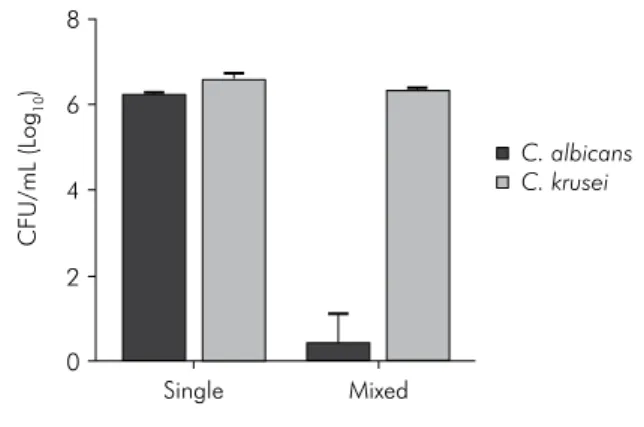
In the study of microbialinteractions, C. albicans showed a signiicantly higher number of CFU/mL in the single bioilm as compared with the mixed bioilm, as regards the non-albicansCandida species. However, the most signiicant difference between the single and the mixed bioilm was observed for the interactions of C. albicans and C. krusei (p < 0.0001).
In the single biofilm, C. albicans grew to 6.24 log (CFU/mL), but the result was 0.40 log when it was grown in the mixed bioilm with C. krusei. These data indicate that the presence of C. krusei in the bioilm inhibited the growth of C. albicans.
The results from the cell viability XTT colorimetric assay are shown in Figure 4. The metabolic activity observed in the single bioilms formed by C. albicans,
Figure 1. Mean values and standard deviation (n = 10)
of CFU/mL (log) of C. albicans and C. tropicalis, organized
in single and mixed biofilms. Student t-test. C. albicans
counts: statistically significant difference between biofilm formed by C. albicans and biofilm formed by C. albicans + C. tropicalis
(p < 0.0001). C. tropicalis counts: statistically significant
difference between biofilm formed by C. tropicalis and biofilm
formed by C. albicans + C. tropicalis (p = 0.0023).
CFU/mL (Log
10
)
Single Mixed
8
6
4
2
0
C. albicans C. tropicalis
Figure 3. Mean values and standard deviation (n = 10)
of CFU/mL (log10) of C. albicans and C. krusei, organized
in single and mixed biofilms. Student t-test. C. albicans
counts: statistically significant difference between biofilm formed by C. albicans and biofilm formed by C. albicans + C. krusei
(p < 0.0001). C. krusei counts: statistically significant
difference between biofilm formed by C. krusei and biofilm
formed by C. albicans + C. krusei (p < 0.0001).
CFU/mL (Log
10
)
Single Mixed
8
4 6
2
0
C. albicans C. krusei
Figure 2. Mean values and standard deviation (n = 10) of
CFU/mL (log10) of C. albicans and C. glabrata, organized
in single and mixed biofilms. Student t-test. C. albicans
counts: statistically significant difference between biofilm formed by C. albicans and biofilm formed by C. albicans + C. glabrata
(p < 0.0001). C. glabrata counts: statistically significant
difference between biofilm formed by C. glabrata and biofilm
formed by C. albicans + C. glabrata (p < 0.0001).
CFU/mL (Log
10
)
Single Mixed
8
6
4
2
0
C. tropicalis, C. glabrata, and C. krusei was similar for the species studied. The results for the interactions between C. albicans and non-albicans species show that the highest metabolic activity was observed for the interaction between C.albicans and C. glabrata, and the lowest, for the interaction between C. albicans and C. krusei. When the single bioilm formed by C. albicans was compared with mixed biofilms formed by the C. albicans and non-albicans species,a statistically signiicant difference was found only for the interaction with C. krusei (p < 0.0001).
Discussion
Recent studies have shown that bioilms in nature are formed by multiple microbial species that are closely associated and interact with each other.16 Some microorganisms have evolved mutualistic or even synergistic interactions to facilitate cohabitation on epithelial surfaces and to utilize metabolic by-products eficiently, whereas others have developed competitive antagonistic approaches during colonization.23
Species of the genus Candida are the most prevalent fungal pathogens in the oral cavity, and their ability to form bioilms is associated with their virulence.24
Candida albicans is considered the most important species, and is found in approximately 70% of oral infections. Nonetheless, non-albicans species, such as Candida glabrata, Candida tropicalis and Candida krusei,
are also frequently associated with the development of infections.25Candida albicans sometimes exists in a mixture with other microbial species in this environment.26 The virulence of C. albicans may be inluenced not only by its own properties but also by its interactions with cohabitating oral microorganisms.20 Further research is required to understand the interactions that occur when different species of Candida coexist in a bioilm.
In the present study, the interactions between C. albicans and non-albicans species in mixed bioilms were evaluated by counting colony-forming units (CFU/mL) and by determining cell viability using the XTT colorimetric assay. The counting of CFU/mL was performed using a chromogenic medium (Candida HiChrome agar) that allows the colonies of C. albicans, C. tropicalis, C. glabrata and C. krusei to be differentiated by color. Chromogenic media are widely used for presumptive identification of Candida species. Rajkumari et al.27 compared the accuracy between
the Automated VITEK 2 Compact system and a chromogenic medium (CHROMagar) for identiication of 445 yeast isolates. VITEK 2 was able to correctly identify 354 (79.5%) isolates, whereas the chromogenic medium correctly identiied 381 (85.6%) isolates.
The results obtained by counting CFU/mL show antagonistic interactions between C. albicans with C. tropicalis, C. glabrata, and C. krusei. El-Azizi et al.14 Figure 4. Mean values and standard deviation (n = 10) of the metabolic activity (XTT analysis) for single biofilms formed by
C. albicans, C. tropicalis, C. glabrata or C. Krusei, and for mixed biofilms formed by the interactions of C. albicans-C. tropicalis, C. albicans-C. glabrata or C. albicans-C. krusei.Analysis of variance (ANOVA): statistically significant differences among the groups
(p < 0.0001).Tukey test: C. albicans vs. C. tropicalis (p = 0.0982), C. albicans vs. C. glabrata (p = 0.9999), C. albicans vs. C. krusei
(p = 0.6625), C. tropicalis vs. C. glabrata (p = 0.0742), C. tropicalis vs. C. krusei (p = 0.9138), C. glabrata vs. C. krusei (p = 0.5859),
C. albicans vs. C. albicans and C. tropicalis (p = 0.7269), C. albicans vs. C. albicans and C. glabrata (p = 0.2459), C. albicans vs. C. albicans and C. krusei (p < 0.0001), C. tropicalis vs. C. albicans and C. tropicalis (p = 0.8751), C. glabrata vs. C. albicans and
C. glabrata (p = 0.3036), C. krusei vs. C. albicans and C. krusei (p < 0.0001).
Optical density (OD)
C. albicans C. tropicalis C. glabrata C. krusei C. albicans and
C. tropicalis
C. albicans and C. glabrata
C. albicans and C. krusei
1.5
1.0
0.5
investigated the interactions between C. albicans and non-albicans species using in vitro models. C. guilliermondii, C. krusei or C. lipolytica were added to a preformed C. albicans bioilm. An increase in the bioilm growth of Candida spp. was observed in the in vitro model, except for C. guilliermondii. Similar results were observed when C. albicans was added simultaneously with non-albicans species to form a mixed biofilm. However, the number of C. albicans cells in the biofilm was signiicantly reduced when the cells were added to the preformed C. guilliermondii, C. krusei or C. lipolytica bioilms, indicating a competition for adhesion sites.
Among the non-albicansCandida species, C. krusei was the species with the highest inhibitory activity against C. albicans. Its greater number of CFU/mL suggests that C. krusei prevailed in this interaction. Using a bioilm model similar to that of this study and Candida reference strains, Rossoni et al.21 veriied that the inhibition of C. albicans was greater in the presence of C. krusei than in the presence of C. glabrata. Thein et al.19 also studied the interaction between C. albicans and C. krusei using an in vitro bioilm model, and observed antagonism between the species; C. krusei suppressed approximately 85% of C. albicans growth. These results suggest that there may be competition for nutrients between these species or that C. krusei produces signaling molecules that inhibit the growth of C. albicans. Furthermore, it has been suggested that C. krusei has a higher initial rate of colonization, perhaps because of C. krusei’s very high cell surface hydrophobicity and resultant adherence to acrylic surfaces.7 In addition, biofilm
formation and coaggregation effects allow competing microorganisms to maximize the colonization surface area in an environment that is highly competitive for space and nutrients.23
To date, most previous studies have focused on analyzing bioilm formation by counting CFU/mL; however, Seneviratne et al.10 suggest that bioilm development results should be analyzed by more than one method. In this study, in addition to colony counting, we used an XTT reduction assay that permits measurement of the metabolic activity of the microbial eukaryotic population present in bioilms. The intracellular reduction of XTT releases a formazan compound that can be quantiied by colorimetric
estimation, thereby allowing characterization of the metabolic activity of cells.9
The single biofilms formed by C. albicans, C. tropicalis, C. glabrata, and C. krusei, on lat-bottom 96-well microtiter plates for 48 h, showed similar metabolic activity, thus conirming the CFU counting method.Seneviratne et al.10 evaluated the growth kinetics of Candida bioilms by counting CFU after 1.5, 24, 48 and 72 h of development. At an adherence time of 1.5 h, approximately 1-7 x 10⁵ cells/mL had
adhered to the well of the microtiter plate. After 48 h, the bioilm community reached a plateau of 0.3-2.2 x 10⁸ cells/mL, and then declined by 72 hour.
The spectrometric proile (520 nm) was also assessed and correlated with the number of CFU, showing maximum cell density at 48 h, declining thereafter.
In mixed bioilms, the results of the XTT colorimetric assay were compared with the single bioilm formed by C. albicans,because it is not possible to differentiate the cellular activity of the individual species, based only on the results of the XTT method. The results obtained in the single bioilms formed by C. albicans were similar to those of the bioilms mixed with C. tropicalis or C. glabrata. However, the presence of C. krusei in the mixed bioilm reduced cell viability, compared with the cell viability observed in the single bioilm formed by C. albicans. Pathak et al.28 also studied the interactions among C. albicans, C. glabrata, C. tropicalis and C. krusei in vitro through optical density values using the crystal violet assay. C. tropicalis decreased the biofilm production of non-albicans species. However, C. krusei negatively impacted the bioilm formation of multiple species, and the presence of C. albicans bioilms increased in the layer of heterotypic bioilms, indicating that C. albicans may provide a substrate for non-albicans species in or on acrylic materials.
In this study, we used clinical isolates from oropharyngeal candidiasis lesions of HIV-positive patients; however, only 1 clinical strain of each species was tested. Previous studies demonstrated that the clinical isolates of Candida exhibit intraspecies variability in relation to bioilm forming ability.29,30
the external cell wall layer of Candida; it promotes strong binding and irreversible adherence to the mucosal membrane or other substrates, contributing to bioilm formation. These authors observed that the CSH values were strain dependent and not species-speciic.
In brief, both the counting of CFU/mL and the XTT colorimetric assay results showed that C. krusei exerted strong inhibitory action on C. albicans during bioilm formation. This data conirms previous indings that the XTT assay yielded results similar to those of the CFU method, thereby making it a useful tool for studying bioilms formed in vitro. In addition, further studies are needed to elucidate the mechanisms of the antagonistic interaction between C. krusei and C. albicans, focusing especially on how C. krusei affects the quorum sensing-mediated molecules, the ilamentation
and the pathogenicity of C. albicans. This study should also be widened to include a larger number of clinical strains of C. albicans, C. tropicalis, C. glabrata and C. krusei.
Conclusion
Considering the clinical Candida strains analyzed in this study, we concluded that C. albicans established antagonistic interactions with non-albicans Candida speciesin mixed biofilms. C. krusei significantly inhibited the growth and the metabolic activity of C. albicans in the mixed bioilm.
Acknowledgements
This study was supported by Fundação de Amparo à Pesquisa do Estado de São Paulo - FAPESP, Brazil, a state funding agency (grant 2011/10071-7).
1. Thein ZM, Samaranayake YH, Samaranayake LP. Effect of oral bacteria on growth and survival of Candida
albicans biofilms. Arch Oral Biol. 2006;51(8):672-80. doi:10.1016/j.archoralbio.2006.02.005
2. Jin Y, Samaranayake LP, Samaranayake YH, Yip HK. Biofilm
formation of Candida albicans is variably affected by saliva and dietary sugars. Arch Oral Biol. 2004;49(10):789-98.
doi:10.1016/j.archoralbio.2004.04.011
3. Harriot MM, Noverr MC. Importance of Candida–bacterial polymicrobial biofilms in disease. Trends Microbiol.
2011;19(11):557-63. doi:10.1016/j.tim.2011.07.004
4. Kirkpatrick WR, Lopez-Ribot JL, Mcatee RK, Patterson TF. Growth competition under broth an biofilms
growing conditions. J Clin Microbiol. 2000;38(2):902-4.
doi:10.1111/j.1567-1364.2006.00121.x
5. Silva S, Negri M, Henriques M, Oliveira R, Williams D, Azeredo J. Adherence and biofilm formation of non-Candida albicans Candida species. Trends Microbiol. 2011;19(5):241-7.
doi:10.1016/j.tim.2011.02.003
6. Bizerra FC, Nakamura CV, Poersch CO, Svidzinski TI, Quesada RM, Goldenberg S, et al. Characteristics of biofilm formation by Candida tropicalis and antifungal resistance. FEMS Yeast Res. 2008;8(3):442-50. doi:10.1111/j.1567-1364.2007.00347.x 7. Samaranayake LP, Samaranayake YH. Candida krusei:
biolog y, epidemiolog y, pathogenicity and clinical manifestations of an emerging pathogen. J Med Microbiol.
1994;41(5):295-310. doi:10.1099/00222615-41-5-295
8. Souza RC, Junqueira JC, Rossoni RD, Pereira CA, Munin E, Jorge AO. Comparison of the photodynamic fungicidal
efficacy of methylene blue, toluidine blue, malachite green and
low-power laser irradiation alone against Candida albicans. Lasers Med Sci. 2010;25(3):385-9. doi:10.1007/s10103-009-0706-z 9. Silva WJ, Seneviratne J, Parahitiyawa NB, Rosa EAR,
Samaranayake LP, Del Bel Cury AA. Improvement
of XTT assay performance for studies involving
Candida albicans biofilms. Braz Dent J. 2008;19(4):364-9.
doi:10.1590/S0103-64402008000400014
10. Seneviratne CJ, Silva WJ, Jin LJ, Samaranayke LP. Architectural
analysis, viability assessment and growth kinetics of
Candida albicans and Candida glabrata biofilms. Arch Oral Biol. 2009;54(11):2260-9. doi:10.1016/j.archoralbio.2009.08.002 11. Costa AC, Rasteiro VM, Pereira CA, Hashimoto ES, Beltrame
Jr M, Junqueira JC, et al. Susceptibility of Candida albicans and Candida dubliniensis to erythrosine- and LED-mediated photodynamic therapy. Arch Oral Biol. 2011;56(11):1299-305.
doi:10.1016/j.archoralbio.2011.05.013
12. Thein ZM, Seneviratne CJ, Samaranayake YH, Samaranayake LP. Community lifestyle of Candida in mixed biofilms: a mini review. Mycoses. 2009;52(6):467-75.
doi:10.1111/j.1439-0507.2009.01719.x
13. Douglas LJ. Medical importance of biofilms in Candida infections. Rev Iberoam Micol. 2002;19:139-43.
doi:10.1016/S0966-842X(02)00002-1
14. El-Azizi MA, Starks SE, Khardori N. Interactions of Candida albicans with other Candida spp. and bacteria in the biofilms. J Appl Microbiol. 2004;96(5):1067-73.
doi:10.1111/j.1365-2672.2004.02213.x
15. Peleg AY, Hogan DA, Mylonakis E. Medically important
bacterial-fungal interactions. Nat Rev Microbiol.
2010;8(5):340-49. doi:10.1038/nrmicro2313
16. Peters BM, Jabra-Rizk MA, Scheper MA, Leid JG, Costerton W, Shirtliff ME. Microbial interactions and differential protein expression in Staphylococcus aureus-Candida albicans dual-species biofilms. FEMS Immunol Med Microbiol. 2010;59(3):493-503. doi:10.1111/j.1574-695X.2010.00710.x 17. Harriot MM, Noverr MC. Candida albicans and
Staphylococcus aureus form polymicrobial biofilms: effects
on antimicrobial resistance. Antimicrob Agents Chemother. 2009;53(9):3914-22. doi:10.1128/AAC.00657-09
18. Tampakakis E, Peleg AY, Mylonakis E. Interaction of Candida
albicans with an intestinal pathogen, Salmonella enterica
Serovar Typhimurium. Eukaryot Cell. 2009;8(5):732-7.
doi:10.1128/EC.00016-09
19. Thein ZM, Samaranayake YH, Samaranayake LP. Characteristics of dual species Candida biofilms on denture surfaces. Arch Oral Biol. 2007;52(12):1200-8.
doi:10.1016/j.archoralbio.2007.06.007
20. Pereira-Cenci T, Deng DM, Kraneveld EA, Manders EM, Del Bel Cury AA, Ten Cate JM, et al. The effect of Streptococcus mutans and Candida glabrata on Candida albicans biofilms formed on different surfaces. Arch Oral Biol. 2008;53(18):755-64. doi:10.1016/j.archoralbio.2008.02.015 21. Rossoni RD, Barbosa JO, Vilela SFG, Santos JD, Barros PP,
Prata MCA, et al. Competitive interactions between C. albicans, C. glabrata and C. krusei during biofilm formation and development of experimental candidiasis. PLos One. 2015 Jul 6;10(7):e0131700. doi:10.1371/journal.pone.0131700
22. Junqueira JC, Vilela SFG, Rossoni RD, Barbosa JO, Costa
ACBP, Rasteiro VMC, et al. Oral colonization by yeasts in
HIV-positive patients in Brazil. Rev Inst Med Trop Sao Paulo. 2012;54(1):17-24. doi:10.1590/S0036-46652012000100004
23. Peters BM, Jabra-Rizk MA, O’May GA, Costerton JW, Shirtliff
ME. Polymicrobial interactions: impact on pathogenesis and human disease. Clin Microbiol Rev. 2012;25(1):193-213.
doi:10.1128/CMR.00013-11
24. Thein ZM, Samaranayake YH, Samaranayake LP. In vitro biofilm formation of Candida albicans and non-albicans Candida species under dynamic and anaerobic conditions. Arch Oral Biol. 2007;52(8):761-7.
doi:10.1016/j.archoralbio.2007.01.009
25. Dovigo LN, Pavarina AC, Ribeiro DG, Adriano CS, Bagnato VS. Photodynamic inactivation of four Candida species
induced by photogem®. Braz J Microbiol. 2010;41(1):42-9.
doi:10.1590/S1517-83822010000100009
26. Shirtliff ME, Peters BM, Jabra-Rizk MA. Cross-kingdom interactions: Candida albicans and bacteria. FEMS Microbiol
Lett. 2009;299(1):1-8. doi:10.1111/j.1574-6968.2009.01668.x
27. Rajkumari N, Mathur P, Xess I, Misra MC. Distribution of different yeasts isolates among trauma patients and comparison of accuracy in identification of yeasts by automated method versus conventional methods for better use in low resource countries. Indian J Med Microbiol.
2014;32(4):391-7. doi:10.4103/0255-0857.142243
28. Pathak KA, Sharma S, Shrivastva P. Multi-species biofilm of Candida albicans and non-Candida albicans Candida
species on acrylic substrate. J Appl Oral Sci. 2012;20(1):70-5.
doi:10.1590/S1678-77572012000100013
29. Sanches-Vargas LO, Estrada-Barraza D, Pozos-Guillen AJ, Rivas-Caceres R. Biofilm formation by oral clinical isolates of Candida species. Arch Oral Biol. 2013;58(10):1318-26.
doi:10.1016/j.archoralbio.2013.06.006
30. Hu L, Du X, Li T, Song Y, Zai S, Hu X, et al. Genetic and
phenotypic characterization of Candida albicans strains isolated from infectious disease patients in Shanghai. J Med
Microbiol. 2015 Jan;64(1):74-83. doi:10.1099/jmm.0.080200-0 31. Muadcheingka T, Tantivitayakul P. Distribution of Candida
albicans and non-albicans Candida species in oral candidiasis
patients: correlation between cell surface hydrophobicity and
biofilm forming activities. Arch Oral Biol. 2015;60(6):894-901.