www.bjorl.org
Brazilian
Journal
of
OTORHINOLARYNGOLOGY
ORIGINAL
ARTICLE
Association
of
tinnitus
and
hearing
loss
in
otological
disorders:
a
decade-long
epidemiological
study
in
a
South
Indian
population
夽
Santoshi
Kumari
Manche
a,b,
Jangala
Madhavi
a,b,
Koralla
Raja
Meganadh
a,
Akka
Jyothy
b,∗aMAAENTHospitals,SpeechandHearingCenter,Somajiguda,Hyderabad,TelanganaState,India
bOsmaniaUniversity,InstituteofGeneticsandHospitalforGeneticDiseases,Hyderabad,TelanganaState,India
Received11August2015;accepted10November2015 Availableonline13February2016
KEYWORDS
Tinnitus; Hearingloss; Chronicsuppurative otitismedia; Otitismedia witheffusion; Otosclerosis
Abstract
Introduction:Tinnitusisacommondisorderthatoccursfrequentlyacrossallstrataof popula-tionandhasanimportanthealthconcern.Tinnitusisoftenassociatedwithdifferentformsof hearinglossofvaryingseverity.
Objective: Thepresentstudyaimedtoidentifytheassociationoftinnituswithhearinglossin variousotologicaldisordersofaSouthIndianpopulation.
Methods:Atotalof3255subjectsreferredtotheMAAENTHospital,Hyderabad,from2004to 2014,affectedwithvariousotologicaldiseaseshavebeenincludedinthepresentcross-sectional study.Diagnosisofthediseaseswasconfirmedbyanear,nose,andthroat(ENT)specialistusing detailedmedicalandclinicalexamination.Statisticalanalysiswasperformedusingthe2test
andbinarylogisticregression.
Results:Tinnitus was observed in 29.3% (956) of the total study subjects that showed an increasedprevalenceingreaterthan40yearsofage.Therewasasignificantincreaseinrisk oftinnituswithmiddle(OR=1.79,95%CI=1.02---3.16)andinner(OR=3.00,95%CI=1.65---5.45) inner eardiseases. Itwasnotedthat96.9%(n=927)ofthetinnitussubjects wasassociated withhearing loss.Otitis media(60.9%), presbycusis(16.6%)andotosclerosis(14.3%)arethe verycommonotologicaldisordersleadingtotinnitus.Tinnituswassignificantlyassociatedwith higherdegreeofhearinglossinchronicsuppurativeotitismedia(CSOM)subjects.
Conclusion: Thepresentstudycouldidentifythemostprevalentotologicalriskfactorsleading todevelopmentoftinnituswithhearinglossinaSouthIndianpopulation.
© 2016Associac¸˜aoBrasileira de Otorrinolaringologiae CirurgiaC´ervico-Facial.Publishedby Elsevier EditoraLtda.Thisisanopenaccess articleundertheCCBY-NC-NDlicense(http:// creativecommons.org/licenses/by-nc-nd/4.0/).
夽
Pleasecitethisarticleas:MancheSK,MadhaviJ,MeganadhKR,JyothyA.Associationoftinnitusandhearinglossinotologicaldisorders: adecade-longepidemiologicalstudyinaSouthIndianpopulation.BrazJOtorhinolaryngol.2016;82:643---9.
∗Correspondingauthor.
E-mail:[email protected](A.Jyothy).
http://dx.doi.org/10.1016/j.bjorl.2015.11.007
1808-8694/©2016Associac¸˜aoBrasileiradeOtorrinolaringologiaeCirurgiaC´ervico-Facial.PublishedbyElsevierEditoraLtda.Thisisanopen
PALAVRAS-CHAVE
Zumbido; Perdaauditiva; Otitemédia supurativacrônica; Otitemédiacom efusão;
Otosclerose
Associac¸ãodezumbidoeperdaauditivaemdistúrbiosotológicos:estudo epidemiológicodeumadécadaemumapopulac¸ãodoSuldaÍndia
Resumo
Introduc¸ão:Ozumbidoéumdistúrbiocomumqueocorrecomfrequênciaemtodososestratos dapopulac¸ão,constituindoumproblemaimportantedesaúde.Ozumbidoéfrequentemente associadoadiferentesformasdeperdaauditivaesuagravidadeévariada.
Objetivo:Opresenteestudotevecomoobjetivoidentificaraassociac¸ãoentrezumbidoeperda auditivaemváriasdoenc¸asotológicasnapopulac¸ãodoSuldaÍndia.
Método: Nototal,3.255indivíduosencaminhadosaoHospitalMAAENTemHyderabadde2004a 2014,comdiversasdoenc¸asotológicas,foramincluídosnesteestudotransversal.Odiagnóstico dasdoenc¸as foiconfirmadopelootorrinolaringologista pormeiodeexamesmédicoeclínico detalhados.Aanáliseestatísticafoirealizadacomotestedo2eregressãologísticabinária. Resultados: Zumbidofoiobservadoem29,3%(956)dototaldeparticipantesdoestudo,com maiorprevalênciaem indivíduoscommaisde40anosdeidade.Houve umaumento signifi-cantedoriscodezumbidoemdoenc¸asdaorelhamédia(OR=1,79,IC95%=1,02-3,16)einterna (OR=3,00,IC95%=1,65-5,45).Observamosqueem96,9%(n=927)dosindivíduoscomzumbido houveassociac¸ãocomperdaauditiva.
Conclusão:Opresenteestudopôdeidentificarosfatoresetiológicosmaisprevalentesquelevam aodesenvolvimentodezumbidoassociadoàperdaauditivaemumapopulac¸ãodoSuldaÍndia. Otite média(60,9%), presbiacusia(16,6%)e otosclerose(14,3%)sãodoenc¸as otológicas fre-quentementeassociadasaozumbido.Emindivíduoscomotitemédiacrônicasupurativa(OMCS), ozumbidofoisignificantementeassociadoaomaiorgraudeperdaauditiva.
©2016Associac¸˜aoBrasileira deOtorrinolaringologiaeCirurgiaC´ervico-Facial.Publicadopor Elsevier EditoraLtda.Este ´e um artigoOpen Access sobuma licenc¸a CCBY-NC-ND(http:// creativecommons.org/licenses/by-nc-nd/4.0/).
Introduction
Tinnitus is a perceptional expression of any sound that originates in an involuntary manner, either unilaterally or bilaterally, in the absence of any external acoustic or electric stimulus.1,2 The etiology of tinnitus remains unknown, but some underlying clinical causes such as middle-eardiseases,nasalallergies,autoimmunity, cardio-vasculardiseases,diabetes,degenerativeneuraldisorders, socio-demographic, and environmental factors have been reported.2---5 Manyclinical studies have reportedthat oto-logicaldisorderscauses changesinthecochlear structures orneuroplasticalterationsinthecentralauditorypathways, leadingtotinnitus.2,4,6,7Globally,about10---15%ofthe gen-eralpopulation is expectedto be affected with tinnitus, withor withoutconcomitant hearingimpairment.4,8 More-over,theprevalenceoftinnituscorrelateswiththeseverity and frequency characteristics of the hearing loss.4,9 Fur-ther, tinnitusis present in 70---85% of hearingimpairment causedbydifferentpathologiesoftheauditorysystem.2,5,10 InIndia,itisestimatedthatapproximately4.5million peo-pleareaffectedwithtinnitus;unfortunately thereareno exact data available on the prevalence and etiology of tinnitus.11 Therefore,thepresentstudyaimedtoestablish theprevalence and toidentify the potentialpredisposing factorsleadingtotinnitusandhearinglossinaSouthIndian population.
Methods
Subjects
Inthepresentcross-sectionalstudy,atotalof3255patients with different otological diseases referred to MAA ENT Hospitals, Hyderabad, Telangana State, over a period of 10 years from2004---2014 constituted the study subjects. All patients underwent a detailed medical examination and clinical history was recorded.Audiometric thresholds of hearing loss were evaluated using pure tone average for the frequencies 0.5, 1, 2, 4 and 8kHz. The study has been carried out with institutional ethics committee clearance.
Statisticalanalysis
Table1 Clinicalanddemographicfindingsinsubjectsaffectedwithtinnitusamongotologicaldisorders.
Characteristics Otological
diseases (n=3255)
Percentage Tinnitus subjects (n=956)
Percentage OR(95%CI)a
Sex
Females 1353 41.6 428 31.6 1.20(1.03---1.40)b
Males 1902 58.4 528 27.8 Reference
Ageofonset(years)
>40 2071 63.6 551 26.6 1.45(1.27---1.73)c
0---40 1184 36.4 405 34.2 Reference
Siteofdisease
Outerear 83 2.6 15 18.1 Reference
Middleear 2808 86.3 796 28.4 1.79(1.02---3.16)b
Innerear 364 11.2 145 39.8 3.00(1.65---5.45)c
Lateralityofear
Bilateral 1338 41.1 402 30.0 1.06(0.91---1.23)
Unilateral 1917 58.9 554 28.9 Reference
Typesofhearingloss
Normalhearing 144 4.4 29 20.1 Reference
Conductivehearingloss 2254 69.2 599 26.6 1.44(0.95---2.18)
Sensorineuralhearingloss 540 16.6 201 37.2 2.35(1.51---3.66)c
Mixedhearingloss 317 9.7 127 40.1 2.65(1.67---4.22)c
Predisposingfactors
Otologicalonly 1906 58.6 610 32.0 Reference
Otological+nasopharyngeal 1188 36.5 290 24.4 0.69(0.58---0.81)c
Otological+metabolicdisorders 161 4.9 56 34.7 1.13(0.81---1.59)
n,Frequency;95%CI,95%confidenceinterval;OR,oddsratio.
a Binarylogisticregressionanalysis.
Levelofsignificanceofoddsratio:bp-value<0.05,cp-value<0.001.
Results
Among the 3255 study subjects with otological diseases, 58.6%(n=1906)wereaffectedwithear-onlydiseases,36.5% (n=1188) withnasalor nasopharyngeal and 4.9% (n=161) with metabolic disorders. Increase in prevalence of mid-dleearotologicaldiseasesi.e.,86.2%(n=2808),compared to inner ear 11.2% (n=364) and outer ear diseases 2.6% (n=83)was observed.The patients were agedbetween 7 and83 years withamean age of 36.0±18.94with58.4% (n=1902) malesand 41.6% (n=1353) females. The preva-lenceoftinnituswasfoundtobe29.4%(n=956)amongthe studysubjects.
The percentage of tinnitussubjects affectedwithonly ear ailments was 63.8% (n=610), nasal or nasopharyn-geal was 30.3% (n=290), and metabolic disorders was 5.9% (n=56). The onset of tinnitus was at mean age of 32.2±20.45andasignificantincreaseinriskwasseeninthe agegroup>40years(OR=1.45;95%CI=1.27−1.73).Among thetinnitussubjects,55.2%(n=528)weremalesand44.8% (n=428)werefemales,withincreasedmalepreponderance of1.23.However,significantincreaseinriskforfemaleswas observed(OR=1.20;95%CI=1.03−1.40).Theoccurrenceof tinnitus was found to be more of unilateral (58.0%) than bilateral (42.0%). However, no significant association was observed betweentinnitus andlaterality. The distribution
of sex, age of onset, site of disease, laterality, type of hearing loss, and predisposing factors is represented in
Table1.
Riskof tinnituswasfound to besignificantlyincreased in subjects affected with inner ear39.8% (OR=3.00; 95% CI=1.65−5.45), followed by middle ear diseases 28.4% (OR=1.79; 95% CI=1.02−3.16). Among the inner ear dis-eases, presbycusis (16.6%), Meniere’s disease (3.3%), and suddensensorineuralhearingloss(SSNHL)(2.8%)weremore prevalent. Chronic suppurative otitis media (CSOM) was foundin49.6%,otosclerosisin14.2%,andotitismediawith effusion(OME)in7%ofotologicaldisorders,contributingto tinnitus in the middle ear. Among the other predisposing factors,upper respiratorydisorders contributedto69.4%, tonsillopharyngitis10.6%, hypertension2.9%,anddiabetes 2.6%fortinnituscases(Fig.1).
1000
900
800
700
600
500
400
Otological
F
requency
Nasal or nasopharyngeal Metabolic disorders Disease
Hearing loss
Tinnitus
300
200
100
0
Otom ycosis
Otosclerosis Meniere’
s disease
Acute suppur ativ
e otitis media
Chronic suppur ativ
e otitis media
Otitis media with effusion Presb
ycusis
Sudden sensor ineur
al hear ing loss
Oto xic dr
ugs
Upper respir ator
y disordersAdenoids
Tonsillophar yngitis
Diabetes Hyper
tension
Hypoth yroidism
Figure1 Prevalenceoftinnitusandhearinglossinotologicaldiseases.
tonsillopharyngitis showed statistical significance (OR= 2.86;95%CI=1.46−5.59)(Table2).
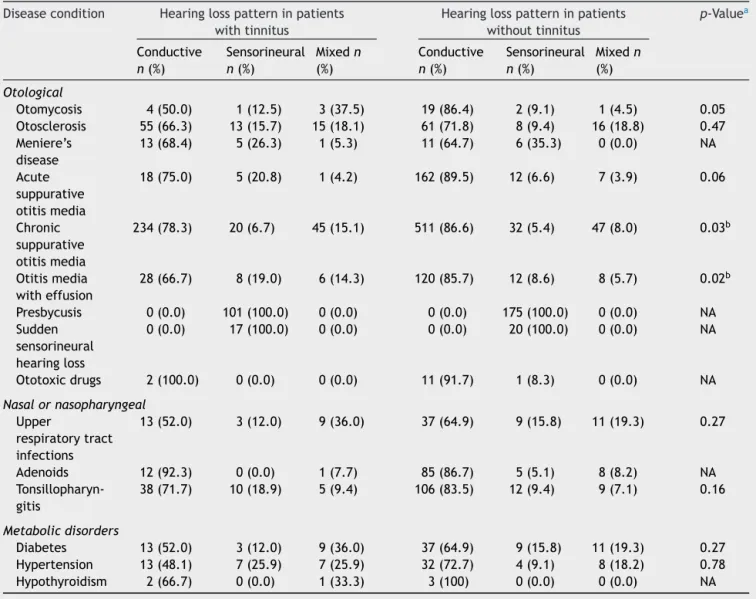
Withregardtopatternofhearingloss,conductivetype was observed in 62.6% (n=599), sensorineural in 21.0% (n=201) and mixed type in 13.3% (n=127) of tinnitus cases (Table 3). It was observed that there is a signifi-cantassociation oftinnituswithsensorineural(37.2%)and mixedhearing loss (40.1%) when comparedtoconductive hearingloss (26.6%) (Table 1,Fig. 1). High prevalence of
sensorineuralandmixedhearinglosswasobservedin tinni-tuscasesaffectedwithotitismedia(Table3).
Discussion
and
conclusion
Tinnitusisacommondisorderwhichoccursfrequentlyacross allstrataofpopulationandexhibitsanimportanthealth con-cern. Clinicalandepidemiologicalstudiesontinnitushave revealed that 5---32% of the world population is affected
Table2 Degreeofhearinglossinsubjectswithandwithouttinnitusinotologicaldisorders.
Diseasecondition Hearinglosswithtinnitus Hearinglosswithouttinnitus OR(95%CI)a
<40dBn(%) >40dBn(%) <40dBn(%) >40dBn(%)
Otological
Otomycosis 3(37.5) 5(62.5) 14(63.6) 8(36.4) 3.33(0.81---13.75)
Otosclerosis 20(24.1) 63(75.9) 13(15.3) 72(84.7) 0.54(0.26---1.14)
Meniere’sdisease 11(57.9) 8(42.1) 12(70.6) 5(29.4) 1.73(0.44---6.79)
Acutesuppurativeotitismedia 19(79.2) 5(20.8) 154(85.1) 27(14.9) 1.50(0.52---4.36) Chronicsuppurativeotitismedia 184(61.5) 115(38.5) 436(73.9) 154(26.1) 1.76(1.32---2.38)c
Otitismediawitheffusion 22(52.4) 20(47.6) 94(67.1) 46(32.9) 1.83(0.92---3.67)
Presbycusis 18(17.8) 83(82.2) 35(20.0) 140(80.0) 1.15(0.61---2.16)
Suddensensorineuralhearingloss 2(11.8) 15(88.2) 3(15.0) 17(85.0) 1.32(0.19---9.02)
Ototoxicdrugs 1(50.0) 1(50.0) 10(83.3) 2(16.7) 5.50(0.24---128.97)
Nasalornasopharyngeal
Upperrespiratorydisorders 140(66.4) 71(33.6) 430(70.1) 183(29.9) 1.21(0.87---1.68)
Adenoids 13(100.0) 0(0.0) 70(71.4) 28(28.6) NA
Tonsillopharyngitis 30(56.6) 23(43.4) 98(77.2) 29(22.8) 2.86(1.46---5.59)b
Co-morbidities
Diabetes 13(52.0) 12(48.0) 34(59.6) 23(40.4) 1.41(0.55---3.61)
Hypertension 15(55.6) 12(44.4) 31(70.5) 13(29.5) 1.79(0.67---4.81)
Hypothyroidism 2(66.7) 1(33.3) 2(66.7) 1(33.3) 1.00(0.03---29.81)
n,Frequency;OR,oddsratio;95%CI,95%confidenceinterval;NA,notapplicable.
aBinarylogisticregressionanalysis.
Table3 Patternofhearinglossinsubjectswithandwithouttinnitusinotologicaldisorders.
Diseasecondition Hearinglosspatterninpatients withtinnitus
Hearinglosspatterninpatients withouttinnitus
p-Valuea
Conductive
n(%)
Sensorineural
n(%)
Mixedn
(%)
Conductive
n(%)
Sensorineural
n(%)
Mixedn
(%)
Otological
Otomycosis 4(50.0) 1(12.5) 3(37.5) 19(86.4) 2(9.1) 1(4.5) 0.05
Otosclerosis 55(66.3) 13(15.7) 15(18.1) 61(71.8) 8(9.4) 16(18.8) 0.47 Meniere’s
disease
13(68.4) 5(26.3) 1(5.3) 11(64.7) 6(35.3) 0(0.0) NA
Acute suppurative otitismedia
18(75.0) 5(20.8) 1(4.2) 162(89.5) 12(6.6) 7(3.9) 0.06
Chronic suppurative otitismedia
234(78.3) 20(6.7) 45(15.1) 511(86.6) 32(5.4) 47(8.0) 0.03b
Otitismedia witheffusion
28(66.7) 8(19.0) 6(14.3) 120(85.7) 12(8.6) 8(5.7) 0.02b
Presbycusis 0(0.0) 101(100.0) 0(0.0) 0(0.0) 175(100.0) 0(0.0) NA
Sudden sensorineural hearingloss
0(0.0) 17(100.0) 0(0.0) 0(0.0) 20(100.0) 0(0.0) NA
Ototoxicdrugs 2(100.0) 0(0.0) 0(0.0) 11(91.7) 1(8.3) 0(0.0) NA
Nasalornasopharyngeal
Upper
respiratorytract infections
13(52.0) 3(12.0) 9(36.0) 37(64.9) 9(15.8) 11(19.3) 0.27
Adenoids 12(92.3) 0(0.0) 1(7.7) 85(86.7) 5(5.1) 8(8.2) NA
Tonsillopharyn-gitis
38(71.7) 10(18.9) 5(9.4) 106(83.5) 12(9.4) 9(7.1) 0.16
Metabolicdisorders
Diabetes 13(52.0) 3(12.0) 9(36.0) 37(64.9) 9(15.8) 11(19.3) 0.27
Hypertension 13(48.1) 7(25.9) 7(25.9) 32(72.7) 4(9.1) 8(18.2) 0.78
Hypothyroidism 2(66.7) 0(0.0) 1(33.3) 3(100) 0(0.0) 0(0.0) NA
n,Frequency;NA,notapplicable.
a
2test.
Levelofsignificanceofoddsratio:bp-value<0.05.
withtinnitus.2,12,13 Manyrisk factorsassociatedwithonset oftinnitushavebeenreported,ofwhichthemostprominent areage,gender,auditory,metabolicandneurological disor-ders,vascularalterations,dentalfactors,exposuretonoise, ototoxicdrugs, caffeine,nicotine, andalcohol.4,8,9,14 Oto-logicaldisordersarethemostcommoncauseoftinnitus.15 Various otological diseases can lead to tinnitus and dif-ferent types of hearing loss. This is due to infection or stiffeningof bonesor spasms ofoneof thetwotiny mus-cles attached to bones of the middle ear, which affects thesoundtransmissionsystemintheear.9,16,17Furthermore, various nasopharyngeal factorsare involved in Eustachian tubedysfunction,predisposingtomiddleearinfections.In the present study, 29.3% of the otological disorders were affectedwithtinnitus,ofwhich30.3% wereaffectedwith nasal or nasopharyngeal factors especially tonsillopharyn-gitisinparticular causingEustachiantubedysfunctionand middle ear infection leadingto hearing loss and tinnitus, probablythroughlymphaticspread.Howeverthisneedsto befurtherstudied.
Manystudies conductedontinnitushave reportedhigh malepreponderance, whichwasmainlyattributedtohigh environmental and occupational exposure.2,18,19 However, higher female preponderance of tinnitus has also been reportedby afew studies.20 In thepresent study,tinnitus hasbeenfoundtoaffectbothmalesandfemales,butwith ahighmalepreponderance,whichisduetothegreater num-berofmalesubjectsvisitingthehospitalwhencomparedto females.However,itwasalsonoticedthattherewasa sig-nificantincrease infemalecasesfor thetreatment atthe chronicstageofeardiseases/tinnitus.
bytheelderlypeoplearereportedtocausetinnitus. More-over, increasedlevel ofinsulin resistance andsome drugs usedfor the treatment of hypertension worsenthe resis-tanceandcanfavortinnitusonset.21,24Inthepresentstudy, tinnituswasobservedin30.1%ofpatientswithdiabetes mel-litus,38.8%in hypertensionand40%withhypothyroidism. Medicationssuchassalicylates,aminoglycosideantibiotics, quinine,orcisplatinusedtotreatotologicaland nasopharyn-gealdiseasescancausedamagetothecochleaandtriggeror enhancetinnitus.1,25,26Itwasfoundthat13.3%ofototoxicity casescontributedtotinnitusinthepresentstudy.
Hearinglossandtinnitusarecloselyrelated,asthe preva-lenceof hearingloss is higher intinnitus cases.5,24 Inthe present study,96.9% of cases withtinnitushave a signifi-cant association withhearing loss, indicating it asone of thecrucialriskfactors.Moreover,theoccurrenceofhearing lossathigherfrequenciesintinnitussubjectsindicatesthe severityofsufferingcausedduetootologicaldisorders.27,28 Further,auditorypathologyinmiddleandinnerpartsofear canleadtodifferentpatternofhearingloss.Interestingly, inthepresentstudyitwasobservedthatconductiveform isthemostcommoncauseofhearinglossandtinnituswhen comparedtosensorineuralhearingloss.Inaddition,middle eardiseasesinthisstudyweremorecompromisedthanthe innerear,unlikeother studies.29,30 Thisvariationcouldbe attributedtogeographical distributionandsocioeconomic status.Further,inthepresentstudy95%ofmiddleear dis-easesobtainedrelieffromhearinglossand86%fromtinnitus aftertreatmentwithsurgicalandmedicalinterventions.In thepresentstudy,therewasasignificantincreaseinhearing lossathigherfrequencywithsensorineuralandmixedtype intinnitussubjectswithCSOM.TheresultsindicateCSOMas oneofthemost commonotologicaldiseases affectingthe middleandinnerearleadingtotinnitusandhearingloss.
Inconclusion,the presentstudy indicatesotitismedia, presbycusis, and otosclerosis are the most common con-tributing factorsleading totinnitus andhearing loss. The prevalence of tinnitus increased with the progression of the otological disorders. Hence, efforts to control these riskfactorsmayhelpinamelioratingtinnitusandimproving qualityof lifeof the affected individuals. Furtherstudies onthegeneticsoftinnitusassociatedwithhearinglosswill undoubtedlyleadtoeffective therapeuticapproachesand clinicalmanagementoftinnitus.
Conflicts
of
interest
Theauthorsdeclarenoconflictsofinterests.
Acknowledgements
Theauthors thankMrs.B.SunitaG Kumar,CMD,MAA ENT Hospitalsfor her support and cooperation in carryingout thework.WealsothankDr.BalakrishnaofNINforproviding supportinperformingthestatisticalanalysis.
References
1.Baguley DM. Mechanisms of tinnitus. Br Med Bull. 2002;63: 195---212.
2.Heller AJ. Classification and epidemiology of tinnitus. OtolaryngolClinNAm.2003;36:239---48.
3.VernonJA,MeikleMB.Measurementoftinnitus:anupdate.In: KitaharaM,editor.Tinnitus:pathophysiologyandmanagement. Tokyo:Igaku-Shoin;1988.p.36---52.
4.Sindhusake D, Golding M, Newall P, Rubin G, Jakobsen K, Mitchell P. Risk factors for tinnitus in a population of older adults: the blue mountains hearing study. Ear Hear. 2003;24:501---7.
5.HoffmanHJ,ReedGW.Epidemiologyoftinnitus.In:SnowJB, editor. Tinnitus: theory and management. Lewiston, NY: BC Decker;2004.p.16---41.
6.ChungDY,GannonRP,MasonK.Factorsaffectingtheprevalence oftinnitus.Audiology.1984;23:441---52.
7.SchecklmannM,VielsmeierV,SteffensT,LandgrebeM,Langguth B, Kleinjung T. Relationship between audiometric slope and tinnituspitchintinnituspatients:insightsintothemechanisms oftinnitusgeneration.PLoSONE.2012;7:e34878.
8.SteinmetzLG,ZeigelboimBS,LacerdaAB,MorataTC,Marques JM.Evaluatingtinnitusinindustrialhearinglossprevention pro-grams.IntTinnitusJ.2008;14:152---8.
9.DobieRA.Overview:sufferingfromtinnitus.In:SnowJB,editor. Tinnitus:theoryand management.Lewiston,NY:BCDecker; 2004.p.1---7.
10.JastreboffPJ,HazellJW.Aneurophysiologicalapproachto tinn-itus:clinicalimplications.BrJAudiol.1993;27:7---17.
11.VempatiA, PrakashSGR,RathnaSB,SandhyaK.Management optionsfor individualswithtinnitus---areview.IntJSciRes. 2013;2:290---4.
12.Quaranta A, AssennatoG, Sallustio V.Epidemiology of hear-ing problems among adults in Italy. Scand Audiol Suppl. 1996;42:9---13.
13.PilgrammM, Rychlick R, LebischH, Siedentop H, GoebelG, Kirchhoff D. Tinnitus in the Federal Republic of Germany: a representative epidemiological study. In: Hazell J, edi-tor. Proceedings of the 6th International Tinnitus Seminar. Cambridge,London:TheTinnitusandHyperacusisCentre;1999. p.64---7.
14.SchleuningAJ.Managementofthepatientwithtinnitus.Med ClinNAm.1991;75:1225---37.
15.CrummerR,GhinwaH.Diagnosticapproachtotinnitus.AmFam Phys.2004;69:120---6.
16.ColesRRA.Classificationofcauses,mechanismsofpatient dis-turbance,andassociatedcounseling.In:VernonJA,MollerAR, editors.Mechanismsoftinnitus,75.NeedhamHeights,MA:Allyn &Bacon;1995.p.1225---37.
17.WeberPC, KleinAJ. Hearing loss. MedClin NAm. 1999;83: 125---37.
18.FabijanskaA, RogowskiM,Bartnik G, SkarzynskiH. Epidemi-ology of tinnitusand hyperacusis in Poland. In: Hazell JWP, editor. Proceedings of the 6th International Tinnitus Sem-inar. London: The Tinnitus and Hyperacusis Centre; 1999. p.569---71.
19.JohanssonMS,ArlingerSD.Prevalenceofhearingimpairmentin apopulationinSweden.IntJAudiol.2003;42:18---28.
20.Cooper JC. Health and Nutrition Examination Survey of 1971---75:PartII. Tinnitus,subjective hearingloss,and well-being.JAmAcadAudiol.1994;5:37---43.
21.DavisA,RafaieEA.Epidemiologyoftinnitus.In:TylerRS,editor. Tinnitushandbook.SanDiego:Singular;2000.p.1---23.
22.PodoshinL,Ben-DavidJ,TeszlerCB.Pediatricandgeriatric tinn-itus.IntTinnitusJ.1997;3:101---3.
23.TeraoK,CureogluS,SchachernPA,MoritaN,NomiyaS,Deroee AF,etal.Cochlearchangesinpresbycusiswithtinnitus.AmJ Otolaryngol.2011;32:215---20.
25.FaustiSA,HenryJA,FreyAH.Ototoxicity.In:NorthernJL, edi-tor.Hearingdisorders.NeedhamHeights,MA:Allyn&Bacon; 1995.p.149---64.
26.FolmerRL,GriestSE.Tinnitusandinsomnia.AmJOtolaryngol. 2000;21:287---93.
27.BaskillJL,ColesRRA. Relationshipbetweentinnitusloudness andseverity.In:HazellJJ,editor.SixthInternationalTinnitus Seminar.Cambridge,UnitedKingdom:TheTinnitusand Hyper-acusisCentre;1999.p.424---8.
28.WeiszN,VossS,BergP,ElbertT.Abnormalauditorymismatch responseintinnitussuffererswithhigh-frequencyhearingloss
is associated with subjective distress level. BMC Neurosci. 2004;5:8---16.
29.Savastano M. Tinnitus with or without hearing loss: are its characteristics different? Eur Arch Otorhinolaryngol. 2008;265:1295---300.