A feasibility study of cell phone and landline
phone interviews for monitoring of risk
and protection factors for chronic
diseases in Brazil
Exequibilidade do uso de entrevistas por telefone
celular e por telefone fi xo no monitoramento
de fatores de risco e proteção para
doenças crônicas
1 Ministério da Saúde, Brasília, Brasil. 2 Núcleo de Pesquisas Epidemiológicas em Nutrição e Saúde, Universidade de São Paulo, São Paulo, Brasil. 3 Expertise Pesquisas, Belo Horizonte, Brasil. 4 Escola de Enfermagem, Universidade Federal de Minas Gerais, Belo Horizonte, Brasil.
Correspondence E. C. Moura Ministério da Saúde. SQSW, Brasília, DF 70673-506, Brasil. [email protected]
Erly Catarina Moura 1,2 Rafael Moreira Claro 2 Regina Bernal 2 Juliano Ribeiro 3
Deborah Carvalho Malta 1,4 Otaliba Morais Neto 1
Abstract
The study objective was to evaluate the feasibil-ity of interviews by cell phone as a complement to interviews by landline to estimate risk and pro-tection factors for chronic non-communicable diseases. Adult cell phone users were evaluated by random digit dialing. Questions asked were: age, sex, education, race, marital status, owner-ship of landline and cell phones, health condi-tion, weight and height, medical diagnosis of hypertension and diabetes, physical activity, diet, binge drinking and smoking. The estimates were calculated using post-stratification weights. The cell phone interview system showed a reduced capacity to reach elderly and low educated popu-lations. The estimates of the risk and protection factors for chronic non-communicable diseases in cell phone interviews were equal to the esti-mates obtained by landline phone. Eligibility, success and refusal rates using the cell phone sys-tem were lower than those of the landline syssys-tem, but loss and cost were much higher, suggesting it is unsatisfactory as a complementary method in such a context.
Chronic Disease; Interview; Telephone
Introduction
The current demographic situation in Brazil indi-cates an increase in life expectancy in all country regions and, consequently, an increase in the el-derly population. This situation, along with im-provements in sanitation, has led to a growth in morbid-mortality caused by chronic non-com-municable diseases 1. Nowadays, in Brazil, about 60% of total deaths and 40% of all diseases are caused by chronic non-communicable diseases 2.
Chronic non-communicable diseases are characterized by presenting multiple and com-mon risk factors, such as smoking, overweight, binge drinking, sedentary lifestyle and inadequate diet 3. Many of these factors may be changed by public policies aiming to improve a population’s quality of life, in order to reduce the prevalence of these diseases. For this reason, in 2006 the Brazil-ian Ministry of Health introduced, in all BrazilBrazil-ian state capitals and in the Federal District, the Risk and Protective Factors Surveillance System for Chronic Non-Communicable Diseases through Telephone Interviews (VIGITEL) 4.
27 places studied presented coverage over 70%, with this being one of the most important biases of VIGITEL 5. These biases can be corrected, par-tially by the use of post-stratification weights, even though in the Federation units with cover-age rates above 70% these bias is disregarded 6. In general, VIGITEL underestimates the percent-age of men, young people and those with lower levels of schooling 5,6,7,8,9. On the other hand, the growth of cell phone coverage 10, mainly in the pre-paid modality has drastically increased in Brazil, representing an important comple-ment to landline coverage, aimed at reaching under-represented populations in VIGITEL and correcting possible remaining biases even after the use of post-stratification weights.
This study subsequently aims to evaluate the feasibility of the use of cell phone interviews (hereafter called VIGITEL-cell) as a comple-ment to VIGITEL, which operates only with land phones (hereafter called VIGITEL-landline) by determining the differences between cell phone interviews and the interviews performed by VIGITEL-landline regarding the socio-demo-graphic characteristics of the interviewed popu-lation, the estimates of certain risk and protection factors for chronic non-communicable diseases as well as the performance of the system.
Material and methods
Study population and sampling
Adult (≥ 18 years old) cell phone users were
stud-ied in two State Capitals served by a VIGITEL-landline: Belo Horizonte (in Minas Gerais State) and Maceió (Alagoas). These cities were chosen because they have landline coverage in extreme limits – slightly above 70% in Belo Horizonte and almost 40% in Maceió.
The method used to choose the sample for mobile lines consisted in random digit dialing 11. This procedure of choosing samples of mobile lines for each conglomerate occurs in two steps, the primary sampling unit (PSU) being defined by the first four digits. The phone directory to the PSU lot was obtained at the National Agency of Telecommunications. In the first step, 1,000 PSUs were randomly chosen. In each PSU selected, three phone numbers were generated by ran-domly adding the four last suffixes which ranged from 0000 to 9999. Each one of these numbers were dialed allowing to classify its PSU either as “promising” or “not promising”. When all the dialed numbers were classified as not promis-ing, that PUS was discarded, otherwise it was retained. The process was then repeated until
all PSUs were used. In the second step, in each retained PSU, 20 phone numbers were generated by randomly adding the four last suffixes. These phone numbers, from which the interviews were conducted, were dialed until those potentially se-lected were all used.
Data collection
All evaluated individuals were questioned about: age, sex, schooling, race, marital status, land and cell phone possession, health conditions, weight and height, hypertension and diabetes medical diagnosis. VIGITEL-cell was operated at the same time as VIGITEL-landline by inter-viewers skilled at landline interviews. The first calls for all the selected lines aimed at identifying the line and the respondent’s eligibility for the study. As the interview was conducted through a cell phone, the first thing to be evaluated was the phone call answering availability. Afterwards, the city of residence and age of the attendant were confirmed. Then, the study eligible popula-tion was randomly divided into three groups, to answer a certain module of questions from the VIGITEL-landline questionnaire: physical activ-ity standard (n = 440), diet standard (n = 384) and binge drink and smoking standard (n = 383). On average, each interview lasted 5 minutes and 17 seconds.
Whenever the answerer agreed, the inter-view was carried out immediately, otherwise it was scheduled for another day and hour that was more convenient for the respondent. Up to ten phone calls were made to every phone number, obligatorily in the morning, in the afternoon and in the evening on a working day, in the morning and in the afternoon on Saturday and in the after-noon on Sunday or on a holiday.
Data analysis
The VIGITEL-cell evaluation initially served to focus the sample representation under study within the system, taking into account the extent to which the sample represents the set of adult individuals from each city. For this purpose, an evaluation was carried out of the existing socio-demographic differences between those individ-uals that answered the interview by cell phone, those by landline phone and the total adult pop-ulation given in the 2000 Demographic Census (IBGE. http://www.ibge.gov.br).
weights were introduced. In the case of the popu-lation with cell phone, the estimates were pro-duced using corresponding individual weights based on the ratio between the number of adults who use the cellular called and the number of cell phone lines used by the person interviewed. In the case of total population, individual weights were multiplied by post-stratification weights that take into account the existing socio-demo-graphic differences between the adult popula-tion with a cell phone and the total adult pop-ulation of the city. To obtain post-stratification weights, the population sample with cell phone was compared to a sample of the city population from the Demographic Census. Such a compari-son was made based on a stratification of the two samples by sex (masculine and feminine), six age groups (18-24, 25-34, 35-44, 45-54, 55-64 and ≥ 65
years) and three schooling levels (0-8, 9-11 and ≥
12 years). For each stratum, the frequency ratio between census sample and monitoring system sample was calculated, in order to correct even-tual sub or super-representation of each stratum studied by the monitoring system 12. Weights of post-stratification were calculated separately for each module of answers, as populations were dif-ferent from each other. Additionally, differences between cell and landline were also investigated for all indicators.
Indicators referring to system technical per-formance – eligibility rates (lines of potential use/total lines carried out), refusal rates (refus-als/eligible lines), success rates (concluded in-terviews/eligible lines) and loss rates [lines of potential use (concluded interviews + refusals)/ eligible lines)] and interview costs (call price + call attempts to complete an interview) – were also evaluated. Office phone numbers, non ex-isting numbers and users under the age of 18 or residents in a different city to that being evalu-ated were considered ineligible, being discarded on the first call; off service phone numbers, dis-connected phone numbers, out of service area/ coverage, those programmed not to receive calls, those temporarily programmed not to receive calls, those programmed not to receive collect calls or in which it was not possible to complete the call were discarded after 10 calls with the same outcome. Every other situation (completed interview, interrupted interview, scheduled in-terview, personalized answering machine, mes-sage in-box, busy, not answered calls and refusal) were considered eligible.
Data was analyzed with the Stata software (Stata Corp., College Station, USA), and the re-sults were compared with a VIGITEL-landline 8 by means of a 95%CI.
Ethical aspects
In this study, as interviews were conducted by phone, free and clarified consent was replaced by verbal consent obtained by phone during con-tact with people interviewed. The study was ap-proved by the Health Commission for Research Ethics with Human Beings in the Brazilian Min-istry of Health.
Results
We performed 1,207 interviews through calls made to cellular telephones; 566 in Belo Hori-zonte and 641 in Maceió. The performance eval-uation of the VIGITEL-cell was compared with data for the VIGITEL-landline, made in 2008 in the same cities, in a total of 2.016 interviews in each one 8.
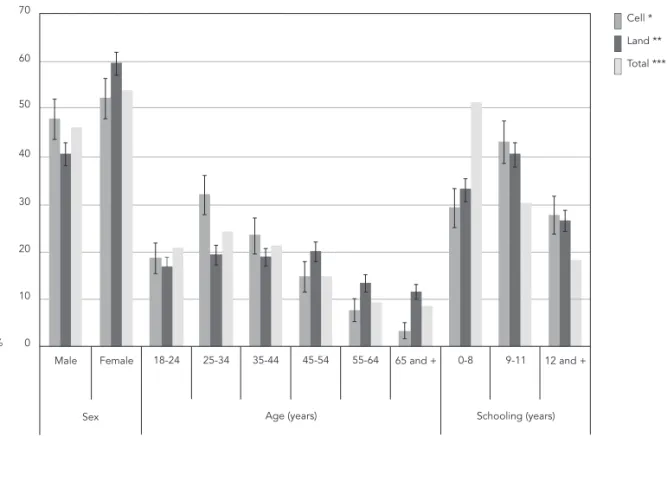
Figures 1 and 2 show that the sex distribution of the population interviewed by cell phone is more similar to the total adult population than was the case for the population interviewed by landline phone, where men are under-represent-ed. The distribution by age range of individuals interviewed by cell is close to that of the total adult population, even if there is an overestima-tion in the proporoverestima-tion of people aged between 25 and 34 and an underestimation of those over 45. For both those populations interviewed by cell and those by landline phones the proportion of individuals with low levels of schooling was un-derestimated. In general, the two cities present similar results, though in Maceió the frequency of individuals with up to 8 years of schooling is higher for the population interviewed by cell compared with the landline group.
All people interviewed were questioned on health, morbidity and nutritional status; however 92 did not divulge information about weight and/ or height, reducing to 1,115 the number of adults whose nutritional status was evaluated.
higher among those interviewed by cell phone. After the use of the post-stratification weights, the estimates were found to be similar between the interviews by cell and landline phone, even when the differences between cell and landline indicators were examined.
Figure 3 illustrates system performance. Rates of eligibility, success and refusals of cell were found to be lower than for those responding through the landline system; however its loss rate is considerably higher. These factors, allied to the higher cost of the cell phone call, have compara-tively increased the cost of cell interviews by a factor of 6.6 compared with landlines.
Discussion
The use of interviews by cell phone, as opposed to by landline phone, increased the participation of two groups: men, guaranteeing a similar
distri-Figure 1
Estimates for the distribution (% and 95%CI) of the adult population with cell phone, of the adult population with land phone and of the total adult population according to socio-demographic variables. Belo Horizonte, Minas Gerais State, Brazil, 2008.
* Weighted to represent distribution of population aged ≥ 18 years with cell phone; ** Weighted to represent distribution of population aged ≥ 18 years with landline phone;
*** Weighted to represent distribution of population aged ≥ 18 years according to Brazil’s Demographic Census for the year 2000 (http://www.ibge.gov.br).
bution ratio for sexes in individuals between 25 and 35 years old (reducing the ratio of people ≥
45 years); and individuals with a greater number of years of schooling (≥ 9 years of study),
under-estimating the ratio of those with low levels of schooling (0-8 years) as in landline interviews. With the exception of the more elderly, the fre-quency of age and schooling stratum in cell phone interviews had a similar distribution to those obtained in landline interviews.
A similar situation with regard to a greater participation of men and young people was ob-served in a study conducted in three American states 13. This increase can be explained by the improved access to these demographic strata outside of their homes. It is natural to believe that a similar phenomenon also serves as an explana-tion for the results of the present study.
Figure 2
Estimates for the distribution (% and 95%CI) of the adult population with cell phone, of the adult population with land phone and of the total adult population according to socio-demographic variables. Maceió, Alagoas State, Brazil, 2008.
* Weighted to represent distribution of population aged ≥ 18 years with cell phone; ** Weighted to represent distribution of population aged ≥ 18 years with landline phone;
*** Weighted to represent distribution of population aged ≥ 18 years according to Brazil’s Demographic Census for the year 2000 (http://www.ibge.gov.br).
participation of those from a lower education stratum, as this modality demands lower finan-cial investment and allows for greater control of amounts spent in bills, compared with post-paid cell phones or landlines. On the other hand, the use of cell phones, recently introduced in Brazil, has not been able to reach the elderly population (compared with young people).
The estimates comparison from some of the indicators evaluated show that people inter-viewed by cell phone and landline phone behave differently 14. This study confirmed that among cell phone users there is a higher frequency of smokers, binge drinking and people that are phys-ically active during leisure time, with good health conditions and a lower prevalence of diabetes. Our data also shows there to be some differences between some indicators: a lower frequency of
Table 1
Percentage (% and 95%CI) of risk and protection factors for chronic non-communicable diseases according to type of telephone interview. Surveillance System of Risk and Protective Factors for Chronic Non-Communicable Diseases through Telephone Interviews (VIGITEL). Belo Horizonte, Minas Gerais State, Brazil, 2008.
Risk and protection factors Interview
Cell phone Landline phone Difference
between cell and landline ** Weight 1 * Weight 2 ** Weight 1 * Weight 2 **
% (95%CI) % (95%CI) % (95%CI) % (95%CI) % (95%CI)
Poor self-related health 3.0 (1.5-4.4) 3.8 (1.8-5.8) 3.9 (2.9-4.8) 3.5 (2.5-4.4) 0.3 (-1.9-2.5)
Hypertension 17.6 (14.4-20.9) 21.9 (17.2-26.5) 27.6 (25.4-29.8) 24.5 (22.0-27.0) -2.6 (-7.9-2.6) Diabetes 4.0 (2.3-5.6) 5.8 (2.9-8.8) 6.0 (4.7-7.0) 5.0 (3.9-6.1) 0.8 (-2.3-4.0) Overweight 39.6 (35.3-44.0) 43.6 (38.0-49.2) 42.8 (40.3-45.3) 43.3 (39.5-47.2) 0.2 (-6.5-4.1) Obesity 10.4 (7.7-13.1) 11.9 (8.3-15.5) 11.4 (9.8-12.9) 12.1 (9.8-14.3) -0.2 (-4.4-4.1) Binge drinking 28.1 (21.2-35.0) 25.1 (17.1-33.1) 20.2 (18.2-22.1) 20.8 (18.2-23.5) 4.3 (-4.2-12.7)
Sufficient leisure-time physical activity 16.6 (11.2-22.0) 21.3 (12.2-30.5) 16.3 (14.5-18.0) 16.1 (13.7-18.4) 5.3 (-4.2-14.7) Regular fruit and vegetable intake 32.5 (25.3-40.0) 35.2 (24.5-45.9) 44.0 (41.6-46.4) 38.6 (35.3-42.0) -3.4 (-14.6-7.7) Recommended fruit and vegetable intake 21.4 (15.1-27.7) 26.6 (15.6-37.6) 25.0 (22.9-27.1) 21.6 (19.0-24.2) 5.0 (-6.2-16.2) Visible meat fat intake 44.0 (36.4-51.6) 42.7 (32.7-52.7) 36.3 (34.0-38.7) 41.1 (37.4-44.8) 1.6 (-9.1-12.2) Whole milk intake 58.6 (51.1-66.1) 61.0 (51.6-70.4) 53.7 (51.3-56.1) 54.4 (50.6-58.1) 6.7 (-3.4-16.8)
Regular soft-drink intake 31.6 (24.4-38.7) 26.8 (19.0-34.6) 22.1 (20.1-24.1) 27.1 (23.2-30.9) -0.2 (-8.9-8.4) Smoker 18.7 (12.8-24.6) 15.9 (9.8-21.9) 15.1 (13.4-16.8) 19.2 (15.4-23.0) -3.3 (-10.4-3.8) Ex-smoker 20.7 (14.6-26.9) 26.1 (16.4-35.9) 22.1 (20.2-24.1) 20.2 (17.9-22.5) 5.9 (-4.1-16.0) Smoker of 20 or more cigarettes/day 7.3 (3.3-11.3) 6.7 (2.4-10.9) 5.4 (4.3-6.5) 7.9 (4.4-11.5) -1.3 (-6.8-4.3)
* Weighted to represent distribution of population aged ≥ 18 years with cell or landline phone;
** Weighted to represent distribution of population aged ≥ 18 years according to Brazil’s Demographic Census for the year 2000 (http://www.ibge.gov.br).
cell phone and landline phone respondents dis-appear after post-stratification weights are used, so that populations interviewed by cell phone and landline phone show similar frequencies of the indicators studied (physical activity, smoking, diet, morbidity and health condition evaluation). This way, for the total population, as far as the studied factors are concerned there were no dif-ferences between the two sub-samples (people interviewed by landline phone and cell phone) in Maceió and Belo Horizonte.
As to the system performance, even though it is not yet possible to make direct compari-sons between data from Brazil and that of other studies 13,15,16, it is worth pointing out the low eligibility of numbers called and the higher in-terview cost per cell phone. The inin-terview cost per cell phone in Brazil was 6.6 times higher than the interview cost per landline phone, a much higher cost than that found in the United States – 2.4 times (including financial incentives for the people interviewed) – capable of reaching five times this value, depending on the sampling system 16.
Both the growth of surveys performed by residential landline telephone and the recent in-crease in coverage of cell telephony (and a fall in landline phone coverage) have been addressed by many researchers, particularly in the United States. Data from a national survey in the United States 14 shows that in 2008, 20.2% of households owned only cell phones, which in general is not taken into account when it comes to selecting the sample to be evaluated. Although it is recog-nized that the differences between people with cell phones and those with landline phones may cause a coverage bias, there is unanimity in the view that the introduction of cell phones will not solve the problem, since part of the popula-tion does not own any kind of telephone. The use of post-stratification weights, such as those used in the VIGITEL, is widely recommended to reduce this bias 16, not only for studies in the health area, but also in other areas, such as the recent example of the North American presi-dential election 14.
Table 2
Percentage (% and 95%CI) of risk and protection factors for chronic non-communicable diseases according to type of telephone interview. Surveillance System of Risk and Protective Factors for Chronic Non-Communicable Diseases through Telephone Interviews (VIGITEL). Macéio, Alagoas State, Brazil, 2008.
Risk and protection factors Interview
Cell phone Landline phone Difference
between cell and landline ** Weight 1 * Weight 2 ** Weight 1 * Weight 2 **
% (95%CI) % (95%CI) % (95%CI) % (95%CI) % (95%CI)
Poor self-related health 4.8 (3.0-6.5) 5.6 (3.2-8.0) 5.6 (4.4-6.7) 6.7 (4.5-8.9) -1.1 (-4.4-2.2) Hypertension 17.4 (14.3-20.5) 20.2 (15.8-24.7) 25.0 (22.9-27.1) 21.8 (18.6-25.0) -1.6 (-7.0-3.9) Diabetes 3.5 (2.0-5.0) 7.1 (2.4-11.8) 6.6 (5.3-7.8) 4.9 (3.7-6.1) 2.2 (-2.7-7.0) Overweight 41.0 (36.8-45.3) 46.7 (41.1-52.4) 43.8 (41.3-46.4) 42.5 (38.2-46.8) 4.3 (-2.9-11.4)
Obesity 13.1 (10.2-16.0) 16.0 (11.8-20.1) 13.1 (11.4-14.9) 13.9 (10.9-16.9) 2.0 (-3.1-7.2) Binge drinking 23.8 (17.4-30.2) 24.2 (16.2-32.3) 16.9 (15.0-18.7) 16.2 (13.2-19.1) 8.1 (-0.4-16.6) Sufficient leisure-time physical activity 15.2 (10.4-20.1) 12.1 (7.5-16.7) 18.4 (16.5-20.3) 15.6 (12.6-18.6) -3.4 (-8.9-2.0) Regular fruit and vegetable intake 29.7 (23.1-36.5) 31.5 (22.7-40.3) 37.3 (35.0-39.6) 28.5 (25.1-31.9) 3.0 (-6.4-12.4) Recommended fruit and vegetable intake 15.3 (10.0-20.6) 16.1 (9.1-23.1) 19.8 (17.9-21.7) 14.5 (12.1-17.0) 1.6 (-5.9-9.0)
Visible meat fat intake 37.1 (30.1-44.1) 36.9 (27.8-45.9) 27.0 (24.8-29.1) 29.1 (25.4-32.8) 7.7 (-2.0-17.5) Whole milk intake 47.0 (39.7-54.3) 43.0 (33.1-53.0) 48.7 (46.3-51.1) 49.7 (45.5-54.0) -6.7 (-17.5-4.2) Regular soft-drink intake 18.1 (12.5-23.6) 15.7 (9.4-22.1) 13.0 (11.3-14.7) 15.2 (12.0-18.3) 0.6 (-6.5-7.6) Smoker 11.1 (6.4-15.8) 11.2 (5.5-17.0) 9.3 (7.9-10.7) 9.7 (7.4-12.0) 1.5 (-4.6-7.7) Ex-smoker 19.0 (13.1-24.9) 18.9 (12.2-25.6) 21.7 (19.8-23.7) 21.6 (18.3-24.9) -2.7 (-10.2-4.8)
Smoker of 20 or more cigarettes/day 2.5 (2.3-4.8) 2.1 (1.4-4.2) 5.4 (4.3-6.5) 2.8 (1.3-4.2) -0.6 (-3.1-2.0)
* Weighted to represent distribution of population aged ≥ 18 years with cell or landline phone;
** Weighted to represent distribution of population aged ≥ 18 years according to Brazil’s Demographic Census for the year 2000 (http://www.ibge.gov.br).
its technical performance, having a high cost, still presenting very low coverage as regards the total adult population especially as far as elderly people and low education individuals are con-cerned. In addition to this, a careful approach must be taken 17, since the cell phone user’s le-gal situation may not allow him/her to answer the telephone. The estimates (corrected by post-stratification weights) of the risk and protec-tion factors were similar between both the cell phone system and landline phone system and there were no benefits in using the cell system in the conditions mentioned. It is recommend that the evaluation of landline telephony and
Figure 3
Performance of the cell phone and landline phone interview system. Belo Horizonte (Minas Gerais State) and Maceió (Alagoas State), Brazil, 2008.
Resumo
Avaliar a exequibilidade do uso de entrevistas por te-lefone celular de forma complementar ao fixo para estimativas de fatores de risco e proteção para doen-ças crônicas não transmissíveis. Questionou-se: idade, sexo, escolaridade, cor, situação conjugal, posse de te-lefones fixos e celulares, estado de saúde, peso e altura, diagnóstico hipertensão arterial e diabetes, atividade física, alimentação, consumo de bebidas alcoólicas e tabagismo. As estimativas foram calculadas com peso pós-estratificação. Observou-se, na população entre-vistada pelo celular, superestimação na idade entre 25 e 34 anos e subestimação na idade ≥ 45 anos e na faixa
de baixa escolaridade. No que se refere aos fatores de risco e proteção para doenças crônicas, as estimati-vas obtidas nas entrevistas por telefone celular foram iguais às obtidas pelo telefone fixo. As taxas de elegi-bilidade, de sucesso e de recusas do sistema por tele-fone celular foram menores do que as do sistema por telefonia fixa; ademais, a perda e o custo foram muito maiores no primeiro sistema, sugerindo que este é in-satisfatório como complemento no atual contexto.
Contributors
E. C. Moura and J. Ribeiro were responsible for data collection and analysis and for writing the article. R. M. Claro participated in the data analysis and article write-up. R. Bernal contributed towards the project de-sign and data analysis. D. C. Malta and O. Morais Neto reviewed the article.
References
1. Ministério da Saúde. Saúde Brasil 2006: uma análi-se da situação de saúde no Brasil. Brasília: Ministé-rio da Saúde; 2006.
2. Malta DC, Cezário AC, Moura L, Morais Neto OL, Silva Junior JB. A construção da vigilância e pre-venção das doenças crônicas não transmissíveis no contexto do Sistema Único de Saúde. Epide-miol Serv Saúde 2006; 15:47-65.
3. World Health Organization. World Health Report 2002. Reducing risks, promoting healthy life. Ge-neva: World Health Organization; 2002.
4. Moura EC, Morais Neto OL, Malta DC, Moura L, Silva NN, Bernal R, et al. Vigilância de Fatores de Risco para Doenças Crônicas por Inquérito Tele-fônico nas capitais dos 26 estados brasileiros e no Distrito Federal (2006). Rev Bras Epidemiol 2008; 11 Suppl 1:20-37.
5. Secretaria de Vigilância em Saúde, Ministério da Saúde. VIGITEL Brasil 2006. Vigilância de fatores de risco e proteção para doenças crônicas por in-quérito telefônico. Brasília: Ministério da Saúde; 2007.
6. Bernal R, Silva NN. Cobertura de linhas telefônicas residenciais e vícios potenciais em estudos epide-miológicos. Rev Saúde Pública 2009; 43:421-6. 7. Secretaria de Vigilância em Saúde, Ministério da
Saúde. VIGITEL Brasil 2007. Vigilância de fatores de risco e proteção para doenças crônicas por in-quérito telefônico. Brasília: Ministério da Saúde; 2008.
8. Secretaria de Vigilância em Saúde, Ministério da Saúde. VIGITEL Brasil 2008. Vigilância de fatores de risco e proteção para doenças crônicas por in-quérito telefônico. Brasília: Ministério da Saúde; 2009.
9. Secretaria de Vigilância em Saúde, Ministério da Saúde. VIGITEL Brasil 2009. Vigilância de fatores de risco e proteção para doenças crônicas por in-quérito telefônico. Brasília: Ministério da Saúde; 2010.
11. Potthoff RF. Some generalizations of the Mitofsky-Waksberg technique for random digit dialing. J Am Stat Assoc 1987; 82:409-18.
12. Moura EC, Malta DC, Morais Neto OL, Monteiro CA. Prevalence and social distribution of risk fac-tors for chronic non communicable diseases in Brazil. Rev Panam Salud Pública 2009; 26:17-22. 13. Link MW, Battaglia MP, Frankel MR, Osborn L,
Mokdad A. A comparison of address-based sam-pling versus random-digit dialing for general pop-ulation surveys. Public Opin Q 2008; 72:6-27. 14. Blumberg SJ, Luke JV. Wirelesssubstitution:
ear-ly release of estimates from the National Health Interview Survey, July-December 2008. http:// www.cdc.gov/nchs/data/nhis/earlyrelease/wire less200905.pdf (accessed on May/2009).
15. Brick JM, Dipko S, Presser, Tucker C, Yuan Y. Non response bias in a dual frame sample of cell and landline numbers. Public Opin Q 2006; 70:780-93. 16. Keeter S, Kenned C, Clark A, Tompson T,
Mokrzy-cki M. What’s missing from national landline RDD surveys? Public Opin Q 2007; 71:772-92.
17. Lavrakas PJ, Shuttles CD, Steeh C, Fienberg SH. The state of surveying cell phone numbers in the United States. Public Opin Q 2007; 71:840-54.
Submitted on 20/Mar/2010