Joelna Eline Gomes Lacerda Freitas Veras
I, Emanuella Silva Joventino
I, Janaina Fonseca Victor Coutinho
I,
Francisca Elisângela Teixeira Lima
I, Andressa Peripolli Rodrigues
I, Lorena Barbosa Ximenes
II Universidade Federal de Ceará, Faculty of Pharmacy, Dentistry and Nursing, Postgraduate Program in Nursing. Fortaleza, Ceará, Brazil.
How to cite this article:
Veras JEGLF, Joventino ES, Coutinho JFV, Lima FET, Rodrigues AP, Ximenes LB.
Risk classification in pediatrics: development and validation of a guide for nurses. Rev Bras Enferm. 2015;68(5):630-9. DOI: http://dx.doi.org/10.1590/0034-7167.2015680521i
Submission: 02-07-2015 Approval: 05-21-2015
ABSTRACT
Objective: to develop and validate a short guide for the protocol to user embracement with risk classifi cation in pediatrics. Method:
methodological study developed in two stages: development of the guide, and face and content validation. The development involved the stratifi cation of the protocol contents into fi ve risk indicators according to the level of complexity; subsequently it was submitted to validation by nine experts divided in two groups: professors who were also researchers, and nurses. Results: in the face validation the experts considered the 25 items of the guide clear and understandable, with agreement levels above 70%. In the content validation, 17 (68%) items were considered relevant by 88.9% of the experts. The eight items considered irrelevant were changed according to suggestions of the experts, yielding an overall content validity index of 0.98. Conclusion: the study resulted in a guide for the classifi cation of risks in pediatrics that is valid to assess children in emergency services.
Key words: Pediatric Nursing; Nursing Assessment; User embracement; Triage. Validation Studies.
RESUMO
Objetivo: construir e validar um guia abreviado do protocolo de Acolhimento com Classifi cação de Risco em pediatria. Método:
estudo metodológico, desenvolvido em duas etapas: elaboração do guia e validação aparente e de conteúdo. A elaboração baseou-se na estratifi cação do conteúdo do protocolo em cinco indicadores de risco, conforme a complexidade, baseou-sendo submetido à validação por nove juízes divididos em dois grupos: docentes-pesquisadores e enfermeiros. Resultados: na validação aparente, os juízes consideraram os 25 itens do guia claros e compreensíveis com concordância acima de 70%. Na validação de conteúdo, 17 (68%) itens foram considerados relevantes por 88,9% dos juízes. Os oito itens considerados irrelevantes foram alterados conforme sugestões dos juízes, alcançando-se o Índice de Validade de Conteúdo global de 0,98. Conclusão: o estudo resultou num guia de classifi cação de risco pediátrico válido para avaliar a criança nos serviços de emergência.
Descritores: Enfermagem Pediátrica; Avaliação em Enfermagem; Acolhimento; Triagem; Estudos de Validação.
RESUMEN
Objetivo: construir y validar una guía abreviada del protocolo de Acogimiento con Clasifi cación de Riesgo en pediatría. Método:
estudio metodológico, desarrollado en dos etapas: elaboración de la guía y validación aparente y de contenido. La elaboración se basó en la estratifi cación del contenido del protocolo en cinco indicadores de riesgo, conforme la complejidad, siendo sometido a la validación por nueve jueces divididos en dos grupos: docentes/investigadores y enfermeros. Resultados: en la validación aparente, los jueces consideraron los 25 ítems de la guía claros y comprensibles por la concordancia más de 70%. En la validación de contenido, 17 (68%) ítems fueron considerados relevantes por 88,9% de los jueces. Los ocho ítems considerados irrelevantes fueron alterados conforme sugestiones de los jueces, alcanzándose el Índice de Validad de Contenido global de 0,98. Conclusión: Se obtuvo una guía de clasifi cación de riesgo pediátrico válido para evaluar el niño en los servicios de emergencia.
Palabras clave: Enfermería Pediátrica; Evaluación en Enfermería; Acogimiento; Triaje; Estudios de Validación.
Risk classifi cation in pediatrics: development
and validation of a guide for nurses
Classifi cação de risco em pediatria: construção e validação de um guia para enfermeiros
Clasifi cación de riesgo en pediatría: construcción y validación de un guía para enfermeras
Joelna Eline Gomes Lacerda Freitas Veras E-mail: [email protected]
Risk classification in pediatrics: development and validation of a guide for nurses
631
Rev Bras Enferm. 2015 sept-oct;68(5):630-9.INTRODUCTION
Inadequacy of the demand for care in pediatric emergency services is a reality in many countries and in almost all Brazil-ian states. Studies shows that the number of patients present-ing health problems that could have been solved in the basic care network ranges between 46.9% and 89%(1-2).
Aiming to ensure better quality of care in emergency hos-pitals, the Ministry of Health, through the National Human-ization Policy, implemented the User Embracement with Risk Classification (ACCR - Acolhimento com Classificação de Risco) strategy, in which nurses embrace patients by means of qualified listening(3-5), identifying urgencies and emergen-cies based on the assessment of physiological parameters and warning signs set by protocols(3) and prioritizing the most se-vere cases(1).
In this context, the performance of nurses cannot be as-sociated only with intuition and clinical experience, but also with valid and relevant information based on research. Other components such as context, environment, available resourc-es, conditions and preferences of patients should also be con-sidered as important indicators for quality user embracement with risk classification(6).
However, studies have identified the use of subjective cri-teria, experience and intuition in such classification by risk(7), as well as flaws in the application of non-validated triage in-struments(8). Therefore, ACCR protocols are being developed and implemented with the support of the Ministry of Health, including the Odilon Beherns Hospital in Belo Horizonte, Minas Gerais, and the ACCR protocol in Pediatrics in Fortale-za, Ceará(9).
The ACCR protocol in pediatrics of Fortaleza consists of 17 pages. However, the hostile environment of emergencies may make it difficult to search the extensive protocols during the assessment of children, increasing the chance of failures in the classification of risks by the nurses working in the em-bracement(2). Thus, it is necessary to develop guides to enable instantaneous visualization of the signs and symptoms accord-ing to the main complaint, standardizaccord-ing the approach to the patient.
The following question was used in the development of this research: do the development and validation of a guide for risk classification in pediatrics ensure a reliable instrument that is valid to be used in the ACCR in pediatric emergency? Its objective was to develop and validate the face and content of a risk classification guide based on the ACCR protocol in pediatrics.
METHOD
A methodological study was developed in two stages: bib-liographic survey for the development of the guide based on the ACCR protocol in pediatrics(9), with subsequent face and content validation of the material by experts.
The first stage of the study was developed between January and May 2011 with a bibliographic survey in the databases Latin American and Caribbean Center on Health Sciences
Information (LILACS), National Library of Medicine (PubMed), Cumulative Index to Nursing and Allied Health Literature (CI-NAHL) and Scopus using the MeSH Terms “triage”, “pediat-rics” and “scale” in order to theoretically conceptualize the construct “risk classification for children” and identify risk indicators. No time frame was adopted and six internation-ally validated protocols and triage scales were included(10-15), as well as two concise measurement instruments(16-17) that sup-ported this study.
The risk classification guide was developed based on the bibliographic survey and the ACCR protocol in pediatrics with the risk indicators airways/breathing, circulatory system/ hemodynamics, level of consciousness, pain and hydration/ elimination, in which the clinical conditions of the protocol were distributed and organized in descending order accord-ing to level of priority in the colors red, orange, yellow, green and blue according to the proposal of the ACCR strategy(9).
The face and content validation stage of the guide took place between June and September 2011 through an analysis by content judges (experienced in validation studies in the area of children’s health) and technicians (clinically experi-enced in risk classification in pediatrics).
Content validity is based on the opinion of experts in the content domain area, who analyze the items and determine their relevance, comprehensiveness, representativeness and whether or not the content is related to what is desired to be measured(18). Face validity consists of the judgment according to clarity, understanding and readability of the content of the items, as well as the form of introduction of the instrument, verifying if the items are understandable to the target popula-tion of the instrument(18).
The guide was evaluated by content experts, who were both professors and researchers, with experience in the de-velopment and validation of instruments and by technical experts, nurses clinically experienced in risk classification in pediatric emergency (target audience to which the instrument was developed).
The selection of the content experts occurred through non-probabilistic intentional sampling based on a search by sub-ject in the Lattes Platform.A total of 23 researchers were found with 70% or more publications on the subject. Ten experts were selected for achieving a minimum score of five points according to the criteria of the expert classification system(19).
The technical experts should have proven expertise in ACCR in pediatrics, pediatric emergency nursing and care of patients in pediatric intensive care unit or child and adoles-cent health care. The snowball sampling criterion was used to conduct the selection as it is a non-probabilistic and in-tentional strategy that considers social networks to locate the sampling(18). Of the 13 nurses found living in Fortaleza, nine were selected as they met the criteria of the experiment set according to requirements of the expert classification system adapted to this research(19).
and content validation, and a copy of the ACCR Protocol in Pediatrics of Fortaleza(9) for consultation. However, only four content experts and five technical experts returned the instru-ment duly filled, totaling a sample of nine experts and meet-ing the recommendations of the literature(20). The instruments were returned to the researcher occurred by mail or e-mail.
The aspects clarity and understanding (confusing, unclear, or clear), and relevance of the items to the risk classification and indicator (no, partially, or yes) were considered for control and organization of the face validation stage of each item, consider-ing a level of agreement of 70% among the experts. Regard-ing content validity, the relevance (no, partially, or yes) and the level of relevance (irrelevant, unimportant, really important, or very important) were evaluated. Finally, a space intended for comments and suggestions by the experts was included.
The content of the guide was validated using the content validity index (CVI), which was calculated based on three math-ematical equations: the S-CVI/AVE (mean of I-CVIs for each item of the scale), S-CVI/UA (proportion of items in a scale that reaches a relevant rating of 3 or 4 for all experts), and the I-CVI (content validity of the individual items: proportion of experts that give the item the relevant rating of 3 or 4). Items with a CVI equal or greater than 0.80 are considered relevant(21). Data were processed using the Statistical Package for the Social Sciences (SPSS), version 17.0, and analyzed by means of descriptive sta-tistics with relative and absolute frequencies.
The study was approved by the Research Ethics Committee of the Federal University of Ceará (Brazil) under the protocol 110/2011. All ethical principles for research involving human subjects specified in Resolution 196 of 1996 of the National Health Council were respected. In this sense, the Free and Informed Consent Form was signed by the experts and sent to the researcher along with the instruments.
RESULTS
The first version of the short guide submitted to validation by the experts was introduced in a material with a 35-cell table, divided into five columns and seven rows. The content of the short guide was taken from the ACCR protocol in pedi-atrics. The first row presented the risk indicators classified in Airways/Breathing, Circulation/Hemodynamics, Level of Con-sciousness, Pain, Elimination/Hydration.
These five risk indicators were distributed in the columns that were divided in order to list the main complaints (symp-toms) and objective signs. Each risk indicator indicates the level of complexity of the patient in descending order of care priority in the colors red (level of complexity and priority I), orange (level of complexity and priority II), yellow (level of complexity and priority III), green (level of complexity and priority IV), and blue (level of complexity and priority V), as shown in Figure 1.
Figure 1 - Proposal for the development of a short guide to the ACCR Protocol in Pediatrics, Nursing Graduate Program,
Uni-versidade Federal do Ceará, Brazil, 2011
1st line: Risk indicators.This line is divided into five columns. The first column represents Airway/Breathing, the second column represents
Circulation/Hemodynamics, the third represents Level of Consciousness, the fourth Pain, and the fifth Elimination/Hydratation.
Airways/Breathing HemodynamicsCirculation/ Level of consciousness Pain Elimination/Hydratation
2nd line: Main complaint (Symptoms) and Objective signs. It subdivides each risk indicator into ten columns. The first column represents the
“Main Complaint (Symptoms)” and the second column represents the “Objective Signs”, as shown below.
Main complaint (Symptoms)
Objective signs
Main complaint (Symptoms)
Objective signs
Main complaint (Symptoms)
Objective signs
Main complaint (Symptoms)
Objective signs
Main complaint (Symptoms)
Objective signs
3rd to 7th lines: These show the content of the clinical conditions in descending level of complexity. It subdivides each risk indicator into two
columns, totaling 10 sub-columns, organized in descending level of complexity (priority I, II, III and IV) in the colors red, orange, yellow, green and blue).
Level of complexity– Priority I
Level of complexity– Priority II
Level of complexity– Priority III
Level of complexity– Priority IV
Risk classification in pediatrics: development and validation of a guide for nurses
633
Rev Bras Enferm. 2015 sept-oct;68(5):630-9.The content arranged in 5 rows and 5 columns (row 3 to 7) comprised 25 items that characterized the clinical condition of patients between the main complaint (symptoms) and objective signs. For a better understanding, numerical values between 1 and 5 were attributed for the indicator airways/breathing, between 6 and 10 for indicator of circulation/hemodynamics, between 11 and 15 for level of consciousness, between 16 and 20 for the indicator pain and between 21 and 25 for elimination/hydration.
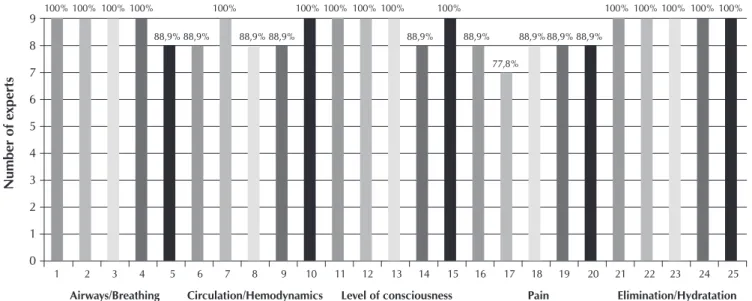
As shown in Figure 1, of the 25 items of the guide, 15 (60%) were considered clear and understandable by all ex-perts (n=9; 100%), and 9 items (36%) presented rates above 80%. Despite being considered clear and understandable by most of the experts, item 17 (referring to the risk indicator “pain”, and related to the risk classification “orange”) was the item presenting the highest number of suggestions for content changes and improvement (Figure 2).
The experts evaluated the relevance of the items (main complaints, and signs and symptoms) in relation to the risk classification (red-priority 1; orange-priority 2; yellow-priority 3, green-priority 4, and blue-priority 5). They considered 23 (92%) items as relevant, with a level of agreement above 70%. Other two (8%) items (item 3 - “airways/breathing” in orange and, item 18- “pain” in yellow) presented agreement in rela-tion to relevance by six (66.7%) of the experts.
The guide was also analyzed in relation to adequacy of the risk indicator regarding the content of the main complaints, and signs and symptoms. Considering that the guide featured five risk indicators with five items each (main complaint, and signs and symptoms) and that it was analyzed by nine experts, the answers by the experts could range between 1 and 45.
Four risk indicators (airways/breathing, circulation/hemo-dynamics, level of consciousness and pain) were considered
appropriate to the content of the items (main complaint, and signs and symptoms) with agreement by all experts (n=9; 100%). One risk indicator (elimination/hydration) presented agreement by all experts for almost all of the items (sum=44; 97.8%). The findings confirm that the content of the guide is related to the purpose for which it was developed.
With regard to the content validity, relevance of the presence of each item in the guide was observed. The experts considered 17 (68%) items relevant and 8 (32%) irrelevant; therefore items 3, 6, 7, 8, 11, 13, 16 and 18 should be removed. However, it was deemed appropriate to calculate the CVI(21) and it was verified that the I-CVI of the items ranged between 0.88 and 1. In addi-tion, an overall CVI (S-CVI/Ave, S-CVI/UA) of 0.98 was identified (Table 1). However, changes suggested by the experts were per-formed in some items so they could remain in the guide.
The main suggestions of the experts included changing the title of the columns “Main Complaints (Symptoms)”, and “Objective Signs” to “Main Complaint”, and “Signs and Symp-toms”, as well as the alignment between them. In the risk dicator “Airways/Breathing”, some experts suggested the in-sertion of respiratory rate and heart rate values in order to provide a better visualization of these parameters.
In the risk indicator “Circulation/Hemodynamics” it was important to accept the suggestion of the experts to include in the sub-column “Main Complaint” the term “Severe infec-tions, sepsis” as it is a relevant clinical condition for the he-modynamic evaluation of children (item 7 of the guide). In the risk indicator “Level of Consciousness”, the cognitive deficit was described as signs and symptoms of the main complaint “Altered mental status” in the item 12; and as suggested by the experts, this was removed from the definitive version of the guide.
9
8
7
6
5
4
3
2
1
0
1 2 3 4 5 6 7 8 9 10 11 12 13 14 15 16 17 18 19 20 21 22 23 24 25
Airways/Breathing Circulation/Hemodynamics Level of consciousness Pain Elimination/Hydratation
N
umber of e
xper
ts
100%100%100%100% 100% 100%100% 100%100% 100% 100%100%100%100%100%
88,9% 88,9% 88,9% 88,9%88,9%
77,8% 88,9%
88,9% 88,9% 88,9%
Figure 2 - Distribution of the statements considered clear and understandable by the experts who evaluated the short ACCR
guide in pediatrics, Fortaleza, Ceará, Brazil, 2011 Legend:
er as JEGLF , e t al. Re v Br as Enf er
m. 2015 sep
t-oct
;68(5):630-9.
Main Complaint
Signs and
Symptoms Main Complaint Signs and Symptoms
Main
Complaint Signs and Symptoms
Main
Complaint Signs and Symptoms
Main Complaint Signs and Symptoms Stop code (beep) Respiratory failure PCR* Imminence of PCR; unresponsive patient; absent/ unstable vital signs
Central Cyanosis, FR* altered Extreme dyspnea, SpO2* < 90%, Airway obstruction
Major trauma
Shock
Thoracic, abdominal, or head trauma with perforation
Hypotension, tachycardia, accentuated pallor, cold skin, sweating, weak pulse Impalpable carotid pulse Stop code Major trauma Shock
ECG between 3 and 8
PCR* Non-responsive Absent vital signs
TCE (ECG 3 to 8)
Sensory changes associated to signs of shock
Unresponsive patient, only responsive to pain Seizure
Lethargy – mental confusion Metabolic disorders (hypoglycemia)
Major trauma
Thoracic, abdominal, or head trauma with: severe pain (9 to 10/10)
Severe dehydration (> 6 signs of dehydration)
Lethargy Difficulty to drink Very dry mouth Very sunken eyes Very depressed fontanelle Skinfold dissolves very slowly (>10 sec)
Pulse is too weak and capillary refill is too slow (>5 sec) Dyspnea, Previous asthma, recurrent wheezing Anaphylaxis
Normal vital signs Stridor, Hypersalivation, severe respiratory distress, muscle strain Severe previous asthma Sat O2 < 92%
Tight feeling in the throat, laryngeal edema Severe trauma Hemodynamic compromise Burn Gastrointestinal bleeding, hemoptysis, epistaxis Severe infections, sepsis
Altered vital signs with symptoms
Extensive injury with active bleeding Amputation, normal vital signs Pallor, sweating Unexplained tachycardia Dizziness when standing
2nd or 3rd degree burns 10%>SCQ<25 or in critical areas (face, perineum) or circumferential
Voluminous hematemesis Frank hemoptysis Epistaxis with altered PA
Unstable vital signs Temperature >38.5ºC, chills Purpuric erythema (meningitis)
FR, FC and PAS or PAD <or > according to age T <35ºC or T>40ºC Altered mental status Head trauma Psychiatric or behavioral disorder Severe alcohol or drug abstinence Agitation, lethargy Irritability, drowsiness, coma
ECG 9 to 13 Loss of consciousness, seizure, mental confusion, Nausea and vomiting
Altered behavior Extreme agitation Unconsciousness Seizure, hallucinations, agitation, palpitation Head trauma Severe trauma Chest pain Visceral-type chest pain Abdominal pain Headache Severe pain
Coma: ECG between 9 and 13, severe headache, neck pain
Moderate to severe pain (5 to 8/10)
Fracture with deformity or bleeding
Amputation, normal vital signs
Altered vital signs
Associated to sweating, nausea, dyspnea
Associations: nausea, vomiting, sweating Severe pain, altered vital signs
Severe and
uncontrollable Stiff neck Nausea and vomiting Focal neurologic signs (paresis, aphasia)
Acute, central (head, chest, abdomen) Dislocation, back pain (traumatic or not), disabling, with reduction of lower limb function
Moderate dehydration WITH vomiting (3 to 6 dehydration signals) Child History of diabetes mellitus Irritation Excessive thirst Dry mouth Sunken eyes Crying without tears Depressed fontanelle Skinfold dissolves very slowly (>10 sec)
Weak and rapid pulse, slow capillary refill (3 to 5 sec)
Risk classification in pediatr
ics: de
velopment and v
alidation of a guide f
or nur
ses
635
Re
v Br
as Enf
er
m. 2015 sep
t-oct
;68(5):630-9.
BREATHING CIRCULATION/HEMODYNAMICS LEVEL OF CONSCIOUSNESS PAIN ELIMINATION/HYDRATION
Main Complaint
Signs and
Symptoms Main Complaint Signs and Symptoms
Main
Complaint Signs and Symptoms
Main
Complaint Signs and Symptoms
Main Complaint
Signs and Symptoms
Mild to moderate dyspnea
Altered vital signs* absence of symptoms
Asthma with dyspnea on exercise Chronic cough Asthma and SpO2 between 92 and 94%
50* < 140ipm, T > 38.5ºC Altered FR
Moderate trauma
Burns
History of diabetes mellitus
Gastrointestinal bleeding
Complaints on joints and soft tissues
Altered vital signs without symptoms
Normal vital signs Minor injury (small) with compressible bleeding Extensive injury by biting
2nd and 3rd degree burns in non-critical areas (SCQ<10% 1st degree burn > 10% SCQ or non-critical areas, face, perineum, hands or feet
1st degree burns on the face, perineum, hands and feet
Glycemia > 300mg/ dl or below 50mg/dl
No current bleeding (last 24 hours) Normal vital signs
Joints or limbs with severe pain, impotence, heat, edema, erythema, fever
Cut-contused wound
FC<50 or >140ipm, Temperature >38.5ºC FR > 200ipm
Head trauma
Seizure
Psychiatric or behavioral disorder
Mental disability
No loss of consciousness ECG 14 to 15 Nausea and vomiting
Normal vital signs Crisis in the last 24 hours or first, but short episode (<5min)
Less intense agitation, but conscious Hallucination, disorientation
---Head trauma
Moderate trauma
Abdominal pain
Pain
Moderate headache No loss of consciousness Nausea and vomiting
Thoracic trauma with mild or moderate pain and with no dyspnea
Normal vital signs Abdominal distension Urinary retention Prostration Fever
Migraine Renal colic
Moderate dehydration WITHOUT vomiting (< 3 signs of dehydration)
History of diabetes mellitus
Irritation Excessive thirst Dry mouth Sunken eyes Crying without tears Depressed fontanelle Skinfold dissolves very slowly (>10 sec)
Weak and rapid pulse, slow capillary refill (3 to 5 sec)
Strong dehydration, vomiting, abdominal pain Glycemia > 300 or <50mgdl Figura 3 (cont.)
V
er
as JEGLF
, e
t al.
636
Re
v Br
as Enf
er
m. 2015 sep
t-oct
;68(5):630-9.
BREATHING CIRCULATION/HEMODYNAMICS LEVEL OF CONSCIOUSNESS PAIN ELIMINATION/HYDRATION
Main Complaint
Signs and
Symptoms Main Complaint Signs and Symptoms
Main
Complaint Signs and Symptoms
Main
Complaint Signs and Symptoms
Main Complaint
Signs and Symptoms
Flu-like symptoms
Severe sore throat Earache Productive cough Purulent rhinorrhea Temperature between 37.8°C and 38.5°C Myalgia
Minor trauma
Fever
Burns and wounds
Normal vital signs Non-extensive bite
Temperature between 37.8°C and 38.5ºC
1st degree burns <10% SCQ, non-critical area
Head trauma
Psychiatric or behavioral disorder
Special situations
No loss of consciousness, no vomiting
Alert (ECG = 15) Accident occurred more than 6 hours ago Normal vital signs
Suicidal thoughts Gesturing, but not agitated
No risk to themselves or to others
Handicapped
Head trauma
Minor trauma
Abdominal pain
Headache
Pain
Low impact, no loss of consciousness Accident occurred more than 6 hours ago and < 10 days
Normal vital signs Thoracic with no rib pain or dyspnea
Sprains, contusions, torsions (possible fracture)
Acute, moderate Absence of prostration
sudden, Non-intense, Non-migraine
More intense back pain Arthralgia with limitation without phlogiston signs
Vomiting AND diarrhea WITHOUT dehydration
Normal vital signs Wet mucosa Usual diuresis Normal skin turgor Defecation/day < 5 episodes Vomiting/day < 5 episodes
Flu-like symptoms
Coryza Mild complaints Sore throat No respiratory symptoms Normal vital signs
Minor trauma
Wounds
Superficial injury Wound not requiring closure
Clean, without systemic symptoms of infection Eschars without systemic signs Control of chronic ulcers
Suture removal 1st degree burn, small, non-critical areas
Psychiatric disorder
Recurrent chronic depression Social crisis Normal mental status
Minor trauma
Abdominal pain
Mild to moderate pain
Pain, contusions, strains, myalgia
Mild, acute pain (< 4/10)
Constipation Normal vital signs
Superficial thoracic pain, chronic, worsens with compressions Chronic neck pain, non-traumatic
Dysuria
Vomiting OR diarrhea
WITHOUT dehydration Normal mental status
Normal vital signs
Figure 3 - Guide for Risk Classification in Pediatrics developed based on the Protocol to User Embracement with Risk Classification in Pediatrics of Fortaleza, Fortaleza, Ceará, Brazil, 2011
Note:
Risk classification in pediatrics: development and validation of a guide for nurses
637
Rev Bras Enferm. 2015 sept-oct;68(5):630-9.Table 1 - Relevance and distribution of the individual content
validity index of each item (I-CVI) according to the opinion of the experts, Fortaleza, Ceará, Brazil, 2011
Items of the guide
Relevance n(%)
Level of relevance (I-CVI)
1 9(100) 1
2 8(88.9) 1
3 7(77.8) 1
4 9(100) 1
5 8(88.9) 1
6 6(66.7) 1
7 7(77.8) 1
8 7(77.8) 1
9 9(100) 1
10 8(88.9) 1
11 7(77.8) 1
12 8(88.9) 1
13 7(77.8) 1
14 8(88.9) 1
15 8(88.9) 0.888889
16 7(77.8) 1
17 9(100) 1
18 7(77.8) 0.888889
19 8(88.9) 0.888889
20 8(88.9) 0.888889
21 8(88.9) 1
22 8(88.9) 0.888889
23 8(88.9) 1
24 9(100) 1
25 9(100) 1
The suggestions of the experts to change the subtitles of the columns to “Main Complaints” and “Signs and Symptoms” confirmed the principles of the ACCR strategy in which the assessment of the patient should focus on the signs and symp-toms based on the related main complaint(8). Some experts re-quested the inclusion of respiratory and heart rate parameters in the risk indicator Airways/Breathing, but it was decided not to enter these. The suitability as the heart and respiratory rate parameters was included as annex A to ACCR protocol in chil-dren which led to the guide(9).
The experts considered relevant the remarks on some as-pects of the circulatory status, heart rate and respiratory effort in the assessment of the hemodynamic status of the child. This result confirms the literature as it facilitates the identification of alert signs and the definition of priority levels(9-10,16).
The cognitive deficit was removed from the guide at the sug-gestion of the experts as they considered it irrelevant in the as-sessment of health conditions of the child. Agreeing with the analyses of the experts, by comparing the cognitive deficit among students and children after traumatic brain injury a study found evidence against the validity of this criterion when applied to the pediatric population(23); therefore it is not important in the assess-ment of children or as a priority level measureassess-ment parameter.
Most experts considered the description of the characteristics of the expression “Severe, central, chronic pain” very confusing and requested the inclusion of the terms “normal vital signs” and “scale of pain”, since these parameters best viewed in annexes A and C of the protocol(9). Pain assessment in children should be conducted via the identification of its severity through the use of instruments that reduce the subjectivity of the pain and ensure the accuracy of the information; it should not be based on the opin-ion of the professopin-ional about what the child is experiencing(24).
In relation to the assessment of dehydration, the ACCR pro-tocol in pediatrics does not quantify the signs and symptoms clearly. Studies indicate that the signs of dehydration evolve rapidly and they are not always reliable; full physical exam and evaluation of physiological parameters are required(25). Thus, the signs and symptoms were quantified in the guide so that the child presenting severe dehydration classified as prior-ity level I should present more than six signs and symptoms; with moderate dehydration, between three and six; and with mild dehydration, less than three signs and symptoms.
As limitation of the study, points to poor adherence of the judges for the validation step, which can be explained by the time required for such work. Recommend new studies that al-low check their clinical appropriateness and must be applied by nurses in pediatric emergency research in different scenarios.
CONCLUSION
The present study enabled the development of the Guide for Risk Classification in Pediatrics based on the ACCR proto-col with five risk indicators identified by Airways/Breathing, Circulation/Hemodynamics, Level of Consciousness, Pain, and Elimination/Hydration related to physiological functions through main complaints, and signs and symptoms. It pres-ents a significant contribution as it provides an instrument that In the evaluation of the risk indicator “Pain”, the experts
con-sidered the pain descriptions “intense, central, and chronic” as being confusing. The clarity of the expression “moderate, acute pain” was also questioned. Changes in the risk indicator “Elimi-nation/Hydration” were suggested in order to better distinguish the priority level between the items 21, 22, 23 and 24. With the changes in the layout and content for adequacy, the latest version of the guide is represented in Figure 3.
DISCUSSION
REFERENCES
1. Veras JEGL, Carvalho AT, Uchôa JL, Nascimento LA, Almeida PC, Ximenes LB. Profile of children and teens attended in emergency according to the risk classification: a documen-tal study. Online Braz J Nurs [Internet]. 2011 Sep-Dec [cited 2014 Jan 24];10(3):1-11. Available from: http://www.objnurs ing.uff.br/index.php/nursing/article/view/3264/1149 2. Huang DT. Clinical review: impact of emergency
depart-ment care on intensive care unit costs. Crit Care [Internet]. 2004 Aug [cited 2014 Jan 25];8(6):498-502. Available from: http://www.ncbi.nlm.nih.gov/pmc/articles/PMC1065047/ pdf/cc2920.pdf
3. Silva EMR, Tronchin DMR. Reception of pediatric emer-gency room users from the perspective of nurses.Acta Paul Enferm [Internet]. 2011 [cited 2014 Fev 02];24(6):799-803. Available from: http://www.scielo.br/pdf/ape/v24n6/ en_a11v24n6.pdf
4. Bellucci Júnior JA, Matsuda LM. [Deployment of the system User Embracement with Classification and Risk Assessment and the use Flowchart Analyzer]. Texto Contexto Enferm [In-ternet]. 2012 Jan-Mar [cited 2014 Jan 05];21(1):217-25. Avail-able from: http://www.scielo.br/pdf/tce/v21n1/a25v21n1.pdf Portuguese.
5. Selhorst ISB, Bub MBC, Girondi JBR. [Protocol for embrace-ment and attention to users that underwent upper gastro-intestinal endoscopy and persons accompanying them]. Rev Bras Enferm [Internet]. 2014 Jul-Aug [cited 2014 Sep 20];67(4):575-80. Available from: http://www.scielo.br/pdf/ reben/v67n4/0034-7167-reben-67-04-0575.pdf Portuguese. 6. Cullum N, Ciliska D, Haynes R B, Marks S. Enfermagem
baseada em evidência: uma introdução. Porto Alegre (RS): Artmed; 2010.
7. Cioffi J. Recognition of patients who require emergency assistance: a descriptive study. Heart Lung [Internet]. 2000 Jul-Aug [cited 2014 Feb 02];29(4):262-8. Available from: http://www.sciencedirect.com/science/article/pii/ S0147956300306148
8. Lowe RA, Bindman AB, Ulrich SK, Norman G, Scaletta TA, Keane D, et al. Refusing care to emergency department pa-tients: evaluation of published triage guidelines. Ann Emerg Med [Internet]. 1994 Feb [cited 2014 Feb 12];23(2):286-93. Available from: http://www.sciencedirect.com/science/ article/pii/S0196064494700427
9. Ministério da Saúde (BR). Equipe humaniza SUS, PNH. Protocolo de acolhimento com classificação de risco em pediatria. Brasília (DF): Ministério da Saúde; 2008.
10. Warren DW, Jarvis A, Leblanc L, Gravel J; CTAS National Working Group; Canadian Association of Emergency Physicians, et al. Revisions to the Canadian Triage and Acu-ity Scale Paediatric Guidelines (PaedCTAS). CJEM [Internet]. 2008 May [cited 2014 Feb 14];10(3):224-43. Available from: http://journals.cambridge.org/download.php?file=% 2FCEM%2FCEM10_03%2FS1481803500010149a.pdf&c ode=548a08ec06cc36c0f111c69b82140018
11. Gravel J, Manzano S, Arsenault M. Validity of the Canadian Paediatric Triage and Acuity Scale in a tertiary care hospital. CJEM [Internet]. 2009 Jan [cited 2014 Feb 14];11(1):23-8. Available from: http://journals.cambridge.org/download.ph p?file=%2FCEM%2FCEM11_01%2FS148180350001088 5a.pdf&code=64e1cf7161d56b826dc05fe2f918880a 12. Toni GMP. The clinical practice of emergency department
triage: application of the Australasian Triage Scale - an ex-tended literature review: Part I: Evolution of the ATS. Austra-las Emerg Nurs J [Internet]. 2006 Dec [updated 2015 Jun 25; cited 2014 Feb 14];9(4):155-62. Available from: http://www. sciencedirect.com/science/article/pii/S1574626706000991 13. Souza CC, Toledo AD, Tadeu LFR, Chianca TCM. Risk
clas-sification in an emergency room: agreement level between a Brazilian institutional and the Manchester Protocol. Rev Latino-Am Enfermagem [Internet]. 2011 Jan-Feb [cited 2014 Mar 04];19(1):26-33 Available from: http://www.scielo.br/ scielo.php?pid=S0104-11692011000100005&script= sci_abstract
14. Gilboy N, Tanabe T, Travers D, Rosenau AM. Emergency Severity Index (ESI): a Triage Tool for Emergency Depart-ment Care [Internet]. Rockville (MD): Agency for Healthcare Research and Quality; 2012 [cited 2014 Mar 21]. Available from: http://www.ahrq.gov/research/esi/esihandbk.pdf 15. Pires CS, Gatto MAF. Escala Canadense de Triagem e
Acuidade (CTAS): validação e aplicação. Rev Emergência. 2005;1(1):14-9.
16. Lyon N, Babekuhl SNSW. Paediatric Triage Tool. Stan-dards and protocols (Pediatrics) NCHN [Internet]. 2007 [cited 2014 Mar 21]. Available from: http://www.nchn. org.au/docs/TriageTool_Sth_All.pdf
17. Ministério da Saúde (BR). Diretrizes nacionais para prevenção e controle de epidemias de dengue [Internet]. Brasília (DF): Ministério da Saúde; 2009 [updated 2015 Jun 25; cited 2014 Mar 21]. Available from: http://bvsms.saude.gov.br/bvs/publi cacoes/diretrizes_nacionais_prevencao_controle_dengue.pdf 18. Lobiondo-Wood G, Haber J. Pesquisa em enfermagem: accurately assesses children in emergency situations based on
scientifically proven actions.
Therefore the instrument meets the purpose for which it was developed and it can be submitted to clinical validation. It may be subsequently used in the everyday life of nursing professionals caring for children for embracement in emer-gency situations. The use of the guide enables embracement nurses to perform their functions associating theory with clini-cal practice, and reducing the practice based on the dyad of
intuition and experience. However, it should not replace the ACCR protocol in pediatrics; instead, these should be used simultaneously in a complementary manner.
Risk classification in pediatrics: development and validation of a guide for nurses
639
Rev Bras Enferm. 2015 sept-oct;68(5):630-9.métodos, avaliação crítica e utilização. Rio de Janeiro: Gua-nabara Koogan; 2001.
19. Melo RP, Moreira RP, Fontenele FC, Aguiar ASC, Joventino ES, Carvalho EC. [Criteria for selection of experts for validation studies of nursing phenomena]. Rev RENE [Internet]. 2011 Apr-Jun [cited 2014 Mar 21];12(2):424-31. Available from: http://www.revistarene.ufc.br/vol12n2_pdf/a26v12n2.pdf Portuguese.
20. Dodt RCM, Ximenes LB, Oria MOB. Validation of a flip chart for promoting breastfeeding.Acta Paul Enferm [In-ternet]. 2012 [cited 2014 Mar 21];25(2):225-30. Avail-able from: http://www.scielo.br/pdf/ape/v25n2/en_a1 1v25n2.pdf
21. Polit DF, Beck CT. The content validity index: are you sure you know what’s being reported? Critique and recommen-dations. Res Nurs Health [Internet]. 2006 Oct [cited 2014 Mar 22];29(5):489-97. Available from: http://onlinelibrary. wiley.com/doi/10.1002/nur.20147/pdf
22. Doak CC, Doak LG, Root JH. Teaching patients with low literacy skills [Internet]. Philadelphia: J.B. Lippincott; 1996
[cited 2014 Mar 22]. Available from: http://www.hsph. harvard.edu/healthliteracy/resources/teaching-pa tients-with-low-literacy-skills/.
23. Fuentes A, Mckay C, Hay C. Cognitive reserve in paediat-ric traumatic brain injury: relationship with neuropsycho-logical outcome. Brain Inj [Internet]. 2010 [cited 2014 Mar 24];24(7-8):995-1002. Available from: http://informahealth care.com/doi/abs/10.3109/02699052.2010.489791
24. Rossato LM, Magaldi FM. Multidimensional tools: appli-cation of pain quality cards in children. Rev Latino-Am Enfermagem [Internet]. 2006 Sep-Oct [cited 2014 Mar 24];14(5):702-7. Available from: http://www.scielo.br/scielo. php?pid=S0104-11692006000500010&script=sci_arttext English, Portuguese.