A Work Project, presented as part of the requirements for the Award of a Masters Degree in Management from the Faculdade de Economia da Universidade Nova de
Lisboa
MPG
MPG
MPG
MPG
docks into the Middle East
Rita Isabel Paiva da Silva no. 480
A Project carried out on the Internationalization Field Lab, with the supervision of: Professor Sónia Dahab and Professor Filipe Castro Soeiro
1. Executive Summary
MPG is a metalworking production company that recently refocused to the shipbuilding
activity, particularly hulls for offshore support vessel (OSV) for staff and equipment transport to oil platforms.
As offshore oil platforms increase, so does the demand for OSV, particularly in the Middle East - one of world’s leaders in the offshore investment. Since the Portuguese market doesn’t present itself as solution and the European market is highly competitive, it is necessary to develop an internationalization plan - the Middle East appears as a very attractive opportunity for MPG to develop operations and gain new competences, like the delivery of a ready to use vessel.
Considering the Middle Eastern market, a joint venture with a Qatari shipping company arises as the best way to achieve the company’s goals. To pursue that path, MPG must first develop new services from project management to production follow-up to other companies; contact Portuguese and Qatari institutions for market information and financial assistance and attend promotional events in the Middle East. MPG would focus on design, planning and production vessels, its main competences, leaving the investment of $200 million1 in facilities, equipment and the other activities to its partner. Since finding the right partner is crucial to be successful, MPG may start with exports for the Middle East region, get experience and knowledge of the market and only then find a Qatari partner.
2. Methodology
3
industry in the global market several interviews to MPG’s management team and to Associação das Indústrias Navais were done. Also, contacts with AICEP representation
in Dubai and with the Câmara do Comércio e Indústria Árabe-Portuguesa, were established to cover specificities of the Middle East countries and business environment, and to find the right partner for internationalization. Other sources include reports, internet resources, and international business and strategy books.
3. Description of the firm and domestic market
MPG- Manuel Pires Guerreiro, Lda started as a metalworking company located in Beja in the 50’s, focusing on design, production, assembly and commercialization of various medium light metal worked products, farm equipment, metal structures and supplying the local mining sector. After Manuel Guerreiro’s passing away, the
company was sold to three entities - two individuals and a SGPS company called Operatio - maintaining most of its infra-structures, organization and personnel.
From 2005 onwards, because there was lack of projects in the metal-mechanic area, the company split into two areas –“Industrial Manufacturing and Assembling” and “Shipbuilding” (hull and blocks), and started focusing on the latter, thus taking advantage of a partner’s previous experience in shipbuilding and repair, as well as their own know-how in metal transformation and structure/equipment manufacturing processes. Nowadays, it has over 200 employees (80% on shipbuilding) and its industrial activity, mostly medium/heavy metalwork production, is still conducted in Beja, including 30% of ship components for Setubal production unit (Shipyard - appendix 1) (Costa & Paz, 2010).
4 offshore support vessels like platform supply vessels (PSV) (fabrication of a PSV – appendix 4 to 7) and anchor handling tug supply vessel (AHTS). MPG also offers other
metal products such as submergible platforms, pontoons (appendix 8), fall pipes, hull for dredgers, wind offshore platforms, hull for container vessels, combining industrial know-how with shipyard facilities to construct great size structures that can be transported by sea. In terms of services, MPG is able to do ship repair that can represent an added value area in terms of its internationalization process (Costa & Paz, 2010).
The Portuguese shipbuilding industry (detailed analysis - appendix 10) is very small - only 13 small and 1 large construction shipyards (DGAE, 2009) and it represents less than 1% of constructions among European countries (ECORYS, 2009). However, it is very diversified, offering different products to different segments - for instance, MPG is the only company constructing offshore vessels and because Portugal does not have oil offshore industry, the company targets the international market.
The companies working in the Portuguese shipyards have licenses to use that shipyard during a limited time, which, according to the AIN, led them to low investment in the shipyards modernization and innovation. Furthermore, these companies have usually a high debt structure, reduced solvency and low financial autonomy, which make them
ineligible for QREN support (IAPMEI, I.P., 2009).
Taking all these factors into consideration, one can conclude that the Portuguese market is not enough for MPG to survive and remain competitive; therefore, they are forced to turn their focus to a more global setting.
5
euros revenues. Until now, the company only constructs a part of the PSV. The future plan is to deliver a ready to use PSV, hence MPG recently signed an agreement with
Rolls-Royce, to transfer technological how-know to MPG and set priority privileges in product delivery time - the vessel design and main engine/propulsion (MPG, 2010).
4. Perspective on Business Mission and Objectives
Company mission: To provide high quality vessels to the energy industry’s shipping transportation and service companies, assuring respect for individual safety and environmental protection.
Company vision: To be a shipbuilding reference to the energy market in Brazil in the next 10 years and to initiate strategic internationalization to Africa and Middle East.
Strategic Objectives:
Medium-Long Term -penetrate the“Deep Water Golden Triangle”2 and Middle East Year 2: To have agreements with the important marine suppliers;
Year 5: To have the Itajaí Shipyard S/A working at full capacity; enter Middle East (possibly Qatar) and earn $150 million in orders by year 1
Year 7: To have the Pernambuco Shipyard working at full capacity;
Up to year 10: Enter first in Angola market and earn one orders in the first.
Financial Objective:
6 5. Market Segmentation: industry mapping
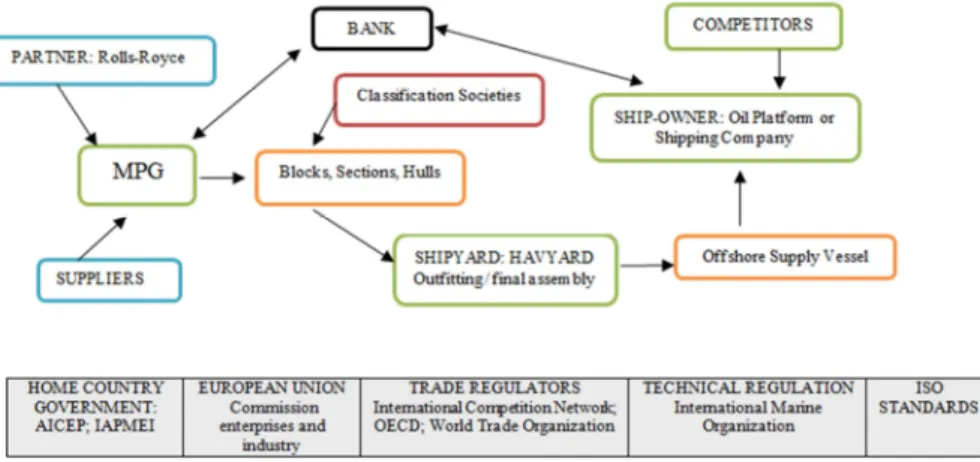
To understand the structure of the shipbuilding industry, identify the main players and MPG’s market position the industry mapping tool was used:
Figure 1: Simplified Industry Map (complete description – appendix 9)
To better understand the intervention of which player in MPG’s activities, the following
workflow process diagram is explained below3:
Figure 2: Process Diagram of shipbuilding
The oil platform owners buy PSV directly from the shipbuilding company or rent the vessels from other ship-owners, like shipping companies, who then choose a
shipbuilder in tenders, to either build the whole vessel or contract other companies to do some parts of the vessel. For example, Solstrand S.A. and Havyard, two Norwegians shipyards, are responsible for the final outfitting, assembly, and the delivery of the vessel to the ship owner but hired MPG to build the hull for two PSV, which will be built at MPG’s shipyard. In turn, MPG designs the hull with and has two major
7
from the shipbuilder, who in turn need assurance of the ability to pay at every step of the construction. The banks are used to get loans for the construction/ payment of the vessels and to give guarantee of refund and performance, preventing contract breaching from both parts. Since financial crisis make bank loans hard to get, some shipbuilders offer financing to its clients (offering subsidized interest or agrees on a 1 or 2 years suspension on interest), usually with support of government guarantees (ECORYS, 2009). In the Middle East, financial institutions are more available to grant guaranties and loans to native than to foreign investors.
MPG’s activity is regulated directly and indirectly by several international institutions:
European Union sets aid framework, quality standards and safety rules for sea transportation, influencing global market trends.
International Marine Organization is responsible for technical regulation of design, construction, equipment, operations, manning and safety and environmental standards (IMO, 2010), than used by Classification societies to enforce application of the technical rules to the vessels and approve the vessels class. These companiesalso carry out companies’ certification - MPG is now in process of getting environmental, quality and occupational health and safety management certification.
IAPMEI and AICEP are the Portuguese institutions that promote the competitiveness and internationalization of the company to the Middle East.
Finally,the World Trade Organization, International Competition Network and the
OECD Competition Committee turn their efforts to making markets open companies
8
global industry, the dynamics between players are influenced by a very particular environmental context.
With the industry map it became clear that shipbuilding is complex, competitive and strategic industry with global and local players and MPG is still a small company playing in a highly regulated arena, where financial and governmental institutions play an important role.
6. External Analysis
6.1 Macroeconomic context- PEST Analysis
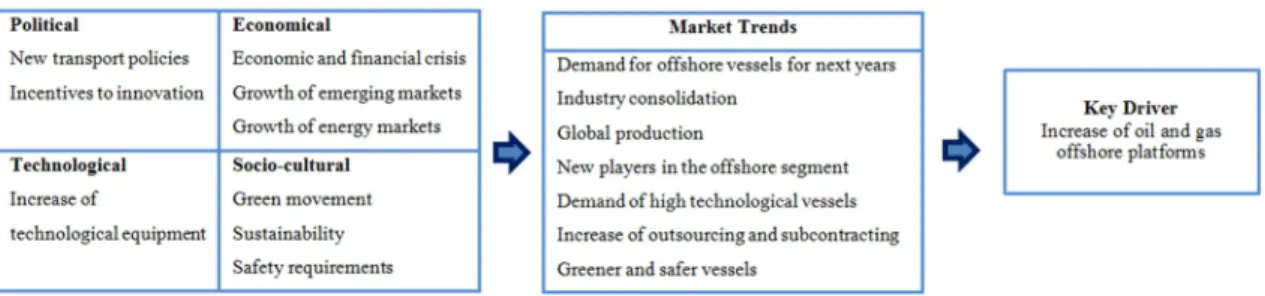
The PEST analysis is performed in order to determine market trends and key drivers
of the industry:
Figure 3: PEST, Market trends and Key Drivers (Europe)
The main driver of demand is the increase of oil offshore platforms, which rides on
GDP growth (Muller, 2007). When GDP grow, it drives trade flow and consequently energy consumption and investment in new offshore rigs (RS Platou Group, 2009)4.
9
Although the exploration & production and drilling rig market suffered some cuts due to the decrease of oil prices and economic growth in 2009 (RS Platou Group, 2009) the investment in offshore drilling worldwide is expected to grow for the next 10 years (Global Drilling Spend 2000-2020 – appendix 12).
Despite the economic crisis emerging markets are still growing; some of them are entering the energy market and some in the offshore support vessels segment as
shipbuilders. Brazil is one of these country representing 3, 2% of world’s orderbook for new vessels in 2008.
Technological requirements are very important in the offshore vessels, where marine equipment suppliers already retain 70-80% of the ship value (Costa & Paz, 2010), leading to outsourcing the least valuable work.
Finally, the increase of safety and environmental concerns led governments to increase shipping requirements (ECORYS, 2009), causing ship-owners to renew their fleet more often.
6.2 Analysis of Industry and Competition
6.2.1 The European Industry: offshore support vessels market
10 6.2.2. Porter’s 5 Forces
As to the analysis of the industry Porter’s 5 Forces framework will be used:
There are no product substitutes and threat of a new entrant is not significant because despite high initial investment and the need to accumulate experience (Fadda, 2008), because governments repeatedly helped finance the entry (Porter & Cho, 1986), offering subsidies, incentives, tax reduction and even raises import barriers against foreign companies (ECORYS, 2009).
The bargaining power of buyers can be very high, depending on the order size in relation to the turnover of the company (Fadda, 2008). Also, it usually has low switching costs and the sensitivity to price depends on the type of vessel, more technological or less, but it’s usually high. As to suppliers, since technological requirements are very important in the offshore vessels, marine equipment suppliers already retain 70-80% of the ship value (Costa & Paz, 2010) forcing bigger players to
outsource and subcontract other companies to do the less valuable work. Also, they are tending to high technological specialization, increasing their bargaining power. Summing up all factors one may infer that the internal rivalry in the industry is
intense and price competition is common due to the high fixed costs, the excess capacity and the high exit barriers, facilities are difficult to convert and there is government pressure to maintain jobs and production (Fadda, 2008).
6.2.3 Competitive Analysis: European Market
A competitive assessment is useful to identify the strengths and weaknesses of MPG’s main competitors. Shipyards from Spain (ex: Metal and Docks), Romania (ex: Santierul), Turkey (ex: Gemax Tuzla) and Poland (ex: Maritim) are the most
11
analysis in appendix one can arrive to the factors that affect these shipyards competitiveness (appendix 13 and 14):
Company organization and costs structure is key: most shipyards have a small number of direct employees, and high flexibility in terms of workforce, to the exception to Santierul. The labor cost is lower in Turkey and Romania, but they face lower
productivity. Poland has similar labor costs but a slightly worse productivity index but is still bidding at much lower prices than the Portuguese company.
In terms of facilities, every shipyard is well positioned to build OVS, but the large dry dock is a great advantage of MPG, allowing the entire assembly of the vessels and other large structures, decreasing costs of the vessel and to diversify the offer. As to added value services, all MPG’s competitors perform ship repair, which allow them to reduce the financial risk, since demand tends to be less related to GDP, and more stable.
The product performance and quality standards are other important factors; Norwegians demand for high quality hulls and they are the main clients in the Spanish, Poland and MPG shipyards, giving good reputation to the shipyard. As to required ISO certifications, MPG is still in process to get them all (Costa & Paz, 2010), which is a disadvantage to Spanish and Romanian competitors.
As to financing capacity, competitors have the advantage, because they either own the shipyard and are able the give guaranties, have public export credit agencies or access to an investment fund such as Metalship and Docks, from Spain (IAPMEI, I.P., 2009).
12
The completion with the delivery time is another valuable capability expected from shipyards. This is the main focus of MPG, but its competitors regularly fail to comply the delivery time (AMEM, 2005).
7. Internal Analysis - MPG’s current context in the European Market
In terms of weaknesses and strengths of MPG, some were already referred in the competitive analysis, others can be found in the table below:
Internal Analysis of MPG
Resources Capabilities
Good reputation among clients Efficient delivery time
Technological access (Roll-Royce) Design capability
Skilled and experience employees Project planning and organization capacities*
Know-how in diverse areas Large Dock – flexibility of projects Good borrowing capacity from Banks
*Competitive Advantage
Table 1: Resource and capabilities of MPG
The main finding is that even though MPG focuses on complying with OSV delivery time and at the contracted costs through detailed project planning and organization capacities and besides its specific design and large metal production know-how, faces some limitations: lack of certification and several domestic market limitations.6 In the European market the internal rivalry is high and price wars are common, it has become clear that MPG must search new markets to increase its competitiveness, develop its skills and capabilities and pursue growth opportunities in regions with more energy potential such as Brazil, Africa and the Middle East (SWOT analysis – appendix 15).
8. Country selection
8.1 Middle East Opportunity
13
countries. This means an expected increase of 40% of world’s energy demand, 30% coming from “unconventional sources” like offshore rigs.
The Middle East is known for its oil and gas reserve, yet governments are trying to reduce the economic dependency on oil profits, liberalizing trade and establishing policies to attract foreign investment. The efforts of economic diversification, the privatization of state-owned companies, the sharp population growth, the regional integration attempts and the reconstruction of Iraq are the major sources of opportunities in the Middle East region (Donboli & Kashefi, 2005).
The Middle East is investing in this field, and the production from offshore platforms
is expected to increase 7% in the next 5 years, which will cause an increase in OPV demand and MPG recognizes this opportunity.
On the other hand, it is important to safeguard that any shipbuilding venture alike should consider a few issues: Middle East may not become a shipbuilding hub due to high costs of labor and living expenses and the high dependency on steel and components imports (Souri, 2009). The Middle East imported 28,5 million tons of steel in 2009, producing only 16,9 million tons (ISSB, 2010). The lack of experience and experts in region and extreme weather temperature are factors that may also cause low efficient shipyards (Souri, 2009).
In spite of these disadvantages, it is still an attractive market due to the large financial resources and the great need of support vessels for the offshore energy industry.
8.2 Country Comparative Analysis
14
facilitate and attract foreign investment (Donboli & Kashefi, 2005): Saudi Arabia,
Unite Arab Emirates (UAE), Qatar, Oman, Bahrain and Kuwait.
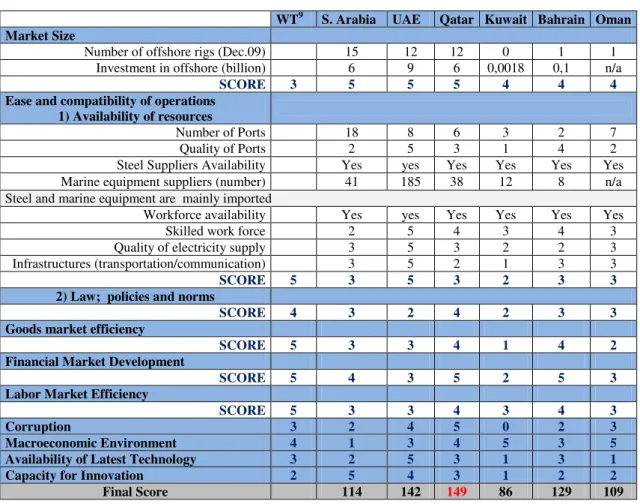
Several characteristics were analyzed and scored according to its importance for the shipbuilding industry and the foreign investment in the detailed grid below:
WT9 S. Arabia UAE Qatar Kuwait Bahrain Oman Market Size
Number of offshore rigs (Dec.09) 15 12 12 0 1 1
Investment in offshore (billion) 6 9 6 0,0018 0,1 n/a
SCORE 3 5 5 5 4 4 4
Ease and compatibility of operations 1) Availability of resources
Number of Ports 18 8 6 3 2 7
Quality of Ports 2 5 3 1 4 2
Steel Suppliers Availability Yes yes Yes Yes Yes Yes
Marine equipment suppliers (number) 41 185 38 12 8 n/a
Steel and marine equipment are mainly imported
Workforce availability Yes yes Yes Yes Yes Yes
Skilled work force 2 5 4 3 4 3
Quality of electricity supply 3 5 3 2 2 3
Infrastructures (transportation/communication) 3 5 2 1 3 3
SCORE 5 3 5 3 2 3 3
2) Law; policies and norms
SCORE 4 3 2 4 2 3 3
Goods market efficiency
SCORE 5 3 3 4 1 4 2
Financial Market Development
SCORE 5 4 3 5 2 5 3
Labor Market Efficiency
SCORE 5 3 3 4 3 4 3
Corruption 3 2 4 5 0 2 3
Macroeconomic Environment 4 1 3 4 5 3 5
Availability of Latest Technology 3 2 5 3 1 3 1
Capacity for Innovation 2 5 4 3 1 2 2
Final Score 114 142 149 86 129 109
Table 2: Grid Analysis – Country Selection (detailed analysis – appendix 16)
At a national level, UAE is the largest market, with the highest number of offshore rigs and the biggest investment, however Qatar is revealed to be the best country to invest, since the government recently performed reforms to improve the entrepreneurial environment and develop other sectors beyond gas and oil, investing in port modernization and developing the shipbuilding and ship repair industry. (QNB, 2010)
9. Environmental context and competitors analysis in Qatar
15
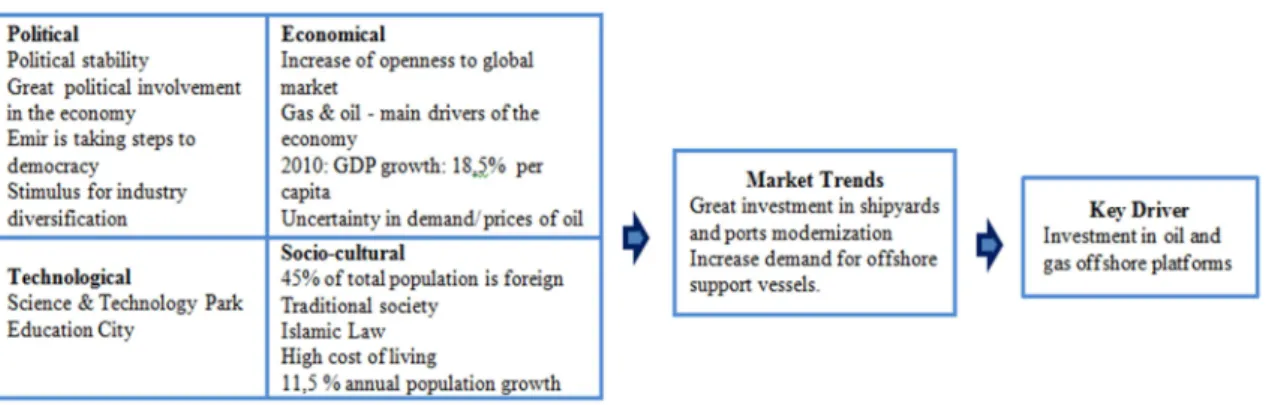
To better understand Qatari market specificities, trends and attractiveness a PEST and industry analysis will be used:
Figure 4: PEST, market trends and key drivers (Qatar)
According to IMF forecast for 2010, GDP will grow 18,5% in 2010 reaching $128 billion, mainly driven by the increase on gas and oil production, exports of gas, oil and petrochemical and related industries.
16 Market Trends
Some of global market trends that affect the industry are also relevant where Qatar is concerned – for instance, the market is also demanding safer, technological, high quality vessels. Qatar invested about $115 billion in the energy industry in the last 5 years there are 12 oil and natural gas rigs operating in Qatari waters. Qatar is determined to develop its key resources with the objective of increasing the gas and oil production; despite the OPEC recommendation of rethinking the investments, Qatar is still committed in investing $6 billion in next years. The investment in offshore rigs, increase the demand of support vessels, like PSV and AHTS, with this in mind Qatar recently invested in the expansion and modernization of its main port, Ras Laffan and in the construction of a shipyard to ship repair and shipbuilding. Investing in ship repair and shipbuilding is not only a way to answer to the internal and regional demand, but it’s a way to develop the whole maritime industry in Qatar.
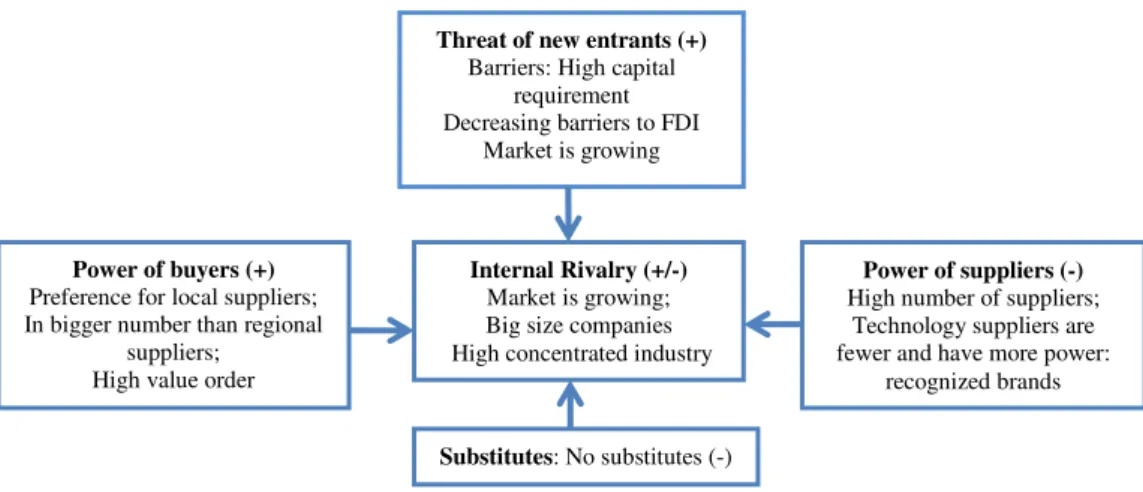
9.2 Industry Porter’s Analysis: Persian Gulf
Figure 5: Porter’s 5 Forces
The shipbuilding industry operating in Qatar is very limited, and Qatar energy and shipping industries have been buying its vessels abroad, for example from UAE companies. Since the Persian Gulf countries are opportunities one may consider the
Internal Rivalry (+/-)
Market is growing; Big size companies High concentrated industry
Power of buyers (+)
Preference for local suppliers; In bigger number than regional
suppliers; High value order
Power of suppliers (-)
High number of suppliers; Technology suppliers are fewer and have more power:
recognized brands
Threat of new entrants (+)
Barriers: High capital requirement Decreasing barriers to FDI
Market is growing
17
whore region. Observing the porter’s 5 forces above one may say rivalry among companies is not intense but it has tendency to increase since market size is increasing and governments are starting to remove the entry barriers to foreign investment.
9.3 Competitive Analysis: Persian Gulf
Shipbuilding companies in the Persian Gulf operate mostly from Dubai. The main company is state owned, Drydocks World Group, Topaz Marine is owned by an investment company and Dubai shipbuilding and Engineering is a small private company more limited in products and services. In Saudi Arabia there is Zamil Offshore Services, owned by a Holding with companies in different sectors and some are
suppliers of the shipbuilding industry. In Qatar there is the company created by the joint venture between Nakilat, a Qatari shipping company and Damen, a Dutch shipbuilding
company with global operations. And Bahrain has the most awarded shipyard of the region, ASRY, a result of the investment of Organization of Arabic Petroleum Exporting
Countries, mostly focused on ship repair.
These companies build ready to use vessels, unlike MPG that only builds the hull, and integrate part of the supply chain and have shipping services, except Dubai Shipbuilding and Engineering and ASRY. All, except the Qatari company, have a long
experience and focus in ship repair and conversion, having mostly started there. To answer to market demand these companies build various types of vessels, specially
18
The major clients are governmental institutions and oil and gas companies with operation in the region or in the country. Some companies have certification to ISO
and OHSAS standards and good facilities and equipment to develop operations. These companies also have a good financing capacity.
The MPG’s ability to organize and plan projects that results in honoring contracts is extremely important in Qatar were the Islamic Law10 is followed even in business. If MPG adds the know-how in the metalworking industry, it will able to develop services and products to the market that may create a sustainable competitive advantage. Obviously, MPG must work towards certification and build partnerships to enable the company to be competitive in that market (detailed competitive analysis – appendix 17).
10.Analysis of the Mode of Entry
Scenario I
Qatar’s foreign investment law limits foreign ownership of local entities to 49% of the entity’s capital, a foreigner cannot own land in the country, except in particular areas, and it’s not eligible to apply to government incentives to investment (AICEP, 2010). The most feasible way for MPG to enter the market is through a joint venture with a local partner, because the company will benefit from its knowledge of the host country competitive conditions, culture, language, political and business system. Also, it would improve access to capital and customer data basis, probably, gaining public liaison with the government and public sector (U.S. Commercial Service, 2009).
19 vessel ready to use -, it has to carefully select a partner but also develop a strong relation with “outfitting” suppliers already present in the region. In terms of disadvantages, since the competitive advantage of MPG is the project planning and management, the risk of losing control over the project is enormous.
A vertical partnership with the Qatari Shipping Company (Q-Ship) would be a good option for MPG to meet its objectives. Q-Ship is a certified12 shipping company
founded in 1992, owned by Qatar Petroleum and Qatar Navigation. Since MPG is now focused on OSV, it is even compatible with Q-Ship’s vision - to enhance the value of all
stakeholder interests by continuously exploiting opportunities in niche areas of the global maritime sector by being the preferred partner of choice.
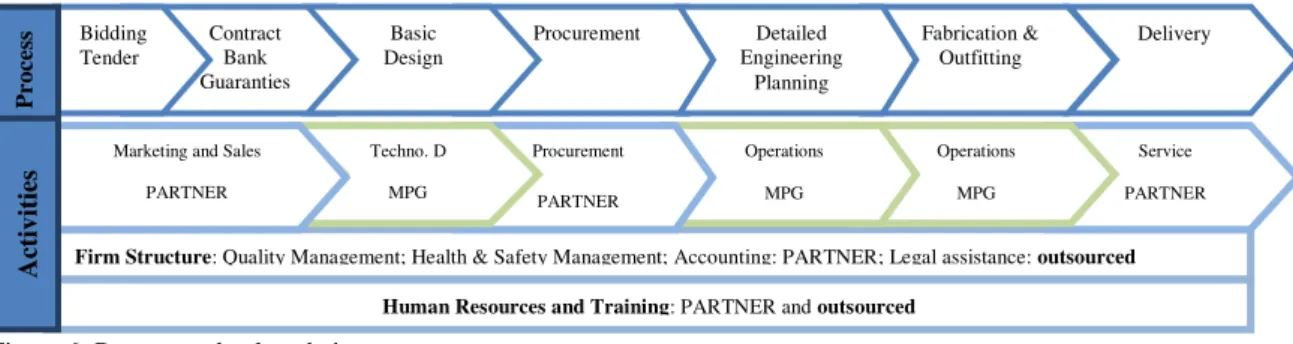
MPG already signed an agreement with Rolls-Royce for know-how transfer in Design and Technology; now a partnership with Q-Ship would help MPG to develop its outfitting and design competences, but also the relations with regional clients, suppliers and government. In a joint venture, MPG would have, for example, a 30% of share13, the partner would provide the shipyard and the equipment and the activities would be share as shown below:
Figure 6: Process and value chain per partner
Given MPG’s competences, the local development in construction and the investment in the marine sector by the Qatari government, MPG should not only offer ready to use OSV, but also services in project management, planning, design, engineering, purchasing, inspection and production follow-up to other companies; services of ship
Firm Structure: Quality Management; Health & Safety Management; Accounting: PARTNER; Legal assistance: outsourced Human Resources and Training: PARTNER and outsourced
Fabrication & Outfitting Delivery Procurement Contract Bank Guaranties Bidding Tender Detailed Engineering Planning Basic Design P ro ce ss Service PARTNER Operations MPG Operations MPG Procurement PARTNER Techno. D MPG Marketing and Sales
20
repair in their shipyard and project management and supervision of repairs at other shipyards. The company’s know-how in designing, construction and commercializing metal structures should also be part of MPG’s portfolio for products and services in the country.
Scenario II
If MPG is available to adjust its expectations of internationalization, they should also consider indirect exports hulls for support offshore vessels, through a local sales representative. In this case the company doesn’t gain the competence expected of delivery of the ready to use vessel and the value proposition to the client would remain the same. Furthermore, it is less risky and there isn’t record off a similar approach by other companies in the market. MPG would build the hull in Portugal, and find local shipyards that would do the final outfitting, similarly to what it does in Europe. To follow this process, MPG should promote the company products and services in conferences, forums, and exhibitions, and contact AICEP in order to find a local commercial agent that will sell the product against a commission.
Of all countries of the Persian Gulf, UAE has more operating companies and is also the most competitive market, which makes it a more appropriate market to enter as a supplier of hulls.
21 Implementation Plan: Joint Venture
Implementing an internationalization venture takes proper planning, including firm’s objectives, key requirements and the monitoring system. In order to find main requirements using the 4M framework, project objectives must first be are defined:
Year 1: Having orders in the value of 150 million dollars; Improve the capabilities of key personnel;
Potentiate relations with suppliers
Year 2: Initiate company’s certification procedures; Having a sales growth of 15% in the OSV segment
MAN
Human resources are crucial in intensive workforce-based industries as shipbuilding and most of it would be recruited only when the company had projects. MPG would develop the design and planning of the project in Portugal and send an Engineer to meet the client and understand its requirements, working closely with the partner in contract negotiation. When there are projects in course, most labor would be recruited locally, and project managers and supervisors would be expatriated to Qatar (complete job description - appendix 18):
Job Description Headcount Comment
With no Project
Project Manager Take care of MPG business and contacts potential clients
1 Expatriate
Secretary To provide administrative assistance 1 Local
Lawyer To counsel on legal rights and obligations - Outsourced
With Project
Project manager Responsible of the performance of the ship building project
1 Already present
in Qatar Welder & metalworker
Supervisor
Supervise and give training on-job to metalworkers and welders
1 Expat during the project Table 3: Job description
22
misunderstandings and inappropriate behavior. The local workers must have training on-job during the project development.
MONEY
The compensation for expatriates must be enough to maintain an equivalent purchasing power as in Portugal and the company should give fringe benefits like housing allowances and education for the employees with children. The regular compensation for Qataris would be a fixed salary and a performance based bonuses.
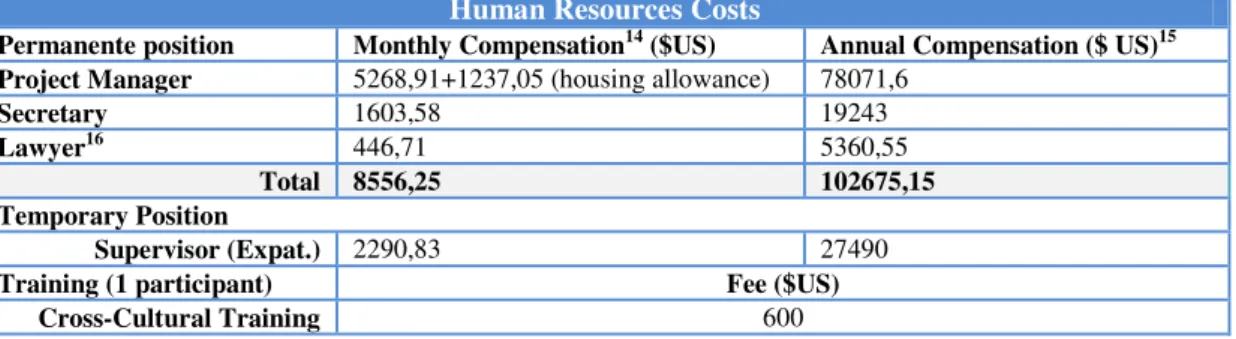
Since the partner of MPG will be responsible for the shipyard, equipment and some activities that require more local knowledge, in the beginning of the venture we can only consider costs related to human resources directly contracted by MGP and cost of activities to find the partner and settle the agreement.
Human Resources Costs
Permanente position Monthly Compensation14 ($US) Annual Compensation ($ US)15 Project Manager 5268,91+1237,05 (housing allowance) 78071,6
Secretary 1603,58 19243
Lawyer16 446,71 5360,55
Total 8556,25 102675,15
Temporary Position
Supervisor (Expat.) 2290,83 27490
Training (1 participant) Fee ($US)
Cross-Cultural Training 600
Table 4: Human Resources Cost
Marketing Expenses (yearly) $US
Exhibitions: Sea Trade Middle East Marine(UAE) Offshore Middle East (Qatar)
7605
Table 5: Marketing Expenses Table 6: Other Costs
Table 7: Initial investment plus annual expenses without projects
Other Expenses $US
Travelling (4 trips ) 2936
Hotel (6 nights) 560,7
Total Initial Investment + Annual Expenses $US
Exhibitions 7605
Travelling 2936
Hotel 560,7
Training 600
P. Manager 78071,6
Lawyer 19243
Secretary 5360,55
23 MINUTE
Controlling the progress of internationalization also implies setting a sequence of activities and milestones (table: dependency of activities – appendix 19):
Jan/11 02 03 04 05 06 07 08 09 10 11 12 Jan/12 … Nov/13
Contact AICEP & QCCI
Attend to forum, conferences Contact potential partners
Initiate contacts with local suppliers Sign joint venture Training of expat Get business license Expatriate in Qatar Make commercial proposals
Sign the first project Hire local workers Initiate certification process
Table 8: Timeline and milestones in the internationalization process
MEMO
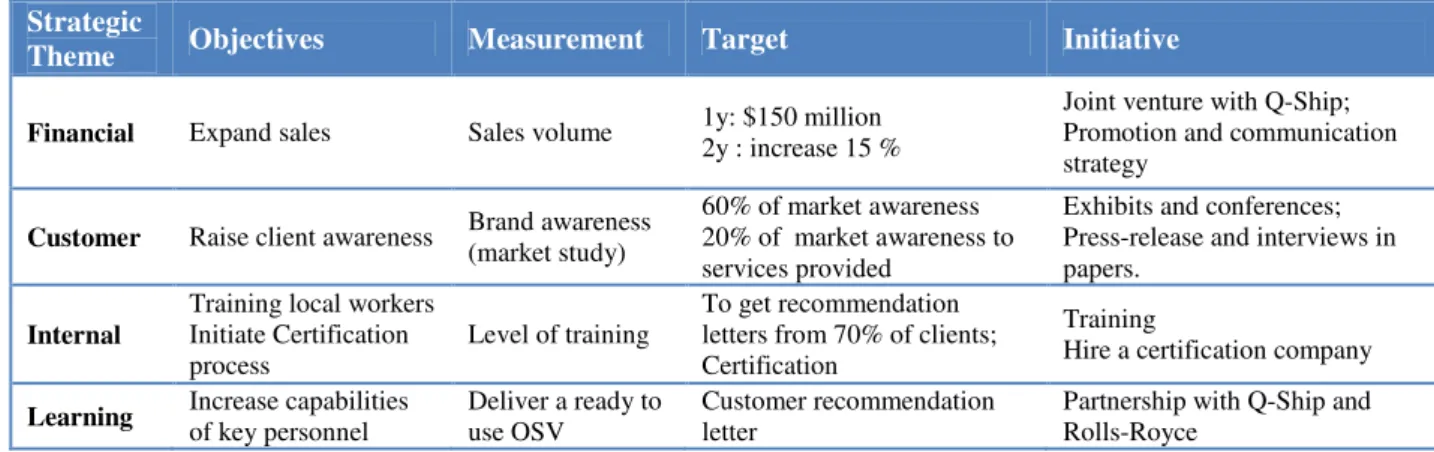
Monitoring the implementation process takes the definition of Key Performance Indicators to regularly compare with the previously set objectives. When one of the areas underperforms, this means that the company must adjust its activities with other initiatives:
Strategic
Theme Objectives Measurement Target Initiative
Financial Expand sales Sales volume 1y: $150 million 2y : increase 15 %
Joint venture with Q-Ship; Promotion and communication strategy
Customer Raise client awareness Brand awareness (market study)
60% of market awareness 20% of market awareness to services provided
Exhibits and conferences; Press-release and interviews in papers.
Internal
Training local workers Initiate Certification process
Level of training
To get recommendation letters from 70% of clients; Certification
Training
Hire a certification company
Learning Increase capabilities of key personnel Deliver a ready to use OSV Customer recommendation letter Partnership with Q-Ship and Rolls-Royce
24 11.Recommendation and conclusions
MPG has great potential, but seems to not be fully leveraging right now. The great advantages of MPG are the project planning capabilities, a large experience and know-how in the metal-working field and the large dock in the shipyard then it’s important to develop a portfolio of services and products that allows the company to not be dependent of the niche market of OSV. Furthermore, since the company is export oriented, it should double its promotion efforts, by partaking in international events from construction to offshore. MPG must turn its competences into added value services, otherwise it will be harder to find willing partners for internationalization to share the risk and acquire other capabilities.
To do business in the Middle East and take advantage of the growing opportunities MPG must that into consideration the need to direct contact with clients and business partners, trips to the region are key17. And even though some states see to be extremely developed and “occidental”, countries are very traditional.
MPG should partner with AICEP in the pursuit of potential partner and information about the market.
MPG must be present in several events in Qatar, the country with good characteristics to develop operations and in UAE, the door to be Middle East market and to develop export operations. Approach the market, and export is an adequate way to start the internationalization to the Middle East, to get to know the market before pursuing a
joint venture to Qatar. Because the critical activity is to find the right partner to the joint venture, time, effort and some experience in the market is crucial.
25
In conclusion, MPG can only be prepared to the Middle East if it rewrites its value proposition and do a step by step approach to the market, starting with exports to the region and just then the joint venture to Qatar.
12.References
AICEP. "AICEP." April 2010. www.portugalglobal.pt (accessed November 1, 2010).
AMEM. "Polish Shipyards." Austrian Marine Equipament Manufacturers. June 18,
2005. http://www.amem.at/ (accessed october 20, 2010).
DGAE. Indústria Naval. April 8, 2009. http://www.dgae.min-economia.pt/
ECORYS. "Study on Competitiveness of the European Shipbuilding Industry." European Commission. October 8, 2009. http://ec.europa.eu/ (accessed September 28, 2010).
IAPMEI, I.P. ANI 1º Sessão de Trabalho com Empresas das Indústrias Marítimas:
Relatório. 2009. http://www.ain.pt/ (accessed September 30, 2010).
ISSB. Middle East & North Africa. 2010. http://www.issb.co.uk/ (accessed November 1, 2010).
Fadda, Eliane. "Construção Naval- Uma indústria Global as Estratégias para a Retoma do Crescimento." Ministério dos Transportes. 2008. http://www.transportes.gov.br/ (accessed October 2, 2010).
Costa, Carlos, and Paulo Paz, interview by Rita Silva and Sara Silva. MPG interview
(September 23, 2010).
QNB. Doing Business in Qatar 2010. Doha: QNB Capital, 2010.
RS Platou Group. The Platou Report. Oslo: Platou, 2009.
Sousa, José, and Filipe Duarte, interview by Sara Silva and Rita Silva. AIN (September 2010, 2010).
U.S. Commercial Service. "Doing Business in Qatar." 2009
1 In case of a greenfield project
2 Gulf of Mexico, Brazil and West Africa, three areas rich in energy potential. 3 MPG’s value chain is considered in appendix 3
4 According to Paulo Paz from MPG, for every offshore oil platform there are on average 15 OSV. 5 Major companies: STX Europe and Bergen Group
6 Domestic market limitations: low demand; restriction in ship repair activities (“no competition” agreement with
LISNAVE)
7 OPEC- Organization of the Petroleum Exporting Countries
8 Grid Analysis - In order to make the grading comparable, a weight between 0 and 5 (no importance - great
importance) was attributed to the indicators, and then that weight was multiplied by the score (0-5) of the indicator in each country. The final score is the sum of all partial results.
9 WT – Weight of each factor
10 Islamic Law & Business: Great importance of comply with commitments; Contracts must be fair to all parties. 11 Estimation of $200 million for the total ownership and construction of the shipyard and for leasing/ equipment to
operate (assumption: similar cost of the projects in Brazil)
12 ISO 9001: 2000 14001:2004 OSHA: 18000:2007
13 Nakilat-Damen joint venture has similar equity sharing of 70/30%. Nakilat owns the shipyard and equipment and
Damen is responsible for the major know-how.
14 Assumption: Local average compensation in Qatar 15 Assumption: 12 months compensation
16 Assumption: outsourced job, annual compensation: 15% of average annual compensation in Qatar
17 According to Sérgio Espadas, AICEP Session: “Conhecer Mais Mercado-Emirados Árabes Unidos” (December
13. Appendices
1- Picture of MPG Shipyard
Source: MPG, 2010
2- Hull production process
3-Value Chain
Firm Structure: corporate overhead (25-35%)
Human Resources Management (contained in primary activities: operations)
Technology Development, including ship design (0,1-03%)*
Procurement Inbound
logistics: inbound
of steel and
equipment,
warehousing
Operations: steel cutting,
fabrication, painting, assembly,
launching + human resources
costs (15%) + purchased
materials (50%)
Outbound
Logistics:
delivery
(0,2-0,4%)*
Marketing and
sales: initial
contract,
contract signing
(2-3%)*
Service:
after sale service Marg
in
s:
1
2
-3
0
27 4- Steel Parking Area
Source: MPG, 2010
5- Blocks
Source: MPG, 2010
6- Assembly in dock
28 7- Platform Supply Vessel
Source: MPG, 2010
8- Pontoon
30 10-Portuguese Industry: Overview
The Portuguese shipbuilding and repair market started to decline during the 70’s with the oil
crisis of 1973 and the revolution of 1974 and the decolonization extinguished the projects and
transportations to Africa, which led to contraction and extinction of some markets. Alteration in
sea routes, budget constraints, changes in the navy functions also had a negative impact in
Portuguese industry. Recently, the increase of competition by the Spanish industry, and changes
in the EU fishing policies, decreased the building of fishing ships. The ship repair also
decreased due to volatility of oil prices, the dollar exchange rate, and new shipyards entering
the market, especially from West Europe, increasing the competition. One may add the
resistance of Portuguese shipyards to convert the activity, to be more innovative when that is
crucial to follow the changes of the global market. (CESA, 2009)
Today, the Portuguese repair and shipbuilding industry is “characterized for having companies
with different size: small and medium dimension shipyards and a small number of shipyards of
big dimension” (DGAE; 2009). According to Direcção-Geral das Actividades Económicas
(2009), there are 13 construction shipyards of medium /small dimensions, which reconverted
their activity of building fishing ship to build small ships to export. Portugal has only 1 big size
shipyard with construction purposes, Estaleiro Naval de Viana do Castelo (ENVC). Ship repair
is done in15 small/ medium shipyards and in 2 shipyards of big dimensions, some of these
shipyards do both activities, Lisnave and ENVC. (DGAE)
In 2008, the industry had 384 companies and 4832 employees. The sales volume was 501
million euros, growing 19,2% when compared to 2007, and 63,5% came from export activities.
The average growth was 14% between 2004 and 2008.
The financial and economic crisis only hit in the end of 2008, according to Associação das
Indústrias Navais (2010), when the repair and shipbuilding activities were tremendously
affected with a turnover contraction of 26,5% in 2009. Shipbuilding revenues had a sharp
downturn of 58,2%, to 54 million euros. Ship repair is more important in Portugal than
shipbuilding and is less affected by the economic cycle, but it also decreased 9,2% revenues to
31 11-World Offshore Vessels 2001-2008
Source: Ecory, 2009
12-Global Offshore Drilling Spend, 2000-2020
Source://www.egyptoil-gas.com/
13-Influences on the Shipbuilding competitiveness
32 14-Competitive Assessment: Europe
Metalships and Docks (Spain) Maritim (Poland) Santierul (Romania) Tuzla Gemak (Turkey) MPG (Portugal)
Year of Start 1999 1992 1950 1977 2005
Sales 105 million n/a n/a n/a 30 million
Buyers Norway, U.S France, German, Norway Italy, Romania Germany, Netherlands Norway, Spain
Main products Offshore vessels Hull, section, offshore Supply vessel, Tankers Hulls, pontoon, tankers Hull, blocks, PSV, AHTS Facilities/ Equipment
Cranes max 140t 100t 480t 220t 100t
Nº of Docks 2 1 4 1 1
Dock max. Size (meters)
162x31x25 172,25x37,2 350x58x10 260x53 420x75
Space (m2) 80.000 100.000 - 60.000 500.000
Annual building capacity
- 35000t/y 50000t/y 20000t/y 35000t/y
Production Nº employees
(direct)
100 240 2700 300 160
Productivity 2009 EU-27 = 100 (EUROSTAT)
110,9 65,3 (f) 47,2 63,4(f) 74,1
Availability of skilled labor Labor costs * (according to MPG management)
130% 100%* 85%* 80%* 100%*
Delivery delays Sometimes Common Common Sometimes No Access to R& D and
innovation Ease access to
financing / governmental
incentives (ECORYS, 2009)
Certification: Quality management, Occupational hygiene and safety, Environmental ISO 9001; ISO
14001; 18001
Complete ISO 9001/ 180001
Complete ISO9001/180001 In progress
33 15-SWOT- Domestic Market
Strength
Efficient project planning
Large shipyard allows projects diversification
Partnership with technology partner
Know-how in metalworking industry
Weaknesses
Lack of certification
Inability to deliver the vessel ready to use
due to the lack of technological development
and capabilities
Opportunities
New offshore energy market
Development of offshore renewables
Threats
New players coming from low labor cost
countries
Aggressive price cuts by competitors
16-Country Selection
WT S. Arabia UAE Qatar Kuwait Bahrain Oman
Market Size
Number of offshore rigs (dec.,09)**** 15 12 12 0 1 1
Investment in offshore (billion)**** 6 9 6 0,0018 0,1 n/a
Trade Bloc (GAFTA)
SCORE 3 5 5 5 4 4 4
Ease and compatibility of operations
1) Availability of resources
Number of Ports ***** 18 8 6 3 2 7
Quality of Ports 2 5 3 1 4 2
Steel suppliers*
Marine equipments suppliers (number) 41 185 38 12 8 n/a
Steel and marine equipment are mainly imported
Workforce availablility
Skilled work force 2 5 4 3 4 3
Quality of electricity supply 3 5 3 2 2 3
Infrastrutures (tranportation/communication) 3 5 2 1 3 3
SCORE 5 3 5 3 2 3 3
2) Law; policies and norms
Institutions
Burden of government regulation 2 3 5 0 2 4
Strength of investor protection 5 1 2 4 3 2
Property righs 3 3 4 2 5 3
SCORE 4 3 2 4 2 3 3
34
WT S. Arabia UAE Qatar Kuwait Bahrain Oman
Starting a business*** 3 5 4 3 0 3 3
Dealing with construting permits*** 3 3 4 4 2 5 0
Enforcing contracts*** 5 0 0 2 0 0 0
Closing a business*** 3 2 0 4 3 5 3
Business impact of rules in FDI 5 2 3 4 0 5 1
Prevelance of trade barriers 5 3 4 5 3 4 3
Prevelance of foreign ownership 5 2 3 4 0 4 2
Taxes 4 4 4 5 3 4 2
Trading across borders* 5 4 5 2 0 3 0
SCORE 5 3 3 4 1 4 2
Financial Market Development
Availability of financial services 5 4 4 4 2 5 2
Ease access to loans 5 4 2 5 2 5 3
Venture capital availability 4 4 4 5 3 4 4
SCORE 5 4 3 5 2 5 3
Labor Market Efficiency
Pay and productivity 5 4 4 5 2 3 3
Employing workers*** 5 2 3 3 4 5 4
Flexibility of wage determination 4 2 4 5 3 4 1
Wages costs US$** 5 4 2 2 4 2 3
SCORE 5 3 3 4 3 4 3
Corruption 3 2 4 5 0 2 3
Macroeconomic environment 4 1 3 4 5 3 5
Availability of Latest Technology 3 2 5 3 1 3 1
Capacity for innovation 2 5 4 3 1 2 2
Final score 114 142 149 86 129 109
Sources: The Arab Competitive Report ,World Bank 2010
*Economic Freedom Report 2010
**http://www.yougovsiraj.com/
***Ease for doing business (2010)
**** www.offshore-mag.com
35 17-Competitors in the Middle East
Drydocks World Group Dubai ship building and engineering Topaz Energy and Marine Zamil Offshore Services Nakilat-Damen
Shipyards Qatar ASRY
Year of start of shipbuilding
operations
1994 1997 2000 2002 2010 1999
Country/ State
of origin Dubai Dubai Dubai Saudi Arabia Qatar/Netherlands
OAPEC (bahrain) Products AHTS, PSV Dredger Pontoons Diving support vessel Bunker tanker Tug boats, pontoons, PSV, skimmers Dredgers, AHTS, workboats, passenger ferries
and fast patrol boats AHTS; PSV; Utility; Vessels/rescue boats Tugs, offshore supply vessels, coastal tankers, corvettes, patrol boats, luxury yachts. Tugs, Work boats, Crew boats, Offshore Service Vessels Clients Dubai Ports Authority; Aker Solutions (Norway); STFA Marine (Turkey); Nasseb maritime (Kuwait); Sea Way International (Romania) Saudi Aramco Dubai municipality; Sadiat Society (Abu Dhabi); Rule’s Court Shell, Total, British Petroleum, Saipem, AGIP KCO, Maersk Oil, QatarGas, J. Ray Mcdermott, Saipem, Dubai Petroleum, PA Resources, Rasgas, and Dolphin Energy Saudi Sea Ports Authority; Saudi Aramco; Qatar Petroleum (19 vessels ordered) Kuwait oil tankers Ship Repair/
conversion Yes Yes Yes Yes Yes Yes
Other services Shipping; Rig building; Ship chandlery; Offshore wind - Shipping; Constructions: steel structures; onshore and offshore installations Maintenance services Shipping; Charterers and chandlers; Engineering; Construction Services; Rigs repair; Sea Operators - -
Employees 10000 n/a 5200 750 n/a n/a
Fabrication facilities
Dubai: 3 docks (max:52
1 x 100 ) Float. D. Hydro-lift Cranes:50-120 tonnes Singapore; Indonesia; Batan Island Jadaf Yards:s Leased by Dry Docks World Hamriyah Free Zone: 20000 m2; Dubai Maritime City Fujairah (Nico Craft) and Abu Dhabi (Adyard) 2 floating dock (2000tonnes); 2 docking bages;
207,000m2 Shipyard (Damman Port) Lift capacity 1500tonnes; 9 dry berths; Shipyard (Ras Laffan) Docks: 270x63x40
3 docks (max: 252x 53, lifting: 33000ton) Cranes: 15-200ton; Certification
ISO 9001: 2000 ISO 14001; OHSAS 180001 ISO 9001:2000 (NICO shipyard) ISO 9001:2000 ;
14001 and OHSAS 180001 n/a ISO 9001:2000; 14001; OHSAS 180001
Ownership governmental 100%
Renaissance Services, SAOG (Oman) Zamil Group Holding Company Joint Venture Nakilat (70%): gas transport company ltd. Damen shipyards Groups (30%) OAPEC (Bahrain, Kuwait, Qatar, Saudi Arabia, UAE, Iraq and
36 18-Implementation plan: Job description
Job Description Headcount Comment
With no Project
Project Manager Take care of MPG business and contacts potential
clients 1 Expatriate
Secretary To provide administrative assistance 1 Local Lawyer To counsel on legal rights and obligations - Outsourced
With Project Naval
Engineers/ Architect
To design ship structures and hulls; To select materials
To write specifications for suppliers and to construction workers
-
Design and project planning
done in the Portuguese office CAD/CAM
Technician To prepare production drawing in 3D modeling Financial
Controller
Financial planning, debt financing, budget management
Project manager Responsible of the performance of the ship
building project 1
Already present in Qatar Welder and
metalworkers Supervisor
Supervise and give training on-job to metalworkers
and welders 1
Expat during the project
Jobs assigned to the partner Procurement and
logistics manager
To coordinate the logistical functions; Responsible for acquisition, distribution, internal allocation,
delivery
1
Wages are the responsibility of
the partner Sales Manager
To liaising with customers; to develop sales and promotional materials
To do quality checks on product and service delivery
to monitor competitors, market conditions
1
Training
Manager Training 1
Quality Control Engineer
To control the application of quality standards in
fabrication 1
Health and
Safety officer To control safety procedures during projects 1 Local workers contract during the project development
Metalworkers and Welders
To cut, bend, shape, and fasten the sheet metal To join of metal products
To handle welding machines Depends on the size
of the project
Wages are responsibility of
the partner
Painters Painting work
Carpenter To do carpentry work
Engine specialist To diagnose, adjust, and repair engines
Electrician To install, connect, test, and maintain electrical systems
Outsourced Jobs
Accountant
Apply principles of accounting to analyze financial information; Prepare financial reports; use of
accounting control procedures
Earnings are responsibility of
the partner Recruitment
37 19- Implementation Plan: Timeline and dependency of activities
Before enter the Market Dependency
Activity 1 Contact AICEP and Qatar Chamber of Commerce and Industry (7 months)
Activity 2 Attend to conferences, forum, expositions (6 months before) Activity 3 Reformulate strategic objectives (6 months before)
Activity 4 Contact potential JV partner (5 months before) Activity 1,2
Activity 5 Establish contacts with local suppliers ( 3 months before) Activity 4 Activity 6 Sign the joint venture (70/30) agreement with partner (2 months before) Activity 4
Activity 7 Get business license (less than 1 month before) Activity 1,6
After enter the Market
Activity 8 Make commercial proposals (1st month) Activity 6,7
Activity 9 Sign the first project (3rd month) Activity 7
Activity 10 Contact HR company and hire workers (contract per project) Activity 9
Activity 11 Initiate certification process Activity 7
14. Support Bibliography
Associação das Indústrias Navais. Relatório de Gestão e Contas. 2009. http://www.ain.pt/ (accessed September 30, 2010).
Balch, Emily. Baird Maritime. February 25, 2010. http://www.bairdmaritime.com/ (accessed October 6, 2010).
CESA. Community of European Shipyards Association. 2009. http://www.cesa-shipbuilding.org/ (accessed October 3, 2010).
Deresky, Helen. Global Management. New Jersey: Prentice Hall, 2002.
DGAE. Indústria Naval. April 8, 2009. http://www.dgae.min-economia.pt (accessed September 30, 2010).
Donboli, John, and Farnaz Kashefi. "Doing Business in tha Middle East: A Primer for U.S.Companies." Cornell International Law Journal, 2005: 414-455.
Dussauge, Pierre, and Bernard Garrette. Cooperative Strategy. Chichester: John Wiley & Sons Ltd, 1999.
Hill, Charles. "Entry Strategy And Strategic Alliances." In International Business: competiting in the global marketplace, by Charles Hill, 469-493. New York: McGraw-Hill, 2009.
MarOceano-Grupo de Trabalho da Indústria Naval. Contributo para a Revalorização da Indústria Naval Portuguesa 2010-2015. April 29, 2010. http://www.maroceano.pt (accessed 21 September, 2010).
Ma'ruf, Buana. "A systematic Approach to Strategic Formulation to Medium-Sized Shipyards." Journal of Management Technology, 2007: 169-178.
38 Muller, Torsten. "Managing cyclical change in European Shipbuilding and ship repair industries."
Eurofound; European Commission. June 28, 2007. http://www.eurofound.europa. (accessed 2 October, 2010).
Organization for Economic Co-operation and Development. OECD. n.d. http://www.oecd.org/ (accessed October 6, 2010).
Organization of Petroleum Exporting Countries. OPEC Web site. 2010. http://www.opec.org (accessed October 23, 2010).
Porter, Michael, and Dong Cho. "Changing Global Industry Leadership: The Case of Shipbuilding." In
Competition in Global Industries, by Michael E. Porter, 539-567. Boston, Massachusetts: Harvard Business School Press, 1986.
Powell, Thomas. "Competitive Advantage: Logical and Philosophical Considerations." Strategic Management Journal, 2001: 875-888.
Saer/ACL. "O Hypercluster da Economia do Mar." Associação Comercial de Lisboa. February 17, 2009. http://www.acl.org.pt/Files/Documents/Hypercluster%20da%20Economia%20do%20Mar.pdf (accessed September 20, 2010).
Souri, Mohammed, interview by Adrien Murphy. Could the Middle East be a Shipbuilding hub? (July 12, 2009).
Sousa, José. "Conjuntura Marítima 2010: Oportunidades e Desafios." Associação das Indústrias Navais.
July 9, 2010. www.ain.pt/ (accessed September 21, 2010).
U.S. Energy Information Administration. EIA. December 2009. http://www.eia.doe.gov/ (accessed October 6, 2010).