AR
TICLE
1 Programa de Mestrado em Biociências e Saúde Centro de Ciências Biológicas e da Saúde, Universidade Estadual do Oeste do Paraná. R. Universitária 2069, Bairro Faculdade. 85814-110 Cascavel PR Brasil.
Effectiveness of the Family Health Strategy in units with,
and without, the
Mais Médicos
(More Doctors) Program
in a municipality in the west of Paraná state, Brazil
Abstract Two years after the Mais Médicos
(More Doctors) Program, (Programa Mais
Médi-cos – PMM) was put in place in Brazil, there is
a need to study its feasibility. This study aims to evaluate the effectiveness of the primary health-care service offered, from the point of view of the health professionals, comparing units which have,
and which do not have, doctors from the Mais
Médicos Program. It is a quantitative survey,
using for data collection the instrument
Prima-ry Care Assessment Tool – Brazil, Version for Health Professionals, applied across the totality of the family health units in a medium sized mu-nicipality in the interior of the southern Brazilian State of Paraná, from November 2015 to Febru-ary 2016. It covered 72 professionals, 47 of them allocated in Family Health Strategy (FHS) units and 25 in FHS units containing the Program. In both groups the scores for core attributes (6.93) and general attributes (7.10) were considered to be appropriate to the precepts of primary
health-care. However, the attributes accessibility (4.17),
in both groups, and coordination – information
system (6.57), in units with the Mais Médicos
Program, did not reach the satisfactory level, indi-cating a need to alter the organization of the Fam-ily Health Strategy, whether the PMM program is
implemented or not.
Key words Primary Healthcare, Primary health doctors, Nurses, Assessment of health services Andreia Carrer 1
Beatriz Rosana Gonçalves de Oliveira Toso 1 Ana Teresa Bittencourt Guimarães 1 Julia Reis Conterno 1
C
ar
re
r A
Introduction
Primary healthcare has been indicated as an im-portant strategy for reorganization and expan-sion of the effectiveness of the health system, with an outstanding effect in the world scenario as a means of reducing the inequities existing in the health sector1. It represents the first level of access
for users of the health system, and is an essential element in the continued process of care, provid-ing actions and services of prevention, promo-tion, protection and rehabilitation of health in such a way as to meet the real health problems of individuals, families and communities2.
It is expected that, to be considered effective, a primary healthcare service should carry out an indissociable group of structuring attributes in the process of care, referred to as core attributes. These comprise: first contact access,
longitudi-nality, integrality and coordination of care. When
associated with the derived attributes family and
community orientation and cultural competence,
they serve to qualify actions in health. Thus the presence and extension of these attributes in the services offered by Primary Healthcare are in-trinsically related to the quality of services and the effectiveness of health actions2.
Thus, surveys of an evaluative nature in health, that show the degree of orientation for primary healthcare, or identify characteristics that are susceptible to change for improvement of the health actions, are important because they portray evidences that indicate their effectiveness and because they produce inputs for decisions of public policies. For these reasons, there is a con-stant need for evaluations of healthcare services3.
The association between actions oriented to the attributes of primary healthcare and quality of services provided has been demonstrated in various studies4-7. Evaluations in industrialized
countries and in developing countries show that, in areas where primary healthcare has a strong degree of orientation, better results in health conditions are found, with impacts in reduction of global mortality rates, infant mortality rates, and heart disease, and also advanced detection of cancer8. When the primary healthcare service
operates in such a way as to achieve the presence of these attributes, it becomes capable of provid-ing full integrated care to individuals, family and community, and, consequently, of taking actions that are effective and resolve problems.
In Brazil, the attempt to broaden the coverage and access to health services for the population has taken place through expansion of the Family
Health Strategy (FHS). At present, it is estimated that primary care units with Family Health teams provide coverage of 59.7% of the population of the country9. However, structural and financial
problems, and lack of human resources, among other factors, continue to be a block on expan-sion of healthcare.
In this context, the creation of public policies by the State is a strategy to improve the assistance offered in the primary healthcare system, and they translate into programs created with a view to qualification of the assistance in this scope of healthcare. Among these we highlight the Mais
Médicos Program (PMM), created by Law 12871,
of October 22, 2013, to provide infrastructure and human resources to populations that live in areas of difficult access or of greater economic and/or social vulnerability, among other objec-tives10.
The PMM aims to minimize the lack of doc-tors in the country and reduce regional inequal-ities in health. It involves three strategic fronts: more vacancies and new courses in Medicine, with revised curricular guidelines; investments in construction of primary healthcare units; and provision of Brazilian and foreign doctors to pri-mary healthcare units11.
This program two years after its implemen-tation, is present in approximately four thou-sand Brazilian municipalities, with a number of approximately 18,000 doctors12. However, since
it was prepared and put in place, it is seen that there have been various criticisms arising from both health professionals and users. Since imple-mentation is recent, there is a significant scarcity of surveys on this subject, principally in relation to the effectiveness of the care offered by the pro-fessionals and by the health teams registered in the program12.
It would be expected that among primary healthcare units, those with the Family Health Strategy would be better evaluated, especially those with PMM doctors. This study, as a general objective, aimed to evaluate the effectiveness of the primary healthcare offered, as perceived by the health professionals, comparing units with and without doctors of the Mais Médicos Pro-gram.
Methodology
aúd
e C
ole
tiv
a,
21(9):2849-2860,
2016
structures, in the urban and rural area of the municipality of Cascavel in the Brazilian State of Paraná. The Family Health Strategy in the municipality has a coverage of 30.68%, half the national figure, but expanding since 2012, now in a total of 10 rural units and 25 urban units. The population of the study comprised medical professionals, nurses and coordinators operating in the Family Health Units, totaling 72 subjects, of whom 33 were doctors (two participants were lost to medical leave during the study), of which nine are members of the PMM, 31 nurses, with a loss of four subjects, and eight coordinators. The data collection took place over the period No-vember 2015 – February 2016.
Data were obtained by individual interview with the professionals, in the health units, after previous scheduling by telephone, with applica-tion of the Primary Care Assessment Tool
(PCA-Tool) – Brazil, Professional Version. This is an
in-strument for evaluation of primary healthcare, validated in Brazil and published by the Health Ministry in 2010. Based on the model for evalua-tion of the quality of health services proposed by Donabedian, in 1966, it measures aspects of struc-ture, process and results of the health services 3.
The instrument comprises 77 items divided into eight variables13, as follows: First Contact
Access – Accessibility (A) – 9 items.
Longitudi-nality (B) – 13 items; Coordination in relation to
Integration of Care (C) – 6 items; Coordination
relating to Information Systems (D) – 3 items;
Integrality relating to Services Available (E) – 22
items; Integrality relating to Services Provided (F) – 15 items. Family Orientation (G) – 3 items; and
Community Orientation (H) – 6 items.
Primary contact access refers to users’ ac-cess and use of the health services, both for a new health event and also for a new episode of the same event2. This attribute, in the PCATool,
covers aspects relating to: waiting time for med-ical attention; availability of attention on spon-taneous demand; whether the attention takes place on the same day that the user seeks it; ease of scheduling consultations; period for which the unit is open and available to users; access to the professionals by phone for orientation; orienta-tions for care when the unit is closed; and access to return consultations13.
The attribute Longitudinality is defined by Starfield2 as the link relationship established
be-tween health professionals and users.
Coordination of care involves two
compo-nents: one relating to the integration of care, in relation to the process of work; and the other in
relation to the information systems, which deal with aspects of structure and process. The
coor-dination – integration of care component deals
with actions that portray the existence of con-stant identification of information about the us-ers, and also the supply of this information to the health professionals, their receipt of it, and its use in the global care for the patient.
In addition to the other attributes, integral-ity is described by Starfield2 as the capacity of
the health team to serve the most diverse needs present in the individual, family and communi-ty, and comprises: integrality – services available, which portrays the existence and availability of basic services that should be offered by prima-ry healthcare; and integrality – services provided, which refers to the care and orientations that are appropriate and should be carried out by the professionals of primary healthcare.
Associated with the core attributes are the derived attributes of family orientation, which according to Starfield2, can be understood as the
health professionals’ capacity to identify the fam-ily both as a space for care and also as a location which potentializes, and is the origin of, health problems. It is analyzed in conjunction with community orientation, defined as existence of contacts between health team and community, in which the health professionals identify and recognize the needs of the community both for direct contact and through interpretation of the epidemiological data2.
The PCATool – Brazil, Health Professionals
Version instrument has a Likert scale of replies
(4 = yes, certainly, 3 = yes, probably, 2 = proba-bly not, 1 = certainly not), with addition of op-tion 9 = don’t know / don’t remember. Based on these responses it is possible to calculate a score for each primary healthcare attribute (and its components) and also a Core Score and a Gen-eral Score. The scores for each attribute (and for its components) are obtained by the arithmetic mean of the answers to its respective items. The Core Score is the arithmetic mean of the scores of the core attributes, and the General Score is the arithmetic mean of the scores of the core and derived attributes13.
To transform these scores on a scale of zero to ten, this formula is used:
(Score obtained - 1) * 10 3
C
ar
re
r A
to score 3, equivalent to the option “yes, proba-bly”13.
The data obtained were tabulated and ana-lyzed in the form of descriptive and inferential statistics, presented in tables and charts for com-parison with the available literature on the sub-ject. The variables analyzed were primarily eval-uated as to the distribution pattern of the data using the Shapiro-Wilk test, and homogeneity of variances using the F test. The variables that were in accordance with these assumptions were analyzed using the t test for independent sam-ples, and the others through the non-paramet-ric Mann-Whitney-U test. In these tests, it was established whether the differences in scores on components of the PCATool – between the family health strategy units with PMM and those with-out PMM –were statistically significant. All the analysis was done assuming a significance level of 0.05, with the help of the XLSTAT 2015 quantita-tive data analysis software14.
The survey was submitted for approval to the Research Ethics Committee of the State Uni-versity of the West of Paraná (Unioeste), and was approved by Opinion 1.219.464, CAAE: 47147245215.4.0000.0107. It received authoriza-tion from the Municipal Health Department of Cascavel. Participants signed the Informed Con-sent Form, giving their conCon-sent, upon agreeing to take part in the investigation.
Results
In the Family Health Strategy units, 47 subjects were interviewed, while in the FHS which had
Mais Médicos Program doctors, 25 subjects were
interviewed – making a total of 72
interview-ees. The profile of the medical professionals and nurses that comprised the study can be described by: age range – from 25 to 63; how recently qual-ified – from one to 35 years; whether specialized in public health and related areas – 25 subjects; formal employment link via public competition – 53 (eight with employment contract under the PMM, and three under the Provab Program
(Program to Value Basic Healthcare
Profession-als – Programa de Valorização do Profissional da
Atenção Básica); all had a working week of 40
hours. The doctors in the PMM program iden-tified themselves as having qualified in Brazil, Cuba, Bolivia, Russia and Venezuela.
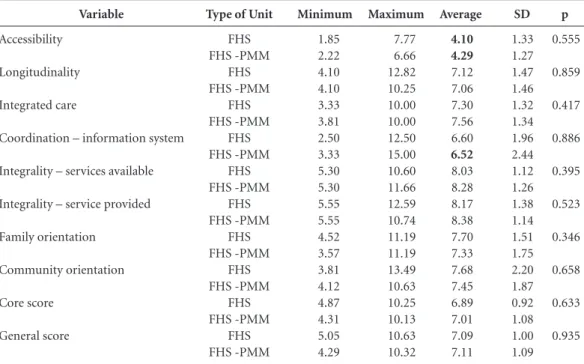
Table 1 shows the attributed scores for pri-mary healthcare for the FHS group and for the FHS-PMM group. We highlight the score for
ac-cessibility (4.20) which did not reach the
thresh-old level for being considered effective. Both the core score (6.9) and the general score (7.1) for primary healthcare were satisfactory.
Table 2 shows the results of the attributes separated into ‘FHS’ and ‘FHS-PMM’. It is seen that the attribute accessibility which showed itself not to be oriented to primary healthcare, had no significant difference between the types of unit (FHS = 4.1; FHS-PMM = 4.3). In the attribute
Coordination – Information System, the score
in the FHS was 6.6, that is to say at the cutoff point for being considered oriented to primary healthcare, whereas in the units with the PMM the value was 6.5, not representing orientation to a primary healthcare. There were no significant differences between the core and general scores, nor in the other attributes (p > 0.05).
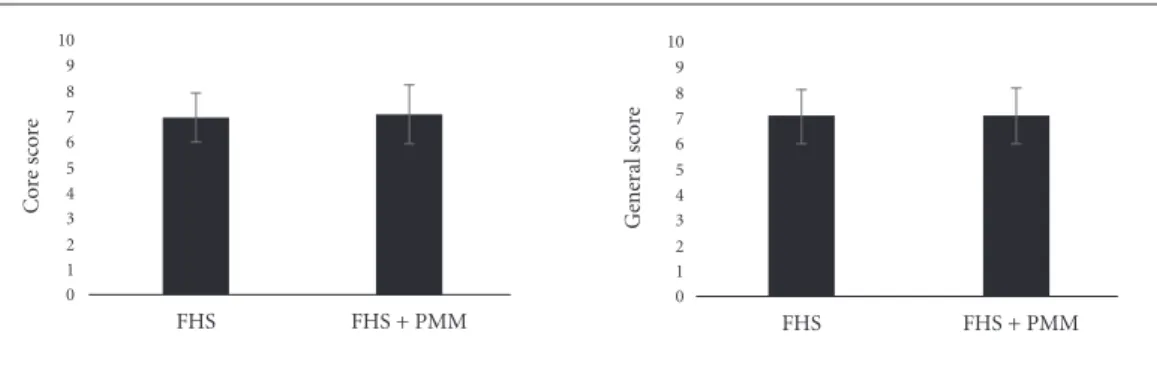
Figures 1 and 2 show the average scores of the primary healthcare attributes, and the core and general scores evaluated.
SD
1.30 1.45 1.32 2.14 1.17 1.29 1.61 2.07 0.98 1.03
Variable
Accessibility Longitudinality Integrated care
Coordination – information system Integrality – services available Integrality – service provided Family orientation
Community orientation Core score
General score
Number
72 72 72 72 72 72 72 72 72 72
Table 1. Scores for Attributes in Primary Health Care. Cascavel, 2016.
Maximum
7.77 12.82 10.00 15.00 11.66 12.59 11.19 13.49 10.25 10.63
Minimum
1.85 4.10 3.33 2.50 5.30 5.55 3.57 3.81 4.31 4.29
Average
4.17
7.10 7.40
6.57
8.12 8.25 7.56 7.59 6.93 7.10
aúd e C ole tiv a, 21(9):2849-2860, 2016
Figure 1 shows a low average for the item
ac-cess at first contact (4.1 ± 1.3), both in the
FHS-PMM, units and also in FHS units. Units that contained PMM professionals showed lower scores (4.1 ± 1.3) than the FHS unit (4.3 ± 1.3), although the difference was not statistically sig-nificant (p = 0.555).
It can also be observed that both the FHS and the FHS-PMM units presented an average above the threshold established by the literature (7.1 ± 1.4) for the attribute longitudinality.Comparing the average scores obtained in both the FHS cat-egories, the FHS units had a higher average score (7.1 ± 1.4) than the FHS-PMM units (7.0 ± 1.4), although the differences were not statistically sig-nificant (p = 0.859).
On coordination, in Figure 1, the average
obtained in our study (7.4 ± 1.3) did not pro-duce significant differences between the FHS and FHS-PMM units (p = 0.417). The other compo-nent of the coordination attribute – information
systems – showed an average with low orientation
of the services to primary healthcare (6.5 ± 2.1). However, when making the comparison between the units it was found that the lower average was obtained (6.5 ± 2.4) in the FHS-PMM units, whereas the score in the FHS units (6.6 ± 1.9), was exactly the threshold cutoff score.
In the item integrality – services available the score was above the average cutoff (8.1 ± 1.1), thus indicating that the FHS units have activities and basic health services that make it possible to carry out qualitative action for the population, as shown by Figure 1. There was no significant statistical difference between the FHS units (8.0 ± 1.1) and the FHS-PMM units (8.2 ± 1.2), with p = 0.395, thus showing that both the units maintained the same basic services intended to be made available by primary healthcare.
In the item integrality – services provided,
the average was 8.2 ± 1.2 in the units evaluat-ed. There were no significant differences (p = 0.523): for FHS the score was 8.3 ± 1.1; and for FHS-PMM, 7.7 ± 1.5 – as shown by Figure 1, thus showing that the work of the FHS health professionals has been carried out with the pre-cepts of integrality.
Bringing together the core attributes gives the Primary Healthcare core score for the group of units as a whole, equivalent to 6.9 ± 0.9, which is above the 6.6 cutoff point, showing that the services are adequately oriented to primary healthcare, as per Figure 2. Separated, the core score of the FHS units was 6.8 ± 0.9, and of the FHS-PMM units, 7.0 ± 1.0, with no statistically significant difference (p = 0.633).
SD 1.33 1.27 1.47 1.46 1.32 1.34 1.96 2.44 1.12 1.26 1.38 1.14 1.51 1.75 2.20 1.87 0.92 1.08 1.00 1.09 Variable Accessibility Longitudinality Integrated care
Coordination – information system
Integrality – services available
Integrality – service provided
Family orientation
Community orientation
Core score
General score
Type of Unit
FHS FHS -PMM FHS FHS -PMM FHS FHS -PMM FHS FHS -PMM FHS FHS -PMM FHS FHS -PMM FHS FHS -PMM FHS FHS -PMM FHS FHS -PMM FHS FHS -PMM
Table 2. Comparison of scores for attributes of Primary Health Care in Family Health Units (n = 45) and Family Health Units with the ‘Mais Médicos’ program (n = 27). Cascavel, 2016.
Maximum 7.77 6.66 12.82 10.25 10.00 10.00 12.50 15.00 10.60 11.66 12.59 10.74 11.19 11.19 13.49 10.63 10.25 10.13 10.63 10.32 Minimum 1.85 2.22 4.10 4.10 3.33 3.81 2.50 3.33 5.30 5.30 5.55 5.55 4.52 3.57 3.81 4.12 4.87 4.31 5.05 4.29 Average 4.10 4.29 7.12 7.06 7.30 7.56 6.60 6.52 8.03 8.28 8.17 8.38 7.70 7.33 7.68 7.45 6.89 7.01 7.09 7.11
Source: Researcher’s database.
C
ar
re
r A
On possible distinctions in the attribute
fam-ily orientation between the two types of unit,
the average score in the FHS group was 7.7 ± 1.5 higher than for the FHS-PMM group (7.3 ± 1.7), but again the difference was not statistically different (p = 0.346) (Figure 1). The FHS group of units showed a strong orientation to this at-tribute (7.5 ± 1.6), i.e. they were affected from
the point of view of primary healthcare with the focus on the family.
The units as a whole provided a reasonable score in community orientation (7.5 ± 2.0), with 7.6 ± 2.2 in the FHS units, higher than 7.4 ± 1.8 for the FHS–PMM units (Figure 1). However the differences were not statistically significant (p = 0.658).
FHS FHS + PMM
0 1 2 3 4 5 6 7 8 9 10 A cc essib ilit y
FHS FHS + PMM
0 1 2 3 4 5 6 7 8 9 10 L o ng it udinalit y
FHS FHS + PMM
0 1 2 3 4 5 6 7 8 9 10 Int eg rat io n o f car e
FHS FHS + PMM
0 1 2 3 4 5 6 7 8 9 10 C o o rdinat io n inf o rmat io n sy st em
FHS FHS + PMM
0 1 2 3 4 5 6 7 8 9 10 Int eg ralit
y - S
er
vic
es a
vailab
le
FHS FHS + PMM
0 1 2 3 4 5 6 7 8 9 10 Int eg ralit y S er vic es p ro vid ed
Figure 1. Representation of Average scores, ± Standard Deviation, in Primary Healthcare attributes, in Family Health Strategy (FHS) units operating with and without doctors of the Mais Médicos Program. Cascavel, Paraná State, Brazil, 2016.
Sources: Investigator’s database.
FHS FHS + PMM
0 1 2 3 4 5 6 7 8 9 10 F amil y o rie ntat io n
FHS FHS + PMM
aúd
e C
ole
tiv
a,
21(9):2849-2860,
2016
The general score for the derived and core attributes, for primary healthcare in this study was 7.1 ± 1.0 for the group of primary healthcare units, which is above the 6.6 threshold, indicat-ing the orientation of these services to primary healthcare. The general score for the FHS units was 7.0 ± 1.0 and for the FHS-PMM units was 7.1 ± 1.0 (Figure 2), the difference not being statisti-cally significant (p = 0.935).
Discussion
The results of this study show that the Fami-ly Health Strategy (FHS) units have in general shown a strong degree of orientation toward, and the core and derived attributes appropriate to, primary healthcare, both in units without PMM professionals and those with permanent doctors from the program, in the opinion of health professionals. This finding is important in that it de-mystifies the ideation that the PMM doctors do not have adequate training to operate in Brazil, especially the foreign ones, reportedly due to supposed problems of communication due to a language barrier. If this was so, it would be expected that the attributes were not similar in both type of unit – which they were.
Since the primary healthcare attributes are intrinsically related to the quality of services, it is seen that the FHS of the municipality has com-monly offered effective health action that resolves problems, although the isolated analysis of each attribute showed the need for improvements in care, specifically in relation to the attributes of accessibility and coordination.
As a structural element of a health system, access requires the establishments to be situated closer to the population, and also to pay atten-tion to the degree of tolerance to appointments that are not scheduled. Access is important, from the point of view of the population served. If the primary healthcare unit is in locations closer to the population, it should be the preferred entry point for users of the health system. It is hoped, thus, that its services should be accessible and its health actions effective in response to individu-als’ needs15.
The FHS aims to be a model for reorganiza-tion of primary healthcare in Brazil, presenting itself as an important strategy in the advance of accessibility to health services, in that it orders that there should be teams of health professionals, through the Family Health Units situated in lo-cations closer to the population and community, minimizing barriers of geography, organization, culture and gender in relation to care; and it also widens the access to the technological benefits with more guarantee of reference and less waste, as it promotes primary healthcare as an ordering factor in the Primary Care Networks (RAS)16-17.
However, even with the advances achieved by the FHS it is seen, in this care model, that prima-ry healthcare has found it difficult to strengthen its function as entry point to the health system. It is perceived that, instead of seeking out the Family Health Unit as priority, the population frequently goes to the emergency services, either because they are close, or accessible at the time when care is required, or provide an immediate resolution to a health problem, or due to the lack of doctors to attend in the health units referred
Figure 2. Representation of Averages, ± Standard Deviation, of Core and General scores in Family Health Strategy (FHS) units operating with and without doctors of the Mais Médicos Program. Cascavel, Paraná State, Brazil, 2016.
Sources: Investigator’s database.
FHS FHS + PMM
0 1 2 3 4 5 6 7 8 9 10
C
o
re
s
co
re
FHS FHS + PMM
0 1 2 3 4 5 6 7 8 9 10
Ge
ne
ral sc
o
C
ar
re
r A
to by users18, an aspect which it would be possible
to improve as from implementation of the PMM. Access to the FHS means, as well as an entry door to the system, capacity for resolution of a user’s health problem, which is also one of the objectives of the PMM – that is to say, provide doctors to the locations where they don’t cur-rently exist. In this case, this assumption was not confirmed, since in the units with PMM doc-tors the index for the attribute access was lower in a situation that is already adverse, since one does not expect access problems for the user in FHS units, since a major feature of this model is changes in the work process of the health teams, precisely to deal with the principles of primary healthcare in its daily work routine19-21.
When the attribute access shows weak orien-tation to primary healthcare, as in our study, a need is demonstrated for reformulation of the work process and the process of welcoming the user, changes in the organizational practices of the units, to bring the level of access for users to the desired level for primary healthcare.
On this subject, welcoming and acceptance strategies such as establishing flow patterns of users in the primary healthcare unit, adoption of models for care, individual care agenda man-agement and evaluation of risk and vulnerability, which require recognition by all the members of the team, have been indicated as important tech-nological tools, used as a way of making accessi-bility viable for the user and responding to what we hear from the health professionals22.
Although there is not a significant difference between the units, we highlight the importance of public policies such as the PMM, which can be considered a means of amplifying access to users in the health services, since it aims to make good the lack of human resources in the medical area in primary healthcare units, which is still a con-stant phenomenon, principally in areas that are more distant from major centers and to which access is geographically difficult10.
However, in spite of the limitations of access, in relation to the attribute longitudinality it can be said that the units of the study have performed in a way that qualifies their services for prima-ry healthcare. The link established between the health teams and the FHS user gives the pro-fessional greater knowledge of demands which emerge only when there is an effective link, and help in the process of care in all its stages – in pre-vention, promotion, treatment and the various cycles of life, as well as in greater participation and support by users2.
For longitudinality to be exercised, the pro-fessionals need to be open to these link relation-ships which, based on neutral trust, sometimes permeated with affection and subjectivities, tend to eliminate a totalitarian approach to knowl-edge, interventionist practices, and other more centralized healthcare attitudes, in favor of a hor-izontal therapeutic project. It is thus a new stance to be exercised by professionals, that goes beyond the biomedical models and institutes a more hu-man way of looking at the population – which on a daily basis reflects what might be called a renewed apprenticeship7.
Ilha et al.23 point out that relationship of
link between professional and user in the fami-ly health system is a requirement to be complied with, and leads to a greater approximation of di-alogue – a process of self-education in sensitivity and solidarity to live the experiences through a widened vision. Subsequent meetings are based on an appropriate acceptance and mutual trust, which bring professionals and users together, and also strengthen primary healthcare as a principal entry point since when users recognize it as the principal source of care, it will be the first place or service that they seek out. Summing up, the attributes first contact access and longitudinality
should go side by side2,24, which does not yet
hap-pen in the reality as studied.
The intention of the PMM is to strengthen
the longitudinality attribute, by proposing that
professionals remain fixed in locations where at present it’s difficult to make them do so. Howev-er, since the program specifies a finite period for this professional availability, the longer term may turn out to be a difficulty in orientation of this attribute to primary healthcare, in establishing a link between users and professionals. Thus, it is necessary to strengthen the link with the service, that is to say, with all the professionals of the unit, not only with the doctor.
The attribute coordination of care is based on evaluating whether the care provided enables it to be continued in its various aspects, whether by the professionals, or by the medical records, or by both, as well as identifying the capacity for recognition by the professionals by the problems and needs of the users in a continuous and pro-cess-related way2,3.
However, some situations have been estab-lished as principal obstacles for establishing the
coordination in primary healthcare, such as the
aúd
e C
ole
tiv
a,
21(9):2849-2860,
2016
this is the inefficiency of the registration of data in health records, and the lack of communication between the team, and absence of interdisciplin-ary work in priminterdisciplin-ary healthcare. Since informa-tion is the essence of coordinainforma-tion, informainforma-tion about individuals needs and the services provid-ed neprovid-eds to be fluidly available to ensure that all those involved in the process of care have access to and can understand this information2,17.
We note also that actions to strengthen co-ordination require efforts from the professionals and the health team in developing the capacity to identify, organize and integrate responses so the group of needs are identified in their users, thus making it possible for care to be continuous, as a primary factor for coordination, identifying problems raised in other services and integrating these actions into the global care for the patient2.
In this case, possible explanation would be that the presence of foreign doctors in the PMM, where the index was lower, could have been in-fluenced in terms of coordination by the fact of their not having deep knowledge of the structure and process of the Brazilian health service.
The following aspects have also been seen to be important strategies to be developed by health professionals in strengthening the attributed
co-ordination25:adoption of a care protocol
orga-nized under the logic of care; knowledge by the professionals on flows of attendance in the care networks; interdisciplinary work with discussion of tracer cases; making of consistent record on the services provided to users, and appropriate use of referral and counter-referral letters.
However, these strategies represent more than only the organization of the work process of the health teams. Management also needs to incorporate care tools and devices. The main dif-ficulties found for coordination of care, both in strengthening primary healthcare and in coordi-nation between levels of care, have been: articula-tion between service providers and professionals; limited supply of specialized service; absence of cooperation between peers; absence of recogni-tion of professionals, and obstacles to strength-ening of primary healthcare as the entry door to the system26.
Some actions and strategies developed by health teams enable greater agility and equity in the care provided to individuals, and also greater availability of information and fluid communi-cation between the professionals of various care points. These include: support for implementa-tion of electronic case records and computerized systems, incentive for management of a waiting
list, de-fragmentation of the services, and greater establishment of practices of regulation between the care points27 – these being measures that need
to be amplified and implemented in the munici-pality that was studied.
Further, also: to give priority to the user’s healthcare, organizing the services based on his/ her needs and expectations in health plans, would make it possible to guide us on our path toward achieving coordination. This is an attribute that is fundamental for the functioning of the others, since without coordination, longitudinality loses its potential, integrality becomes abstract, and the first contact becomes a purely administrative function, without links between the professional end users2,27.
The availability of services, relating to the attribute integrality, is an essential factor for the performance not only of primary healthcare but of all levels of care since the user’s need becomes the central focus of care. However, to restrict lon-gitudinality to the availability of services would be the equivalent to not offering an integral care. The meaning of integrality goes beyond the ques-tion of guaranteeing care to the users between the care points that become necessary; it demands that in their work practices professionals should understand it in its totality, providing adequate welcome and acceptance, a care that has dignity, is humanized and based on a relationship of a link28.
Integrality thus presupposes the guarantee to users of an integral care, both from the point of view of the biopsychosocial character of the health-illness process, and also in actions of pro-motion, prevention, cure and rehabilitation that are appropriate to the context of primary health-care and which require efforts by professionals to make it effective29.
To serve families on the basis of these attri-butes requires from professionals a knowledge about their dynamics, social context and the role of each member of the families, to enable plan-ning and systematization of actions that are di-rected to them based on identification needs both by the user and by the health team, so that based on a relationship of link and mutual correspon-dence they can experience situations of empow-erment30.
C
ar
re
r A
In this aspect the FHS, as can be seen in this study, has represented itself as an important strategy for healthcare coverage and in terms of approximation of users to the primary healthcare services30.
The derived attribute community orientation
identified whether the health actions offered by the FHS were also focused on the community, since the multi-causality of the health-illness process, and also the prospect of an amplified concept of health, bring out the perception of the diversity of conditioning and determining factors that involve the production of care. Thus the actions in health based on this logic require that the primary health teams should act in such a way as to meet the health needs of the popula-tion in prevenpopula-tion and promopopula-tion both individ-ually, and in collective terms in their territories16.
However, health actions based on promotion and prevention to improve quality of life are ef-fective only when they include a multi-territo-rial view, in which the existence of other agents that are influential in this dynamic of the area of coverage of a health unit is recognized. Thus, through an inter-sectorial work between health team and these agents – community leaders, NGOs, social movements, and other institu-tions – jointly with social actors, the breadth of achievement of results will be obtained which is truly able to change the social and epidemiologi-cal profile of a territory31.
The assumption that there could be differenc-es between the units due to the fact of there being foreign doctors working, sometimes with diffi-culties of communication, was not confirmed by this study, due to the similar values between the attributes in both the types of health units.
In this context, the FHS is seen to be an im-portant advance in access to health services, since it inserts health teams and units at locations clos-er to the population, breaking physical, cultural and social barriers that sometimes in the past limited the user from exercising his/her right to health. This has been confirmed by this present study, which identified that health actions and services, in relation to the core and derived attri-butes of primary healthcare are being effective,
without significant differences between the units that have, and the units that don’t have, PMM doctors. However, the two groups (with and without PMM) also showed similar values for the attribute accessibility and coordination, but not all the aspects of primary healthcare: this suggests the need for improvements in the service, both in the structural aspects and in the organization of the health system of the municipality, to ensure care that has quality and is oriented to the pre-cepts of primary healthcare.
Conclusion
Efforts have been made over the years in the var-ious levels and spheres of health management in Brazil to strengthen primary healthcare, aiming to widen users’ access, reinforcing it as a principal port of entry into the system, and to strengthen it as a coordinator of care and an ordering function within the care networks, so as to provide health action and resolution of problems to the whole population. This study, in that it found no differ-ences of perception about the effectiveness of their operation between health professionals in units with and without PMM doctors, shows that the efforts on programs aiming to improve primary healthcare in the country have met with success, and should continue to exist and be strengthened. We also note the importance of production of further knowledge about the continuity of public programs and policies through evaluation of the health services, since through this knowledge it becomes possible to identify, in daily practices, the processes that need reaffirmation or refor-mulation to strengthen primary healthcare, with the participation and commitment of health pro-fessionals, and managers and the population in the quest for better health conditions.
aúd
e C
ole
tiv
a,
21(9):2849-2860,
2016
Collaborations
A Carrer worked in the research, methodolo-gy, conception and final drafting; BRGO Toso worked in the research, methodology, conception and final drafting; ATB Guimarães worked on the methodology and final drafting; JR Conterno worked on the research; and KC Minosso worked on the research.
References
Brasil. Ministério da Saúde (MS). Melhoria contínua da qualidade na atenção primária à saúde. Brasília: MS; 2010.
Starfield B. Atenção primária: equilíbrio entre necessida-des de saúde, serviços e tecnologia. Brasília: UNESCO/ MS; 2002.
Brasil. Ministério da Saúde (MS). Manual do instru-mento de avaliação da atenção primária à saúde. Pri-mary Care Assesment Tool PCATool – Brasil. Brasília: MS; 2010.
Turci MA, Costa MFL, Macinko J. Influência de fatores estruturais e organizacionais no desempenho da aten-ção primária à saúde em Belo Horizonte, Minas Gerais, Brasil, na avaliação de gestores e enfermeiros. Cad Sau-de Publica 2015; 31(9):1941-1952.
Silva SS, Baitelo TC, Fracolli LA. Avaliação da atenção primária à saúde: a visão de usuários e profissionais so-bre a estratégia de saúde da família.Rev Lat Am Enfer-magem 2015; 23(5):979-987.
Araújo RL, Mendonça AVM, Sousa MF. Percepção dos usuários e profissionais de saúde no Distrito Federal: os atributos da atenção primária.Saude Debate 2015; 39(105):387-399.
Silva AS, Nogueira DA, Paraizo CMS, Fracolli LA. Ava-liação da atenção primária à saúde: visão dos profissio-nais de saúde. Rev Esc Enferm USP 2014; 48(Esp):126-132.
Harzheim E, Lima KM, Hauser L. Reforma da atenção primária a saúde na cidade do Rio de Janeiro: avaliação dos primeiros três anos de clínica da família. Pesquisa avaliativa sobre aspectos de implantação, estrutura, pro-cesso e resultados das clínicas da família na cidade do Rio Janeiro. Porto Alegre: OPAS; 2013.
Brasil. Ministério da Saúde (MS). Portal da Saúde. Mais Médicos. [acessado 2016 fev 2]. Disponível em: http:// portalsaude.saude.gov.br/index.php/cidadao/acoes-e -programas/mais-medicos/mais-sobre-mais-medi-cos/5953-comofunciona-o-programa
Brasil. Ministério da Saúde. Lei nº 12.871, de 22 de ou-tubro de 2013. Institui o Programa Mais Médicos, alte-ra as Leis no 8.745 de 9 de dezembro de 1993 e no 6.932 de 7 de julho de 1981 e dá outras providências. Diário Oficial da União 2013; 23 out.
Santos LMP, Costa AM, Girarde SN. Programa Mais Médicos: uma ação efetiva para reduzir iniquidades em saúde. Cien Saude Colet 2015; 20(11):3547-3552. Brasil. Ministério da Saúde (MS). Portal da Saúde. His-tórico de cobertura da saúde da família. [acessado 2016 fev 15]. Disponível em: http://dab.saude.gov.br/portal-dab/historico_cobertura_sf.php
Hauser L, Castro RCL, Vigo A, Trindade TG, Gonçal-ves MR, Stein AT, Duncan BB, Harzheim E.Tradução, adaptação, validade e medidas de fidedignidade do instrumento de avaliação da atenção primária à saúde (PCATool) no Brasil: versão profissionais de saúde. Rev Bras Med Fam Comun 2013; 8(29):244-255.
Addinsoft. XLSTAT for Windows, versão 2015. [aces-sado 2016 jan 15]. Disponível em: https://www.xlstat. com/es/
Oliveira MAC, Pereira IC. Atributos essenciais da aten-ção primária e a estratégia saúde da família. Rev Bras Enferm 2014; 66(n. spe):158-164.
1.
2.
3.
4.
5.
6.
7.
8.
9.
10.
11.
12.
13.
14.
C
ar
re
r A
Brasil. Ministério da Saúde (MS). Secretaria de Atenção Básica. Política nacional de atenção básica. Brasília: MS; 2012. Séries Pacto pela Saúde.
Mendes EV. As redes de atenção à saúde. Brasília: MS/ OPAS; 2011.
Freire AB, Fernandes DL, Moro JS, Kneipp MM, Car-doso CM, Lima SBS. Serviços de urgência e emergên-cia: quais os motivos que levam o usuário aos pronto -atendimentos? Rev Saude 2015; 41(1):195-200. Reichert APS, Leôncio ABA, Toso BRGO, Santos NCCB, Vaz EMC, Collet N. Orientação familiar e co-munitária na atenção primária à saúde da criança. Cien Saude Colet, 2016; 21(1):119-127.
Vaz EMC, Magalhães RKBP, Toso BRGO, Reichert APS, Collet N. Longitudinalidade do cuidado à criança na estratégia saúde da família. Rev Gaúcha Enferm. 2015; 36(4):49-54.
Silva RMM, Silva-Sobrinho RA, Neves ET, Toso BRGO, Viera CS. Desafios à coordenação na atenção primária à saúde da criança. Cien Saude Colet, 2015; 20(4):1217-1224.
Brasil. Ministério da Saúde (MS). Secretaria de Atenção à Saúde. Departamento de Atenção Básica. Cadernos de atenção básica. Brasília: MS; 2013.
Ilha S, Dias MV, Backes DS, Backes MTS. Vínculo pro-fissional-usuário em uma equipe da estratégia saúde da família. Cienc Cuid Saude 2014; 13(3):556-562. Cunha EM, Giovanella L. Longitudinalidade/continui-dade do cuidado: identificando dimensões e variáveis para a avaliação da atenção primária no contexto do sistema público de saúde brasileiro. Cien Saude Colet 2011; 16(Supl. 1):1029-1042.
Mendes EV. A construção social da atenção primária à saúde. Brasília: Conselho Nacional de Secretários de Saúde – CONASS; 2015.
Almeida PF, Giovanella L, Nunan BA. Coordenação dos cuidados em saúde pela atenção primária à saúde e suas implicações para a satisfação dos usuários. Saude Debate 2012; 36(94):375-391.
Mendes EV. As redes de atenção à saúde. Cien Saude Colet 2010; 15(5):2297-2305.
Freitas CASL, Fernandes AT, Chagas MIO, Soares CHA, Silva MJ, Brito MCC. O principio da integralidade na perspectiva dos coordenadores de um sistema de saúde no interior do Ceará. Cad Saude Colet 2010; 18(4):494-499.
Souza MC, Araújo TM, Reis WMR, Souza JN, Vileva ABA, Franco TB. Integralidade na atenção à saúde: um olhar da equipe de saúde da família sobre a fisioterapia. Mundo Saude 2012; 36(3):452-460.
Chapadeiro CA, Andrade HYSO, Araújo MRN. A famí-lia como foco da atenção primária à saúde. Belo Hori-zonte: NESCON/UFMG; 2011.
Pereira MPB, Barcellos C. O território no programa de saúde da família. Hygeia 2006; 2(2):47-55.
Article submitted 13/03/2016 Approved 15/06/2016
Final version submitted 17/06/2016 16.
17. 18.
19.
20.
21.
22.
23.
24.
25.
26.
27. 28.
29.
30.