AR
T
CILE
1 Escola Nacional de Saúde Pública, Fiocruz. R. Leopoldo Bulhões 1480, Manguinhos. 21041-210 Rio de Janeiro RJ Brasil. angelacasanova@ ensp.fiocruz.br
Health care networks implementation and regional governance
challenges in the Legal Amazon Region: an analysis
of the QualiSUS-Rede Project
Abstract This paper aims to analyze the poten-tial, limits and challenges of regional governance in the implementation process of health care net-works in three Brazilian regions: Alto Solimões (Amazonas), Belém (Pará) and an interstate region comprising Tocantins, Pará and Maran-hão states (Topama). The study is based on the evaluation study on the implementation of the Quality Health Care Network Development and Improvement Project (QualiSUS-Rede). This is a qualitative multiple case study with the anal-ysis of official documents and use of semi-struc-tured interviews with key stakeholders conducted from July to December 2014. Governance review encompassed three components: stakeholders in-volved, especially local steering groups and their regional coordination capacity; strategies used for strengthening regional governance, anchored on the intervention’s modeling; and implementation of local health care networks. Results point that the regional managing commissions were the main governance strategy and that the QualiSUS-Re-de Project strengthened regional governance and integration differently in every case, depending on stakeholders’ administration and consensus ca-pacity on regional and political priorities. Key words Governance, Health care networks, Regionalization
Angela Oliveira Casanova 1
Marly Marques Cruz 1
Ligia Giovanella 1
Glaydes dos Reis Alves 1
C
asano
va A
Introduction
The implications of adopting decentralization as a guideline in the implementation of health systems and its relationship with sector reform movements have been pointed out in the nation-al and internationnation-al literature1-4. Analyzes about
the municipalist realm of the Brazilian health system show diverse results and are strongly con-ditioned by the context of implementation, re-flecting the realities of the municipalities and the political will of governmental stakeholders1,5,6.
This setting has placed at the center of the debate the need to reconcile health policy decentraliza-tion with regionalizadecentraliza-tion strategies in order to promote more complementary intergovernmen-tal relations, balance autonomy and interdepen-dence between government entities, encourage the formalization of agreements and organize an integrated health system at regional level5,7-9.
Norms and guidelines were then published to give materiality to regionalization2,5,7,8. In this
process, parameters were established to define territorial distribution (health regions) and in-terregional collegiates were established, with representatives of the different spheres of gov-ernment responsible for conducting health pol-icy at the regional level8. Several tools have also
been formulated for regional planning9.
How-ever, there are discontinuities and changes in its scope, vis-à-vis the different theoretical and po-litical nuances that guided the strategies adopted for regionalization in Brazil: the conformation of
regions and health care networks (RAS)9.
Since 2011, the implementation of RAS in the country has been induced through federal funding around priorities established in accordance with clinical or organizational guidelines, such as moth-er and child health, psychosocial care, chronic diseases or urgent and emergency services, called
thematic networks10,11. One of the mechanisms
for this strategy is governance of care networks, understood as an organizational institutional ar-rangement that favors the management of the net-works’ components (care and diagnostic and/or logistical support services) and aims to strengthen relations of cooperation and solidarity between those in charge to obtain more satisfactory
out-comes for the region11,12. The governance system
aims to foster a mission and vision for the health region, define goals and objectives, promote the articulation of institutional and intersectoral poli-cies and strengthen its own regional management capacity through planning, monitoring and
eval-uation10-12. This arrangement encompasses three
aspects: institutional, through the strengthening of SUIS management bodies; managing, with the organization of steering groups of the regions ac-cording to the thematic network, responsible for the elaboration of the regional diagnoses and de-sign of the action plans; and financing10.
Despite the existence of a range of orienta-tions, norms and guidelines, the implementation of the RAS and regionalization itself face diffi-culties that have not been overcome2,8,13,14. Health
regionalization occurs through relationships with different stakeholders, with different orien-tations and interests, not necessarily convergent and involving several negotiation processes. This relational dynamic, which is the basis of the po-litical process of regionalization, has been char-acterized by municipalist, political-partisan, eco-nomic, privatist interests, among others, making it difficult to institutionalize health regions. In addition, there are several stages of regionaliza-tion instituregionaliza-tionalizaregionaliza-tion in the country, a process strongly conditioned by historical-structural, political-institutional and cyclical aspects2,13, to
which we add diverse operational strategies, frag-ile management tools, lack of planning culture, difficulty in regulating the contracted private sec-tor, underfunding and lack of regional coordina-tion tools that legally guarantee agreements2,13-15.
This paper aims to analyze the implemen-tation of care networks with emphasis on the aspects of regional governance in three regions of the country of the Legal Amazon. These re-gions received investments from the Training and Health Care Network Quality Improvement Project (QualiSUS-Rede Project) that aimed to support the implementation of networks in fif-teen regions of the country and provide institu-tional innovations in a context of few consoli-dated experiences. The projects were financed by funds obtained through a loan from the World Bank and the Ministry of Health (MS). Each selected region elaborated a project prioritizing investments in the axes: strengthening PHC, the-matic networks, logistical support and/or diag-nosis and regional governance16.
To evaluate the level of implementation of the interventions of the regional projects, an assess-ment research was carried out and completed in
December 201516. Regional governance, the focus
of this paper, considered the strengthening strat-egies designed in each project and the process of regional coordination in the implementation of the networks.
aúd
e C
ole
tiv
a,
22(4):1209-1224,
2017
understand to what extent these initiatives have contributed to the strengthening of regional gov-ernance and the obstacles to achieve greater insti-tutionality. We considered that the analysis of the impact of interventions aimed at strengthening regional governance can increase understanding in diverse contexts and, at the same time, identi-fy more general elements that facilitate or hinder regionalization.
Methodological procedures
The methodological strategy adopted was a mul-tiple case study with a qualitative method and a regional analysis plan16. The information was
an-alyzed from data collected in the framework of the QualiSUS-Rede Evaluation Research for the three selected regions: official documents and semi-structured interviews. Field research was conducted between July and December 2014.
Context of the study - selection and characterization of the regions
The criteria that supported the choice of the three regions considered participation in the QualiSUS-Rede Project and the regions’ geo-graphical location: international border region (Alto Solimões), metropolitan region (Belém) and interstate border region that encompass-es the statencompass-es of Tocantins, Pará and Maranhão (TOPAMA), with regions that are character-ized as opaque spaces or of corporative use of the territory17,18. The three regions are part of
the Legal Amazon, where important logistical and infrastructure difficulties are observed and which need to deal with interests related to the maintenance of their biodiversity, qualification of traditional economic activities and expansion of agro-economic activities19. Characteristics of
the selected regions are summarized in Table 1.
Sources of information and data processing
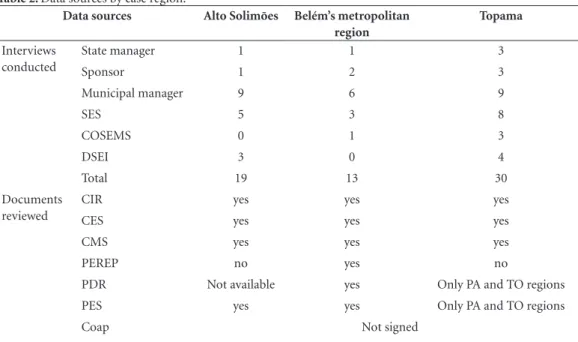
Interviews were carried out with the steering group responsible for formulating and imple-menting QualiSUS-Rede in the regions. Minutes of meetings of managing collegiates and health councils and state and regional planning tools were used for documentary analysis. These were organized and analyzed by region, and are shown in Table 2.
For the purposes of this paper, the analysis of governance in the regions articulated
infor-mation from evaluative research and established three main components:
1. Stakeholders: To coordinate and implement the projects, a QualiSUS-Rede steering group was set up in each region, with the task of mobilizing strategic stakeholders, formulating projects, sup-porting and monitoring their implementation. It should include representatives of state manage-ment, municipalities, COSEMS and education and research partner institutions, if necessary, in addition to an institutional MS sponsor, des-ignated for local support to the steering group. The coordination and financial execution of the project was assigned to the state manager. This component considered the composition of the groups, the role of stakeholders involved and the intersectoral articulation capacity.
2. Strategies: Refers to the logical analysis of the actions proposed for the strengthening of regional governance. The modeling of these in-terventions sought to identify and express co-herence between the problem situation of the re-gions regarding the regional governance process, with the intended actions and expected results.
3. Implementation of Health Networks: The level of implementation of the QualiSUS was evaluated according to a matrix of analysis and opinion that added six evaluative realms: com-pliance, coordination mechanisms, governance, social participation, technical quality of human resources and sustainability. Implementation was understood in terms of the technical and politi-cal aspects of regional governance. The following analytical subcomponents have been established:
. Regional coordination: content of the dis-cussions and negotiations; relationship between entities; orientation to regional issues and re-gional articulation;
. Organization of care networks: networking and regionalization; intra-sectoral integration (indigenous health); use of planning and man-agement tools;
. Co-financing and sustainability: definition of responsibilities among entities, formalization of conventions and agreements.
Results
Stakeholders
C
asano
va A
Table 1. Characteristics of the selected regions.
Characteristics Alto Solimões Belém’s metropolitan
region Topama
UF Amazonas Pará Tocantins, Pará and Maranhão
Nº Municipalities 9 5 110
Population Characteristics
Consisting of 3 microregions (Tabatinga, Santo Antônio do Içá and Fonte Boa). Area of national security and international border with two countries (Peru and Colombia), concentration of indigenous (various ethnic groups), riverine and
extractive population. The main element of connection and accessibility to municipalities is the Solimões River.
Insular and with important contingents of riverine population. Disordered
occupations, resulting from the migratory process, essentially of people / families coming from the municipalities most distant from urbanized centers. The municipalities of Belém and Santa Bárbara do Pará have rural settlement areas.
Covers 03 macroregions (north of the State of Tocantins, southeast of Pará and southwest of Maranhão) with 110 municipalities – 65 in TO, 22 in PA and 23 in MA – distributed in 07 health regions.
Total population 248.118 2.162.223 2.394.901
Population density 1,05 hab/km2 1122,68/km² 12,05/km²
CIR 1 1 7
Geographic situation
International Border Metropolization Opaque spaces and corporate use of the
territory Health Region
Type a
Low socioeconomic development and low supply of services
High socioeconomic development and average supply of services
3 regions – one in each UF: Medium / high socioeconomic development and low supply of services
1 Region – TO – Medium socioeconomic development and medium / high supply of services Regionalization
Institutionalization
in the State b
Amazonas: Incipient Pará: Intermediary Pará – intermediary
(States TO and MA were not investigated)
CIB’s operating dynamics - Content of the
negotiations b
Diversified.
Adherence to regional issues (endemic and service delivery). Power asymmetry. Greater weight of the State.
Diversified. Adherence to the state reality, but with greater weight of the federal agenda. Balanced power ratio.
(TO and MA were not investigated)
CIB’s operating dynamics - Political process
Cooperative-conflictive and restricted
Cooperative-formalist (TO and MA were not investigated)
Sources: Population: For Alto Solimões and Belém’s metropolitan regions (Projection 2016. Http://www.resbr.net.br/indicadores/ view). For the region of Topama (Projeto QualiSUS-Topama). Geographic situation: Machado et al.20. National typology of health
aúd
e C
ole
tiv
a,
22(4):1209-1224,
2017
governmental stakeholders and low coordination with other segments of government or society, as per Chart 1.
In the Alto Solimões region, the steering group was set up before the establishment of the Regional Interagency Commission (CIR). Initial-ly, this group counted on the participation of the directorate of the Garrison Hospital (of the Min-istry of Defense), an important back-up in the region, and with a representative of the Federal University of Amazonas. However, this compo-sition was later modified, keeping only managers and technicians of the health secretariats. Choos-ing this region for the project was based on the existence of a strong indigenous component in the population composition. The incorporation of the indigenous health subsystem, through the participation of the three indigenous health dis-tricts (DSEI) of the region in the steering group, favored the coordination of demands and some level of shared resources, although there were divergences regarding regional priorities. The region partnered with the Amazonas Regional Development Project for the Green Free Zone (PRODERAM), coordinated by the Amazon De-velopment Company (CIAMA), in partnership with the World Bank, which has health as one of its lines of action in the region.
Table 2. Data sources by case region.
Data sources Alto Solimões Belém’s metropolitan
region
Topama
Interviews conducted
State manager 1 1 3
Sponsor 1 2 3
Municipal manager 9 6 9
SES 5 3 8
COSEMS 0 1 3
DSEI 3 0 4
Total 19 13 30
Documents reviewed
CIR yes yes yes
CES yes yes yes
CMS yes yes yes
PEREP no yes no
PDR Not available yes Only PA and TO regions
PES yes yes Only PA and TO regions
Coap Not signed
Source: Brazil, Fiocruz, ENSP, DENSP/LASER16.
Likewise, in the metropolitan area of Belém, at the time of the QualiSUS-Rede project, CIR had not yet been established. During the im-plementation, the participation of the represen-tatives in the steering group (SG) was neither consistent nor uniform. Nonetheless, it was pos-sible to formalize partnerships with the state uni-versity for professional training and permanent education, as well as to make diagnostic support available via Telessaúde (equivalent of Telemedi-cine). The participation of a philanthropic health facility in the SG was also mentioned, which is responsible for back-up urgent and emergency services in the region.
Given the impossibility of involving manag-ers of all municipalities, TOPAMA region’s rep-resentatives were the municipalities of reference of their health regions. The SG was attended by different technical areas and the management of state secretariats, COSEMS and local sponsors. An indigenous health representative was later incorporated by integrating demands from this area into the project.
C
asano
va A
Chart 1. Regional governance stakeholders of Alto Solimões, Belém’s metropolitan region and Topama.
Stakeholders Alto Solimões
Belém’s Metropolitan
region
Topama
TO PA MA
Components of the Guiding Group
SMS - Managers representing the 3 Macroregions
SMS - All managers of the region
02 SMS 02 SMS 02 SMS
SES - Management and technical areas (Deputy Healthcare Executive Secretariat - Rural areas - SEAASI), Department of Planning / SUSAM, PRODERAM Coordination Office
SES - Management, Managing Collegiate and Regional Health Center Coordination Office
Management and technical areas (Planning and Care and Promotion)
Management and technical areas (QualiSUS-Rede and Control and Assessment, Audit and Regulating of Marabá Regional Office)
Management and technical areas (Planning and Regional Manager of the SES through municipalities of reference)
Indigenous Health Subsystem - DSEI Javari Valley, DSEI Alto Rio Solimões, DSEI Médio Solimões and tributaries
- QualiSUS SESAI Sponsor
MS - state sponsor MS - local
institutional sponsor and state sponsor
MS - local institutional sponsor and state sponsor
-
-- COSEMS COSEMS
TO - 02 representatives
COSEMS PA - 02 representatives
COSEMS MA -02 representatives Other
stakeholders
Garrison Hospital - Ministry of Defense (discontinued)
Not mentioned
Not mentioned
Federal University of Amazonas (discontinued) MS - state sponsor Municipal Health Councils Unaids
Partnerships Development
Company of the State of Amazonas (CIAMA) - Regional Development Project of the State of Amazonas for the Green Free Zone (PRODERAM)
State University of Pará (UEPA)
Not mentioned
aúd
e C
ole
tiv
a,
22(4):1209-1224,
2017
the TOPAMA region, in addition to this aspect, there were changes in the composition of the departmental teams in one of the state secretar-iats, including the planning area, responsible for conducting the COAP and the Project. All these aspects point to difficulties faced by the regions in assuring institutionality to the decisions and agreements made.
The definition of the state manager in the co-ordination of the project seems to have had the effect of recognizing his role in the regions in inducing regionalization and implementation of RAS. In Amazonas and Pará, the performance of state management was fundamental when taking on the coordination of projects, inserting them in their order of priorities and creating the neces-sary organizational conditions to facilitate its im-plementation. The region of Belém highlighted the redefinition of health regions and the impetus for the implementation of regionalization-linked networks, processes that until then had occurred slowly and gradually. In TOPAMA, the capacity for integration among the states was a constant concern, due to the lack of available human re-sources, difficulties in reconciling the agenda of managers and technicians in the three states, and in the definition of financing for the region.
Institutional sponsors were mentioned as important articulators in the regions and with essential role as mediators of conflicts and inter-ests. However, this support faces hardships in in-stitutionalizing and ensuring the permanence of these professionals in the regions, given the types of employment contracts established, with con-sequent inconsistency of sponsors in the regions. The inclusion of other segments was quite low and, in the case of TOPAMA, it did not even occur. The representation of society in all re-gions was sought through the municipal and/or state health councils, but the analysis of minutes showed that when there was some agenda related to the Project and its developments for the re-gion, this was discussed in a timely manner, with emphasis on investments made in reforms and acquisition of equipment, among others.
Strategies for strengthening governance
The interventions proposed in the scope of the Project were analyzed, according to the iden-tification of the problem situation by each Re-gion, as shown in Chart 2.
In the Alto Solimões region, the group recog-nized the lack of regional planning culture, with little use and outdated planning tools. At the time
of designing the project, two municipalities were in full management, none had adhered to the management pact and only four submitted the Municipal Health Plan for the period 2010-2013. Thus, one of the main objectives of this region was to strengthen the processes of planning and construction of management tools through guid-ance to municipalities. Another objective was to strengthen the CIR as a regional governance body, which occurred through actions aimed at its structuring and functioning.
The TOPAMA region also guided its actions around regional planning. It sought to formulate and integrate municipal and state management plans and tools, as well as to provide regional forums for the organization of RAS. One of its main strategies was to establish guidelines for the creation of an interstate collegiate through a deed of undertaking signed by the states. An internal agenda was established to define how to institu-tionalize this space of governance, without disre-garding the aspects and limits of legal (or norma-tive) provisions, such as Decree 7.508.
The metropolitan area of Belém prioritized training actions for managers, professionals, municipal health councils and representatives of civil society, especially regarding RAS (Chart 2).
In the preparation of the QualiSUS-Rede projects, there was an expectation of formulat-ing the Public Action Organizational Contract (COAP). This would also be a mandatory goal to be achieved by all regions. However, in the course of the procedure, it was considered that this could not be required, given the different moments of the regions in relation to this discussion. Some respondents acknowledged that the prioritiza-tion of the implementaprioritiza-tion of RAS in the regions put COAP debates in the background, so that only the Belém region made an initial effort in this direction.
Implementation of care networks
Regional Coordination
man-C
asano
va A
aged to move towards proposals more in line with regional needs.
In Alto Solimões, the project worked as a re-gional articulation mechanism, providing meet-ings and discussions among all municipal man-agers and a greater leadership role in the coordi-nation of the process by the state manager around regional objectives, despite hardships in recon-ciling different demands of the technical areas, such as the indigenous subsystem and municipal interests. Initially, municipalities’ demands were considered, based on their respective health plans. A health map the region was elaborated with a
view to identifying common gaps and difficulties, which resulted in the elaboration of a regional health plan. The group also sought to identify other possible financing sources at state or federal level, in order to prioritize, in the project, actions lacking funds for the structuring of networks.
In TOPAMA, each State chose specific lines of care to organize networks, according to their own interests. Funds were equally distributed and each state signed a deed of undertaking and drew up a specific procurement plan. Different move-ments were identified for implementation of actions among states, depending on the impor-Chart 2. Strategies for strengthening regional governance in Alto Solimões, Belém’s metropolitan region and Topama, 2014.
QualiSUS-Rede Regions Alto Solimões Belém Topama
Problem Situation
SUS management tools are used infrequently, precariously and with little updating. The necessary presence of the DSEIs and the Ministry of Defense is a Tripartite Council and not a Bipartite as required by the current legislation
Poor qualification of administrators, managers and technicians in planning actions aimed at designing Health Care Networks
The need to qualify and provide managers and technicians with the necessary tools to develop and plan actions based on the conception of networks and structures of the regionalization process, such as federative relations, public-private relations, internal management capacities, financial sustainability, care regulation and the establishment of quality standards for the provision of (public and private) services, as well as management and performance standards of health facilities, among others.
Strategies To guide municipalities in the
construction of planning tools; Organizing a workshop for the construction of COAP in the region
Training of health professionals and representatives of civil society in concepts of networks, legal tools and current projects
To elaborate the interstate directives involving the CIR of the Topama region and to establish the Interstate Regional Collegiate.
To establish a quality assessment system in hospitals of the municipalities headquarters of the
microregions and to build a tool for the user satisfaction evaluation survey
Train SMS and SES professionals in the elaboration of SUS planning tools
To purchase equipment and furniture for the structuring of CIR’s Executive Secretariat
To conduct periodic meetings of the GC with previous discussions in the CIR and regional forums for the organization of the RAS and implementation of the provisions of Decree 7.508 /11.
To support CIR and QSR’s GC meetings by providing airline tickets and lodging to its members.
aúd
e C
ole
tiv
a,
22(4):1209-1224,
2017
tance assigned in the state management agenda and institutional capacity. The situational diag-nosis was an important step for the mobilization and sensitization of managers regarding regional issues of this territorial division, which goes be-yond the borders of municipalities, states or even health regions defined within each state. It was carried out in the three states and evidenced the main hurdles, especially in the identification of the existing care gap, and the establishment of regional objectives, subsidizing the process of negotiation between states and municipalities for the allocation of financial resources in the project axes. However, these moments were character-ized by several conflicts and divergences, between the technical areas and related to the advocacy of municipal interests. The relationship between the three states was distinct and not always polit-ically friendly, with disputes over resources to be assigned to each state.
We work with three states and each one has advanced differently in structuring and planning actions. I believe that, because of the very politi-cal issue of each state [...]. I believe that it moves forward when we gather and try to solve the condi-tions within the Region.... when even with different processes in the States, we try to find solutions for the Topama Region (GC-TOPAMA-2105).
In the region of Belém, a diagnosis was made with the mapping of the needs of municipalities and the region. Some respondents pointed out that difficult access by the population due to the lack of local services made it hard to define the scope of networks. As in other regions, despite initial disagreements, the group established a consensus on regional needs. Respondents con-sidered that the project was an additional oppor-tunity for the strengthening of regionalization and networks in the face of the debates it pro-moted. These reflections added to the range of other initiatives in the region. The main features of regional coordination in the three cases are summarized in Chart 3.
The prerogative of centralization of the total execution of the Project in the health secretari-ats of the states was the strengthening of its role in the coordination of regionalization and net-works. However, some respondents said this was a problem in view of the volume of projects that the state management handles daily. It was con-sidered that a part of the financial implementa-tion could have been left under the responsibility of municipalities, which would provide greater agility to the bidding processes. It was also point-ed out that this centralization seems to have had
the effect of a smaller implication of municipal-ities in the more systematic monitoring of the implementation of interventions. It was consid-ered that a certain “cooling down” occurred in the content of discussions during the implemen-tation of the project, which is a more ritualistic phase of regional governance.
Organization of networks
In all three regions, the guidelines and regula-tions of Ordinance 4.279 and Decree 7.508 were integrated into the design of the projects and, to the extent possible, an alignment was sought be-tween the latter and the regional plans for the-matic networks. The priority care networks in the regions were the Urgent and Emergency care (RUE), Rede Cegonha (“Stork”, mother and child care), and Care for People with Chronic Diseas-es with a focus on cancer (Chart 3). Among the components of the care networks, regulation was considered fundamental for its organization in the three regions.
The establishment of a Regional Regulatory Complex was identified by Alto Solimões respon-dents as an important advance, with the defini-tion and organizadefini-tion of flows and agreement of reference facilities, a process confirmed in docu-mentary analysis. The acquisition of equipment, extension and qualification of reference labora-tory, in the diagnostic support and structuring of Urgent and Emergency and “Cegonha” Networks were considered, overall, as the main achieve-ments of the region.
The strengthening of PHC through the “Rede Cegonha” Network is one of the priorities. Since it is the first time that it is developing, the Emergen-cy Network is facing great difficulties, but these are beginning to be solved and will serve as an example for other regions. Such is the case for the implemen-tation of regulation and SAMU (GC-AS-15).
C
asano
va A
In TOPAMA, it was mentioned that the main results achieved were the scale-up of articula-tion and integraarticula-tion among the states; greater knowledge of the region’s reality, qualification of managers and technicians and advances in the definition of flows, regulation and integration of services, starting with the oncology care network.
The issue of regulation was recurrent in the agenda of the several meetings we had, so that this Chronic Disease Care Network could work, so much so that it brought in regulation, protocol discussions and service organization discussions (GC-TOPAMA-21022).
Conceived as one of the main contributions of the project in the three regions, health trans-port never took off the ground. Proposals were deemed unviable by concentrating on the acqui-sition of transport (land and/or river) and/or the contracting of passenger services, without the establishment of a structuring plan (route plan, flow organization, regulation, definition of re-sponsibilities and costing). The lack of regional experiences and an executive project model with-in the MS itself were aspects that contributed to the failure to advance in a consistent proposal. The project execution schedule was also insuffi-cient, given its complex design and implementa-tion.
With regard to indigenous health, a priority in the Alto Solimões and TOPAMA regions, it was sought to promote the articulation of de-mands of this specific population in the projects. In placing the responsibility of managers with regard to the health of the indigenous popula-tion on the agenda, both regions considered that the project provided progress in integration, al-though it did not occur as desired:
[...] One of the great advances of the QualiS-US-Rede Project ... besides integrating the discus-sion with the Municipality and the State, in this case, covering three States on indigenous health, was to make municipal and state managers aware of their responsibility to this population. This was a great gain for us, people of indigenous health
(GC-TOPAMA-15103).
We have integrated the PHC Network of the municipalities with the Indigenous Health Dis-tricts. Today, we can speak a closer language, al-though it is not ideal yet. And we were able to define some flows from PHC to secondary care, addressing PHC for the Urgent and Emergency Network, per-haps this is the main thing (GC-AS-5).
As for the planning and management tools for the organization of networks, there were different responses among regions, encompass-ing both those indicated in the Health Pact and those designated in Ordinance Nº 4.279. In the three regions, the definition of network flows, the management pact, municipal health plans, regional plans, management reports and, in par-ticular, the action plans and terms of adherence formulated under the thematic networks were referred to interchangeably. Regulatory manage-ment systems and a monitoring system based on SisPacto indicators were also mentioned.
Co-financing and sustainability
One of the main strategies of continuity and sustainability in Alto Solimões was the establish-ment of a public health consortium, created with the purpose of enabling regional health manage-ment, reducing costs and expanding assistance. Association with PRODERAM contributed to its formalization.
In Belém, few respondents were able to men-tion strategies for continuity and sustainability of interventions. They mentioned the impor-tance of state co-financing in PHC, medium and high complexity, as well as the investments made in the qualification of the state regulation center and integration with municipal systems. Efforts made for the establishment of the CIR and the elaboration of its internal rules were also deemed important for the strengthening of regional gov-ernance.
In TOPAMA, some respondents highlighted that there are conflicts in the definition of re-sponsibility between entities. Some stakeholders argue that this definition was not formalized, considering that the COAP was not signed. Most respondents were not aware about co-financing strategies or proposals for the sustainability of the implemented actions. Those who identified them described continuity of interstate colle-giates, federal funding and co-financing of states and municipalities. Strategies and recommenda-tions for network sustainability and strengthen-ing of regional governance are summarized in Chart 3.
aúd
e C
ole
tiv
a,
22(4):1209-1224,
2017
Chart 3. Implementation of health care networks in Alto Solimões, Belém’s metropolitan region and Topama, 2014.
Regional Coordination
Alto Solimões Belém Topama
CIR – Important regional
mobilization and articulation space. Its operation was structured through the Project. Discussions and agreements not necessarily coordinated with management performance at the local level
CIR – Under establishment.
Elaboration of regulations.
Interstate CIR – Mobilization for its
establishment based on previous experiences (PEBA Region). Creation of interstate collegiate, by terms of commitment between states. Internal agenda to define how to institutionalize this space considering definitions of Decree 7.508.
Initial planning based on municipal
plans and needs diagnosis. Initial disputes (disputes over resources, technical areas, different needs / different priorities)
Planning: more strategic
initial discussion contents, with strengthening of regional planning, despite conflicts over priorities. Demobilization during implementation
Planning based on the priorities of each
state. Great effort to establish regional objectives (interstate perspective)
Intergovernmental relations:
characterized initially by disputes over resources and local vision to the detriment of regional objectives.
Further strengthened in the process, especially in the relationship between State and municipalities. Greater integration between managers and strengthening of discussion on regional issues and care network.
Intergovernmental relations:
characterized initially by disputes over resources and local vision to the detriment of regional objectives.
Strong role of the State in coordination. Agenda priority and institutional capacity building.
Intergovernmental relations: Initial
agreement difficulties, characterized by divergent interests and interstate disputes over resources. Predominance of local vision to the detriment of regional vision, also among municipalities. States with different priorities in coordination and different institutional capacities. In the process, it was possible to advance and agree on priorities for the interstate region, with greater maturity of managers regarding the regional perspective.
SMS – Little knowledge and use of
planning and management tools.
Turnover - management
discontinuity, with implications for regional governance.
SMS – Little knowledge
and use of planning and management tools.
High turnover - management discontinuity, with
implications for regional governance.
SMS – Little knowledge and use of
planning and management tools.
Turnover - management discontinuity, with implications for GC work regional governance.
Local context with structural
problems of logistics (transport and connectivity) and insufficient service network.
Local context with poor
network of services and logistical problems. Previous institutional political context favorable to regionalization, with process initiated to redefine health regions and qualification.
Local context with characteristics that
hinder regionalization in the interstate perspective (geographic and logistic aspects, network structure of services, flows, connectivity and different municipal information systems).
C
asano
va A
Regional Coordination
Alto Solimões Belém Topama
Advances in regional planning:
Window of opportunity established for the region to support its regionalization process. Efforts for synergy between the various proposals that have started to be region-oriented. Preparation of a regional plan not yet validated by the CIB.
Advances in regional planning:
Strengthening planning for regional issues. Active participation of state regional unit in the discussion venues (GC and CIR). Emphasis on discussion with local councils.
Preparation of a regional plan.
Advances in regional planning:
Strengthening interstate regional planning and perspective. Scale-up of articulation and integration between states. Greater knowledge of the region and alignment of strategies required. Qualification of municipal managers. Hardships in providing greater capillary definitions - multiple settings (CIR, CES, CMS) considering the 3 states. Elaborating the “Guidelines, objectives and targets” and proposed regulations for interstate CIR. Awaiting CIBs’ approval and CIT guidance.
Care Networks Organization
Prioritized thematic networks: RUE
and “Cegonha” (“Stork’, mother and child health program).
Prioritized thematic networks:
RUE and Cancer Care Network.
Prioritized thematic networks: RAPS,
“Cegonha”. RUE and Cancer Care Network.
Effort to articulate guidelines of the regionalization and implementation of the RAS (Decree and ordinances) to the design of the project. QualiSUS as a driver and mobilizer of the RAS discussion, favoring the strengthening of institutional capacity.
Effort to articulate guidelines of the regionalization and implementation of the RAS (Decree and ordinances) to reflect the region and the necessary planning. QualiSUS as facilitator and mobilizer of these discussions, regional vision and relationship of interdependence among the entities.
Region with three state public
administrations - Different timings
and movement in implementation, according to the order of priority given by state management and its institutional capacity.
Initiatives: Conforming regulatory
complex and SAMU - organization of flows, including PHC, among the points of care according to RAS. Agreement of references. Structuring of diagnostic support.
Initiatives: Advances in RUE,
articulated to the role of PHC in this network, Cancer Network and therapeutic diagnostic support. Updating protocols. Regulatory Complex.
Articulation between the RAS plans and Project purposes – complementary actions.
Initiatives: Advances in the Cancer
Network that, together with the Regulation, stimulated discussions on the organization of networks: systems integration by the lines of care – protocol and service organization. Previous organization of two RAS in the municipalities of reference favored the synergy of integration efforts with the project objectives.
Planning and management tools:
Situational diagnosis, based on municipal priorities. Map of the health region and identification of regional needs. Regional Plan. RAS action plans. Definition of flows, Management agreement, management reports and municipal health plans.
Planning and management
tools: Diagnosis:
epidemiological profile and gaps in the provision of services. Action Plans, Multiannual Plan, management reports and PDR, PDI and State Monitoring System based on SISPACTO.
Planning and management tools:
Diagnosis (population profile, service infrastructure, logistics and patient flow). Mapping the regional service network and its gaps. Seeking intersection of health problems and needs in the region.
it continues
aúd
e C
ole
tiv
a,
22(4):1209-1224,
2017
Governance is not only participating in a meet-ing of the CIR, but to have attitudes, to carry out actions to make flows happen. [...] It is this under-standing that managers and even many technicians still do not understand. Governance is not just CIR meeting, it’s not just going there to discuss papers, it’s taking action, doing, intervening and building a reality. It’s making a change, breaking paradigms... (GC-AS-3)
Discussion
In terms of use and occupation of the territories, the different regional realities have significantly conditioned the implementation of the Quali-SUS-Rede Projects in the health regions8,18,20. In
Alto Solimões and Belém, respondents empha-sized that, if on the one hand, the purpose of the project was to qualify RAS, on the other hand, there were constraints in relation to its initial Organização das Redes de Atenção
Alto Solimões Belém Topama
Indigenous Health - Integration
of primary care and RUE (with the definition of flows between the points of care) with the
Indigenous Districts. Sharing
resources.
Does not apply Indigenous Health. It placed the
responsibility of the managers for this subsystem on the agenda. However, fragmentation remains.
Co-financing and sustainability
Definition of responsibilities in
the organization of the RAS - Action plans and statement of acceptance.
Definition of responsibilities in the
organization of the RAS - Plans of action, statement of acceptance, articulation between tools such as Management Agreements, Management Reports and Multiannual Programming. PDR and PES review.
Definition of responsibilities in the
organization of RAS - Management agreements, statement of acceptance, protocols and defined flows, interstate regulations and CIR agreements.
Co-financing of SES and SMS,
provided for in the statement of acceptance to networks and CIR agreements.
Co-financing provided for in
the statement of acceptance to networks and CIR agreements. SES - medium and high complexity financing - own structure and co-financing of other levels / structure.
Co-financing provided for in the
statement of acceptance to networks and CIR agreements.
Difficulties in achieving the agreements and decisions defined in the GC meetings.
Strategies: establishing the
public consortium – ASAVIDA aiming at facilitating
regional health management, reducing costs and expanding healthcare.
Strategies: SES co-financing
ordinance PHC. Negotiations for an integrated state regulation center. Interagency agreements with goals and indicators plan – evaluations once every four months. PHC planning with workshops and training for technicians and managers. Including actions in the action plans. Negotiating inclusion in municipal budgets of their counterparts. Indicating technicians responsible for monitoring the processes.
Strategies: Interstate Collegiate that
ensures discussions provided with the Project and the Guidelines for the region. Validating Interstate Regulations. Continuity of the guiding group, with definition of meetings schedule. Keeping technical areas integrated.
The emptying of the COAP discussion was flagged as an element that indicates the difficulty of sharing resources and responsibilities and ensuring sustainability to decisions.
Intersectoral coordination:
Regional Development Program (PRODERAM)
Intersectoral coordination:
incipient
Intersectoral coordination: hardships.
Source: Own elaboration.
C
asano
va A
objectives in view of the poor existing services network, mainly in the medium complexity. Dif-ficult access, transportation, communication and connectivity implied initial investments in the diagnostic and logistical support.
Albuquerque21 points out in a study carried
out in the Amazon Region that the regional-ization process in the states was directed to the organization of networks and flows, which also occurred in the regions studied here, in addition to the expanded installed capacity.
As found in other studies, the CIR was the main governance strategy15,22. It should be noted
that the three regions started the Projects before CIRs were even established. The QualiSUS-Rede Project contributed to boost the formalization of these articulation arenas. However, the need for a differentiated composition in Alto Solimões and in TOPAMA reflects the hardships faced by regional specificities before the need to adapt to current regulations. In the case of Alto Solimões, there was an interest to establish a tripartite par-ticipation, including the Ministry of Defense, due to the Garrison Hospital. In TOPAMA, in the in-terstate region there was a limitation of manage-rial participation in more than one formalized health region. The lack of rules and tools that facilitate formalizing agreements in interstate re-gions is also noteworthy22. The rules of federative
design are coupled with the regionalization pro-cess, disregarding that regions can have differen-tiated territorial divisions. How can we ensure the participation of an entity in more than one regional management area: that of state health region and of the interstate region? These are is-sues that need to be considered.
In the period and regions analyzed, the tech-nical realm of network formation seemed to gain prominence and priority in relation to the political realm, which was compromised for some reasons: firstly, because the collaboration agreement between federative entities through the COAP did not materialize; second, because in two regions (Alto Solimões and TOPAMA), while regional plans were elaborated, they were not signed in the respective CIBs. Moreover, in terms of financing, there are no definitions of possible financial arrangements, especially in the (international and/or interstate) border area14,21.
Another important aspect is that the strong fed-eral induction for the establishment of thematic networks may have been a constraint for the or-der of regional priorities.
Recent studies indicate that regional gover-nance has been characterized by a predomigover-nance
of municipalist, political-partisan, economic and privatist interests, in an unfavorable context of low formalization and institutionality14,15. Results
indicate that these aspects were also found in the regions of this study, during the implementa-tion of the Project. There was recogniimplementa-tion in all regions that QualiSUS and the implementation of networks contributed to the strengthening of regional governance with differentiation between cases, depending on the capacity of management and production of consensus among the stake-holders over regional and political priorities.
However, regionalization and its governance are processes under construction that need to be matured. The priority given to political, electoral, municipal and state aspects, to the detriment of the technical aspects, problems in combining the diversity of interests of many stakeholders, dif-ferent institutional capacities, changes in man-agement and staffing resulting from electoral processes, difficulties in defining responsibilities among different entities and in establishing the transparency of decision-making processes and the diversity of planning and management tools with overlaps and sometimes lack of articulation are factors that hamper regional planning and significantly limit progress and consolidation of regionalization.
The low participation of other stakeholders in the discussions and definitions of the regional agenda continues to indicate intersectoral artic-ulation hardships in the regions14. As a result, it
becomes harder to strengthen a health region-alization articulated with economic and social development projects, fundamental for over-coming the limits imposed by structural regional inequalities that characterize the Legal Amazon Region19,20. In territories characterized by lower
technical and normative density, rarefied terri-torial fluidity and forgotten by the interests of modern hegemonic economy, it is important to strengthen partnerships with other institutions, to expand the scale of action and interaction, even with other regions, in order to enable pro-cesses, expand governance capacity in the territo-ry and reduce its dependency ratio20.
aúd
e C
ole
tiv
a,
22(4):1209-1224,
2017
Some limitations of this study point to the need for future research: to identify how other ongoing projects in the regions interact or could interact to enhance intersectoral articulation and regional development, in order to foster more structuring development proposals, as well as how to ensure greater transparency and access to the local population on decisions and definitions for the region and elucidate the role and influ-ence of the private sector in the regional health governance arenas.
Collaborations
AO Casanova, MM Cruz, L Giovanella, GR Alves and GCP Cardoso worked on the design, analysis, interpretation of data, paper writing and review.
Acknowledgements
C
asano
va A
References
1. Marques E, Arretche M. Condicionantes locais da des-centralização das políticas de saúde. Cad CRH 2003; 39:55-81.
2. Lima LD, Viana ALD, Machado CV, Albuquerque MV, Oliveira RG, Iozzi FL, Scatena JHG, Mello GA, Pereira AMM, Coelho APS. Regionalização e acesso à saúde nos estados brasileiros: condicionantes histó-ricos e político-institucionais. Cien Saude Colet 2012; 17(11):2881-2892.
3. Saltman R, Busse R, Figueras J. Decentralization in
health care: strategies and outcomes. London:
Mc-Graw-Hill Education; 2007.
4. Viana ALD, Lima LD, Oliveira RG. Decentralization and federalism: the health politics in new context-les-sons of the Brazilian case. Cien Saude Colet 2002; 7(3):493-507.
5. Lima LD, Queiroz LFN, Machado CV, Viana ALD. Des-centralização e regionalização: dinâmica e condicio-nantes da implantação do Pacto pela Saúde no Brasil.
Cien Saude Colet 2012; 17(7):1903-1914.
6. Souza C. Governos e sociedades locais em contextos de desigualdades e de descentralização. Cien Saude Colet
2002; 7(3):431-442.
7. Dourado DA, Elias PEM. Regionalização e dinâmica política do federalismo sanitário brasileiro. Rev Saude
Publica 2011; 45(1):204-211.
8. Viana ALD, Ibanes N, Elias PEM, Lima LD, Albuquer-que MV, Iozzi FL. Novas perspectivas para a regionali-zação da saúde. São Paulo em Perspect 2008; 22(1):92-106.
9. Albuquerque MV de, Viana ALD. Perspectivas de re-gião e redes na política de saúde brasileira. Saúde Em
Debate 2015; 39(n. esp.):28-38.
10. Brasil. Ministério da Saúde (MS). Secretaria de Atenção à Saúde. Implantação das Redes de Atenção à Saúde e
outras estratégias da SAS. Brasília: MS; 2014.
11. Mendes EV. As redes de atenção à saúde. Cien Saude
Colet 2010; 15(5):2297-2305.
12. Brasil. Ministério da Saúde (MS). Portaria 4.279. de 30 de dezembro de 2010. Diário Oficial da União 2010; 30 dez.
13. Viana ALD, Lima LD, Ferreira MP. Condicionantes estruturais da regionalização na saúde: tipologia dos Colegiados de Gestão Regional. Cien Saude Colet 2010; 15(5):2317-2326.
14. Mello G, Pereira APC de M, Iozzi FL, Uchimura L, Demarzo MMP, Viana ALD. O olhar gestor sobre a regionalização da saúde brasileira. Novos Caminhos [Internet]. 9 (Pesquisa Política, Planejamento e Gestão das Regiões e Redes de Atenção à Saúde no Brasil):30. [acessado 2016 abr 15]. Disponível em: www.regioao-eredes.com.br
15. Santos AM, Giovanella L. Regional governance: strat-egies and disputes in health region management. Rev
Saude Publica 2014; 48(4):622-631.
16. Fiocruz. Avaliação de Implementação do Projeto de For-mação e Melhoria da Qualidade da Rede de Atenção à
Saúde (QualiSus-Rede). Rio de Janeiro: Fiocruz; 2016.
Report Nº 3.
17. Viana ALD, Machado CV, Faria Baptista TW, Lima LD, Mendonça MHM, Heimann LS, Albuquerque MV, Ioz-zi FL, David VC, Ibañez P, Frederico S. Sistema de saúde universal e território: desafios de uma política regional para a Amazônia Legal Universal health systems and territory: challenges for a regional policy in the Brazi-lian Legal Amazon. Cad Saúde Pública 2007; 23(Supl. 2):S117-S131.
18. Silveira ML. Uma situação geográfica: do método à me-todologia. Rev Territ 1999; 16:21-28.
19. Centro de Gestão e Estudos Estratégicos (CGEE). Pla-no de Ciência, TecPla-nologia e IPla-novação para o
Desenvolvi-mento da Amazônia Legal. Brasília: CGEE; 2013.
(Do-cumentos Técnicos). Report Nº 17.
20. Machado CV, Iozzi FL, Lima LD, Heimann LS, Men-donça MHM, Albuquerque MV, Ibanez P, Frederico S, Baptista TWF, David VC. Proteção social em saúde no Brasil: desafios de uma política para a Amazônia Legal. In: Viana ALD, Ibañez N, Elias PEM, organizadores.
Saúde, desenvolvimento e território. São Paulo: Ed
Hu-citec; 2009.
21. Machado CV, Lima LD, Viana ALD, Oliveira RG, Iozzi FL, Albuquerque MV, Scatena JH, Mello GA, Pereira AM, Coelho AP. Federalism and health policy: the in-tergovernmental committees in Brazil. Rev Saude
Pu-blica 2014; 48(4):642-650.
22. Albuquerque MV. O enfoque regional na política de saú-de brasileira (2001-2011): diretrizes nacionais e o
pro-cesso de regionalização nos estados brasileiros [tese]. São
Paulo: Universidade de São Paulo; 2013.
23. Mendes A. Estratégias institucionais inovadoras para a constituição republicana do SUS. Oral apresentado
em: 11º Congresso Brasileiro de Saúde Coletiva; 2015 jul
29; Goiânia.
Article submitted 13/05/2016 Approved 04/08/2016