Original Article
Artigo Original
Posture and body balance of schoolchildren
aged 8 to 12 years with and
without oral breathing
Postura e equilíbrio corporal de escolares de
oito a doze anos com e sem respiração oral
Bruna Roggia1
Valdete Alves Valentins dos Santos Filha1
Bruna Correa1
Ângela Garcia Rossi1
Keywords
Posture Postural Balance Proprioception Vestibular System Children and Oral Respiration
Descritores
Postura Equilíbrio Postural Propriocepção Sistema Vestibular Crianças e Respiração Bucal
Correspondence address: Bruna Roggia
Unversidade Federal de Santa Maria – UFSM
Rua Duque de Caxias, 683/101, Centro, Faxinal do Soturno (RS), Brazil, CEP: 97220-000.
E-mail: [email protected]
Received: January 12, 2015
Accepted: October 18, 2015
Study carried out at Universidade Federal de Santa Maria – UFSM - Santa Maria (RS), Brazil.
1 Universidade Federal de Santa Maria – UFSM - Santa Maria (RS), Brazil.
Financial support: nothing to declare.
Conlict of interests: nothing to declare. ABSTRACT
Purpose: This study aims to evaluate the posture and body balance of students with and without oral breathing, as well as to verify whether there is a correlation between the values obtained in this evaluation and those of the analysis of sensory systems. Methods: The research was conducted with school children aged 8 to 12 years. The sample was subdivided into two study groups: schoolchildren with oral breathing and school children without oral breathing (control). The division of the groups was determined on the basis of pre-established criteria investigated in the anamnesis, hearing evaluation, and assessment of the stomatognathic system. The schoolchildren from both groups were submitted to postural evaluation using the Postural Assessment Software (SAPO) on the right and left lateral views and the Foam-laser Dynamic Posturography test. Results: In the assessment of posture, a statistically signiicant difference was found only in the knee angle on the left lateral view. With regards to the Dynamic Posturography, there was a statistically signiicant difference in the values obtained in the six tests of sensory organization (TOS). There was a moderate correlation between the position of the head on the left lateral view and the sensory systems. Conclusions: Schoolchildren with oral breathing present postural changes compared with those without oral breathing, mainly regarding the positioning of the knee. The body balance in the group of schoolchildren with oral breathing showed greater impairment compared with that in the group of schoolchildren without oral breathing. There is a correlation between the cephalic position and the different sensory systems.
RESUMO
INTRODUCTION
In order for the individual to remain in the standing position and perform body movements, an active postural control system is essential(1,2). The postural control system is a mechanism organized by the Central Nervous System (CNS) and triggered by relections(3). The term postural control encompasses two different mechanisms: balance and posture.
Body Balance refers to the maintenance of body center of mass within the ground support base limits; assists in the stabilization of certain parts of the body, while others are in motion(4).
Triggering the body balance effectively requires the integration of information emanating from the visual, proprioceptive and vestibular systems(5-7). Sensory information act at different levels of the CNS and activate the appropriate neuromuscular synergy enabling the body posture for each situation(8).
The body posture, in turn, refers to the alignment of the torso and head regarding gravity, support base, and visual ield and internal references(2). Thus, the body posture is a static moment with very limited periods of oscillation while the body balance, a dynamic moment that can be maintained even with a greater or lesser body oscillation(9).
It is important to note that the correct postural alignment and effective body balance mechanisms are essential for the improvement of motor, psychological and communicative skills(10,11). Deicit in these mechanisms may lead to negative consequences, mainly in children, since it can promote the unset of spatial dificulties, laterality and inadequate head positioning, which interfere with the learning of reading and writing(11).
Given the biomechanical complexity involved in the implementation of balance and body posture, note that many factors can interfere negatively in the correct realization of these mechanisms and cause bodily adjustments and compensatory engines. Mouth breathing is one of the conditions that have been addressed in the literature as a precursor to postural changes in children(12).
Oral breathing causes physical changes, especially in the head position in order to allow its installation and functionality(12,13). Authors state that improper positioning of the head causes a change in optical links, the positioning of the vestibular apparatus, and also changes the cervical proprioception(14).
Thus, this research aims to evaluate posture and body balance of students with and without oral breathing and check for presence of, in mouth breathers, correlations between the values obtained in the evaluation of body posture and analysis of sensory systems (visual, vestibular and somatosensory).
METHOD
The study presented is part of a larger project that aims to evaluate the otoneurological aspects and auditory processing in students. The project was approved by the institution Ethics Committee under the protocol number 0242.0.243.000-08, on January 09, 2009. Data were collected on a Municipal Elementary School.
Initially, all the regular students received an anamnesis and a free and informed consent form (ICF), which was read and signed by the responsible. From this population, we selected only the students aged 8 to 12 years. Then these students were subjected to evaluation of the stomatognathic system and hearing assessment.
In order to determine the study group (children with mouth breathing) and control group (students without oral breathing), we created an inclusion and exclusion criteria based on researched information on history, the hearing assessment and evaluation of the stomatognathic system.
Both groups, study and control, underwent assessment of posture and body balance.
The selection of the students in the study group followed the inclusion criteria: aged between 8 and 12; male or female; have three or more signs of mouth breathing in history and three or more characteristics of mouth breathing in the evaluation of the stomatognathic system(15,16). The control group consisted of 8 to 12 years old students, female or male, lack of oral breathing signs in history and less than three characteristics of mouth breathing in the evaluation of the stomatognathic system. For both groups, the students who had musculoskeletal deformities, neurological syndromes or deicits, visual or hearing deicits, use of anti-vertigo medication and be or have been submitted (less than six months) orthodontic therapy, physical therapy or speech therapy were excluded. In addition, frequent respiratory complaints were also used as an exclusion criterion for the control group.
From the total of anamnesis and ICF applied (about 380), only 210 came back with both documents properly illed out. Thus after the reviews and looking to meet pre-established criteria, 62 schoolchildren were initially selected for the study group, and for the control group, 68 schoolchildren. However, in the course of evaluations, there was sample loss and the inal sample consisted of 109 students, being 51 with mouth breathing and 58 without mouth breathing, both male and female, ranging in age from 8 to 12 years.
In anamnesis, many speech therapy aspects are investigated such as pregnancy, childbirth, infant and childhood development, health, sleep, food, among others. However, they were considered only questions about the main clinical manifestations of oral breathing: nighttime and daytime breathing mode, frequent allergy or respiratory problems, learning dificulties, among others.
In the evaluation of the stomatognathic system, we tried to analyze structures, functions and habits in order to ind the main characteristics of mouth breathing (straight facial type, tongue tonus, cheeks and lower lip, malocclusion, half-open lip posture, dark circles, lip dryness, etc.). The breathing mode was measured by water test(17). Children should stay at least two minutes with water in the oral cavity to consider nasal breathing mode, otherwise it would be considered oral breathing mode. The criteria used in the evaluation of the stomatognathic system were based on some studies, which also selected groups of mouth breathers stipulating a minimum number of clinical manifestations(15,16).
audiometry and acoustic impedance, was carried out at a hospital. The assessment was used as diagnostic criteria, especially the precepts of Davis and Silverman(18) and Katz(19).
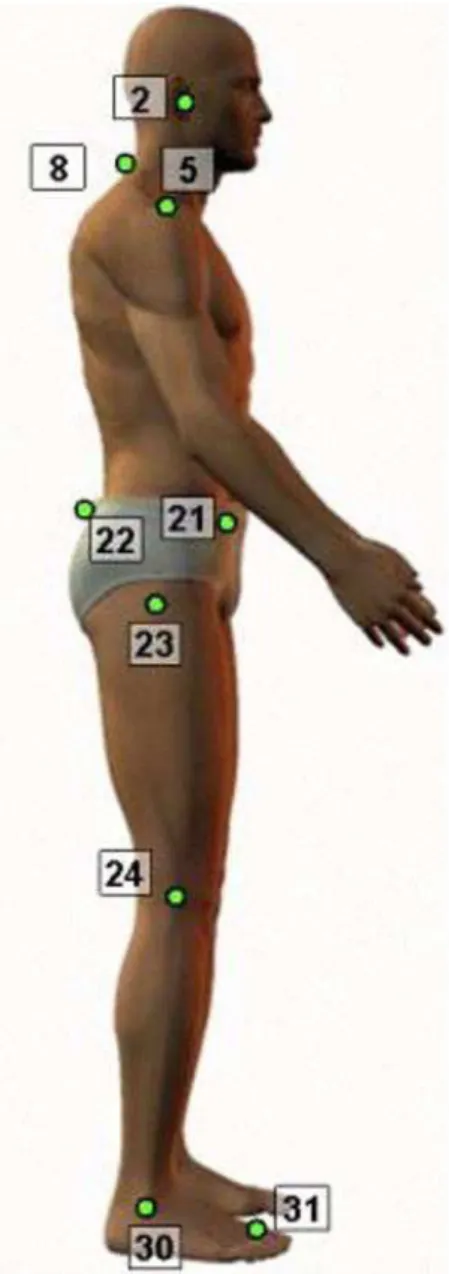
The posture evaluation was performed in a quantitative manner by means of digital photographs and the Software of Posture Analysis - SAPO®(20). The photographs were taken on the right and left eye. According to previous studies, the sagittal plane is the most affected in mouth breathers(14). The preparation of student and the photographic record for computerized evaluation of posture were performed as the SAPO® protocol. For marking the anatomical points, they used polystyrene spheres of 5 mm wrapped with relective tape. The following points were scored: tragus (2), C7 spinous process (8), acromion (5) anterior iliac spine (21), posterior-superior iliac spine (22), femur trochanter (23), joint line of the knee (24), lateral malleolus (30) point between the head of the 2nd and 3rd metatarsal (31) (Figure 1).
To capture the photographs, the student remained at a distance of three meters from the digital camera (Sony brand, DSC -S40 with 4.1 megapixel resolution, 3.0× zoom). We also placed next to the plumb line, which promotes an absolutely vertical line. In this thread, two points were scored, away from each other in a meter. This feature is important to promote the image of the calibration in the program. The child was advised to keep the posture daily adopted: parallel feet, upper limbs relaxed along the body and look at the horizon.
To maintain the same base support on two photographs, foolscap sheets were used, in which the foot is designed contour right and left foot, forming a mat. After the photograph was taken in particular view, the carpet was rotated 180° and the child oriented to reposition on it with the feet on the picture.
For the analysis of photographs, the following sequence was used: opening image, image calibration from the plumb line and marking the anatomical points. Among the various angles measured by SAPO®, this research used only ive angles, and they correspond to the horizontal alignment of the head (head), vertical body alignment (trunk), horizontal alignment of the pelvis (pelvis), knee angle (knee) and ankle angle (ankle). All angles were measured in degrees (°). These angles were chosen with the intention of assessing the body posture as a whole (position of the upper limbs and lower limbs).
To determine the horizontal alignment of the head, we considered the angle formed between the tragus, C7 spinous process and the horizontal. We stipulated that the lower the angular measurement, the bigger the head anteriorization. To determine the vertical alignment of the body, considered the angle formed between the acromion, lateral malleolus and the vertical. We stipulated that when the angular measurement was positive, the body would be inclined forward and, when negative back. To determine the horizontal alignment of the pelvis, called the angle formed between the anterior superior iliac spine, posterior-superior iliac spine and the horizontal. We stipulated concavity when the angular measure was negative, rectiication when close to zero, the less negative, closer to normal. To determine the knee angle, we considered the greater trochanter, joint line of the knee and lateral malleolus (posterior angle). We stipulated that when the angular measurement was positive, bending, and when negative, hyperextension. To determine the angle of the ankle, we considered the joint line of the knee, lateral and horizontal malleolus. When the angular measurement was greater than 90°, the tibia was tilted back and when less than 90°, the tibia was leaning forward.
To assess the body balance, we used the dynamic posturography (Foam-laser Dynamic Posturography - FLP) developed by Castagno(21). In the dynamic Posturography, the subject is exposed to six different test conditions, called Sensory organization test (SOT), namely SOT I, SOT II, SOT III, SOT IV, SOT V and SOT VI.
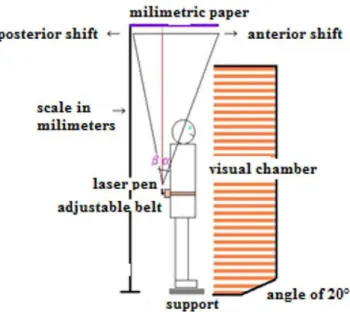
For assessment, each participant was positioned bare within a cabin of 1 m2, with a height of 2 m, made of iron separable support, wrapped in a cotton fabric with horizontal, light and dark stripes, each 10 cm. The cabin is a simple mechanical system and manually moves 20° forward and backward. To modify the somatosensory system conditions, we used a cushion 10 cm
Figure 1. Anatomical points in sagittal plan (right lateral view). Source:
thick, moderate density, 50 cm × 50 cm, between the feet of the person and the ground. A laser pen is ixed vertically on a belt made from foams, whose ends are adaptable to the waist of each individual, with the tip up, it is projected on a graph paper 50 cm × 50 cm, which is set above the individual’s body in an iron support. Figure 2 shows a simulation of physical structures that comprise the dynamic sot, as well as the position of the individual within the cabinet.
In SOT I, II, III, the individual remains unchanged somatosensory condition, or ixed platform (without cushion), unlike SOT IV, V, VI, where somatosensory condition is modiied, or a mobile support platform (cushion use). In SOT II and IV, changes to visual condition (eyes are closed) and in SOT III and VI, there is conlicting sensory information, i.e., oscillating visual cabin (10 seconds manually tilted forward and 10 seconds to return to the initial position).
Starting from the conditions assumed for each measured position, it is observed that the SOT I evaluates integrating the three information systems without conlict. SOT II investigates mainly the somatosensory and vestibular systems. SOT III evaluates primarily the visual system. SOT IV investigates mainly the somatosensory systems. The SOT V mainly evaluates the somatosensory and vestibular system in overload conditions, due to the elimination of visual afference and the use of pad. SOT VI assesses integration of the three systems with conlicting information.
Each test lasts for twenty seconds and in that time frame, there is the maximum anteroposterior displacement obtained by the laser pen on graph paper. The procedure is repeated three times in each test and is considered as the inal value the average of three values. The inal values of each SOT are incorporated into the formulas for calculating the oscillation of the computer program - Excel.
The formula is obtained, in addition to body balance scores (values obtained for each SOT), the analysis of the sensory systems, both expressed as percentages. This analysis shows the ability to use the somatosensory, visual, vestibular and degree of visual preference in maintaining the orthostatic balance. The latter refers to the ability to use the visual sensory information in conlict situations. The analysis of the somatosensory system is obtained by dividing the value of the SOT II by SOT I; the visual system, dividing the value of the SOT IV by SOT I; the vestibular system, dividing the value of the SOT V by SOT I; and visual preference by dividing the sum of the SOT values III and VI SOT by the sum of the SOT II and SOT V values.
The evaluation of the stomatognathic system, as well as dynamic posturography and postural evaluation were performed in the school’s physical space. Hearing assessment, evaluation of the stomatognathic system and dynamic posturography were performed and always analyzed by the same evaluative. Postural evaluation was performed by the institution team of physical therapists and educators that performed the marking of points taken from photographic images as well as analysis and data processing.
Data were submitted to descriptive analysis and analytical statistics. We used the Kruskal-Wallis (5% signiicance level)
to compare between the study group and the control group, the values obtained in the evaluation of posture and body balance. To evaluate the mouth breathers, the correlation between the values obtained in the evaluation of body posture and analysis of sensory systems. We used Pearson correlation coeficient, which considered the weak correlation values between 0 to 0.25, both positive as negative scale; average correlation values comprised between 0.25 to 0.75, both positive as negative scale range; and a strong correlation, when values range between 0.75-1, both positive scale as negative scale.
RESULTS
The survey was conducted with 109 students, 51 (46.8%) students in the study group, 31 (28.4%) males and 20 (18.45) female, with an average age of 9.18; and 58 (53.2%) students in the control group, 24 (22%) were male and 34 gender (31.2%) were female with an average age of 9.38.
Table 1 shows a descriptive and comparative analysis of the results obtained in the body posture evaluation of students with and without oral breathing, considering the right lateral view. There was no statistically signiicant difference between the two groups in all positions.
Table 2 shows a descriptive and comparative analysis of the results obtained in the body posture evaluation of children with and without oral breathing, considering the left lateral view. There was a statistically signiicant difference between the groups only in relation to the knee position.
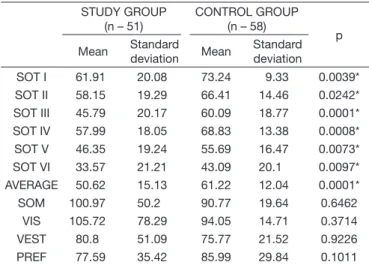
Table 3 shows the mean, standard deviation and comparative statistical analysis of the results in foam laser dynamic posturography of students with and without mouth breathing. There was a statistically signiicant difference between the two groups in all positions of the SOT I, II, III, IV, V and VI, however, it found no such signiicance in the analysis of sensory systems.
Figure 2. Foam laser Dynamic Posturography. Source: adapted from
Table 4 shows the correlation analysis between the results of the assessment of posture (left lateral view) and body balance of children with mouth breathing. There was a statistically signiicant difference in correlation only between the head position and analysis of sensory systems.
DISCUSSION
Mouth breathing requires a number of anatomical and physiological adaptations that interfere negatively in postural organization and balance. These adjustments cause damage to children´s development. From the data obtained in this research it will be possible to observe more speciically the used settings and its consequences.
Regarding the average values in the angular segment of the cephalic segment (head), there was no statistically signiicant difference between students with and without oral breathing (Tables 1 and 2). It was also found average values of the lower mouth breathers, both on the right side view (48.26) as on the left side view (48.37) compared to the control group (right: 49.57; left: 49.87). By analyzing, descriptively, the average of the igures, there was greater anterior cephalic segment of students with mouth breathing compared to students without oral breathing, both on the right side view and the left side view.
Similarly, some researchers, assessed 42 children from eight to 12 years (21 oral breathers and 21 nasal breathers), and found differences, only clinically, the positioning of the head of the mouth breathers when compared to nasal breathers(22). In a study in order to assess the posture of 176 mouth breathing children, aged ive to 12 years, it was found that 89% of the sample had head protrusion(23).
Researchers add that, as a result of the cephalic anterior, mouth breathers have increased craniocervical angle, reduction of cervical lordosis, increased head elevation and greater extension of this in relation to the cervical spine(12,13). We believe that the
Table 1. Descriptive and comparative analysis of the results obtained in the body posture evaluation of scholars with and without oral breathing, considering the right lateral view
STUDY GROUP (n – 51)
CONTROL GROUP (n – 58)
p
Mean Standard
deviation Mean
Standard deviation
Head 48.26 6.05 49.57 5.70 0.1399
Body 3.36 1.48 2.90 1.35 0.0822
Pelvis –15.16 6.19 –13.11 6.17 0.2892
Knee 2.79 6.04 5.40 5.83 0.0635
Ankle 84.33 3.20 83.38 3.31 0.1680
Captions: Angle measurement units: degrees (°); p - Kruskal-Wallis test; n – number of scholars
Table 2. Descriptive and comparative analysis of the results obtained in the body posture evaluation of scholars with and without oral breathing, considering the left lateral view
STUDY GROUP (n – 51)
CONTROL GROUP (n – 58)
p
Mean Standard
deviation Mean
Standard deviation
Head 48.37 6.98 49.87 6.12 0.2892
Body 2.91 1.38 3.25 1.40 0.0661
Pelvis –15.78 6.00 –14.85 5.63 0.4037
Knee 0.01 5.78 2.75 6.00 0.0170*
Ankle 84.96 2.88 84.09 3.09 0.1251
Captions: p - Kruskal-Wallis test; Angle measurement units: degrees (°); n – number of scholars
* Statistically significant difference (p<0.05)
Table 3. Descriptive and comparative analysis of SOT I, II, III, IV, V and VI and the Sensorial analysis (SOM, VIS, VEST, PREF), school data with and without oral breathing, obtained in dynamic posturography Foam Laser
STUDY GROUP (n – 51)
CONTROL GROUP (n – 58)
p
Mean Standard
deviation Mean
Standard deviation
SOT I 61.91 20.08 73.24 9.33 0.0039*
SOT II 58.15 19.29 66.41 14.46 0.0242*
SOT III 45.79 20.17 60.09 18.77 0.0001*
SOT IV 57.99 18.05 68.83 13.38 0.0008*
SOT V 46.35 19.24 55.69 16.47 0.0073*
SOT VI 33.57 21.21 43.09 20.1 0.0097*
AVERAGE 50.62 15.13 61.22 12.04 0.0001*
SOM 100.97 50.2 90.77 19.64 0.6462
VIS 105.72 78.29 94.05 14.71 0.3714
VEST 80.8 51.09 75.77 21.52 0.9226
PREF 77.59 35.42 85.99 29.84 0.1011
Captions: p - Kruskal-Wallis test; n – number of scholars; SOT – Sensorial organization test; VIS – visual; SOM – somatossensorial; VEST – vestibular; PREF – visual preference
* Statistically significant difference (p<0.05)
Table 4. Comparative analysis of the results obtained in the correlation between the evaluation of body posture (on the left side view) and Sensory Analysis of dynamic posturography of children with mouth breathing (n – 51)
Pair of variables Correlation
coefficient p
head × visual –0.34686 0.0127*
head × somatosensorial
–0.35376 0.0109*
head × vestibular –0.35183 0.0113*
body × visual –0.05674 0.6925
body × somatosensorial
–0.06497 0.6506
body × vestibular –0.14003 0.3271
pelvis × visual 0.09964 0.4866
pelvis × somatosensorial
0.07198 0.6157
pelvis × vestibular 0.19764 0.1645
knee × visual –0.15715 0.2708
knee × somatosensorial
–0.14322 0.3161
knee × vestibular –0.15685 0.2717
ankle × visual 0.15949 0.2636
ankle × somatosensorial
0.16108 0.2588
ankle × vestibular 0.21719 0.1258
forward head in mouth breathers is probably to adjust the angle of the pharynx and facilitate the entry of air through the mouth in an attempt to obtain a better greater airlow(14).
In this study, still in relation to body posture, only statistically signiicant difference was found in the average knee angle on the left side view (p=0.0170) (Table 2). Although the average values of knee angle have not been negative indicating hyperextension, the descriptive analysis of averages, the study group (49%) had a higher tendency to hyperextension compared to students in the control group (34%).
With regard to the angular extent of the knees, the medical literature, it was found that oral breathing may have knee valgus(23) and hyperextended knees(24). In this research, it was identiied with respect to the knee angle, the greater the tendency hyperextension. The result differ from results obtained in a study that sought to compare the body posture in mouth breathers of different etiologies (obstructive and functional) with nasal breathing through computerized photogrammetry. The authors found no statistically signiicant difference between groups with respect to knee angle, with respect to knee angle such indings justiied the different postures adopted compensation (forward and pelvis antepulsion)(15).
Still on body posture, more speciically, the comparison of the mean values for the vertical alignment of the body, horizontal alignment of the pelvis and ankle angle was not found in this study, a statistically signiicant difference (Table 1 and 2). Speciically, the pelvis horizontal alignment evaluation of mouth breathers, anteversion was found both on the right side (–15.16°) and the left (–15.78°). However, the detected difference between the groups was not statistically signiicant both in assessing right side view (p=0.28) and to assess left side view (p=0.40).
Similar data were obtained in the literature identiied incidence of anteversion in 66.67% of mouth breathers(24). However, the authors point out that this change is commonly found in children due to the physiological growth period and, therefore, does not necessarily occur depending mouth breathing(23).
Regarding the assessment of the ankle angle, the present research, we found no statistical signiicance, values in the right side view (p=0.16) and left (p=0.12), when analyzing Table 1 and 2.
This result differs from results in the literature. When comparing the measurements obtained in the ankle angle of the mouth breathers (of different etiologies) and nasal breathers, we found statistically signiicant differences only when comparing the control group with the group of mouth breathers of functional etiology. Thus, the authors point out such changes as the one found in functional mouth breathers, this compensation to be used to maintain body balance(15).
Regarding the assessment of body balance held by foam laser dynamic posturography, in groups of children with and without oral breathing, there was a statistically signiicant difference on the six sensory conditions (Table 3). The scores obtained in the evaluation of body balance in scholars with mouth breathing, in all sensory organization tests (SOT), were
more affected when compared to the students without oral breathing. This result may possibly be related to structural and physiological changes that the body posture adopted causes the sensory systems (visual, vestibular and somatosensory) which determine the body balance.
Similar data were found in a study that sought to assess the posture and body balance of mouth breathers in age from eight to 12 years with regard to gender. The study showed that the body balance of scholars with mouth breathing, in both genders, are most affected in relation to students without oral breathing, especially in the presence of sensory conlict(25).
In the analysis of sensory systems, there was no statistically signiicant difference between the mean values obtained for the study and control groups - somatosensory (p=0.64), visual (p=0.37), buccal (p=0.92) and visual preference (p=0.10).
Regarding the use of sensory systems, the medical literature, research found that bring results to differ.
One of these studies was developed in order to develop a standard. They compared the balance of 29 children of 12 years with the balance of 68 young adults aged 20 years. They found that, like adults, children also use the somatosensory system. They also observed that children have greater reliance on visual information and vestibular information, in children, are less eficient(26).
In another survey of students aged from six to 10 years in order to evaluate the relationship between gender and the level of development of the systems responsible for postural balance by dynamic posturography, the results found in the general group (without differentiating genres) to the somatosensory and visual preference were below the reference values. The values found for the visual and vestibular system were above the reference values of foam laser dynamic posturography for adults(27).
Furthermore, researchers investigated in children postural balance to determine which age is the integration of sensory systems similarly to what occurs in normal young adults. We evaluated 80 children aged between six and 12 years of both genders, and a group of 20 healthy young adults aged between 20 and 22 years of both genders. The age range of 11 and 12 years demonstrated using visual information similar to the one used by adults. Only 12 years old children showed the use vestibular information similar to that found in adults(28).
To evaluate the correlation between the analysis of the sensory systems and head posture in mouth breathers, it becomes possible to detect how much the posture change converges to a less eficient balance. In Table 4, it was possible to ind an average ratio to correlate the head positioning with the visual system (–0.34), with the somatosensory system (–0.35) and the vestibular system (–0.35). From these data, it is clear that the higher the forward head, the greater the impairment of visual, somatosensory and vestibular.
From the foregoing, it is emphasized that the improper placement head modiies sensory information and, therefore, it generates a conlict of information at the central level(30). According to some authors, the head is the most important segment of the body for eficient postural control, it accommodates two main sensory organs: the labyrinth and visual organ(3). The forward head, caused by mouth breathing, generates changes in mandibular rest position, the occlusal contacts in optical plans and bipupilar(14).
With this research, you could see that postural changes in both upper limbs and lower limbs, can hinder a greater or lesser extent, body balance, since there are sensory receptors distributed throughout the body. Although not found a positive correlation between the other evaluated aspects of body posture (trunk, pelvis, knee and ankle) and sensory systems, it is believed that the overall assessment of oral breathing child remains valid and important for proper treatment, considering that, as a biomechanics change unit therefore arise accommodation of near or distant body structures through compensations(12).
CONCLUSION
Students with mouth breathing showed postural changes, particularly in the knee position considering the left side view. Body balance was more impaired when compared to the students without oral breathing. It was also veriied a correlation between the positioning head and the different sensory systems in schools mouth breathers.
REFERENCES
1. Prado JM, Stoffregen TA, Duarte M. Postural sway during dual tasks in young and elderly adults. Gerontology. 2007;53(5):274-81. http:// dx.doi.org/10.1159/000102938. PMid:17510558.
2. Horak FB. Postural orientation and equilibrium: what do we need to know about neural control of balance to prevent falls? Age Ageing. 2006;35(S2, Supl 2):ii7-11. PMid:16926210.
3. Massion J. Postural control systems in developmental perspective. Neurosci Biobehav Rev. 1998;22(4):465-72. http://dx.doi.org/10.1016/ S0149-7634(97)00031-6. PMid:9595556.
4. Buzzatti DRP, Albertin C, Carmona ST, Oliveira AE, Byrro C, Roberto I. Reabilitação vestibular. Fisioterapia Brasil. 2007;8(1):47-52.
5. Lourenço EA, Lopes KC, Pontes AJ Jr, Oliveira MH, Umemura AE, Vargas AL. Distribuição dos achados otoneurológicos em pacientes com disfunção vestíbulo-coclear. Rev Bras Otorrinolaringol. 2005;71(3):288-96. http://dx.doi.org/10.1590/S0034-72992005000300005.
6. Peterson ML, Christou E, Rosengren KS. Children achieve adult-like sensory integration during stance at 12-years-old. Gait Posture.
2006;23(4):455-63. http://dx.doi.org/10.1016/j.gaitpost.2005.05.003. PMid:16002294.
7. Stack B, Sims A. The relationship between posture and equilibrium and the auriculotemporal nerve in patients with disturbed gait and balance. Cranio. 2009;27(4):248-60. http://dx.doi.org/10.1179/crn.2009.036. PMid:19891259.
8. Souza GS, Gonçalves DF, Pastre CM. Propriocepção cervical e equilíbrio: uma revisão. Fisioter Mov. 2006;19(4):33-40.
9. Guidetti G. Diagnosi e terapi del disturbi dell’equilibrio. 2. ed. Roma: Marropense; 1997.
10. Franco ES, Panhoca I. Sintomas vestibulares em crianças com queixa de dificuldades escolares. Rev Soc Bras Fonoaudiol. 2008;13(4):362-8. http://dx.doi.org/10.1590/S1516-80342008000400011.
11. Caovilla HH, Ganança MM, Munhoz MS, Silva ML, Ganança FF, Frazza MM. Vertigem paroxística benígna da infância. In: Silva ML, Munhoz MS, Ganança MM, Caovilla HH. Quadros clínicos otoneurológicos mais comuns. São Paulo: Atheneu; 2000. p. 109-117.
12. Yi LC, Jardim JR, Inoue DP, Pignatari SSN. The relationship between the excursion of diaphragm and curvature of spinal column of mouth breathing children. J Pediatr (Rio J). 2008;84(2):171-7. PMid:18372937.
13. Cuccia AM, Lotti M, Caradonna D. Oral breathing and head posture. Angle Orthod. 2008;78(1):77-82. http://dx.doi.org/10.2319/011507-18.1. PMid:18193952.
14. Krakauer LH, Guilherme A. Relação entre respiração bucal e alterações posturais em crianças: uma análise descritiva. Rev Dent Press Ortodon Ortop Facial. 2000;5(5):85-92.
15. Lima LC, Baraúna MA, Sologurem MJ, Canto RS, Gastaldi AC. Postural alterations in children with mouth breathing assessed by computerized biophotogrammetry. J Appl Oral Sci. 2004;12(3):232-7. http://dx.doi. org/10.1590/S1678-77572004000300014. PMid:21049259.
16. Abreu RR, Rocha RL, Lamounier JL, Guerra AFM. Prevalence of mouth breathing among children. J Pediatr (Rio J). 2008;84(5):467-70. http:// dx.doi.org/10.1590/S0021-75572008000600015. PMid:18830512.
17. Ferreira LP. Temas de fonoaudiologia. In: Ferreira LP et al. Respiração:
tipo, capacidade e coordenação pneumofonoarticulatória. São Paulo: Loyola; 1984. p. 9-39.
18. Davis H, Silverman RS. Hearing and deafness. 3. ed. New York: Holt, Rinehart & Wilson; 1970.
19. Katz J. Tratado de audiologia clínica. 4. ed. São Paulo: Manole; 1999. 20. Portal SAPO. Portal do projeto software para avaliação postural [Internet].
São Paulo: Incubadora Virtual Fapesp; 2004 [citado em 2008 Mar 05]. Disponível em: http://sapo.incubadora.fapesp.br/portal
21. Castagno LA. Distúrbio do equilíbrio: um protocolo de investigação racional. Rev Bras Otorrinolaringol. 1994;60(2):124-41.
22. Neiva PD, Kirkwood RN, Godinho R. Orientation and position of head posture, scapula and thoracic spine in mouth-breathing children. Int J Pediatr Otorhinolaryngol. 2009;73(2):227-36. http://dx.doi.org/10.1016/j. ijporl.2008.10.006. PMid:19056131.
23. Yi L, Guedes ZCF, Pignatari SE, Weckx LLM. Avaliação postural em crianças de 5 a 12 anos que apresentam respiração oral. Fisioter Mov. 2003;16(3):29-33.
24. Breda D, Moreira HSB. Avaliação postural e da função respiratória em crianças com rinite alérgica, hipertofia de adenóide e síndrome do respirador bucal. Fisioterapia Brasil. 2003;4(4):247-52.
25. Roggia B, Correa BM, Pranke GI, Facco R, Rossi AG. Controle postural de escolares com respiração oral em relação ao gênero. Pro-fono R. Atal. Cient. 2010;22(4):433-8.
27. Alves RF, Rossi AG, Pranke GI, Lemos LFC. Influencia do gênero no equilibrio postural de crianças com idade escolar. Rev. CEFAC. 2013;15(3):528-37. http://dx.doi.org/10.1590/S1516-18462012005000070.
28. Peterson ML, Christou E, Rosengren KS. Children achieve adult-like sensory integration during stance at 12 years-old. Gait Posture. 2006;2006(23):455-63. http://dx.doi.org/10.1016/j.gaitpost.2005.05.003. PMid:16002294.
29. Soares AV. A contribuição visual para o controle postural. Rev Neurocienc. 2010;18(3):370-9.
30. Madeleine P, Prietzel H, Svarrer H, Arendt-Nielsen H. Quantitative posturography in altered sensory conditions: a way to assess balance instability in patients with chronic whiplash injury. Arch Phys Med Rehabil. 2004;85(3):432-8. http://dx.doi.org/10.1016/j.apmr.2003.03.003. PMid:15031829.
Author contributions