R
E
V
IS
Ã
O
R
E
V
IE
W
1
Department of Epidemiology, School of Public Health, University of Alabama at Birmingham. Ave. South, Suite 120. 35294 Birmingham AL, USA. [email protected] 2
Franklin and Marshall College, Lancaster, Pennsylvania, EUA 3
Department of Veterans Affairs Medical Center, Birmingham, Alabama, USA
Formaldehyde exposure and asthma in children:
a systematic review
Exposição ao formol e asma em crianças: uma revisão sistemática
Resumo Apesar de múltiplos estudos publicados sobre a associação entre exposição ao formol e asma infantil, uma relação consistente ainda não foi identificada. Nós relacionamos os resultados de revisão de estudos publicados a fim de fornecer uma imagem mais compreensível desta relação. Após pesquisa, foram identificados sete estudos que proviam resultados quantitativos sobre a asso-ciação entre a exposição ao formol e a asma in-fantil. Estudos foram heterogêneos em relação à definição de asma. Para cada estudo, uma razão de chances (RC) e 95% de intervalo de confiança (IC) para asma foram abstraídos de resultados publicados ou calculados baseados nos dados for-necidos. Foram usados modelos de efeitos fixos e aleatórios para calcular RC agrupados e IC de 95%; medidas de heterogeneidade também foram cal-culadas. Um modelo de efeitos fixos produziu um a RC de 1.03 (IC de 95%, 1.02-1.04), e o modelo de efeitos aleatórios produziu uma RC de 1.17 (IC de 95%, 1.01-1.36), ambos refletindo um aumen-to de 10 µg/m3 de exposição ao formol. As
estatís-ticas de Q and I2 indicaram uma quantidade mo-derada de heterogeneidade. Resultados indi-cam uma associação positiva entre exposição ao formol e asma infantil. Devido à natureza de cru-zamento de dados destes estudos por baixo desta meta-análise, um estudo de prospectiva epidemi-ológica mais aprofundada é necessário.
Palavras- chave Asma, Crianças, Epidemiolo-gia, Formol
Abstract Despite multiple published studies
re-garding the association between formaldehyde ex-posure and childhood asthma, a consistent asso-ciation has not been identified. Here we report the results of a systematic review of published lit-erature in order to provide a more comprehen-sive picture of this relationship. After a literature search, we identified seven studies providing quan-titative results regarding the association between formaldehyde exposure and asthma in children. Studies were heterogeneous with respect to the definition of asthma. For each study, an odds ra-tio (OR) and 95% confidence interval (CI) for asthma were abstracted from published results or calculated based on the data provided. We used fixed- and random-effects models to calculate pooled ORs and 95% CIs; measures of heteroge-neity were also calculated. A fixed-effects model produced an OR of 1.03 (95% CI, 1.02–1.04), and random effects model produced an OR of 1.17 (95% CI, 1.01–1.36), both reflecting an increase of 10 µg/m3 of formaldehyde. Both the Q and I2
statistics indicated a moderate amount of hetero-geneity. Results indicate a positive association between formaldehyde exposure and childhood asthma. Given the largely cross-sectional nature of the studies underlying this meta-analysis, fur-ther well-designed prospective epidemiologic stud-ies are needed.
Key words Asthma, Children, Epidemiology, Formaldehyde
M
cG
w
Acute exposure to formaldehyde can cause eye, nose, throat, and skin irritation, whereas long-term exposure has been associated with certain cancers (e.g., sinonasal) as well as asthma (Dai-sey et al. 2003). Exposure to formaldehyde oc-curs in certain occupational settings (e.g., em-balmers), but exposure via formaldehyde-emit-ting products such as particle board, urea form-aldehyde insulation, carpeting, and furniture is more common (Garrett et al. 1999). In the Unit-ed States, the legal occupational limit for short-term (i.e., < 15 min) formaldehyde exposure is 2 ppm, and the long-term limit (i.e., > 15 min) is 0.75 ppm [Occupational Safety and Health Ad-ministration (OSHA) 2005]. In contrast, the National Institute for Occupational Safety and Health suggests that exposure be limited to much lower levels: 0.016 ppm (long term) and 0.1 ppm (short term).
Much of the research regarding the health ef-fects of formaldehyde has focused on cancer, whereas less attention has been paid to more common conditions such as asthma. In the Unit-ed States, the prevalence of asthma is approxi-mately 7% among adults and 9% among chil-dren (Akinbami et al. 2009; Moorman et al. 2007). Among adults, some studies have reported a pos-itive association between formaldehyde and asth-ma (Wieslander et al. 1997), while others have not (Krzyzanowski et al. 1990). It has been sug-gested that certain groups, specifically children, may be particularly sensitive to formaldehyde exposure; however, as with adults, the results have been inconsistent, with some studies reporting an association (Garrett et al. 1999) and others not (Symington et al. 1991). All of these studies have specific limi-tations including small sample sizes (Delfino et al. 2003), the use of self-reported asthma (Smedje et al. 1997), and potential selec-tion bias (Garrett et al. 1999). In addiselec-tion, the ex-tent of formaldehyde exposure varies widely across studies. For example, Mi et al. (2006) reported a range of 3–20 µg/m3, whereas the range reported
by Rumchev et al. (2002) was ~ 0–224 µg/m3.
How-ever, the former study derived measurements from schools while the latter study obtained measure-ments from homes. Moreover, most studies are cross-sectional and fail to provide information on exposure levels that reflect individual exposure (in magnitude and/or duration).
Although there have been multiple reviews of the literature pertaining to formaldehyde and asthma in children, these have all been qualita-tive (Mendell 2007). The relationship between formaldehyde and respiratory symptoms has received attention recently because of concerns
regarding air quality in mobile homes and travel trailers provided by the Federal Emergency Man-agement Agency (FEMA) to displaced Gulf Coast residents in the aftermath of Hurricane Katrina. We conducted the current study, a systematic re-view of the literature regarding the potential as-sociation between formaldehyde exposure and asthma in children, to shed additional light on the issue.
Methods
ú
d
e C
o
le
tiv
a, 16(
9)
:3845-3851,
2011
well as whether such estimates were adjusted and, if so, for what measures (Table 1). Three of 10 studies did not contain actual formaldehyde mea-surements, and attempts to obtain this informa-tion from the study authors have been unsuc-cessful to date (Doi et al. 2003; Pati and Parida 2005; Tavernier et al. 2006).
Once the relevant results from each study were extracted, we determined that homogenizing the individual study results using a single unit of form-aldehyde measurement would be necessary. Be-cause most studies reported their results as odds ratios (ORs) per 10-µg/m3 unit increase in
form-aldehyde, this was chosen as the common met-ric. Thus, results for those studies using different units were transformed. For example, if a study reported an OR reflecting a 1-µg/m3 increase in
formaldehyde, the natural logarithm of the OR was calculated and multiplied by 10; this value was then exponentiated to obtain an OR for a 10-µg/m3 unit increase in formaldehyde. This
process was repeated for the 95% confidence in-terval (CI). Thus, for each study, an OR and 95% CI for the association between asthma and a 10-ìg/m3 unit increase in formaldehyde exposure was obtained. One study (Zhao et al. 2008) provided two estimates: one for indoor and another for outdoor exposure, both of which were used.
Pooled ORs and 95% CIs were obtained us-ing inverse variance-weighted, fixed-effects, and random-effects models. We tested heterogeneity using the Q test and quantified with the I2
statis-tic. Whereas the Q test only determines whether statistically significant heterogeneity exists, the I2 statistic calculates the proportion of the variabil-ity that can be attributed to heterogenevariabil-ity across the studies. I2 values of 25%, 50%, and 75% have been suggested as indicators of low, moderate, and high heterogeneity, respectively. Fixed-effects models are considered appropriate for values of < 50%, whereas for values of > 50%, random-effects models are preferred. To evaluate whether the observed results were unduly influenced by any individual study and to determine if there was any publication bias, an influence plot and a funnel plot, respectively, were used.
Results
Overall, 10 studies involving 6,387 participants including 635 with diagnosed or self-reported asthma were selected for systematic review, of which seven studies were able to be used in the meta-analysis involving a total of 5,930 partici-pants, 364 of whom had diagnosed asthma
(Ta-ble 1). Most studies were cross-sectional; half re-lied on self-reported information on asthma di-agnoses, whereas the remainder used actual phy-sician diagnoses. Studies of the former type gen-erally queried participants about whether they had ever been diagnosed with asthma, and thus those responding affirmatively are best characterized as prevalent cases. With respect to those studies us-ing physician diagnosis, based on the study de-signs as they were described, it was frequently clear that those with asthma would also be best char-acterized as prevalent cases. In only one study was it entirely clear that the cases were truly incident (i.e., newly diagnosed). Participation rates ranged from 46% to 99%; however, this information was not available for half of the studies.
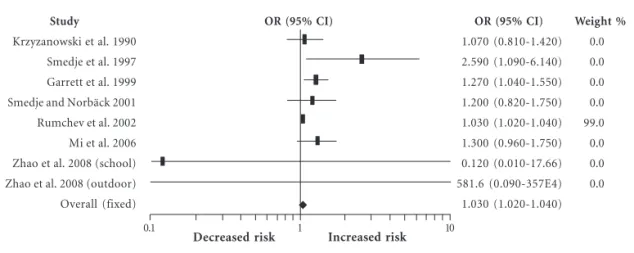
The results for each individual study as well as the fixed-and random-effects pooled ORs and 95% CIs are shown in Figure 1. The forest plots for both fixed-and random-effects models can be seen in Figures 1 and 2, respectively. The results of the fixed-effects model indicate a 3% increase (95% CI, 1.02–1.04, p < 0.0001) in asthma risk for each 10 µg/m3
unit increase in formaldehyde, whereas the random-effects model indicates a 17% increase (95% CI, 1.01–1.22, p = 0.0158). The Q and I2
statistics were 14.28 (p < 0.0001) and 51%, respec-tively, indicating the presence of moderate be-tween-study heterogeneity.
The influence plot indicated that one study (Rumchev et al. 2002) may have had an undue influence on the study results (data not shown). When this study was excluded, the resulting ORs from fixed-and random-effects models were 1.24 (95% CI, 1.09–1.42) and 1.24 (95% CI, 1.07–1.44), respectively (Table 2). The Q and I2
statistics were 6.76 and 11.2%, respectively. Table 2 presents the pooled results stratified according to specific study characteristics.
M cG w Participation rate Unknown 82% Unknown 66% Unknown Unknown 99% 46% Unknown 90% 90% Exposure Home School Home School Home NA School Home Home School Outdoor Formaldehyde levels (µµµµµg/m3)
< 50 to > 87.5 < 5 to 10 < 20 to > 50
< 5 to 72 < 10 to > 60
NA 3 to 20
NA NA 1 to 5 5 to 7 Source
Krzyzanowski et al. 1990 Smedje et al. 1997 Garrett et al. 1999 Smedje and Norbäck 2001 Rumchev et al. 2002 Doi et al. 2003 Mi et al. 2006 Tavernier et al. 2006 Pati et al. 2005 Zhao et al. 2008 Zhao et al. 2008
No. (asthma) 298 (47) 627 (40) 148 (53) 1,258 (56) 192 (88) 155 (122) 1,414 (44) 130 (65) 172 (84) 1,993 (36) 1,993 (36)
OR (95% CI) per 10µµµµµg/m3 increase
1.07 (0.81–1.43) 2.59 (1.10–6.19) 1.27 (1.04–1.55) 1.20 (0.80–1.70) 1.03 (1.02–1.04) NA 1.30 (0.72–2.32) a b 0.12 (0.0008–17.32) 581.59 (0.06–2263796.94) Source
Krzyzanowski et al. 1990 Smedje et al. 1997 Garrett et al. 1999 Smedje and Norbäck 2001 Rumchev et al. 2002 Doi et al. 2003 Mi et al. 2006 Tavernier et al. 2006 Pati et al. 2005 Zhao et al. 2008 Zhao et al. 2008
Setting United States Sweden Australia Sweden Australia Japan China United Kingdom India China China Design Cross-sectional Cross-sectional Cross-sectional Cohort Case–control Case–control Cross-sectional Case–control Case–control Cross-sectional Cross-sectional Asthma definition Self-report Self-report Diagnosis Self-report Diagnosis Diagnosis Self-report Diagnosis Diagnosis Self-report Self-report Incident vs. prevalent cases Prevalent Prevalent Prevalent Incident Unclear Prevalent Prevalent Prevalent Unclear Prevalent Prevalent Table 1. Summary of studies selected for inclusion in meta-analysis.
Adjusted No Yes No Yes Yes NA Yes Yes NA Yes Yes Mean age (years) 9.3 13–14 10.2 10.314.3 1.9 9.4 13.0 8.1 NA 12.8 12.8
NA, not applicable. a Elevated (nonsignificant) ORs for living room and bedroom formaldehyde levels. b Indoor exposure to formaldehyde significantly
increased the risk of asthma.
OR (95% CI) per 10-µµµµµg/m3
increase 1.17 (1.01–1.36) 1.24 (1.07–1.45) 1.26 (0.97–1.64) 1.12 (0.88–1.44) 1.26 (1.03–1.55) 1.10 (0.95–1.27) 1.33 (1.02–1.74) 1.43 (0.92–2.23) 1.09 (0.96–1.25) p-Value 0.202 0.0026 0.0446 0.1711 0.0122 0.1056 0.0179 0.1139 0.1924 All studies
Excluding Rumchev et al. Diagnosis method Self-reported Diagnosed Study design Cohort Case–control Cross-sectional Exposure setting Home School Participation rate > 60% Unknown Nº of studies 7 6 6 2 1 1 6 3 4 4 3
OR (95% CI) per 10-µµµµµg/m3
increase 1.03 (1.02–1.04) 1.24 (1.09–1.42) 1.21 (1.02–1.46) 1.03 (1.02–1.04) 1.20 (0.80-1.70) 1.03 (1.02-1.04) 1.25 (1.08–1.44) 1.03 (1.02–1.04) 1.32 (1.05–1.66) 1.34 (1.00–1.81) 1.03 (1.02–1.04) p-Value < 0.0001 0.0013 0.0158 < 0.0001 0.1711 < 0.0001 0.0013 < 0.0001 0.0082 0.0519 < 0.0001 Q 14.28 6.76 6.66 4.22 6.72 4.29 3.48 5.66 4.29 Table 2. Pooled ORs and 95% CIs for fixed- and random-effects models.
Fixed effects Random effects
I 2
51.0 11.3 24.9 76.3 25.6 53.4 13.8 29.3 30.1
For the random-effects model, the OR for home exposure was 1.10 (95% CI, 0.95–1.27), and the OR for school exposure was 1.33 (95% CI, 1.02–
ú
d
e C
o
le
tiv
a, 16(
9)
:3845-3851,
2011
2006; Smedje and Norbäck 2001; Smedje et al. 1997; Zhao et al. 2008) that provided participa-tion rates (66%, 82%, 90%, and 99%) were stron-ger than the results for those for which partici-pation rates were unknown.
The funnel plot did not show evidence of pub-lication bias either with or without Rumchev et al. 2002 (data not shown).
Discussion
Asthma is a disorder characterized by episodic symptoms and a physiology associated with air-way hyperresponsiveness, broncho-constriction, and excessive mucus production. Fundamentally,
asthma is a disorder with inflammation of air-ways that creates a microenvironment capable of reacting to specific and/or nonspecific stimuli with a stereotypic pathogenic response. Although de-bate on the topic continues, multiple studies have suggested a link between inhalation exposure to formaldehyde and the development of airway hy-perresponsiveness and asthma (Thompson et al. 2008). Several mechanisms have been identified that provide plausible connections between formalde-hyde exposure and airways disease. Formaldeformalde-hyde is a well-recognized irritant affecting multiple tis-sues; it has been demonstrated to provoke tran-sient decline in pulmonary function (Paustenbach et al. 1997). As a small molecule, formaldehyde may associate with larger protein molecules (e.g., Figure 1. Forest plot of the relative risk estimates and their 95% CIs from the studies included in the meta-analysis of the association between formaldehyde exposure and asthma in children based upon a fixed-effects model.
10 1
0.1
Decreased risk Increased risk
Study
Krzyzanowski et al. 1990 Smedje et al. 1997 Garrett et al. 1999 Smedje and Norbäck 2001 Rumchev et al. 2002 Mi et al. 2006 Zhao et al. 2008 (school) Zhao et al. 2008 (outdoor) Overall (fixed)
OR (95% CI) 1.070 (0.810-1.420) 2.590 (1.090-6.140) 1.270 (1.040-1.550) 1.200 (0.820-1.750) 1.030 (1.020-1.040) 1.300 (0.960-1.750) 0.120 (0.010-17.66) 581.6 (0.090-357E4) 1.030 (1.020-1.040)
OR (95% CI) Weight %
0.0 0.0 0.0 0.0 99.0 0.0 0.0 0.0
Figure 2.Forest plot of the relative risk estimates and their 95% CIs from the studies included in the meta-analysis of the association between formaldehyde exposure and asthma in children based on a random-effects model.
10 1
0.1
Decreased risk Increased risk
Study
Krzyzanowski et al. 1990 Smedje et al. 1997 Garrett et al. 1999 Smedje and Norbäck 2001 Rumchev et al. 2002 Mi et al. 2006 Zhao et al. 2008 (school) Zhao et al. 2008 (outdoor) Overall (fixed)
OR (95% CI)
1.070 (0.810-1.420) 2.590 (1.090-6.140) 1.270 (1.040-1.550) 1.200 (0.820-1.750) 1.030 (1.020-1.040) 1.300 (0.960-1.750) 0.120 (0.010-17.66) 581.6 (0.090-357E4) 1.170(1.010-1.360)
OR (95% CI) Weight %
M
cG
w
albumin) to create newly antigenic moieties. Such exposure presumably would provoke formation of specific IgE antibodies that could bind to mast cells and, upon subsequent exposure, lead to mast cell degranulation and the elaboration of media-tors traditionally associated with the asthmatic (early-and late-phase) response. Alternatively, formaldehyde inhalation, through its nonspecific irritant effect, could provoke mucosal inflamma-tion in airways. If the resultant inflammatory re-sponse is T helper-2 dominant, cytokine media-tors typically associated with asthma [interleukin (IL)-4, IL-5, IL-9, IL-13] would subsequently be produced (Elias et al. 2003). Recently, formalde-hyde has also been demonstrated to alter thiol bi-ology, leading to the accelerated reduction of the endogenous bronchodilator S-nitrosoglutathione, thus providing another putative mechanistic link between formaldehyde exposure and airways dis-ease (Thompson et al. 2008).
The results of this study, which pooled the results of seven published studies, suggest a pos-itive relationship between formaldehyde exposure and childhood asthma. To place the observed re-sults (OR of 1.17 per 10-µg/m3 increase) in
con-text, when compared with indi-viduals with no formaldehyde exposure, those with the highest levels of exposure reported in the seven studies (i.e., 80 µg/m3) would have 3.5-times higher odds
of asthma. The results reported herein are consis-tent with much of the previously published litera-ture regarding the association between formalde-hyde exposure and childhood asthma. This should not be surprising in that many of these studies serve as the foundation of our meta-analysis. However, in addition to the seven studies includ-ed in the meta-analysis, two additional studies, each reporting a positive association, could not be included, yet they provide further support for the observed quantitative results (Pati and Parida 2005; Tavernier et al. 2006). Tavernier et al. (2006) reported elevated but not statistically significant ORs for specific levels of formaldehyde exposure; unfortunately, the authors did not provide the actual, quantitative values associated with those levels. Similarly, Pati and Parida (2005) simply reported that, indoor exposure to formaldehyde . . . signifi-cantly increased the risk of having asthma.
Additionally, Symington et al. (1991) compared the prevalence of respiratory symptoms exhibit-ed by children living within 1 mile of a formalde-hyde-emitting foundry with that of children liv-ing in other areas and reported no differences (Symington et al. 1991). Franklin et al. (2000) de-termined that individuals with a home formalde-hyde concentration of at least 50 ppb had a
signif-icantly increased volume of exhaled nitric oxide, which serves as a marker of airway inflammation (Franklin et al. 2000). Venn et al. (2003) did not observe an association between persistent wheez-ing and formaldehyde exposure; however, among children with persistent wheezing, those report-ing frequent nighttime symptoms had higher formaldehyde levels compared with those not ex-periencing nocturnal symptoms (Venn et al. 2003). Erdei et al. (2003) reported a significant increase in immune biomarkers in children exposed to high amounts of formaldehyde (Erdei et al. 2003). Doi et al. (2003) found only 2 of 122 asthmatic children have formaldehyde-specific IgE and con-cluded that formaldehyde is not a risk factor for childhood asthma (Doi et al. 2003).
num-ú
d
e C
o
le
tiv
a, 16(
9)
:3845-3851,
2011
References
Akinbami LJ, Moorman JE, Garbe PL, Sondik EJ. 2009. Status of childhood asthma in the United States, 1980–2007. Pediatrics 123:S131–S145.
Burr ML. 1999. Indoor air pollution and the respiratory health of children. Pediatr Pulmonol (suppl)18:3–5. Daisey JM, Angell WJ, Apte MG. 2003. Indoor air qual-ity, ventilation and health symptoms in schools: an analysis of existing information. Indoor Air 13:53– 64.
Delfino RJ, Gong H Jr, Linn WS, Pellizzari ED, Hu Y. 2003. Asthma symptoms in Hispanic children and daily ambient exposures to toxic and criteria air pollutants. Environ Health Perspect 111:647–656. Doi S, Suzuki S, Morishita M, Yamada M, Kanda Y,
Torii S, Sakamoto T. 2003. The prevalence of IgE sensitization to formaldehyde in asthmatic children.
Allergy 58:668–671.
Elias JA, Lee CG, Zheng T, Ma B, Homer RJ, Zhu Z. 2003. New insights into the pathogenesis of asthma.
J Clin Invest 111:291–297.
Erdei E, Bobvos J, Brózik M, Páldy A, Farkas I, Vaskövi E, Rudnai P. 2003. Indoor air pollutants and im-mune biomarkers among Hungarian asthmatic chil-dren. Arch Environ Health 58:337–347.
ber of strategies that were employed to minimize this problem. Although some studies provided adjusted estimates, others did not. Thus, our pooled results may be subject to residual con-founding. The extent of this problem is a function of the individual study weights; the two studies that did not provide adjusted estimates generally had higher weights than those that did. Finally, the temporal relationship between etiologically relevant formaldehyde exposure and asthma can-not be established in most of the studies included in our analysis because of their cross-sectional designs. As a result, our pooled results are largely cross-sectional in nature, and the measured form-aldehyde levels do not reflect personal exposures. This problem is compounded by the inclusion of those studies wherein “ever asthma” was used as an indication of a positive outcome, because such a definition will capture transient outcomes whose etiology may lie in acute exposures that occurred in the distant past and may not be captured by current exposure levels. The study by Smedje and Norbäck (2001) does not suffer from this poten-tial limitation given its use of a cohort study de-sign. The inability to quantify etiologically rele-vant formaldehyde levels is attributable to several
factors. Formaldehyde levels were not measured at the same time of the year from one study to the next. This is important, because formaldehyde levels can vary with temperature and humidity. Whereas formaldehyde levels were measured at the subjects’ home in some studies, others focused on the school setting. Taken together, the implica-tion is that the observed formaldehyde levels and their association with asthma may not reflect the true the magnitude of formaldehyde exposure, specifically that preceding asthma onset.
Conclusions
Subject to the limitations discussed above, the results of this systematic review suggest that there is a positive association between formaldehyde levels and childhood asthma. Taken in conjunc-tion with a plausible biological mechanism, the results of this study provide important evidence regarding the potential causal link between form-aldehyde and asthma in children. This is not to suggest that closure can be brought to this issue. Well-designed prospective epidemiologic studies are needed to shed additional light on this issue.
Franklin P, Dingle P, Stick S. 2000. Raised exhaled nitric oxide in healthy children is associated with domes-tic formaldehyde levels. Am J Respir Crit Care Med
161:1757–1759.
Garrett MH, Hooper MA, Hooper BM, Rayment PR, Abramson MJ. 1999. Increased risk of allergy in children due to formaldehyde exposure in homes.
Allergy 54:330–337.
Google Scholar. 2009. Google Scholar. Available: http:/ /scholar.google.com/schhp?hl=en=ws [accessed 1 May 2009].
Krzyzanowski M, Quackenboss JJ, Lebowitz MD. 1990. Chronic respiratory effects of indoor formaldehyde exposure. Environ Res 52:117–125.
Mendell MJ. 2007. Indoor residential chemical emis-sions as risk factors for respiratory and allergic ef-fects in children: a review. Indoor Air 17:259–277. Mi YH, Norbäck D, Tao J, Mi YL, Ferm M. 2006.
M
cG
w
Moorman JE, Rudd RA, Johnson CA, King M, Minor P, Bailey C, Scalia MR, Akinbami LJ; Centers for Dis-ease Control and Prevention (CDC). 2007. National surveillance for asthma—United States, 1980–2004.
MMWR Morb Mortal Wkly Rep 56:1–54.
National Library of Medicine. 2009. PubMed. Avail-able: http://www.ncbi.nlm.nih.gov/sites/entrez [ac-cessed 1 May 2009].
OSHA (Occupational Health and Safety Administration). 2005. Threshold Limit Values and Biological Expo-sure Indices for 2005–2006, IBR approved for §1910.120, PEL definition. Available: http:// w w w . o s h a . g o v / p l s / o s h a w e b / owa-disp.show_document?p_table=STANDARDS &p_id=10075 [accessed 1 May 2009].
Pati S, Parida SN. 2005. Indoor environmental risk fac-tors for asthma and respiratory ill health in pre-school children of coastal Orissa, India. Epidemiol-ogy 16:S132–S133.
Paustenbach D, Alarie Y, Kulle T, Schachter N, Smith R, Swenberg J, Witschi H, Horowitz SB. 1997. A rec-ommended occupational exposure limit for form-aldehyde based on irritation. J Toxicol Environ Health
50:217–263.
Rönmark E, Jönsson E, Platts-Mills T, Lundbäck B. 1999. Different pattern of risk factors for atopic and non-atopic asthma among children—report from the Obstructive Lung Disease in Northern Sweden Study.
Allergy 54:926–935.
Rumchev KB, Spickett JT, Bulsara MK, Phillips MR, Stick SM. 2002. Domestic exposure to formalde-hyde significantly increases the risk of asthma in young children. Eur Respir J 20:403–408.
Smedje G, Norbäck D. 2001. Incidence of asthma diag-nosis and self-reported allergy in relation to the school environment—a four-year follow-up study in schoolchildren. Int J Tuberc Lung Dis 5:1059– 1066.
Smedje G, Norbäck D, Edling C. 1997. Asthma among secondary schoolchildren in relation to the school environment. Clin Exp Allergy 27:1270–1278. Stroup DF, Berlin JA, Morton SC, Olkin I, Williamson
GD, Rennie D, Moher D, Becker BJ, Sipe TA, Thack-er SB. 2000. Meta-analysis of obsThack-ervational studies in epidemiology: a proposal for reporting. Meta-analysis of Observational Studies in Epidemiology
(MOOSE) group. JAMA 283(15):2008–2012.
Symington P, Coggon D, Holgate S. 1991. Respiratory symptoms in children at schools near a foundry. Br J Ind Med 48:588–591.
Tavernier G, Fletcher G, Gee I, Watson A, Blacklock G, Francis H, Fletcher A, Frank T, Frank P, Pickering CA, Niven R. 2006. IPEADAM study: indoor en-dotoxin exposure, family status, and some housing characteristics in English children. J Allergy Clin Immunol 117:656–662.
Thompson CM, Subramaniam RP, Grafstrom RC. 2008. Mechanistic and dose considerations for support-ing adverse pulmonary physiology in response to formaldehyde. Toxicol Appl Pharmacol 233:355–359. Venn AJ, Cooper M, Antoniak M, Laughlin C, Britton J, Lewis SA. 2003. Effects of volatile organic com-pounds, damp, and other environmental exposures in the home on wheezing illness in children. Tho-rax 58:955–960.
Wantke F, Demmer CM, Tappler P, Götz M, Jarisch R. 1996. Exposure to gaseous formaldehyde induces IgE-mediated sensitization to formaldehyde in school-children. Clin Exp Allergy 26:276–280. Wieslander G, Norbäck D, Björnsson E, Janson C, Boman
G. 1997. Asthma and the indoor environment: the significance of emission of formaldehyde and vola-tile organic compounds from newly painted indoor surfaces. Int Arch Occup Environ Health 69:115– 124.
Zhao Z, Zhang Z, Wang Z, Ferm M, Liang Y, Norbäck D. 2008. Asthmatic symptoms among pupils in rela-tion to winter indoor and outdoor air pollurela-tion in schools in Taiyuan, China. Environ Health Perspect
116:90–97.