*e-mail: [email protected], [email protected]
Sol-Gel TiO
2Thin Films Sensitized with the Mulberry Pigment Cyanidin
Emerson Henrique de Faria, Alex Lemes Marçal, Eduardo José Nassar,
Katia Jorge Ciuffi*, Paulo Sergio Calefi*
Universidade de Franca – UNIFRAN, Av. Dr. Armando Salles Oliveira, 201,
14404-600 Franca - SP, Brazil
Received: April 19, 2007; Revised: November 28, 2007
TiO2 films have various applications, among them solar cells and photodegradation of pollutants. In this study, we investigated TiO2 films functionalized with the organic dye cyanidin extracted from black mulberry (Morus nigra). The TiO2 was functionalized by the sol-gel method and the film was deposited on glass substrates by dip-coating. Our aim was to investigate the interaction between the semiconductor and the dye, as well as the influence of the velocity and number of deposits on the characteristics of the film. Using ultraviolet-visible spectroscopy, we observed a shift from the maximum absorption band at 545 nm for the dye’s ethanol solution to 595 nm for the film, indicating interaction of the cyanidin with the TiO2. The absorption spectra in the infrared region of the functionalized TiO2 particles showed bands characteristic of the oxide and indicated their interaction with the dye. Using profilometry and m-line techniques, we found that the films presented thicknesses in the order of 100 nm. A SEM analysis confirmed the high density of the films.
Keywords: TiO2, films, cyanidin, sol-gel
1. Introduction
Porous TiO2 electrodes have various applications, among them solar cells and heterogeneous photoelectrocatalysis for the degradation of pollutants. In these devices, the structure of the oxide film deposited on transparent electrodes affects the energy conversion efficiency, for the size of the particles and pores interferes in the penetration of the electrolyte in solar cells and in the interaction with pollutant molecules in photocatalytic devices1-3.
Solar cells based on dye-sensitized TiO2 nanoparticles were first developed by Grätzel and coworkers4. Regenerative
photoelectrochemical cells are composed of nanocrystalline TiO2 films sensitized with a dye. Under a light beam, the dye absorbs photons and injects electrons into the semiconductor’s conduction band. The charge carriers then scatter to the external circuit. The dye is reduced by a redox pair, which, in turn, is also regenerated in the counter electrode1-4.
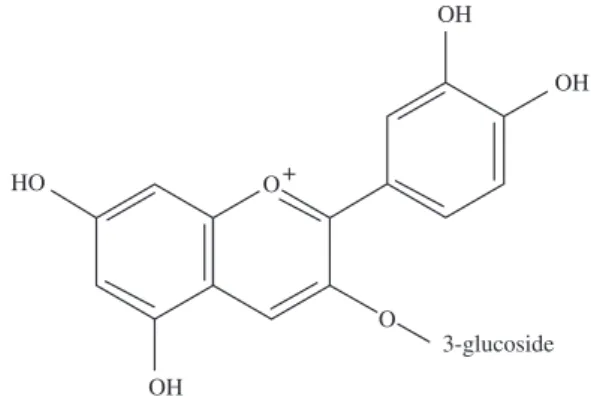
The use of natural products such as organic dyes in solar cells offers promising prospects for the advance of this technology, since photoexcitable dyes are substances that cede electrons easily, while the use of synthetic dyes involves several problems, such as their synthesis, purification and use, as well as the fact that they require rare metals5-8. Cyanidin is an organic dye of the flavonoid class found
in leaves and fruits and responsible for the colors of various vegetal tissues, which has been studied for application as a sensitizer of this type of solar cell7-11 (Figure 1).
In most of these solar energy conversion devices, the TiO2 film is obtained by deposition of a colloidal suspension of commercial oxide particles (usually Degusa®), but the development of nanocrystalline
films with large and porous surface areas has increased the efficiency of these devices. In this context, the sol-gel process has proved to be a viable alternative to produce these films, since it is a simple and versatile method for the production of oxide nanoparticles of controlled sizes. The conventional method uses the hydrolytic route, which involves the initial hydrolysis of the alkoxide precursor
followed by continual condensations between the hydrolyzed particles forming the gel. The reactions are:
Hydrolysis
≡Ti–OR + H2O →≡Ti–OH + ROH (1)
Condensation
≡Ti–OH + HO–Ti≡→≡Ti–O–Ti≡ + H2O (dehydration) (2)
≡Ti–OR + HO–Ti≡→≡Ti–O–Ti≡ + ROH (dealcoholation) (3) This process is carried out at room temperature, and the desired morphological properties of the particles are obtained by controlling the conditions under which the synthesis is carried out. Moreover, these materials are easily produced in film form. However, their disadvantages are the high cost of raw materials and considerable contraction in the process12-15.
The dip-coating technique, which consists of immersing a substrate in the sol at a controlled speed, has been used successfully to deposit oxide in the form of a thin film. This technique allows one not only to control the speed but also to vary the number of depositions, thereby obtaining films with controlled thicknesses12.
In this paper, we report on the preparation of TiO2 films functionalized with cyanidin from black mulberry (Morus nigra),
of the films. Titanium dioxide was chosen and the semiconductor material, since it is a low-cost, abundant, and chemically inert material whose properties have already been studied. Because TiO2 is white and therefore does not absorb visible light, it is the cyanidin from mulberry that determines the absorption of light and the spectral response of the semiconductor.
2. Experimental
The titanium oxide was prepared by the hydrolytic sol-gel method, while the cyanidin solution was obtained from mulberries by macerating 1 g of the fruit with 12 mL of ethanol and filtering the resulting product. The titanium oxide sol functionalized with raw mulberry (Morus nigra) cyanidin extract was prepared by mixing
12 mL of ethanolic solution of dye, 1 mL of acetic acid as a stabilizing agent and 1 mL of titanium (IV) isopropoxide. The resulting blue sol was stirred for 30 minutes at 25 °C. The flowchart in Figure 2 illustrates the experimental procedure.
The sol-gel method was utilized to synthesize TiO2 because it is carried out at a low temperature, resulting in small particles with a high surface area and a large quantity of superficial Ti-OH groups due to incomplete condensation. Mulberries were used as a dye source because they contain large quantities of cyanidin11.
Deposition of the films was carried out by the dip-coating method using an controller model MQCT 2000-MP microprocessor-controlled syringe pump to deposit the films on glass substrate. The substrates were immersed in the sol at speeds of 50, 70 and 100 mm/min, varying the number of immersions in the sol from 1 to 5 times to obtain films with different thicknesses.
The material left behind by deposition of the films was dried in the form of xerogel for subsequent FTIR, thermal and morphological characterization.
3. Results and Discussion
The absorption spectra in the ultraviolet-visible region were obtained using a HP 8452A diode array spectrophotometer. The cyanidin ethanol solution presented maximum absorption at 545 nm, while the cyanidin-functionalized TiO2 sol showed maximum absorption at 590 nm and the films at 595 nm. The shift to the infrared region at the absorption maxima of the sol and the functionalized film confirmed the reaction between the TiO2 and the mulberry cyanidin extract, since the interaction caused a reduction of the electron density in the chromophore group, thus reducing its polarity (bathochromic effect). Figure 3 illustrates the absorption spectra in the UV-visible region.
The surface area and porosity of the TiO2 and cyanidin-functionalized TiO2 xerogel were determined by nitrogen
adsorption-HO
OH
OH
OH
O
O
3-glucoside O+
Figure 1. Molecular structure of the cyanidin.
400 500 600 700
0.0 0.5
c b a
Absorbance (a.u.)
Wavelength (nm)
Figure 3. Absorption spectra: a) cyanidin ethanol solution; b) cyanidin-functionalized TiO2 sol; and c) cyanidin-functionalized TiO2 film. Figure 2. Flowchart of the experimental procedure.
Characterization: UV-Vis, Profilometry and
SEM TiO2 thin films sensitized with natural cyanidin
pigment Deposition on
glass by the dip-coating
method
Ethanolic solution of cyanidin +
Acetic acid +
Titanium IV isopropoxide (Stirring for 30 minutes, at 25 °C)
Sol TiO2 sensitized
with cyanidin
Characterization: FTIR, TGA and Surface area
Xerogel Production of ethanolic
dye solution
desorption isotherms in a Micromeritics ASAP 2020 Surface Area and Porosity Analyzer. The TiO2 xerogel showed a BET surface area of 202.9 m2.g–1, a total pore volume of 0.105 cm³.g–1, and an
and 48.9 Å, respectively. Because these measures are based on the adsorption and desorption of nitrogen by OH groups at the surface of TiO2 particles, the measures will show incorrect values if the OH groups are linked to a molecule, preventing them from interacting with the nitrogen. The alterations in the values of surface area and porosity are attributed to the efficiency of the dye’s adsorption by the TiO2 particles. In a study of TiO2 R-213 produced by a chemical company, Agnieszka16 reported values of 39.9 m2.g–1, 0.0 981 cm3.g–1
and 98.4 Å for BET surface area, total pore volume and average pore size, respectively. The larger surface area of the TiO2 material presented here was probably due to incomplete condensation of Ti – OH groups and low particle sizes characteristic of materials obtained by the sol-gel process, which allowed for the adsorption of a larger amount of dye per TiO2 mass. Dye-TiO2 interactions were confirmed by a shift of Ti-O surface vibration in the FTIR analysis. The conventional methods of solar cell film production require a thick TiO2 layer (1 to 10 µm) so that a sufficient quantity of dye is adsorbed to allow for the absorption of a significant fraction of the incident light17. Our films, whose thickness was in the order of 100
nm, presented light absorption in the same order of magnitude as 4
µm thick films produced by the conventional method.
The infrared absorption spectra of the xerogels were obtained with a Perkin Elmer FTIR 1600 infrared spectrophotometer, operating from 400 to 4000 cm–1 using KBr tablets. The absorption spectra
in the infrared region of the TiO2 xerogel and of the cyanidin-functionalized oxide presented bands characteristic of TiO2, with the bands at 550 and 655 cm–1 attributed to normal TiO
2 stretching.
The bands in the regions of 1030, 1425 and 1542 cm–1
, observed for
non-sensitized TiO2, were attributed to stretching and vibrations of the Ti – O – Ti group, indicating the formation of the inorganic matrix18-20. The band at 1425 cm–1 in the TiO
2 spectrum shifted to 1445
cm–1 in the spectrum of the functionalized TiO
2. The band ascribed
to superficial Ti – O vibrations appeared at 755 cm–1 for TiO 2 and at
790 cm–1 in the cyanidin-functionalized oxide, indicating the oxide
was functionalized by the dye18-20 (Figure 4).
The band at 3745 cm–1 in the TiO
2-cyanidin spectrum was
attributed to stretching of the OH groups of the glycoside and of the phenolic groups, confirming the presence of the dye in the material20-23.
The TGA curves and the curves of the TiO2 and cyanidin-functionalized TiO2 xerogels were obtained with a SDT Q600
Simultaneous DTA-TG analyzer (TA Instruments) in a nitrogen atmosphere at a heating rate of 20 °C/min.
The samples showed rapid weight loss at around 100 °C resulting from the evaporation of residual solvent in the xerogel (powder), and another weight loss at around 340 °C corresponding to the decomposition of organic compounds such as acetic acid covalently bonded to TiO2. The DTG curve of cyanidin-functionalized TiO2 xerogel presented a peak at around 430 °C, which was not present in the DTG curve of TiO2 xerogel and which can be attributed at cyanidin linked to TiO2 decomposition. These results led us to consider that the cyanidin, in this material, reaches thermal stability at around 400 °C (Figure 5 and 6).
The thickness of the films was determined by the profilometry technique, which indicated a thickness of about 100 nm as well as good homogeneity.
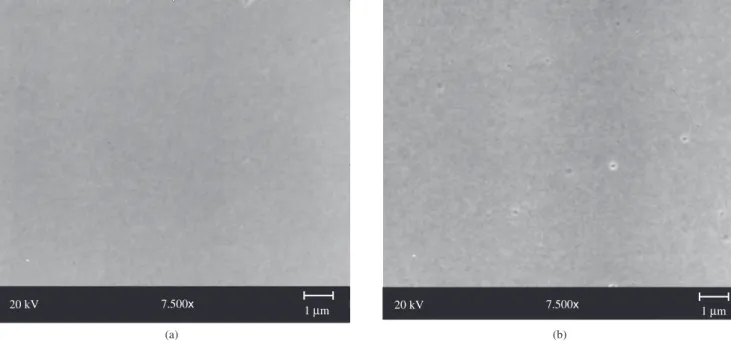
The SEM micrographs, obtained with a JEOL JSM T330A scanning electron microscope, revealed that the films were of high density and had a very homogeneous structure devoid of cracks, as indicated in Figure 7.
200 400 600
60 70 80 90 100 Temperature (°C) W eight (%) DTG TG
Figure 5. TG curve and DTG of TiO2 powder.
Figure 4. FT-IR spectra: a) TiO2; and b) cyanidin-functionalized TiO2.
200 400 600
50 60 70 80 90 100 DTG TG Temperature (°C) W eight (%)
Figure 6. TG curve and DTG of cyanidin-functionalized TiO2 powder. Wavelenght (cm–1)
500 1000 1500 2000 2500 3000 3500 4000
4. Conclusions
Unlike the systems studied previously, in which the interaction between cyanidin and TiO2particles occurs after the particles or films have been obtained, in the present work this interaction occurred during the reactions of hydrolysis and condensation, resulting in a material with a larger quantity of adsorbed dye molecules in relation to the number of titanium atoms, possibly leading to the greater efficiency of solar cells obtained by this methodology.
The thin films were transparent, homogeneous, uniform, with a thickness in the order of 100 nm, and presented excellent adhesion to the substrate. These characteristics indicate the possible application of these films in solar cells.
References
1. Falaras P, Goft AH, Bernard MC, Xagas A. Characterization by Resonance Raman Spectroscopy of sol-gel TiO2 films sensitized by the Ru(PPh3)2(dcbipy)Cl2 complex for solar cells application. Solar Energy Materials & Sollar Cells. 2000; 64(2):167-184.
2. Tennakone K, Kumarashinghe AR, Kumara GRRA, Wijayantha KGU, Sirimanne PM. Nanoporous TiO2 photoanode sensitized with the flower pigment cyaniding. Journal of Photochemistry and Photobiology. 1997; 108:193-195.
3. Agnaldo JS, Bastos JBV, Cressoni1 JC, Viswanathan, G.M. Células Solares de TiO2 sensibilizado por corante. Revista Brasileira de Ensino de Física. 2006; 28(1):77-84.
4. ´Regan BO, Grätzel M. A low-cost, high-efficiency solar cell based on dye-sensitized colloidal TiO2 films. Nature. 1991; 353:737-740. 5. Gerfin T, Grätzel M. Molecular and supramolecular surface modification
of nanocrystalline TiO2 films: charge-separating and charge-injecting devices. Progress in Inorganic Chemistry. 1997; 44:345-393.
6. Niyama E, Alencar AC, Vila LD, Stucchi EB, Davolos MR. Filmes delgados luminescentes obtidos a partir de hidroxicarbonetos de ítrio ativados por európio ou térbio. Química Nova. 2004; 27(2):183-187. 7. Nozik AJ. Quantum dot solar cells. Physica E: Low-dimensional Systems
and Nanostructures. 2002; 14:115-120.
8. Cherepy NJ, Smestad GP, Gratzel M, Zhang JZ. J. Phys. Chem. Ultrafast Electron Injection: Implications for a Photoelectrochemical Cell Utilizing an Anthocyanin Dye-Sensitized TiO2 Nanocrystalline Electrode. Journal of Physical Chemistry B. 1997; 101:9342-9351.
9. Smestad GP, Gratzel, M. Demonstrating Electron Transfer and Nanote-chnology: A Natural Dye-Sensitized Nanocrystalline Energy Converter. J. Chem. Education. 1998; 75(6):752-756.
10. Hinsch A, Kroon JM, Kern R, Uhlendorf I, Holzbock J, Meyer A, Ferber J. Long-term stability of dye-sensitised solar cells. Prog. Photovoltaics. 2001; 9(1):425-438.
11. Malacrida CR, da Motta S. Antocianinas de suco de uva: composição e estabilidade. B. CEPPA. 2006; 24(1):59-82.
12. Nassar EJ, Ciuffi KJ, Gonçalves RR, Messaddeq Y, Ribeiro SJL. Filmes de Titânio-Silício preparados por “spin” e “dip-coating”. Química Nova. 2003; 26(5):674-677.
13. Li X, Xiong Y, Li Z, Xie Y. Large Scale Fabrication of TiO2 Hierarchical Hollow Spheres. Inorganic Chemistry. 2006; 45(9):3943-3495. 14. Corriu RJP. The Control of Nanostructured Solids: A Challenge for
Molecular Chemistry. Eur. J. Inorganic Chemistry. 2001; 5:1109-1121. 15. Sanchez C, Julian B, Belleville P, Popall M. Applications of hybrid
organic–inorganic nanocomposites. J. Materials. Chemistry. 2005; 15:3559-3592.
16. Andrzejewska A, Krysztafkiewicz A, Jesionowski T. Adsorption of or-ganic dyes on the aminosilane modified TiO2 surface. Dyes and Pigments. 2004; 62(2):121-130.
17. Ehret A, Stuhl L, Spitler MT. Spectral Sensitization of TiO2 Nanocrys-talline Electrodes with Aggregated Cyanine Dyes. J. Phys. Chem. 2001; 105:9960-9965.
18. González MB, Wu A, Vilarinho PM. Influence of Solvents on the Micro-structure and Dieletric Properties of Ba0.5Sr0.5TiO3 Thin Films Prepared by a Diol-Based Sol-Gel Process. Chem. Mater. 2006; 18:1737-1744. 19. Kontos AI, Arabatzis IM, Tsoukleris DS, Kontos AG, Bernard MC,
Pet-rakis DE, Falaras P. Efficient photocatalysts by hydrothermal treatment of TiO2. Catalysis Today. 2005; 101(3-4):275-281.
20. MairaAJ, Coronado JM, Augugliaro V, Yeung YKL, Conesa ZJC, Soria J. Gas-phase photo-oxidation of toluene using nanometer-size TiO2 catalysts. Journal of Catalysis. 2001; 202(2):413-420.
Figure 7. SEM micrograph of films: a) 70 mm/min 3 dips; and b) 50 mm/min 2 dips.
(a) (b)
21. Dangles O, Norio S, Brouillard R. Kinetic and Thermodynamic Control of Flavylium Hydration in the Pelargonidin-Cinnamic Acid Complexation. Origin of the Extraordinary Flower Color Diversity of Pharbitis nil. J. Am. Chem. Soc. 1993; 115:3125-3132.
22. Marković DJM, Baranac JM, Brdarić TP. Electronic and infrared vi-brational analysis of cyanidin–quercetin copigment complex.
Spectro-chimica Acta Part A: Molecular and Biomolecular Spectroscopy. 2005; 62(1-3):673-680.