*e-mail: [email protected]
The Effects of ZrO
2Nanoparticles on Physical and Mechanical Properties
of High Strength Self Compacting Concrete
Ali Nazari*, Shadi Riahi
Department of Technical and Engineering Sciences, Islamic Azad University,
Saveh Branch, Saveh, Iran
Received: September 29, 2010; Revised: November 27, 2010
In this work, strength assessments and coefficient of water absorption of high performance self compacting concrete containing different amounts of ZrO2 nanoparticles have been investigated. The results indicate that the strength and the resistance to water permeability of the specimens are improved by adding ZrO2 nanoparticles in the cement paste up to 4.0 wt. (%). ZrO2 nanoparticles, as a result of increased crystalline Ca(OH)2 amount especially at the early age of hydration, could accelerate C-S-H gel formation and hence increase the strength of the concrete specimens. In addition, ZrO2 nanoparticles are able to act as nanofillers and recover the pore structure of the specimens by decreasing harmful pores. Several empirical relationships have been presented to predict flexural and split tensile strength of the specimens by means of the corresponding compressive strength at a certain age of curing. Accelerated peak appearance in conduction calorimetry tests, more weight loss in thermogravimetric analysis and more rapid appearance of the peaks related to hydrated products in X-ray diffraction results, all indicate that ZrO2 nanoparticles could improve mechanical and physical properties of the concrete specimens.
Keywords: ZrO2 nanoparticles, water permeability, strength, pore structure, thermogravimetric analysis
1. Introduction
Advancements in concrete technology have resulted in the development of a new type of concrete which is known as self compacting high performance concrete (SCHPC). The qualities of SCHPC are based on the concept of self compacting high performance concretes. Self compacting concrete (SCC) is a fluid concrete that spreads through congested reinforcement, fills every corner of the formwork, and consolidated under its weight1. SCC necessitates excellent filling ability, good passing ability, and adequate segregation resistance. But it does not include high strength and good durability as significant performance criteria. On the other hand, high performance concrete (HPC) has been defined as a concrete which is appropriately designed, mixed, placed, consolidated, and cured to provide high strength and low convey properties or good durability2. HPC exhibits good segregation resistance, but does not provide excellent filling and passing ability, and therefore needs external means such as rodding or vibration for suitable consolidation. Hence, a concrete that fulfills the performance criteria of both SCC and HPC can be referred to as SCHPC. An SCHPC is that concrete, which offers excellent performance with respect to filling ability, passing capability, segregation resistance, strength, transport properties and durability.
Virtually all research has used SCC which includes active additions to satisfy the great demand for fines needed for this type of concrete, thereby improving their mechanical properties in comparison with NVC. Köning et al.3 and Hauke4 registered strength increase in SCCs made with different amount of fly ash. According to Fava et al.5, in SCCs with granulated blast furnace slag, this increase is also evident. On the other hand, when limestone filler is used, Fava et al.5 and Daoud et al.6 achieved a tensile strength in SCC lower than the other normal types of concrete.
Permeability of concrete is defined as the movement of liquid and/or gas through a mass of concrete under a constant pressure gradient. It is an inherent property of concrete that chiefly depends
upon the geometric arrangement and characteristics of the constituent materials. The permeability of concrete is mainly controlled by the solidity and porosity of the hydrated paste present in bulk paste matrix and interfacial transition zone. In the hydrated paste, the capillary and gel pores can be distinguished. The gel pores are very small. Although they constitute a network of open pores, the permeability of this network is very low. Conversely, the capillary pores are relatively large spaces existing between the cement grains. It is the capillary porosity that greatly affects the permeability of concrete7. The permeability of SCHPC is typically lower than that of ordinary concrete. The previous research showed that SCHPC results in very low water and gas permeability8,9. This is mostly attributed to the superior flow properties, dense microstructure and refined pore. Good flow properties result in superb packing condition due to better consolidation, and thus contribute to reduce the permeability of concrete.
Since strength assessments and water permeability of concrete are joined together to affect the final performance of concrete, considering mechanical properties in terms of various types of strengths together with physical properties of concrete specimens seems essential. Hence, in this work, both physical and mechanical properties of concrete specimens have been studied.
As our knowledge, there are few works on incorporating nanoparticles about SCCs to achieve improved physical and mechanical properties. Only, there are several reports on incorporation of nanoparticles in NVCs which most of them have focused on using SiO2 nanoparticles10-19 and TiO
2 nanoparticles
20,21. There are a few studies on incorporating nano-Fe2O322, nano-Al
2O3
nanoparticles evaluating the mechanical properties of the composites. Nanoparticles can act as heterogeneous nuclei for cement pastes, further accelerating cement hydration because of their high reactivity, as nano-reinforcement, and as nano-filler, densifying the microstructure, thereby, leading to a reduced porosity. The most significant issue for all nanoparticles is that of effective dispersion.
Incorporating of other nanoparticles is rarely reported. Therefore, introducing some other nanoparticles which probably could improve the mechanical and physical properties of cementitious composites is inherent. The aim of this study is incorporating ZrO2 nanoparticles into SCCs to study compressive strength and water permeability of self compacting high strength concrete. In addition, pore structure, thermal properties and microstructure of the concrete specimens have been evaluated. Several specimens with a constant amount of polycarboxylate superplasticizer (PC) have been prepared and their physical and mechanical properties have been considered when, instead of cement, ZrO2 nanoparticles were partially added to the cement paste.
2. Materials and Methods
Ordinary Portland Cement (OPC) conforming to ASTM C150[35] standard was used as received. The chemical and physical properties of the cement are shown in Table 1.
ZrO2 nanoparticles with average particle size of 15 nm and 45 m2/g Blaine fineness producing from Suzhou Fuer Import & Export Trade Co., Ltd was used as received. The properties of ZrO2 nanoparticles are shown in Table 2.
Crushed limestone aggregates were used to produce self-compacting concretes, with gravel 4/12 and two types of sand: one coarse 0/4, for fine aggregates and the other fine 0/2, with a very high fines content (particle size < 0.063 mm) of 19.2%, the main function of which was to provide a greater volume of fine materials to improve the stability of the fresh concrete.
A polycarboxylate with a polyethylene condensate defoamed based admixture (Glenium C303 SCC) produced from Muhu (China) Construction Materials Co., Ltd was used. Table 3 shows some of the physical and chemical properties of polycarboxylate admixture used in this study.
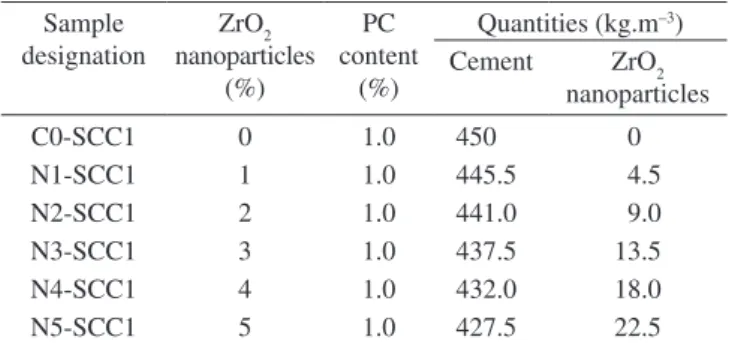
Totally, two series of mixtures were prepared in the laboratory trials. C0-SCC series mixtures were prepared by cement, fine and fine crushed limestone aggregates with 19.2% by weight of ultra-fine ones and 1.0% by weight of polycarboxylate admixture replaced by water. N-SCC series were prepared with different contents of ZrO2 nanoparticles with average particle size of 15 nm. The mixtures were prepared with the cement replacement by ZrO2 nanoparticles from 1.0 to 5.0 wt. (%) and 1.0 wt. (%) polycarboxylate admixture. The superplasticizer was dissolved in water, and then the nano-ZrO2 was added and stirred at a high speed for 3 minutes. Though nano-ZrO2 cannot be dissolved in water, a smaller amount of nano-ZrO2 can be dispersed evenly by the superplasticizer11. The water to binder ratio for all mixtures was set at 0.40[36]. The binder content of all mixtures was 450 kg.m–3. The proportions of the mixtures are presented in Table 4.
The mixing sequence for SCCs was consisted of homogenizing the sand and cementitious materials for one minute in the mixer
and then approximately 75% of the mixing water were added. The coarse aggregate was introduced and then the superplasticizer was pre-dissolved in the remaining water and was added at the end of the mixing sequence. The total mixing time including homogenizing was 5 minutes.
Several types of tests were carried out on the prepared specimens:
• Strength evaluation tests: Cubic specimens with 100 mm edge length for compressive tests. Cylindrical specimens with the diameter of 150 mm and the height of 300 mm for split tensile tests and Cubic specimens with 200 × 50 × 50 mm edges length for flexural tests were made. The moulds were covered with polyethylene sheets and moistened for 24 hours. Then the specimens were demoulded and cured in water at a temperature of 20o C in the room condition prior to test days. The strength tests of the samples were determined at 2, 7 and 28 days of curing. Compressive tests were carried out according to the ASTM C 39[37] standard, split tensile tests were done in accordance to the ASTM C 496[38] standard and flexural tests were performed conforming to the ASTM C 293[39] standard.
Table 1. Chemical and physical properties of Portland cement wt. (%).
Material SiO2 Al2O3 Fe2O3 CaO MgO SO3 Na2O K2O Loss on ignition
Cement 21.89 5.3 3.34 53.27 6.45 3.67 0.18 0.98 3.21
Specific gravity: 1.7 g.cm–3.
Table 2. The properties of nano-ZrO2.
Diameter (nm)
Surface volume ratio (m2.g–1)
Density (g.cm–3)
Purity (%) 15 ± 3 165 ± 12 <0.15 >99.9
Table 3. Physical and chemical characteristics of the polycarboxylate admixture.
Appearance Yellow-brown liquid % solid residue Approximately 36%
pH 5.2-5.3
Specific gravity (kg.L–1) Approximately 1.06 Rotational Viscosity (MPa) 79.30
% C 52.25
ppm Na+ 9150
ppm K+ 158
Table 4. Mixture proportion of nano-ZrO2 particles blended self compacting concretes.
Sample designation
ZrO2 nanoparticles
(%)
PC content
(%)
Quantities (kg.m–3) Cement ZrO2
nanoparticles
C0-SCC1 0 1.0 450 0
N1-SCC1 1 1.0 445.5 4.5
N2-SCC1 2 1.0 441.0 9.0
N3-SCC1 3 1.0 437.5 13.5
N4-SCC1 4 1.0 432.0 18.0
N5-SCC1 5 1.0 427.5 22.5
Table 5. Strength assessments and water permeability of C0-SCC and N-SCC specimens.
Sample designation
SiO2 nanoparticles
(%)
Compressive strength (MPa)
Split tensile strength (MPa)
Flexural strength (MPa)
Percentage of water absorption (%) 2 days 7 days 28 days 2 days 7 days 28 days 2 days 7 days 28 days 2 days 7 days 28 days
C0-SCC1 0 14.0 20.6 31.6 0.4 1.2 1.6 2.8 3.7 4.2 2.30 4.28 3.89
N1-SCC1 1 14.2 22.9 33.4 0.7 1.2 1.5 2.9 3.8 4.2 4.09 2.10 1.93
N2-SCC1
2
15.4 27.5 36.4 1.2 1.5 1.9 3.1 4.1 5.1 4.41 2.00 1.69N3-SCC1
3
16.9 30.8 42.3 1.5 1.9 2.4 3.2 4.5 5.9 4.78 1.87 1.40N4-SCC1
4
17.9 35.7 47.6 1.8 2.2 2.8 3.4 5.0 6.6 5.18 1.58 1.16N5-SCC1
5
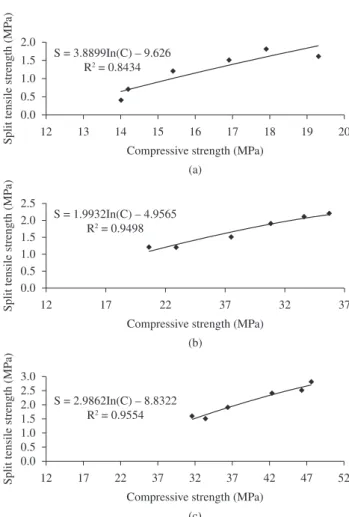
19.3 33.6 46.3 1.6 2.1 2.5 3.3 4.8 6.3 4.96 1.68 1.29Figure 1. The relationship between split tensile strength and compressive strength of the specimens cured at a) 2 days; b) 7 days; and c) 28 days. C denotes compressive strength and S denotes split tensile strength.
Figure 2. The relationship between flexural strength and compressive strength of the specimens cured at a) 2 days; b) 7 days; and c) 28 days. C denotes compressive strength and F denotes flexural strength.
After the specified curing period was over, the concrete cubes were subjected to related test by using universal testing machine. The tests were carried out triplicately and average strength values were obtained.
• Water permeability tests: Water permeability tests are performed with several methods such as percentage of water absorption, rate of water absorption and coefficient of water absorption. In this work, to evaluate the water permeability of the specimens, percentage of water absorption is an evaluation of the pore volume or porosity of concrete after hardening, which is occupied by water in saturated state. Water absorption values of ZrO2 nanoparticle blended concrete samples were
measured as per ASTM C 642[40] after 2, 7 and 28 days of moisture curing.
• X-raydiffraction(XRD): A Philips PW-1730 unit was used for XRD analysis which was taken from 4 to 70°.
3. Results and Discussion
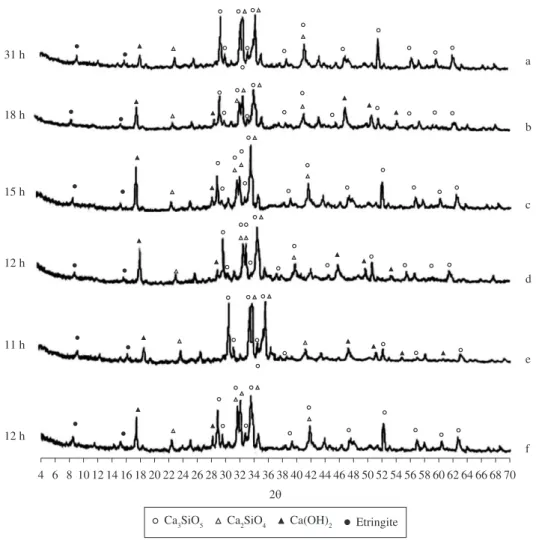
Figure 3. XRD results indicating the formation of hydrated products for different N-SCC specimens: a) C0-SCC1; b) N1-SCC1; c) N2-SCC1; d) N3-SCC1; e) N4-SCC1; and f) N5-SCC1.
with much higher compressive strength with respect to C0-SCC and N-SCC specimens with 1.0, 2.0 and 3.0 wt. (%) ZrO2 nanoparticles. The reduced compressive strength by adding more than 4 wt. (%) ZrO2 nanoparticles may be due to this fact that the quantity of ZrO2 nanoparticles present in the mix is higher than the amount required to combine with the liberated lime during the process of hydration thus leading to excess silica leaching out and causing a deficiency in strength as it replaces part of the cementitious material but does not contribute to strength. Also, it may be due to the defects generated in dispersion of nanoparticles that causes weak zones. The higher compressive strength in the N-SCC series mixtures with respect to C0-SCC series is due to the rapid consumption of crystalline Ca(OH)2 which quickly are formed during hydration of Portland cement specially at early ages as a result of high reactivity of ZrO2 nanoparticles. As a consequence, the hydration of cement is accelerated and larger volumes of reaction products are formed. Also ZrO2 nanoparticles recover the particle packing density of the blended cement, directing to a reduced volume of larger pores in the cement paste.
Table 5 shows the split tensile strength and the flexural strength of C0-SCC and N-SCC series concretes. Similar to the compressive strength, the split tensile strength and the flexural strength of all N-SCC specimens is more than those of C0-SCC specimens. In addition, the split tensile strength and the flexural strength of N-SCC series is increased by adding ZrO2 nanoparticles up to 4.0 wt. (%) and
water permeability of these series is decreased with respect to the C0-SCC series concrete.
Table 5 also shows that the percentage of water absorption in N-SCC series at 7 and 28 ages of curing is decreased by increasing the ZrO2 nanoparticles content up to 4.0 wt. (%) and then it is increased. Once again, this may be due to unsuitable dispersion of the nanoparticles in the cement paste when the content of the nanoparticles goes beyond 4 wt. (%). On the other hand, at 2 days of curing, more water requirement by increasing nanoparticles content up to 4.0 wt. (%) results in the decreased the coefficient of water absorption. Therefore, it can be suggested that with prolonged curing, increasing the ages and percentages of ZrO2 nanoparticles can lead to reduction in permeable voids. This is due to the pozzolanic action and filler effects of ZrO2 nanoparticles. Another finding is that the interfacial transition zone in concrete had improved due to pozzolanic reaction as well as filler effect of the ZrO2 nanoparticles. This finding is partially in confirmation of the results of the study by Bui et al.41.
Figure 3 shows XRD analysis of C0-SCC and N-SCC specimens at different times after curing. As Figure 3 also shows, the peak related to formation of the hydrated products shifts to appear in earlier times indicating the positive impact of PC on formation of Ca(OH)2 and C-S-H gel at early age of cement hydration.
4. Conclusions
The results obtained in this study can be summarized as follows: • As the content of ZrO2 nanoparticles is increased up to
4 wt%, the compressive strength, split tensile strength and flexural strength of SCC specimens is increased. This is due to more formation of hydrated products in presence of ZrO2 nanoparticles.
• ZrO2 nanoparticles could act as nanofillers and improve the resistance to water permeability of concrete at 7 and 28 days and curing. At 2 days of curing, the coefficient of water absorption is increased by increasing the nanoparticles content up to 4.0 wt. (%) since the specimens require more water to rapid forming of hydrated products.
• Someempiricalrelationshipsintermsoflogarithmicequations were provided to correlate the split tensile strength and flexural strength of a certain mixture to its compressive strength.
References
1. Khayat KH. Workability, testing, and performance of self-consolidating
concrete. ACI Materials Journal, 1999; 96(3):346-353.
2. Russell HG. ACI defines high-performance concrete. Concrete
International, 1999, 21(2):56-57.
3. Köning G, Holsechemacher K, Dehn F and Weie D. Self-compacting concrete-time development of material properties and bond behaviour. In: Proceedings of the 2nd International RILEM Symposium on
Self-Compacting Concrete; 2001; Tokyo. COMS Engineering Corporation. p. 507-516.
4. Hauke B. Self-compacting concrete for precast concrete products in
Germany. In: Proceedings of the 2nd International RILEM Symposium
on Self-Compacting Concrete. 2001; Tokyo. COMS Engineering Corporation. p. 633-642.
5. Fava C, Bergol L, Fornasier G, Giangrasso F and Rocco C. Fracture
behaviour of self –compacting concrete. In: Proceedings of the 3rd
InternationalRILEMSymposiumonSelf-CompactingConcrete; 2003; Reykjavik. RILEM Publications S.A.R.L. p. 628-636.
6. Daoud A, Lorrain M and Laborderie C. Anchorage and cracking behaviour of self-compacting concrete. In: Proceedings of the 3rd International
RILEM Symposium on Self-Compacting Concrete; 2003; Reykjavik. RILEM Publications S.A.R.L. p. 692-702.
7. Perraton D, Aïtcin P-C and Carles-Gbergues A. Permeability, as seen by the researcher. In: Malier Y, editor. High performance concrete: from material to structure. London, UK: E & FN Spon; 1994. p.186-195.
8. Zhu W and Bartos PJM. Permeation properties of self-compacting
concrete. Cement and Concrete Research. 2003; 33(6):921-926.
9. Schutter GD, Audenaert K, Boel V, Vandewalle L, Dupont D, Heirman G et al. Transport properties in self-compacting concrete and relation with
durability: overview of a Belgian research project. In: Proceedings of
the 3rdInternationalRILEMSymposiumonSelf-CompactingConcrete.
2003; Bagneux, France. RILEM Publications. p.799-807.
10. Bjornstrom J, Martinelli A, Matic A, Borjesson L and Panas I. Accelerating effects of colloidal nano-silica for beneficial calcium–silicate–hydrate formation in cement. Chemical Physics Letters. 2004; 392(1-3):242-248.
11. Ji T. Preliminary study on the water permeability and microstructure of concrete incorporating nano-SiO2. Cement and Concrete Research. 2005;
35(10):1943-1947.
12. Jo B-W, Kim C-H, Tae G-h and Park J-B. Characteristics of cement mortar with nano-SiO2 particles. Construction and Building Materials.
2007; 21(6):1351-1355.
13. Li H, Xiao H-g and Ou J-p. A study on mechanical and pressure-sensitive
properties of cement mortar with nanophase materials. Cement and
Concrete Research. 2004; 34(3):435-438.
14. Li H, Zhang M-h and Ou J-p. Abrasion resistance of concrete containing
nanoparticles for pavement. Wear. 2006; 260(11-12):1262-1266.
15. Qing Y, Zenan Z, Deyu K and Rongshen C. Influence of nano-SiO2
addition on properties of hardened cement paste as compared with silica
fume. Construction and Building Materials. 2007; 21(3):539-545.
16. Lin KL, Chang WC, Lin DF, Luo HL and Tsai MC. Effects of nano-SiO2
and different ash particle sizes on sludge ash–cement mortar. Journal of Environmental Management. 2008; 88(4):708-714.
17. Lin DF, Lin KL, Chang WC, Luo HL and Cai MQ. Improvements
of nano-SiO2 on sludge/fly ash mortar. Waste Management. 2008;
28(6):1081-1087.
18. Sobolev K, Flores I, Torres-Martinez LM, Valdez PL, Zarazua E and Cuellar EL. Engineering of SiO2 nanoparticles for optimal performance
in nano cementbased materials. In: Nanotechnology in construction:
Proceedings of the 3rd International Symposium on Nanotechnology in
Construction-NICOM3. 2009; Prague, Czech Republic. p. 139-48.
19. Qing Y, Zenan Z, Li S and Rongshen C. A comparative study on the
pozzolanic activity between nano-SiO2 and silica fume. Journal of
Wuhan University of Technology - Materials Science Edition. 2008; 21(3):153-157.
20. Sobolev K and Ferrada-Gutiérrez M. How nanotechnology can change
the concrete world: part 2. American Ceramic Society Bulletin. 2005;
84(11):16-19.
21. Li H, Zhang M-h and Ou J-p. Flexural fatigue performance of concrete containing nano-particles for pavement. International Journal of Fatigue.
2007; 29(7):1292-1301.
22. Li Z, Wang H, He S, Lu Y and Wang M. Investigations on the preparation and mechanical properties of the nano-alumina reinforced cement composite. Materials Letters. 2006; 60(3):356-359.
23. Garboczi EJ and Bentz DP. Modelling of the microstructure and transport
properties of concrete. Construction and Building Materials. 1996;
10(5):293-300.
24. Chang T-P, Shih J-Y, Yang K-M and Hsiao T-C. Material properties
of Portland cement paste with nano-montmorillonite. Journal of the
Materials Science. 2007; 42(17):7478-87.
25. Kuo W-Y, Huang J-S and Lin C-H. Effects of organo-modified montmorillonite on strengths and permeability of cement mortars. Cement and Concrete Research. 2006; 36(5):886-95.
26. Lee SJ and Kriven WM. Synthesis and hydration study of Portland cement
components prepared by the organic steric entrapment method. Materials
27. Nazari A, Riahi Sh, Riahi Sh, Shamekhi SF and Khademno A. Mechanical
properties of cement mortar with Al2O3 nanoparticles. Journal of
American Science. 2010; 6(4):94-97.
28. Nazari A, Riahi Sh, Riahi Sh, Shamekhi SF and Khademno A. The effects of incorporation Fe2O3 nanoparticles on tensile and flexural strength of
concrete. Journal of American Science. 2010; 6(4):90-93.
29. Nazari A, Riahi Sh, Riahi Sh, Shamekhi SF and Khademno A.
Improvement the mechanical properties of the concrete by using TiO2
nanoparticles. Journal of American Science. 2010; 6(4):98-101.
30. Nazari A, Riahi Sh, Riahi Sh, Shamekhi SF and Khademno A. Embedded
TiO2 nanoparticles mechanical properties monitoring in cementitious
composites. Journal of American Science. 2010; 6(4):86-89.
31. Nazari A, Riahi Sh, Riahi Sh, Shamekhi SF and Khademno A. Benefits of Fe2O3 nanoparticles in concrete mixing matrix. Journal of American
Science. 2010; 6(4):102-106.
32. Nazari A, Riahi Sh, Riahi Sh, Shamekhi SF and Khademno A. Assessment of the effects of the cement paste composite in presence TiO2 nanoparticles. Journal of American Science, 2010; 6(4):43-46.
33. Nazari A, Riahi Sh, Riahi Sh, Shamekhi SF and Khademno A. An investigation on the Strength and workability of cement based concrete
performance by using TiO2 nanoparticles. Journal of American Science. 2010; 6(4):29-33.
34. Nazari A, Riahi Sh, Riahi Sh, Shamekhi SF and Khademno A. Influence of Al2O3 nanoparticles on the compressive strength and workability of blended concrete. Journal of American Science. 2010; 6(5):6-9.
35. ASTM. ASTM C150. Standard Specification for Portland Cement.
Philadelphia, PA: ASTM; 2001. Annual book of ASTM standards.
36. Zivica V. Effects of the very low water/cement ratio. Construction and Building Materials. 2009; 23(8):2846-2850.
37. ASTM. ASTM C39. Standard Test Method for Compressive Strength of
Cylindrical Concrete Specimens. Philadelphia, PA: ASTM; 2001.
38. ASTM. ASTM C496. Standard Test Method for Splitting Tensile Strength
of Cylindrical Concrete Specimens. Philadelphia, PA: ASTM; 2001.
39. ASTM. ASTM C293. Standard Test Method for Flexural Strength of
Concrete(UsingSimpleBeamWithCenter-PointLoading). Philadelphia, PA: ASTM; 2001.
40. ASTM. ASTM C642. Standard Test Method for Density, Absorption, and
Voids in Hardened Concrete. Philadelphia, PA: ASTM; 2001.
41. Bui DD, Hu J and Stroeven P. Particle size effect on the strength of rice
husk ash blended gap-graded Portland cement concrete. Cement and