85
Abstract
Beneiciation of manganese ores has been conducted around the world by cir-cuits composed basically of crushing, screening and spiral classiier. Therefore, solely the coarse size fractions (and commonly the richest) are actually recovered: “lump” (-75+9mm) and “sinter feed” (-9+0.15mm). In the industrial plant which processes the ore from the Azul Mine-PA, the overlow of the spiral classiier (- 0.15mm) is disposed of in a tailings dam because it bears a low Mn content (<10%) and high kaolinite content (70%). This paper reports the indings of a process development conducted on laboratory scale with the aim of concentrating Mn-bearing minerals from the tailings of the Azul Mine-PA (7% of Mn and 70% of kaolinite). The process is composed of desliming (-10μm), followed by reverse cationic lotation of kaolinite (rougher, scaven-ger) at pH~5. Results indicate that the reverse cationic lotation in the acid medium, when utilizing amide amine as collector and in the presence of a silicate activator and a dispersing agent could be a possible route for the concentration of tailings that had previously been deslimed at 10μm.
The results yielded a mass recovery of 18%, a metallurgical recovery of 50% and a 32% Mn concentrate which may be mixed with current high grade products, increasing the overall recovery of the plant.
Keywords: Manganese tailings, froth lotation, reverse lotation, cationic collector. Helder Silva Souza
Mestre em Engenharia Mineral
Escola Politécnica - Universidade de São Paulo Departamento de Engenharia de Minas e de Petróleo São Paulo - SP - Brasil
Andre Soares Braga
Pesquisador
Escola Politécnica - Universidade de São Paulo Laboratório LFQI - Departamento de Engenharia de Minas e de Petróleo
São Paulo - SP - Brasil [email protected]
Arildo Henrique de Oliveira
Ph.D, Gerente de Reservas e Planejamento Longo Prazo Fertilizantes
Belo Horizonte - MG - Brasil [email protected]
Laurindo de Salles Leal Filho
Ph.D, Diretor Científico
Instituto Tecnológico Vale e Professor do Departamento de Engenharia de Minas e de Petróleo Escola Politécnica - Universidade de São Paulo Ouro Preto - MG - Brasil
[email protected], [email protected]
Concentration of manganese
tailings via reverse flotation in
an acid medium
Mining
Mineração
http://dx.doi.org/10.1590/0370-44672015690069
1. Introduction
Manganese ore is a mineral resource of great prominence in Brazil, owing to the large existing reserves (53.5 million tons in 2012) and concentrated production (3.5 million de tons in 2012). Furthermore, it is a strategic mineral due to its widespread use in the production of ferroalloy (DNPM, 2013).
Azul is the biggest Brazilian manga-nese mine and has been in operation since 1985. It is located in the north of Brazil in the Carajás mineral province and operates in synergy with other mines in the region.
The manganese ore in the Azul mine is processed in a plant composed of crushers, scrubbers, screens and a spiral classiier. The coarse fractions are naturally rich in man-ganese, and the products from the unit are lump ore (particle size of more than 9mm)
and sinter feed (size of more than 0.15mm), the ines are discarded in a tailings dam.
The development of an appropriate technology to concentrate manganese ines will enable a production upgrade by pro-cessing the tailings as they are discharged from the plant, as well as, any that are already in the tailings dam. In addition to enhancing production, the recovery of manganese ines will also reduce the envi-ronmental impact of this mining activity, since it minimizes the disposal of tailings. Therefore, the reverse lotation of kaolinite was evaluated for the recovery of manga-nese from the tailings (Souza, 2015).
The relevance of kaolinite lotation study is due to its presence in various kinds of ores, therefore studies of
complemen-tary concentration routes have become relevant. The number of articles relating to the lotation of kaolinite in manganese ores is relatively small in relation to baux-ite and iron ore. This study investigated the separation of kaolinite in the reverse lotation of the concentration of manga-nese tailings (Rodrigues, 2009).
According to Xu et al. (2004) the
amide amine is the best collector for ka-olinite lotation, therefore the amide amine collector was adopted in the experiments.
2. Methodology
The sample of tailings was obtained from the industrial plant after the ore had been subjected to the steps of crushing, scrubbing, screening and classiication. The spiral classiier ines (overlow) were collected and subsequently, dried and homogenized for the characterization and lotation tests.
Mineralogy studies were conducted in order to provide important information from the laboratory scale lotation stud-ies in the deinition of the concentration route. A scanning electron microscope
with energy-dispersive X-ray spectroscopy (SEM/EDS) and a Mineral Liberation Analyzer (MLA) were used to determine the minerals present in the tailings. The textures, grain sizes, mineral associations and liberations were analyzed.
Following the above procedures, lotation tests were carried out on a labo-ratory scale, in which, the samples had previously been deslimed at 10μm in order to prepare them for the concentration tests (Leal Filho et al. 2012).
The collector conditioning time in
both cases was one minute and the silicate activator conditioning time was 3 min. The froth collection was carried out until exhaustion, and established at 6.5 min for the tests using Flotigam 5530 , and 4.5 min for the tests using Custamine UU13. The lotation tests were done at 30% solids.
Laboratory scale lotation studies were conducted so as to understand the behavior of the sample in relation to the cationic reagent in the acid medium. Tests were performed according to the operating conditions presented in Table 1.
Table 1
Experimental conditions in the flotation tests
Test Conditioning Dosage Collector
PETB05 H2SiF6= 2,108 g/t (pH=3.0) Flotigam 5530 =300 g/t pH=3.0
PETB06 H2SiF6=1,240 g/t (pH=4.0) Flotigam 5530 =300 g/t pH=4.0
PETB07 H2SiF6=1,116 g/t (pH=4.8) Custamine UU13 = 300g/t pH=4.7
PETB08 H2SiF6= 1,240 g/t (pH=4.8) Custamine UU13 = 600g/t pH=4.8
PETB09 H2SiF6=1,240 g/t (pH=5.0) Custamine UU13 = 450g/t pH=4.9
PETB10 H2SiF6= 1,240 g/t
Na2SiO3= 500g/t (pH=4.3) Custamine UU13 = 450g/t pH=4.3
PETB11 H2SiF6=1,240 g/t
Na2SiO3 =1,000g/t (pH=4.3) Custamine UU13 = 450g/t pH=4.3
PETB47 H2SiF6=1,127g/t (pH=3.8)
NaPO3=2,000 g/t (pH=4.5) Flotigam 5530 = 252 g/t pH=4.7
PETB48 H2SiF6 =1,124g/t (pH=3.7)
87
3. Results and Discussion
Initially, studies of mineralogy were conducted in order to provide important information in the deinition of the concentration route, in which, the tailings were mainly composed of kaolinite and smaller proportions of
manganese oxides. Kaolinite presented a global liberation of 88%, whilst manganese oxides presented a global liberation level of 52% and an increase in the ines (Kahn et al. 2011).
According to Table 2, the sample
of tailings has a Mn content of only 7.1% a silica content of 34.2% and an alumina content of 29.7% together with a high volatile content (12.5% loss on ignition) , followed by 7.3% Fe and 1.1% TiO2.
Table 2 Chemical composition of the tailings used in the laboratory study (%)
Mn Fe P SiO2 Al2O3 TiO2 LOI
7.1 7.3 0.1 34.2 29.7 1.1 12.5
According to Table 3 the mineral-ogical composition conirms the
chemi-cal composition, given that the sample is composed mainly of kaolinite (71 wt %),
accompanied by cryptomelane/hollandite (17%), goethite (3.7%) and bixbyite (3.1%).
Minerals Percentage of the
mass Minerals Percentage of the mass
Cryptomelane /
hollandite 17.0 Ilmenite 1.8
Kaolinite 71.0 Lithiophorite 1.0
Goethite 3.7 Quartz 0.7
Bixbyite 3.1 Other 1.7
Table 3 Mineralogical composition of the sample used in the study
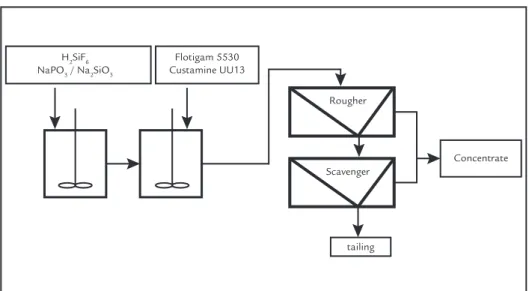
Figure 1 Schematic Flowsheet of the reverse flotation in the acid medium
H2SiF6 NaPO3 / Na2SiO3
Flotigam 5530 Custamine UU13
Rougher
Scavenger
tailing
Concentrate
In tests PETB-05 to PETB-11, condi-tioned pulp, together with H2SiF6 in 30% of solids, were utilized with the intention of activating the silicates (kaolinite) and sodium hexametaphosphate/sodium
silicate for the dispersion of the pulp in sequence and then added to the cationic collector (amide amine) at the rougher and scavenger stages. In tests PETB47/48, conditioned pulp together with H2SiF6
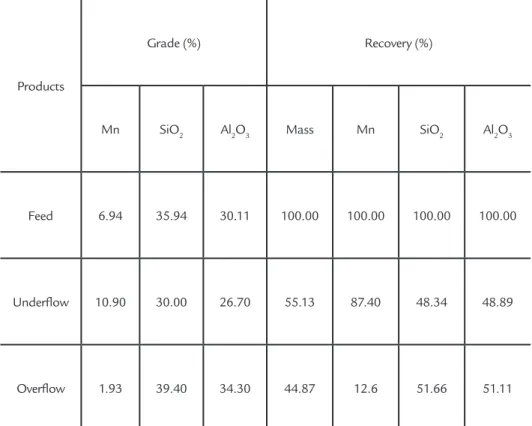
The mass of the metal recoveries and desliming were 55% and 87%, respectively. The overlow were poor in Mn (1.93%) and rich in SiO2 (39.4%)
and Al2O3 (34.3%), indicating the elimi-nation of a signiicant amount of gangue mineral (kaolinite).
Table 5 shows the results of the
particle size distribution in the lotation feed where it can be observed that the sample is very ine and shows values of F80 ~ 0.056mm.
particle size
(mm) + 0.210
- 0.210
+ 0.149
- 0.149
+ 0.105
- 0.105
+ 0.074
- 0.074
+ 0.044
- 0.044
+ 0.037
- 0.037
+0.020
% Passing 90.2 88.6 86.1 84.3 77.3 75.4 72.9
Table 5
Particle size distribution the feed flotation
mass
(%)
Kaulinite Mn-bearning minerals 68
28 82
38 84
48 90
68
95 88
83
52 Global Liberation
-0.6+0.15 -0.15+0.074 -0.074+0.037 -0.037+0.020 -0.020+0.010 Total
Fraction(mm)
Figure 2
Global liberation between the
Mn-bearing minerals and kaolinite by fraction
Owing to the fact that the kaolinite particles (the main gangue mineral) pres-ent a greater degree of liberation than the
manganese minerals particles, the reverse cationic lotation of the gangue is more recommendable.
Table 4 shows the results of deslim-ing where the lotation feed (underlow) presents an 11% Mn content.
Products
Grade (%) Recovery (%)
Mn SiO2 Al2O3 Mass Mn SiO2 Al2O3
Feed 6.94 35.94 30.11 100.00 100.00 100.00 100.00
Underflow 10.90 30.00 26.70 55.13 87.40 48.34 48.89
Overflow 1.93 39.40 34.30 44.87 12.6 51.66 51.11 Table 4
Metallurgical and
mass balances of desliming Figure 2 shows the comparison of
the global liberation between the
89
It can be observed in Table 6, that the best result was obtained using the collector (amide amine) with a lotation concentrate of 32% manganese and 13% SiO2. The mass recovery was 18% and metallurgic recovery 50%.
There is a need to use a high collector dosage collector possibly due to the ine characteristics of the tailings.
The best result obtained with the lotigam 5530 collector was possibly because this collector is an amine con-densate which probably increases the adsorption of the collector molecules in clay minerals possibly through two adsorption mechanisms: by electrostatic attraction and hydrogen bonding. More fundamental research is therefore
neces-sary in order to verify this hypothesis. The Mn grade of 32% in the concentrate is an indication that the reverse cationic lotation in the acid medium, with amide amine and in the presence of a silicate activator and dispersing agent, is a possible route for the concentration of tailings that had previously been deslimed.
4. Conclusion
Within the scope of this research, one can conclude that:
The studies of mineralogy showed that the tailings were mainly composed of kaolinite and smaller proportions of manganese oxides. Kaolinite presented a global liberation of 88%, whilst manga-nese oxides presented a global liberation level of 52% and an increase in the ines.
The study carried out in the
labora-tory scale showed that it is technically feasible to produce a concentrate with a 32% Mn content from a tailing sample, taken from the Azul plant, with a7% Mn content, using desliming and cationic re-verse lotation in an acid medium and in a circuit of rougher and scavenger stages together with an amide amine collector and in the presence of an activator of silicates and dispersing agent.
The results yielded a mass recovery of 18%, a metallurgical recovery of 50% and a 32% Mn concentrate which may be mixed with current high grade products, increasing the overall recovery of the plant.
Therefore the results in this project conirm the research carried out by Xu
et al. (2004) who also demonstrated that
amide amine is a good collector for ka-olinite lotation.
Table 6 The reverse flotation performance with a cationic collector in an acid medium
Test
Grade (%) Recovery (%)
Mn SiO2 Al2O3 Mass Mn SiO2 Al2O3
PETB05 12.6 28.9 25.3 76.9 92.5 71.1 71.7
PETB06 11.7 29.7 26.2 80.9 93.9 76.1 76.8
PETB07 9.7 31.9 28.6 80.9 90.9 78.1 78.4
PETB08 15.1 26.9 23.5 64.8 86.2 57.1 57.5
PETB09 13.9 27.3 24.2 72.5 87.9 66.2 66.8
PETB10 15.3 26.3 23.3 59.7 82.6 51.3 51.9
PETB11 14.3 27.1 23.9 68.4 87.9 60.9 61.5
PETB47 12.3 31.0 27.4 88.5 95.6 85.6 85.9
PETB48 32.0 12.7 14.1 17.6 50.5 6.9 8.7
Table 6 shows the results of lotation in an acid medium (pH ~ 5) with the
5. References
DNPM. Sumário Mineral. Ed. Brasília, v.33. p.95, 2013.
KAHN, H., TASSINARI, M. M., ULIANA, D. Estudos de caracterização tecnológica em amostras de minério de manganês da Mina do Azul. Relatório LCT-042/11. São Paulo: Escola Politécnica da USP/Laboratório de Caracterização Tecnológica – EPUSP, , 2011.
LEAL FILHO, L.S., BRAGA, A., VILLANOVA, I. Desenvolvimento de rota de lo-tação para minério de manganês – Estudos com pelito tabular – Relatório-1. São Paulo: Escola Politécnica da Universidade de São Paulo, 2012.
NEDER, E. E, O uso de aminas graxas e seus derivados na lotação de minérios
brasileiros. São Paulo: Escola Politécnica da Universidade de São Paulo USP, São
Paulo, 2005. 108 p. (Dissertação de Mestrado).
RODRIGUES, O. M. S. Estudos de lotação de Caulinita. Belo Horizonte: Escola de Engenharia da UFMG, 2009. 95p. (Dissertação de Mestrado em Engenharia Metalúrgica e de Minas).
SOUZA, H.S. Concentração do rejeito de manganês por lotação. São Paulo: Escola Politécnica da Universidade de São Paulo USP, São Paulo, 2015. 145p. (Dissertação Mestrado em Engenharia Mineral).
XU, Z. PLITT, V. LIU, Q. Recent advances in reverse lotation of diasporic ores.
Mi-nerals Engineering, v. 17, p. 1017-1022, 2004.