*e-mail: [email protected]
Presented at the International Symposium on High Temperature Corrosion in Energy Related Systems, Angra dos Reis - RJ, September 2002.
Nano-Structured Alloy and Composite Coatings for
High Temperature Applications
Wei Gao*, Zhengwei Li
Department of Chemical & Materials Engineering, The University of Auckland, Private Bag 92019, New Zealand
Received: September 2, 2002; Revised: September 4, 2002
Nano-structured materials often possess special properties that materials with identical composi-tions but ordinary grain size do not have. This paper reports our work on the surface nano-crystallisa-tion and nano-structured alloy and composite coatings. A number of processing methods including magnetron sputtering, thermal spray and pulse electro-spark deposition have been used to produce surface nano-crystalline structure. The compositions and microstructures can be well controlled by using different targets or electrodes, nano-structured composites and adjusting processing parameters. Surface nano-structured coatings can provide special chemical, mechanical and electronic properties such as high temperature corrosion and corrosive wear resistance. It has potential applications such as turbine blades, engine parts for petrochemical, aerospace and electronic device industries. This paper is focused on the study of the interrelations between processing, microstructure and properties. Physical models have been established to explain the effects of nano-crystalline structure on the properties.
Keywords:Nano-materials, coating, high temperature corrosion, metal-oxide composite coat-ings, Ti and Ti-Al based materials
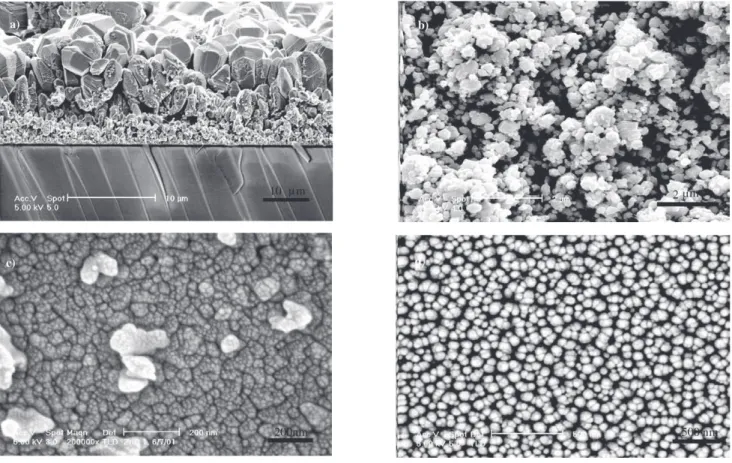
(PVD), thermal spray, electrochemical deposition, sol-gel methods, electro-spark deposition, and laser and electron beam surface treatment4. Processing parameters can be carefully controlled to obtain a fine grain size and processing temperature should be kept low. Magne-tron sputter deposition (a PVD technique) has been used to produce alloy coatings with a wide range of alloy composi-tions5. When an alloy coating is deposited with an unbal-anced magnetron sputter, the grain size and deposition rate are affected by the working Ar pressure, substrate bias volt-age, target current and the distance between target and substrate6-7. When Ni-Cr-Al alloy coatings are deposited on alloy substrate, the coating grain size is mainly a func-tion of the Ar pressure. Grain size as small as ~50 nm was obtained with a low Ar pressurez of 2-5 mTorr7,8. Doping can also change the grain size and shape of the deposited thin films. Figure 1 shows an example in which the Zn and ZnO thin films were deposited on a glass substrate by magnetron sputtering with DC or RF sources9. It can be seen that the Zn grains are much smaller toward the substrate surface (Fig. 1a); and the Al doping reduced the grain size
1. Introduction
Nano- and micro-crystal materials often possess special properties that materials with identical compositions but ordinary crystal size do not have. These materials are find-ing wide applications especially as electronic, photonic, magnetic, and biomedical materials1. Nano- and micro-crys-tal materials are also known to have superior mechanical properties due to the extremely fine grain size2. However, it has not been well known that alloy and alloy-oxide com-posite coatings with nano- and micro-crystal grains have special properties for high temperatures corrosion proper-ties. Nano structures promote selective oxidation, forming protective oxidation scales with superior adhesion to the substrate. Progress has been made in this area as nano- and micro-crystal alloy coatings, oxide dispersive alloy coat-ings and metal-oxide composite coatcoat-ings show superior high-temperature corrosion resistance3.
2. Processing of nano-crystal coatings
to the level of ~50 nm (Fig. 1b). Zn oxide thin films can also be obtained by oxidation of thin Zn films under a controlled oxygen partial pressure. Nano-structured ZnO grains form clusters of ~100 nm size (Fig. 1c). When ZnO
was directly deposited onto a substrate, the grain size was much smaller compared with metallic Zn (Fig. 1d). The microstructure, oxidation state, doping elements and dop-ing levels have strong effects on the electronic properties
Figure 1. Zinc and ZnO thin films formed with direct oxidation and magnetron sputtering, a) Zn cross-section, b) Zn + 1.2at.%Al surface morphology showing the effect of Al doping on the microstructure, c) ZnO formed through oxidation of Zn under Po2 @ 10-3atm at 380°C
for 24 hrs, and d) ZnO film with DC magnetron sputtering.
of the oxide thin films, such as transparency, conductivity and photoluminescence (PL) properties10.
Co-deposition and reactive deposition were also car-ried out using unbalanced magnetron sputter. Co-deposi-tion is to sputter metals from two or more targets, or from a composite target11-13. Composite target is a plate made of several different materials. Coating compositions can be accurately controlled by adjusting the currents on the dif-ferent targets, or the constitution of the composite target. Reactive deposition is performed by introducing certain amounts of reactive gases (e.g. O2 or N2) into the chamber 13.Alloy-oxide or alloy-nitride coatings can be produced
in this way. Fig.2 shows high-resolution SEM micrographs of co-deposited 310 stainless steel and Al, as well as reac-tive deposited Al coatings. The co-deposited coating has an average grain size of ~100 nm. The reactive deposited coating shows clusters of ~500 nm, each of which appeared to consist of many small grains. By careful control of the processing parameters, coatings with gradient compositions and microstructures can also be produced. These coatings have compositions gradually changing from interface to surface, resulting in higher concentrations of desirable com-ponents near the coating surface, and better interface con-nection between the coating and metal substrate. These coatings performed very well against high temperature cor-rosion11-13.
Some novel but simple techniques were also developed to produce nano- and submicro- and micro-crystal coat-ings. Electro-spark deposition and high-energy, pulse plasma surface treatment are two of the recent develop-ments14-18. These techniques use highly concentrated en-ergy to melt the electrode and substrate surface, originally for producing hard and wear resistant coatings19. Nano-and submicro-crystal coatings with grain sizes of
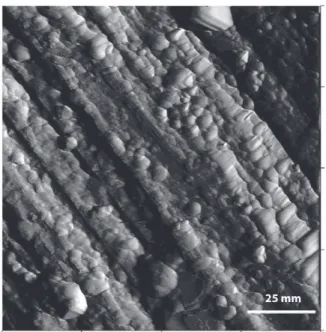
Figure 3. AFM image of electro-spark deposited coating surface on stainless steel, showing nano-crystal structure produced by rapid solidification.
50 - 500 nm are then formed due to the subsequent rapid-solidification. Nano-sized oxides such as Al2O3 and Y2O3 can be added into the coatings, resulting in oxide disper-sive strengthening (ODS) alloy coatings. Fig. 3 is an atomic force microscopic (AFM) photo of the electro-spark treated surface, showing very fine crystal structure. Fig. 4 shows transmission electron micrographs (TEM) of oxide disper-sion in Fe-Cr-Ni-Al-Y2O3 ODS coatings, showing spherical Y2O3 particles of ~15 nm size. These coating techniques
Figure 5. Ti3Al-TiC composite fabricated through MA and HIPing: a) etched, shows the TiC particles; b) shows the formation of fine oxides.
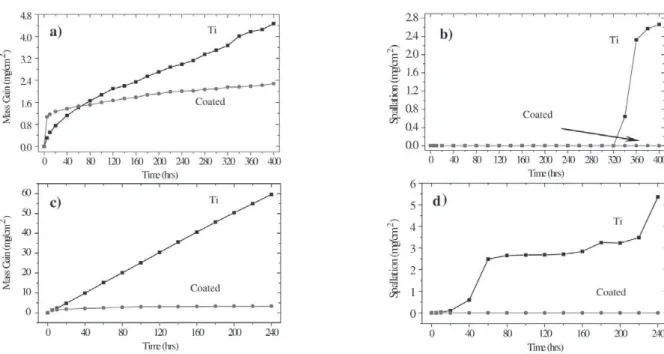
Figure 6. Oxidation kinetics and scale spallation of Ti with and without composite coating: a-b) 700 °C; c-d) 800 °C.
produce nano-crystal coatings with strong metallurgical bonding, exhibiting remarkably improved high-tempera-ture oxidation and hot-corrosion resistance14,16,17. These tech-niques also have the advantages of simple/portable equip-ment and fast/easy operation. Vacuum or protective atmos-pheres can be applied but are not necessary. These features make the techniques very attractive for industrial applica-tions such as parts repairing and in situ treatment20.
3. Nano-composites and coatings for Ti and Ti
alloys
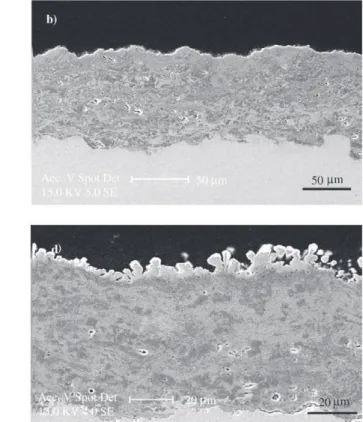
Figure 7. Cross-sections of Ti with and without composite coating: a) 700 °C, 400 h; Ti, b) 700 °C, 400 h, coated Ti; c) 800 °C, 240 h, Ti; d) 800 °C, 240 h, coated Ti.
oxidation resistance at elevated temperatures is poor. The formation of TiO2 does not provide good protection against further oxidation. As a result, Ti, Ti alloys and Ti3Al based materials can only be ed up to ~650 °C without excessive oxidation. Great efforts have been made to improve their oxidation resistance. Expensive alloying additions (e.g. Nb) were used to improve the oxidation resistance. The results are not satisfactory.
SiC and TiC particulate reinforced Ti3Al intermetallic matrix composites were fabricated using mechanical alloy-ing and hot pressalloy-ing or HIPalloy-ing methods. Fig.5 shows the microstructure of a Ti3Al-20vol.%TiC composite after etch-ing. It was found that the oxidation resistance of the com-posites is significantly improved compared to Ti, Ti alloys and Ti3Al intermetallics. Ti3Al-SiC showed a rather low mass gain due to the formation of Ti-Si compounds and discontinuous SiO2 particles. However, the most signifi-cant improvement is that all composite samples exhibited excellent scale spallation resistance. While the cast Ti3Al suffered severe spallation, no scale spallation could be found on the composites during oxidation tests. It is be-lieved that the small oxide grain size relieves the stresses in
the scale effectively, and the complex oxide-metal inter-face results in strong adherence between the scale and the substrate21,22.
A special type of composite, Ti3Al(O)-Al2O3, was pre-pared by ball milling of TiO2 with Al and consolidation23. It was applied on pure Ti substrate as a coating through ther-mal spraying. The coatings show superior oxidation and scale spallation resistance at 700 and 800°C up to 400 h exposure, Fig. 6. The enhanced resistance is attributed to the incorporation of Al2O3 into the coating, which plays a multiple role during oxidation. Thick TiO2 scale with a layered structure formed on Ti metal during oxidation. Cracks tend to develop along the scale, causing detach-ment (Figs. 7a and 7c). On the other hand, the coated mate-rial showed very different morphology. The alumina parti-cles served as a diffusion barrier, an inhibitor to crack propa-gation in the oxide scale, and the connectors between the coating and oxide scale, Figs. 7b and 7d. As a result, the coating can increase the application temperature of Ti, Ti and Ti3Al alloys from ~650 °C to ~800 °C24.
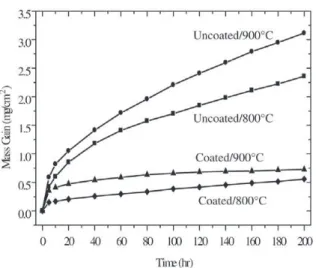
Figure 8. Oxidation of coated and uncoated Ti3Al-Nb with ESD aluminide coating
intermetallics25-26. Isothermal oxidation tests showed that the coated specimens exhibited much lower oxidation rates than uncoated specimens (Fig. 8). The formation of TiO2 was largely suppressed; and Al2O3 then became the main oxidation product. Furthermore, oxide scale spallation re-sistance was greatly improved by the nano-structure. No scale cracking or spallation could be observed on the coated specimens during the oxidation tests (Fig. 9). Nano- or submicro-alloy coatings produced by electro-spark depo-sition, therefore, provide another powerful tool for Ti-Al intermetallics to be used as high temperature structural materials.
4. Selective oxidation of nano-crystal coatings
One of the most important advantages of nano-crystal coatings is the ability to promote selective oxidation. En-gineering alloys rely on the formation of protective oxide films such as Al2O3 and Cr2O3 to resist high-temperature and corrosive environments. Unfortunately, relatively large concentrations of Al or Cr are needed to form a complete Al2O3 or Cr2O3 scale. In the Ni-20Cr-Al alloy system, for instance, > 6 wt.%Al is required to form a complete Al2O3 scale27. High Al contents, however, often degrade the me-chanical properties of alloys. If the Al content is lower than 6wt.%, complex oxides consisting of Cr2O3, NiCr2O4 and internal Al2O3 may form, resulting in high reaction rates and poor oxidation resistance.
With nano-crystal alloy coatings, the Al content that is required to form a complete protective oxide scale can be substantially reduced. Experimental results indicated that when the grain size of Ni-20Cr-Al coatings was in the level of ~60 nm, alloys containing ~2 wt.%Al could form a com-plete α-Al2O3 scale at 1000 °C in air. This concentration is
only 1/3 of the required %Al for the Ni-20Cr alloy with normal grain size! Fig.10 shows the cross-section SEM mi-crographs of oxidised samples, exhibiting very different oxide scales that formed on the Ni-20Cr-2Al coatings with different grain sizes.
Due to the formation of highly protective α-Al2O3, the
oxidation rate of the nano-crystal coatings is much lower than the coatings with the same composition but a larger grain size. A detailed study showed that the composition and microstructure of the oxide scales are a function of coating grain size. Fig. 11 shows the relationship between the oxide products, coating grain size and Al content, indi-cating that the selective oxidation of Al is greatly promoted by nano-crystal structure7. The promotion effect of nano-crystal grains on selective oxidation is attributed to short-circuit diffusion of Al through the grain boundaries.
Mathematical models based on simultaneous diffusion through the crystal lattice and grain boundaries have been established to predict selective oxidation and to describe Figure 9. Cross-section morphology showing oxide layers on
oxidation kinetics. These models showed a good agree-ment with the experiagree-mental results obtained by the authors in other materials and reported in the literatures7,28.
5. Improve oxide scale spallation resistance
Parts working at high-temperatures and corrosive envi-ronments rely on the formation of an oxide scale to protect the materials from further oxidation. This oxide scale should be strong, tough and possess good adherence to the metal substrate. A problem many alloys have is that the protec-tive oxide scales do not last long. Scale cracking and spal-lation take place after certain time at high-temperatures, or during thermal cycles, contaminating the equipment and
Figure 10. Cross-section of Ni-20Cr-2Al coating samples after oxidation at 1000 °C for 100 h: a) coating grain size ~60 nm; b) coating grain size ~370 nm.
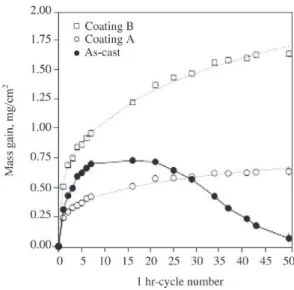
substantially reducing the service life of the parts. The ox-ide scales formed on nano- and micro-crystal coatings show a superior resistance to cracking and spallation. Cyclic and long-time oxidation resistance was significantly improved by applying nano-crystal coatings of AISI 310 stainless steel11, Ni-Cr-Al29-30, FeAl intermetallic compounds31, and Ti-Al intermetallic composites21,23,32. Fig. 12 compares the cyclic oxidation behaviours of Ni-20Cr-3.5Al as a cast al-loy (average grain size 0.4 mm), a submicro-crystal coating (~0.5 µm) and a crystal coating (~50 nm). Both
nano-and micro-crystal coatings show good oxide spallation re-sistance compared to the as-cast alloy. The nano-crystal Figure 11. A diagram showing the relationship of grain size, Al
content, and oxidation products for Ni-20Cr-xAl at 1000 °C in air.
coating also showed a lower oxidation rate.
Scale spallation is a complex process influenced by many mechanical and chemical factors. The mechanisms by which nano-crystal structures improve scale spallation resistance are also complex. Several mechanisms can be suggested based on the experimental results. Firstly, nano-crystal structures promote selective oxidation to form more protective oxides. Secondly, the fine-grained coatings and/ or the fine-grained oxide scales often show a fast creep rate at high-temperatures, which can release the stresses accu-mulated in the scales, and therefore reducing the scale spal-lation tendency. Thirdly, the oxides formed on nano- and submicro-crystal coatings are pegged onto the grain boundaries to form a complex interface. The so-called “mi-cro-pegging” effect of the inward-grown oxides results in better scale adhesion to the metal substrate.
6. Summary
This paper demonstrated that nano- and submicro-struc-tured coatings possess superior high-temperature oxidation and corrosion resistance. The high-density of grain bounda-ries provide fast diffusion paths, promoting the selective oxidation of protective oxide scales. Scale adhesion and spallation resistance are also improved by stress release and micro-pegging effects. Nano- and micro-crystal alloy and alloy-oxide composite coatings have been proven to be a powerful technique to combat high-temperature corro-sion. The theories and models developed from this research can be used to design coatings and alloys for high-tem-perature, energy related applications.
Acknowledgement
The authors would like to thank their collaborators and group members at the University of Auckland, particularly Y. He, Z. Liu, S. Li, K. Dahm, K. He, H. Gong, H. Pang, X. Yang, D. Wang, F. Wang, C. Xu, H. Cooper, M. Hodgson, J. Liang and D. Zhang.
References
1. Siegel, R. Physics of New Materials, 2nd ed. by and Technology, v. 5, n. 799, 1986.
2. Morris, D. Mechanical Behaviour of Nanostructured Ma-terials (Trans Tech Publications Ltd., Switzerland, 1998). 3. Gao, W.; Liu, Z.; Li, Z. Advanced Materials, v. 13,
n. 1001, 2001.
4. Goldstein, Ed. A.; Handbook of Nanophase Materials (Maecel Dekker, Inc. New York, 1997).
5. Nicholls, J.; Hancock P.; Yasiri, L. Materials Science and Technology, v. 5, n. 799, 1986.
6. Arnell, R.; Surface and Coatings Technology, v. 59, n. 105 1993.
7. Liu, Z.; Gao, W.; Dahm K.; Wang, F.; Acta Materialia, v. 46, n.1691, 1998.
8. Liu, Z.; Gao, W.; Dahm K.; Wang, F.; Scripta Materialia, v. 37, n. 1551, 1997.
9. Li, Z.; Gao, W. Internal Report on Oxidation of Zn (un-published), The University of Auckland, June 2002. 10. Gao, W. Z.; Li, R. Harikisun and S. Chang, in press in
Materials Letters, 2002.
11. Liu, Z.; Gao, W.; Dahm K.; He, Y. High Temperature Materials & Processes, v.16,n. 159, 1997.
12. Liu, Z.; Gao W.; Li, M. Oxid ation of Metals, v. 51, n. 403, 1999.
14. He, Y.; Huang Z. v. 45, n. 79, 2000.
15. He, Y.; Qi, H.; Bai, X.; Wang, D.; Li, Z.; Xu, C.; Gao,W. High Tempe rature Materials & Processes, v. 19, n. 71, 2000.
16. Liang, J.; Gao, W.; Li, Z.; He, Y. Proceedings of High-Temperature Corrosion and Protection 2000, Hokkaido Japan, Eds. Narita et al, 2000, p.383.
17. He, Y.; Pang, H.; Qi, H.; Wang, D.; Li, Z.; Gao, W. Mate-rials Science and Engineering A, v. 334, n. 179, 2002. 18. Yang, X.; He, Y.; Wang, D.; Gao, W. Chinese Science
Bulletin, v. 47, n. 525,2002.
19. Johnson, R. in Elevated Temperature Coatings: Sci-ence and Technology 1, ed. N Dahotre, J. Hampikian and J Striglich, (The Minerals, Metals & Materials So-ciety, 1995), p.265.
20. Li, Z.; Gao, W.; Kwok, P.; He, Y. High Temperature Materials and Processes, v. 19, n. 443, 2000.
21. Gao, W.; Li, Z.; Zhang, Z. D. Cai and J. Liang, Proceed-ings of the 3rd Asian-Australasian Conference on Com-posite Materials, 39,2002.
22. Li, Z.; Gao, W.; Liang, J.; Zhang, D. submitted to Mate-rials Letters, July 2002.
23. Gao, W.; Li, Z.; Zhang, D. Oxidation of Metals, v. 57, n. 99, 2002.
24. Li, Z.; Gao, W.; An internal report to NERF New Zea-land, The University of AuckZea-land, June, 2002. 25. Li, Z.; Gao, W.; He, Y. Scripta Materialia, v. 45, n.1099
2001.
26. Li, Z.; Gao, W.; Yoshihara, M.; He, Y. Materials Science and Engineering A, in press, 2002.
27. Wallwork, G.; Hed, A. Oxidation of Metals, v. 3, n. 171, 1971.
28. Liu, Z.; Gao, W.; He,Y. Oxidation of Metals, v. 53, n. 341, 2000.
29. Liu, Z.; Gao, W.; Dahm, K.; Wang, F. Oxidation of Metals, v. 50, n. 51,1998.
30. Liu, Z.; Gao, W. Scripta Materialia, v. 38, n. 877, 1998. 31. Liu, Z.; Gao, W.; Wang, F. Scripta Materialia, v. 39, n.
1497, 1998.