JOURNAL OF NANO- AND ELECTRONIC PHYSICS Р А А - А Р
Vol. 7 No 4, 04081(3pp) (2015) Том7№ 4, 04081(3cc) (2015)
2077-6772/2015/7(4)04081(3) 04081-1 2015 Sumy State University
Investigation of Corrosion Behavior of Bioactive Coverings on Commercially Pure Titanium and its Alloys
M.Yu. Gazizova, M.B. Ivanov, T.N. Vershinina
Belgorod National Research University, 85, Pobedy St., 30015 Belgorod, Russia
(Received 02 October 2015; published online 24 December 2015)
A microporous and macroporous bioactive coatings on boimedical titanium alloys (VT1-0, VT6, Ti-6Al-7Nb) were formed by a micro-arc oxidation method. The effect of the phase composition of microporous and macroporous coatings on corrosion behavior titanium and its alloys was investigated. The results show that phase composition of the coatings microporous presented only titanium oxides: anatase and rutile, at that the phase composition macroporous coatings consists of anatase, rutile and calcium phosphate com-pounds: tricalcium phosphate (TCP) -Ca3(PO4)2 and calcium deficient hydroxyapatite Ca9HPO4(PO4)5OH. Corrosion behavior of MAO coatings was investigated in solution 0.9 % NaCl using potentiodynamic polar-ization tests. The microporous coatings exhibited a more highest corrosion resistance than macroporous coatings, it is connected with containing calcium phosphate compounds in macroporous coatings.
Keywords: Titanium, Titanium alloys, Microarc oxidation, Bioactive coatings, Corrosion resistance.
PACS numbers: 81.65 – b, 87.85.J, 82.45.Bb
1. INTRODUCTION
The titanium and titanium alloys are used for pro-duction of different medical implants, for example for a hip and dental implants. Such widely usage of titanium for medical applications is due to its properties such as biocompatibility, low elastic modulus and good corro-sion resistance. Today in Russia the need for replace-ment of large joints (hip, knee) the number of opera-tions performed at times exceeds [1]. One of the main methods of fixing the hip implant is a method of ce-mentless fixing. When using cece-mentless method fixa-tion elements of implant it’s necessary to provide with bone a reliable level of primary fixation and accelerated integration with the bone, which is the key to a long-term functioning. The positive effect on osseointegra-tion provides formaosseointegra-tion on the surface of the implant bioactive coatings composed of calcium phosphate com-pounds [2]. Creating an environment at the surface of porous coating with developed level of roughness also helps to accelerate the process of osseointegration.
In the present studies, microarc oxidation method (MAO) was used for forming a bioactive porous coatings based on calcium phosphate compounds on the surface titanium VT1-0 and its alloys VT6 and Ti-6Al-7Nb [3]. In the work the comparative studies of the effect of regimes of MAO on a structure coatings and corrosion properties of investigated the titanium alloys were carried out, which are used in the manufacture of im-plants.
2. EXPERIMENTAL PROCEDURE
The study was conducted on the titan VT1-0 and on titanium alloys VT6 and Ti-6Al-7Nb. The formation of bioactive coatings on based calcium phosphate was carried out by a method of micro-arc oxidation. The electrolyte consisted only of chemical elements and compounds which are safe for a human body. The com-ponents used for electrolyte can also serve as a basis for forming bioglass which tend to dissolve in a body after implantation. Thus electrolyte contains a
saturat-ed solution of calcium hydroxide, a disodium phosphate and a sodium silicate. Coatings were performed on two regimes for each of said titanium alloys, allowing to form two types of coatings: microporous (electrolyte Na-Si-Ca) and macroporous (electrolyte Na-Si-Ca-P). The duration of the process MAO for microporous coatings was 20 minutes and 30 minutes for macroporous coat-ings. After coating, all samples were subjected to wash-ing three times in an ultrasonic bath in distilled water at 70 °C.
The surface morphology and structure of the modi-fied layers were investigated with using a scanning electron microscope (SEM) Nova NanoSEM 450 in low vacuum mode with a use of detector HELIX. Evalua-tion of surface roughness performed with the help of a contact precision profilometer Surtronic 25. The corro-sion test was conducted by an electrochemical method in accordance with GOST R ISO 10993-15-2009 using the potentiostat IPC-Pro and a standard three-electrode cell. Distribution of pores according with the size was studied with the help of a planimetric method for determining grain size in metals as per GOST 21073.4-75 standard. The silver chloride electrode was used as reference electrode, the carbon electrode acted as an auxiliary. All studies were performed at 37 ±1° C in the isostatic solution 0,9 % NaCl Ph 6.4. Initially stationary potential was measured not less than 120 minutes, at that the potential change during in the last 30 minutes were not more than 30 mV. Next anod-ic polarization of samples was conducted at a rate of potential sweep 1 mVs– 1. Studies of changes of a sur-face morphology before and after tests on corrosion resistance were performed using SEM.
3. RESULTS AND DISCUSSION
M.YU. GAZIZOVA,M.B. IVANOV,T.N. VERSHININA J.NANO-ELECTRON.PHYS. 7, 04081 (2015)
04081-2
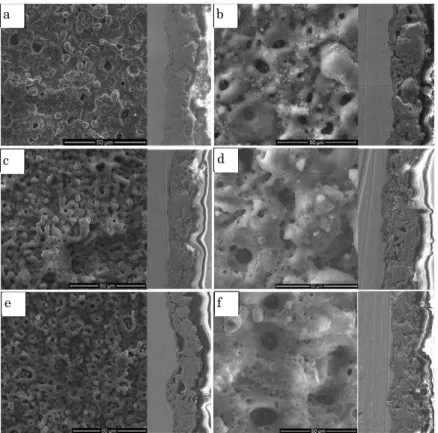
Fig. 1 – The surface morphology and structure of the cross section of MAO coatings: a) VT1-0 microporous coating, l 10 ± 1 m; b) VT1-0 macroporous coating, l 18 ± 2 m; c) VT6 microporous coating, l 11 ± 2 m; d) VT6 macroporous coating, l 20 ± 7 m; e) Ti-6Al-7Nb microporous coating, l 12 ± 2 m; f) Ti-6Al-7Nb macroporous coating, l 34 ± 7 m
Fig. 2 – XRD patterns of MAO coatings: a) microporous coatings; b) macroporous coatings
a b
c d
INVESTIGATION OF CORROSION BEHAVIOR OF BIOACTIVE COVERINGS… J.NANO-ELECTRON.PHYS. 7, 04081 (2015)
04081-3
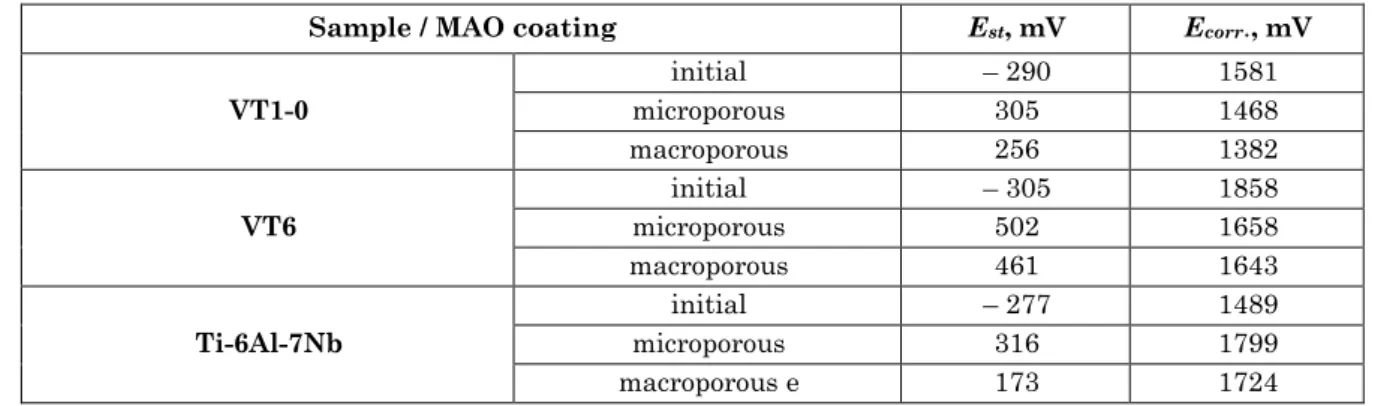
Table 1 – Electrochemical properties of the samples before and after forming of MAO coatings
Sample / MAO coating Est, mV Ecorr., mV
VT1-0
initial – 290 1581
microporous 305 1468
macroporous 256 1382
VT6
initial – 305 1858
microporous 502 1658
macroporous 461 1643
Ti-6Al-7Nb
initial – 277 1489
microporous 316 1799
macroporous е 173 1724
and Ti-6Al-7Nb, respectively.The coating thickness is changed from 10 to 12 m (Fig. 1).The phase composi-tion of the microporous coatings is amorphous and crystalline components, which consists only of titanium oxides (anatase and rutile). The morphology of the surface of macroporous MAO coatings are different from the microporous (Fig. 1), they have a more devel-oped the surface topography and the proportion pores sizes ≥ 5 mm is 29 %, 71 % and 26 % for VT1-0, VT6 and Ti-6Al-7Nb respectively. The arithmetic average roughness Ra increases from 1.4-1.7 m to microporous coatings up to 2,4-5,8 m macroporous coatings.
The XRD patterns of the microporous and macroporous coatings formed of method MAO are shown in Fig. 2. It can be seen in Fig. 2 that the mi-croporous coatings consisted from titanium oxides such as rutile and anatase. The phase composition of the coatings of macroporous also is represented with amor-phous and crystalline phases, including anatase and rutile crystals, and calcium phosphate compounds: tricalcium phosphate (TCP) -Ca3(PO4)2 and calcium deficient hydroxyapatite Ca9HPO4(PO4)5OH (Fig. 2). In the case of macroporous MAO coatings on commercially pure titanium VT1-0 the compounds of calcium phos-phate are presented only α-modification Ca3(PO4)2.In medicine, -Ca3(PO4)2 is used much less frequently than -Ca3(PO4)2 it’s mainly due to its high rate of dissolution, but in recent years there is an increasing number of works, the proposed use of the alpha modifi-cation of TCP, as substances contributing bone remod-eling [4]. Analysis of results of corrosion behavior showed that the formation on the surface MAO coat-ings as mi-croporous so and macroporous adduce to shifts values stationary potential Est in the region of positive values, which indicates about improving corro-sion resistance as compared with untreated samples (Table 1). For samples with a microporous coating typi-cal more positive values stationary otential than for
macroporous coatings due to the fact that the phase composition of the microporous coating contains titani-um oxide TiO2 (rutile and anatase), that is character-ized by high stability and corrosion resistance. It is worth noting the differences in the dependence of change stationary potential on the time for macroporous and microporous coatings. Thus, for the macroporous coatings is characteristically by a de-crease of the stationary potential in the first 20 minutes of testing (Fig. 3), while for the microporous coverings observed in the same period, an increase in the value Est.The difference in the corrosion behavior of the coatings macroporous on commercially pure tita-nium and its alloys are also connected with the differ-ence in the phase composition, so the value of the sta-tionary potential to macroporous coatings on titanium substrates VT1-0 less, than on alloys VT6 and Ti-6Al-7Nb (Table 1). This is due to the absence in its the phase composition of calcium deficient hydroxyapatite which it is more stable compound in comparison with other the calcium phosphate compounds [5].
4. CONCLUSIONS
The structure and phase composition of the coatings of two types: microporous and macroporous inflicted by a method micro-arc oxidation on substrate from com-mercially pure titanium VT1-0 and from titanium al-loys VT6 and Ti-6Al-7Nb were investigated. The phase composition of microporous coatings represented with anatase and rutile, macroporous coatings further com-prises a tricalcium phosphate and a calcium deficient hydroxyapatite. The MAO coatings both microporous and macroporous are contributing to increase the cor-rosion resistance of all titanium alloys studied.
This work was supported by the Ministry of Education and Science of the Russian Federation (project no No 2014/420-330
).
REFERENCES
1. O. Kosiakov, O. Rosenderg, V. Bondar, K. Grebenicov, S. Sohan, N. Ulianchich, J. Orthopaedics, Traumatology and Prosthetics No 4, (2010).
2. T.V. Safronov, V.I. Putlyaev, J. Nanosystems: Phys., Chem., Math.No 4(1), (2013).
3. E.A. Korneeva, A.N. Skomorokhov, Yu.R. Kolobov, G.V. Khramov, I.N. Kuz’menko, V.V. Rakityansky, Com-pos. Nanostructur. No 4, (2011).
4. Ather Farooq Khan, Muhammad Saleem, Adeel Afzal, Asghar Ali, Afsar Khan, Abdur Rahman Khan,Mater. Sci.
Eng. C 35, 245 (2014).
5. Biocomposites on based of calcium-phosphate coatings,