Abstract—The average downlink bandwidth of GPRS is about 25Kbps, while the bit-rate of typical streaming media is at least 100Kbps. It is an exigent job for GPRS business system to decrease bit-rate of streaming media. In this paper we propose a novel scheme, which can select decoding parameters (based on the special attribute of different kinds of streaming media program) automatically to fit the bandwidth of GPRS. Our designation is promised to provide preferable visual quality for streaming media running on GPRS networks. Some practice results are also proposed in this paper.
Index Terms—GPRS, H.264, Mobile-streaming media,
I. INTRODUCTION
Experience has shown that most data communication applications do not require continuous data transfer. Users may need to be connected to a data communication network, but it does not mean that they are sending and receiving data at all time. The requirements of data transferring are not generally balanced. In the majority of cases, users tend to sending small messages and receiving large downloading data. Therefore, most of the data transfer is unidirectional.
On the other hand, packet based GPRS does not set up a continuous channel from a portable terminal for transmission and reception data, in stead, it transmits and receives data in packets. It makes very efficient use of
Wang hongtao is the vice general manager of data department in Hunan Mobile Communications Corp. He holds a MB degree in Communication technology from South-China University of Technology in 1998.E-Mail: [email protected]
Shen Qing received a BS degree in electronic instrument from Changcun Geologic Institute. He was a professor in the Institute of Computer Science at National University of Defense Technology, China. Now he is the first technical consultant of Hunan Talkweb Information System corp. E-Mail:[email protected]
Xiang Liseng is a vice technical supervisor in Hunan Talkweb Information System corp. He received a BS degree in computer
science from Hunan University in 1996. E-Mail:
channel resource. And users pay only for the volume of data sent and received, which is more cost-effective.
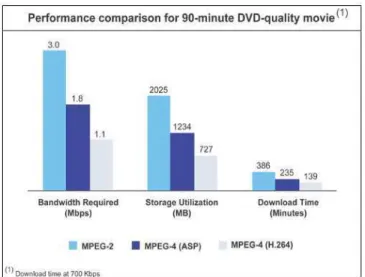
Generally, the bandwidth requirement of MTV video is 3.0 Mbps in Mpeg-2 and 1.1Mbps in H.264/AVC (fig 1) at most. Technically, GPRS may provide more than 100Kbps bandwidth (four times greater than conventional GSM systems). But in practice, the average downlink bandwidth only 25Kbps almost, which is too narrow for streaming media to run smoothly on a business GPRS system. In this paper we propose a novel scheme to solve this exigent job.
Fig 1 Bandwidth, storage and download time needs for different standard
The characteristic of our scheme includes:
(1) Audio first, to prove a fluent speech, music and song.
(2) Select a more efficient video-coding standard, which is H.264/AVC (fig 1).
(3) Decoding parameters are changed automatically according to the original attribute of different media sources.
A Scheme to Decrease Bit-rate of Streaming
Media for GPRS
Wang hongtao1, Shen Qing2, Xiang Liseng2
1 Hunan Mobile Communications Corp. 2 Talkweb Information System Corp.,
IAENG International Journal of Computer Science, 33:1, IJCS_33_1_21
______________________________________________________________________________________
II. PUT THE SCHEME ABOVE INTO PRACTICE
Decoding parameters in H.264
As we known, context-adaptive variable length coding (CAVLC) scheme is used in H.264 and get a lot of advantages:
1. After prediction, transformation and quantization, blocks are typically sparse (containing mostly zeros). CAVLC uses run-level coding to compactly represent strings of zeros.
2. The highest non-zero coefficients after the zig-zag scan are often sequences of +/-1. CAVLC signals the number of high-frequency +/-1 coefficients ("Trailing 1s" or "T1s") in a compact way.
3. The number of non-zero coefficients in neighboring blocks is correlated. The number of coefficients is encoded using a look-up table; the choice of look-up table depends on the number of non-zero coefficients in neighboring blocks.
4. The level (magnitude) of non-zero coefficients tends to be higher at the start of the reordered array (near the DC coefficient) and lower towards the higher frequencies. CAVLC takes advantage of this by adapting the choice of VLC look-up table for the "level" parameter (threshold) depending on recently coded level magnitudes.
In practice, the "level" parameter is threshold and influences the quality of encoded movies seriously. A higher "level" may loss more higher frequencies and loss more quality (more mosaic) but in lower bit-rate; Contrarily, lower "level" may loss less higher frequencies and in higher quality, of course in higher bit-rate. In this paper we take a briefly name "factor" to "level" parameter. That means: I factor is the threshold for I frame, P factor for P frame and IP factor for I and P frame together.
B. Relationship between IP factor and quality (effect in view)
As mentioned above, IP factors are important parameters for H.264 encoding. We'd like to know how large a factor might lead to quality loss to an unacceptable level. In this paper, we consider the subjective visual effect is the main quality meteyard for streaming media.
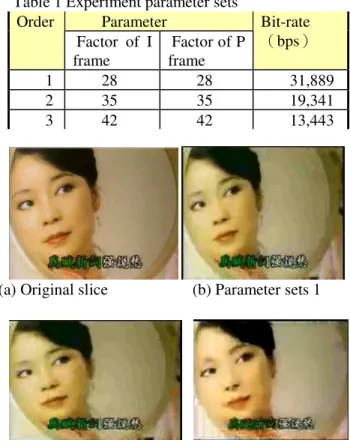
In order to get a clear result, we select pictures having a large face and having strongly changes on edges. Fig 2 shows the results of the same MTV slice in different IP factor. In which, fig 2(a) is the original slice, and fig 2(d) is the worst one. Taking a careful look at fig 2(d), you can see the left eyebrow of the star is lost. Compare fig 2(b) to
fig 2(c), the loss on left eyebrow is trivial. Fig 2(c) is still acceptable and has a smaller bit-rate (only 19Kbps).
Table 1 Experiment parameter sets Parameter
Order
Factor of I frame
Factor of P frame
Bit-rate bps
1 28 28 31,889
2 35 35 19,341
3 42 42 13,443
(a) Original slice (b) Parameter sets 1
(c) Parameter sets 2 (d) Parameter sets 3
Fig2 Different results of different parameter sets
The experiment result shows in fig 3. We found that when IP factor changes from 14 to 30, bit-rate decreases rapidly (blue line in fork mark) and the effect in view decreases slowly (black line in square mark). If the IP factor increases further, the bit-rate decreases slowly (with fork mark) but the effect in view deteriorated rapidly (with square mark).
I/P factor effect in
view
C. Relationship between frame rate and quality
For the analysis the inference of frame rate to video fluency and clearness, we select same MTV in same parameters (audio bit-rate, video size, IP factor, Interval of I frames, etc.) but in different frame rate.
(1) Audio bit-rate. AMR WB6.6Kbps single channel gets a good result; G722 8Kbps is better than AMR WB6.6K and gets a fluently result, so it is selected as constant parameter.
(2) Video size. Here are two video size: QCIF (176*144) and SQCIF (128*96). The latter is smaller but still has an acceptable view size, so it is selected as constant parameter.
(3) Interval of I frames (Interval between neighboring I frames). There is a small difference between Interval 12 and 6. The latter one is better, so it is selected as constant parameter.
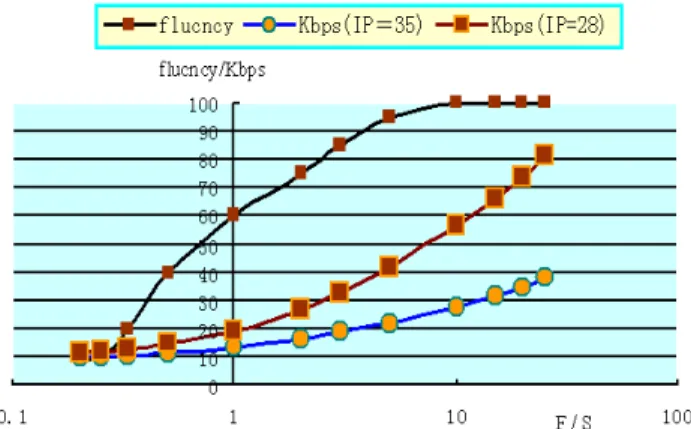
(4) IP factor. 28 and 35 are selected as to compare. From fig 4 we can see:
(1) When frame rate is small, the bit-rate and fluency increasing linearly with frame rate. But when frame rate reach 5 or more, the fluency increasing small but bit-rate increasing quickly. So we see, increase frame rate when it tills a meaningful value, continue to increase frame rate only has little value for GPRS.
(2) Compare with blue line (circular mark) with brown line (square mark), we can see the bit-rate increasing faster than IP factor is 35.
(3) There is less mosaic when IP factor is 28 than 35, similar as fig 3.
Fig 4 Relationship between IP factor and fluency (also bit-rate)
D. Relationship between frame size and quality
When frame rate is 2f/s (3f/s or more) and IP factor is 28: (1) If frame size changes from 176*144 (QCIF) to 128*96 (SQCIF), bit-rate decreasing quickly; (2) If Interval of I frames changes from 6 to 12, bit-rate decreasing slowly; (3) If audio changes from 8Kbps to
6.8 Kbps, bit-rate decreasing lesser, but quality loss larger.
III. CONCLUSIONS
From the work above, we get a set of useful parameter for the reducing bit-rate of streaming media coding and get an acceptable quality. We'd like to share them for you as in table 2:
Table 2 a useful parameter set
Common parameters The Interval between
frame I=6, I/P factor=28~35 In the cost of loosing
video, the materials which are interested at audio mainly, such as news, medical advertisement, etc.,
SQCIF,
Frame rate=1~3f/s, Audio bit-rate=16Kbps, I/P factor may somewhat lager
In the cost of loosing audio, the materials which are interested at video mainly, such as football match, fashion show, etc.,
QCIF,
Frame rate=2~4f/s, Audio bit-rate=8Kbps, I/P factor may somewhat smaller
Under the parameter set above, we get results below: (1) MTV bit-rate: average at 26Kbps, (27% (at SQCIF, Frame rate=2f/s, Audio bit-rate=8Kbps,IP factor =35),
(2) Compare bit-rate between different materials: flash: medical advertisement: news: MTV: fashion show=1.5: 2.2:2.5:2.8:3.3
ACKNOWLEDGMENT
This project was supported by Hunan Mobile Communications Corp. No: HMC-200410.
REFERENCES
1. ITU-T Rec. H.264 / ISO/IEC 11496-10, "Advanced Video Coding", Final Committee Draft, Document JVT-E022, September 2002