USING CREDIT SCORING METHOD FOR PROBABILITY
OF NON-FINANCIAL COMPANIES DEFAULT
ESTIMATION AT INDUSTRY LEVEL
Prof. Ioan TRENCA, PhD
Assist. Annamária BENYOVSZKI, PhD Student „Babeş-Bolyai” University, Cluj-Napoca
Introduction
The credit scoring models are multivariate models which use the main economic and financial indicators of a company as input, attributing a weight to each of them, that reflects its relative importance in forecasting default. The result is an index expressed as a numerical score, which indirectly measures the borrower’s probability of default (Resti, A. & Sironi, A., 2007:287). These models were applied with success in credit institutions.
Despite the techniques underlying credit scoring models were devised in the’30s, in the articles by Fischer, R. A. (1936) and Durand, D. (1941), these models were developed further in the ’60s in papers by Beaver, W. (1967) and Altman, E. I. (1968). Beaver, W. (1967) using a sample of 158 companies (79 non-defaulted companies, 79 defaulted companies) analyzed the predictive power of 14 indicators to classify companies in two categories (defaulted and non-defaulted), using the univariate discriminant analysis. Altman, E. I. (1968) developed a multiple discriminant analysis method on a sample of 66 companies (33 non-defaulted and 33 non-defaulted companies) with 5 financial ratios for the 1946-1965 period.
The multiple discriminant analysis have been used by many other authors to estimate the probability of default, as Deakin, E. (1972), Edmister, R. (1972), Blum, M. (1974), Taffler, R. J. & Tisshaw, H. (1977), Altman, E. I. et al. (1977),
Bilderbeek, J. (1979), Micha, B. (1984), Lussier, R. N. (1995), Altman, E. I. (2005). In most of these studies the two hypothesis of the analysis were violated: the explanatory variables follow a multivariate normal distribution and the variance and covariance matrices of the independent variables are equal for the two groups of companies.
In the ’80, the use of logistic regression became more and more popular. It was used for the first time by Ohlson, J. (1980) being the first to use logistic regression 1 for bankruptcy prediction on a sample of 105 defaulted and 2,058 non-defaulted companies in the 1970-1976 period. In literature have been published a considerable number of articles using the logit regression to estimate the probability of default, as Zavgren, C. V. (1983), Grentry, J. A. et al. (1985), Keasy, K. & Watson, R. (1985), Mensah, Y. M. (1984), Platt, H. D. & Platt, M. B. (1990), Mossman, C. E. et al. (1998), Lizal, L. (2002), Becchetti, L. & Sierra, J. (2003). Zmijewski, M. E. (1984)2 was the first author who used the probit regression. .
In the ’80s the recursive partitioning algorithm was begun to be used (Frydman, H. et al., 1985). The artificial intelligence models appeared beginning
1
The logit model doesn’t need to fulfill the conditions of the discriminant analysis and allows the use of disproportional samples.
from the ’90s: neural networks3 and genetic algorithms4.
1. The Logit Regression
This type of regression estimates the discrete values (type 0-1, non-defaulted or defaulted company), which result in a continuous and limited5 measure, which can be interpreted as the probability of a client belonging to a category or the other on the basis of the explanatory variable Xi beingcharacterized by.The estimated probability is given by the formula:
) (
1
Xe
p
p
,where X is the array of the explanatory variables, β represents the regression coefficients array and p is the probability of default (Bhatia, M., 2006:97).
The logit regression has the following formula: ) (
1
1
)
1
(
Xe
Y
P
.
A consequence of the function above is that the variation impact of an explanatory variable Xi, as well as the impact of β coefficients on p, is the maximum on the average level of the explanatory variables and which corresponds to the 0.5 probability and tends to be 0 at the extreme values of the parameters.
The logit model estimation has to be done using the maximum likelihood method, in which the explanatory variable is binomial distributed and the distribution of βX is logistic.
2. Data Used in the Model
The sample of data used for the non-financial companies’ probability of default estimation consists of 224,314
3 Neural networks were applied by Bell, T. et al. (1990), Kira, D. S. et al. (1997).
4 Genetic algorithms were applied by Varetto, F. M. (1998), Shin, K. S. & Lee, Y. J. (2002).
5 For instance, in the (0,1) range.
companies in Romania. Estimating the models we used the financial statements data of the companies6 for the 2006 year. These data are published by the Ministry of Public Finance7.
The sample consists of companies which have presented their financial statements in 20068 9, 222,551 non-defaulted firms and 1,763 firms, of which 970 were already defaulted in 2007, and 793 only in 2008. We investigated the status of each company in the database of The National Trade Register Office, RECOM online10. In order to estimate probability of default models at industry level, companies are grouped in the following categories, according to their domain of activity: agriculture11, trade12, constructions, industry 13 , transport, storage and communications and other services14.
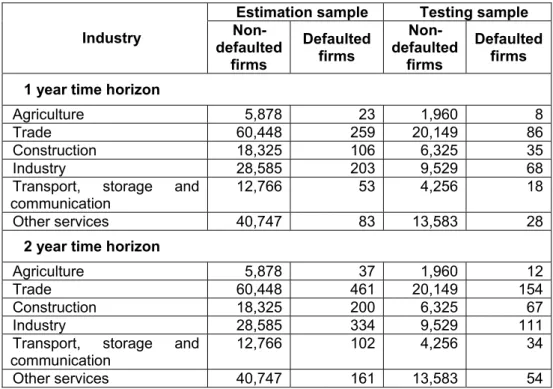
The sample is randomly divided in each industry, in two subsamples: estimating and testing samples. The estimation sample contains 75% of observations (both in case of non-defaulted and non-defaulted companies) and
6
A validation requirement of a probability of default estimation model is that the source of data has to be public annual documents.
7
http://www.mfinante.ro/contribuabili/link.jsp?body=/c ontribuabili/pjuridice.htm
8
Financial companies are not included.
9 Firms existed with anomalies in their financial statements In the initial database. Companies were excluded if any of the following conditions were fulfilled:: total assets ≤ 0, turnover ≤ 0, total costs ≤ 0, total income ≤ 0, common equity ≤ 0. Firms without debts were not included as well.
10 http://recom.onrc.ro
11 Companies in the following industries: agriculture, hunting, sylviculture and fishery.
12 Companies in the following industries: wholesale and retail, car, motorcycle and household goods repairing activities.
13 Companies in the following industries: extractive industry, manufacturing.
the testing sample contains 25% of the observations. The structure of the data
used in the models can be followed in the table presented below.
Table 1: Data structure
Estimation sample Testing sample
Industry Non-defaulted
firms
Defaulted firms
Non-defaulted
firms
Defaulted firms
1 year time horizon
Agriculture 5,878 23 1,960 8
Trade 60,448 259 20,149 86
Construction 18,325 106 6,325 35
Industry 28,585 203 9,529 68
Transport, storage and communication
12,766 53 4,256 18
Other services 40,747 83 13,583 28
2 year time horizon
Agriculture 5,878 37 1,960 12
Trade 60,448 461 20,149 154
Construction 18,325 200 6,325 67
Industry 28,585 334 9,529 111
Transport, storage and communication
12,766 102 4,256 34
Other services 40,747 161 13,583 54
According to Insolvency Law no. 85/200615, the insolvency is such state of a debtor’s private that is characterized by a shortage of available funds for the payment of debts falling. The initiation of bankruptcy procedures based on a state of “imminent insolvency” appears to be available only to the debtor itself.
3. Explanatory Variables of the Models
The data taken in account in credit scoring models shouldn’t have an exclusive accounting character, but it has to deal with all important pertinent elements. The retained variables (for company portfolios) at the beginning of the selection procedure should cover at least the classic set of the criteria used in
15 The Insolvency Law was published in Official Gazette no. 359/21.04.2006.
client analysis and should particularly include: the past and future capacity to generate liquidity, equity structure, evolution of the financial results, information quality, level of indebtedness, sensitivity on the demand, ease of access to financial markets, management, competitiveness, sensitivity on country risk.
Table 2: Explanatory variables used in estimation of the models
Notation Name Definition Empirical support
ROA Return on Assets
Assets Total
Profit
Net Becchetti, L. & Sierra, J. (2003), Arshad, K. (1985)
ROE Return on Equity
Equity Profit
Net Pompe, P. &
Bilderbeek, J. (2005), Arshad, K. (1985)
Indat1 Indebtedness Rate1
Equity Debt
Total Laitinen, E. & Laitinen, T. (2000), Chi, L. & Tang, T. (2006),
Indat2 Indebtedness Rate 2
Assets Total
Debt
Total Beaver, W. (1966);
Laitinen, E. & Laitinen, T. (2000) CoefCS Leverage
Equity s ' Sharholder
Assets Total
RataCpr Rate of Private Equity
Assets Total
Equity
Private Cielien, A. et al.
(2004) RotAC Current Assets Turnover
Rate Current Assets
Sales
IncasCreante Average Collection Period 360 Sales
s Receivable
RotStocuri Inventories Turnover Rate
s Inventorie
Sales Beaver, W. (1966);
Young, R. & Yue, W. T. (2005),
RotAt Assets Turnover Rate
Assets
Total
Sales
Altman, E. (1968),Raghupathi, W. et al. (1991)
MarjaPrB Gross Profit Margin
Sales
Profit
Gross
Cielien, A. et al.(2004); Kim, H. & Gu, Z. (2006)
MarjaPrN Net Profit Margin
Sales
Profit
Net
Beaver, W. (1966),Kim, H. & Gu, Z. (2006)
RotCpr Equity Turnover Rate
Equity
Private
Sales
Cielien, A. et al.(2004), Pompe, P. & Bilderbeek, J. (2005)
Disp Cash Share
Assets Current
Cash
The data collection phase is followed by the data preparing phase for the modeling. This phase might be the most complex part of the empirical estimations in case of any unpredicted problems
regarding the observations and/or the variables. The models were estimated using the STATA Data Analysis and Statistical Software.
4. Industry Level Explanations of the results
4.1. Agriculture
In case of agriculture, on one year time horizon, the rate of private equity and the indebtedness rate are the variables retained in the model, such explanatory variables for probability of
default. The statistical analysis indicates that other variables have an insignificant informational contribution for the explanation of the probability of default.
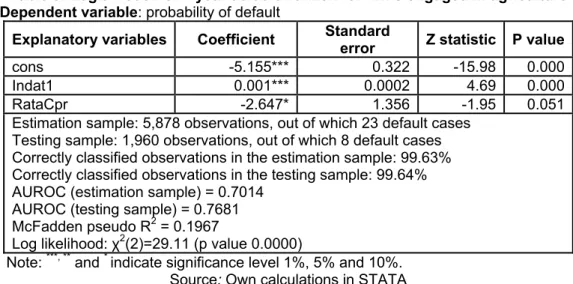
Using the two mentioned criteria for logit function estimation, the result we obtained on the estimation sample will be the one indicated below.
Table3:Logit model for 1 year default horizon for firms engaged in agriculture Dependent variable: probability of default
Explanatory variables Coefficient Standard
error Z statistic P value
cons -5.155*** 0.322 -15.98 0.000
Indat1 0.001*** 0.0002 4.69 0.000
RataCpr -2.647* 1.356 -1.95 0.051
Estimation sample: 5,878 observations, out of which 23 default cases Testing sample: 1,960 observations, out of which 8 default cases Correctly classified observations in the estimation sample: 99.63% Correctly classified observations in the testing sample: 99.64% AUROC (estimation sample) = 0.7014
AUROC (testing sample) = 0.7681 McFadden pseudo R2 = 0.1967
Log likelihood: χ2(2)=29.11 (p value 0.0000)
Note: ***, ** and * indicate significance level 1%, 5% and 10%. Source: Own calculations in STATA The values of the statistical tests
done on the estimation survey level reveals that the models obtained are econometrically confirmed, with statistically significant coefficients16 . The rate of private equity and the indebtedness rate have their signs according to the economical theory. The probability of default is negatively influenced by the rate of private equity, meanwhile the indebtedness rate influences in positive way17. The general explanatory power of the model is good,
16The statistical relevance of the selected criteria is also evidenced by the substantial values of the Z statistics associated with coefficients of the estimated multivariate coefficients.
17 The plus sign attached to a variable indicates an increase of the variable if the other factors remain unchanged, leading to an increase of the probability of default, meanwhile the minus sign shows the opposite influence.
taking in account the McFadden pseudo R2 with 0.196718 value.
We studied the accuracy ratio of the logit model, on the estimation and testing sample. In case we choose a cutoff point of 0.5, 99.63% of the observations are classified correctly in the estimation sample. On the testing sample the share of observations classified correctly is 99.64%.
In order to test the discriminatory power of the model we used the ROC curve and the AUROC19 indicator The results of the evaluation indicate average values of the area under ROC, both for estimation (0.7014) and testing (0.7681) samples.
The results of the estimation on 2 years time horizon are presented in
18 A value between 0.2 and 0.4 is considered a good fit.
19
Appendix 1. The determinants of defaults are: indebtedness rate, rate of private equity and cash rate. All the three variables have the expected sign and are statistically significant. In case of a cutoff point of 0.5, the share of correctly identified observations in both samples is 99.39%.
4.2. Trade
The variables which determine the probability of default on a horizon of one year in trade sector are: return on assets, indebtedness rate, rate of private equity, cash rate and the assets turnover rate. Table 4 presents the results of the estimations.
Table4:Logit model for 1 year default horizon for firms engaged in trade activities
Dependent variable: probability of default
Explanatory variables Coefficient Standard
error Z statistic P value
cons -1.891*** 0.314 -6.01 0.000
ROA -0.783*** 0.265 -2.97 0.003
Indat2 -3.425*** 0.424 -8.06 0.000
RataCpr -5.507*** 0.585 -9.41 0.000
Disp -1.913*** 0.355 -5.39 0.000
RotAt -0.150*** 0.054 -2.78 0.005
Estimation sample: 60,448 observations, out of which 259 default cases Testing sample: 20,149 observations, out of which 86 default cases Correctly classified observations in the estimation sample: 99.57% Correctly classified observations in the testing sample: 99.57% AUROC (estimation sample) = 0.7267
AUROC (testing sample) = 0.7504 McFadden pseudo R2 = 0.2491
Log likelihood: χ2(5) = 164.05 (p value 0.0000) Note: ***indicate significance level 1%
Source: Own calculations in STATA The coefficients are statistically
significant at a significance level of 1%. Except for the indebtedness rate all the variables have the expected sign. The probability of default is influenced in negative way all the five explanatory variables. The general degree of explanation is good taking in account the value of the indicator McFadden pseudo R2 0.2491. At the cutoff point of 0.5, 99.57% of the observations are correctly estimated in both samples. In order to test the discriminatory power of the model, the ROC curve and the AUROC indicator has been used. The results indicate average values of the area under ROC for both samples (0.7267 for the estimation samples and 0.7504 for the testing sample).
We obtained similar results with our analysis made on a 2 years horizon. All the explanatory variables and their signs remain unchanged. The share of correctly identified cases on both the estimation and testing sample are 99.24%. The results of the estimation are presented in the Appendix 2.
4.3. Constructions
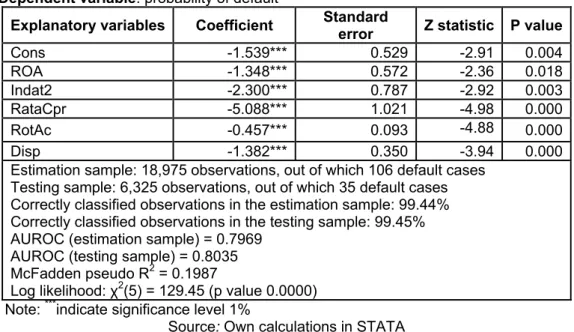
firms in trade. Table 5 presents the results of the estimation on one year
horizon.
Table 5: Logit model for 1 year default horizon for firms engaged in constructions
Dependent variable: probability of default
Explanatory variables Coefficient Standard
error Z statistic P value
Cons -1.539*** 0.529 -2.91 0.004
ROA -1.348*** 0.572 -2.36 0.018
Indat2 -2.300*** 0.787 -2.92 0.003
RataCpr -5.088*** 1.021 -4.98 0.000
RotAc -0.457*** 0.093 -4.88 0.000
Disp -1.382*** 0.350 -3.94 0.000
Estimation sample: 18,975 observations, out of which 106 default cases Testing sample: 6,325 observations, out of which 35 default cases Correctly classified observations in the estimation sample: 99.44% Correctly classified observations in the testing sample: 99.45% AUROC (estimation sample) = 0.7969
AUROC (testing sample) = 0.8035 McFadden pseudo R2 = 0.1987
Log likelihood: χ2(5) = 129.45 (p value 0.0000) Note: ***indicate significance level 1%
Source: Own calculations in STATA
The results of the statistical tests effectuated on the estimation sample denote that the model obtained respects the exigencies of the econometrics. The coefficients are statistically significant at 1% level. The ROA, the rate of private equity, the current assets turnover rate and the cash share have signs according to the economical theory and the indebtedness rate indicates an unexpected sign. The probability of default is negatively influenced by all five variables. The general explanation degree of the model is good, taking in account the value of the indicator McFadden pseudo R2 0.1987.
The high accuracy of the model is ensured by the scoring function in terms of discriminatory power, stability and adequate calibration of the estimations. The discriminatory power test of the sample has been done for both the estimation and testing samples. According to this, the ROC curve and the indicator AUROC have been used. The
area under ROC indicate a high value for both, estimation (0.7969) and testing (0.8035) samples. These values exceed the 0.75 reference value. In addition, the numeric results are strengthened by the form of the ROC curve.
perfect, the scores of all of the default cases would have been smaller than the non-defaulted cases.
4.4. Industry
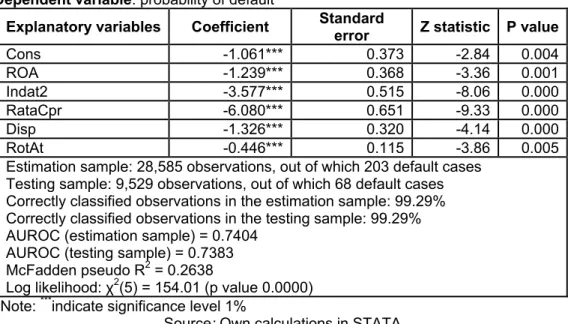
In case of companies in industry the statistically significant explanatory
variables are the return on assets, the indebtedness rate, the rate of private equity, the cash share and the assets turnover rate on both one and two year term. (see Appendix 4.).
Table 6:Results of the logit model estimation on estimation sample, one year horizon (industry)
Dependent variable: probability of default
Explanatory variables Coefficient Standard
error Z statistic P value
Cons -1.061*** 0.373 -2.84 0.004
ROA -1.239*** 0.368 -3.36 0.001
Indat2 -3.577*** 0.515 -8.06 0.000
RataCpr -6.080*** 0.651 -9.33 0.000
Disp -1.326*** 0.320 -4.14 0.000
RotAt -0.446*** 0.115 -3.86 0.005
Estimation sample: 28,585 observations, out of which 203 default cases Testing sample: 9,529 observations, out of which 68 default cases Correctly classified observations in the estimation sample: 99.29% Correctly classified observations in the testing sample: 99.29% AUROC (estimation sample) = 0.7404
AUROC (testing sample) = 0.7383 McFadden pseudo R2 = 0.2638
Log likelihood: χ2(5) = 154.01 (p value 0.0000) Note: ***indicate significance level 1%
Source: Own calculations in STATA
The coefficients of the explanatory variables are statistically significant on 1% level of significance. Except for the indebtedness rate, all the variables have the expected sign. The probability of default is influenced negatively by all the five variables. The general explanatory degree of the model is good taking in account the value of the indicator McFadden pseudo R2 0.2638. At a cutoff point of 0.5, 99.29% of the observations are estimated correctly on both samples on one year horizon and 98.84% on 2 years horizon. Using the ROC curve and the AUROC indicator to test the discriminatory power of the model, the
area under ROC curve indicates average values for both estimation (0.7404) and testing samples (0.7383).
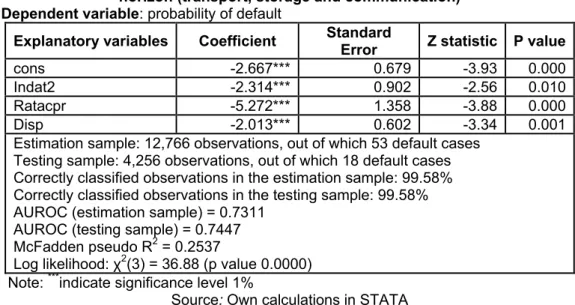
4.5. Transport, Storage and Communications
Table 7:Results of the logit model estimation on estimation sample, one year horizon (transport, storage and communication)
Dependent variable: probability of default
Explanatory variables Coefficient Standard
Error Z statistic P value
cons -2.667*** 0.679 -3.93 0.000
Indat2 -2.314*** 0.902 -2.56 0.010
Ratacpr -5.272*** 1.358 -3.88 0.000
Disp -2.013*** 0.602 -3.34 0.001
Estimation sample: 12,766 observations, out of which 53 default cases Testing sample: 4,256 observations, out of which 18 default cases Correctly classified observations in the estimation sample: 99.58% Correctly classified observations in the testing sample: 99.58% AUROC (estimation sample) = 0.7311
AUROC (testing sample) = 0.7447 McFadden pseudo R2 = 0.2537
Log likelihood: χ2(3) = 36.88 (p value 0.0000) Note: ***indicate significance level 1%
Source: Own calculations in STATA The values obtained as results of the
statistical tests effectuated on the estimation sample denote that the obtained model fulfill the requests for a good econometrical performance. The coefficients are significant at 1% level. The variables private equity rate and cash share have signs in concordance with economical theory, indebtedness rate having a different sign, all the three variables influencing the probability of failure in negative way. The general explanatory degree of the model is good, according to the indicator McFadden pseudo R2 0.2537.
In case of a 0.5 cutoff point the share of correctly identified observations is
99.58% on the estimation and testing sample. The area under the ROC curve is 0.7311 for the estimation sample and 0.7447 for the testing sample, values close to the 0.75 reference level.
4.6. Other Services
Table 8:Results of the logit model estimation on estimation sample, one year horizon (other services)
Dependent variable: probability of default
Explanatory variables Coefficient Standard
Error Z statistic P value
cons -1.919*** 0.490 -3.92 0.000
ROA -0.336*** 0.125 -2.69 0.007
Indat2 -3.999*** 0.679 -5.89 0.000
RataCpr -7.079*** 0.954 -7.42 0.000
Disp -1.920*** 0.383 -5.00 0.000
Estimation sample: 40,747 observations, out of which 83 default cases Testing sample: 13,583 observations, out of which 28 default cases Correctly classified observations in the estimation sample: 99.80% Correctly classified observations in the testing sample: 99.79% AUROC (estimation sample) = 0.7892
AUROC (testing sample) = 0.8122 McFadden pseudo R2 = 0.2782
Log likelihood: χ2(4) = 93.36 (p value 0.0000) Note: ***indicate significance level 1%
Source: Own calculation in STATA The values of the statistical tests
effectuated on the estimation sample emphasize that the model matches the exigencies of the good econometrical performance. Coefficients are significant at 1% level. ROA, private equity rate and cash share have signs in accordance with the economical literature, but indebtedness rate has an unexpected sign. The probability of default is negatively influenced by all the four explanation variables. The general explanation degree of the model is good, according to the McFadden pseudo R2 0.2782.
99.80% of the observations are identified correctly in the estimation sample and 99.79% in case of the testing sample, fact which indicates a high accuracy rate. The high accuracy of the estimations done with the model is ensured by the scoring function performance in terms of discriminatory power, stability and adequate calibration of the estimations.
The area under ROC is higher than the 0.75 reference level in case of both samples (0.7892 for the estimation sample and 0.8122 for the testing sample), the numeric exemplification
being strengthened by the form of the ROC curve as well.
Conclusions
In this paper we used logit models in order to estimate the probabilities of default for Romanian companies. The study was elaborated with the use of a sample containing 222,551 non-default non-financial companies having their financial statements in 2006 and 1,763 default companies, among which 970 defaulted in 2007, and 793 in 2008. For the estimation of our models we used data from the 2006 balance sheet and financial results of the companies. The influence of 14 indicators has been studied on one and 2 years horizon.
Variables influencing significantly the probabilities of default of the companies by industry are the following:
- Agriculture: on one year horizon private equity rate, indebtedness rate, on 2 years time horizon the two variables being completed with the cash rate.
- Constructions: ROA, indebtedness rate, private equity rate, current assets turnover and cash rate influencing the probability of default on both one and two years term.
- Transport, storage and
communications: indebtedness rate,
private equity rate and cash rate are the variables influencing the probability of default on one and two year horizon.
- Other services: on one and two years horizon the influence factors are the ROA, the indebtedness rate, the private equity rate and the cash rate.
REFERENCES
Altman, E. I. “An emerging market credit scoring system for corporate bonds”, Emerging Market Review, 2005, nr. 6, pg. 311-323;
Becchetti, L. & Sierra, J.
“Bankruptcy Risk and Productive Efficiency in Manufacturing Firms”, Journal of Banking and Finance, 2003, vol. 27(11), pg. 2099-2120;
Bhatia, M. Credit Risk Management & Basel II, An Implementation Guide, Risk Books, London, 2006;
Lizal, L. “Determinants of financial distress: what drives bankruptcy in a transition economy? The Czech Republic case.”, Wiliam Davidson Working Paper nr. 451, 2002, pg. 1-45;
Moinescu, B. Sistem de previziune a evenimentelor de deteriorare a ratingului CAAMPL, Caiete de studii, Nr. 23, BNR, 2007;
Resti, A. & Sironi, A.
Risk Management and Shareholders’ Value in Banking, John Wiley & Sons, Chichester, 2007;
***** Legea nr. 85/2006 privind procedura insolvenţei, apărută în Monitorul Oficial al României, Partea I, nr. 359 la data de 21 aprilie 2006; ***** http://www.mfinante.ro/contribuabili/link.jsp?body=/contribuabili/pjuridi
ce.htm;
Appindex 1. Logit model for 2 year default horizon for firms engaged
in agriculture
Dependent variable: probability of default
Explanatory variables Coefficient Standard
error Z statistic P value
cons -4.406*** 0.268 -16.44 0.000
Indat1 0.001*** 0.0002 4.50 0.000
RataCpr -1.847*** 0.990 -1.86 0.062
Disp -2.186*** 0.998 -2.19 0.029
Estimation sample: 5,878observations, out of which 37 default cases Testing sample: 1,960 observations, out of which 12 default cases Correctly classified observations in the estimation sample: 99.39% Correctly classified observations in the testing sample: 99.39% AUROC (estimation sample) = 0.6859
AUROC (testing sample) = 0.6828 McFadden pseudo R2 = 0.1741
Log likelihood: χ2(3)=33.25 (p value 0.0000) Note: ***indicate significance level 1%
Source: Own calculations in STATA
Appindex 2. Logit model for 2 year default horizon for firms engaged
in trade activities
Dependent variable: probability of default
Explanatory variables Coefficient Standard
error Z statistic P value
cons -1.579*** 0.242 -6.51 0.000
ROA -0.729*** 0.226 -3.22 0.001
Indat2 -3.256*** 0.323 -10.06 0.000
RataCpr -5.605*** 0.446 -12.55 0.000
Disp -1.090*** 0.232 -4.69 0.000
RotAt -0.113*** 0.037 -3.01 0.003
Estimation sample: 60,448 observations, out of which 461 default cases Testing sample: 20,149 observations, out of which 154 default cases Correctly classified observations in the estimation sample: 99.24% Correctly classified observations in the testing sample: 99.24% AUROC (estimation sample) = 0.7014
AUROC (testing sample) = 0.6758 McFadden pseudo R2 = 0.2451
Log likelihood: χ2(5)=244.17 (p value 0.0000) Note: ***indicate significance level 1%
Appindex 3. Logit model for 2 year default horizon for firms engaged
in construction
Dependent variable: probability of default
Explanatory variables Coefficient Standard
error Z statistic P value
cons -1.489*** 0.399 -3.73 0.000
ROA -1.154*** 0.431 -2.68 0.007
Indat2 -2.441*** 0.599 -4.07 0.000
RataCpr -5.138*** 0.753 -6.82 0.000
RotAc -0.191*** 0.049 -3.88 0.000
Disp -0.732*** 0.237 -3.08 0.002
Estimation sample: 18,325 observations, out of which 200 default cases Testing sample: 6,325 observations, out of which 67 default cases Correctly classified observations in the estimation sample: 98.95% Correctly classified observations in the testing sample: 98.95% AUROC (estimation sample) = 0.7313
AUROC (testing sample) = 0.6927 McFadden pseudo R2 = 0.2614
Log likelihood: χ2(5)=136.40 (p value 0.0000) Note: ***indicate significance level 1%
Source: Own calculations in STATA
Appindex 4. Logit model for 2 year default horizon for firms engaged
in industry
Dependent variable: probability of default
Explanatory variables Coefficient Standard
error Z statistic P value
cons -1.243*** 0.300 -4.14 0.000
ROA -0.807*** 0.366 -2.20 0.028
Indat2 -2.691*** 0.403 -6.67 0.000
RataCpr -4.875*** 0.502 -9.70 0.000
Disp -1.345*** 0.256 -5.25 0.000
RotAt -0.445*** 0.090 -4.90 0.000
Estimation sample: 28,585 observations, out of which 334 default cases Testing sample: 9,529 observations, out of which 111 default cases Correctly classified observations in the estimation sample: 98.84% Correctly classified observations in the testing sample: 98.84% AUROC (estimation sample) = 0.7205
AUROC (testing sample) = 0.7551 McFadden pseudo R2 = 0.2519
Log likelihood: χ2(5)=188.96 (p value 0.0000) Note: ***indicate significance level 1%
Appindex 5. Logit model for 2 year default horizon for firms engaged
in transport, storage and communication
Dependent variable: probability of default
Explanatory variables Coefficient Standard
error Z statistic P value
cons -2.826*** 0.490 -5.76 0.000
Indat2 -1.461*** 0.627 -2.33 0.020
RataCpr -4.693*** 0.970 -4.84 0.000
Disp -0.951*** 0.363 -2.62 0.009
Estimation sample: 12,766 observations, out of which 102 default cases Testing sample: 4,256 observations, out of which 34 default cases Correctly classified observations in the estimation sample: 99.20% Correctly classified observations in the testing sample: 99.20% AUROC (estimation sample) = 0.6907
AUROC (testing sample) = 0.7341 McFadden pseudo R2 = 0.2373
Log likelihood: χ2(3)=44.40 (p value 0.0000) Note: ***indicate significance level 1%
Source: Own calculations in STATA
Appindex 6. Logit model for 2 year default horizon for firms engaged in other services
Dependent variable: probability of default
Explanatory variables Coefficient Standard
error Z statistic P value
cons -1.954*** 0.364 -5.36 0.000
ROA -0.329*** 0.103 -3.20 0.001
Indat2 -2.960*** 0.479 -6.18 0.000
Ratacpr -6.758*** 0.705 -9.59 0.000
Disp -1.428*** 0.264 -5.40 0.000
Estimation sample: 40,747 observations, out of which 161 default cases Testing sample: 13,583 observations, out of which 54 default cases Correctly classified observations in the estimation sample: 99.61% Correctly classified observations in the testing sample: 99.60% AUROC (estimation sample) = 0.7693
AUROC (testing sample) = 0.7997 McFadden pseudo R2 = 0.2733
Log likelihood: χ2(4) = 154.19 (p value 0.0000) Note: ***indicate significance level 1%