vol. 39, n. 4, out./dez., 2003
Antimicrobial activity of flavonoids and steroids isolated from two
Chromolaena
species
Silvia Helena Taleb-Contini
1, Marcos José Salvador
1, Evandro Watanabe
2, Izabel Yoko Ito
2,
Dionéia Camilo Rodrigues de Oliveira
2*1Departamento de Química, Faculdade de Filosofia Ciências e Letras de Ribeirão Preto, Universidade de São Paulo, 2 Departamentos de Física e Química e de Análises Clínicas, Toxicológicas e Bromatológicas, Faculdade de Ciências
Farmacêuticas de Ribeirão Preto, Universidade de São Paulo
The crude extracts (dichloromethanic and ethanolic) and some compounds (8 flavonoids and 5 steroids) isolated from Chromolaena squalida (leaves and stems) and Chromolaena hirsuta (leaves and flowers) have been evaluated against 22 strains of microorganisms including bacteria (Gram-positive and Gram-negative) and yeasts. All crude extracts, flavonoids and steroids evaluated have been shown actives, mainly against Gram-positive bacteria.
*Correspondence:
D. C. R. de Oliveira
Departamento de Física e Química Faculdade de Ciências Farmacêuticas de Ribeirão Preto, USP
Av. do Café, s/n
14040-903, Ribeirão Preto - SP, Brasil E mail: [email protected]
Unitermos
• Chromolaena
• Asteraceae • Flavonoids • Steroids
• Antimicrobial activity
INTRODUCTION
Flavonoids are phenolic substances widely distributed in all vascular plants. They are a group of about 4000 naturally compounds known, and have been shown to have contribute to human health through our daily diet. They are ubiquitous in plant foods and drinks such as fruits, vegetables, tea, wine, coffee and beer (Giulia et al., 1999). In a review, discussed by Harborne and Willians (2000), many studies have suggested that flavonoids exhibit antioxidant, anti-inflamatory, antimicrobial, vascular activities and others medicinal properties. Many reports on the antimicrobial activity of flavonoids are available (Baez et al., 1999; Xu, Lee, 2001; Ogundipe et al., 2001). Related studies of antimicrobial activity indicate that crude extracts containing flavonoids, triterpenes and steroids have showed significative activity
against various strains of Staphylococcus aureus,
Streptococcus faecalis and Escherichia coli
(Chattopadhay et al., 2001).
Antibacterial effect against eight strains of Gram-positive and Gram-negative bacteria (Minimum Inhibitory
Concentration (MIC) in the range of 64 to 250 µg/mL) was showed for crude extract of Castanea sativa. The analyse by TLC and HPLC of the active fraction showed the presence of flavonoids rutin, hesperidin, quercetin, apigenin, morin, naringin, galangin and kaempferol. Standards of these flavonoids were assayed against the same bacterial strains, and the highest activity was shown by quercetin, rutin and apigenin (Basile et al., 2000).
Antimicrobial screening of 13 phenolic substances was carried out by diffusion methods against Aspergillus niger, Bacillus subtilis, Candida albicans, Escherichia coli, Micrococcus luteus, Pseudomonas aeruginosa,
Saccharomyces cerevisiae, Staphylococcus nervous and
Staphylococcus epidermidis. The flavonoids flavone, quercetin and naringenin inhibited the growth of these organisms (Rauha et al., 2000).
MATERIAL AND METHODS
General experimental procedure
The IR spectra were obtained on KBr pellets in a
Perkin Elmer model 1420 spectrophotometer. 1H NMR
(300 MHz) and the 13C NMR (75 MHz) spectra were
recorded on a Brucker Avance DPX 300; and the 1H NMR
(400 MHz) and 13C NMR (100 MHz) spectra were
recorded on a Brucker-Avance DPX 400, in CDCl3 and
DMSO-d6 with TMS as internal standard. The UV spectra were obtained in Hitachi U-3501 spectrophotometer. TLC was carried out on Si gel PF-254 (Merck), CC on Si gel 60 (0.063-0.200), (Merck) and CC on Sephadex LH 20 (Sigma, 25-100 µ).
Plant material of Chromolaena squalida
Aerial parts (leaves and stems) of C. squalida (ex E. squalidum) was collected by Prof. Dr. N. P. Lopes in Furnas, a town in the state of Minas Gerais - Brazil, in April 1998, and identified by Prof. Dr. E. E. Schilling (University of Tennessee – Knoxville, TN, USA) and Prof. Dr. H. Robinson (Department of Botany, Smithsonian Institute, Washington D.C., USA). The voucher specimen (NPL 126) was deposited in the Herbarium of the Department of Biology, FFCLRP/USP, Brasil, SPFR 04414.
Extraction and preparation of test solutions
Test solutions were prepared in DMSO/sterile water
(5:95) at 1000 µg/mL for the crude extracts from C.
squalida (leaves and stems) and C. hirsuta (leaves and flowers) and at 500 µg/mL for each isolated compounds (flavonoids and mixture of steroids).
Isolation of compounds from Chromolaena species
Dried and pulverized leaves (73 g) and stems (64 g) of C. squalida were extracted at room temperature with CH2Cl2 and then EtOH, separately, to give the respective crude extracts.
The CH2Cl2 crude extract of leaves Csd1 (3.91 g) and stem Csd2 (0.75 g) were chromatographed over Silica gel 60 (CC), eluting with hexane and gradually increasing the polarity with EtOAc and then MeOH.
From the Csd1 crude extract was extracted the
flavonoid 1 (0.007 g). The crude extract Csd2 furnished the mixture (0.012 g) of steroids stigmasterol 9, β -sitosterol 10, campesterol 11, espinasterol 12, Δ7
-stigmastenol 13.
The EtOH crude extract of leaves Cse1 (2.08 g) was chromatographed on Sephadex LH-20, eluting with MeOH. All collected fractions were monitored by TLC, and the reunited fractions were purified by chromato-graphic process. This extract furnished the flavonoid 2 (0.012 g).
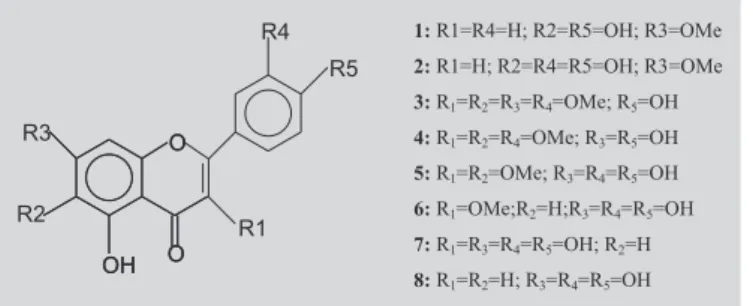
Dichloromethanic and ethanolic crude extracts (leaves and flowers) of C. hirsuta were previously studied (Taleb-Contini, 2002; Taleb-Contini, Oliveira, 2000). It resulted in isolation of the flavonoids 3-8 which were, in this study, evaluated for antimicrobial activity.
The structures of the flavonoids are presented on Figure 1.
Microorganisms strains
Twenty two strains of bacteria (Gram-positive and Gram-negative) and yeasts were used in the antimicrobial assays. The following microorganisms were used:
Escherichia coli - ATCC 10538; E. coli - 26.1 (field
strain); Pseudomonas aeruginosa - ATCC 27853; P.
aeruginosa - Pn (field strain); Micrococcus luteus - ATCC
9341; Staphylococcus aureus - ATCC 25923, 6538 and
29213; S. aureus - 7+ penicillinase producer; S. aureus -8-penicillinase non-producer; Staphylococcus epidermidis
- 6ep (field strains); Candida albicans - ATCC 1023; Candida albicans-cas and Candida tropicalis - ct (field strains), cultivated for 24 hours at 37 °C in Mueller Hinton
broth (Difco)-MHb; Enterococcus faecalis - ATCC
10541; Streptococcus mutans - ATCC 25175; S. mutans
(strains Fab3; 87.1; 203.1; 211.1; 213.1) and
Streptococcus sobrinus - 87.3 (field strains) incubated for 24 hours at 37 °C in Brain Heart Infusion (Difco) - BHI. The standart strains and field strains (oral cavity) were collected from Departamento de Análises Clínicas, Toxicológicas e Bromatológicas, Faculdade de Ciências Farmacêuticas de Ribeirão Preto, Universidade de São Paulo, Ribeirão Preto (SP), Brasil.
Determination of antimicrobial activity
The inoculum size of each test strain was standardized according to the National Committee for Clinical Laboratory Standards (NCCLS, 1993). The test bacterial and yeasts strains were inoculated into Mueller Hinton broth (Difco) - MHb agar plates (Escherichia,
Pseudomonas, Micrococcus, Staphylococcus and
Candida strains) and Brain Heart Infusion (Difco)-BHI
plates (Enterococcus and Streptococcus strains),
containing an inoculum size of 106 cfu/mL (0.5 McFarland
scale).
Antimicrobial activity was performed by the well diffusion method (well technique in double layer) (Cole, 1994; Grove, Randall, 1955).
A volume the 20 µL of each test-drug solution were applied into 5.0 mm diameter wells. After holding the plates at room temperature for 2 hours to allow diffusion of test-drug into the agar, they were incubated at 37 °C for 24 hours and the inhibition zone, corresponding to the halo
(H) formed from well edge to the beginning of the region of microbial growth was measured in millimeters (mm). The MIC was determined in µg/mL for each isolated compound with concentration between 25 and 500 µg/mL (Salvador et al., 2002; Okeke et al., 2001; Okunji et al., 1990). In these tests, bacitracine (0.2 UI/mL), gentamicine discs (10 µg) and ketoconazole (100 µg/mL) were used as experimental positive controls for microorganism strains and DMSO/sterile water (5:95) as negative control for which no inhibitory effect could be observed. The bioassays were performed in duplicate for each strain of microorganism evaluated.
RESULTS AND DISCUSSION
The identities of steroids stigmasterol, β-sitosterol,
campesterol, espinasterol and Δ7-stigmasterol were
confirmed by GC analysis, using authentic samples. The bioactive flavonoids 1 and 2 were caracterized by comparing physical and spectroscopic properties (1H,
TABLE I - Antimicrobial activity of crude extracts of C. squalida (leaves and stem) and C. hirsuta (leaves and flowers)
Microorganisms Csd1 Cse1 Csd2 Cse2 Chd1 Che1 Chd3 Che3 B G K
H H H H H H H H H H H
M. luteus (ATCC 9341)b - - - - - - - - 25 28
-S. aureus (ATCC 6538)b 7 - 8 - 6 9 13 6 23 26
-S. aureus (ATCC 25923)b 6 - 7 - 6 7 10 - 29 28
-S. aureus (ATCC 29213)b 8 - - - 6 8 9 - 29 28
-S. aureus (7+)c 8 7 8 - 6 7 11 7 25 28
-S. aureus (8-)c 8 - 7 - 7 8 13 6 25 26
-S. epidermidis (6ep)c 6 - 6 - 7 7 12 - 31 27
-E. faecalis (ATCC 10541)b - - - - - - 8 - 28 22
-S. mutans (ATCC 25175)b - - - - 6 7 - - 24 23
-S. mutans (Fab3)b - - 6 - 6 8 - - 24 24
-S. mutans (87.1)c 6 6 - - 6 7 7 6 24 20
-S. mutans (203.1)c - - - - 7 7 6 6 22 21
-S. mutans (211.1)c - - - - - - - 6 22 20
-S. mutans (213.1)c - - - - 6 - - - 22 22
-S. sobrinus (87.3)c - - 6 6 - 7 - - 23 24
-E. coli (ATCC 10538)b - - - - - - - - 30 30
-E. coli (26.1)c - - - - - - - - 32 30
-P. aeruginosa (ATCC 27853)b - - - - - - - 22 25
-P. aeruginosa (Pn)c - - - - - - - - 22 24
-C. albicans (ATCC 1023)b - - - - - - - - - - 30
C. albicans (cas)c - - - - - - - - - - 30
C. tropicalis (ct)c - - - - - - - - - - 15
- = absence of inhibition of microbial growth at 1000 mg/mL; H = halo of inhibition (mm); Diluent = DMSO/sterile water (5:95); B = Bacitracine, 0.2 UI/mL; G = Gentamicine discs, 10 mg; K = Ketoconazole, 100 mg/mL; Csd1 = C. squalida
dichloromethanic leaves; Csd2 = C. squalida dichloromethanic stem; Cse1 = C. squalida ethanolic leaves; Cse2 = C. squalida
ethanolic stem; Chd1 = C. hirsuta dichloromethanic leaves; Chd3 = C. hirsuta dichloromethanic flowers; Che1= C. hirsuta
13C NMR, IR and UV) spectra, with those reported in the
literature, i.e. 1 (Silva et al., 1977), 2 (Saúl-Escarria et al.,
1977). The spectral date of 1HNMR showed the proton
resonances commoly found in flavonoids and their substituents. Ultraviolet-visible absorption spectroscopy was useful to aid both identification of the flavonoid type and definition of the oxygenation pattern.
All the crude extracts (ethanolic and dichlorome-thanic) from leaves and stems of C. squalida and leaves and flowers from C. hirsuta showed antimicrobial activity,
mainly against Gram-positive (Staphylococcus and
Streptococcus) bacteria, at 1 000 mg/mL (Table I). The evaluated compounds showed actives at least against two indicative strains used (Table II). The flavonoids 6, 7 and 8 were the most bioactives. The mixture of steroids (500 mg/mL) showed to be active mainly against Streptococcus mutans and S. sobrinus
strains, however with very limited activity. The flavonoids 1 and 2 were active against S. aureus (ATCC 6538 and
ATCC 29213), S. sobrinus (87.3) and Enterococcus
faecalis (ATCC-10541) strains.
From all test-drug only the flavonoid 7 showed
activity against the Gram-negative (Escherichia coli and
Pseudomonas aeruginosa) bacteria and yeast (Candida albicans and C. tropicalis).
The results reveal that the most bioactive flavonoids are those that have dyhydroxy groups at C3’ and C4’ positions, a hydroxy substituent at position C7, and the position C6 unsubstituted.
The structure-activity relantionships become very interesting when we compare the structures of flavonoids 6, 7 and 8. They all have a group hydroxy at positions C7, C3’ and C4’, but only the flavonoid 7 (that exhibited activity against Gram-negative bacteria and yeast) has a hydroxy group at C3 position. The flavonoids 1 and 2 that show the same substitution pattern of A ring and the C3 unsubstituted, were found to be active against the same bacterial strains, problaby acting by the same mechanism of action. However, it is necessary to make profound studies to better understand the mechanism of action of these evaluated substances.
CONCLUSION
Ethanolic and dichloromethanic crude extracts from leaves and stems of C. squalida and leaves and flowers from
TABLE II - Antimicrobial activity of compounds isolated from C. squalida and C. hirsuta
Microorganisms Evaluated material MIC (µg/mL)
1 2 3 4 5 6 7 8 9-13
M. luteus (ATCC 9341)b - - 100 500 50 - 500 -
-S. aureus (ATCC 6538)b 100 500 - 500 500 100 100 500
-S. aureus (ATCC 25923)b - 500 - - 500 - 100 100
-S. aureus (ATCC 29213)b 100 500 100 - - 100 100 -
-S. aureus (7+)c - - 500 - - 500 100 500 500
S. aureus (8-)c - - - - - 100 100 -
-S. epidermidis (6ep)c 500 500 - - - 100 100 -
-E. faecalis (ATCC 10541)b 500 500 - - - 500 100 -
-S. mutans (ATCC 25175)b - - - - - - 500 500 500
S. mutans (Fab3)b - - - - - - 50 -
-S. mutans (87.1)c - - - - - 100 100 - 500 S. mutans (203.1)c - - - - - 500 - - 500
S. mutans (213.1)c - - - - - 500 100 - -S. mutans (211.1)c - - - - - 500 500 - -S. sobrinus (87.3)c 500 500 - - 500 100 100 500 500 E. coli (ATCC 10538)b - - - - - - 500 500 -E. coli (26.1)c - - - - - - 100 500 -P. aeruginosa (ATCC 27853)b - - - - - - 100 -
-P. aeruginosa (Pn)c - - - - - - 100 -
-C. albicans (ATCC 1023)b - - - - - - 500 -
-C. albicans (cas)c - - - - - - 500 -
-C. tropicalis (ct)c - - - - - - 500 -
-- = absence of inhibition of microbial growth until 500 mg/mL; MIC = Minimum Inhibitory Concentration (mg/mL);
C. hirsuta showed antimicrobial activity, mainly against
Gram-positive (Staphylococcus and Streptococcus)
bacteria.
All the evaluated compounds showed to be bioactive, mainly the flavonoids 6, 7 and 8.
ACKNOWLEDGEMENTS
The authors are grateful to Fundação de Amparo à Pesquisa do Estado de São Paulo (FAPESP), CAPES and CNPq for financial support and FAPESP, for a graduate fellowship to S.H.T.; to Prof. E.E. Schilling and Prof. H. Robinson for plant identification.
RESUMO
Atividade antimicrobiana de flavonóides e esteróides isolados de duas espécies de Chromolaena
Os extratos diclorometânicos e etanólicos de folhas e caule de Chromolaena squalida e de folhas e flores de Chromolaena hirsuta foram avaliados quanto à ativida-de antimicrobiana. Oito flavonóiativida-des e cinco esteróiativida-des fo-ram desafiados frente a 22 cepas indicadoras, incluindo bactérias (Gram-positivas e Gram-negativas) e levedu-ras. Todos os extratos brutos, flavonóides e esteróides en-saiados mostraram atividade antimicrobiana, principal-mente frente a bactérias Gram-positivas.
UNITERMOS: Chromolaena. Asteraceae. Flavonóides. Esteróides. Atividade antimicrobiana.
REFERENCES
BAEZ, D. A.; VALLEJO, L. G. Z.; JIMENEZ-ESTRADA, M. Phytochemical studies on Senna skinneri and Senna wishizeni. Nat. Prod. Lett., Berks, v. 13, p. 223-228, 1999.
BASILE, A.; SORBO, S.; GIORDANO, S.; RICCIARDI, L.; FERRARA, S.; MONTESANO, D.; COBIANCHI, R. C.; VUOTTO, M. L.; FERRARO, L. Antibacterial and allelopathic activity of extract from Castanea sativa
leaves. Fitoterapia, Milano, v. 71, p. 110-116, 2000.
CHATTOPADHYAY, D.; MAITI, K.; KUNDU, A. P.; CHAKRABORTY, M. S.; BHADRA, R.; MAUDAL, S. C.; MAUDAL, A. B. Antimicrobial activity of Alstonia macrophylla: A folklore of bay islands. J. Ethnopharmacol., Lausanne, v. 77, p. 49-55, 2001.
COLE, M. D. Key antifungal, antibacterial and anti-insect assays – a critical rewiew. Biochem. Syst.Ecol., Oxford, v. 22, p.837-856, 1994.
GIULIA, D. C.; NICOLA, M.; ANGELO, A.; FRANCESCO, C. Flavonoids: Old and new aspects of a class of natural therapeutic drugs. Life Sci., Oxford, v. 65, p. 337-353, 1999.
GROVE, D. C.; RANDALL, W. A. Assay methods of
antibiotics: a laboratory manual [Antibiotics monographs, 02]. New York: Medical Encyclopedia Inc., 1955. 80 p.
HARBORNE, J. B.; WILLIANS, C. A. Advances in flavonoid research since 1992. Phytochemistry, Oxford, v. 55, p. 481-504, 2000.
NATIONAL COMMITTEE FOR CLINICAL
LABORATORY STANDARDS. Methods for dilution in
antimicrobial susceptibility tests. Approved standard M2-A5. National Committee for Clinical Laboratory Standard, Villanova, PA, 1993.
OGUNDIPE, O. O.; MOODY, J. O.; HOUGHTON, P. J.; ODELOLA, H. A. Bioactive chemical constituents from
Alchormea laxiflora (benth) pax and hoffman. J. Ethnopharmacol., Lausanne, v. 74, p. 275-280, 2001.
OKEKE, M. J.; IROEGBU, C. U.; EZE, E. N.; OKOLI, A. S.; ESIMONE, C. O. Evaluation of extracts of the root of
Landolphia owerrience for antibacterial activity. J. Ethnopharmacol., Lausanne, v. 78, p. 119-127, 2001.
OKUNJI, C. O.; OKEKE, C. N.; GUGNANI, H. C.; JWU, M. M. Antifungal saponin from fruit pulp of Dracaena manni.
Int.J.Crude Drug Res., Lisse, v. 28, p. 193-199, 1990.
RAUHA, J. P.; REMES, S.; HEINONEN, M.; HOPIA, A.; KAHKONEN, M.; KUYALA, T.; PIHLAYA, K.; VUORELA, H.; VUORELA, P. Antimicrobial effects of Finnish plant extracts containing flavonoids and other
phenolic compounds. Int.J.Food Microbiol.,
Amsterdam, v. 56, p. 3-12, 2000.
SALVADOR, M. J.; FERREIRA, E. O.; PRAL, E. M. F.; ALFIERI, S. C.; ALBUQUERQUE, S.; ITO, I. Y.; DIAS, D. A. Bioactivity of crude extracts and some
constituents of Blutaparon portulacoides
SAÚL-ESCARRIA, R.; TORRENEGRA, R. D.; ANGARITA, B. Colombian plants of the genus
Gnaphalium. Phytochemistry, Oxford, v. 16, p. 1618-1619, 1977.
SILVA, M.; WISENFELD, A.; SAMMES, P.G.; TYLER, T.W. New sesquiterpenes from Pleocarphus Revolutus.
Phytochemistry, Oxford, v. 16, p. 379-385, 1977.
TALEB-CONTINI, S. H. Fitoquímica de duas espécies de
Chromolaena (Eupatorieae-Asteraceae). Ribeirão Preto, 2002. 224p. [Tese (Doutorado em Química). Faculdade de Filosofia, Ciências e Letras de Ribeirão Preto da Universidade de São Paulo].
TALEB-CONTINI, S. H.; OLIVEIRA, D. C. R. Constituintes químicos de Chromolaena hirsuta (Hook. & Arn.) R. King & H. Robinson (Euparorieae-Asteraceae). In: REUNIÃO ANUAL DA SOCIEDADE BRASILEIRA DE QUÍMICA, 23., 2000, Poços de Caldas. Livro de Resumos. São Paulo: SBQ, 2000. v. 2, p. PN-057.
XU, H. X.; LEE, S.F. Activity of plant flavonoids against antibiotic-resistant bacteria. Phytother. Res., London, v. 15, p. 39-43, 2001.