
Gap Symmetry of Superconducting Borocarbide
YNi
2
B
2
C and Skutterudite PrOs
4
Sb
12
H. Won,
1Q. Yuan,
2P. Thalmeier
3, and K. Maki
41
Department of Physics, Hallym University, Chunchon 200-702, South Korea
2
Texas Center for Superconductivity and Advanced Materials, University of Houston Houston TX 77204, USA
3
Max-Planck-Institute for the Chemical Physics of Solids, N ¨othnitzer Str.40, 01187 Dresden, Germany
4
Department of Physics and Astronomy, University of Southern California, Los Angeles, CA 90089-0484, USA
Received on 23 May, 2003.
Within the quasiclassical approximation we have studied the thermodynamics and the thermal conductivity in the vortex state in nodal superconductors (sc). Recent angle dependent magnetothermal conductivity results indicate a gap function∆(k) corresponding to f- wave sc in Sr2RuO4 and d- wave sc in CeCoIn5 and κ
-(ET)2Cu(NCS)2respectively. More recently it is shown that∆(k)in both YNi2B2C and PrOs4Sb12have point
nodes described by hybrid s+g wave gap function.
1
Introduction
The gap symmetry of superconductivity is the central issue since the appearance of many unconventional and/or nodal superconductors in heavy Fermion systems, organic super-conductors, high Tccuprate superconductors, Sr2RuO4and borocarbides YNi2B2C and LuNi2B2C . Following the qua-siclassical approach introduced by Volovik [2] it is possible to calculate both the thermodynamic and transport proper-ties of the vortex state in nodal superconductors.
Especially in quasi 2D systems like high Tc cuprates,
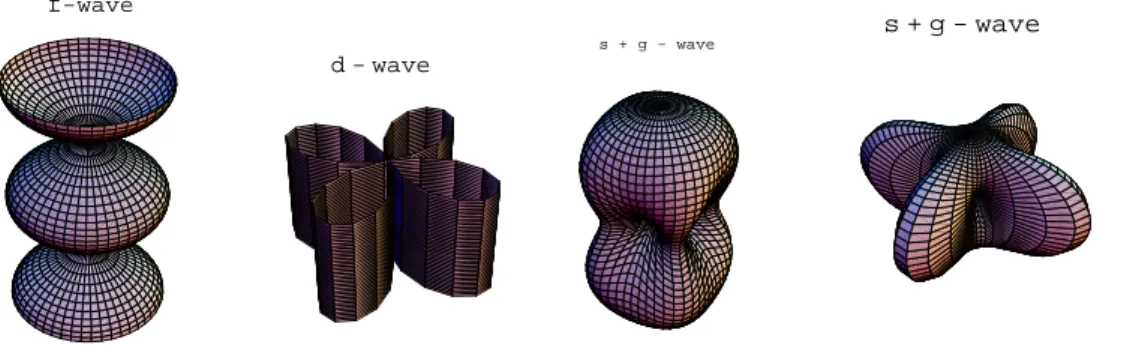
Sr2RuO4 , CeCoIn5 and κ-ET2X with X=Cu(NCS)4, Cu[N(CN)2]Br and Cu[N(CN)2]Cl the thermal conductivity in a magnetic field within the conducting plane provides the crucial insight on the nodal structure of∆(k)[3, 4]. Indeed Izawa et al have shown f-wave sc in Sr2RuO4[5], d-wave sc in CeCoIn5[6] andκ-(ET)2Cu(NCS)2[7] through the angle dependent magnetothermal conductivity. More recently gap functions∆(k) in borocarbide YNi2B2C and skutterudite PrOs4Sb12are shown to have point nodes and described in terms of s+g-wave sc [8-12]. We show|∆(k)|of these su-perconductors in Fig. 1.
f-wave
d - wave
s + g - wave
s + g - wave
Figure 1. Anisotropic gap functions for Sr2RuO4, CeCoIn5, PrOs4Sb12 (A- phase) and YNi2B2C .
2
The Volovik effect
For simplicity we shall consider four examples of nodal
∆(k)in quasi- two dimensional systems;∆(k)=∆f(k) with f = cos(2φ),sin(2φ), e±iφcos(ckz), e±iφcos(c2kz). They are dx2−y2- wave, dxy- wave, f- wave and f’- wave. The
last one is introduced by Zhitomirsky and Rice [13] (i.e. the multigap model) in order to account for the nodal
supercon-ductor seen in Sr2RuO4through the specific heat [14] and the magnetic penetration depth [15]. Indeed all four states have the same quasiparticle density of states as d-wave su-perconductors [16]. As we shall see later, however, the multigap model is incompatible with the angle dependent magnetothermal conductivity observed by Izawa et al [5] and the universal heat conduction inκzzobserved by Suzuki
con-ductivity data are fully consistent with f-wave sc shown in Fig. 1.
In the absence of a magnetic field the quasiparticle den-sity of states (DOS) of these four superconductors is given by [16]
g(x) = N(E)
N0
=
½ 2
πxK(x) forx=
|E| ∆ <1 2
πK(x
−1
) forx >1 (1)
Where N0is the the normal state DOS and K(x) is the complete elliptic integral of the first kind. In particular for |x| ≪1
g(E)≃|E∆| (2) Now in a magnetic field H perpendicular to the conduct-ing plane Eq. (2) is replaced by
g(E, H)≃D|E−∆v·q|E (3) Where v·q is the Doppler shift [18]; with v denoting the Fermi velocity and 2q the pair momentum describing the circulating superflow around vortices. Hereh...imeans av-erage over the Fermi surface and over the unit cell of the vortex lattice. In the present configuration this is readily done [2, 19]
g(0, H) = 4v
πd2∆
Z π2
0
dαcosα
Z d
0 rdr
2r =
2
π v√eH
∆ (4)
where we have assumed a square vortex lattice [20]. Here d=√eH. For a usual triangle lattice Eq. (4) will be multi-plied by a factor
q√
3/2= 0.9306. . Then the specific heat, the spin susceptibility and the superfluid density at low tem-perature (i.e. T≪v√eH ≪∆0) are given by [21]
Cs/γnT = χs/χn=g(0, H)
1−ρs(H)/ρs(H = 0) = g(0, H) (5)
T1−1/T −1
1n = g
2
(0, h)
This√H dependence of the specific heat has been seen in YBCO[22, 23], LSCO[24] and Sr2RuO4[21]. Further the √
H dependence ofχsand the H linear dependence of T−
1 1 have been seen by NMR in a slightly underdoped Bi2212 [25]. Although the above expressions are obtained in the absence of impurity scattering, the Eqs. (4),(5) still hold in the superclean limit where (∆Γ)12 ≪ v√eH withΓ
de-noting the quasiparticle scattering rate in the normal state [3, 4]. There are only two energy scales in this limit, namely v√eH and T. Therefore the thermodynamic functions obey the scaling law as proposed by Simon and Lee [26] and shown for a particular case by K¨ubert and Hirschfeld [19].
The thermal conductivity is treated similarly. In the ab-sence of magnetic fieldκxxexhibits the universal heat
con-duction [27, 28] for all four superconductors.
κxx
T =
2 3π
n
∆m (6)
This is also valid forκzz except for the f’- wave sc of
the multigap model where we have
κzz
T =
16 3 π
Γn
∆2m (7)
Thus for f’- waveκzz depends on the scattering rateΓ
and never reaches the universality limit contrary to [17]. In a magnetic field Hkc we obtain
κxx=
2
π2 v2
(eH)
∆2 (8)
in the superclean limit for all four superconductors. The H linear thermal conductivity has been seen in Sr2RuO4[5].
3
Field angle dependent thermal
con-ductivity
When the magnetic field lies in the a-b plane the Doppler shift generates the quasiparticles in the plane perpendicular to the magnetic field. When the plane cuts the nodal di-rections, there will be strong increase in the quasiparticle density. Therefore the thermal conductivity takes the maxi-mum value when the magnetic field is perpendicular to the nodal directions [3, 4]. In particular in the superclean limit we obtain
κxx
κn
= 2
π
˜
v2(eH)
∆2 Ii(φ) (9)
κxy
κn
= −2
π
˜
v2
(eH)
∆2 Ji(φ) (10)
for i= 1,2,3,4 which corresponds to dx2−y2- wave, dxy
-wave, f- wave and f’- wave superconductors respectively. Here v˜2
= vavc andφ is the azimuthal angle of H with
respect to the a axis. We obtain the following angular func-tions Ii(φ)and Ji(φ):
I1(φ) ≃ 0.912 + 0.05 cos(4φ) I2(φ) ≃ 0.925−0.256 cos(2φ)
−0.042 cos(4φ) (11)
I3(φ) ≃ 1.479−0.128 cos(2φ) I4(φ) ≃ 0.439−0.128 cos(2φ) Ji(φ) ≃ −aisin(2φ)
to identify one of four∆(k)gap functions we have consid-ered sofar.
−90 −45 0 45 90
φ [deg.]
0 0.5 1 1.5 2
Ji
(
φ
) , I
i
(
φ
)
I3
I1
I2
I4
Ji
Figure 2. Angular dependence of thermal conductivitiesκxx(Ii) and thermal Hall coefficientκxy(Ji) according to Eq. (11) for the various 2D gap functions i=1,2,3,4 (dx2
−y2-, dxy-, f- and f’- wave respectively).
In this way∆(k)in Sr2RuO4 [5], CeCoIn5[6] and κ-(ET)2Cu(NCS)2 [7] are identified. On the other hand the φ- dependence ofκxxandκxyin YBCO so far determined
[30, 32, 33] do not match the one for dx2−y2- wave. This
is because in the above analysis we have limited ourselves for T≪ ˜v√eH, while the experiments have been done for T≫˜v√eH[29].
4
Superconductivity in Borocarbides
YNi
2B
2C and LuNi
2B
2C
So far we limit ourselves to the quasi- 2D systems. In 3D systems it is more expedient to consider the thermal con-ductivity as function of both θandφ, which are the polar coordinates defining the field direction. In this respect the superconductivity in YNi2B2C and LuNi2B2C is of great interest in part due to their relatively high transition tem-perature 15.5 K and 16.5 K resepectively [34]. Although the dominance of s-wave component in∆(k)has been es-tablished by substituting Ni by a small amount of Pt and subsequent opening of the energy gap [35, 36], the conductivity exhibits many characteristics of nodal super-conductors like T3 behaviour of T−11 and the
√
H- depen-dence of the specific heat[38]. Due to their tetragonal space groupI4/mmmthe borocarbides have fourfold rotational symmetry within the a-b plane. The simplest∆(k)which satisfies these constraints appears to be s+g-wave supercon-ductor [8, 9]
∆(k) = 1
2∆(1−sin
4
ϑcos(4ϕ)) (12)
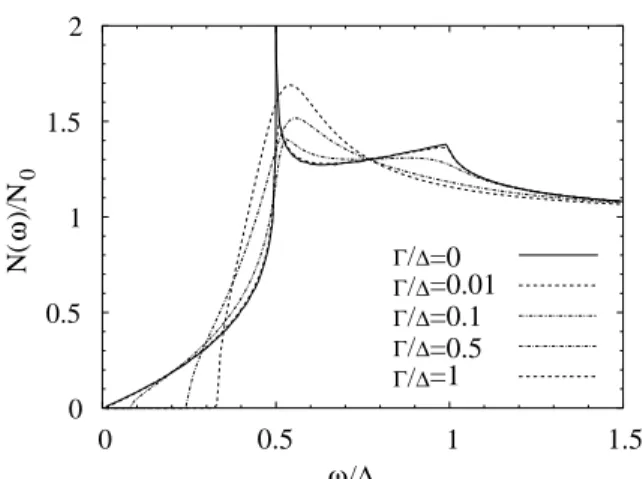
whereϑandϕare polar coordinates describing k. We show the quasiparticle DOS in Fig. 3. For|E|/∆≪1, we obtain
0 0.5 1 1.5 2
0 1
N(
ω
)/N
0
ω/∆ Γ/∆ Γ/∆ Γ/∆ Γ/∆ Γ/∆
=0.01
1.5 =0.1
=0.5 =1 =0
0.5
Figure 3. Normalised quasiparticle DOS for s+g wave gap in pure YNi2B2C (Γ/∆=0 or x = 0) and for various doping induced
nonzeroΓ.
g(E) = N(E)
N0
= π
4
|E|
∆ (13)
Also there are similarity and difference between d-wave superconductors as seen in [39]. In a magnetic field with orientation defined by (θ, φ) the quasiparticle DOS is given by [10]
g(0,H) = ˜v
√ eH
2∆ I(θ, φ)
I(θ, φ) = 1 2 ¡
Is(θ, φ) +Ic(θ, φ)
¢
Is(θ, φ) = (1−sin
2
θsin2φ)12 (14)
Ic(θ, φ) = (1−sin2θcos2φ)
1 2
Then the specific heat, the spin susceptibility and the su-perfluid density for T≪∆0are given by
Cs/γsT = g(0,H)
χs/χN = g(0,H) (15)
1−ρab
s (0,H)/ρabs (0,0) =
3 2g(0,H)
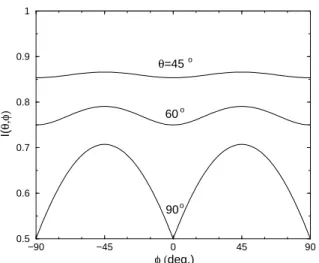
We show in Fig. 4 theφdependence of I(θ, φ)for var-ious polar field anglesθ. In particular for θ = π
2, I(θ, φ) develops cusps atφ=0 and π2 etc. They are a characteristic signature of the point nodes. We note that a recent specific heat measurement on YNi2B2C has excactly found these cusps[40].
−90 −45 0 45 90
φ (deg.)
0.5 0.6 0.7 0.8 0.9 1
I(
θ,φ)
θ=45
60
90 o
o
o
Figure 4. Angular function I(θ, φ) which determinesκzz(θ, φ)for s+g wave gap function in Eq. (18).
˜
ωn = ωn+ Γ
˜
ωn
q ˜
ω2
n+ ( ˜∆−
1 2∆f)
2
®
(16)
˜
∆ = 1
2∆ + Γ
( ˜∆−
1 2∆f)
q ˜
ω2
n+ ( ˜∆−
1 2∆f)
2
®
(17)
where f=12sin 4
ϑcos(4ϕ). Then forω →0, we findω˜ →0
and∆˜ → 1
2∆ + Γ. In other words the energy gap opens up immediately withΓ. The energy gapωg(Γ)visible in Fig. 3
is well approximated byωg(Γ)=Γ/(1 +2Γ∆).
This immediate opening of the energy gap is very dif-ferent from the case of s+d- wave superconductors as dis-cussed in [36]. This has immediate consequences: There are no nodal excitations for T < Γ. In this limit both the specific heat and the thermal conductivity decrease expo-nentially. Also there will be no universal heat conduction [27, 28] in sharp contrast to usual nodal superconductors. From this we expect that also the thermal conductivity in the vortex state of the s+g wave superconductor will be quite different from the case of usual nodal superconductors. It is now given by
κzz
κn
= x
ln¡2
x
¢(1−y
2
)32θ
H(1−y)
κxx
κn
= 3
2 ln¡2
x
¢ ¡x
′
x
¢2 (cos−1
y+y′p 1−y′2
+1 6x(1−y
′2
)32¢θ
H(1−y′) (18)
x = 2
π
˜
v√eH
∆ I(θ, φ) x
′ = 1 π
˜
v√eH
∆ Ic(θ, φ)
y = Γ
∆x y
′= Γ
∆x′
Here θH is the Heaviside step function. Furthermore
κnrefers to the normal state, ˜v = √vavc and we have
as-sumedΓ,T≪˜v√eH ≪∆. In the other limitv˜√eH < Γ
there will be no nodal excitations. We note that first of all the angular dependence ofκzzis given by I(θ, φ) which is
fully confirmed in [8]. The details of the above expressions are different from those given previously [9, 10] due to the
present more realistic treatment of the impurity scattering in the s+g wave case. On the other hand the conclusion that a gapωg≃Γopens immediately for s+g wave order
parame-ter makes it now hard to understand the H linear dependence of thermal conductivity at lowest temperatures reported in [42].
1.00
0.99
0.98
0.97
0.96 κ zz
(
φ
) /
κ zz
(45)
135 90
45 0
−45
φ (degree)
T= 0.8 K
µ0H= 1 T Y(Ni1−xPtx)2B2C x=0.0
x=0.05
Figure 5. Cusp-like fourfold oscillations in κzz(π2, φ) of
YNi2B2C are destroyed by 5% Pt- substitution [43].
As is readily seen from Eq. (18) we predict thatκzz
in-creases like√Hwhile the dominant term inκxxis
indepen-dent of H. Indeed the√H dependence ofκzzis consistent
with the experimental data in [8]. More recently the anglular dependence of the thermal conductivity in a single crystal of Y(Ni1−xPtx)2B2C with x = 0.05 has been studied[43]. It is shown in Fig. 5 in comparison to the pure YNi2B2C (x=0). Clearly no fourfold oscillation inκ(π
2, φ)survives in the 5% Pt- doped compound. From Tc= 13.1 K of the 5% Pt-
sub-stituted crystal and Tc= 15.5 K for YNi2B2C (x=0) we can estimateΓusing
−ln(Tc
Tc0
) = hf
2 i
1 +hfi2[ψ(
1 2+
Γ 2πTc
)−ψ(1
2)] (19)
whereψ(z) is the di-gamma function, f =sin4θcos(4φ)and hf2
i= 0.203. The resultingΓ = 23.8 K>Tc shows that
we are already close to the limit l=~v/˜ Γ ≃ξ0. Clearly the largeΓhas eliminated the nodal excitations. Therefore it is of great interest to study the thermal conductivity of the Pt-substituted crystals with x<0.05. It is also necessary to study theoretically the extremely dilute limit where eventu-ally the gap induced by impurity scattering should become inhomogeneous and a crossover to a new regime should set in.
5
Skutterudite PrOs
4Sb
12a gap∆(k)with planar symmetry in A while one with axial symmetry in B phase (see Fig. 6). Also, the singlet pairing in this system is very likely though not confirmed sofar. In order to describe the angular dependent thermal conductiv-ity we have proposed [12, 11] the hybrid gap functions
H H c2
* 2.0
1.5
1.0
0.5
H
(
T )
2.0 1.5
1.0 0.5
0.0
T ( K )
✁✁ ✁✁ ✁✁
✂✁✂✁✂ ✂✁✂✁✂ ✂✁✂✁✂
✄✁✄✁✄ ✄✁✄✁✄ ✄✁✄✁✄
☎✁☎✁☎ ☎✁☎✁☎ ☎✁☎✁☎
B A
Figure 6. B-T phase diagram of PrOs4Sb12with different nodal
structures of A- and B- phases as obtained fromκzz(θ, φ) depen-dence [11].
(A-phase)∆(k) = ∆(1−k4x−k
4
y)
(B-phase)∆(k) = ∆(1−k4
y) (20)
Where the A- phase again corresponds to a (tetragonal) s+g wave gap. A and B- phases have point nodes in x,y and y directions respectively. We assume here the absence of nodes along the z- direction since they have not been confirmed sofar. Their corresponding quasiparticle DOS is shown in Fig. 7 In zero field these phases exhibit characteris-tics of nodal superconductors like those in YNi2B2C . Again impurity scattering immediately opens a gap. Also as before there is no resonance scattering and universal low tempera-ture heat conduction since it vanishes likeexp(−Γ/T). In the presence of a magnetic field the residual quasiparticle DOS is given by (v=va,c)
0 0.5 1 1.5 2
0 0.5 1 1.5 2 2.5
/∆ E
N(E)/N
0
Figure 7. Quasiparticle DOS for A- phase (full line) and B- phase (dashed line) of PrOs4Sb12.
g(0,H) = 2
π v√eH
∆ Ii(θ, φ) (21)
whith angular functions given by
IA(θ, φ) =
1
2[(1−sin
2 θsin2
φ)12 + (1−sin2θcos2φ) 1 2]
IB(θ, φ) =
1
4(1−sin
2 θsin2
φ)12 (22)
We note that IA(θ, φ) ≡I(θ, φ)given in Eq. (14).
De-spite the different functional form of|∆(k)|these s+g wave sc phases have the same quasiparticle DOS. As discussed in Sect.(4) this expression is valid whenv√eH ≫ Γ. Also the effect of a small Γ may be incorporated by changing v√eHIi(θ, φ) → v
√
eHIi(θ, φ)-Γ. The specific heat etc.
are expressed in terms of g(0,H) as before. Like the residual quasiparticle DOS the thermal conductivityκzz(θ, φ)for the
A- phase is given by the same expression Eq. (18) as for the YNi2B2C s+g- wave gap with I(θ, φ) →Ii(θ, φ)(i=A,B).
Its angular dependence is completely determined by Ii(θ, φ)
and agrees with the experimentally observed fourfold and twofold oscillations observed in the A- and B- phases re-spectively in PrOs4Sb12below T = 0.5 K. However experi-mental results at lower temperatures are highly desirable. At this preliminary stage the microscopic origin of the symme-try breaking into planar and axial symmesymme-try seen in A and B- phases is not yet clear.
6
Concluding remarks
Acknowledgement:
We thank Konomi Kamata, Koichi Izawa and Yuji Matsuda for useful discussions, especially on ongoing experiments on YNi2B2C and PrOs4Sb12 . We thank also K. Kamata to allow us to use her unpublished data of the single crystal Y(Ni1−xPtx)2B2C with x = 0.05.
References
[1] K. Maki and H. Won in Fluctuating Paths and Fields, W. Janke et al (eds.), World Scientific (Singapore 2001) pp 457-473.
[2] G. E. Volovik, JETP Lett. 58, 469(1993)
[3] H. Won and K. Maki, cond-mat/004105
[4] T. Dahm, K. Maki, and H. Won, cond-mat/006301
[5] K. Izawa, H. Takahashi, H. Yamaguchi, Yuji Matsuda, M. Suzuki, T. Sasaki, T. Fukase, Y. Yoshida, R. Settai, and Y. Onuki, Phys. Rev. Lett. 86, (2001) 2653
[6] K. Izawa, H. Yamaguchi, Y. Matsuda, H. Shishido, R. Settai, and Y. Onuki, Phys. Rev. Lett. 87, 57002 (2001)
[7] K. Izawa, H. Yamaguchi, T. Sasaki, and Yuji Matsuda, Phys. Rev. Lett. 88, 27002 (2002)
[8] K. Izawa, K. Kamata, Y. Nakajima, Y. Matsuda, T. Watanabe, M. Nohara, H. Takagi, P. Thalmeier, and K. Maki, Phys Rev. Lett. 89, 137006 (2002)
[9] K. Maki, P. Thalmeier, and H. Won, Phys. Rev. B 65, R140502 (2002)
[10] P. Thalmeier and K. Maki, Acta Physica Pol. B 34, 557 (2003)
[11] K. Izawa, Y. Nakajima, J. Goryo, Y. Matsuda, S. Osaki, H. Sugawara, H. Sato, P. Thalmeier, and K. Maki, Phys. Rev. Lett. 90, 11701 (2003)
[12] K. Maki, W. Won’, P. Thalmeier, Q. Yuan, K. Izawa, and Y. Matsuda, cond-mat/0212090
[13] M. I. Zhitomirsky and T. M. Rice, Phys. Rev. Lett 87 057001 (2001)
[14] S. Nishizaki, Y. Maeno, and Z. Mao J. Phys. Soc. Jpn 69, 572 (2000)
[15] I. Bonalde, B. D. Yanoff, M. B. Salamon, D. J. Van Harlin-gen, and E. M. E. Chia, Phys. Rev. Lett. 85, 4775 (2000).
[16] H. Won and K. Maki, Phys. Rev. B 49, 1397 (1994).
[17] M. Suzuki, M. A. Tanatar, N. Kikugawa, Z. Q. Mao, Y. Maeno, and T. Ishiguro, Phys. Rev. Lett. 88, 227004 (2002).
[18] K. Maki and T. Tsuneto, Prog. Theor. Phys. (Kyoto) 27, 228 (1961).
[19] C. K¨ubert and P.J. Hirschfeld, Sol. State Commun. 105, 459 (1998).
[20] H. Won and K. Maki, Phys. Rev. B 53, 5927 (1996).
[21] H. Won and K. Maki, Europhys. Lett. 54, 248 (2001).
[22] K. A. Moler, D. J. Baar, J. S. Urbach, R. Liang, W. N. Hardy, and A. Kapitulnik, Phys. Rev. Lett. 73, 2744 (1994).
[23] B. Revaz, J.-Y. Genoud, A. Junod, K. Neumaier, A. Erb, and E. Walker Phys. Rev. Lett. 80, 3364 (1998).
[24] S. J. Chen, C. F. Chang, H. L. Tsay, H. D. Yang, and J.-Y. Lin, Phys. Rev. B 58, R14753 (1998).
[25] G. Q. Zheng, W. G. Clark, Y. Kitaoka, K. Asayama, Y. Ko-dama, P. Kuhns, and W. G. Moulton, Phys. Rev. B 60, R9947 (1999).
[26] S. H. Simon and P.A. Lee, Phys. Rev. Lett. 78, 1548 (1997).
[27] P.A. Lee, Phys. Rev. Lett. 71, 1887 (1993).
[28] Y. Sun and K. Maki, Europhys. Lett. 32, 355 (1995).
[29] H. Won and K. Maki, Current Appl. Phys. 1, 291 (2001).
[30] F. Yu, M. B. Salamon, A. J. Leggett, W. C. Lee, and D. M. Ginsberg, Phys. Rev. Lett 74, 5136 (1995).
[31] H. Aubin, K. Behnia, M. Ribault, R. Gagnon, and L. Taillefer Phys. Rev. Lett. 78, 2624 (1997).
[32] R. Oca˜na and P. Esquinazi, Phys. Rev. Lett. 87, 167006 (2001).
[33] R. Oca˜na and P. Esquinazi, Phys. Rev. B 66, 064525 (2002).
[34] P.C. Canfield, P.L. Gammel, and D. J. Bishop, Physics Today
51, 40 (1998).
[35] M. Nohara, M. Issiki, F. Sakai, and H. Takagi, J. Phys. Soc. Jpn 68, 1078 (1999).
[36] L. S. Boukowski and P.J. Hirschfeld, Phys. Rev. B 49, 15404 (1994).
[37] G. Q. Zheng, Y. Wada, K. Hashimoto, Y. Kitaoka, K. Asayama, H. Takeya, and K. Kadowaki, J. Phys. Chem. Solid
59, 2169 (1998).
[38] M. Nohara, M. Isshiki, H. Takagi, and R. Cava, J. Phys. Soc. Jpn. 66, 1888 (1997).
[39] H. Jang, H. Won and K. Maki, cond-mat/0302103.
[40] T. Park, M.B. Salamon, E.M. Choi, H. J. Kim, and S.I. Lee, Phys. Rev. Lett. 90, 177001 (2003).
[41] S. Lee et al, to be published.
[42] E. Boaknin, R. W. Hill, C. Proust, C. Lupien, L. Taillefer, and P.C. Canfield, Phys. Rev. Lett. 23, 237001 (2001).
[43] K. Kamata, Master thesis, University of Tokyo (2003).
[44] E. D. Bauer, N.A. Frederick, P-C Ho, V-S Zapf, and M.B. Maple, Phys. Rev. B 65 R100506 (2002).
[45] R. Vollmer, A. Faißt, C. Pfleiderer, H. v. L ¨ohneysen, E. D. Bauer, P.-C. Ho, and M. B. Maple, Phys. Rev. Lett. 90, 57001 (2003).
![Figure 6. B-T phase diagram of PrOs 4 Sb 12 with different nodal structures of A- and B- phases as obtained from κ zz (θ, φ) depen-dence [11].](https://thumb-eu.123doks.com/thumbv2/123dok_br/18979690.456577/5.892.110.386.183.447/figure-phase-diagram-pros-different-structures-phases-obtained.webp)
