INTERNATIONAL
JOURNAL
OF BIOMEDICINE
doi: 10.21103/Article5(4)_OA7International Journal of Biomedicine 5(4) (2015) 203-206
ORIGINAL ARTICLE
Cardiology
Eff
ectiveness of Personalized Therapy in Elderly Patients with Isolated Systolic
Hypertension
E.A. Kartashova, PhD
1; I.V. Sarvilina, PhD, ScD
21
Rostov-on-Don State Medical University
2Medical Centre “Novomeditsina”
Rostov-on-Don, the Russian Federation
Abstract
The purpose of this study was the development of personalized modes of therapy in elderly patients with isolated systolic hypertension (ISH).
The study included 306 persons divided into two groups: Group 1 (Control) included 150 elderly persons without arterial hypertension (AH), and Group 2 included 256 elderly patients (early old-age pension, between 65 and 74 years) with ISH (ESH/ ESC,2013) according to the inclusion/exclusion criteria. All patients of Group 2 were divided into three subgroups depending on the combination of drugs at the beginning of the study. Group 2a (n=53) received amlodipine (5 mg/day) and indapamide-retard (1.5 mg/day), Group 2b (n=53) received valsartan (80 mg/day) and indapamide-retard (1.5 mg/day), and Group 2c (n=50) received amlodipine (5 mg/day) and valsartan (80 mg/day). The duration of therapy was 5.2 years.
At the stage of data collection and screening, we applied standard methods for identiication of ISH and secondary
hypertension. Molecular phenotyping of blood serum was performed with methods of proteomics. We obtained the data of the molecular interactions and functional features of proteins from the STRING 10.0 database.
Proteomic analysis contributes to the development of a personalized mode treatment in ISH patients, which is the safest
and most eficient: 135 ISH patients switched to the administration of the amlodipine+valsartan combination. (Int J Biomed. 2015;5(4):203-206.)
Keywords: isolated systolic hypertension; personalized therapy; proteomics; bioinformatics; molecular interactions.
Introduction
The purpose of this study was the development of personalized modes of therapy in elderly patients with isolated systolic hypertension (ISH).
Currently, arterial hypertension (AH) is often deined
as accelerated aging. Aging has a pronounced effect on the cardiovascular system, largely involving vessels (vascular aging). Aging is associated with the development of the remodeling processes in the cardiovascular system [1-3]. Experimental and clinical trials have shown that myocardial contractility and stiffness of vascular walls are vulnerable to age-related changes [3]. A molecular map of aging in the cardiovascular system of elderly patients, accompanied by the emergence of AH, cannot be described only on the basis of standard methods of clinical research.
Modern methods and technologies of molecular analysis of large interactomes (blood, urine) and human tissues (myocardium, vascular wall)—including methods of genomics, transcriptomics, proteomics, and metabolomics— allow us to explore pathways of aging of target organs in elderly AH patients.
According to multicenter studies, modern hypotensive drugs indirectly eliminate remodeling processes in the myocardium and vascular walls, mainly by reducing systolic and diastolic blood pressure (BP). Today we need progress in the development and clinical application of the hypotensive drugs which impact key genomic-epigenomic interactions underlying the aging processes of the cardiovascular system, taking into account the results of population studies.
Materials and Methods
To address this need, we conducted a comparative prospective cohort study with parallel design. The study included 306 persons divided into two groups: Group 1 *Corresponding author: Irina V. Sarvilina, PhD, ScD.
204 E. A. Kartashova & I. V. Sarvilina / International Journal of Biomedicine 5(4) (2015) 203-206
(Control) included 150 elderly persons without AH, and Group 2 included 256 elderly patients (early old-age pension, between 65 and 74 years) with ISH, according to the inclusion/ exclusion criteria. Patients with ISH corresponded to the
criteria for the classiication of BP levels (SBP>140 mmHg and DBP<90 mmHg) and risk stratiication – middle (n=87)
and high (n=69) additional risk proposed by the ESH/ESC (2013) Guidelines for the management of arterial hypertension [4]. ISH duration was 13.5 years. All patients of Group 2 were divided into three subgroups depending on the combination of drugs [(amlodipine (calcium antagonist), indapamide-retard (diuretic), and valsartan (angiotensin receptor blocker)] at the beginning of the study.
Group 2a (n=53) received amlodipine (5mg/day) and indapamide-retard (1.5mg/day), Group 2b (n=53) received valsartan (80mg/day) and indapamide-retard (1.5mg/day), and Group 2c (n=50) received amlodipine (5mg/day) and valsartan (80mg/day). The duration of therapy was 5.2 years. The subgroups were matched for age, sex, SIH Grades,
middle/high additional risk stratiication, and disease duration. The antihypertensive eficacy of different treatment regimes
was evaluated by the BP decrease (more than 15%) and achievement of target BP.
At the stage of data collection and screening, we applied
standard methods for identiication of ISH and secondary
hypertension: the assessment of the patient`s complaints, medical history, physical examination, 24-hour ABPM, ECG (ATES MEDICA, Italy-Russia), echocardiography (Samsung-Medison, South Korea), blood and urine tests, biochemical analysis of blood and urine, blood level of aldosterone and corticosteroids, plasma renin activity, urinary catecholamines and metabolites (ELISA, Siemens 2000, Germany), coagulogram («Instrumentation Laboratory», USA), and an MRI of adrenal
glands, kidney and brain (Philips Intera 1.5Т, Japan).
Molecular phenotyping of blood serum was performed with methods of proteomics: the prefractionation, the separation of proteins with standard sets (MB-HIC C8 Kit, MB-IMAC Cu, MB-Wax Kit, «Bruker», USA), and the
matrix-assisted, laser desorption-ionization, time-of-light mass spectrometry (MALDI-TOF-MS/MS, Ultralex II, «Bruker», USA). The partially identiied sequences were then
submitted to “BLAST protein-protein” and screened against the Homo sapiens Swissprot database to check whether this
identiication matched the MASCOT-identiication (Matrix
Science). We obtained the data of the molecular interactions and functional features of proteins from the STRING 10.0 database.
Based on the data of standard methods of identiication
of ISAH and molecular phenotyping of blood serum, we conducted a personalized selection of hypotensive drug therapy for each patient. After 3 years of personalized hypotensive drug therapy, parameters of standard methods and molecular phenotyping of blood serum were measured.
The study was conducted in accordance with ethical principles of the Declaration of Helsinki andapproved by the Rostov-on-Don State Medical University Ethics Committee. Written informed consent was obtained from each patient.
Statistical analysis was performed using the statistical
software «Statistica 12.0». A probability value of P<0.05 was
considered statistically signiicant.
Results
Among Group 2 patients, Grade 1(n=48), Grade
2(n=82), and Grade 3(n=26) of SIH were identiied (Table 1).
MRI signs of leukoaraiosis were detected in all patients with ISAH.
Table 1.
Clinical and anamnestic characteristics of ISH patients
Parameter Group 2a (n=53)
Group 2b (n=53)
Group 2c (n=50)
Sex (male/female), n 34/19 33/20 27/23
Age, years 69.2±2.9 67.3±2.5 68.2±2.8
Weight, kg 66.7±1.3 69.4±1.6 68.5±1.5
Height, cm 170.3±1.9 167.5±1.3 169.5±1.5
BMI, kg/m2 19.6±1.2 20.8±1.3 22.0±1.5
Duration of disease, years 12.3±1.5 15.7±1.9 14.2±1.8
Hypertensive crises, n 16 11 7
Risk factors: Heredity AH CHD Dyslipoproteinemia Anamnesis CVD Dyslipoproteinemia Smoking Poor nutrition Obesity
Low physical activity
34 34 34 25 34 11 22 -25 34 34 34 27 34 8 13 -23 35 35 35 25 35 10 17 -25
Target organs and associated clinical conditions:
Brain and eyes (headache, dizziness, impairment of view, speech, TIA, sensory and motor disorders)
Heart (heartbeat, pain in
the chest, shortness of breath, swelling)
Kidney (thirst, polyuria, nocturia, hematuria, swelling) Peripheral arteries (cold extremities, intermittent claudication) 34 34 4 5 34 34 5 8 35 35 5 7 Physical examination: Vascular changes in the fundus Heart (offset heart borders, arrhythmia, CHF) Peripheral arteries (pulse weakening or disappearance, asymmetrical radial pulse, cold extremities, symptoms of skin ischemia)
Carotid arteries (systolic murmur) 34 34 8 9 34 34 13 12 35 35 9 10 ECG data:
Sokolov – Lyon index (SV1+RV5-6)>3.5mV, n
Cornell voltage QRS duration
product (>244 mV*ms), n
34 34 34 34 35 35
205 E. A. Kartashova & I. V. Sarvilina / International Journal of Biomedicine 5() (2015) 203-206
At the stage of data collection and screening, we detected intergroup differences between indicators of 24-h daytime and nighttime SBP and DBP and heart rate in ISH patients taking
3 modes of hypotensive therapy. We revealed a signiicant
reduction of these parameters in Group 2c compared to similar indicators in Groups 2a and 2b.
Daytime SBP: 141.2±3.4mmHg (2a), 138.3±3.6mmHg (2b), and 117.6±3.5mmHg (2c), P2a/2c<0.001, P2b/2c<0.001;
Daytime DBP: 78.4±1.6mmHg (2a), 73.5±1.3mmHg (2b), and 69.4±2.4mmHg (2c), P2a/2c<0.001, P2b/2c<0.01;
Nighttime SBP: 130.9±3.6mmHg (2a), 127.4±3.2mmHg (2b), and 117.6±2.9mmHg (2c), P2a/2c<0.001, P2b/2c<0.001;
Nighttime DBP: 81.8±1.4mmHg (2a), 75.4±1.2mmHg (2b), and 67.6±1.8mmHg (2c), P2a/2c<0.001, P2b/2c<0.01;
Heart rate: 84.5±1.5bpm (2a), 77.2±1.8bpm (2b), and 72.3±1.2bpm (2c), P2a/2c<0.001, P2b/2c<0.01.
The downward trend of LVMI [139.5±4.7g/m2 (2a),
137.3±4.3g/m2 (2b), and 129,4±3,9g/m2 (2c), P2a/2c<0.001,
P2b/2c<0.05] was observed in patients taking the combination of amlodipine and valsartan.
Proteomic analysis helped in the detection of differences in the component composition of the serum proteins in ISH patients with varying grades who were taking different modes of hypotensive therapy, compared to Group 1 (Table 2).
Proteomic analysis contributes to the development of a personalized mode treatment in ISH patients, which is the
safest and most eficient: 135 ISH patients switched to the administration of the amlodipine+valsartan combination. After 3 years of personalized hypotensive drug therapy, we identiied a signiicant decrease in parameters of daytime/nighttime
SBP and DBP, daily indexes, heart rate and of the myocardial performance index, as well as signs of the progression of ischemic, distrophic, metabolic, and morphogenetic disorders in the cardiovascular system in accordance with changes of peptide indicators in patients of Group 2c.
Bioinformatics analysis revealed the presence of molecules that are the participants in the universal pathways of cardivascular aging and the molecular interactions involved.
Discussion
Proteomic analysis revealed an increase in the absolute
number of ISH patients with an abnormal proile of serum
proteins performing certain biological functions and having various localizations in the intra- and extracellular spaces (Table 2). Molecules interact among themselves and with other molecules as participants in universal pathways in cardivascular aging in ISH patients: RAAS
(renin-Table 2
Qualitative proile of serum proteins in elderly ISH patients and control group
№ Protein name Number of patients with the expression of the serum protein (n) MW* (Dа)
Functional process (sources: InterPro, Entrez,
SWISS-PROT, NRDB, , PDB, KEGG) Control
(n=150) Gr. 2a (n=53)
Gr. 2a¹ (n=11)
Gr. 2b (n=53)
Gr. 2b² (n=10)
Gr. 2c (n=50)
Gr. 2c³ (n=135) 1
Disheveled-associated activator of morphogenesis 1
23 53 8 53 7 50 28 123396
Epidermal cell proliferation, and glucose and lipid metabolism
2 Apolipoprotein D 138 12 3 15 2 35 114 21262 Fatty acid and steroid metabolism
3 Brain spectrin 144 22 6 19 7 34 108 41404
Cytoskeletal protein,
neurotransmission, neuromuscular junction
4 Myocardial ischemic preconditioning
upregulated protein 1 137 34 4 37 4 44 103 56904
Nuclear factor, cell apoptosis, the gene expression of downstream
inlammatory mediators
5 Neprilysin
10 22 10 23 8 27 14 85460 Amyloid beta regulation,the regulation of signaling peptides
6 Gamma butyrobetaine
hydroxylase 145 22 3 33 6 45 130 44687
L-carnitine biosynthesis pathway, mitochondrial beta oxidation 7 Endothelial growth
factor А 142 32 4 35 7 44 132 27042 Vasculogenesis, neovascular age-related macular degeneration 8 Angiotensin-converting
enzyme 4 14 3 10 3 10 2 149715
The convertion of vasoactive peptides
9 Angiotensinogen
3 12 3 9 3 10 1 53154 Blood pressure, body luid and electrolyte homeostasis 10 Hypoxia inducible
factor 1 129 23 7 34 8 42 132 92670
Transcription factor, regulator the hypoxia in cells
11 Peroxisome
proliferator-activated receptors D 125 28 6 34 9 40 127 49903
Nuclear hormone receptor, integrator of transcription repression and nuclear receptor signaling
12 Voltage-dependent calcium channels 1D
and 1С 26 29 5 32 7 22 47 245141
The regulator of hormone and neurotransmitter release, muscle contraction, cellular functions
13 Nitric oxide synthase,
endothelial 147 39 5 41 9 45 132 133289
Vascular tone, cellular proliferation, leukocyte adhesion, platelet
aggregation
14 Endothelin I 4 42 7 38 8 31 35 24425 Vasoconstrictor, vascular homeostasis
206 E. A. Kartashova & I. V. Sarvilina / International Journal of Biomedicine 5(4) (2015) 203-206
angiotensin-aldosterone system), PPARs, WNT (Wg/Int), NOTCH signaling pathways, mitochondria and ROS signaling pathways (electron-transport chain signaling, stress-induced
protein kinases: JNK and MST-1), and genome surveillance
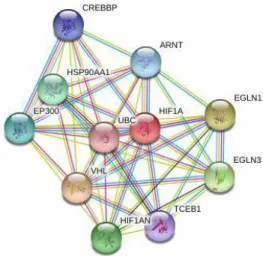
pathways (tumor suppressors and antagonistic pleiotropy). Each protein molecule in the functional group interacts with other protein molecules. For example, the molecular interactions of hypoxia inducible factor 1, alpha subunit
(HIF-1alpha) are presented in Fig.1. Serum HIF-1alpha
concentration rose in ISH patients, and was most pronounced in Group 2c.
Conclusion
We identiied potentially new biomarkers of
cardiovascular aging that could help in developing a noninvasive, serum-based diagnostic test. This study is the
irst step in the development of a new system for creation
of personalized hypotensive therapy. The dynamics in the proteome-map of blood serum in ISH patients revealed the molecular mechanism of neuro-, cadio- and vascular protective effects of amlodipine and valsartan, as a geroprotective mode of drug action.
Competing interests
The authors declare that they have no competing interests.
References
1. Nielsen WB, Vestbo J, Jensen GB. Isolated systolic hypertension as a major risk factor for stroke and myocardial infarction and an unexploited source of cardiovascular
prevention: a prospective population-based study. J Hum
Hypertens. 1995; 9(3):175-80.
2. Boutouyrie P, Tropeano A, Asmar R, Gautier I, Benetos A, Lacolley P, at al. Aortic stiffness is an independent predictor of primary coronary events in hypertensive patients: a longitudinal study. Hypertension. 2002. 39(1):10-5.
3. McEniery CM1, Yasmin, Hall IR, Qasem A, Wilkinson IB,
Cockcroft JR. Normal vascular aging: differential effects on wave relection and aortic pulse wave velocity: the Anglo-Cardiff Collaborative Trial (ACCT). J Am Coll Cardiol. 2005;
46(9):1753-1760.
4. Mancia G, Fagard R, Narkiewicz K, Redon J, Zanchetti A, Böhm M, et al. 2013 ESH/ESC guidelines for the management of arterial hypertension: the Task Force for the Management of Arterial Hypertension of the European Society of Hypertension (ESH) and of the European Society of Cardiology (ESC). Eur
Heart J. 2013;34(28):2159-219.
Fig. 1. Molecular interactions of HIF-1alpha (STRING 10.0 database)