ATUALIZAÇÃO ESPACIAL DE ALVOS A FRENTE E ATRÁS DO OBSERVADOR.
David Horn, Jack Loomis
University of California, Santa Barbara - USA
Resumo: Esta pesquisa comparou a acurácia da atualização espacial de alvos situados à frente com a de alvos situados atrás do observador. O participante observava um alvo no solo distante vários metros dele e então, sem a visão, andou de lado ao longo de uma corda-guia enquanto tentava atualizar mentalmente a localização do alvo. Em algumas tentativas, a localização do alvo esteve à frente do observador e, em outras tentativas, a localização do alvo foi atrás. Os participantes respondiam encarando a localização atualizada do alvo com os olhos fechados. Os resultados indicaram que as pessoas são capazes de atualizar a localização de alvos localizados atrás delas aproximadamente tão bem quanto localizações de alvos à frente delas.
Palavras-chave: Percepção visual, percepção espacial, locomoção, ação
SPATIAL UPDATING OF TARGETS IN FRONT AND BEHIND.
Abstract: This research compared the accuracy of spatial updating of targets in front with that of targets behind. The participant viewed a target on the ground several meters away and then, without vision, sidestepped along a guide rope while trying to mentally update the location of the target. On some trials, the target location was in front as the person sidestepped and, on other trials, the target location was behind. Participants responded by facing the updated target location with eyes closed. The results indicate that people are able to update target locations behind them very nearly as well as target locations in front.
Key-words: Visual perception, space perception, locomotion, action
Artigo recebido para publicação em 27/08/2003; aceito em 18/12/2003. Endereço para correspondência: David Horn, Surgical Resident Department of Otolaryngology-Head & Neck Surgery - Indiana University School of Medicine - Indianapolis, IN 46220, USA E-mail: [email protected] - ou -Jack M. Loomis - Department of Psychology - University of California, Santa Barbara - Santa Barbara, CA 93106, USA - E-mail: [email protected]
Spatial updating refers to the ability of a human or non-human agent to mentally keep track of one of more stationary targets, initially localized on the basis of sensory information, as the agent moves about in space while receiving no further sensory information about the target locations. Many non-human species are capable of spatial updating of initially viewed objects (the toad [Collett, 1982] and the jumping spider [Hill, 1979]). Similarly, humans can easily and accurately update one or more target locations initially specified by vision (Farrell & Robertson, 1997; Fukusima, Loomis, & Da Silva, 1997; Loomis, Da Silva, Fujita, & Fukusima, 1992; Philbeck, Loomis, & Beall, 1997; Rieser, 1989; Thomson, 1983), by audition (Ashmead, DeFord, &
Northington, 1995; Loomis, Lippa, Klatzky, & Golledge, 2002), or by touch (Hollins & Kelley, 1988) as rotate, translate, or both.
76 Method
Participants. We tested 28 participants, 13 females and 15 males, ages 19-22. All but two were undergraduate students at the University of California, Santa Barbara (UCSB). Each participant reported having normal visual acuity with or without optical correction. None had knowledge about the purpose of the experiment.
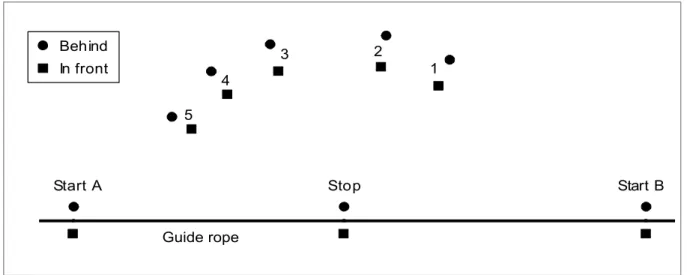
Figure 1 shows the experimental setup including stimulus layout. The 11-m guide rope was parallel to the edge of the sidewalk and attached at its ends to two stanchions. It was kept taut and positioned at waist height. The locations marked Start A, Start B, and Stop were on the sidewalk. The 10 target locations, labeled 1 to 5, were in the grassy field. Depending on the trial, the participant started out at the one of the two Start A or two Start B locations and subsequently sidestepped, while holding the guide rope, to one of the two Stop locations. The paired start and stop locations, on both sides of the rope, were used according to whether the trial involved updating behind or in front. For Behind trials, the participant was on the side of the rope nearer the field facing the rope, and on In Front trials, the participant was on the far side, also facing the rope. The two start locations were separated by 10.2 m and the Stop point was roughly midway between them.
Guide rope
Start A S top S t a r t B
B ehind In front
3 2
1 4
5
Figure 1. Experimental setup. A guide rope was positioned over a sidewalk adjacent to a grassy field in which the visual target could be positioned. The Start and Stop points nearer the target locations were used for the Behind condition, and the Start and Stop points on the other side of the rope were used for the In Front condition. The corresponding target locations were chosen to be approximately 3.3 m from the corresponding Stop point.
Experimental setting, stimulus layout, and materials. The experiment was conducted in a large grassy field on the UCSB campus adjacent to a straight concrete sidewalk. The field was free of any trees, shrubs, or other distinctive objects within 20 m of where the visual targets were placed, and the area in which the targets were placed was very nearly level. All trials were run during daylight hours, thus allowing abundant visual information for perceiving the target locations,
The 10 target locations, 5 for Behind trials and 5 forthe target locations. In Front trials, were positioned approximately 3.3 m from the corresponding Stop locations. On a given trial, a white Styrofoam ball, 30 cm in diameter, was place on the ground at one of the target locations. It was fixed in place by impaling it on a thick wire inserted into the ground. The change in direction of the various targets
going from Start A to Stop ranged from 36 to 102 deg, with a mean direction change of 69 deg. The change in direction of the various targets going from Start B to Stop ranged from 22 to 85 deg, with a mean direction change of 50 deg. For the two start locations, the mean direction change was 59.5 deg.
The participant indicated the direction of the imaginally updated target by turning the body and
head to face it, all with eyes closed. The heading of the body was measured with a KVH electronic compass (model Azimuth 100) worn on the back. It had a digital display that could be read to the nearest degree. The participant also wore a backpack that carried a 12V battery that powered the electronic compass.
Procedure. There were several slight variations in procedure used in the experiment that proved inconsequential. Participants 1-10 simply closed the eyes when appropriate; whereas, participants 11-28 used a blindfold to prevent vision. Similar updating research by the second author has more often not used a blindfold (Loomis, et al., 1992; Fukusima, et al., 1997) because participants have been observed to comply with the instruction to keep the eyes closed. Also, participants 11-19 used a headset apparatus to prevent localization of incidental environmental sounds; whereas, the remaining participants had the use of normal hearing. Fukusima et al. (1997) found that spatial updating performance was not influenced by blocking the localization of environmental sounds.
Participants were deprived of vision during the experiment other than between trials and during the brief period at the beginning of each trial when the participant viewed the target. The experimenter and an assistant conducted the experiment. The experimenter gave instructions to the participant, led the participant to the appropriate start point on each trial, stopped the participant after the sidestepping traverse to the appropriate stop point, and recorded the compass readings. The assistant placed the target at the appropriate location on the ground prior to each trial.
Prior to each trial, the participant was led to either Start A or Start B on the appropriate side of the rope, depending on whether it was an In Front or Behind trial. In all cases, the trial began with the participant’s turning the body (without vision) to face the Stop point while holding onto the rope. The participant used one hand to hold the rope; for those using a blindfold, the other hand was used to raise and lower the blindfold. Once facing the Stop point, the participant was told to view the target by raising the blindfold or opening the eyes. The participant turned the head, but not the body, toward the grassy
field and viewed the target until satisfied with knowing its location. When ready, the participant closed the eyes or lowered the blindfold, turned the head toward the Stop point, and, then while holding the rope with one hand, turned the body (and head) toward the rope. On the rare occasion where this sequence was performed incorrectly, the trial was skipped and then reinserted at the end of the experiment.
78
other side of the rope and then completed 2 trials in the other condition, again from opposite starting points. In other words, the starting point varied in rectangular fashion (Start A, In Front: Start B, In Front: Start B, Behind: Start A, Behind). This procedure was repeated until each of the 4 starting points was used once with each of the 5 targets, thus resulting in 20 trials in total.
Upon completion of the 20 trials, participants stopped in the final location and then faced body and head toward each of the 5 targets using vision. The instructions for facing the targets were identical to those used in the experimental trials, but now the participants no longer had to imagine each target. The headings were recorded for each of the 5 targets, after which the participant moved to the other Stop point and repeated the procedure. The 10 headings for In Front and Behind targets obtained with visually-based facing were used as reference values in computing the updating errors on the experimental trials. Use of these reference values eliminated some of the measurement error associated with variations in how the electronic compass was placed on the back and in how different participants aimed their bodies toward the visible or updated target.
Results
Two of the 28 participants were excused from the experiment because of technical problems. For the remaining participants, signed error scores (in deg) were computed for each trial. For a given target, this error score was the difference between the compass reading of the updating response and the compass reading when the participant faced the same target using vision. For each target, condition, and participant, we obtained two signed error scores, one for Start A and one for Start B. For each pair of scores we computed the standard deviation, which is also equal to one half of the absolute value of the difference score.
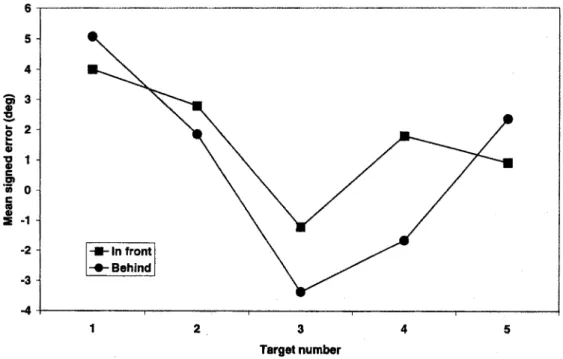
The mean signed error for each participant’s two responses (for Start A and Start B) was computed for each target in each condition. These individual means were then averaged over participants to give the means plotted in Figure 2, as a function of target and condition. Mean signed error is a measure of any systematic bias away from the correct direction. The grand means for In Front and Behind were 1.7 deg and 0.9 deg, respectively. A mixed-model three-way ANOVA computed on the individual mean constant errors indicated no significant effects.
The two absolute errors for each participant’s two responses (for Start A and Start B) were averaged to obtain the individual’s mean absolute error for each target in each condition. These individual means were then averaged over participants to give the means plotted in Figure 3, as a function of target and condition. Mean absolute error indicates the magnitude of error, regardless of sign, expected on a typical trial for the typical participant. The grand means for In Front and Behind were 12.6 and 14.8 deg, respectively. A mixed-model three-way ANOVA indicated two statistically significant effects: a main effect of target (F(4, 22) = 3.032, p < .05) and an interaction between target and condition, (F(4, 22) = 4.495, p < .01). The effect of condition was marginally significant, (F(1, 25) = 3.732, p = .065). This analysis indicates that updating behind is worse than updating in front for one or more of the targets.
Figure 3. Mean absolute errors in the experiment as a function of target number and condition.
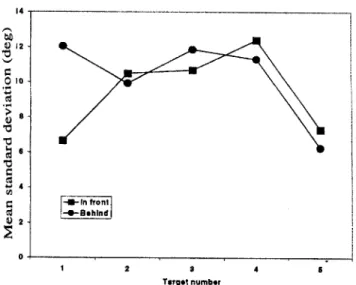
Figure 4. Mean values of the standard deviation based on the participant’s two responses (from Start A and Start B) for each target and condition.
Figure 4 gives the mean value of the standard deviation (in deg) as a function of target and condition. Each mean was computed on the 26 standard deviations (computed on the two signed errors for each of the 26 participants). The grand means of these standard deviations for In Front and Behind were 9.5 and 10.3 deg, respectively. A mixed-model three-way ANOVA indicated that only the main effect of target was significant, (F(4,22) = 5.084, p < .05).
Discussion
In this experiment, participants sidestepped through space while updating targets that were in front or behind. The mean change in direction of the targets during these traverses was 59.5 deg. The results given in Figure 1 show that the mean signed error, averaged over participants, ranged from 4 to -1 deg in the In Front condition and from to 5 to -3 deg in the Behind condition. Compared to the mean change in directions of the targets, these small mean signed errors signify that participants were, on average, accurate in updating targets both in front and behind. Even the mean absolute errors, which indicate the magnitude of error expected on a given trial and which averaged 12.6 and 14.8 deg for In Front and Behind, respectively, are an impressively small fraction of the mean change in direction.
80
1989) and, thus, non-existent in the imaginal space behind the person’s head, the spatial images associated with spatial updating definitely do exist in all directions. This study shows that, at least with respect to body translations, spatial updating is comparable in front and in back. Given the critical role of spatial updating in everyday life (keeping track of threatening animals and people), a role that surely goes back beyond the origins of human existence, it is no surprise that spatial updating ought to operate well in all directions relative to the head and body. Whereas visual imagery is known to be associated with early stages of visual processing (V1), spatial updating is generally thought to be associated with amodal or multimodal spatial representations of posterior parietal cortex (PPC), which receives sensory input from vision, hearing, and touch (Andersen, Snyder, Bradley, & Xing, 1997; see also, Philbeck, Behrmann, & Loomis, 2001). Given that we can readily perceive the locations of sound sources and haptically sensed objects that are behind us, it is not surprising that there would be brain areas, like PPC, involving abstract spatial representations of location, including those initiated by visual input, that are independent of direction relative to the head and body.
References
Andersen, R.A., Snyder, L.H., Bradley, D.C., & Xing, J. (1997). Multimodal representation of space in the posterior parietal cortex and its use in
planning movements. Annual Review of
Neuroscience, 20, 303-330.
Ashmead, D.H., DeFord, L.D., & Northington, A. (1995). Contribution of listeners’ approaching motion to auditory distance perception. Journal of Experimental Psychology: Human Perception and Performance, 21, 239-256.
Collett, T.S. (1982). Do toads plan routes? A study of the detour behavior of Bufo viridis. Journal of Comparative Physiology, 146, 261-271.
Farah, M.J. (1985). Psychophysical evidence for a shared representational medium for mental images and percepts. Journal of Experimental Psychology: General, 114, 91-103.
Farrell, M.J., & Robertson, I.H. (1997). Mental rotation and the automatic updating of body-centered spatial relationships. Journal of Expe-rimental Psychology: Learning, Memory, and Cognition, 24, 227-233.
Finke, R.A. (1989). Principles of mental imagery. Cambridge: MIT Press.
Fukusima, S.S., Loomis, J.M., & Da Silva, J.A. (1997). Visual perception of egocentric distance as assessed by triangulation. Journal of Experi-mental Psychology: Human Perception and Psychophysics, 23, 86-100.
Hill, D.E. (1979). Orientation by jumping spiders of the genus Phidippus (Araneae: Salticidae) during the pursuit of prey. Behavioral Ecology and Sociobiology, 5, 301-322.
Hollins, M., & Kelley, E.K. (1988). Spatial updating in blind and sighted people. Perception & Psychophysics, 43, 380-388.
Loomis, J.M., Da Silva, J.A., Fujita, N., & Fukusima, S.S. (1992). Visual space perception and visually directed action. Journal of Experimental Psychology: Human Perception and Performance, 18, 906-921.
Loomis, J.M., Klatzky, R.L., Golledge, R.G., & Philbeck, J.W. (1999). Human navigation by path integration. In R.G. Golledge (Ed.), Wayfinding: cognitive mapping and other spatial processes
(pp. 125-151). Baltimore: Johns Hopkins.
Loomis, J.M., Lippa, Y., Klatzky, R.L., & Golledge, R.G. (2002). Spatial updating of locations specified by 3-D sound and spatial language.
Journal of Experimental Psychology: Learning, Memory, & Cognition, 28, 335-345.
Philbeck, J.W., Behrmann, M., & Loomis, J.M. (2001). Updating of locations during whole-body rotations in patients with hemispatial neglect.
Cognitive, Affective, and Behavioral Neuroscience, 1, 330-343.
Philbeck, J.W., Loomis, J.M., & Beall, A.C. (1997). Visually perceived location is an invariant in the control of action. Perception & Psychophysics, 59, 601-612.
Rieser, J.J. (1989). Access to knowledge of spatial structure at novel points of observation. Journal of Experimental Psychology: Learning, Memory, and Cognition, 15, 1157-1165.
Thomson, J.A. (1983). Is continuous visual monitoring necessary in visually guided
locomotion? Journal of Experimental
Psychology: Human Perception and Performance, 9, 427-443.
Agradecimentos: