Introduction
Sleep is an important component of daily circadian rhythm and plays a pivotal role in the promotion of health 1. It is even more important during adolescence as this period is characterized by a series of biological and psychosocial changes that may affect adolescent sleep patterns (i.e. insuficient sleep duration and poor quality of sleep) 2, 3, resulting in a number of negative consequences (e.g. low academic achievement, impaired cognitive function, obesity) 4, 5. Therefore, improvements in sleep quality and duration should be targeted for improving adolescents’ health.
It has been shown that physical activity is associated with longer sleep duration and better sleep quality in adolescents 6. Moreover, a previous systematic review showed that aerobic exercise training improves overall sleep quality (ie. reduced latency to fall asleep, increased sleep time) 7, suggesting that, despite the beneits of aerobic exercise, little attention has been given to other types of exercise (ie. strenght training). Interestingly, Loprinzi and Loenneke 8 have shown that engagement in muscular strengthening activities is associated with a 19% greater chance to meet sleep duration guidelines
(7-8 hours/night) in adults; however, whether regular practice of strength exercise improves sleep parameters of adolescents remains unknown.
Interestingly, there is some evidence indicating that there is a substantial interindividual variability in response to exercise training 9, 10, suggesting that some individuals may experience signiicant responses, while others show minimal or even opposite responses to training. Therefore, examining the individual and average effect of strength training on sleep parameters of adolescents would be important for having a more complete evaluation of the eficacy of this mode of exercise in improving health in this population.
Thus, the aim of this present study was to analyze the average and individual responses of sleep quality and daytime sleepiness in adolescents after four weeks of strength training.
Methods
Sample
Nineteen adolescents of both genders (6 girls; 13 boys),
Original Article (short paper)
Individual and average responses of sleep quality
and daytime sleepiness after four weeks of
strength training in adolescents
Heimer1, Marcos André Moura dos Santos1,2*
1Universidade de Pernambuco, UPE, Camaragibe, PE, Brazil. 2Universidade de Pernambuco, UPE, Recife, PE, Brazil.
3Universidade Federal Rural de Pernambuco, UFRPE, Recife, PE, Brazil. 4Instituto Federal de Pernambuco, Vitória de Santo
Antão, IFPE, PE, Brazil. 5Hospital Metropolitano Sul Dom Helder Câmara, IMIP Hospitalar, Cabo de Santo Agostinho, Brazil.
Abstract — Aims: To analyze the average and individual responses of sleep quality and daytime sleepiness in
adolescents after four weeks of strength training. Methods: 19 adolescents with sleep problems recruited in the Federal Institute of Pernambuco, were subject to anthropometric evaluations as well as those for body composition assessment, a 1 repetition maximum test, the sleep parameters (Pittsburgh Sleep Quality Index—PSQI and Epworth Sleepiness Scale—ESS)and were submitted to four weeks of strength-training, performed alternately by segment, two sessions per week, according to recommendations for this population. Results: A decrease in the average PSQI score was observed (10.3±3.3 vs 8.8±4.0; p=0.006), but not in ESS (p>0.05), after intervention. The individual analyses demonstrated that ~63% of adolescents experienced reductions ≥ 3 points in the PSQI and ~58% of them experienced reductions ≥ 3 points in the measure of daytime sleepiness. The prevalence of poor sleep quality and daytime sleepiness reduced from 84.2% to 68.4% and from 52.6% to 31.6%, respectively. The comparisons of high and low responders to exercise training show that adolescents who reduced ≥3 points in the score of a least one sleep parameter presented lower weight, fat mass, and fat percentage (p<0.05). Conclusion: A short-term strength-training program is able to improve global sleep quality, but not daytime sleepiness in adolescents. Furthermore, the changes after training are highly heterogeneous. Further studies are required to better understand the effects of strength training on sleep parameters of adolescents.
Keywords:adolescence; sleep quality; strength training; daytime sleepiness; individual responses
Maria Julia Lyra1, Antonio Henrique Germano-Soares2, Ladyodeyse da Cunha Silva Santiago1, Daniel da Rocha
recruited at the Federal Institute of Pernambuco (FIPE), participated in the present study. FIPE is located in an economically poor, rural zone of the state of Pernambuco, in northeastern Brazil. All students stay at FIPE from Monday to Friday. Males and females are housed separately, and have similar routines such as dining, class time, and bed time. In addition, alcohol and tobacco consumption is forbidden. The Research Ethics Committee of the University of Pernambuco approved the study procedure, which followed the established norms of the National Research Ethics Commission (CONEP: No. 89.701), and each adolescent who participated provided a written informed consent form.
The inclusion criteria were as follows: i) complaints of non-restorative sleep (poor sleep quality and sleep disturbance), ii) daytime sleepiness, iii) not involved in physical exercise programs, iv) no presence of any muscular or orthopedic injuries that might compromise the performance of the intervention sessions, v) did not perform moderate or vigorous physical activity during the 12 hours prior to the evaluation, vi) no use of sleeping drugs.
Anthropometry and body composition
Weight and height were measured by a digital scale (to the nearest 0.1kg; Filizola, São Paulo, Brazil) and a portable stadiometer (to the nearest 0.5cm; Sanny, São Paulo, Brazil), respectively. Measurements were taken with shoes off, feet together, and head in the Frankfurt horizontal plane 11. Body mass index was calculated by my dividing weight (kg) by the square of height (m²).
To estimate the body composition, the two-compartment model (fat mass and lean mass) was adopted measuring skinfold thickness using a scientiic adipometer (Lange®, Cambridge Scientiic Instruments, Cambridge, Maryland), with a constant pressure of 10 g/mm2, and an accuracy of 1 mm. The collection points were biceps, triceps, subscapular, and suprailiac and followed the recommendations previously described. The measurements were performed in triplicate and the median value was adopted. Relative body fat was estimated from the mathematical model proposed by Deurenberg, Weststrate, Seidell12.
One repetition maximum (1RM) test
Prescription of the load in each exercise was based on the 1RM test. This test aims to evaluate the maximum force in the exercises used in the experimental program. In each exercise, the test was started with a warm-up (ten repetitions), using approximately 50% of the load established for the irst 1RM attempt. After a two-minute interval, the adolescents were instructed to perform two replicates with the estimated 1RM
attempts, to determine the 1RM load. To reduce possible faults in the identiication of loads, strategies were adopted such as: explanation and technical demonstration of movements by the evaluators, before each exercise; correction and monitoring of the movement technique of each exercise, when necessary; and verbal encouragement during the test 13, 14.
Sleep parameters
The Sleep Quality Index Questionnaire (Pittsburgh Sleep Quality Index—PSQI)
The PSQI was used to assess the quality of sleep, which determines an index of the severity and nature of the sleep disturbance15. The PSQI is a seven-domain (19 questions), self-rated questionnaire evaluating sleep habits during the last month. The seven-domain scores combine to provide an overall sleep quality index including: subjective sleep quality, sleep latency, sleep duration, habitual sleep eficiency, sleep disturbance, use of sleeping drugs, and daytime dysfunction. The possible scores range from zero to 21 and the higher the score, the worse the quality of sleep. For this study, a PSQI score > 5 revealed that the individual had poor quality sleep and > 10 indicated that the participant had a sleep disorder. This instrument had good reliability and high internal consistency (α = 0.83) and good test-retest reliability (r = 0.85) 15, 16. This instrument was duly validated in Portuguese for adolescents17.
Epworth Sleepiness Scale (ESS)
Daytime sleepiness was evaluated by using the Epworth Sleepiness Scale (ESS-BR), which has been widely used in adolescents 18-20. This self-administered questionnaire aims to quantify the propensity to fall asleep during eight routine situations. The answers reach values between zero and 24 points, with 10 being the cut-off point. The interviewee should provide points from zero to three, quantifying their tendency (probability) to fall asleep 21. The points given to each of the questions are added together. A total of 10 or more points is indicative of the presence of excessive daytime sleepiness 21.
Strength Training Session
Statistical analysis
All analyses were performed using SPSS software, version 21.0. The normality and homogeneity of the data were conirmed by the Shapiro-Wilk and Levene tests. Considering a power analysis of 80%, an alpha error of 5%, and an effect size of 0.4, the sample size required was 19 adolescents. The two-way ANOVA was employed to compare the average changes on PSQI and ESS, between boys and girls. Comparisons of average changes on PSQI and ESS scores from pre- to post-intervention were performed by using the paired Student’s t-test. Individual responses were obtained by calculating the absolute changes for each score (Δ= post-intervention – pre-intervention), and the Independent Student’s t-test was employed to compare general characteristics between adolescents who did or did not present reductions ≥3 points in at least one sleep parameter, which represents 14% or higher of the total score. Statistical signiicance was set at p value ≤0.05.
Results
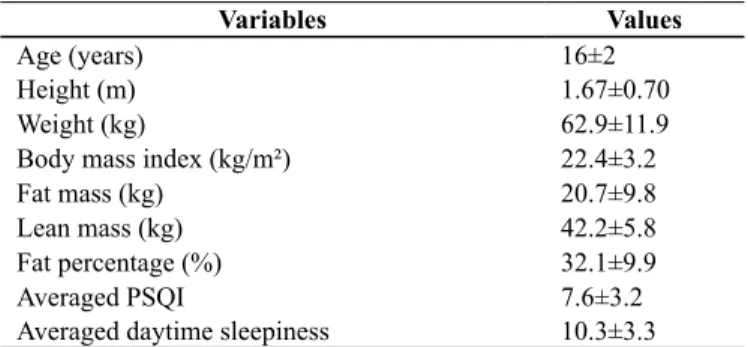
The general characteristics of the adolescents are presented in Table 1.
Table 1. General characteristics of the adolescents included in this study (n=19)
Variables Values
Age (years) 16±2
Height (m) 1.67±0.70
Weight (kg) 62.9±11.9
Body mass index (kg/m²) 22.4±3.2
Fat mass (kg) 20.7±9.8
Lean mass (kg) 42.2±5.8
Fat percentage (%) 32.1±9.9
Averaged PSQI 7.6±3.2
Averaged daytime sleepiness 10.3±3.3 Data presented as mean and standard deviation
Since we showed no interaction between sex and time for both PSQI (mean = -1.17 [CI95%: -3.69 to 1.35] for girls and -2.46 [CI95%: -4.33 to -0.59] for boys; p=0.380) and ESS (mean = -1.17 [CI95%: -5.54 to 3.21] for girls and -1.69 [CI95%: -4.34 to 0.96] for boys; p=0.808), the subsequent analyses were performed with boys and girls together.
The average changes in PSQI and ESS scores from pre- to post-intervention are presented in Figure 1. A decrease in the PSQI score (7.6±3.2 vs 5.8±2.4; p=0.006) was observed, while no changes for ESS score after strength training (10.3±3.3 vs 8.8±4.0; p=0.131) were observed.
Figure 1. PSQI (Panel A) and daytime sleepiness (Panel B) before and after four weeks of resistance training in adolescents.
The individual analyses are presented in igure 2. From the 19 adolescents submitted to exercise training, eight of them experienced reductions ≥ 3 points in the PSQI score (~42%), while seven experienced reductions ≥ 3 points in the daytime
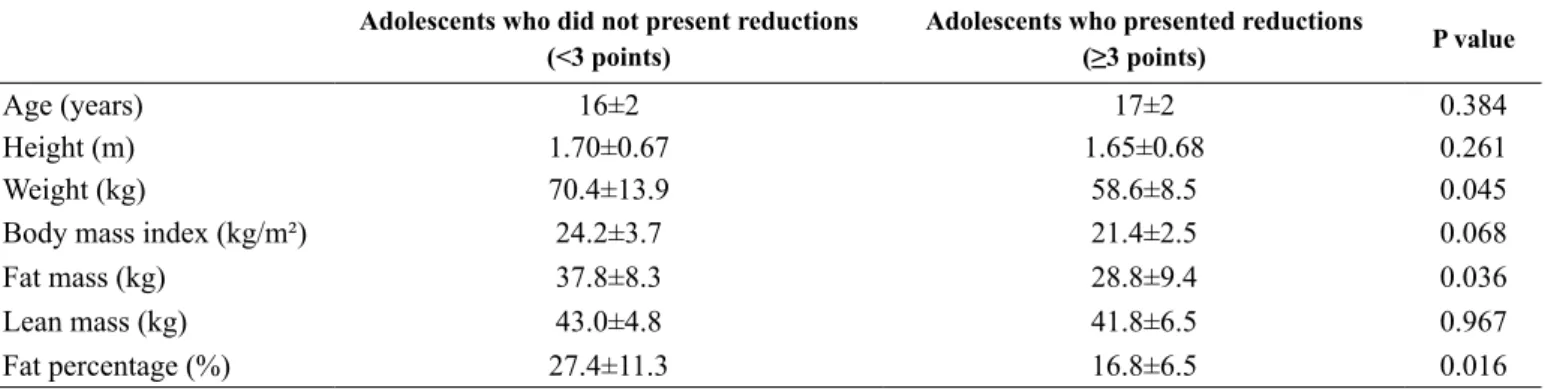
The comparisons of the general characteristics between high and low responders to exercise training are presented in Table 2. The adolescents who reduced ≥3 points in the score of
at least one sleep parameter presented lower weight, fat mass, and fat percentage (p<0.05); furthermore, there was a trend to have lower body mass index (p=0.068).
Table 2. Comparison of the general characteristics between adolescents who presented or did not present reductions ≥3 points in the score of at
least one sleep parameters
Adolescents who did not present reductions (<3 points)
Adolescents who presented reductions
(≥3 points) P value
Age (years) 16±2 17±2 0.384
Height (m) 1.70±0.67 1.65±0.68 0.261
Weight (kg) 70.4±13.9 58.6±8.5 0.045
Body mass index (kg/m²) 24.2±3.7 21.4±2.5 0.068
Fat mass (kg) 37.8±8.3 28.8±9.4 0.036
Lean mass (kg) 43.0±4.8 41.8±6.5 0.967
Fat percentage (%) 27.4±11.3 16.8±6.5 0.016
Data presented as mean and standard deviation
Figure 2. Pre-to post PSQI (Panel A) and daytime sleepiness (Panel B) individual changes after four weeks of resistance training.
Discussion
This is perhaps the irst study examining the effects of a short-term strength-training program on sleep parameters of adolescents. The indings of this study indicated that four weeks of strength training induced improvements in both global sleep quality and daytime sleepiness in the majority the adolescents. Furthermore, such improvements are related to body mass index, body fat, and fat percentage in this subgroup.
It`s well recognized that insuficient sleep is a relevant public health problem in adolescents. In fact, it has become increasingly common and frequent 24, causing an increase in the prevalence of poor sleep quality and daytime sleepiness with advancing age 25, 26. This is further important since these problems are associated with an increased risk for cardiometabolic diseases (i.e. hypertension, diabetes, obesity). It also affects the process of growth and development 27-29, and negatively impact the
reduction of the PSQI score, indicating an improvement in global sleep quality of the adolescents. In fact, Ferris, Williams, Shen, O’Keefe, Hale31 showed reductions on PSQI score after three months of strength training in older adults. Moreover, Silva-Batista et al. 33 found that 12 weeks of strength training was able to reduce the PSQI score in healthy individuals, as well as in individuals with Parkinson’s disease. Interestingly, the current study showed that even a short-term strength-training program (i.e. four weeks of training) was able to improve global sleep quality. Since we have previously demonstrated that a single session of strength exercise is able to improve sleep quality in adolescents, the results of the current study expand to the literature that this mode of exercise also has chronic effects 13. Taken together, these results highlight the beneicial effects of strength training on sleep quality in different age groups.
and disposition for the day activities after awakening 34. However, despite the lack of changes in the average score, the analysis of individual data showed a high heterogeneity in the changes in both PSQI and ESS. In total, 42.1% and 36.8% of the adolescents experienced reductions ≥3 points in the PSQI and ESS, respectively. Moreover, 63.2% of the adolescents reduced ≥3 points in at least one of these parameters, suggesting that the majority of the adolescents may beneit from the strength training. Differences in sample characteristics may explain, at least in part, such interindividual variability in response to exercise training. In fact, adolescents who reduced ≥3 points in at least one of the sleep parameters presented lower weight, fat mass and fat percentage in comparison with adolescents who did not present reductions. Thus, these aspects allow us to speculate that adolescents with a higher fat percentage are less likely to present sleep beneits after a short-term strength-training program. Corroborating this hypothesis, previous studies have shown that the frequency of daytime sleepiness is higher among obese individuals 35. Furthermore, values of body mass index are associated with impaired daytime sleepiness in obese adolescents 36. Although the cutoff point of ≥3 points in the score was able
to identify the characteristics of adolescents that responded and did not respond to training, further studies are warranted to examine whether changes of such magnitude are associated with adverse outcomes. Likewise, future studies are necessary to identify the mechanisms underlying the differences on sleep parameter changes between normal weight and obese adolescents following strength training programs. However, in this context, Loprinzi, Loenneke8 reported that sleep may help the body repair exercise-induced tissue damage occurring during wakefulness. Future mechanistic work is needed, mainly in adolescents, but the present indings suggest that, the engagement in muscular strengthening activities is associated with optimal sleep duration. This is an encouraging inding as, if corroborated by future prospective and experimental work, muscular strengthening activities may serve as a non-pharmacological, behavioral-based alternative to aerobic physical activity to help facilitate improved sleep among individuals.
From a practical point of view, the results of the current study showed the beneicial effects of a short-term strength-training program on global sleep quality and daytime sleepiness in adolescents. These improvements are important in view of the role of sleep on the changes that are experienced in this life period, which affect not only the risk for the onset of diseases, but also psychosocial health and school performance of the adolescents. Interestingly, we found that the adolescents with a higher percentage of body fat were less likely to beneit from resistance training, and therefore, the association of regular exercise practice with other strategies to improve body composition may be helpful in this subset.
The lack of a control group without exercise is deinitively the main limitation of this study. Nevertheless, our results are comparable to other studies investigating sleep quality, daytime sleepiness and their consequences. Another potential limitation is the lack of objective tools to measure sleep, such as a sleep-wake diary or actigraphy data, in association to references and
concerns surrounding delayed sleep phase disorder. Despite having similar nutrition, the quantity or frequency of ingested caffeinated food was not evaluated, which may also have an inluence on the results. Finally, the speciic characteristics of the sample (i.e. institutionalized adolescents) may limit the generalizability of the results to other adolescents.
In conclusion, a short-term strength-training program is able to improve global sleep quality, but not daytime sleepiness in adolescents. Furthermore, the changes after training are highly heterogeneous. Further studies are required to better understand the effects of the strength training on sleep parameters of adolescents.
References
1. Van Dongen HP, Dinges DF. Investigating the interaction between the homeostatic and circadian processes of sleep-wake regulation for the prediction of waking neurobehavioural performance. J Sleep Res. 2003;12(3):181-7.
2. Dahl RE, Lewin DS. Pathways to adolescent health sleep regulation and behavior. J. Adolesc. Health. 2002;31(6):175-84. 3. Carskadon MA. Sleep in adolescents: the perfect storm. Pediatr.
Clin. North Am. 2011;58(3):637-47.
4. Perez-Chada D, Perez-Lloret S, Videla AJ, Cardinali D, Bergna MA, Fernandez-Acquier M, et al. Sleep disordered breathing and daytime sleepiness are associated with poor academic performance in teenagers. A study using the Pediatric Daytime Sleepiness Scale (PDSS). Sleep. 2007;30(12):1698-703. 5. Cappuccio FP, Taggart FM, Kandala NB, Currie A, Peile E,
Stranges S, et al. Meta-analysis of short sleep duration and obesity in children and adults. Sleep. 2008;31(5):619-26.
6. Brand S, Gerber M, Beck J, Hatzinger M, Puhse U, Holsboer-Trachsler E. High exercise levels are related to favorable sleep patterns and psychological functioning in adolescents: a comparison of athletes and controls. J. Adolesc. Health:
oficial publication of the Society for Adolescent Medicine.
2010;46(2):133-41.
7. Yang PY, Ho KH, Chen HC, Chien MY. Exercise training improves sleep quality in middle-aged and older adults with sleep problems: a systematic review. J. Physiother. 2012;58(3):157-63.
8. Loprinzi PD, Loenneke JP. Engagement in muscular strengthening activities is associated with better sleep. Prev Med Rep. 2015;2:927-9.
9. Churchward-Venne TA, Tieland M, Verdijk LB, Leenders M, Dirks ML, de Groot LC, et al. There Are No Nonresponders to Resistance-Type Exercise Training in Older Men and Women. J Am Med Dir Assoc. 2015;16(5):400-11.
10. Bouchard C, An P, Rice T, Skinner JS, Wilmore JH, Gagnon J, et al. Familial aggregation of VO(2max) response to exercise training: results from the HERITAGE Family Study. J Appl Physiol (Bethesda, Md : 1985). 1999;87(3):1003-8.
12. Deurenberg P, Weststrate JA, Seidell JC. Body mass index as a
measure of body fatness: age-and sex-speciic prediction formulas.
Br J Nutr. 1991;65(02):105-14.
13. Santiago LdCS, Lyra MJ, Cunha Filho M, Cruz PWdS, Santos MAMd, Falcão APST. Efeito de uma sessão de treinamento de força sobre a qualidade do sono de adolescentes. Rev Bras Med Esporte. 2015;21:148-52.
14. Brzycki M. Strength testing—predicting a one-rep max from reps-to-fatigue. J. Phys. Health Educ. Recr. Dance. 1993;64(1):88-90. 15. Buysse DJ, Reynolds CF, Monk TH, Berman SR, Kupfer DJ. The
Pittsburgh Sleep Quality Index: a new instrument for psychiatric practice and research. Psychiatry Res. 1989;28(2):193-213. 16. Chellappa SL, Araujo JF. Qualidade subjetiva do sono em pacientes
com transtorno depressivo. Estud. psicol. 2007;12(3):269-74. 17. Passos MH, Silva HA, Pitangui AC, Oliveira VM, Lima AS,
Araújo RC. Reliability and validity of the Brazilian version of the Pittsburgh Sleep Quality Index in adolescents. J Pediatr. 2016. 18. Pereira ÉF, Teixeira CS, Louzada FM. Sonolência diurna excessiva
em adolescentes: prevalência e fatores associados. Rev Paul Pediatr. 2010;28:98-103.
19. Souza JC, Souza N, Arashiro ESH, Schaedler R. Sonolência diurna excessiva em pré-vestibulandos. J. bras. psiquiatr. 2007;56:184-7. 20. Gibson ES, Powles AC, Thabane L, O’Brien S, Molnar DS,
Trajanovic N, et al. “Sleepiness” is serious in adolescence: two surveys of 3235 Canadian students. BMC Public Health. 2006;6:116.
21. Bertolazi AN, Fagondes SC, Hoff LS, Pedro VD, Barreto SSM, Johns MW. Validação da escala de sonolência de Epworth em português para uso no Brasil. J Bras Pneumol. 2009;35(9):877-83. 22. McCambridge T, Stricker P. Strength training by children and
adolescents. Pediatrics. 2008;121(4):835-40.
23. Robertson RJ, Goss FL, Rutkowski J, Lenz B, Dixon C, Timmer J, et al. Concurrent validation of the OMNI perceived exertion scale for resistance exercise. Med Sci Sports Exerc. 2003;35(2):333-41. 24. Adolescent Sleep Working Group Coa, Council on school health
School Start Times for Adolescents. Pediatrics. 2014;134(3):642-9. 25. Chen M-Y, Wang EK, Jeng Y-J. Adequate sleep among adolescents
is positively associated with health status and health-related behaviors. BMC Public Health. 2006;6(1):59.
26. Borges GA, Schwarztbach C. Menarcheal age of youth from Marechal Cândido Rondon-PR. Rev Bras Cineantropom Desempenho Hum. 2003;5(2):15-21.
27. Gonzaga NC, SENA ASS, Coura AS, Dantas FG, Oliveira RC, MEDEIROS CCM. Sleep quality and metabolic syndrome in overweight or obese children and adolescents. Revista de Nutrição. 2016;29(3):377-89.
28. Natal CL, Lourenço TJ, Silva LA, Boscolo RA, Silva A, Tuik S,
et al. Gender differences in the sleep habits of 11-13 year olds. Rev. Bras. Psiquiatr. 2009;31(4):358-61.
29. El Shakankiry HM. Sleep physiology and sleep disorders in childhood. Nat Sci Sleep. 2011;3:101.
30. Group ASW. School start times for adolescents. Pediatrics. 2014;134(3):642-9.
31. Ferris LT, Williams JS, Shen CL, O’Keefe KA, Hale KB. Resistance training improves sleep quality in older adults a pilot study. J Sports Sci Med. 2005;4(3):354-60.
32. Singh NA, Clements KM, Fiatarone MA. A randomized controlled trial of the effect of exercise on sleep. Sleep. 1997;20(2):95-101. 33. Silva-Batista C, Campos de Brito L, Corcos DM, Roschel H, Tulio de Mello M, Pimentel Piemonte ME, et al. Resistance Training Improves Sleep Quality In Subjects With Moderate Parkinson’s Disease. J. Strength Cond. 2016.
34. Pereira ÉF, Daronco LSE, Teixeira CS, Kothe F, Merino EAD. Percepção de qualidade do sono e da qualidade de vida de músicos de orquestra. Rev psiquiatr clín (São Paulo). 2010;37(2):48-51. 35. Sena ASS, Cardoso AdS, Carvalho DFd, Medeiros JL, Coutinho
GF, Albuquerque FCdL, et al. Excessive daytime sleepnessand cardiometabolic risk factors in children and teenagers with overweight. J Hum Growth Dev. 2013;23:24-30.
36. Feldner CBRdF, Zulmária Rezende; Rodrigues, Bruno Soares; Dias Nunes, João Elias; Santos, Heitor Cunha. Associação da ingestão demacronutrientes com o padrão de sono de adolescentes obesos. ConScientiae Saúde. 2015;14:592-9.
Acknowledgments
This study was supported by National Council for Scientiic and Technological De -velopment (CNPq) and Coordination for the Improvement of Higher Education Personnel (CAPES).
Corresponding author
*Marcos André Moura dos Santos
Mailing address: Arnóbio Marques Street, 310. Escola Superior de Educação Físi-ca, Santo Amaro, Recife, PE.
Email: [email protected]
Manuscript received on June 29, 2017
Manuscript accepted on October 1, 2017
Motriz. The Journal of Physical Education. UNESP. Rio Claro, SP, Brazil