Re lative influe nce o f age , re sting
he art rate and se de ntary life style
in sho rt-te rm analysis o f he art rate
variability
1Laboratorio de Fisiología Cardiovascular, Departamento de Fisiología,
Facultad de Medicina, Montevideo, Uruguay
2Fellow of the “Agencia Española de Cooperación Internacional”,
Facultad de Medicina, Universidad del País Vasco, Vitoria-Gasteiz, Spain
3Sanatorio Adventista de Asunción, Asunción, Paraguay
E.R. Migliaro1,
P. Contreras1, S. Bech1,
A. Etxagibel2, M. Castro1,
R. Ricca1 and
K. Vicente3
Abstract
In order to assess the relative influence of age, resting heart rate (HR) and sedentary life style, heart rate variability (HRV) was studied in two different groups. The young group (YG) consisted of 9 sedentary subjects aged 15 to 20 years (YG-S) and of 9 nonsedentary volunteers (YG-NS) also aged 15 to 20. The elderly sedentary group (ESG) consisted of 16 sedentary subjects aged 39 to 82 years. HRV was assessed using a short-term procedure (5 min). R-R variability was calculated in the time-domain by means of the root mean square successive differences. Frequency-domain HRV was evaluated by power spectrum analysis considering high frequency and low fre-quency bands. In the YG the effort tolerance was ranked in a bicycle stress test. HR was similar for both groups while ESG showed a reduced HRV compared with YG. Within each group, HRV displayed a negative correlation with HR. Although YG-NS had better effort tolerance than YG-S, their HR and HRV were not significantly different. We conclude that HRV is reduced with increasing HR or age, regardless of life style. The results obtained in our short-term study agree with others of longer duration by showing that age and HR are the main determinants of HRV. Our results do not support the idea that changes in HRV are related to regular physical activity.
Co rre spo nde nce
E.R. Migliaro
Departamento de Fisiología Facultad de Medicina Av. Gral. Flores, 2125
11800 Montevideo Uruguay
Fax: + 598-2-924-0395 E-mail: erm@ fmed.edu.uy
Research partially supported by Consejo Nacional de Investigaciones
Científicas y Tecnológicas (CO NICYT), Uruguay (FCE No. 2081).
Received O ctober 5, 1999 Accepted February 6, 2001
Ke y wo rds
·Heart rate variability
·Short-term analysis
·Autonomic nervous system
·Aging
·Sedentary life style
Intro ductio n
The analysis of heart rate variability (HRV) is a simple noninvasive technique used to assess the instantaneous beat-to-beat variations in terms of R-R interval length. HRV has been considered as a suitable marker for the estimation of autonomic nervous sys-tem function (1,2).
HRV is reduced in many pathological
In a normal population without any patho-logical interference, HRV shows broad limits because autonomic outflow is labile. Modifi-cations in age, postural changes, emotions, or time of the day can induce changes in HRV (10-13). In healthy subjects, an alert re-sponse increases the sympathetic outflow and reduces the parasympathetic one. We can say that the alert HRV response reproduces the behavior observed in a pathological situation. Studies of situations in which mental or physi-cal stress induces a reduction of HRV give support to this point of view (11,14). On the contrary, interventions that reduce the sympa-thetic outflow may induce an increase in HRV; this is the case for pharmacological maneuvers (15), some relaxation techniques (16-18) and, hypothetically, physical training (19). Con-versely, a sedentary life style may induce a reduction in parasympathetic outflow paral-leled by an increase in sympathetic outflow (20).
HRV can be analyzed during daily activi-ties (including sleeping hours) by Holter monitoring (21,22). On the other hand, short-term analysis can also be used (23). This type of study usually lasts a few minutes and can be performed under controlled labora-tory conditions. In the present study we used a short-term technique involving similar con-ditions for all subjects.
Our main goal was the evaluation of the relative influence of age, resting heart rate (HR) and sedentary life style on HRV. In order to assess age effect, we chose two groups of healthy people of different mean age. The effect of HR on HRV was analyzed within each group. The influence of seden-tary life style was studied in the younger group which included sedentary and non-sedentary subjects.
We show that age and HR are the main determinants of HRV. These results agree with others based on longer recordings than those used here (24). Our results do not support the point of view that regular physi-cal activity modifies HRV.
Mate rial and Me tho ds
Subje cts
We studied 34 healthy volunteers divided into two groups. The first group (YG) con-sisted of 18 young subjects (12 men and 6 women) aged 15 to 20 years. Nine of them (6 men and 3 women) engaged in physical ac-tivities (running, playing soccer or basket-ball) at least five days a week and are re-ferred to as nonsedentary subjects of the YG group (YG-NS). The remaining persons were sedentary ones matched with the others for age and gender and are referred to as seden-tary subjects of the YG group (YG-S).
Another group of elderly sedentary sub-jects (ESG) consisted of 16 sedentary volun-teers (2 men and 14 women) aged 39 to 82 years (see Tables 1 and 2 for mean age values).
He art rate variability study
A standard recorder (Fukuda FJC7110) was used to obtain an ECG. The ECG signal was connected to an electronic device which triggers a square wave pulse when the signal amplitude reaches an adjustable voltage threshold. A standard ECG lead was chosen to obtain a good R wave shape. The detec-tion threshold was set according to the volt-age of this particular R wave.
The pulses were fed to a computer through a parallel port. A specifically designed soft-ware (25) measured the time between suc-cessive R waves and stored them as ASCII files (values in ms).
In a previous study, the sensitivity and specificity of this method were found to be similar to those of Holter monitoring (26).
period of 10 to 15 min, an initial 15-min delay was included to allow the reduction of heart rate to a minimum level.
Stre ss te st
After the acquisition of data for HR and HRV measurement, each subject in the YG group underwent a stress test based on a continuous bicycle protocol for assessment of training rank. Tests were initiated with a load of 50 watts and an additional 50-watt load was added every 3 min. The tests were stopped when maximal HR (calculated ac-cording to age) was achieved or when mus-cular fatigue occurred. In each case we re-corded workload, time of effort and maxi-mum HR achieved.
The ESG group did not perform the stress test.
D ata analysis
To correct false R-R intervals due to detection of noise or non-sinusal R waves, we used a digital filtering routine (27). Briefly, the filter removes R-R intervals which are below or above a specified thresh-old (in this case 20%) of either the last compared interval or the mean value of all the intervals included up to that point. As usual for short-term analysis (28), we used the same sample interval (5 min) for all cases.
As mentioned above, our records lasted 10-15 min but we only used the 5 min of the central segment of the entire record. In this segment, conditions were more stable as we avoided operator influences during connec-tion and disconnecconnec-tion of the equipment.
The average HR measured during this period was considered to be the resting HR. The variability between R-R intervals was assessed in the time-domain by means of the
square root of the mean of the sum of squares of successive differences between adjacent normal-to-normal intervals (rMSSD) (29). This index is considered to be a good marker for the fast changes in R-R duration (6,28) which is useful for parasympathetic activity evaluation.
Frequency-domain measurements were assessed by spectral analysis. For the pur-poses of the present study, only two bands of the spectrum were considered, i.e., a low frequency band (LF, 0.03 to 0.15 Hz) and a high frequency band (HF, 0.15 to 0.40 Hz). Very low and ultralow (28) frequencies should not be taken into consideration in a short-term analysis like ours. The values for the bands are reported as power spectrum density units (ms2/Hz)1.
For statistical analysis, the unpaired non-parametric Mann-Whitney test was used. Data are reported as means ± standard devia-tion. Results were considered significant when P<0.05 and P values are reported.
Re sults
Influe nce o f age
Influence of age was analyzed by com-paring the HRV between the elderly group (ESG) and the young group (YG). As seen in Table 1, rMSSD, HF and LF were signifi-cantly lower in ESG than YG.
Se de ntary life style
Stress tests were applied only to YG. Most subjects performed submaximal tests, but all of them reached HR levels above 85% of the maximal HR calculated for their ages. Table 2 shows the average values of achieved workload for the sedentary (YG-S) and nonsedentary (YG-NS) subjects within YG. YG-NS reached significantly higher
loads than YG-S. This result agrees with the regular physical activity which defines the YG-NS. Nevertheless, rMSSD, HF and LF were not significantly different between the two YG subgroups, as shown in Table 2.
Influe nce o f re sting he art rate
Mean HR values did not differ signifi-cantly between YG and ESG or between YG-S and YG-NS in YG (Tables 1 and 2).
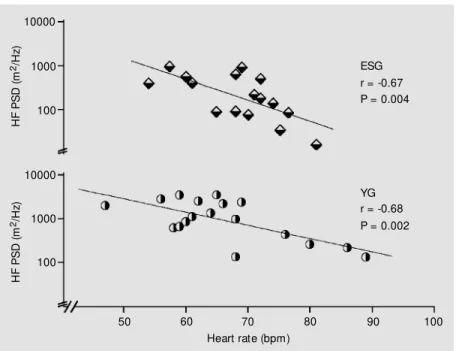
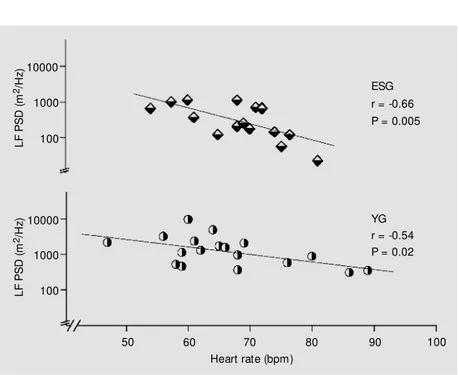
There was a negative exponential corre-lation between the three calculated indices of HRV and HR for both groups. Figures 1-3 show a semi-logarithmic data transforma-tion for a linear regression analysis. The correlation coefficients obtained were statis-tically significant in all cases.
D iscussio n
The aim of our study was to analyze the relative influence of age, sedentary life style
and HR on HRV, measured with a short-term procedure.
Influe nce o f he art rate
The HRV values depend on R-R interval duration. The shorter the interval, the smaller the range of variability that can be measured (30). This agrees with the widespread obser-vation that an increase in sympathetic drive, which reduces the duration of R-R intervals, also reduces HRV. Conversely, the reduc-tion of HR by an increase of parasympa-thetic activity leads to an increase of the duration of R-R intervals and an enhance-ment of HRV. Accordingly, we showed a negative correlation between rMSSD and HR within each group (Figure 1).
It should be pointed out that YG, whose mean HR was similar to that of ESG, showed higher mean rMSSD values (Table 1). Such observation indicates that HR influence should be considered together with other
Table 1 - M ean values of age, HR and HRV indices (rM SSD, HF and LF) for YG and ESG.
Values are reported as mean ± SD. All values but HR differed significantly betw een groups (see P values). n.s., Not significant. HR, Heart rate; HRV, heart rate variability; rM SSD, square root of the mean of the sum of squares of successive differences betw een adjacent normal-to-normal intervals; HF, high frequency band; LF, low frequency band; YG, young group; ESG, elderly sedentary group.
Age (years) HR (bpm) rM SSD (ms) HF (ms2/Hz) LF (ms2/Hz)
YG (N = 18) 17.3 ± 1.7 66.1 ± 10.8 60.9 ± 31.0 1418.0 ± 1143.0 1891.5 ± 2224.7
ESG (N = 16) 54.2 ± 11.9 68.3 ± 7.3 30.1 ± 14.4 334.7 ± 311.2 467.1 ± 390.0
P value <0.0001 n.s. 0.0018 0.0009 0.0018
Table 2 - M ean values of age, HR, achieved w orkload and HRV indices (rM SSD, HF and LF) for sedentary (YG-S) and nonsedentary (YG-N(YG-S) subjects of the young group (YG).
Values are reported as mean ± SD (N = 9). The only parameter that show ed a statistically significant difference w as the achieved w orkload (see text for discussion). For abbreviations, see legend to Table 1.
Age HR Workload rM SSD HF LF
(years) (bpm) (w atts) (ms) (ms2/Hz) (ms2/Hz)
YG-NS 17.3 ± 1.7 65.1 ± 13.2 1266.7 ± 250.0 49.9 ± 29.0 1122.7 ± 1047.5 1031.7 ± 807.7
YG-S 17.2 ± 1.8 66.9 ± 30.4 866.7 ± 235.0 66.4 ± 28.8 1713.8 ± 1217.4 2587.3 ± 2930.1
HRV determinants such as age (see below). Physiological increases of HR are related to a rise in sympathetic drive with the con-comitant reduction of the parasympathetic one. In the frequency-domain analysis of HRV, there is general agreement that the HF band reflects parasympathetic activity, whereas the LF band has been related to sympathetic drive (28). However, the asso-ciation between sympathetic activity and LF band is not as clear as in the case of HF and the parasympathetic drive (31).
In our study, the negative relationship be-tween HR and the HF band found in both groups (Figure 2) agreed with a reduction of parasympathetic drive with increasing HR. On the other hand, HR increases when sympa-thetic tone is higher, and therefore we can expect a positive relationship between HR and LF. The negative relationship between LF and HR observed here (Figure 3) may reflect the previously mentioned contribution of the para-sympathetic branch to this band.
Tsuji and co-workers (24) showed a nega-tive correlation between HRV and HR in 2-h ECG recordings. Our s2-hort-term analysis supports the same relationship within each group.
Influe nce o f age
Age was pointed out as one of the most important determinants of HRV in the above mentioned longer study (24). In our short-term HRV analysis, the group of older people (ESG) had reduced HRV when compared with the young group (YG) (Table 1). Aging of the autonomic nervous system, specifical-ly of its parasympathetic branch (32), could explain this observation, showing that the evaluation of age is essential when consider-ing HRV for clinical or research purposes.
Effe ct o f se de ntary life style
The effects of maintained physical activ-ity have been related to an increase in
para-Figure 2 - Fitted regression line of natural log transformation of the pow er spectrum density (PSD) of the HF band (in ms2/Hz) as a function of resting heart rate (bpm) for ESG (N = 16) and YG (N = 18). For abbreviations, see legend to Table 1.
Figure 1 - Fitted regression line of natural log transformation of rM SSD (in ms) as a function of resting heart rate (bpm) for ESG (N = 16) and YG (N = 18). For abbreviations, see legend to Table 1.
H
F
P
S
D
(
m
2/H
z)
10000
100
50 60 70 80 90
Heart rate (bpm)
ESG r = -0.67 P = 0.004
YG r = -0.68 P = 0.002 1000
100
10000
1000
100
H
F
P
S
D
(
m
2/H
z)
rM
S
S
D
(
m
s
)
100
100 10
100
10
rM
S
S
D
(
m
s
)
50 60 70 80 90
Heart rate (bpm)
ESG r = -0.55 P = 0.03
sympathetic response with a concomitant reduction in sympathetic outflow (33). As expression of such adaptations, nonseden-tary individuals are supposed to have lower HR (34) and blood pressure at rest (35). As mentioned earlier, since parasympathetic activity increases HRV we could expect re-duced HRV in sedentary people (36,37). However, the influence of programmed ex-ercise on HRV is an open issue (20). Some reports show differences in HRV between trained and nontrained groups (9,36,38), whereas others do not show such differences (35,39) or describe more complex results (40,41).
In the present study we recruited a group of young people including sedentary (YG-S) and nonsedentary (YG-NS) individuals. We
could expect a lower HR in the YG-NS than in the YG-S. However, it should be pointed out that the simple measurement of HR is a labile parameter when measured in wakeful conditions. HR can be altered by the influ-ence of the quality and duration of previous rest (42) and also by anxiety (14) or other psychological influences. To avoid these in-fluences, for comparative purposes some authors considered HR during sleep even in athletes (18). Taking into account these con-siderations, we prefer to assess the differ-ences in sedentary life styles by means of a bicycle effort test.
Our results confirmed the validity of this reasoning since YG-NS and YG-S are clearly differentiated by the stress test (YG-S had less tolerance to effort). However, they have similar HR and HRV.
We may conclude that in our short-term analysis, age and HR are the most powerful determinants of HRV. The same conclusion was reached by other authors (24) using longer recording periods. Among individu-als with similar HR, HRV depends mainly on age. Conversely, for similar age, HR be-comes the variable for differentiation. In such case physical activity does not seem to affect HRV.
On the basis of our results, HRV should not be referred to as an index without considering age or HR.
Ackno wle dgm e nts
The authors are grateful to the Centro de Cardiología Prof. Dighiero and to B.M. Esther Comas for the execution of the stress tests. We also thank Adriana Migliaro for technical assistance with the preparation of the manuscript.
L
F
P
S
D
(
m
2/H z)10000
100
50 60 70 80 90
Heart rate (bpm)
ESG r = -0.66 P = 0.005
YG r = -0.54 P = 0.02 1000
100
10000
1000
100
L
F
P
S
D
(
m
2/H
z)
Re fe re nce s
1. Pagani M , Lom bardi F, Giuzzet t i S, Rimoldi O, Furlan R, Pizzinelli P, Turiel M , Baselli G, Cerutti S & M alliani A (1986). Pow er spectral analysis of heart rate and arterial pressure variabilities as a marker of sympatho-vagal interaction in man and conscious dog. Circulation Research, 59: 178-193.
2. Hedman A, Hartikainen J & Hakumaki M (1998). Physiological background underly-ing short-term heart rate variability. An-nals of Noninvasive Electrocardiology, 3: 267-280.
3. M alpas SC & M aling TJ (1990). Heart rate variability and cardiac autonomic function in diabetes. Diabetes, 39: 1177-1181. 4. Thomaseth K, Cobelli C, Bellavere F,
Balzani I, De M asi G, Bax G & Carenza P (1990). Heart rate spectral analysis for as-sessing autonomic regulation in diabetic patients. Journal of the Autonomic Ner-vous System, 30: S169-S172.
5. Odemuyina O, M alik M , Farrell T, Bashir Y, Poloniecki J & Camm J (1991). Com-parison of the predictive characteristics of HRV index and left ventricular ejection fraction for all cause mortality, arrhythmic events and sudden death after acute myo-cardial infarction. American Journal of Car-diology, 68: 434-439.
6. Bigger JT, Kleiger RE, Fleiss JL, Rolnitzky LM , Steinman RC, M iller JP & M ulticen-ter Post-Infarction Research Group (1988). Components of heart rate variability meas-ured during healing of acute myocardial infarction. American Journal of Cardiol-ogy, 61: 208-215.
7. Stein PK, Rich M W, Rottman JN & Kleiger RE (1995). Stability of index of heart rate variability in patients w ith congestive heart failure. American Heart Journal, 129: 975-981.
8. Woo M A, Stevenson WG, M oser DK, Trelease RB & Harper RM (1992). Pat-terns of beat-to-beat heart rate variability in advanced heart failure. American Heart Journal, 123: 704-710.
9. Pagani M , Lucini D, Rimoldi O, Furlan R, Piazza S & Biancardi L (1995). Effects of physical and mental exercise on heart rate variability. In: M alik M & Camm AJ (Edi-tors), Heart Rate Variability. Armonk, New York.
10. Yeragani VK, Sobolew ski E, Kay J, Jampala VC & Igel G (1997). Effect of age on long-term heart rate variability. Cardio-vascular Research, 35: 35-42.
11. M cCraty R, Atkinson M , Tiller WA, Rein G & Watkins AD (1995). The effects of
emo-tions on short term pow er spectrum anal-ysis of heart rate variability. American Journal of Cardiology, 76: 1089-1093. 12. Huikuri HV, Kessler KM , Terracall E,
Castellanos A, Linnaluoto M K & M yeburg J (1990). Reproducibility and circadian rhythm of heart rate variability in healthy subjects. American Journal of Cardiology, 65: 391-393.
13. M alik M , Farrell T & Camm AJ (1990). Circadian rhythm of heart rate variability after acute myocardial infarction and its influence on the prognostic value of heart rate variability. American Journal of Cardi-ology, 66: 1049-1054.
14. Kaw achi I, Sparrow D, Vokonas PS & Weiss ST (1995). Decreased heart rate variability in men w ith phobic anxiety (data from the Normative Aging Study). Ameri-can Journal of Cardiology, 75: 882-885. 15. Tuininga YS, Crijns HJ, Brouw er J, van
den Berg M P, M an in’t Veld AJ, M ulder G & Lie KI (1995). Evaluation of importance of central effects of atenolol and meto-prolol measured by heart rate variability during mental performance tasks, physi-cal exercise, and daily lif e in st able postinfarct patients. Circulation, 92: 3415-3423.
16. Sakakibara M , Takeuchi S & Hayano J (1994). Effect of relaxation training on car-diac parasympathetic tone. Psychophysi-ology, 31: 223-228.
17. Lucini D, Covacci G, M ilani R, M ela GS, M alliani A & Pagani M (1997). A controlled study of the effects of mental relaxation on autonomic excitatory responses in healthy subjects. Psychosomatic M edi-cine, 59: 541-552.
18. Peng C-K, M ietus JE, Liu Y, Khalsa G, Douglas PS, Benson H & Goldberger AL (1999). Exaggerated heart rate oscillations during tw o meditation techniques. Inter-national Journal of Cardiology, 70: 101-107.
19. M olgaard H, Sorensen KE & Bjerregaard P (1991). Circadian variation and influence of risk factors on heart rate variability in healthy subjects. American Journal of Car-diology, 68: 777-784.
20. Tulppo M P, M akikallio TH, Seppanen T, Laukkanen RT & Huikuri HV (1998). Vagal modulation of heart rate during exercise: effects of age on physical fitness. Ameri-can Journal of Physiology, 274: H424-H429.
21. Furlan R, Guzzetti S, Crivellaro W, Dassi S, Tinelli M , Baselli G, Cerutti S, Lombardi F, Pagani M & M alliani A (1990).
Continu-ous 24-hour assessment of the neural regulation of systemic arterial pressure and RR variabilities in ambulant subjects. Circulation, 81: 537-547.
22. Kleiger RE, M iller JP, Bigger Jr JT, M oss J & M ulticenter Post-Infarction Research Group (1987). Decreased heart rate vari-ability and its association w ith increased mortality after acute myocardial infarction. American Journal of Cardiology, 59: 256-262.
23. Lucreziotti S, Gavazzi A, Inserra C, Klersy C, Campana C, Ghio S, Vanoli E & Tavazzi L (2000). Five-minute recording of heart rate variability in severe chronic failure: Correlates w ith right ventricular function and prognostic implications. American Heart Journal, 139: 1088-1095.
24. Tsuji H, Venditti FJ, M anders ES, Evans JC, Larson M G, Feldman CL & Levy D (1996). Determinants of heart rate vari-ability. Journal of the American College of Cardiology, 28: 1539-1546.
25. Coro F, M achado A, Ricca R, Vicente K, Nuñez H & M igliaro ER (1993). Programa de análisis de la variabilidad de la frecuen-cia cardíaca. XI Congreso Uruguayo de Cardiología, M ontevideo, Uruguay, De-cember 9-11, 1993, 14 (Abstract). 26. M igliaro ER, Vicente K & Soto E (1996).
M ét odo breve para el est udio de la variabilidad de la frecuencia cardíaca. Comparación con estudios de 24 h. Re-vista Uruguaya de Cardiología, 11: 74-83. 27. M achado A, M igliaro ER, Contreras P & Coro F (2000). Digital filter for heart rate variability analysis. Annals of Noninvasive Electrocardiology, 5: 255-261.
28. Task Force of the European Society of Cardiology and the North American Soci-ety of Pacing and Electrophysiology (1996). Heart rate variability. Standards of meas-urement, physiological interpretation, and clinical use. Circulation, 93: 1043-1065. 29. von Neumann J, Kent RH, Bellinson RH &
Hart BI (1941). The mean square succes-sive difference. Annals of M athematics and Statistics, 12: 153-162.
30. M alik M , Farrell T, Cripps T & Camm AJ (1989). Heart rate variability in relation to prognosis after myocardial infarction: se-lection of optimal processing techniques. European Heart Journal, 10: 1060-1074. 31. Karemaker JM (1999). Autonomic
integra-tion: the physiological basis of cardiovas-cular variability. Journal of Physiology, 517: 316.
on cardiac autonomic and postganglionic sudomotor function. M uscle and Nerve, 13: 152-157.
33. Fletcher GF, Balady G, Froelicher VF, Hartley LH, Haskell WL & Pollock M L (1995). Exercise standards. Circulation, 91: 580-613.
34. Chacon-M ikahil M PT, Forti VAM , Catai AM , Szrajer JS, Golfetti R, M artins LEB, Lima-Filho EC, Wanderley JS, M arin-Neto JA, M aciel BC & Gallo-Jr L (1998). Cardio-respiratory adaptations induced by aero-bic training in middle-aged men: the im-portance of a decrease in sympathetic stimulation for the contribution of dynam-ic exercise tachycardia. Brazilian Journal of M edical and Biological Research, 31: 705-712.
35. Davy KP, Willis WL & Seals DR (1997).
Influence of exercise training on heart rate variability in post-menopausal w omen w ith elevated arterial blood pressure. Clinical Physiology, 17: 31-40.
36. Yataco AR, Fleisher LA & Katzel LI (1997). Heart rate variability and cardiovascular fitness in senior athletes. American Jour-nal of Cardiology, 80: 1389-1391. 37. Gregoire J, Tuck S, Yam am ot o Y &
Hughson RL (1996). Heart rate variability at rest and exercise: influence of age, gender, and physical training. Canadian Journal of Applied Physiology, 21: 455-470.
38. De M eersman RE (1993). Heart rate vari-ability and aerobic fitness. American Heart Journal, 125: 726-731.
39. Lazoglu AH, Glace B, Gleim GW & Coplan NL (1996). Exercise and heart rate
vari-ability. American Heart Journal, 131: 825-826.
40. Furlan R, Piazza S, Dell’Orto S, Gentile E, Cerutti S, Pagani M & M alliani A (1993). Early and late effects of exercise and ath-letic training on neural mechanisms con-trolling heart rate. Cardiovascular Re-search, 27: 482-488.
41. Sacknoff DM , Gleim GW, Stachenfeld N & Coplan NL (1994). Effect of athletic training on heart rate variability. American Heart Journal, 127: 1275-1278.