www.bjournal.com.br
Volume 44 (9) 814-965 September 2011
Braz J Med Biol Res, September 2011, Volume 44(9) 933-938
doi: 10.1590/S0100-879X2011007500103
Hypertensive effects of the iv administration of picomoles of
ouabain
A.S. Padilha, M. Salaices, D.V. Vassallo, P.R. Batista and F.D.M. Siman
Institutional Sponsors
The Brazilian Journal of Medical and Biological Research is partially financed by
All the contents of this journal, except where otherwise noted, is licensed under a Creative Commons Attribution License
Faculdade de Medicina de Ribeirão Preto Campus
Ribeirão Preto
Ex plor e H igh - Pe r for m a n ce M S Or bit r a p Te ch n ology I n Pr ot e om ics & M e t a bolom ics
Hypertensive effects of the
iv
administration
of picomoles of ouabain
A.S. Padilha
1, M. Salaices
2, D.V. Vassallo
1,3, P.R. Batista
1and F.D.M. Siman
11Departamento de Ciências Fisiológicas, Universidade Federal do Espírito Santo, Vitória, ES, Brasil 2Departamento de Farmacología y Terapéutica, Facultad de Medicina, Universidad Autónoma Madrid, MD, Spain
3Departamento de Ciências Fisiológicas, Escola Superior de Ciências da Santa Casa de Misericórdia de Vitória,
Vitória, ES, Brasil
Abstract
Ouabain, an endogenous digitalis compound, has been detected in nanomolar concentrations in the plasma of several mam-mals and is associated with the development of hypertension. In addition, plasma ouabain is increased in several hypertension models, and the acute or chronic administration of ouabain increases blood pressure in rodents. These results suggest a possible association between ouabain and the genesis or development and maintenance of arterial hypertension. One explanation for
this association is that ouabain binds to the α-subunit of the Na+ pump, inhibiting its activity. Inhibition of this pump increases
intracellular Na+, which reduces the activity of the sarcolemmal Na+/Ca2+ exchanger and thereby reduces Ca2+ extrusion.
Consequently, intracellular Ca2+ increases and is taken up by the sarcoplasmic reticulum, which, upon activation, releases
more calcium and increases the vascular smooth muscle tone. In fact, acute treatment with ouabain enhances the vascular reactivity to vasopressor agents, increases the release of norepinephrine from the perivascular adrenergic nerve endings and promotes increases in the activity of endothelial angiotensin-converting enzyme and the local synthesis of angiotensin II in the tail vascular bed. Additionally, the hypertension induced by ouabain has been associated with central mechanisms that increase sympathetic tone, subsequent to the activation of the cerebral renin-angiotensin system. Thus, the association with peripheral mechanisms and central mechanisms, mainly involving the renin-angiotensin system, may contribute to the acute effects of ouabain-induced elevation of arterial blood pressure.
Key words: Ouabain; Hypertension; Vascular reactivity; Renin-angiotensin system
Introduction
Correspondence: A.S. Padilha, Departamento de Ciências Fisiológicas, CBM/UFES, Av. Marechal Campos, 1468, 29040-091 Vitória, ES, Brasil. Fax: +55-27-335-7330. E-mail: [email protected]
Presented at the XV Simpósio Brasileiro de Fisiologia Cardiovascular, São Paulo, SP, Brazil, February 2-5, 2011.
Received February 22, 2011. Accepted July 20, 2011. Available online August 19, 2011. Published September 16, 2011.
Endogenous cardiac glycoside increases to nanomolar concentrations in the plasma of hypertensive humans and rats (1,2); in patients with diabetes (3), myocardial infarction (4), congestive heart failure (5) and other diseases, and after acute physical exercise (6). This substance was characterized as ouabain or as an isomer of ouabain (7) and is produced in the central nervous system (8,9), the adrenal cortex (10), and the heart (11). Acute administration of ouabain promotes a positive inotropic effect (12) and increases blood pressure and the contraction of vascular smooth muscle (13,14). These
findings suggest that ouabain increases vascular resistance
and induces hypertension (Figure 1).
In addition to its hypertensive effects, endogenous
oua-bain also modifies cardiac function and modulates cellular
proliferation and differentiation in the heart (15) and vascular smooth muscle (16).
The primary site of ouabain action is generally assumed
to be the α-subunit of Na+,K+-ATPase, which is a heterotrimer composed of α-, β- and γ-subunits which exist as isoforms
(17,18). Ouabain inhibits Na+,K+-ATPase by binding mainly
to the α2 and α3 isoforms of the α-subunit of the enzyme in
rodents (13,19). This inhibition increases the Na+ concentration
in the cytoplasm, which reduces the activity of the Na+/Ca2+
exchanger (NCX) and consequently increases the amount of Ca2+ available to activate contraction in tissues such as the heart, producing a positive inotropic effect (19,20).However, low concentrations of ouabain stimulate Ca2+ transients in
arterial smooth muscle without raising cytosolic (Na+) (21). This
apparent contradiction can be explained by the co-localization
of the α2 and α3 isoforms of Na+,K+-ATPase and the NCX,
which increases Na+ concentration only at the plasmerosome
con-934 A.S. Padilha et al.
centration in the plasmerosome region might reduce the activity of the NCX. As a result, intracellular calcium concentration increases, as do vascular tone and blood pressure (19,21). This suggests that ouabain acts as a pressor agent.
Xie and Cai (22) propose that low doses of ouabain, which
are insufficient to inhibit Na+,K+-ATPase activity, could bind
the caveolar Na+,K+-ATPase and activate some protein and
lipid kinase cascades, thus generating several secondary messengers that, in turn, might modify cellular function. Thus, ouabain may modulate cellular proliferation and differentiation in the heart (15) and vascular smooth muscle (16), which could contribute to the maintenance of hypertension.
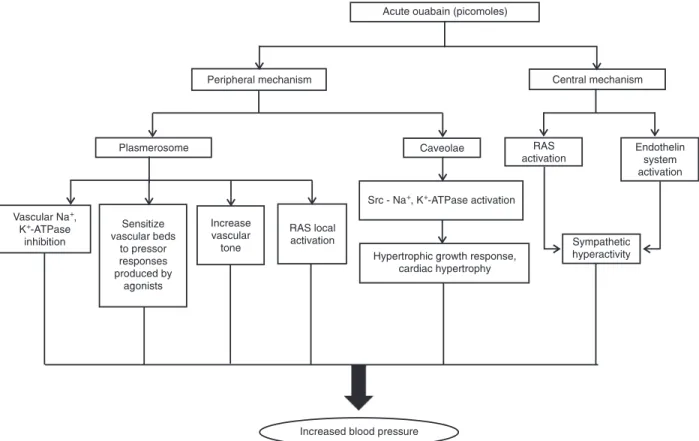
Ouabain might increase blood pressure via different mechanisms on different tissues and systems. In this review, we shall focus on the acute effects of ouabain on vascular reactivity and the central nervous system, mechanisms which might contribute to the development of hypertension.
Acute effects of picomole quantities of
ouabain on vascular reactivity
In normal human volunteers (23) and rats (14,24), short-term iv administration of ouabain in the range of 10-30 nmol/ kg produces a pressor response that is peripheral in origin.
In addition, an iv subpressor dose of ouabain, 0.1 mg/m2, enhances the ability of a single dose of norepinephrine to increase mean arterial pressure (25).Indeed, low doses of ouabain (6 and 18 µg/kg, which correspond to approximately 10 and 30 nmol/kg) increase the vasoconstrictor response to phenylephrine (24).
In the reflex-blocked anesthetized rat, ouabain increases
diastolic pressure by phentolamine-sensitive and -insensitive mechanisms (26,27). At the doses used, ouabain induced increases in diastolic pressure but did not alter the dose-response curve for phenylephrine or the responsiveness to
submaximal doses of norepinephrine. Because reflexes were
blocked, the authors concluded that the short-term pressor effects of ouabain are not related to its direct central nervous system actions. Moreover, the authors suggested that the pressor actions of ouabain are mediated by norepinephrine released from sympathetic nerves as well as by a direct action on vascular smooth muscle cells. Presumably, both actions are due to the inhibition of Na+,K+-ATPase. Thus, the role of
endogenous ouabain in hypertension would also include the
amplification of contractile responses.
In some rat models of hypertension, including the SHR model (28), renovascular hypertension and L-NAME-induced hypertension (29), acute ouabain administration
increases blood pressure, whereas no change in blood pressure is observed in normotensive rats (14,30,31). These
results suggest that the effects of ouabain are amplified in
hypertensive conditions. We recently demonstrated in SHR that low picomole doses of ouabain (iv) increases systolic and diastolic blood pressure by a mechanism that seems to depend on activation of the renin-angiotensin system (31). However, because the effect of ouabain on diastolic blood pressure was not blocked by canrenone (1 mg/kg), we suggest that ouabain may have a mechanism of action that is independent of Na+ pump inhibition.
Ouabain and a series of structurally related analogs have hypertensinogenic activity, regardless of their potency as Na+ pump inhibitors (32). In addition, Ward et al. (33)
suggested that adrenocortical cells express ouabain recep-tors that are distinct from the Na+ pumps. These findings could explain why the pressor effect of ouabain on diastolic blood pressure seems not to depend on its effect on the Na+ pump.
In the past few years, it has become apparent that bind-ing of either endogenous or exogenous cardiotonic steroids, such as ouabain, to caveolar Na+,K+-ATPase evokes protein
and lipid kinase cascades, thus generating several sec-ondary messengers (22). This signaling pathway involves the association of protein tyrosine kinases (Src) with the Na+,K+-ATPase in a caveolar domain (34). Therefore, once the Na+,K+-ATPase/Src complex is activated by ouabain,
Src is activated, initiating a cascade of signaling events. As a result, downstream effectors are activated, resulting in the activation of protein kinase cascades and the generation of second messengers. This leads to a cascade that involves the generation of reactive oxygen species (ROS), activa-tion of extracellular signal-regulated protein kinase (ERK) through activation of its mitogen-activated protein kinase (MEK), activation of phosphatidylinositol 3-kinase (PI3K), stimulation of endocytosis and activation of Akt, as well as activation of protein kinase C (22,34,35). This binding of ouabain to Na+,K+-ATPase affects multiple cellular func-tions, thereby influencing cell growth, heart hypertrophy
and apoptosis (22).
Ouabain can act directly on the vasculature to increase vascular resistance or to sensitize vascular beds to pressor responses produced by norepinephrine, angiotensin II, and phenylephrine (28,36-40). In vitro, picomole doses of oua-bain enhance caffeine-induced contractures and increase the ability of phenylephrine to potentiate caffeine-induced contractions of rat isolated vascular preparations (41). These observations support the hypothesis that picomole quantities of ouabain should selectively interact with the
high-affinity α2 and α3 isoforms of Na+,K+-ATPase to
en-hance the actions of vasoconstrictor agents.
Endothelium-derived factors might positively or nega-tively modulate the vascular actions of ouabain. Thus, the endothelium modulates the actions of picomole quantities of acutely administered ouabain in vascular preparations
from normotensive and hypertensive rats (28,29,40). In the tail vascular bed from normotensive Wistar rats, Rossoni et al. (40) demonstrated that the acute perfusion of ouabain (10 nM) induces the release of a potassium channel opener and that the effects of ouabain are par-tially modulated by the endothelium. On the other hand, in cultured rat aortic endothelial cells, ouabain (10 nM) contributes to the bradykinin-stimulated increase of nitric oxide (NO) production by inhibiting plasma membrane Na+,K+-ATPase activity and increasing intracellular Na+
concentration (42). Moreover, Eva et al. (43) demonstrated that small quantities of ouabain stimulate NO production in human umbilical artery endothelial cells via PI3K. The binding of ouabain to Na+,K+-ATPase initiates a signal via
PI3K, which turns on the proliferation and survival pathways that involve Akt and that stimulate endogenous nitric oxide synthase (eNOS) and NO production (43). Because NO is an endothelial factor that activates Na+,K+-ATPase (44),
we speculated that picomole quantities of ouabain could release NO, which, in turn, could stimulate Na+,K+-ATPase
activity, reducing vascular reactivity in normotensive rats. In L-NAME-hypertensive rats, the acute administration of ouabain (10 nM) induces the release of endothelium-derived hyperpolarizing factor in the tail vascular bed (29). This and other results support the notion that the endothelium might modulate the action of acute and chronic ouabain administration (28,29,40,45).
936 A.S. Padilha et al.
observations indicate that in SHR, ouabain activates the local renin-angiotensin system, which induces increases in vascular resistance and blood pressure. The classical effect of ouabain is the inhibition of Na+,K+-ATPase activity by binding mainly to the α2 and α3 isoforms of the α-subunit
of the enzyme in rodents (13,19). Indeed, we demonstrated that in SHR, 1 nM ouabain activates rather than inhibits Na+,K+-ATPase activity in vascular smooth muscle (28),
an observation similar to that described by Gao et al. (48) in cardiac myocytes. However, the angiotensin II released by the action of ouabain may also be able to stimulate Na+,K+-ATPase activity (49).
Although the peripheral actions of ouabain could contrib-ute to increased blood pressure, the central mechanisms, already well established, are also important mediators of increased pressure induced by this digitalis. Therefore, the central mechanism of ouabain is described below.
Acute effects of ouabain on the central
nervous system
The effects of ouabain on the central nervous system
have been well established. Neurons express the α3 isoform
of Na+/K+-ATPase, the most ouabain-sensitive isoform of the α-subunits, and therefore neurons are very sensitive
to the effects of this substance.
Indeed, the acute administration of ouabain in some regions of the central nervous system, such as the me-dian preoptic nucleus (50), paraventricular nucleus (51) or rostral ventrolateral medulla (52), causes dose-dependent increases in sympathetic nerve activity, blood pressure and
heart rate. Therefore, these findings suggest that endog -enous ouabain might be a regulator of sympathetic tone
and arterial blood pressure by influencing some areas of
cardiovascular pressor control. This hypothesis seems to
be confirmed by reports that the sympathoexcitatory and
pressor effects induced by ouabain can be reversed and prevented by the intracerebroventricular administration of antibody Fab fragments, which bind ouabain, blocking its actions (9,53). The sympathetic hyperactivity induced by ouabain and the consequent increase in blood pressure appear to involve the central renin-angiotensin system. This observation is supported by reports that the sympa-thetic hyperactivity induced by ouabain is prevented by an AT1 receptor blocker (50-52), suggesting that the central renin-angiotensin system could be the sympathoexcitatory component involved in the hypertensinogenic effect of ouabain. In addition, the acute hypertensinogenic effect of
ouabain is attenuated in transgenic rats that are deficient
in brain angiotensinogen (54). Therefore, in some diseases that are accompanied by an increased level of endogenous ouabain, such as hypertension (1), heart failure (55) and diabetes (35), the increase in sympathoexcitatory activity could be due to the actions of ouabain on the central renin-angiotensin system. In addition to the sympathoexcitatory
activity induced by ouabain via the central renin-angiotensin-aldosterone pathway, D’Amico at al. (56) demonstrated that the central endothelin system (periaqueductal gray area) of rats is also involved in this sympathetic activation and in the ouabain-induced hemodynamic effects.
Ouabain release in the brain is very sensitive to sodium loading (9). This position is supported by the observation that the effects of sodium loading can be mimicked by intra-hippocampal microinjection of ouabain (57). Indeed, acute intrahippocampal administration of an extremely low dose of ouabain (60 pg) in Dahl salt-sensitive rats (DSS) is as-sociated with activation of the renin-angiotensin-aldosterone system in the hypothalamus and adrenal cortex, an increase in the adrenocortical level of marinobufagenin, inhibition of sodium pumps in the vasculature and kidney, and pressor and natriuretic responses (57). Moreover, the central admin-istration of NaCl or NaCl loading in DSS or SHR rats induces increases in brain endogenous ouabain that, in turn, induce sympathoactivation and increase blood pressure (9,53). However, the evidence regarding the relationship between NaCl loading and increased ouabain level is contradictory. Manunta et al. (58) demonstrated in healthy humans that NaCl depletion produced an elevation in the plasma concentration of endogenous ouabain, but in the same study, 3 days of NaCl loading (171 mEq NaCl/day) caused a transient eleva-tion in the plasma concentraeleva-tion of endogenous ouabain. In another report (59), acute NaCl loading in DSS and Dahl salt-resistant (DR) rats caused a transient increase in an ouabain-like compound in the pituitary gland, adrenal gland, and plasma, followed by a decrease to baseline. Therefore, it seems that the plasma level of endogenous ouabain may not be a good indicator of volume expansion because it displays transient response.
General considerations
Endogenous ouabain was discovered in humans 20 years ago, and its effects on sodium pumps have been
widely explored, although much remains to be clarified. In
general, endogenous ouabain participates in the control of blood pressure and sodium balance (1), but it also
modi-fies cardiac function and modulates cellular proliferation
and differentiation of the heart (15) and vascular smooth muscle (16).
Acutely, ouabain in picomole quantities increases blood pressure (24,28-31), pressor and vascular reactivity to vasoconstrictor agents (14,24,28-31,40,41), and sympatho-excitatory activity (9,53). These effects of ouabain are due at least in part to activation of the central and peripheral renin-angiotensin system (31,28,50-52).
hypertension (1,2), diabetes (3), myocardial infarction (4), and congestive heart failure (5), the basal plasma level of ouabain is increased. Therefore, acute conditions that elevate ouabain should be evaluated and studied to verify the systemic repercussions.
Acknowledgments
Research supported by CNPq, CAPES, FAPES/ FUNCITEC (#SAF2009 02376) and MCIIN (#SAF2009 02376) and Banco Santader.
1. Hamlyn JM, Hamilton BP, Manunta P. Endogenous ouabain, sodium balance and blood pressure: a review and a hypoth-esis. J Hypertens 1996; 14: 151-167.
2. Pamnani M, Huot S, Buggy J, Clough D, Haddy F. Demon-stration of a humoral inhibitor of the Na+-K+ pump in some
models of experimental hypertension. Hypertension 1981; 3: II-96-II-101.
3. Bagrov YY, Manusova NB, Egorova IA, Fedorova OV, Bagrov AY. Endogenous digitalis-like ligands and Na/K-ATPase inhibition in experimental diabetes mellitus. Front Biosci 2005; 10: 2257-2262.
4. Bagrov AY, Fedorova OV, Maslova MN, Roukoyatkina NI, Ukhanova MV, Zhabko EP. Endogenous plasma Na,K-ATPase inhibitory activity and digoxin like immunoreactivity after acute myocardial infarction. Cardiovasc Res 1991; 25: 371-377.
5. Manunta P, Messaggio E, Casamassima N, Gatti G, Carpini SD, Zagato L, et al. Endogenous ouabain in renal Na(+) handling and related diseases. Biochim Biophys Acta 2010; 1802: 1214-1218.
6. Bauer N, Muller-Ehmsen J, Kramer U, Hambarchian N, Zo-bel C, Schwinger RH, et al. Ouabain-like compound changes rapidly on physical exercise in humans and dogs: effects of beta-blockade and angiotensin-converting enzyme inhibi-tion. Hypertension 2005; 45: 1024-1028.
7. Hamlyn JM, Blaustein MP, Bova S, DuCharme DW, Harris
DW, Mandel F, et al. Identification and characterization of a
ouabain-like compound from human plasma. Proc Natl Acad Sci U S A 1991; 88: 6259-6263.
8. Songu-Mize E, Bealer SL, Caldwell RW. Effect of AV3V le-sions on development of DOCA-salt hypertension and vas-cular Na+-pump activity. Hypertension 1982; 4: 575-580.
9. Huang BS, Leenen FH. Blockade of brain “ouabain” prevents sympathoexcitatory and pressor responses to high sodium in SHR. Am J Physiol 1996; 271: H103-H108.
10. Laredo J, Hamilton BP, Hamlyn JM. Ouabain is secreted by bovine adrenocortical cells. Endocrinology 1994; 135: 794-797.
11. D’Urso G, Frascarelli S, Balzan S, Zucchi R, Montali U. Production of ouabain-like factor in normal and ischemic rat heart. J Cardiovasc Pharmacol 2004; 43: 657-662.
12. Cattell M, Gold H. The influence of digitalis glycosides on
the force of contraction of mammalian cardiac muscle. J Pharmacol Exp Ther 1938; 62: 116-125.
13. Blaustein MP. Physiological effects of endogenous ouabain: control of intracellular Ca2+ stores and cell responsiveness.
Am J Physiol 1993; 264: C1367-C1387.
14. Vassallo DV, Songu-Mize E, Rossoni LV, Amaral SM. Effects of ouabain on vascular reactivity. Braz J Med Biol Res 1997; 30: 545-552.
15. Huang L, Li H, Xie Z. Ouabain-induced hypertrophy in
cul-tured cardiac myocytes is accompanied by changes in ex-pression of several late response genes. J Mol Cell Cardiol 1997; 29: 429-437.
16. Aydemir-Koksoy A, Abramowitz J, Allen JC. Ouabain-induced signaling and vascular smooth muscle cell prolifera-tion. J Biol Chem 2001; 276: 46605-46611.
17. Shull GE, Greeb J, Lingrel JB. Molecular cloning of three distinct forms of the Na+,K+-ATPase alpha-subunit from rat
brain. Biochemistry 1986; 25: 8125-8132.
18. Shamraj OI, Lingrel JB. A putative fourth Na+,K(+)-ATPase
alpha-subunit gene is expressed in testis. Proc Natl Acad Sci U S A 1994; 91: 12952-12956.
19. Blaustein MP, Juhaszova M, Golovina VA. The cellular mechanism of action of cardiotonic steroids: a new hypoth-esis. Clin Exp Hypertens 1998; 20: 691-703.
20. Blaustein MP. Sodium/calcium exchange and the control of contractility in cardiac muscle and vascular smooth muscle. J Cardiovasc Pharmacol 1988; 12 (Suppl 5): S56-S68. 21. Arnon A, Hamlyn JM, Blaustein MP. Ouabain augments
Ca2+ transients in arterial smooth muscle without raising
cytosolic Na+. Am J Physiol Heart Circ Physiol 2000; 279:
H679-H691.
22. Xie Z, Cai T. Na+-K+-ATPase-mediated signal transduction:
from protein interaction to cellular function. Mol Interv 2003; 3: 157-168.
23. Mason DT, Braunwald DE. Studies on digitalis. X. Effects of ouabain on forearm vascular resistance and venous tone in normal subjects and in patients in heart failure. J Clin Invest 1964; 43: 532-543.
24. Barker LA, Rossoni LV, Vassallo DV. Acute pressor actions of ouabain do not enhance the actions of phenylephrine or norepinephrine in anesthetized rats. J Cardiovasc Pharma-col 2001; 37: 339-348.
25. Yamaji I, Kikuchi K, Nishimura M, Nozawa A, Hasegawa T, Kobayakawa H, et al. The role of Na,K-ATPase inhibitor on pressor responsiveness in patients with benign essential hypertension. Am J Hypertens 1990; 3: 176-181.
26. Caldwell RW, Songu-Mize E, Bealer SL. The vasopressor response to centrally administered ouabain. Circ Res 1984; 55: 773-779.
27. Veerasingham SJ, Leenen FH. Ouabain- and central sodium-induced hypertension depend on the ventral an-teroventral third ventricle region. Am J Physiol 1999; 276: H63-H70.
28. Padilha AS, Rossoni LV, Xavier FE, Vassallo DV. Ouabain at nanomolar concentration promotes synthesis and release of angiotensin II from the endothelium of the tail vascular bed of spontaneously hypertensive rats. J Cardiovasc Pharmacol 2004; 44: 372-380.
29. Rossoni LV, dos Santos L, Barker LA, Vassallo DV. Ouabain changes arterial blood pressure and vascular reactivity to
938 A.S. Padilha et al.
phenylephrine in L-NAME-induced hypertension. J Cardio-vasc Pharmacol 2003; 41: 105-116.
30. Rossoni LV, Pinto VD, Vassallo DV. Effects of small doses of ouabain on the arterial blood pressure of anesthetized hypertensive and normotensive rats. Braz J Med Biol Res 2001; 34: 1065-1077.
31. Siman FD, Stefanon I, Vassallo DV, Padilha AS. A low con-centration of ouabain (0.18 microg/kg) enhances hyperten-sion in spontaneously hypertensive rats by inhibiting the Na+
pump and activating the renin-angiotensin system. Braz J Med Biol Res 2010; 43: 767-776.
32. Manunta P, Hamilton BP, Hamlyn JM. Structure-activity relationships for the hypertensinogenic activity of ouabain: role of the sugar and lactone ring. Hypertension 2001; 37: 472-477.
33. Ward SC, Hamilton BP, Hamlyn JM. Novel receptors for ouabain: studies in adrenocortical cells and membranes. Hypertension 2002; 39: 536-542.
34. Wang H, Haas M, Liang M, Cai T, Tian J, Li S, et al. Ouabain assembles signaling cascades through the caveolar Na+/
K+-ATPase. J Biol Chem 2004; 279: 17250-17259.
35. Bagrov AY, Shapiro JI, Fedorova OV. Endogenous cardioton-ic steroids: physiology, pharmacology, and novel therapeutcardioton-ic targets. Pharmacol Rev 2009; 61: 9-38.
36. Marin J, Sanchez-Ferrer CF, Salaices M. Effects of oua-bain on isolated cerebral and femoral arteries of the cat: a functional and biochemical study. Br J Pharmacol 1988; 93: 43-52.
37. Sanchez-Ferrer CF, Fernandez-Alfonso MS, Ponte A, Casado MA, Gonzalez R, Rodriguez-Manas L, et al. En-dothelial modulation of the ouabain-induced contraction in human placental vessels. Circ Res 1992; 71: 943-950. 38. Songu-Mize E, Vassallo DV, Rashed SM, Varner KJ.
Oua-bain amplifies contractile responses to phenylephrine in rat
tail arteries in hypertension. J Basic Clin Physiol Pharmacol 1995; 6: 309-319.
39. Ponte A, Sanchez-Ferrer CF, Hernandez C, Alonso MJ, Marin J. Effect of ageing and hypertension on endothe-lial modulation of ouabain-induced contraction and sodium pump activity in the rat aorta. J Hypertens 1996; 14: 705-712.
40. Rossoni LV, Cunha V, Franca A, Vassallo DV. The influence
of nanomolar ouabain on vascular pressor responses is modulated by the endothelium. J Cardiovasc Pharmacol 1999; 34: 887-892.
41. Weiss DN, Podberesky DJ, Heidrich J, Blaustein MP. Nano-molar ouabain augments caffeine-evoked contractions in rat arteries. Am J Physiol 1993; 265: C1443-C1448.
42. Dong XH, Komiyama Y, Nishimura N, Masuda M, Takahashi H. Nanomolar level of ouabain increases intracellular cal-cium to produce nitric oxide in rat aortic endothelial cells. Clin Exp Pharmacol Physiol 2004; 31: 276-283.
43. Eva A, Kirch U, Scheiner-Bobis G. Signaling pathways involving the sodium pump stimulate NO production in endothelial cells. Biochim Biophys Acta 2006; 1758: 1809-1814.
44. Gupta S, Phipps K, Ruderman NB. Differential stimulation of
Na+ pump activity by insulin and nitric oxide in rabbit aorta.
Am J Physiol 1996; 270: H1287-H1293.
45. Rossoni LV, Salaices M, Miguel M, Briones AM, Barker LA, Vassallo DV, et al. Ouabain-induced hypertension is accom-panied by increases in endothelial vasodilator factors. Am J Physiol Heart Circ Physiol 2002; 283: H2110-H2118. 46. Tamura M, Piston DW, Tani M, Naruse M, Landon EJ,
Ina-gami T. Ouabain increases aldosterone release from bovine adrenal glomerulosa cells: role of renin-angiotensin system. Am J Physiol 1996; 270: E27-E35.
47. Huang BS, Leenen FH. Brain renin-angiotensin system and ouabain-induced sympathetic hyperactivity and hyperten-sion in Wistar rats. Hypertenhyperten-sion 1999; 34: 107-112. 48. Gao J, Wymore RS, Wang Y, Gaudette GR, Krukenkamp IB,
Cohen IS, et al. Isoform-specific stimulation of cardiac Na/K
pumps by nanomolar concentrations of glycosides. J Gen Physiol 2002; 119: 297-312.
49. Simon G. Stimulation of vascular Na-K pump with subpres-sor angiotensin II in rats. Proc Soc Exp Biol Med 1992; 199: 424-431.
50. Budzikowski AS, Leenen FH. Brain ‘ouabain’ in the median preoptic nucleus mediates sodium-sensitive hypertension in spontaneously hypertensive rats. Hypertension 1997; 29: 599-605.
51. Gabor A, Leenen FH. Mechanisms in the PVN mediating local and central sodium-induced hypertension in Wistar rats. Am J Physiol Regul Integr Comp Physiol 2009; 296: R618-R630.
52. Teruya H, Yamazato M, Muratani H, Sakima A, Takishita S, Terano Y, et al. Role of ouabain-like compound in the rostral ventrolateral medulla in rats. J Clin Invest 1997; 99: 2791-2798.
53. Leenen FH, Harmsen E, Yu H. Dietary sodium and central vs. peripheral ouabain-like activity in Dahl salt-sensitive vs. salt-resistant rats. Am J Physiol 1994; 267: H1916-H1920. 54. Huang BS, Ganten D, Leenen FH. Responses to central
Na+ and ouabain are attenuated in transgenic rats deficient
in brain angiotensinogen. Hypertension 2001; 37: 683-686. 55. Leenen FH, Huang BS, Yu H, Yuan B. Brain ‘ouabain’ medi-ates sympathetic hyperactivity in congestive heart failure. Circ Res 1995; 77: 993-1000.
56. D’Amico M, Di Filippo C, Piegari E, Rinaldi B, Rossi F, Filip-pelli A. ETA endothelin receptors are involved in the ouabain-induced haemodynamic effects in the periaqueductal gray area of rats. Life Sci 2003; 72: 2211-2218.
57. Fedorova OV, Zhuravin IA, Agalakova NI, Yamova LA, Talan MI, Lakatta EG, et al. Intrahippocampal microinjection of an exquisitely low dose of ouabain mimics NaCl loading and stimulates a bufadienolide Na/K-ATPase inhibitor. J Hyper-tens 2007; 25: 1834-1844.
58. Manunta P, Hamilton BP, Hamlyn JM. Salt intake and deple-tion increase circulating levels of endogenous ouabain in normal men. Am J Physiol Regul Integr Comp Physiol 2006; 290: R553-R559.