Effe cts o f sm all do se s o f o uabain o n the
arte rial blo o d pre ssure o f ane sthe tize d
hype rte nsive and no rm o te nsive rats
Departamento de Ciências Fisiológicas, Universidade Federal do Espírito Santo, Vitória, ES, Brasil
L.V. Rossoni, V.D. Pinto and D.V. Vassallo
Abstract
Ouabain increases vascular resistance and may induce hypertension by inhibiting the Na+ pump. The effects of 0.18 and 18 µg/kg, and 1.8 mg/ kg ouabain pretreatment on the phenylephrine (PHE; 0.1, 0.25 and 0.5 µg, in bolus)-evoked pressor responses were investigated using anesthe-tized normotensive (control and uninephrectomized) and hypertensive (1K1C and DOCA-salt treated) rats. Treatment with 18 µg/kg ouabain increased systolic and diastolic blood pressure in all groups studied. However, the magnitude of this increase was larger for the hypertensive 1K1C and DOCA-salt rats than for normotensive animals, while the pressor effect of 0.18 µg/kg ouabain was greater only in DOCA-salt rats. A very large dose (1.8 mg/kg) produced toxic effects on the normoten-sive control but not on uninephrectomized or 1K1C rats. Rat tail vascular beds were perfused to analyze the effects of 10 nM ouabain on the pressor response to PHE. In all animals, 10 nM ouabain increased the PHE pressor response, but this increase was larger in hypertensive DOCA-salt rats than in normotensive and 1K1C rats. Results suggested that a) increases in diastolic blood pressure induced by 18 µg/kg ouabain were larger in hypertensive than normotensive rats; b) in DOCA-salt rats, smaller ouabain doses had a stronger effect than in other groups; c) hypertensive and uninephrectomized rats were less sensitive to toxic doses of ouabain, and d) after treatment with 10 nM ouabain isolated tail vascular beds from DOCA-salt rats were more sensitive to the pressor effect of PHE than those from normotensive and 1K1C hypertensive rats. These data suggest that very small doses of ouabain, which might produce nanomolar plasma concentrations, enhance pressor reactivity in DOCA-salt hypertensive rats, supporting the idea that endogenous ouabain may contribute to the increase and maintenance of vascular tone in hypertension.
Co rre spo nde nce
D.V. Vassallo
Departamento de Ciências Fisiológicas, CBM, UFES Av. Marechal Campos, 1468 29040-095 Vitória, ES Brasil
Fax: + 55-27-335-7330 E-mail: daltonv2@ terra.com.br
Research supported by CNPq and FINEP.
Received April 24, 2000 Accepted May 18, 2001
Ke y wo rds
·Pressor reactivity ·O uabain ·Phenylephrine ·1K1C rats ·DO CA-salt ·Uninephrectomy
Intro ductio n
Previous reports have shown that oua-bain pretreatment of normotensive rats en-hances arterial blood pressure and vasopres-sor responses to vasoconstrictor agents in vivo and in vitro (1,2). In vivo, the
were not enough to induce the same effect in normotensive rats (1).
In vitro, we also demonstrated that both 100 µM and 10 nM ouabain enhance the vasoactive responses elicited by phenyleph-rine in rat tail arteries (1,2). In these prepara-tions the enhancement of the vasoconstrictor responses to phenylephrine was greater in SHR (1).
The sensitization produced by ouabain is caused by the inhibition of the Na+
pump (3). A reduction in Na+
pump activity leads to Na+
accumulation in the myoplasm (4). The Na+ increment affects the Na+/Ca2+ exchange mechanism and consequently increases the amount of activator Ca2+
necessary for contraction of vascular smooth muscle (4,5). Therefore, disturbances in such mechanisms can produce contractile changes, which may be relevant for arterial blood pressure homeostasis. Indeed, the conse-quence of the inhibition of the sarcolemmal Na+
pump is an enhanced responsiveness of vascular smooth muscle to constrictor agents (2).
It is now known that all three isoforms of the Na+
,K+
-ATPase a subunit have distinct sensitivities for cardiac glycosides and all are expressed in rat tail arteries and aorta (6). The presence of high-affinity isoforms in the vasculature raises the possibility that, even at low levels, endogenous ouabain may act as a modulator increasing tone or pressor responses to endogenous vasoactive agents (5). This possibility is reinforced by the de-scription of ouabain as an endogenous com-pound existing in human plasma (7) and in several other animal species (8,9).
The purpose of the present study was to determine whether ouabain at concentrations similar to the endogenous ones can increase vascular tone and enhance phenylephrine-induced vasoconstriction in vivo and in vitro
in normotensive control, uninephrectomized, hypertensive one kidney, one clip (1K1C) rats and in deoxycorticosterone acetate (DOCA)-salt rats.
Mate rial and Me tho ds
Expe rim e ntal anim als
Studies were performed on 129 male Wistar rats weighing 200 to 380 g, divided into five main groups: 22 control rats (nor-motensive rats), 58 uninephrectomized rats, 21 DOCA-salt-treated rats, and 28 1K1C rats. The care and use of the laboratory ani-mals were in accordance with NIH guide-lines. All rats had free access to water and rat chow ad libitum.
Hype rte nsio n m o de ls
Renovascular hypertension. With rats under ether anesthesia, renovascular hyper-tension (Goldblatt 1K1C model) was pro-duced by application of a silver clip (0.2-mm internal diameter) to the left renal artery, combined with nephrectomy of the right kid-ney through an abdominal incision. Weight-matched control rats were uninephrectomized and submitted to right-side nephrectomy without the clip application. After these pro-cedures, muscle layers were reconnected, and the skin incision was closed. Rats were placed in plastic cages with supplies of water and chow for 30 days.
DOCA-salt hypertension. Male 45-day-old rats were uninephrectomized under ether anesthesia. Four days later the ani-mals were treated with either DOCA (8 mg/kg twice a week) or vehicle (soybean oil, 0.25 ml/animal). This treatment was repeated twice a week for 30 days. The vehicle-treated uninephrectomized rats drank water and the DOCA-salt rats drank saline solution (0.9% NaCl) during the treatment.
Ane sthe tize d anim als
At the end of the treatments, rats were anesthetized with urethane (1.8 g/kg, ip), supplemented when necessary. The jugular vein and the carotid artery were dissected and cannulated with a polyethylene catheter (PE-50 with heparinized saline) for drug infusion and arterial blood pressure meas-urements, respectively. Arterial blood pres-sure was meapres-sured with a prespres-sure trans-ducer (Gold P23XL) connected to an MP 100 amplifier (FUNBEC, São Paulo, SP, Brazil) and recorded on a polygraphic re-corder (RG 300, FUNBEC). ECG was also measured using standard procedures.
The following protocol was used for all groups. Pressor reactivity was investigated by measuring arterial blood pressure and by in-jecting (iv) increasing doses of phenylephrine (0.1, 0.25 and 0.5 µg) administered in small volumes (5 µl or less) before and 1 h after ouabain treatment. All groups of rats were divided into three subgroups and each sub-group was treated with either 0.18 µg/kg, 18 µg/kg or 1.8 mg/kg ouabain. Ouabain treat-ments were employed based on the human loading doses, but taking into consideration that the rat is more resistant to ouabain. In humans, acute digitalization with ouabain is obtained with 4 to 5 µg/kg. We then adminis-tered ouabain covering the range of toxic (1.8 mg/kg) and non-toxic doses (18 µg/kg), in-cluding a very small dose (0.18 µg/kg) which is expected to produce plasma concentrations at the nanomolar level. Systolic and diastolic blood pressure and the ECG were monitored continuously for heart rate evaluation.
Isolated rat tail vascular bed prepara-tion. Isolated rat tail vascular beds were used in this study as previously reported (10). Briefly, the rats were anesthetized with sodium pentobarbital (65 mg/kg, ip) and heparin (500 IU, ip) was administered after loss of the righting reflex. Ten minutes after the administration of heparin, 1 cm of the tail artery was dissected free and cannulated
with an intracath (Gelco 24) near the base of the tail. The vascular bed was flushed with Krebs-Henseleit buffer (KHB) (120 mM NaCl, 5.4 mM KCl, 1.2 mM MgCl2, 1.25 mM CaCl2, 2.0 mM NaH2PO4, 27 mM NaHCO3, 11 mM glucose, and 0.03 mM EDTA) bubbled with 5% CO2-95% O2 at 36 ± 0.5oC. The tail was then severed from the body and placed in a tissue bath and perfused with KHB at a constant flow of 2.5 ml/min with a peristaltic pump (Milan, Colombo, PR, Brazil). After a 30- to 45-min equilibration period, the exper-imental protocol was initiated. Mean perfu-sion pressure was measured with a pressure transducer (TP-200T, Nihon-Kohden con-nected to an MP-100 pressure amplifier, FUNBEC) and the data were recorded using an interface and software for computer data ac-quisition, BIOPAC MP100A (Biopac System, Inc., Santa Barbara, CA, USA) with a sample rate of 500 Hz per channel. Because a constant flow was maintained, changes in the perfusion pressure represented changes in vascular resis-tance. The following protocol was used.
After 30 min stabilization bolus injec-tions of increasing doses of phenylephrine (0.5, 1, 2, 5 and 10 µg, in 100 µl) were administered in the absence or in the pres-ence of 10 nM ouabain. The second dose-response curve was constructed 1 h after continuous infusion of KHB containing 10 nM ouabain. At the end of the experiment, preparations were contracted by continuous infusion of phenylephrine (100 nM) and en-dothelial integrity was tested using bolus in-jection of acetylcholine (5 µg in 100 µl). Endothelial integrity of the preparations was considered adequate when relaxation in re-sponse to acetylcholine attained 50% or more. This protocol was performed in preparations from normotensive (control, N = 6, and uni-nephrectomized, N = 8) and hypertensive (1K1C, N = 7, and DOCA-salt, N = 7) rats.
Statistical analysis
Results regarding perfusion pressure meas-urements are presented as changes in the mean perfusion pressure calculated by sub-tracting peak pressure from baseline pres-sure. Data were analyzed by the Student
t-test and ANOVA. When the ANOVA showed a significant treatment effect, the Tukey post hoc test was used to compare the different treatment groups. The level of significance was set at P<0.05.
D rugs and re age nts use d
Deoxycorticosterone acetate, urethane, L-phenylephrine hydrochloride, acetylcho-line chloride, and ouabain octahydrate were purchased from Sigma Chemical Co. (St.
Louis, MO, USA). Heparin was purchased from Roche (São Paulo, SP, Brazil) and pentobarbital sodium was purchased from Fontoverter (Itapira, SP, Brazil).
Re sults
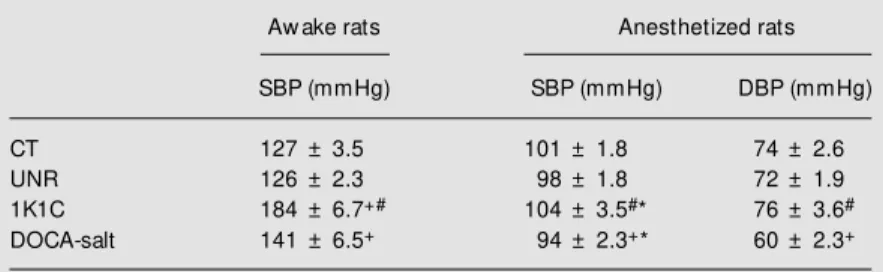
On the day before the experiments the systolic blood pressure was measured in awake unrestrained animals and the DOCA-salt and 1K1C hypertension was confirmed (Table 1). The systolic blood pressure meas-ured after 30 days was higher in 1K1C than in DOCA-salt rats.
Ane sthe tize d anim als
After urethane anesthesia, systolic and diastolic blood pressure were reduced in all models and this reduction was significantly larger in the 1K1C and DOCA-salt groups (Table 1).
Figure 1 shows the time-course changes of systolic blood pressure for 1 h after 18 µg/ kg ouabain administration (iv) in all groups. Between 1 to 3 min after injection, systolic blood pressure increased and then decreased back to control values (approximately 15 to 20 min) after which it increased slowly again. It is interesting to note that this systolic blood pressure increment became signifi-cant only after 40 min. Heart rate did not change after ouabain treatment and the changes produced by phenylephrine injec-tions were similar both before and after oua-bain (data not shown).
The administration of 18 µg/kg ouabain caused a similar increase in systolic blood pressure after 1 h in all groups studied (Fig-ure 2). Diastolic blood press(Fig-ure did not change significantly after this dose of oua-bain in control rats but increased in the other groups, including uninephrectomized rats (Figure 3). Analysis of the changes in dia-stolic pressure before and 1 h after 18 µg/kg ouabain showed that hypertensive rats had a significant enhancement of diastolic pres-Table 1. Systolic (SBP) and diastolic (DBP) blood pressure in normotensive (control, CT;
uninephrectomized, UNR) and hypertensive (1K1C and DOCA-salt) aw ake and anes-thetized rats.
Aw ake rats Anesthetized rats
SBP (mmHg) SBP (mmHg) DBP (mmHg)
CT 127 ± 3.5 101 ± 1.8 74 ± 2.6
UNR 126 ± 2.3 98 ± 1.8 72 ± 1.9
1K1C 184 ± 6.7+# 104 ± 3.5#* 76 ± 3.6#
DOCA-salt 141 ± 6.5+ 94 ± 2.3+* 60 ± 2.3+
+P<0.01, comparison betw een hypertensive and normotensive rats; #P<0.01, comparison betw een 1K1C and DOCA-salt rats;
* P<0.05, comparison betw een hypertensive anesthetized and aw ake rats(t-test).
Figure 1. Time course of sys-t olic blood pressure (SBP) changes during 1-h treatment w ith 18 µg/kg ouabain in normo-tensive (control, CT; uninephrec-tomized, UNR) and hypertensive (1K1C and DOCA-salt) rats after anesthesia. Points represent the means ± SEM . * P<0.05 com-pared to before ouabain treat-ment (time zero) for all groups (ANOVA).
S
B
P
(
m
m
H
g
)
140
126
112
98
84
70
0 0.5 3 5 15 30 40 50 60
Time (min) CT
UNR
1K1C
DOCA-salt
Figure 2. Changes in systolic blood pressure (SBP) in response to increasing doses of phenylephrine (PHE) in normotensive (control, CT; uninephrectomized, UNR) and hypertensive (1K1C and DOCA-salt) rats before (open symbols) and after (closed symbols) treatment w ith 18 µg/kg ouabain. Points represent the means ± SEM . * P<0.05 compared to before ouabain treatment (ANOVA).
S
B
P
(
m
m
H
g
)
150 150
0.50 0.40 0.30 0.20 0.10 0.00
*
* *
* *
* *
*
136
122
108
94
80
* *
* *
0.50 0.40 0.30 0.20 0.10 0.00
CT
DOCA-salt 136
122
108
94
80
0.00 0.10 0.20 0.30 0.40 0.50 1K1C
150
136
122
108
94
80
0.50 0.40 0.30 0.20 0.10 0.00
UNR
*
* *
*
PHE (µg) PHE (µg)
150
136
122
108
94
80
D
B
P
(
m
m
H
g
)
120 120
0.50 0.40 0.30 0.20 0.10 0.00
* *
* *
* *
* *
106
92
78
64
50
0.50 0.40 0.30 0.20 0.10 0.00
CT
DOCA-salt 106
92
78
64
50
0.00 0.10 0.20 0.30 0.40 1K1C
120
106
92
78
64
50
0.50 0.40 0.30 0.20 0.10 0.00
UNR
*
* *
*
PHE (µg) PHE (µg)
120
106
92
78
64
50
0.50
sure compared to the normotensive controls (normotensive - control: 8.50 ± 2.62 mmHg; uninephrectomized: 16.41 ± 3.47 mmHg, P>0.05 vs control, ttest, and hypertensive -1K1C: 20.10 ± 3.13 mmHg, P<0.02 vs con-trol, t-test; DOCA-salt: 21.71 ± 4.20, P<0.03
vs control, t-test). When pressor reactivity was tested (Figures 2 and 3), it could be seen that dose-dependent phenylephrine-evoked systolic and diastolic blood pressure re-sponses were shifted upwards. However, ouabain did not change the gain of this re-sponse.
Treatment with 0.18 µg/kg ouabain pro-duced a smaller but significant increment in systolic blood pressure and had no signifi-cant effect on diastolic blood pressure in the control rats (Figures 4 and 5). This dose is expected to produce nanomolar levels of circulating ouabain if we assume that the drug is being diluted in 40 ml of extracellular fluid per each 100 g of rat. In normotensive rats, phenylephrine-evoked pressor effects were similar before and after ouabain treat-ment. However, this very low dose of oua-bain increased both systolic and diastolic blood pressure in the hypertensive groups (1K1C and DOCA-salt), and in the uni-nephrectomized rats (Figures 4 and 5). When pressor reactivity was tested (Figures 4 and 5) it could be seen that dose-dependent phen-ylephrine-evoked systolic and diastolic blood pressure responses were shifted upwards. Moreover, analysis of the magnitude of sys-tolic and diassys-tolic pressure increment before and 1 h after 0.18 µg/kg ouabain showed that DOCA-salt rats were more responsive to the effects of ouabain than normotensive and 1K1C hypertensive rats (Table 2).
122 108 94 0.50 0.40 0.30 0.20 0.10 0.00 150 136 80 S B P ( m m H g ) 122 108 94 150 136 80 122 108 94 150 136 80 122 108 94 150 136 80 0.50 0.40 0.30 0.20 0.10 0.00 0.50 0.40 0.30 0.20 0.10 0.00 0.50 0.40 0.30 0.20 0.10 0.00
PHE (µg) PHE (µg)
1K1C CT DOCA-salt UNR * * * * * * * * * * * * 0.50 0.40 0.30 0.20 0.10
0.00 0.00 0.100.20 0.300.400.50
PHE (µg) PHE (µg)
0.50 0.40 0.30 0.20 0.10
0.00 0.00 0.10 0.20 0.300.400.50
D B P ( m m H g ) 92 78 64 120 106 50 92 78 64 120 106 50 92 78 64 120 106 50 92 78 64 120 106 50 * * * * * * * * * 1K1C CT DOCA-salt UNR
Figure 4. Changes in systolic blood pressure (SBP) in response to increasing doses of phenylephrine (PHE) in normotensive (control, CT; uninephrectomized, UNR) and hyperten-sive (1K1C and DOCA-salt) rats before (open symbols) and after (closed symbols) treatment w ith 0.18 µg/kg ouabain. Points represent the means ± SEM . * P<0.05 compared to before ouabain treatment (ANOVA).
Figure 5. Changes in diastolic blood pressure (DBP) in response to increasing doses of phenylephrine (PHE) in normotensive (control, CT; uninephrectomized, UNR) and hypertensive (1K1C and DOCA-salt) rats before (open symbols) and after (closed symbols) treatment w ith 0.18 µg/kg ouabain. Points represent the means ± SEM . * P<0.05 compared to before ouabain treatment (ANOVA).
Another dose of ouabain was used. Since we knew from previous experiments that SHR are more resistant to toxic doses of ouabain, another protocol was performed using 1.8 mg/kg ouabain to test this behavior in another hypertensive group. 1K1C rats and their uninephrectomized controls were investigated and both behaved like SHR, with an increase in systolic and diastolic blood pressure after ouabain treatment (Table 3).
Iso late d rat tail vascular be d pre paratio n
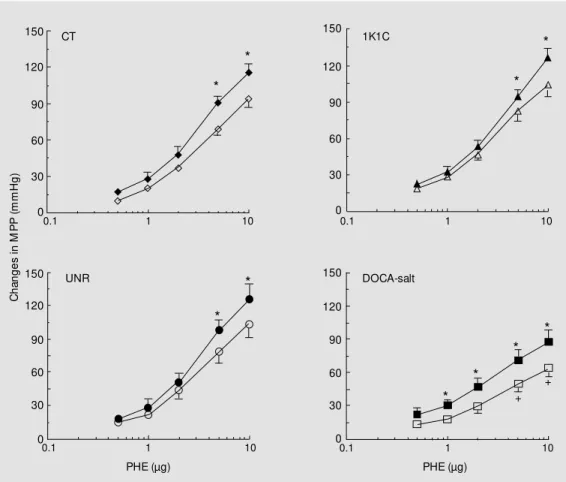
Phenylephrine produced a dose-de-pendent increase in mean perfusion pres-sure in the rat tail vascular bed from all animals (Figure 6). This increment did not differ between normotensive and 1K1C hypertensive rats but was smaller in DOCA-salt rats compared to the other groups (Figure 6).
After treatment with 10 nM ouabain for 60 min, the baseline perfusion pressure was reduced in all animals (normotensive: con-trol, from 74 ± 3.24 to 66 ± 1.60 mmHg, and uninephrectomized, from 79 ± 4.88 to 64 ± 3.13 mmHg; hypertensive: 1K1C, from 82 ± 6.85 to 67 ± 2.12 mmHg, and DOCA-salt, from 77 ± 6.13 to 61 ± 4.93 mmHg; P<0.05
for all groups, paired t-test). Perfusion with ouabain-free Krebs solution for 1 h also reduced the baseline perfusion pressure but did not enhance the pressor response to phen-ylephrine (data not shown). After ouabain treatment the pressor response to phenyl-ephrine was significantly enhanced only at the 5- and 10-µg doses in normotensive and 1K1C hypertensive rats (Figure 6). How-ever, in DOCA-salt hypertensive rats the increment of the pressor response obtained after ouabain treatment became significant at a lower dose of phenylephrine, i.e., 1 µg (Figure 6).
Table 3. Changes in systolic (SBP) and diastolic (DBP) arterial blood pressure (in mmHg) in response to the vasopressor effects of increasing doses of phenylephrine (PHE) before and after 1.8 mg/kg ouabain treatment in normotensive (control, CT; uninephrectomized, UNR) and hypertensive (1K1C) rats.
PHE (0) PHE (0.1 µg) PHE (0.25 µg) PHE (0.5 µg)
SBP DBP SBP DBP SBP DBP SBP DBP
CT Before 109 ± 9.4 79 ± 10.6 120 ± 9.4 90 ± 10.4 120 ± 6.9 93 ± 8.1 124 ± 6.7 98 ± 7.9
After 88 ± 4.4* 78 ± 6.1 98 ± 7.7* 85 ± 5.9 102 ± 10.5* 87 ± 7.2 100 ± 10.2* 90 ± 7.6
UNR Before 99 ± 4.9 72 ± 5.3 104 ± 4.5 78 ± 4.6 107 ± 3.9 81 ± 4.6 110 ± 3.7 85 ± 4.6
After 114 ± 5.3* 93 ± 5.3* 119 ± 5.2* 97 ± 5.1* 120 ± 4.7* 97 ± 5.2* 123 ± 5.1* 102 ± 5.2*
1K1C Before 112 ± 6.1 81 ± 5.9 121 ± 6.4 92 ± 6.5 123 ± 6.5 94 ± 6.3 127 ± 6.5 98 ± 6.3
After 141 ± 7.7* 116 ± 7.8* 145 ± 7.6* 118 ± 7.6* 147 ± 7.8* 120 ± 7.8* 150 ± 8.0* 123 ± 8.0*
* P<0.05 compared to before ouabain treatment (ANOVA).
Table 2. Changes in systolic (SBP) and diastolic (DBP) blood pressure before and after 0.18 µg/kg ouabain in normotensive (control, CT; uninephrec-t om ized, UNR) and hyperuninephrec-t ensive (1K1C and DOCA-salt) rats.
DSBP (mmHg) DDBP (mmHg)
CT 7.6 ± 3.6 3.7 ± 3.6
UNR 9.3 ± 2.7 9.2 ± 3.1
1K1C 12.7 ± 4.2 10.7 ± 3.8
DOCA-salt 24.3 ± 2.6*+ 27.2 ± 3.5*+
* P<0.001, comparison betw een hypertensive and normotensive rats;
+P<0.001, comparison betw een DOCA-salt and
D iscussio n
The present results suggest that DOCA-salt rats were more sensitive to pressor ef-fects after treatment with small doses of ouabain (0.18 µg/kg) than normotensive and 1K1C rats in vivo. When using higher doses of ouabain (18 µg/kg) the hypertensive 1K1C and DOCA-salt rats showed similar behav-ior regarding the pressor effects induced by this digitalis compound. Although ouabain did not increase sensitivity to phenylephrine
in vivo, this effect was observed in vitro in isolated vessels obtained from DOCA-salt rats. These findings suggest that the increase of arterial pressure caused by small doses of ouabain in DOCA-salt rats seems to be the result of an increased sensitization of vascu-lar smooth muscle to pressor a-agonist agents. Our results also suggest that the
pres-sor response to ouabain depends on the dose and on the hypertensive animal model used.
Ouabain inhibits Na+ ,K+
-ATPase by bind-ing to the a subunits of the enzyme in several tissues like the heart, vessels, kidneys and the nervous system (3,6,11). The cell mem-brane enzyme Na+,K+-ATPase is the bio-chemical expression of the electrogenic Na+ pump and exchanges 3 Na+
for 2 K+ , main-taining the resting potential of excitable cells (3). A reduction in Na+
pump activity leads to Na+
accumulation in the myoplasm (4). Inhibition of the pump also affects the Na+/ Ca2+
exchange mechanism and, conse-quently, the amount of activator Ca2+
neces-sary for contraction in several tissues such as vascular smooth muscle (4). By inhibiting the Na+
pump, ouabain may have effects on the homeostatic mechanisms affecting the regulatory control of blood pressure,
there-C
h
a
n
g
e
s
i
n
M
P
P
(
m
m
H
g
)
150
120
90
60
30
0
10 1
0.1 0.1 1 10
10 1
0.1 0.1 1 10
150
120
90
60
30
0
150
120
90
60
30
0
150
120
90
60
30
0
CT 1K1C
UNR DOCA-salt
PHE (µg) PHE (µg)
Figure 6. Changes in mean per-fusion pressure (M PP) in re-sponse to increasing doses of phenylephrine (PHE) in normo-tensive (control, CT; uninephrec-tomized, UNR) and hypertensive (1K1C and DOCA-salt) rats be-fore (open symbols) and after (closed symbols) infusion of 10 nM ouabain. Points represent means ± SEM . *P<0.05
com-pared to before ouabain treat-ment; +P<0.05 compared to
nor-motensive control, uninephrec-tomized and hypertensive 1K1C rats rats (ANOVA).
* *
* *
+ + *
* *
*
fore playing a central role in the develop-ment and maintenance of hypertension (4). Indeed, many reports have suggested such a role since ouabain can produce hypertension during long-term administration in rats (9,12,13).
Recently, ouabain has been reported to be an adrenocortical hormone present in plasma at nanomolar or subnanomolar con-centrations (4,8,9). There are results indicat-ing that a circulatindicat-ing ouabain-like substance is increased in DOCA-salt rats and in low-renin rat models such as 1K1C (14,15). A recent study using anesthetized normoten-sive and SHR rats has reported that the pres-sor effects induced by ouabain were opera-tive in vivo (1). In SHR, sensitization was present at doses of ouabain reaching the nanomolar level. This effect was observed when vascular smooth muscle was challenged by phenylephrine stimulation after ouabain treatment. Therefore, the possibility of sen-sitization by ouabain may manifest in vivo
since vascular smooth muscle is continu-ously stimulated by the sympathetic drive or by the presence of endogenous vasopressor substances. The present study was designed to investigate the vascular reactivity of anes-thetized 1K1C and DOCA-salt rats after sev-eral ouabain treatments.
As seen in Table 3, a toxic dose of oua-bain (1.8 mg/kg) produced a hypotensive effect in normotensive rats but not in the other groups. It has been reported that nor-motensive rats show a reduction of systolic blood pressure after this ouabain treatment while SHR show an increase in systolic blood pressure (1). Diastolic blood pressure did not change significantly after 1.8 mg/kg oua-bain treatment in normotensive rats but in-creased in the others. Also, confirming pre-vious findings (1), this large dose of ouabain frequently produced arrhythmias in normo-tensive rats, characterizing a toxic effect. The hypotension was probably caused by a reduction in cardiac output produced by the presence of arrhythmias in the normotensive
group or by a putative calcium overload causing diastolic dysfunction. This suggests that hypertensive and uninephrectomized rats are more resistant to the toxic effects of ouabain than normotensive rats.
The arrhythmogenic effect of ouabain is also related to the inhibition of Na+
,K+ -ATPase. This inhibition increases intracel-lular sodium concentration and depolarizes the cell. The Na+
/Ca2+
exchange activity is also reduced and Ca2+ accumulates inside the cell. Once intracellular Ca2+
increases, the Na+
/Ca2+
exchanger is stimulated and, since this is an electrogenic exchange, depo-larizing currents are generated causing ar-rhythmias (16). The resistance to the toxic effects of ouabain in the hypertensive group has been explained by the fact that Na+
,K+ -ATPase activity is reduced in hypertrophic hearts from hypertensive animals (17,18). Moreover, some of these reports show that the a2 isoform of Na+,K+-ATPase is reduced (18) while the a3 isoform increases (19). Since the a3 isoform is less sensitive to intracellular Na+ (19), this could explain the increased resistance of the hypertrophied myocardium to the effects of this digitalis compound.
The intermediate dose of ouabain (18 µg/ kg) increased arterial systolic blood pressure after 1 h. It is interesting to note that ouabain, even at the largest dose, never increased significantly the diastolic blood pressure of normotensive rats, which reflects the lack of effects on systemic peripheral resistance.
pres-sure is larger in these animals. Ouabain treat-ment with the smaller dose of 0.18 µg/kg was able to increase arterial pressure. How-ever, in contrast to what occurred when 18 µg/kg ouabain was used, this pressure incre-ment was larger in DOCA-salt rats than in normotensive and 1K1C rats. These data show that not all hypertension models have the same sensitivity to ouabain at very small doses. Treatment with ouabain increased ar-terial pressure and shifted upwards the vaso-pressor responses to phenylephrine in all models at all doses studied. However, no changes in the gain of phenylephrine pressor responses were observed. An interesting re-sult was obtained with the uninephrectomized rats whose response to ouabain reached an intermediate level between hypertensive and normotensive control rats. This was not the only difference they showed compared to normal rats, since a reduction of cardiac contractility was also reported following uni-nephrectomy (20). These findings led us to conclude that uninephrectomized animals cannot be considered as a normal control. Our results, however, cannot discriminate the underlying mechanisms responsible for this sensitization effect but suggest that a) ouabain increases blood pressure and main-tains phenylephrine-evoked pressor re-sponses in all groups studied when acute digitalization doses are used, b) these effects are still present even when smaller doses of ouabain are used in all groups of rats except the normotensive ones, c) the increment in systolic and diastolic blood pressure is more efficient in DOCA-salt hypertensive rats, and d) hypertensive and uninephrectomized rats are less sensitive to toxic doses of oua-bain.
One possible mechanism that explains the changes in pressor responses caused by ouabain in these models of hypertension is a vascular mechanism. Previous reports have demonstrated that higher doses of ouabain sensitize the contractile response to a -adre-nergic agonists and to KCl in 1K1C rats
(21,22). The same occurs with DOCA-salt rats in which ouabain treatment increased even more the pressor responses (23). This would help to explain why 18 µg/kg ouabain was capable to produce a significant increase of diastolic pressure in hypertensive, but not normotensive rats. However, these results were obtained with higher doses of ouabain and this may mask a different effect obtained with lower doses of ouabain. Indeed, the effect obtained in DOCA-salt rats after 0.18 µg/kg ouabain could be explained by such enhanced sensitization of the vascular bed.
It has been reported that low plasma con-centrations of ouabain may modulate vascu-lar reactivity without directly affecting vas-cular smooth muscle tone (2,24,25). For ex-ample, low ouabain concentrations (10 nM) increase caffeine-evoked contractions in rat aortic rings (26). Using a perfused rat tail vascular bed preparation we showed (2,24) that 10 nM ouabain did not alter baseline perfusion pressure but increased the sensi-tivity to phenylephrine-evoked pressor re-sponses both in normotensive rats and SHR. The same was observed in our normotensive control rats. Ouabain was able to sensitize the pressor response to phenylephrine in the tail vascular bed from all models studied, without causing changes in baseline perfu-sion pressure.
Recently, it has been shown that small increments of myoplasmic Ca2+
rats when compared with normotensive and hypertensive 1K1C rats. This result also ex-plains why low doses of ouabain caused a larger pressor response in DOCA-salt rats compared to 1K1C. Possible mechanisms that could be modified in these models of hypertension and could explain the results described here are changes in the expression and activity of the Na+
pump.
The expression and activity of Na+ ,K+
-ATPase and its a isoform are regulated by multiple factors such as developmental stage (27), hormones (28), endothelial factors (29) and the occurrence of hypertension (30,31). Furthermore, it has been shown that a sub-units of Na+
,K+
-ATPase consist of different
a1, a2 and a3 subunits with different affini-ties for digitalis (11). Since the Na+
,K+ -ATPase isoforms may change under several situations the maintenance of the sensitizing mechanism could be of clinical relevance. Recently, Blaustein et al. (5) suggested that a special distribution of the a2 and a3 isoforms of Na+
,K+
-ATPase exists in the sarcolemma that binds ouabain preferentially and they are located near the vesicles of the sarcoplas-mic reticulum. This special localization en-ables the increment of cytosolic calcium near the reuptake sites, facilitating the operation of the proposed mechanism. Then, when vascular smooth muscle is stimulated the final result is an amplification of the cal-cium released and an increase in the re-sponse of the vasculature to agents that pro-duce constriction (1,2,24,26). This is an amplification mechanism that operates even at low ouabain concentrations.
These results lead us to speculate that there might be differences in Na+
,K+
-ATPase isoforms in these normotensive and hyper-tensive rats. One possible explanation for this difference would be the up-regulation in hypertensive groups. Recently, Liu et al. (31) reported up-regulation of both a1 and a2 isoforms after a 2- or 4-day stretch in cul-tured vascular smooth muscle cells. Similar results have been obtained in several models
of cardiac hypertrophy (18,19,32). Increase of Na+ pump activity and up-regulation of the expression of a1 mRNA in the heart, together with a down-regulation of the a2 mRNA as a result of DOCA-salt hyperten-sion, has been reported (6,30). However, increased a1 isoform activity would result in low levels of inhibition by ouabain sufficient to make 1K1C and uninephrectomized rats more resistant to the toxic effects of the drug. In the aorta, it has been reported that cortico-steroids regulate Na+
,K+
-ATPase isoform ex-pression and activity in vascular tissue, sug-gesting a mineralocorticoid-dependent modu-lation of the a2 isoform (28). Also, up-regu-lation of the a2 isoform in DOCA-salt hyper-tensive rats may facilitate ouabain binding, further increasing its sensitizing effects.
pressor effects of phenylephrine were dis-placed upwards but no sensitization was ob-served. Part of this response can be explained by the action of ouabain or by the arterial pressure elevation stimulating the barore-flex. Also, there are reports showing that ouabain, instead of blunting the baroreflex, can enhance it in normotensive animals, an effect that is amplified in SHR (39). On this basis, we may suppose that a putative in vivo
sensitization might be masked by this effect. Another interesting aspect is related to the fact that the in vitro pressor responses to phenylephrine are reduced in DOCA-salt rats compared to the other models studied. Previous reports have shown that in DOCA-salt rats the chronic increment of sympa-thetic tone in vascular beds with more sym-pathetic innervation, like the mesenteric ar-teries, might reduce the response of these arteries to norepinephrine. Prolonged expo-sure to high levels of norepinephrine may reduce the action of a-adrenergic agonists
via stimulation of the vascular endothelium, leading to an increased production of va-sodilator factors like nitric oxide (40). This mechanism should explain the reduction of the pressor response to phenylephrine of the tail vascular bed from DOCA-salt rats since the tail artery is highly innervated. In addi-tion, previous results from our laboratory have suggested that endothelial modulation of the pressor response to phenylephrine is enhanced in DOCA-salt rats.
In conclusion, these results suggest that ouabain treatment increases blood pressure and that this increment is more marked in hypertensive rats. The pressor effects after the administration of low ouabain concen-trations were more pronounced in hyperten-sive DOCA-salt rats in vivo and in vitro. These increments still occurred with very low doses of ouabain in hypertensive rats, suggesting an enhanced pressor reactivity which may contribute to the genesis and maintenance of hypertension.
Re fe re nce s
1. Vassallo DV, Songu-M ize E, Rossoni LV & Amaral SM C (1997). Effects of ouabain on vascular reactivity. Brazilian Journal of M edical and Biological Research,30: 545-552.
2. Rossoni LV, Cunha V, França A & Vassallo DV (1999). The influence of nanomolar ouabain on vascular pressor responses is modulated by the endothelium. Journal of Cardiovascular Pharmacology, 34: 887-892.
3. Lingrel JB (1992). Na,K-ATPase: isoform structure, function, and expression. Jour-nal of Bioenergetics and Biomembranes, 24: 263-270.
4. Blaustein M P (1996). Endogenous oua-bain: Role in the pathogenesis of hyper-tension. Kidney International, 49: 1748-1753.
5. Blaustein M P, Juhaszova M & Golovina VA (1998). The cellular mechanism of ac-tion of cardiotonic steroids: A new hypo-thesis. Clinical and Experimental Hyper-tension, 20: 691-703.
6. Sahin-Erdemli I, M edford RM & Songu-M ize E (1995). Regulation of Na+, K+
-ATPase a-subunit isoforms in rat tissues
during hypertension. European Journal of Pharmacology, 292: 163-171.
7. Rossi GP, M anunta P, Hamlyn JM , Pavan E, De Tone R, Semplicini A & Pessina AC (1995). Immunoreactive endogenous oua-bain in primary aldosteronism and essen-tial hypertension: relationship w ith plasma renin, aldosterone and blood pressure lev-els. Journal of Hypertension, 13: 1181-1191.
8. Ludens JH, Clark M A, Robinson FG & DuCharme DW (1992). Rat adrenal cortex is a source of a circulating ouabain-like compound. Hypertension, 19: 721-724. 9. M anunta P, Rogow ski AC, Hamilton BP &
Hamlyn JM (1994). Ouabain-induced hy-pertension in the rat: relationships among circulating and tissue ouabain and blood pressure. Journal of Hypertension, 12: 549-560.
10. França AS, Rossoni LV, Amaral SM C & Vassallo DV (1997). Reactivity of the iso-lated perfused rat tail vascular bed. Brazil-ian Journal of M edical and Biological Re-search,30: 891-895.
11. Sw eadner KJ (1989). Isozymes of the Na+/
K+-ATPase. Biochim ica et Biophysica
Acta, 988: 185-220.
12. Yuan CM , M anunta P, Hamlyn JM , Chen S, Bohen E, Yeun J, Haddy FJ & Pamnani M B (1993). Long-term ouabain adminis-tration produces hypertension in rats. Hy-pertension, 22: 178-187.
13. Rossoni LV, Lores A, Salaices M & Vassallo DV (2000). Alterations on vascu-lar reactivity and Na+K+-ATPase in
hyper-tension induced by chronic administration of ouabain. Annals of the XVI Latin-Ameri-can Congress of Pharm acology, São Paulo, SP, Brazil, September 13-17, No. 02.021, 124.
14. Kojima I (1984). Circulating digitalis-like substance is increased in DOCA-salt hy-pertension. Biochemical and Biophysical Research Communications,122: 129-136. 15. Pamnani M B & Haddy FJ (1988). Humoral sodium-potassium inhibitor in reduced re-nal mass-saline hypertension rats. Prog-ress in Biochemical Pharmacology,23: 35-45.
16. Nordin C (1989). Abnormal Ca2+ handling
17. Sw eadner KJ, Herrera VL, Am at o S, M oellmann A, Gibbons DK & Repke KR (1994). Immunologic identification of Na+, K(+ )-ATPase isoforms in myocardium. Isoform change in deoxycorticosterone acetate-salt hypertension. Circulation Re-search, 74: 669-678.
18. Liu X & Songu-M ize E (1997). Alterations in alpha subunit expression of cardiac Na+,K+-ATPase in spontaneously
hyper-tensive rats: effect of antihyperhyper-tensive therapy. European Journal of Pharmacolo-gy, 327: 151-156.
19. Charlemagne D & Sw ynghedauw B (1995). M yocardial phenotypic changes in Na+,
K+ ATPase in left ventricular hypertrophy:
pharm acological consequences. Euro-pean Heart Journal, 16 (Suppl C): 20-23. 20. Vassallo DV, Vasquez EC & M ill JG (1990).
M yocardial depression produced by uni-lateral nephrectomy in rats. Clinical and Experim ent al Hypert ension. Part A, Theory and Practice, A12: 597-616. 21. Ceron PIB & Bendhack LM (1997).
In-creased contractile response induced w ith ouabain is abolished by thapsigargin in aorta of renal hypertensive rats. Gen-eral Pharmacology,29: 707-712. 22. Overbeck HW (1984). Effect of ouabain
on arteriolar responses to norepinephrine in chronic, benign, volume-expanded hy-pertension. Hypertension,6 (Suppl I): 82-97.
23. Sekihara H, Yazaki Y & Kojima T (1992). Ouabain as an amplifier of mineralocorti-coid-induced hypertension. Endocrinol-ogy,131: 3077-3082.
24. Davel APC, Rossoni LV & Vassallo DV (2000). Effects of ouabain on the pressor response to phenylephrine and on the so-dium pump activity in diabetic rats. Euro-pean Journal of Pharmacology,406: 419-427.
25. Arnon A, Hamlyn JM & Blaustein M P (2000). Ouabain augments Ca2+
tran-sients in arterial smooth muscle w ithout rising cytosolic Na+. American Journal of
Physiology,279: H679-H691.
26. Weiss DN, Podberesky DJ, Heidrich J & Blaustein M P (1994). Nanomolar ouabain augments caffeine-evoked contractions in rat arteries. American Journal of Physiolo-gy, 265: C1443-C1448.
27. Orlow ski J & Lingrel JB (1988). Tissue-specific and developmental regulation of rat Na+,K+-ATPase catalytic a isoform and
ß subunit mRNAs. Journal of Biological Chemistry, 263: 10436-10442.
28. M ichea L, Valenzuela V, Bravo I, Schuster A & M arusic ET (1998). Adrenal-depend-ent modulation of the catalytic subunit isoforms of the Na+-K+-ATPase in aorta.
American Journal of Physiology, 275: E1072-E1081.
29. Gupta S, Phipps K & Ruderman NB (1996). Differential stimulation of Na+ pump
ac-tivity by insulin and nitric oxide in rabbit aorta. American Journal of Physiology, 270: H1287-H1293.
30. Herrera VLM , Chobanian AV & Ruiz-Opazo N (1988). Isoform specific modulation of Na+,K+-ATPase alpha-subunit gene
ex-pression in hypertension. Science, 241: 221-223.
31. Liu X, Hymel LJ & Songu-M ize E (1998). Role of Na+ and Ca2+ in stretch-induced
Na+,K+-ATPase a-subunit regulation in
aortic smooth muscle cells. American Journal of Physiology, 274: H83-H89. 32. Book CBS, Wilson RP & Ng YC (1994).
Cardiac hypert rophy in t he f erret in-creases expression of the Na+,K+-ATPase a1- but not a3-isoform. American Journal
of Physiology, 266: H1221-H1227. 33. Leenen FHH, Harmsen E & Yu H (1994).
Dietary sodium and central vs peripheral
ouabain-like activity in Dahl salt-sensitive vs salt-resistant rats. American Journal of Physiology, 267: H1916-H1920. 34. Cabral AM & Vasquez EC (1991). Time
course of cardiac sympathetic and vagal tone changes in renovascular hyperten-sive rats. Hypertension, 4: 815-819. 35. Bissoli NS, Cicilini M A, Vasquez EC &
Cabral AM (2000). The diuretic chlorthali-done normalizes baroreceptor and Bezold-Jarisch reflexes in DOCA-salt hyperten-sive rats. Pharmacological Research, 41: 483-491.
36. Rodríguez-M añas L, Sánchez-Ferrer CF, Pareja A, Casado M A, Arribas S, Salaices M & M arín J (1994). Neurogenic compo-nent of ouabain-evoked contractions is modulated by the endothelium. Hyperten-sion, 23: 10-17.
37. Leite R & Salgado M CO (1992). Increased vascular formation of angiotensin II in one-kidney, one clip hypertension. Hyperten-sion,19: 575-581.
38. Larivière R, Thibault G & Schiffrin EL (1993). Incresed endothelin-1 content in blood vessels of deoxycorticosterone ac-etate-salt hypertensive but not in sponta-neously hypertensive rats. Hypertension, 21: 294-300.
39. Abreu GR, Cabral AM , Futuro Neto HA & Vasquez EC (1998). Ouabain produces di-verse excitatory effects on afferent baro-receptor nerve activity in SHR and WKY animals. Clinical and Experimental Hyper-tension,20: 85-94.