INTERDISCIPLINARY TEAM PERFORMANCE
WITH STUDENTS THAT HAVE LOW VISION
DUE TO THEIR DIAGNOSIS OF STARGARDT DISEASE
Atuação de equipe interdisciplinar com escolar que apresenta
baixa visão por hipótese diagnóstica de doença de Stargardt
Amanda Brait Zerbeto(1), Fernanda Fonseca dos Santos Lopes (1), Rita de Cássia Ietto Montilha (1),
Maria Elisabete Rodrigues Freire Gasparetto (1)
(1) Universidade Estadual de Campinas- UNICAMP.
Campi-nas, SP, Brasil.
Graduate Program in Health, Interdisciplinary and Rehabilitation, School of Medical Sciences – FCM, University of Campinas.
Conlict of interest: non-existent
Low vision is deined as severe loss of vision
that cannot be corrected by medical or surgical treatment or with conventional glasses2. Stargardt
Disease is one of the causes that lead to low vision, a progressive retinal dystrophy, hereditary autosomal
recessive, usually bilateral that starts in the irst two
decades of life3. Stargardt Disease has a population
incidence estimated from 1/1660 to 1/15000 and is responsible for about 7% of retinal abnormalities found in the world. The signs of the disease are
noticeable by the age of seven, occurring signiicant
reduction of central vision, loss of sensitivity to colors and evolution to a low central visual acuity that can reach up to about 20/200 4.
INTRODUCTION
Oral and written communication is a ield of
speech therapy in which the performance of an interdisciplinary team can greatly contribute to the progress of cases. Reading and writing of individuals
with low vision is a ield, which has been little explored, but that as science has much to contribute
to the rehabilitation process in these cases1.
ABSTRACT
The theme of this study are the low sight or visual impairment scholars that may have dificulties
in writing and reading activities and therefore show postural alterations, as a consequence of having to adjust, when getting closer to the materials, as an attempt to see them better. This current study is characterized as a case study, in which the performance of the interdisciplinary team
involved in the visual qualiication process of a 12 year-old scholar with the diagnostic hypothesis of
Stargardt disease will be described. The research team comprised of a Social Worker, Pharmacist, Physiotherapist, Speech Therapist, Ophthalmologist, Pedagogue, Psychologist and Occupational Therapist. Nine sessions of one hour each were carried out weekly at a school clinic of a São Paulo
State University. The interventions beneited the scholar with the use of assistive technology resources,
such as telescopic system, electronic magnifying glasses, an inclined plane for reading and writing and the enlargement of the lines in the notebook pages. After the intervention, the adopted body posture in the reading and writing activities became more balanced, the scholar was able to keep his head furthermost from the book, as well as more aligned, not showing rotation compensatory movements to the right and inclination, which led to a decrease of the pain in the cervical region. The interventions carried out also allowed the scholar to show an improvement in the distance and near visual performance. The performance of the interdisciplinary team enabled positive results in the activities of reading and writing of the low sight scholar, and in daily life activities, enabling thus the educational and social inclusion of the Adolescent.
rehabilitation process of a student with low vision, diagnosed with Stargardt Disease.
CASE PRESENTATION
This is a case study with a methodological approach17. The assessments were made at a Public
Service University and in an ophthalmological ofice
in a city in the State of São Paulo. The study was approved by the Ethics in Research comittee (No 814/2011) and started after written consent by the responsible for the PJ.
The work with the language used a theoretical framework with a social interactionist approach, which assumes that language is acquired and developed in social interaction. In writing, this theory was applied in the use and discussion of the subject’s written productions, which were related to
his interest and social context18.
In 2012, the adolescent PJ, 12 years old, was
studying in the ifth grade of a public school in a
low-income neighborhood in a city of the State of São Paulo. In 2008, when noting the student’s visual impairment while conducting near and far activities, his teacher alerted the family about suspected visual problems. He was referred from the Basic Health Unit to a University Hospital in the region where no visual problems were detected after a
simple eye exam. The situation was explained to
the teacher, who continued to observe his visual impairment, and after some time, she sent a letter to PJ’s family asking them to seek for a specialized evaluation again. Again, no visual problem was
identiied in PJ. After returning to school, the teacher
insisted his father to seek another eye clinic for further investigation. Then the father took the child to a private eye hospital and the student received the diagnosis of Stargardt Disease, but he did not receive guidance on the use of assistive technology resources and guidelines for better visual perfor-mance at school. PJ’s teacher, concerned about the situation, researched on the internet services related to visual impairment in the region and found the Public Service University, a department in which the student was included in the Program for Adolescents and Adults with Visual Disabilities.
PJ’s parents were born in the State of Alagoas and live in the state of São Paulo for 17 years. They Individuals with low vision may have decreased
quality of life5, have dificulties in performing daily
life activities and the reading and writing process can also be affected6. Dificulties with reading and
writing can cause extreme repercussions for the
life of a student and the work of an interdisciplinary team proves essential for enabling children with this condition.
In the rehabilitation process, an important feature is the adaptation of an optical device, consisting of the following steps: evaluation, indication, guidance for functional use, training, prescription and monitoring7. Training is the longest
period and begins with a detailed interview to know the individual and his needs. It is important that the
family take part in the process and experiment with
devices, to understand and support their relative with low vision8,9. At the end, the aid is prescribed
and periodic follow-ups are conducted7.
The assistance adapted for individuals with low vision also include non-optical assistance. In these individual’s rehabilitation, speech therapy has the role of aggregate resource use of assistive technology (optical, non-optical and electronic devices) for reading and writing, thus aiming at the improvement of the communication of the subject1.
Working together with the school and family is important, so that devices can be better used in all of the students’ environments. Another factor that may hinder the reading and writing process for individuals with Stargardt disease is the posture they adopt. For childrenin the schooling phase, when reading and writing they may feel the need to be closer to the book and perform rotations, twists and bends in the cervical region for better visual perfor-mance10. Maintaining of these unsuitable positions
for long periods of time can lead to pain, immobility,
decreased lexibility and postural change11. A
physical therapy method that can be used for inter-vention in cases of low vision is Holistic Gymnastics, which stimulates body awareness, encouraging postural reeducation. The body awareness will allow the child with low vision to be more attentive to the habits of improper posture while performing school activities and other activities that require detail view12,13.
-also performed, where the teenager’s body was drawn in real dimensions on craft paper and repre-sented, graphically, drawing and writing, organs and body structures that provoked his curiosity.
There were therapeutic interventions with the family and school. The interventions with the family discussed awareness and understanding about the adolescent’s disease, guidance on his needs and constraints due to low vision, resulting, thus, in a change in social interaction with PJ and his family. At school, there was a meeting with all teachers involved, clarifying doubts about the pathology, and guidelines were provided regarding PJ’s capabilities and limitations in his school routine. For a better visual performance at school, guidelines for adapta-tions of materials and changes were also conducted in the school environment.
Aspects such as lexibility, body awareness and
postural reeducation were made during the physio-therapy appointments, with the Holistic Gymnastics method. Initially a dynamic evaluation of the cervical
region was performed, measuring the lexibility of
the posterior muscle chain and observation of the child’s posture in reading and writing activities. To correct postures, movements with varied materials the physiotherapeutic method was used in the proposal.
RESULTS
When entering the Program for Adolescents and Adults with Visual Disabilities from the Public Service University, PJ’s father had brought an ophthalmological report that focused Stargardt’s
disease as diagnosis hypothesis. For clariication
regarding diagnosis, the student was assessed
by an ophthalmologist who conirmed the Retinal
Degeneration diagnosis compatible with Stargardt
Disease and Fundus Flavimaculatus. No signiicant
refractive errors were found.
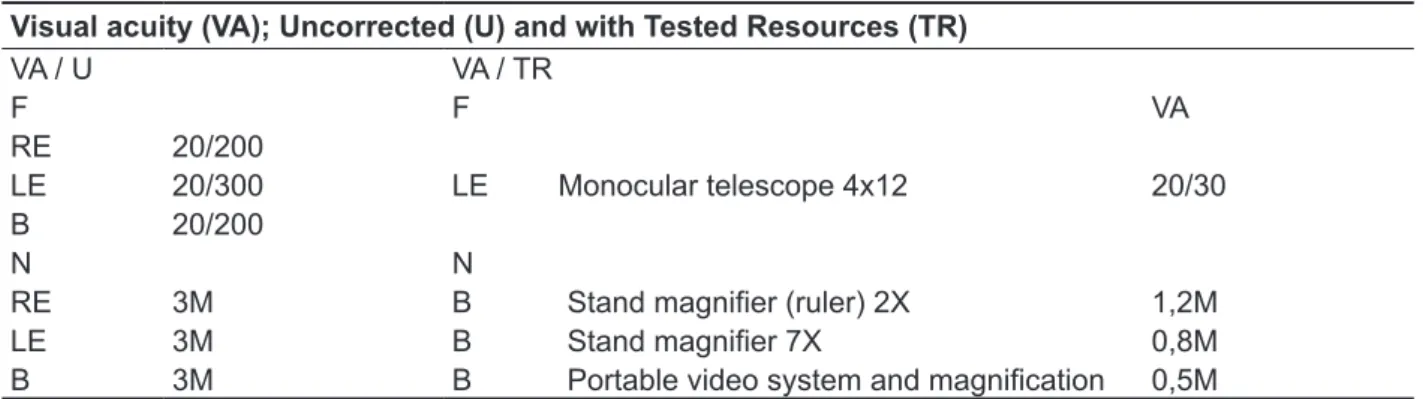
The assessment values the of functional vision and visual acuity are shown in Table 1.
tasks. Their routine seems to be dynamic, there seems to be little mobilization or availability of family members to assist the teenager in his homework and activities that require more visual performance.
The student was evaluated by an interdisciplinary team consisting of a Social Worker, Arts Educator, Nurse, Pharmacist, Physiotherapist, Speech Therapist, Ophthalmologist, Orthoptist, Pedagogue, Psychologist and Occupational Therapist. Despite the evaluation, discussion and planning have involved the whole team, the assistance described in this case study were conducted by a Physiotherapist, Speech Therapist, Ophthalmologist and Orthoptist, supervised by a Pedagogue and an Occupational Therapist.
There were nine weekly sessions with an average duration of one hour each. Weekly reports were produced by the professionals so that, along with video recordings, they could provide subsidies for the case study and record the student’s evolution within the Program.
For ophthalmological research the following tests were performed: retinoscopy, direct gonioscopy, fundoscopy and retinography. The evaluation of visual acuity for distance was performed with the following tables: Feinbloom chart for numbers; Snellen chart for letters; Lighthouse letters chart; and for near Lighthouse letters chart, prepared by the Subnormal Vision Service, FCM-UNICAMP. Resources for assistive technology for near were
evaluated: a 7x stand magniier; a 2x magnifying ruler; and a portable video magniication system;
and for far, a 4X12 telescope system,12.5.The need of non-optical devices use was also evaluated.
The speech therapy aimed to provide to the student improvement in visual performance for reading the blackboard, books and notebooks. As strategies reading comics, books and writing, with
interpretations of texts of interest were used, which were inaccessible because of PJ’s visual dificulty.
According to the social interactional language theory, in therapy, materials of interest and that are
part of the social context of the subjects need to be
portable magniication system he started identifying
letters in the size of 0.1 cm2.
Regarding near vision the Video System and
A-MAX Portable Magniication (Figure 1) was
prescribed, which has the following features: LCD screen 3.5; rechargeable battery lasting for 3 hours; USB charger; increasing the area of vision 2-15 times; made of plastic, orange and black color; 100 g weight; auto off; using still picture and inverse
display color mode; text display and background
colors (black on white and white in black). The equipment was acquired, training was conducted and the student ha been using it.
As shown in Table 1, the results of visual acuity for distance and without corrective lenses were 20/200, which means that the visual stimuli that the student saw at 20 feet can be seen by a person who does not present low vision at a distance of 200 feet. To enhance visual performance by far, it has been tested, prescribed and guided on the telescopic system of 4X12, 12.5o. The prescription was for the
left eye, because it was the better seeing eye. With the telescopic system the student began to identify visual stimuli at a distance of 20 feet, while people with normal vision can identify the same stimulus at a distance of 30 feet. However, the telescopic system is not being used because the school was respon-sible for the purchase of equipment and during the period the student attended, the equipment had not been purchased.
In near vision acuity without corrective lenses the student discriminated letters in the size of 0.5 cm2
at an average distance of 20 cm between the eye and the table. This means that the student with low vision discriminated letters at an average distance of 10 cm, which can be viewed by a person with normal vision at a distance of 3 meters.
The evaluation results with the stand magniier,
type ruler 2X, assess visual acuity of 1.2M, which means that the student is identifying letters the size of 0.3 cm2. With the 7X stand magniier, the student
began to identify letters in size 0.15 cm2 and with the
Table 1 – Uncorrected visual acuity and with tested resources Visual acuity (VA); Uncorrected (U) and with Tested Resources (TR)
VA / U VA / TR
F F VA
RE 20/200
LE 20/300 LE Monocular telescope 4x12 20/30
B 20/200
N N
RE 3M B Stand magniier (ruler) 2X 1,2M
LE 3M B Stand magniier 7X 0,8M
B 3M B Portable video system and magniication 0,5M
VA – Visual Acuity; U – Uncorrected; C – Corrected; F – Far N – Near; RE – Right Eye; LE – Left Eye; B – Both
Figure 1 – Video System and Portable
presentations, the student has preferred writing with the 4B pencil and medium intensity lines with 1.5 cm spacing. In Figures 2 and 3 are two main tests with writing materials with non-optical devices.
For non-optical devices tested: the inclined plane for writing and reading; lined sheets with various distances and intensities of lines; pencils with different contrasts: 2B; 4B; 6B; and a mechanical
pencil 0.9 tip; and a Fine Pen ultraine tip. With these
Figure 2 – Test with school ruled notebook
of the head in reading and writing. Thus, he could read and write with more balanced musculature of the neck without changing the posture of the head.
The assessment and rehabilitation processes, along with an indication of the optical, electronic and non-optical resources and the performance of an interdisciplinary team, were fundamental to improving the use of residual vision with his homework, reading and writing. After a short atten-dance, PJ’s teacher contacted the team and reported that his performance in class and at home had a great improvement, and that even his relationship with the colleagues improved, and that one of the reasons was the use of the electronic device that all students compared to a mobile phone. The role of the interdisciplinary team and joint action with family and school during the process was considered crucial to the results obtained in the case.
DISCUSSION
With the suspected diagnosis of Stargardt’s
Disease, PJ’s main demand was school dificulties caused by low vision. The dificulty in reading
during classes has a negative impact on the child’s education, relevant factor for inclusion, because reading has an important role in social interactions
and in productive activities, which may excluded
from the cultural system individuals with great potential19.
With the purpose of improving PJ’s perfor-mance, reading and writing activities, the objective of the interdisciplinary team was to evaluate visual, speech and physical aspects to improve his posture in reading and writing activities and training optical and non-optical resources, which favored him in his schoolwork.
In the literature, it is recommended that the assessment of people with low vision is carried out by an interdisciplinary team, in which each profes-sional has his/her participation. The ophthalmologist should evaluate visual functioning and assistive technology resources20. Speech pathologists,
educators and other professionals from habilitation and rehabilitation have wide performance on the
tasks of assessing visual functioning and eficiency
and training of assistive technology resources. The physiotherapist performance is very important for In the test shown in Figure 2, PJ took a long time
to write, he used the eraser many times to erase
what he has written and had great dificulty to read
the written material. In Figure 3, writing analysis, we
ind a better letter design and a smaller number of
erased letters, and reading the material by the writer
himself was faster and more eficient compared to the test in Figure 2. The use of materials and texts
with themes chosen by the adolescent was important to maintain his interest during the assessment and intervention, because reading and writing were not always easy and enjoyable activities due to low vision.
In the physiotherapy evaluation it was observed that when reading a book, PJ kept his head very close (10 cm) of the book and performed a rotation and inclination of the head with the objective of bringing the left eye towards the book. After some time in that position, he reported much discomfort
and pain. In assessing the lexibility of the posterior
muscle chain, measured by the distance between
the middle inger of the left hand and the ground,
with the patient standing, keeping the knees
extended and raising the head, trunk and bringing
hands toward the ground, PJ presented 21 cm of distance. The student also had limitation of cervical rotation to the left side, as diagnosed during cervical dynamic evaluation.
In human body project, PJ preferred eyes and spine both when drawing as in writing, and drew, above the head, a thought bubble. The eyes and
the column were the irst drawings made by PJ, who
seemed to establish a link between his low vision and physiotherapy interventions, with the schematic representation. In the thought bubble he wrote the word “dream”, making a report that all people dream, using writing to represent his ideas.
After the intervention, PJ showed increased amplitude of neck rotation to the left side, managing
graphically recorded the reading and writing worked in speech therapy and bodily perceptions worked in physiotherapy. Childlike drawing is one of the most important aspects for the full development of the individual and constitutes a mediator of knowledge and self-knowledge element. From the drawing the
children can organize information, experiences and
thought process, reveal their learning and develop a unique style of representation of the world25. Those
aspects are of utmost importance in the adopted language approach.
In the case of PJ, visual habilitation became an important process for improving the performance of reading and writing in school tasks. Thus, the visual
qualiication and knowledge of technical aspects
were considered processes that provided functional vision improvement and quality of life. This is done by evaluating, adapting the prescribed resources, beyond health, educational and social aspects that guide public policies26.
The role of interdisciplinary team during the evaluation and rehabilitation process proved of great importance to the progress achieved in the case. According to Japiassú27, interdisciplinary
is seen as solution to the problem of disciplinarily
that is contextualized in the disease, and should
therefore, be treated through interdisciplinary practice. To its viability, it indicated the presence of professionals from various areas for development
projects. In interdisciplinary it is extremely important
communication between disciplines, resulting in a
modiication between them through understandable dialogue, since the simple exchange of information
between disciplinary organizations does not constitute an interdisciplinary method27.
In this report, the interdisciplinary team partici-pation was critical to the quality and speed of the student response within the proposed improvement tasks, independent of ophthalmological diagnosis and prognosis (still under investigation).
CONCLUSION
The interdisciplinary team from the Public Service University performed assessment and conduct in the case of a student with low vision with diagnosis of Stargardt Disease. These processes were fundamental to improving the use of residual vision in reading and writing of school activities. To optimize the use of residual vision there were prescribed optical, electronic and non-optical devices. The team guided the school regarding the use of these resources and is open to new requests that the case may require. The interdisci-plinary team had primary function favoring written communication with the student with low vision as these professionals together, forming an
interdisci-plinary team, proved to be of great importance for PJ’s evolution.
Because of the ophthalmologist performance the
eyes exams supported the research of diagnosis,
which was important, especially for the family that remained distressed by the ignorance of the disease that was causing PJ’s visual acuity decrease. After understand better the student’s situation and receive guidance, the family began to assist him in daily tasks.
An important phase of visual habilitation was the
choice and resources training. Before the deinition
and acquisition of resources to be trained for PJ’s use, the telescopic system 4X12-12.5o and the
electronic portable magnifying A-MAX with
magni-ication up to 15X have been researched and many resources tested. Importantly, to achieve eficient
use of technology with good results, it is observed that there is not technology that meets all the needs of visually impaired patients, since all have positive and negative aspects; thus, it should be evaluated and used more than one technology22.
The visual performance of people with low vision
can be maximized by assistive technology resource use, thus broadening the experiences, whether in
family, social and educational level, having as one
of its goals the expansion of the visual image of
objects in order to perceive its details. Generally, this use brings a new perspective to people with visual disabilities, providing them access to the labor market, education and recreation; to knowledge, autonomy and manifestation of productive capacity: thus, these conditions may be important factors in the social inclusion23 process.
The recommendation and use of electronic
magniier by PJ during the process of visual habili -tation was important for reading books, dictionaries and comic books, providing social inclusion in the educational environment. Before using this resource, PJ suffered bullying from colleagues,
who insisted on stating that he was not eficient in
carrying out school activities. With the prescription and use of a device in the classroom, the attitude of colleagues was amended and now they identify
him as eficient and using next-generation devices.
Prescription of high-tech devices for people with low vision has been a path currently used in clinical practice and should be considered the fact that the
portable electronic magniier is a powerful tool, and
its effectiveness depends on the user’s training and adaptation24.
ACKNOWLEDGMENTS
Monaliza Jaime Sbampato Souto (Orthoptist and
Nurse); Alexandre Cupello Souto (Ophthalmologist)
and Silvia dos Santos Silva (Pharmacist). well as in the educational and social inclusion. Thus,
working together provided a greater understanding of the work of another professional within the
inter-disciplinary process and maximizes the immediate beneits in the school routine.
REFERENCES
1. Monteiro MMB, Montilha RCI, Gasparetto MERF. A atenção fonoaudiológica e a linguagem escrita de
pessoas com baixa visão: estudo exploratório. Rev
Bras Educ Espec. 2011;18(1):121-36.
2. Colenbrander A. Guide for evaluation of visual impaiment of international Society for Low Vision
Research and Rehabilitation (ISLRR) EUA: Paciic
Vision Foundation; 1999.
3. Aragão REM, Barreira IMA, Holanda Filha
JG. Fundus lavimaculatus e neovascularização
subretiniana-relato de caso. Arq Bras Oftalmol.
visão em crianças com catarata congênita bilateral. Arq Bras Oftalmol. 2009;72(4):467-80.
6. Monteiro MMB, Carvalho KMM, Gasparetto MERF, Montilha RCI. Reading of people with acquired low vision under the rehabilitation process. Distúrb Comun. 2013;25(1):47-56.
7. Sampaio MW, Haddad MAO. Avaliação
oftalmológica da pessoa com baixa visão. In:
Sampaio MW, Haddad MAO, Costa-Filho HA,
Siaulys MOC. Baixa Visão e cegueira: os caminhos
para a reabilitação, a educação e a inclusão. Rio de Janeiro: Cultura Médica Guanabara Koogan; 2010, p. 45-53.
8. Gilbert C, Foster A. Childhood blindness in the
RESUMO
Esse estudo tem como tema os escolares com baixa visão que podem ter diiculdades em atividades
de leitura e escrita e apresentar alterações posturais devido aos ajustes ao se aproximarem dos mate -riais para visualizá-los melhor. O presente trabalho caracteriza-se como um estudo de caso, no qual será descrita a atuação de equipe interdisciplinar no processo de habilitação visual de um escolar de 12 anos com hipótese diagnóstica de Doença de Stargardt. A equipe foi composta por Assistente Social, Arte-Educadora, Enfermeira, Farmacêutica, Fisioterapeuta, Fonoaudióloga, Oftalmologista,
Ortoptista, Pedagoga, Psicóloga e Terapeuta Ocupacional. Foram realizadas nove sessões sema
-nais, com duração de uma hora em uma clínica escola de uma Universidade Estadual de São Paulo. As intervenções favoreceram ao escolar a utilização de recursos de tecnologia assistiva, como o
sistema telescópio, a lupa eletrônica, o plano inclinado para leitura e escrita e a ampliação das pau-tas nas folhas de caderno. Após a intervenção, a postura corporal adotada nas atividades de leitura e escrita tornou-se mais equilibrada, o escolar conseguiu manter a cabeça mais afastada do livro e mais alinhada, sem apresentar movimentos compensatórios de rotação à direita e inclinação, o que
levou a diminuição da dor na região cervical. As intervenções realizadas contribuíram para que o
escolar apresentasse melhora no desempenho visual para longe e para perto. A atuação da equipe
interdisciplinar proporcionou ganhos nas atividades de leitura e escrita do escolar com baixa visão,
nas tarefas escolares e atividades da vida diária, e proporcionaram a inclusão educacional e social do adolescente.
serviço universitário do Brasil [Tese]. Campinas (SP): Universidade Estadual de Campinas. Faculdade de Ciências Médicas; 1993.
21. Montilha RCI, Temporini ER, Kara-José N,
Nobre MIRS. Deiciência visual: características e expectativas da clientela de serviço de reabilitação.
Rev Ciênc. Med. 2000;9(3):123-8.
22.Alencar MS, Galdino JF. Evolução dos sistemas de acessibilidade para os invisuais. In: IV Encontro
de extensão da UFCG, MUCA – Mostra Universitária
de Ciência, Cultura e Arte; Campina Grande; 2007, p. 1-3.
23.Gasparetto MERF, Montilha RCI, Arruda SMC, Spe rque J, Azevedo TP, Nobre MIRS. Utilização de recursos de tecnologia assistiva por escolares com
deiciência visual. Informática na Educação: teoria e
prática. 2012;15(2):113-30.
24. Bidarra J, Boscarioli C, Peres SM. Software
XLUPA- um ampliador de tela para auxílio na educação de alunos com baixa visão. Rev. Bras.
Educ. Espec. 2011;17(1):151-72.
25. Goldberg LG, Yunes MAM, Freitas JV. O desenho infantil na ótica da ecologia do desenvolvimento humano. Psicol. em Estudo Maringá. 2005;10(1):97-106.
26. Fernandes LC. Reabilitação visual do indivíduo com baixa visão irrecuperável e cego. Reabilitação
visual: o que é, como e quando ocorre. In: Kara-José N, Rodrigues MLV. Saúde ocular e prevenção da cegueira. Rio de Janeiro: Cultura Médica; 2009, p. 155-9.
27.Japiassú H. Interdisciplinaridade e patologia do saber. Rio de Janeiro: Imago; 1976.
10. Silva MB, Shimano SGN, Oliveira CCES, Conti
V, Oliveira NML. Avaliação das alterações posturais e retrações musculares na deiciência visual: estudo
de caso. Saúde Coletiva. 2011;49(8):77-82.
11. Kendall FP, McCrearv KE, Provence PG.
Músculos: provas e funções. São Paulo: Manole;
2007.
12. Bolsanello D. Educação somática: o corpo
enquanto experiência. Motriz. 2005;11(2):99-106. 13. Ehrenfried L. Da educação do corpo ao equilíbrio do espírito. São Paulo: Summus; 1991.
14. Haddad MAO, Lobato FJC, Sampaio MW, Kara-José N. População infantil com
deiciência visual: estudo de 385 casos. Clinics.
2006;61(3):239-46.
15. Monteiro MMB, Montilha RCI. Intervenção
fonoaudiológica e deiciência visual: percepções de proissionais de equipe interdisciplinar. Medicina.
2010;43(1):11-9.
16. Bonatti JA, Sampaio MW, Bonatti FAZ, Santos MCL, Kara-José N. Responsabilidade social em oftalmologia: interdisciplinaridade e inclusão visual subnormal. Rev. Med. 2007:86(4):195-200.
17. Lüdke M, André MEDA. Pesquisa em educação: abordagens qualitativas. São Paulo: EPU; 1986.
18. Bakhtin M. Marxismo e Filosoia da Linguagem.
São Paulo: Hucitec; 1981.
19. Simões JF, Carnielli BL. A importância da
leitura para o desempenho escolar dos alunos do ensino fundamental. Rev Educ Puc Campinas. 2002;(13):51-63.
20. Carvalho KMM. Visão Subnormal: apresentação de um modelo de atendimento e caracterização
das condições de diagnóstico e tratamento de um
Received on: January 20, 2014 Accepted on: April 24, 2014
Mailing address: Amanda Brait Zerbeto. Av Princesa Isabel, nº 2808 Ilhabela – SP – Brasil CEP: 11630-000