BRIEF COMMUNICATION
Dimensions of youth psychopathy differentially predict
concurrent pro- and antisocial behavior
Guilherme W. Wendt,
1Alice J. Bartoli,
1Adriane Arteche
21Department of Psychology, Goldsmiths, University of London, London, United Kingdom.2Programa de Po´s-Graudac
¸a˜o em Psicologia,
Pontifı´cia Universidade Cato´lica do Rio Grande do Sul (PUCRS), Porto Alegre, RS, Brazil.
Objective:To investigate the unique contribution of narcissism and impulsivity, in addition to callous-unemotional (CU) traits, in explaining concurrent prosocial and antisocial behavior.
Method:Two hundred and forty-nine schoolchildren (53% female; age 9-12 years) completed the self-report Strengths and Difficulties Questionnaire (SDQ) and the Antisocial Process Screening Device (APSD). Two statistical models were tested, predicting conduct problems (CP) and prosocial behavior (PB). In the first one, CU traits and gender were entered into the equation. The second model added narcissism and impulsivity.
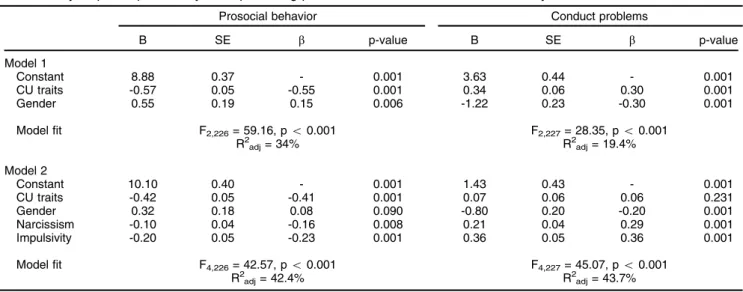
Results:Gender, narcissism and impulsivity, but not CU, were statistically significant predictors of CP in the second model (F3,226= 45.07, po0.001, R2= 43.7%; betas: gender = -0.20, narcissism =
0.29, impulsivity = 0.36, CU = 0.06). PB was significantly predicted by all domains except gender (F3,226= 42.57, p o 0.001, R2= 42.4%; betas: gender = 0.08, narcissism = -0.16, impulsivity =
-0.23, CU = -0.41).
Conclusion:Our results confirmed that CU traits refer to a distinct manifestation of psychopathy in youth, but we also found that narcissism and impulsivity are equally important when predicting CP. Previous reports of sex differences on APSD and SDQ domains were also corroborated.
Keywords: Child psychiatry; diagnosis and classification; personality disorders - cluster B (antisocial-borderline-histrionic-narcissistic); violence/aggression; gender differences
Introduction
Children with dysfunctional levels of aggression and anti-social behavior may meet criteria for a diagnosis of conduct disorder (CD). CD is characterized by behavior that violates the rights of others or societal norms1and interferes with typical social and/or academic functioning.2The presence of conduct problems (CP) during childhood and adoles-cence places individuals at risk of serious outcomes such as delinquency, criminal involvement, substance misuse, relationship problems, and severe psychopathy.3 Within the most recent iteration of the DSM-5, the definition of CD has been developed to include a specifier to this dia-gnosis for those who also display limited prosocial emot-ions, such as deficits in empathy and in expression of guilt.2These characteristics overlap with the concept of
callous-unemotional (CU) traits.
CU traits are a category of behavior characterized by persistent, negative acts intended to harm others, as well as the absence of emotional responsiveness and little to no empathy. In this sense, CU traits can be considered as a developmental precursor to psychopathy.1To date, it has been proposed that CU traits may be associated
with genetic, brain-based, and environmental factors,4-5 which predispose a child to this particular and persistent interpersonal style. CU traits are typically associated with adverse outcomes such as increased CP, substance use, and risk-taking behaviors. Elevated levels of CU traits have been shown to delineate a group of individuals with more severe behavioral difficulties and with very similar rates of CD and oppositional defiant disorder as opposed to those with non-elevated CU traits,6 who tend to be more heterogeneous with regards to behavioral symp-toms. Additionally, the combination of early psychopathic traits such as impulsivity, CU traits, and aggression has established influences on propensity, situational context, and deterrence of violent offending trajectories.7-9
Although CU traits may play a key role in youth psychopathy, there is no consensus as to whether the presence of CU traits is sufficient to classify this subgroup of youth. To date, researchers have repeatedly neglected the contribution of traits such as narcissism and impulsiv-ity to the development of psychopathy – realms that are equally important in determining potential prospects of future psychopaths.10,11 This is alarming, since early treatment is imperative to attenuate the numerous con-sequences related to psychopathy along the lifespan. For instance, longitudinal research has shown that nar-cissism, impulsivity, and CU traits as measured by the Antisocial Process Screening Device (APSD) significan-tly predicted the ‘‘meanness’’ (e.g., lack of empathy, cal-lousness, cruelty) domain of the Triarchic Psychopathy
Correspondence: Guilherme Welter Wendt, Unit for School and Family Studies, Department of Psychology, Goldsmiths, University of London, The Bungalow Building, Lewisham Way, SE14 6NW, London, UK.
E-mail: [email protected]
Submitted Oct 18 2016, accepted Mar 25 2017.
Revista Brasileira de Psiquiatria. 2017;39:267–270 Associac¸a˜o Brasileira de Psiquiatria
Measure (TriPM) later on, in young adulthood (b= 0.39, 0.24, and 0.44, respectively).12 In addition, data from a child sample highlights the role of narcissism as an important predictor of aggression above and beyond CU traits.10 Nevertheless, no studies have investigated the
magnitude to which impulsivity and narcissism would explain concurrent pro- and antisocial behaviors in school children. To shed some light on this topic, the present study aimed to investigate the unique contribution of narcissism and impulsivity – in addition to CU traits – in explaining those behaviors, while also taking into acc-ount the role of gender.
Methods
Participants and procedures
A total of 249 schoolchildren (aged 9 to 12 years, 54.9% girls) participated in this research. All participants attended mainstream primary schools in the London area. This study was approved by the ethics committee of the Dep-artment of Psychology, Goldsmiths, University of London. Informed consent was obtained from the parents or gua-rdians of each participant. The data presented in this study were collected as part of a larger study of child behavioral difficulties. All measures were completed by the partici-pants, and there were no a priori exclusion criteria.
Measures
Antisocial Process Screening Device (APSD)13
The APSD is one of the most widely used measures to assess psychopathic traits in youth. It is a 20-item rating scale that can be completed by a parent or teacher, or self-rated. It comprises three subscales (CU, narcissism, and impulsivity). In the present study, self-reported APSD yielded adequate indices of internal consistency (Cron-bach’sa= 0.71; Guttman’sl6= 0.79).
Strengths and Difficulties Questionnaire (SDQ)14
The SDQ assesses five dimensions: peer relations (PR), conduct problems (CP), emotional problems (EP), pro-social behaviors (PB), and hyperactivity. It comprises 25 items on a three-point Likert-type scale (0 = not true, 1 = somewhat true, and 2 = certainly true). Again, the self-reported SDQ presented adequate indices of internal consistency in the present study (Cronbach’s a = 0.75; Guttman’sl6= 0.82).
Data analysis
The dataset was coded and analyzed using SPSS version 20 and JASP version 0.8. To characterize the sample, frequencies, correlations, means, and standard deviations were calculated for the variables of interest. Inferential
t-tests were used for comparisons between means for boys and girls. Hierarchical regression analyses were performed to understand the unique contributions of the predictors CU traits, narcissism, and impulsivity to pro- and antisocial behaviors defined as outcomes.
Results
Descriptive statistics and gender differences
For SDQ PB and CP, mean (SD) values were 7.99 (1.80) and 2.77 (1.99), respectively. Mean (SD) values for APSD CU traits, narcissism, and impulsive behavior were, res-pectively, 2.99 (1.77), 4.04 (2.67), and 4.18 (2.02). Aside from CU traits, all other variables showed statistically sig-nificant differences between boys and girls. Boys scored higher on CP, impulsive behavior, and narcissism than girls (t1,228= -4.89, p o0.001, d = -0.65;t1,226= -2.27,
p = 0.02, d = -0.30; t1,226= -3.53, p o0.001, d = -0.47,
respectively), whereas girls displayed elevated PB scores (t1,225= 2.89, p = 0.004, d = 0.39).
Correlations and predictors
As expected, CP was negatively linked with PB (r = -0.46), and positively associated with CU traits (r = 0.34), narcis-sism (r = 0.53), and impulsivity (r = 0.55). PB was negati-vely associated with CU traits, narcissism, and impulsivity (r = -0.56, -0.45, and -0.46, respectively). CU traits were associated with narcissism (r = 0.39) and impulsivity (r = 0.36). Finally, narcissism was positively linked with impuls-ivity (r = 0.46). All correlations were significant at po0.001.
Hierarchical regression analyses were performed with CU traits and gender as predictors firstly (Model 1). To understand the increment in the model, narcissism and impulsivity were added in the second step (Model 2). Interestingly, when using gender and CU traits alone to predict conduct problems, the model explained 19.4% of the variance. Nevertheless, adding narcissism and impulsivity resulted in a substantial increase in the amo-unt of variance explained by the predictors (from 19.4 to 43.7%), although CU traits failed to retain their statistical significance. For the model exploring predictors of prosocial behaviors, the second model displayed better results when compared to the model that considered CU traits and gender alone. The amount of variance explained increased from 34% (first model) to 42.4% (second model), and gender failed to retain its statistical significance from step one to two (Table 1).
Discussion
In the current study, we primarily sought to examine the extent to which impulsivity and narcissism predicted concurrent prosocial and antisocial behaviors in school-children over and above CU traits alone. To achieve these goals, hierarchical regression models were used. We found that there are differential predictors of the domains of pro- and antisocial behavior, which should not simply be seen as two sides of the same coin.
For PB, CU traits are the strongest (negative) predictor, although narcissism and impulsivity are also significant negative predictors. On the other hand, for prosocial behavior, when a model including CU traits, narcissism, and impulsivity was tested, CU traits were not a statist-ically significant predictor of antisocial behavior in this community sample of children. This finding is particularly
Rev Bras Psiquiatr. 2017;39(3)
interesting given the recent addition of the limited pro-social emotions specifier in DSM-5.2
One of the key reasons for including this specifier into the DSM-5 is to allow for specialized care, treatment, and research pathways for children who show both negative (i.e., antisocial) and positive behaviors (i.e., display of appropriate prosocial emotions). Our research has shown that early personality features (narcissism) and behavioral features (impulsivity) also make important contributions to child behavioral presentation. It should be noted that impulsivity was a statistically significant variable in all models tested in this study. In this sense, therapies directed at aggressive behaviors may be particularly relevant.10A similar pattern was observed for narcissism, which was also a statistically significant predictor of pro-and antisocial behavior, although less strong than impulsi-vity. Here, implications for clinical treatment might include transferring excessive focus from the individual (i.e., avo-idance of fostering egocentricity features) and stressing perspective-taking abilities and empathy.15,16
To conclude, it is certainly relevant to consider gender and CU traits as important risk factors for the development of the psychopathic personality. However, a more compre-hensive examination including the exploration of narcissism and impulsivity not only gives us a more robust picture – as explained by a significant increase in the variance explained – but also implications in terms of intervention designs aiming to prevent CP and promote prosocial behaviors among at-risk populations.13 In addition, understanding the role of CU traits, alongside narcissism and impulsivity, in predicting CP may help researchers identify homogenous groups with greater accuracy, as well as contribute to capturing a richer picture of etiologies and trajectories of antisociality.17,18
Acknowledgements
GWW thanks Coordenac¸a˜o de Aperfeic¸oamento de
Pes-soal de Nı´vel Superior (CAPES) for the support provided through doctoral scholarship BEX 893713-3.
Disclosure
The authors report no conflicts of interest.
References
1 Jones APJ, Wendt GW. Neuropsychology of psychopathic traits in children. In: Delisi M, Vaughn M. The Routledge international handbook of biosocial criminology. London: Routledge; 2015. p. 218-35.
2 American Psychiatric Association. Diagnostic and Statistical Manual of Mental Disorders, Fifth Edition (DSM-5). Arlington: American Psychiatric Publishing; 2013.
3 Gumpel TP. Linking psychopathy and school aggression in a non-clinical sample of adolescents. J Sch Violence. 2014;13:377-95. 4 Viding E, Jones AP, Paul JF, Moffitt TE, Plomin R. Heritability of
antisocial behaviour at 9: do callous-unemotional traits matter? Dev Sci. 2008;11:17-22.
5 Fontaine NM, Rijsdijk FV, McCrory EJ, Viding E. Etiology of different developmental trajectories of callous-unemotional traits. J Am Acad Child Adolesc Psychiatry. 2010;49:656-64.
6 Frick PJ, Ray JV, Thornton LC, Kahn RE. Can callous-unemotional traits enhance the understanding, diagnosis, and treatment of serious conduct problems in children and adolescents? A comprehensive review. Psychol Bull. 2014;140:1-57.
7 McCuish EC, Corrado RR, Lussier P, Hart SD. Psychopathic traits and offending trajectories from early adolescence to adulthood. J Crim Justice. 2014;42:66-76.
8 Corrado RR, McCuish EC, Hart SD, DeLisi M. The role of psycho-pathic traits and developmental risk factors on offending trajectories from early adolescence to adulthood: a prospective study of incar-cerated youth. J Crim Justice. 2015;43:357-68.
9 Corrado RR, McCuish EC, Hart SD, Delisi M. The role of symptoms of psychopathy in persistent violence over the criminal career into full adulthood. J Crim Justice. 2015;43:345-56.
10 Kerig PK, Stellwagen KK. Roles of callous-unemotional traits, nar-cissism, and Machiavellianism in childhood aggression. J Psycho-pathol Behav Assess. 2010;32:343-52.
11 Feilhauer J, Cima M. Youth psychopathy: differential correlates of callous-unemotional traits, narcissism, and impulsivity. Forensic Sci Int. 2013;224:1-7.
12 Kyranides MN, Fanti KA, Sikki M, Patrick CJ. Triarchic dimensions of psychopathy in young adulthood: associations with clinical and physiological measures after accounting for adolescent psychopathic traits. Personal Disord. 2017;8:140-9.
Table 1 Psychopathic personality traits predicting pro- and antisocial behaviors in 9-to-12-year-olds
Prosocial behavior Conduct problems
B SE b p-value B SE b p-value
Model 1
Constant 8.88 0.37 - 0.001 3.63 0.44 - 0.001 CU traits -0.57 0.05 -0.55 0.001 0.34 0.06 0.30 0.001 Gender 0.55 0.19 0.15 0.006 -1.22 0.23 -0.30 0.001
Model fit F2,226= 59.16, po0.001
R2 adj= 34%
F2,227= 28.35, po0.001
R2
adj= 19.4%
Model 2
Constant 10.10 0.40 - 0.001 1.43 0.43 - 0.001 CU traits -0.42 0.05 -0.41 0.001 0.07 0.06 0.06 0.231 Gender 0.32 0.18 0.08 0.090 -0.80 0.20 -0.20 0.001 Narcissism -0.10 0.04 -0.16 0.008 0.21 0.04 0.29 0.001 Impulsivity -0.20 0.05 -0.23 0.001 0.36 0.05 0.36 0.001
Model fit F4,226= 42.57, po0.001
R2
adj= 42.4%
F4,227= 45.07, po0.001
R2
adj= 43.7%
SE = standard error.
For all predictors, collinearity values were acceptable, with the variance inflation factor ranging from 1.005 to 1.439. All tested models survived analyses of residuals (Durbin-Watson’s values of 1.967 and 1.826 for prosocial behaviors and conduct problems, respectively).
13 Frick PJ, Hare RD. The Antisocial Process Screening Device (APSD). Toronto: Multi-Health Systems; 2001.
14 Goodman R. Psychometric properties of the strengths and difficul-ties questionnaire. J Am Acad Child Adolesc Psychiatry. 2001;40:1337-45. 15 Barry CT, Frick PJ, Killian AL. The relation of narcissism and self-esteem to conduct problems in children: a preliminary investigation J Clin Child Adolesc Psychol. 2003;32:139-52.
16 Mun˜oz Centifanti LC, Kimonis ER, Frick PJ, Aucoin KJ. Emotional reactivity and the association between psychopathy-linked narcissism
and aggression in detained adolescent boys. Dev Psychopathol. 2013;25:473-85.
17 Eisenbarth H, Demetriou CA, Kyranides MN, Fanti KA. Stabi-lity subtypes of callous-unemotional traits and conduct dis-order symptoms and their correlates. J Youth Adolesc. 2016;45: 1889-901.
18 Salekin RT. Psychopathy in childhood: why should we care about grandiose-manipulative and daring-impulsive traits? Br J Psychiatry. 2016;209:189-91.
Rev Bras Psiquiatr. 2017;39(3)