DEVELOPMENT OF LANGUAGE SKILLS IN CHILDREN
WITH COCHLEAR IMPLANTS: DOES THE GENDER
HAVE ANY INFLUENCE?
Desenvolvimento da linguagem em crianças com implante coclear:
terá o gênero alguma inluência?
Daniela Ramos (1), João Xavier Jorge (2), António Teixeira (3), Carlos Ribeiro (1), António Paiva (1)
(1) Centro Hospitalar e Universitário de Coimbra, Coimbra,
Portugal.
(2) Faculdade de Medicina da Universidade de Coimbra,
Coimbra, Portugal.
(3) Departamento de Eletrónica, Telecomunicações e
Informá-tica da Universidade de Aveiro, Aveiro, Portugal.
Conlict of interest: non-existent
sensorineural deafness, in which the beneit of
hearing correction with conventional hearing aid is limited.
According to some researchers, it is expected
that the children with surgically implanted cochlear implants, at an early age, may reach a development
equivalent to what would be expected for their
chronological age3. However, the auditory perfor-mance and the development of language may be
inluenced by a number of factors2,7,9.
The inluence of gender on the process of
language acquisition and development in normal hearing children is currently discussed with some attention. In this respect, there seems to be no consensus between the various authors10. Mendes et al. (2012)11 and Rezende et al. (2005)12 analysed
the inluence of gender on the development of the
linguistic skills in hearing children and found no
statistically signiicant differences between genders.
On the other hand, Normand et al. (2008)13 studied
the lexical and grammatical development in male
and female children and found a slight advantage of the female gender up to 36 months. The same
INTRODUCTION
The absence of hearing experiences resulting from the existence of congenital severe to profound deafness, inluences in a very signiicant way
the development of language in children1, thus jeopardising school performance and the social interaction of the children.
Cochlear implant is a revolutionary element on both the hearing (re)habilitation and the improvement of the quality of life of the children with this type and degree(s) of deafness, when performed at an early stage2-8. This method of treatment is recommended for children with severe to profound congenital
ABSTRACT
Purpose: to evaluate the gender’s inluence in the development of language skills in children with
severe to profound sensorineural deafness after cochlear implant. Methods: thirty children, 12 females and 18 males, aged between 8 years and 1 month and 10 years, with severe to profound congenital bilateral sensorineural deafness with cochlear implant were studied. The language structures analyzed
were semantics, morphosyntax and phonology. The assessment tool used was the Observation Grid
Language - school level. Results: the average hearing age was of 72 months for females and 72.7 months for males. The scores obtained in the three structures were statistically similar between genders. Into each structure, the comparison of each test, were also similar. Conclusions: gender
did not inluence the development of oral language in children with cochlear implants, in the three
linguistic structures studied.
32.61±7.8 months for males and 30.33±7.0 months for females. At the time of the diagnosis the male children were, in average, 25.31±10.3 months, while the female children were 25.17±7.0 months old.
According to the Service standards, the amount of speech therapy prior to cochlear implant surgery is on average 4 months.
All children were assessed within the framework of regular speech therapy sessions carried out at the Cochlear Implants Functional Unit, that take place after discharge from the initial auditory habilitation program, after the cochlear implant placement.
The linguistic competences data were collected
with the Language Observation Grid – school level (GOL-E). This assessment tool is part
of the Assessment of Children with Cochlear Implants Protocol (PAC-IC) and it is standardized for Portuguese children between 5 years and 7 months old and 10 years of age. The observation grid, developed by Kay et al. (2003)17, allows the assessment of three major linguistic structures
(semantics, morphosyntax and phonology) in
primary school aged children.
Each assessment structure is made up of various tests. The semantic structure consists of three
tests. The irst is word deinition, which analyses the ability to describe concepts. The second test,
naming classes, assesses the vocabulary range in relation to superordinate terms. The third test,
opposites, assesses the knowledge of opposite terms. The morphosyntactic structure is assessed
in four tests. The irst one, recognition of agram -matical sentences, assesses the ability to make grammatical judgements. The second test, coordi -nation and subordi-nation of sentences, analyses the
ability to build complex subordinate and coordinate
sentences from two simple sentences. The third and fourth tests, word order in a sentence and derivation
of words assess the ability to order words to form sentences and the use of morphological rules to create derived words. There are four tests for the
phonologic structure. The irst two, selection of words and selection of pseudo-words test the capacity of auditory discrimination. The identiication of words
that rhyme and syllabic segmentation are two other
tests that are part of this structure. The irst aims to
assess the ability to identify rhymes and the second, the ability to segment words into syllables.
The following tests were used for statistical was observed in the studies of Sandri et al. (2009)10
who analysed the communicative proile in children
between 1 and 3 years of age, having observed a superiority of the female gender, although the differences between genders were not statistically
signiicant. The inluence of gender in children with
the cochlear implant has also been the subject of investigation9,14-16. However, there also appears to be no convergence in the results and observations by different authors. In their records regarding the studies of children with cochlear implant, Ching
et al. (2013)14, Geers et al. (2007)15 and Geers et al. (2003)16 concluded that female children have been showing better results in language than
male children. The studies of Gérard et al. (2010)9
concluded that there were no statistically signiicant
differences between genders regarding language development.
We have found no references, in literature, of researches conducted in Portugal that have focused on this topic. This occurrence, in particular, under-lines the interest of the present study. The aim of
this study is to assess the inluence of gender in language skills, semantics, morphosyntax and
phonology in children with severe to profound congenital bilateral sensorineural deafness after cochlear implant.
METHODS
The present study had the approval of the Ethics Committee of the Hospital Centre and University of Coimbra, to which the protocol no. CHUC-75-12 was attributed.
The study carried out was a prospective and transversal type. Thirty children with severe to profound congenital bilateral sensorineural deafness with a unilateral cochlear implant were studied. The procedure took place in the Otorhinolaryngology Service of the Hospital Centre and University of the institution of origin.
The sample consisted of 12 female children and 18 males. The numerical difference did not prove
statistically signiicant. The inclusion criteria of the
values of the scores obtained for each gender were very similar. They were generally higher in male
children: semantics 16.89, morphosyntax 21.11 and
phonology 26.83, than in female children: semantics
14.42, morphosyntax 13.75 and phonology 25.33. However, there were no statistically signiicant
differences when comparing both genders. The results are shown in Table 1.
RESULTS
The average hearing age, 72 months for female children and 72.7 months for males, was similar, p=0.873.
On the general analysis of the results it was found that in all three linguistic structures studied,
semantics, morphosyntax and phonology, the
Table 1 – Average score obtained on the semantics, morphosyntax and phonology structure, in children with cochlear implants, distributed according to gender, assessed with the Language Observation Grid – School Level
GOL-E Female
X ± D P
Male
X ± D P p
Semantics 14.42±7.9 16.89±10.7 0.50
Morphosyntax 13.75±11.7 21.11±12.8 0.12
Phonology 25.33±11.7 26.83±10.6 0.71
Key: GOL-E: Language Observation Grid – School Level
Statistical Test: Student t-test: p=0.05
There were also no relevant differences on the
particular analysis of the semantics, morphosyntax
and phonology test structures.
The scores registered on the children, on the semantics structures tests, proved to be slightly higher for the male gender, on the word deinition
test, 6.61±4.8 vs 5.17±3.3 and naming classes 5.28±3.4 vs 4.58±2.5. The opposites test was the
exception, in which the results were very similar
among genders. However, there were no
statisti-cally signiicant differences in all the cases. Table 2
presents such detailed results.
Table 2 – Mean score obtained on the semantic structure tests, in children with cochlear implant, distributed according to gender, assessed with the Language Observation Grid – School Level
GOL-E Female
X ± D P
Male
X± D P p
Word deinition 5.17±3.3 6.61±4.8 0.37
Naming classes 4.58±2.5 5.28±3.4 0.55
Opposites 4.58±2.6 4.78±3.1 0.86
Key: GOL-E: Language Observation Grid – School Level
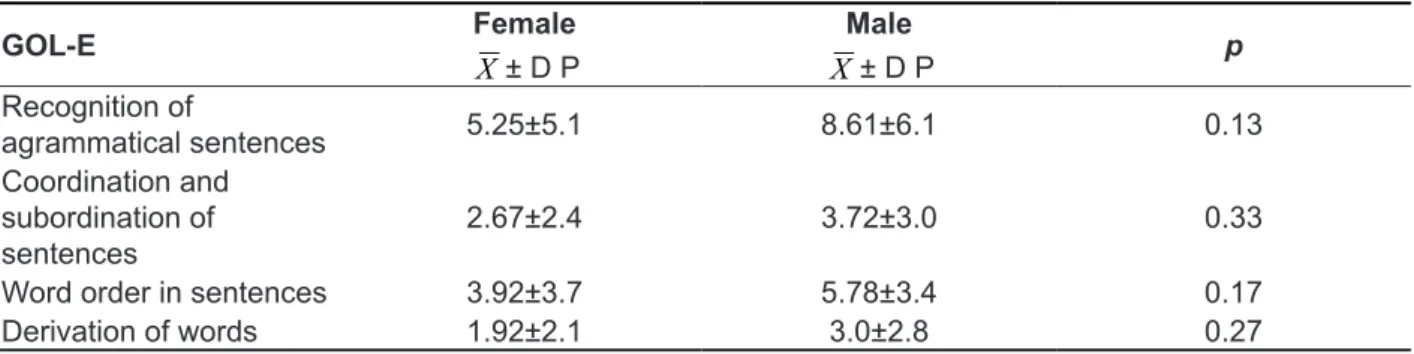
tests, higher than the females, especially in agram -matical sentence recognition 8.61±6.1 vs 5.25±5.1 and sentence word order 5.78±3.4 vs 3.92±3.7, as can be seen in Table 3.
When observing the different components of the morphosyntactic structure, the differences found
were not signiicant either. However, in this particular
structure the average score for males was, in all
Table 3 - Mean score obtained on the morphosyntax tests, in children with cochlear implant, distributed according to gender, assessed with the Language Observation Grid – School Level
GOL-E Female
X ± D P
Male
X ± D P p
Recognition of
agrammatical sentences 5.25±5.1 8.61±6.1 0.13 Coordination and
subordination of sentences
2.67±2.4 3.72±3.0 0.33
Word order in sentences 3.92±3.7 5.78±3.4 0.17 Derivation of words 1.92±2.1 3.0±2.8 0.27 Key: GOL-E: Language Observation Grid – School Level
Statistical Test: Student t-test: p=0.05
Once the data obtained on the phonology tests
was determined, the inexistence of statistically signiicant differences when comparing genders
was evident. It is worth highlighting that the results of the scores on the four tests, presented closer
results among themselves, with the exception of the syllabic segmentation test, in which the mean value was higher in male children, 8.22±2.3 vs 7.00±2.8, as shown in Table 4.
Table 4 – Mean scores obtained on the phonology structure tests, in children with cochlear implant, distributed according to gender, assessed with the Language Observation Grid – School Level
GOL-E Female
X ±D P
Male
X ± D P p
Discrimination of word
pairs 6.58±3.2 6.50±3.3 0.94
Discrimination of
pseudo-words 6.33±2.87 6.06±3.1 0.80
Identiication of words
that rhyme 5.17±4.5 6.06±3.7 0.56
Syllabic segmentation 7.00±2.8 8.22±2.3 0.21 Key: GOL-E: Language Observation Grid – School Level
The results by Ching et al. (2013)14 also differ with
regard to their tendency concerning our indings. In a
study involving 134 children with cochlear implants, up to the age of 3, in which language development was assessed, those authors found that the best results were associated to the female gender. This
was also corroborated by Geers et al. (2007)15 in a
study conducted with 200 children and by Geers et
al. (2003)16 when they assessed 181 children from 8 to 9 years of age with cochlear implants. In effect,
despite having no signiicant differences recorded, the doubt is maintained as to a possible inluence of
gender on linguistic gains of children with cochlear implant.
Although implanted children are capable of devel-oping good linguistic capacities, the great variability of results between genders, observed by different authors, remains a matter of motivation9,14-16. It is a fact that the number of individuals in our sample was relatively small. Future studies, with a larger sample, which will be used for a better character-ization and recognition of the language gains in reference to gender, may help clarify this fact and optimize the (re)habilitation process of children with cochlear implant, in case the differences between both genders are recognized.
CONCLUSIONS
Gender had no signiicant inluence in the
development of the linguistic skills (semantics,
morphosyntax and phonology), in children with
severe to profound congenital bilateral sensori-neural deafness after cochlear implant, evaluated with the assessment tool, Language Observation
Grid – School level. In the different tests for each
linguistic structure, gender did not prove to be a
variable capable of inluencing the results achieved
by children users of cochlear implant.
ACKNOWLEDGMENTS
The authors would like to thank the speech therapists Marisa Alves and Helena Alves for their valuable contribution in the collection of data, all doctors and technicians who participated in the cochlear implantation procedure and parents/ caretakers and children involved in the study.
DISCUSSION
When analysing the results of the semantics,
morphosyntax and phonology structures, comparing
the female and male genders, a superiority in the male results was evident in all the studied structures. This difference of values was more evident in the
morphosyntax structure. Although the differences in
all structures between both genders were not
statis-tically signiicant, it is nonetheless a notable inding. A research by Gérard et al. (2010)9, conducted with children with cochlear implants and using a scale
that evaluates ive components of oral language also concluded that there were no signiicant differ -ences between genders9 , thus supporting the results obtained in this study. Mendes et al. (2012)11 and Rezende et al. (2005)12 veriied the same conclusion in their studies with normal hearing children. Although the study carried out by Normand et al. (2008)13 did not ind any statistically signiicant differences in hearing children, it nonetheless
veriied, contrary to our indings, that the female
children had a slight advantage in language gains. The data registered by Sandri et al. (2009)10 on the
analysis of the communicative proile of the normal
hearing children between the ages of 1 and 3 years old, has also differed form the data we found. Those
authors veriied a tendency for larger linguistic gains
among female children.
The tendency of the observed values was similar in the individualized analysis of the results achieved by both genders in the linguistic structure tests, although, generically speaking, there were no statistically relevant differences. On the semantics structure the male gender reached higher results on the deinition of words and naming classes tests. The results between both genders were only similar on the opposites test. In the ield of morphosyntax, the results were, in all tests, higher in males. It is worth mentioning that on the recognition of agram -matical sentences and word order in a sentence
tests, the differences between the registered values were more evident.
deaf children. Int J Pediatr Otorhinolaryngol. 2010;74:642-8.
10. Sandri MA, Meneghetti SL, Gomes E. Peril
comunicativo de crianças entre 1 e 3 anos com desenvolvimento normal de linguagem. Rev CEFAC. 2009;11(1):34-41.
11. Mendes JCdP, Pandoli MM, Carabetta Júnior V,
Novo NF, Colombo-Souza P. Fatores associados a
alteração da linguagem em crianças pré-escolares.
Rev. soc. bras. fonoaudiol. 2012;17(2):177-81.
12. Rezende MA, Beteli VC, Santos JLFd. Avaliação
de habilidades de linguagem e pessoal-sociais pelo Teste de Denver II em instituições de educação infantil. Acta Paul Enferm. 2005;18:56-63.
13. Normand M, Parisse C, Cohen H. Lexical
diversity and productivity in French preschoolers: developmental, gender and sociocultural factors. Clin Linguist Phon. 2008;22(1):47-58.
14. Ching T, Dillon H, Marnane V, Hou S, Day J, Seeto M et al. Outcomes of early- and late-identiied children at 3 years of age: indings from a
prospective population-based study. Ear Hear. 2013;34(5):535-52.
15. Geers AE, Nicholas JG, Moog JS. Estimating the Inluence of Cochlear Implantation on
Language Development in Children. Audiol Med. 2007;5(4):262-73.
16. Geers A, Nicholas J, Sedey A. Language skills
of children with early cochlear implantation. Ear &
REFERENCES
1. Kim L-S, Jeong S-W, Lee Y-M, Kim J-S. Cochlear
implantation in children. Auris, nasus, larynx.
2010;37(1):6-17.
2. Russell JL, Pine HS, Young DL. Pediatric
Cochlear Implantation: Expanding Applications
and Outcomes. Pediatric Clinics of North America. 2013;60(4):841-63.
3. Fortunato C, Bevilacqua M, Costa Md. Análise comparativa da linguagem oral de crianças ouvintes e surdas usuárias de implante coclear. Rev CEFAC. 2009;11(4):662-72.
4. Anderson I, Weichbold V, D’Haese PSC, Szuchnik
J, Quevedo MS, Martin J et al. Cochlear implantation in children under the age of two—what do the outcomes show us? Int J Pediatr Otorhinolaryngol. 2004;68(4):425-31.
5. Moret ALM, Bevilacqua MC, Costa OA. Implante coclear: audição e linguagem em crianças
deicientes auditivas pré-linguais. Pró-Fono R.
Atual. Cient. 2007;19:295-304.
6. Wolfgang KG, Jafar H, Brigitte E, Wolf DB. Speech
Perception Performance in Prelingually Deaf Children with Cochlear Implants. Acta Otolaryngol. 2000;120:209-13.
7. Polat B, Başaran B, Kara H, Ataş A, Süoğlu Y.
The impact of social and demographic features
on comprehensive receptive and expressive
performance in cochlear implant patients. Kulak
RESUMO
Objectivo: avaliar a inluencia do gênero no desenvolvimento da linguagem de crianças com surdez
severa a profunda neurossensorial, após implante coclear. Métodos: foram estudadas 30 crianças,
12 do gênero feminino e 18 do masculino, entre os 8 anos e 1 mês e os 10 anos com surdez severa a profunda neurossensorial bilateral congênita com implante coclear. Avaliaram-se as estruturas lin
-guísticas semântica, morfossintaxe e fonologia. Utilizou-se o instrumento de avaliação: Grelha de
Observação da Linguagem - nível escolar. Resultados: a idade auditiva média foi de 72 meses no
gênero feminino e 72.7 meses no masculino. As pontuações obtidas nos três níveis linguisticos foram estatisticamente semelhantes, quando comparados os gêneros. Nas provas de cada estrutura lin
-guística também não se veriicaram diferenças estatisticamente signiicantes. Conclusões: o gênero
não inluenciou o desenvolvimento da linguagem oral nas crianças utilizadoras de implante coclear, nas três estruturas linguísticas estudadas.
Received on: February 19, 2014 Accepted on: August 30, 2014
Mailing address:
Daniela Castanheira Ramos
Urbanização Quinta São Luiz Lote 92 2ºDireito Pereira. Coimbra - Portugal
3140-348