Microbiologic profile of hospitalized healthcare workers
RAFAEL BARBERENA MORAES1*, ANDRÉIA DELLA GIUSTINA2, ELIANA MADALENA VICENTINI FARENZENA2, LAURADE MATTOS MILMAN2,
RENATA SEHBE FEDRIZZI2
1PhD and MSc in Endocrinology- UFRGS; Instructor, Department of Internal Medicine at Hospital Nossa Senhora da Conceição; Intensive care specialist at the Hospital de Clínicas de Porto Alegre and Fêmina Hospital; Specialist in Intensive Care from the AMIB, Medical Residency Program.
2Resident in Internal Medicine, Hospital Nossa Senhora da Conceição.
S
UMMARYStudy conducted at Hospital Nossa
Senhora da Conceição
Article recieved: 15/10/2013
Accepted for publication: 14/2/2014
*Correspondence
Address: Rua Erechim, 100/31 Postal Code: 90830-000
Porto Alegre, RS – Brazil Phone/Fax: +55 51 30280591
Financial support: GEP- GHC: Teaching and Research Management Department Grupo Hospitalar Conceição.
http://dx.doi.org/10.1590/1806-9282.60.05.016
Conflict of interest: none
Objective: according to the epidemiologic and antimicrobial resistance profile, infections are usually classified as community-acquired or nosocomial. Reports on patients without the classic criteria for nosocomial infection with multidrug--resistant germs are increasing. There is a particular concern regarding which mi-crobiological profile must be addressed in case of infections in healthcare wor-kers. This study was carried out with the purpose of identifying the prevalence of infection by multidrug-resistant germs in healthcare workers exposed to oc-cupational contact with such germs at work.
Methods: observational and retrospective study. In a 7-year period, healthcare worker hospitalizations were identified and the cultures results were assessed in order to identify the prevalence of infection by multidrug-resistant pathogens. Results: 1,487 healthcare workers hospitalizations were identified. In 105 of the-se hospitalizations, cultures were collected on the first 5 days after admission, and in 22 patients, 24 germs were identified. Multidrug-resistant pathogens were not found.
Conclusion: in our sample, composed of workers from a tertiary public hospi-tal who were hospihospi-talized, none of the individuals presented MDR colonization or infection. These results suggest that when healthcare workers present infec-tions, they must receive antibiotic therapy directed to community-acquired pa-thogens. In light of the limitations of this study, further larger and multicenter studies must be developed to enlighten such issue.
Keywords: nosocomial infection, antibacterial resistance, community-acqui-red infection, healthcare workers.
I
NTRODUCTIONKnowing the colonization profile of the population ad-dressed is crucial to determine an empirical antibiotic the-rapy to be employed.1,2 Historically, infections are defined
as community-acquired (patients from extra-hospital set-ting) or nosocomial (acquired after at least 48 hours of ad-mission or due to it), and empirical therapy is based on the germs commonly involved in each situation. More recen-tly, the literature has used the expression “healthcare-as-sociated infections”3,4 to designate infections caused by
multidrug-resistant organisms in outpatients with risk fac-tors and exposure to MDRs, including those residing in
nursing homes, or who had extended contact with intra-hospital or hemodialysis facilities in the past 30 days, re-quired hospitalization in emergency units for a period ex-ceeding 48 hours in the last 90 days, or who underwent intravenous therapies in past 30 days.2-4
single empirical antibiotic therapy would be correct in case of infection in a healthcare worker: empirical cove-rage directed to community germs or MDR bacteria?5-8
Based on that, defining the colonization profile of healthcare workers is a matter of great importance and aims to avoid prescription of inadequate empirical anti-biotic therapy, which is associated with increased morbi-dity and mortality (if using limited spectrum antibiotic medication to treat patients with MDR bacteria), as well as the development of antimicrobial resistance within the population and unnecessary hospitalizations (in cases of improper use of broad-spectrum antibiotics).9-12 To
cor-roborate the elucidation of this question, we developed this retrospective observational study aimed to identify the microbiological profile of infections in healthcare professionals who required hospitalization.
M
ETHODSAn observational study was conducted through search of electronic medical charts at the Nossa Senhora da Concei-ção Hospital (HNSC), located in Porto Alegre, state of Rio Grande do Sul, Brazil. Admissions of employees of the Con-ceição Hospital Group (GHC), which includes the Nossa Senhora da Conceição Hospital, Cristo Redentor Hospi-tal, Fêmina HospiHospi-tal, and the Conceição Children’s Hos-pital, were identified retrospectively. The GHC is compo-sed of tertiary level hospitals with endemic rates of colonization with MDR bacteria. All hospitalizations oc-curred at the Nossa Senhora da Conceição, since this is the hospital for clinical admissions in the GHC.
The population enrolled included workers of the GHC, admitted to the Nossa Senhora da Conceição Hospital in the period from January 2005 to January 2012, identi-fied by means of their punch-in cards, regardless of the reason for hospitalization. Of these, patients with risk factors for colonization that did not arise from work ac-tivities were excluded: previous hospitalization for less than six months, with cultures collected after the fifth day of hospitalization, or with the absence of cultures. Data collection was initiated once the project was appro-ved by the Research Ethics Committee-GHC, being per-formed from April to October 2012. The information was collected using searches for the following variables: gen-der, age, occupation (physician, nurse, nursing assistant/ technician, or positions with no direct contact with pa-tients), comorbidities, reason for hospitalization, ICU ad-mission, and type outcome (hospital discharge vs. death).
tion or colonization with MDR bacteria, such as emergency rooms, ICUs, recovery rooms and wards, were regarded as professionals in contact with MDRs. Professionals who did not work in these sectors or who worked in these sec-tors performing activities without direct patient contact were considered as workers not in contact with MDRs. The reason for admission was classified as infectious or non--infectious and, in the case of infection, its focus was esta-blished. Patients with positive cultures who did not recei-ve antibiotic treatment, on account of being asymptomatic despite bacterial growth on culture or whose medical charts did not mention infection, were defined as colonized pa-tients (carriers). Empirical antibiotic therapy was conside-red adequate if the bacteria were sensitive to the antibiotic used. De-escalation of antimicrobial treatment after cul-ture results was also assessed. Research sources were the admission form, the hospital discharge form and the out-patient consultation charts kept electronically by the hos-pital. The first chest radiography on admission was asses-sed. The chest X-ray was classified as compatible or not with bronchopneumonia, being compatible in case of new lobar consolidation, interstitial infiltrates or cavitating le-sions. To define multidrug-resistant germs, we adopted the definition of ESKAPE pathogens previously created to emphasize the pathogens that most often correlate with hospital infections and that “escape” the effects of anti-bacterial drugs. They include: Vancomycin-resistant entero-cocci, methicillin-resistant Staphylococcus aureus, Klebsiella
spe-cies and ESBL-producing Escherichia coli, Acinetobacter baumannii, Pseudomonas aeruginosa and extended spectrum beta-lactamase (ESBL)- or carbapenemase-producing Entero-bacteriaceae.13 Importantly, the data were subjected to
to-tal secrecy, not allowing the identification of patients/staff. Since this was a retrospective chart review, no consent form was applied, as approved by the local ethics committee.
Statistical analysis was performed with SPSS 17.0 software (statistical package software, SPSS Incorpora-tion, Chicago, IL, USA). The X2 was used to evaluate ca-tegorical variables and Student’s t test for parametric con-tinuous variables. For sample size calculation, the prevalence of positive cultures in 50% of the hospitaliza-tions was estimated with a confidence level of 90%, being thus required the identification of 97 admissions.
R
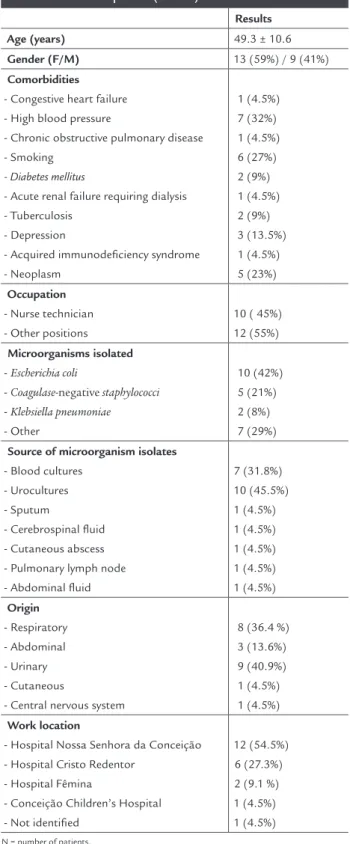
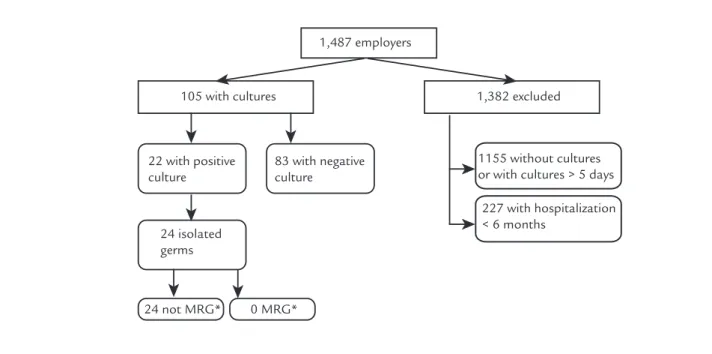
ESULTSdays, 83 were negative, and 22 hospitalizations had 24 bacteria isolated (Table 1 and Figure 1): Escherichia coli
(10), Coagulase-negative staphylococci (CoNS,5), Klebsiella pneumoniae (2) and 7 other germs: Enterococcus faecium, En-terococcus faecalis (both sensitive to ampicillin), Serratia marcescens, Staphylococcus epidermidis (oxacillin
suscepti-ble), Pseudomonas aeruginosa (sensitive to quinolones, ce-fepime, piperacillin-tazobactam and carbapenems), Strepto-coccus agalactiae and Cryptococcus neoformans. Multiresistant bacteria were not isolated from any employee.
The profile of the sample is shown in Table 1. Among the 22 patients, 10 (45.5%) were nursing technicians and 12 (54.5%) had positions without direct patient contact: supervisors, administrative technicians, elevator opera-tors, nutrition attendants, managers, pharmacy assistants, biomedical technicians, dispensers and cast technicians. There were no physicians or nurses in the sample. Based
on workplace and job function, 10 employees had possi-ble contact with MDR bacteria, 11 had no contact and 1 (4.5%) could not be determined.
Of the 22 admissions with bacterial isolates, 15 (68.2%) were hospitalizations due to infectious causes and 7 (31.8%), non-infectious. Thirteen patients received anti-biotics. In 8 patients, the initial antibiotic therapy was considered appropriate to the pathogen, being maintai-ned in 5 cases and de-escalated in 3, according to antibio-gram. In the other 2 patients, antibiotics were initiated after culture results. Among the 3 hospitalizations in which he empirical antibiotic therapy was considered inappropriate, one had the antibiotic therapy disconti-nued once the infection was attributed to cryptococcal me-ningitis, and in 2 the antibiotic therapy was adjusted after
culture results (amoxicillin-clavulanate was replaced by pi-peracillin-tazobactam and metronidazole was replaced by ce-phalothin). The bacteria isolated in these cultures were
Pseudomonas aeruginosa and Staphylococcusepidermidis,
res-pectively. In the other 9 hospitalizations, antibiotics were not used because they were considered cases of coloniza-tion or sample contaminacoloniza-tion.
In this study, MDR bacteria were not found among the 24 cultures isolated from biological material taken from 22 employees of a general hospital. It is essential to point out that ten of these employees worked in areas with endemic presence of MDR bacteria. Reports prepa-red by the Commission of Hospital Infection at the Nos-sa Senhora da Conceição Hospital highlight the high
pre-TABLE 1 Patient profile (n = 22)
Results Age (years) 49.3 ± 10.6
Gender (F/M) 13 (59%) / 9 (41%)
Comorbidities
- Congestive heart failure - High blood pressure
- Chronic obstructive pulmonary disease - Smoking
- Diabetes mellitus
- Acute renal failure requiring dialysis - Tuberculosis
- Depression
- Acquired immunodeficiency syndrome - Neoplasm
1 (4.5%) 7 (32%) 1 (4.5%) 6 (27%) 2 (9%) 1 (4.5%) 2 (9%) 3 (13.5%) 1 (4.5%) 5 (23%)
Occupation
- Nurse technician - Other positions
10 ( 45%) 12 (55%)
Microorganisms isolated
- Escherichia coli
- Coagulase-negative staphylococci - Klebsiella pneumoniae - Other
10 (42%) 5 (21%) 2 (8%) 7 (29%)
Source of microorganism isolates
- Blood cultures - Urocultures - Sputum
- Cerebrospinal fluid - Cutaneous abscess - Pulmonary lymph node - Abdominal fluid
7 (31.8%) 10 (45.5%) 1 (4.5%) 1 (4.5%) 1 (4.5%) 1 (4.5%) 1 (4.5%)
Origin
- Respiratory - Abdominal - Urinary - Cutaneous
- Central nervous system
8 (36.4 %) 3 (13.6%) 9 (40.9%) 1 (4.5%) 1 (4.5%)
Work location
- Hospital Nossa Senhora da Conceição - Hospital Cristo Redentor
- Hospital Fêmina
- Conceição Children’s Hospital - Not identified
12 (54.5%) 6 (27.3%) 2 (9.1 %) 1 (4.5%) 1 (4.5%)
N = number of patients.
The current evidence on healthcare-associated infec-tions suggests that the bacteria involved in this new clas-sification have resistance profiles different from those commonly associated with community-acquired infec-tions, in addition to being associated with higher morbi-dity and mortality.2,4,12.16,17 Few studies that evaluate
heal-thcare-associated infections address healthcare workers. Given the occupational exposure, it is important to study the microbiological profile of workers in the health seg-ment. The few studies conducted in this context are limi-ted to exceptional case reports describing rare events of direct transmission, with both patient and caretaker af-fected by the same pathogen.6,7 Other reports have also
associated infections in healthcare workers with certain scenarios from medical practice such as cardiopulmonary resuscitation rooms,18, 19 operating rooms20 and
intensi-ve care units.21,22 The report of unusual cases tends to
wrongly magnify the fear of MDR infection in healthca-re workers. Our sample seems mohealthca-re healthca-rephealthca-resentative of the actual scenario: the incidence of infections in healthcare workers was low and mostly the clinical presentation did not reveal increased severity, being associated with com-munity-acquired germs.
valence of germs such as Pseudomonas aeruginosa,
Staphylococcus aureus, Acinetobacter baumannii and Klebsiel-la pneumoniae among local cultures, stressing local rates of imipenem resistance at 93% among isolates of Acineto-bacter baumannii and 37% positivity for plasmid resistan-ce for Klebsiella pneumoniaecarbapenemase (KPC) in the
ge-nomic regions blaKPC-1 until blaKPC-7.14,15
Two microorganisms were isolated from urine cultu-re and abdominal fluid samples. Of the pathogens isola-ted, 14 (58.3%) were considered infectious and 10 (41.7%) colonizing. Among the admissions analyzed, 3 (13.6%) re-fer to ICU stays and 1 (4.5%) progressed to death. The only healthcare worker admitted to ICU and who progressed to death was diagnosed with Acquired Immunodeficiency Syndrome and Cryptococcus neoformans isolated in CSF. Des-pite immunosuppression and ICU admission, this patient had no positive cultures for MDR bacteria.
D
ISCUSSIONThis study shows the largest sample described to date with profiles of colonization and infection in healthcare workers who required hospitalization. The result of our study suggests that health professionals, even when
ex-1,487 employers
105 with cultures
22 with positive culture
83 with negative culture
24 isolated germs
24 not MRG* 0 MRG*
1,382 excluded
1155 without cultures or with cultures > 5 days
227 with hospitalization < 6 months
FIGURE 1 Flowchart allocation of employees with hospitalization.
sion; nevertheless, no bacterial growth was found. This may have occurred for several reasons such as methodo-logical limitation, technical issues, cultures collected af-ter antibiotics were given, or possibly the absence of pa-tient colonization/infection. We observed that in most patients hospitalized for infectious reasons, the causati-ve germ was isolated. Some, though presenting acticausati-ve in-fection, had culture results suggestive of colonization, but the possible microorganism involved in the infection was not identified.
The average age of our sample was low (49 years) and predominantly comprised staff members without multi-ple comorbidities. The fact that these are individuals enomically and socially active, also without relevant co-morbidities, explains the low incidence of infections in this population and the lack of data regarding this topic, as well as the impossibility of carrying out prospective trials, either observational or clinical in nature.
Our study has several limitations. First, let us remem-ber that this is a unicentric study. Therefore, we consider it relevant to the literature that many centers report the incidence of infections and the profile of antibacterial re-sistance in infections occurring in healthcare workers. The retrospective design and the definition of contact with MDRs derived from occupation and the identifica-tion of the work segment of the worker do not allow ac-curate determination of direct contact between the wor-ker and carriers of MDR bacteria, even though the commission of hospital infection control in this group does report high rates of colonization with MDR bacte-ria in the wards.14 Let us keep in mind that out of 1,487
admissions screened, only 22 had pathogens identified. As possible explanations, we can mention: a significant number of admissions due to non-infectious causes (in-dividuals economically and socially active, with few co-morbidities), the non-systematic collection of samples for cultures in the first five days from patients hospitali-zed with infection, the presence of recurrent hospitaliza-tions, and negative cultures in the first 5 days. In our sam-ple, the population was limited to nursing technicians and other occupations previously mentioned; doctors and nurses were not included. The fact that HNSC is a hospital that treats exclusively patients from the Brazi-lian Unified Health System (SUS public system) can in part justify this limitation, since those who can afford health insurance plans are usually admitted to the priva-te network of hospital care. Likewise, some employees may have been hospitalized in other public hospitals, wi-thout our knowledge. Another possible limitation is due to the low number of infectious cultures in our sample,
since in many cases, even the blood cultures were charac-terized as colonizing.
C
ONCLUSIONIn our sample, composed of employees of a public tertiary care hospital with high rates of colonization by MDR un-dergoing clinical hospitalization, we found a low prevalen-ce of both infections and colonization. Although evidenprevalen-ce from the literature suggest that the antibiotic spectrum for empirical treatment of patients with healthcare-associated infections should be expanded, our results suggest that heal-thcare workers should not be included in this new classifi-cation when presenting infections. Thus, we suggest that antibiotic therapy is directed towards pathogens with resis-tance profiles of community-acquired bacteria, since no em-ployee showed colonization or infection with MDRs. In light of the limitations of this study, further larger and multicen-ter studies must be developed to enlighten the issue.
R
ESUMOPerfil microbiológico de profissionais de saúde com in-ternação hospitalar.
Objetivo: conforme perfil epidemiológico e resistência antimicrobiana, as infecções costumam ser divididas en-tre comunitárias e nosocomiais. É crescente o relato de pacientes sem critérios clássicos para infecções nosoco-miais com infecções por germes multirresistentes (GMR). Há particular preocupação perante qual perfil microbio-lógico deve ser coberto na presença de infecções em pro-fissionais de saúde. Realizamos este trabalho com intui-to de identificar a prevalência de infecção por GMR em profissionais de saúde expostos a contato laboral com tais germes.
Métodos: estudo observacional, retrospectivo. Em um período de 7 anos, foram identificadas internações hos-pitalares de profissionais de saúde e aferidos resultados de culturas visando a identificar prevalência de infecção por GMR.
Resultados: identificamos 1.487 internações de profis-sionais de saúde. Em 105 internações, foram solicitadas culturas nos primeiros 5 dias de internação. Em 22 inter-nações, foram identificados 24 germes. Não houve isola-mento de GMR.
devem receber antibioticoterapia voltada para patógenos comunitários. Tendo em vista as limitações deste estudo, são necessários estudos maiores e multicêntricos para elu-cidar essa questão.
Palavras-chave: infecção hospitalar; resistência antimi-crobiana; infecção comunitária; pessoal da saúde.
R
EFERENCES1. Leanne B, Lautenbach E. Prevention and Treatment of healthcare–acquired infections. Med Clin North Am. 2008;92: 295-313.
2. American Thoracic Society, Infectious Diseases Society of America. Guidelines for the management of adults with hospital-acquired, ventilator-associated, and healthcare-associated pneumonia. Am J Respir Crit Care Med. 2005;171:388-416.
3. Mylotte JM. Nursing Home–Associated Pneumonia. Clin Geriatr Med. 2007;23:553-65.
4. Friedman ND, Kaye KS, Stout JE, McGarry SA, Trivette SL, Briggs JP, et al. Healthcare–associated bloodstream infections in adults: a reason to change the accepted definition of community-acquired infections. Ann Intern Med. 2002;137:791-7
5. Baba H, Iinuma Y, Imaizumi K, Hasegawa Y, Hasegawa T, Ohta M, et al. Transmission of bacterial infections to healthcare workers during intubation and respiratory care of patients with severe Infect Control Hosp Epidemiol. 2009;30:1019-21.
6. Whitman TJ, Qasba SS, Timpone JG. Occupational transmission of acinetobacter baumannii from a United States Service man ounded in Iraq to a Healthcare Worker. Clin Infect Dis.2008;47:439-43.
7. Lacy MD, Horn K. Nosocomial transmission of invasive group A streptococcus from patient to healthcare worker. Clin Infect Dis. 2009;49:354-7. 8. Vargas SL, Ponce CA, Gigliotti F, Ulloa AV, Prieto S, Muñoz MP, et al.
Transmission of pneumocystis carinii DNA from a patient with P. carinii Pneumonia to immunocompetent contact healthcare workers. J Clin Microbiol. . 2000;38:1536-8.
9. Siegel JD, Rhinehart E, Jackson M, Chiarello L. Management of multidrug-resistant organisms in healthcare settings. Am J Infect Control. 2007;35(10 Suppl 2):S165-93.
10. Pateron DL. The epidemiological profile of infeccions with multidrug-resistant Pseudomonas aeruginosa and Acinetobacter species. Clin Infect Dis. 2006;43(Suppl 2):S43-8.
11. Cohen AL, Calfee D, Fridkin SK, Huang SS, Jernigan JA, Lautenbach E, et al. Recommendations for metrics for multidrug- resistant organisms in healthcare settings: SHEA/HICPAC Position Paper. Infect Control Epidemiol. 2008;29:901-13.
12. Kollef MH, Morrow LE, Baughman RP, Craven DE, McGowan JE Jr, Micek ST, et al. Healthcare- associated pneumonia (HCAP): a critical appraisal to improve identification, management, and outcomes --proceedings of the HCAP Summit. Clin Infect Dis. 2008;46(Suppl 4):S296-S334.
13. Boucher HW, Talbot GH, Bradley JS, Edwards JE, Gilbert D, Rice LB, et al. Bad bugs, no drugs: no ESKAPE! An Update from the Infectious Diseases Society of America. Clin Infect Dis. 2009;48:1-12.
14. Puga LS, DiasLC. Relatório de resistência bacteriana aos antibióticos-CIH/ HNSC. Available from: intranet HNS:H:\PUBLICO\Setores\ CIH-HNSC. 15. Alves AP, Behar PRP. Infecções hospitalares por enterobactérias produtoras de
Kpc em um hospital terciário do sul do Brasil. Rev AMRIGS. 2013;57:213-8 16. Carratala J, Mykietiuk A, Fernandez-Sabe N, Suárez C, Dorca J, Verdaquer
R, et al. Healthcare-associated pneumonia requiring hospital admission: epidemiology, antibiotic therapy, and clinical outcomes. Arch Intern Med. 2007; 167:1393-9.
17. Venditti M, Falcone M, Corrao S, et al. Outcomes of patients hospitalized with community-acquired, healthcare-associated, and hospital-acquired pneumonia. Ann Intern Med 2009; 150:19.
18. Chalumeau M, Bidet P, Lina G, Mokhtari M, André MC, Gendrel D. Transmission of Panton-Valentine Leukocidin–Producing Staphylococcus aureus to a Physician during Resuscitation of a Child.Clinical Infectious Diseases. 2005; 41:e29–30.
19. Valenzuela TD, Hooton TM, Kaplan EL, Schlievert P. Transmission of “toxic strep” syndrome from an infected child to a firefighter during CPR. Ann Emerg Med.1991; 20:90–2.
20. Chandler RE, Lee LE, Townes JM, Taplitz RA. Transmission of group A streptococcus limited to healthcare workers with exposure in the operating room. Infect Control HospEpidemiol.2006; 27:1159–63.
21. Lannigan R, Hussain Z, Austin TW. Streptococcus pyogenesas a cause of nosocomial infection in a critical care unit. Diagn Microbiol Infect Dis.1985; 3:337- 41.