ORIGINAL
RES
EAR
CH
Correspondence to: Karla Mendonça Menezes – Laboratório de Pesquisa e Ensino do Movimento Humano – Avenida Roraima, 1.000, Cidade Universitária, Prédio 51, sala 1025 – Camobi – CEP: 97105-900 – Santa Maria (RS), Brasil – E-mail: [email protected]
Presentation: Jul. 2012 – Accepted for publication: Feb. 2013 – Financing source: none – Conflict of interest: nothing to declare – Approval from the Ethics Committee nº
ABSTRACT | Objective: This study intended to identify the effects of hippotherapy on the postural control of mul-tiple sclerosis (MS) patients. Methods: Eleven MS patients were separated into two groups: Intervention Group (IG) and Control Group (CG). Hippotherapy consisted of two 50-minute sessions each week for four months. Postural stability was evaluated before and after hippotherapy us-ing a force plate to calculate the center of pressure (COP), when subjects stood still for 30 seconds, with eyes open and closed. Statistical analysis was performed by ANOVA and post hoc Tukey tests, p<0.05. Results: Hippotherapy significantly reduced the amplitude of oscillation in the an-teroposterior direction in IG while CG remained unaltered. In both groups postural stability was reduced after the sup-pression of visual information. Conclusions: Hippotherapy induced functional adaptations that resulted in better pos-tural stability of subjects with MS. This study corroborates literature supporting the use of hippotherapy as a possible intervention for balance disorders in patients with MS.
Keywords | postural balance; equine-assisted therapy; multiple sclerosis.
RESUMO | Objetivo: Este estudo se propôs a
verifi-car se a estimulação por meio da equoterapia é capaz de desencadear alterações no controle postural de
Effect of hippotherapy on the postural stability of
patients with multiple sclerosis: a preliminary study
Efeito da equoterapia na estabilidade postural de portadores de esclerose múltipla:
estudo preliminar
Efecto de la hipoterapia en la estabilidad postural de portadores de esclerosis múltiple:
estudio preliminar
Karla Mendonça Menezes1, Fernando Copetti2, Matheus Joner Wiest3, Cláudia Morais Trevisan4,
Aron Ferreira Silveira5
Study conducted at Federal University of Santa Maria(UFSM) – Santa Maria (RS), Brazil.
1Masters Degree in Health Sciences by UFSM – Santa Maria (RS), Brazil.
2PhD in Human Movement Science; Associate Professor of the Center of Physical Education and Sports of UFSM – Santa Maria (RS), Brazil. 3PhD candidate in Neurophysiology at University of Alberta– Edmonton (AB), Canada.
4PhD in Health Sciences; Adjunct Professor at the Center of Health Sciences of UFSM – Santa Maria (RS), Brazil. 5PhD in Veterinary Medicine; Full Professor at the Center of Health Sciences of UFSM – Santa Maria (RS), Brazil.
portadores de esclerose múltipla (EM). Método: Fizeram parte deste estudo 11 portadores de EM divididos em Grupo Intervenção (GI) e Grupo Controle (GC). O GI foi inserido num programa de hipoterapia durante 4 me-ses, sendo conduzidas 2 sessões semanais com du-ração de 50 minutos cada. A estabilidade postural foi avaliada utilizando uma plataforma de força (utilizada para calcular o deslocamento do centro de pressão – COP), durante 30 segundos, em postura ereta quasi-es-tática, com olhos abertos e fechados, antes e após o treinamento com equoterapia. O tratamento estatístico foi feito através do ANOVA e Post hoc de Tukey com p<0,05. Resultados: A amplitude de oscilação antero-posterior reduziu significativamente no GI após a esti-mulação, enquanto o GC manteve um comportamento inalterado entre as avaliações. Em ambos os grupos, a estabilidade postural foi reduzida com a supressão da informação visual. Conclusões: A adaptação funcional proporcionada pela equoterapia foi capaz de melhorar a estabilidade postural dos portadores de EM. Os re-sultados corroboram a literatura que suporta o uso da equoterapia como uma intervenção em potencial nas desordens de controle postural em portadores de EM.
INTRODUCTION
Multiple sclerosis (MS) is a chronic neuropathology char-acterized by the iniltration of inlammatory cells in the central nervous system (CNS) with presumed autoimmune
etiology1,2. Epidemiological studies in North America and
Europe point MS as the most common cause of acquired physical incapacity that appears predominantly at the
adult age3. In Brazil, studies revealed rates of 15 cases per
100,000 inhabitants in the South and Southeast regions4,5.
Alterations in the mechanisms of postural control and the consequent increase in the number of falls are frequent
in MS6-11. Disturbances in the visual system caused by
plaques in the optic nerve12, the involvement of
vestibu-lar ducts associated with vertigo and nystagmus13, besides
proprioception and spasticity disorders and muscle
weak-ness3,8,14,15 are observed in MS. Altogether, these factors can
lead to the deterioration of the quality of postural stability. Studies indicate that interventions such as physical ther-apy and therapeutic physical exercises can improve many
of the deiciencies observed in MS3,14,16,17. However, the
ef-fectiveness of such interventions is not always conirmed
in relation to functional aspects. Recently, Flachenecker17
described an overview of rehabilitation strategies designed for autoimmune conditions, identifying as the main com-ponents of MS rehabilitation: increased physical capacity, muscle strength, aerobic resistance and functional skills. Once MS involves a wide range of symptoms, the reha-bilitation of these patients requires a multidisciplinary
ap-proach17, and more satisfactory results are observed with
techniques that make use of sensory strategies16.
In the past decades, the efectiveness of hippotherapy18
as a therapeutic method has been described in a series of neurologic conditions that compromise postural control
and mobility19-22. his method requires postural reactions
combined with the dissociation of the pelvic and scapular waist, and constant tonic adjustments, besides varying the visual information in quantity and magnitude, and also in-creasing the demand for sensory information sent to the
vestibular system19,20.
Up to the present moment, two articles investigating the efect of the hippotherapy intervention on the balance
of patients with MS have been found20,23. hese studies
used the Berg scale to measure functional balance. Studies that assess and identify the behavior of postural oscilla-tions in this population have not been found. Besides, the implications that visual information produces in the pos-tural control of patients with MS have not been clearly deined yet.
With these conjectures, this study aimed to verify if hippotherapy is able to trigger changes in the postural sta-bility of MS patients.
METHODOLOGY
Design
his study presents a non-random convenience sample, characterizing the research as a non randomized clinical trial with temporal series.
Ethical procedures
he evaluation methods and intervention protocols used in this study are in accordance with the guidelines of Resolution nº 196/96, from the National Health
RESUMEN | Objetivo: El objetivo de éste estudio fue identificar los efectos de la hipoterapia sobre el control postural en pacientes con esclerosis múltiple (EM). Método: Hicieron parte de este estudio 11 portadores de EM divididos en Grupo Intervención (GI) y Grupo Control (GC). El GI fue insertado en un programa de hipoterapia du-rante cuatro meses, siendo realizadas dos sesiones semanales con duración de 50 minutos cada una. La estabilidad postural fue eva-luada utilizando una plataforma de fuerza (utilizada para calcular el desplazamiento del centro de presión – COP), durante 30 segun-dos en postura erecta casi-estática, con ojos abiertos y cerrasegun-dos, antes y después del entrenamiento con hipoterapia. El tratamiento estadístico fue realizado a través de ANOVA y Post hoc de Tukey
con p<0,05. Resultados: la amplitud de oscilación antero-posterior se redujo significativamente en el GI después de la estimulación, mientras que el GC mantuvo un comportamiento sin cambios en-tre las evaluaciones. En ambos grupos la estabilidad postural fue reducida con la supresión de la información visual. Conclusiones: la adaptación funcional proporcionada por la hipoterapia fue capaz de mejorar la estabilidad postural de los portadores de EM. Los re-sultados corroboran la literatura que soporta el uso de la hipotera-pia como una potencial intervención en los desordenes del control postural en portadores de EM.
Council on research involving human beings, and they were approved by the Research Ethics Committee of Ferderal University of Santa Maria, according to Report nº 0169.0.243.000-09.
Study group
he origin group of this study consisted of 43 subjects with MS who were part of the Association of MS pa-tients of Santa Maria (RS), Brazil. Out of these, 29 sub-jects were excluded for presenting the inability to stand still, without using a support machine, for at least one minute; for not being allowed to practice hippotherapy by the doctor; and for having previously participated in any equestrian activity.
After clarifying the objectives and methodological procedures, 14 subjects signed the informed consent form and agreed to participate in the study. Out of these, 7 complained of body imbalance and were submitted to 30 sessions of hippotherapy in a four-month period (Intervention Group – IG). he subjects who did not complain of body imbalance and were not interested in participating in the intervention sessions (seven) were observed in the Comparison Group (CG). hree sub-jects from the CG left the study without completing the inal tests. hus, the study group was comprised of 11 subjects: 7 in the IG and 4 in the CG.
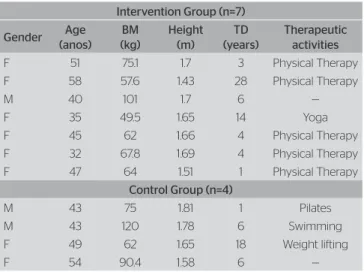
It is worth to mention that the stimulation activi-ties proposed for the IG were included in the rou-tine of the subjects in this study as a complemen-tary therapeutic method, since they were already on some type of therapeutic activity. Daily life activi-ties, medication or the insertion of new activities were controlled and remained unaltered during the period of intervention for both groups. The speci-fications of groups and the individual characteriza-tion of subjects can be observed in Table 1.
Procedures
he clinical history and the anthropometric evaluation were investigated for the description of subjects.
Postural stability was assessed by means of a stabi-lometry, which registered body oscillations in relation to the center of pressure (COP) of subjects in quasi-static erect posture, placed over a OR6-7 AMTI force plate (Advanced Mechanical Technologies, Inc., USA), with sample frequency of 100 Hz. During the evalu-ations, the subjects remained barefoot, on biped sup-port, with the feet separated to the width of the hip.
A ixed goal was placed at the height of the eyes and taken back 1 m for visual reference. Two sensory condi-tions were determined: open eyes (OE), available visual information; and closed eyes (CE), suppressed visual information. Each subject underwent 3 assessments of 30 seconds in each condition. After the period destined to hippotherapy, the subjects were reassessed. Data
went through a 10 Hz and 4th order low-pass ilter and
were processed in a Matlab 7.3 environment (Matrix Laboratory, Mathworks, Inc., USA).
he following variables of COP were considered for analysis: 1) amplitude of anterior posterior displace-ment (AMPap) — distance between the maximum and minimum displacement of the COP in the ante-rior posteante-rior direction; 2) amplitude of medial lateral displacement (AMPml) — distance between the maxi-mum and minimaxi-mum displacement of the COP in the medial-lateral direction; 3) mean speed of the anterior posterior displacement (VMap); and 4) mean speed of the medial lateral displacement (VMml).
Hippotherapy
Sessions took place twice a week, during a four-month period, and lasted approximately 50 minutes each. he initial stage of the session, the approxima-tion stage, lasted for 10 minutes and was developed in two steps: the irst one on the ground, in which the subject prepared for the activities through global stretching exercises and established the irst contact with the horse. Afterwards, there was the connection between the horse and the rider. At this time, the
Table 1. Characterization of subjects
M: male; F: female; BM: body mass; TD: time of diagnosis of multiple sclerosis. Note: According to the neurological diagnosis, the subjects did not have a defined classification as to the type of multiple sclerosis.
Intervention Group (n=7)
Gender Age (anos)
BM (kg)
Height (m)
TD (years)
Therapeutic activities
F 51 75.1 1.7 3 Physical Therapy F 58 57.6 1.43 28 Physical Therapy
M 40 101 1.7 6 —
F 35 49.5 1.65 14 Yoga
F 45 62 1.66 4 Physical Therapy F 32 67.8 1.69 4 Physical Therapy F 47 64 1.51 1 Physical Therapy
Control Group (n=4)
M 43 75 1.81 1 Pilates
M 43 120 1.78 6 Swimming
F 49 62 1.65 18 Weight lifting
participants were guided to reorganize the posture on the horse and adjust the riding accessories ac-cording to the objectives of the session. At the main stage, the time of riding was ixed in 30 consecutive minutes with the horse walking. In this stage, exer-cises to adapt to the riding posture were used, as well as stretching, horseback riding techniques and pre-sports exercises, such as changing directions to stim-ulate the dissociation of pelvic and scapular waists; ground variations, cadence (sand, asphalt and grass) and terrain (plane, uneven and inclined), with the ob-jective to intensify movements of pelvic anteversion and retroversion. Movements of ankle plantarlex-ion and dorsilexplantarlex-ion, hip lexplantarlex-ion and elevatplantarlex-ion of the stirrup were used to increase the action of the lower limbs in order to maintain the posture on the horse. he characteristics of the activities proposed to the subjects were mainly from the hippotherapy pro-gram, exploring the physical therapy potential of the horse. he individual ability to complete tasks was respected, and the level of diiculty increased gradu-ally. he inal stage of the session, the disconnection stage, lasted 10 minutes. In this stage, the activities on the back of the horse were inished, and another sequence of ground stretching was conducted.
he activities were performed in pairs and assisted by skilled professionals, and the priority was to keep the same horse for each participant throughout the treat-ment. Two horses that were trained for hippotherapy were used: a 5-year-old female, with no speciic breed, 155 cm height at the withers, body mass of 480 kg, and a 10-year-old male, American quarter horse, 158 cm at the withers, body mass of 510 kg, both with medium stride. he horses were equipped with blanket, open stirrups and reins, and they were conducted by auxil-iary guides. All the safety procedures adopted during
the sessions were in accordance with the guidelines by ANDE-Brasil concerning the use of proper helmets and clothes.
Statistical analysis
Data were described in mean and standard devia-tion values. he Shapiro-Wilk test indicated normal distribution of data. he statistical treatment was performed with a completely casual design, with a
varied number of repetitions in a 23 factorial
experi-ment (2 groups: IG and CG; 2 tests: pre and post; 2 sensory conditions: OE and CE). he variance analysis (ANOVA) was used by means of the F test and the post hoc Tukey test. All of the analyses were made with the SAS 8.0 software (Statistical Analysis System), and the statistical decision was made based on the signiicance level p<0.05.
RESULTS
Clinical and demographic data of the subjects were pre-sented in Table 1. he age ranged between 32 and 58
years old (44±9.09) for IG, while in the GC it ranged
from 43 to 54 years old (47.25±5.31). he time of MS
diagnosis was 8.57±9.5 years for IG and 7.75±7.22 years
for GC. here were no statistical diferences between the groups in relation to age and time of diagnosis.
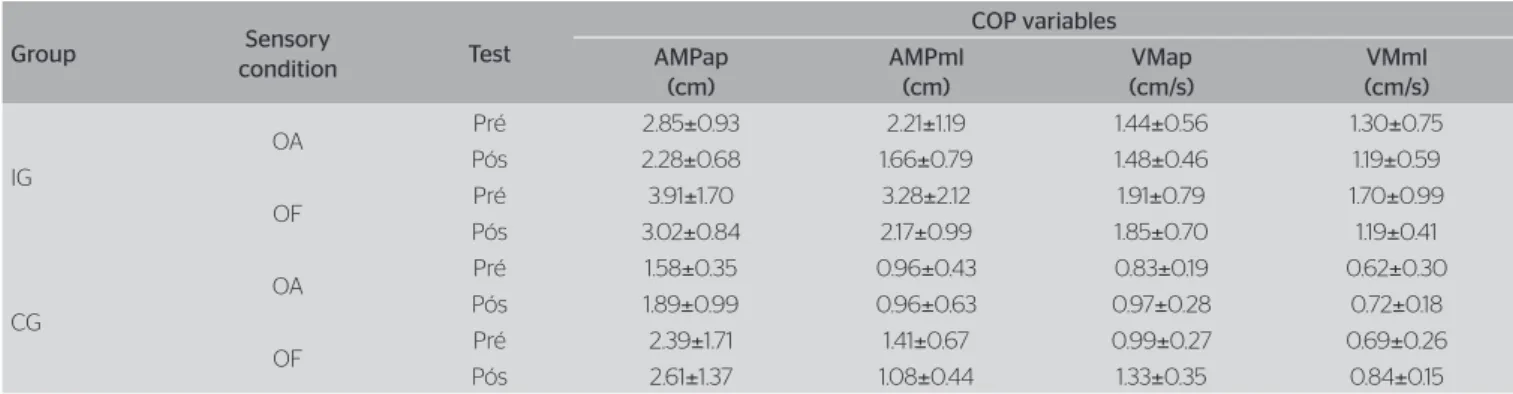
he results of the evaluations of postural stability are presented in Table 2.
he multiple comparison of means showed signii-cant diferences between IG and CG (p<0.01) in the investigated COP variables, with predominance of higher values in the IG. Signiicant diferences between
COP: Center of pressure; IG: Intervention Groupo; CG: Control Group; OE: open eyes; CE: closed eyes; AMPap and AMPml: amplitude of COP displacement in the anterior posterior and medial lateral directions, respectively; VMap and VMml: mean speed of the COP displacement in the anterior posterior and medial lateral directions, respectively.
Table 2. Postural control of patients with multiple sclerosis submitted to hippotherapy
Group Sensory
condition Test
COP variables AMPap
(cm)
AMPml (cm)
VMap (cm/s)
VMml (cm/s)
IG
OA Pré 2.85±0.93 2.21±1.19 1.44±0.56 1.30±0.75 Pós 2.28±0.68 1.66±0.79 1.48±0.46 1.19±0.59
OF Pré 3.91±1.70 3.28±2.12 1.91±0.79 1.70±0.99 Pós 3.02±0.84 2.17±0.99 1.85±0.70 1.19±0.41
CG
OA Pré 1.58±0.35 0.96±0.43 0.83±0.19 0.62±0.30 Pós 1.89±0.99 0.96±0.63 0.97±0.28 0.72±0.18
the sensory conditions were observed for both groups (p<0.01), which presented lower performance with the privation of visual information. Interactions between pre and post-test and IG and CG were observed in the
AMPap (5.07 F, p<0.01) and VMml (5.50 F, p=0.02).
Tukey’s test was used to locate the signiicances within these interactions.
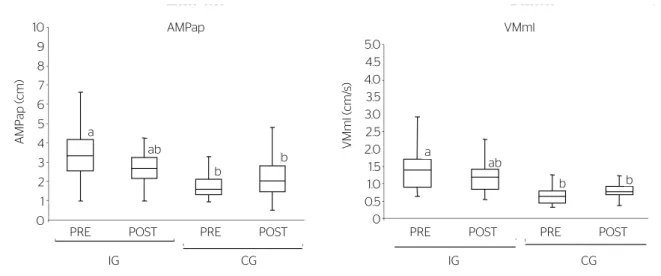
Figure 1 illustrates the distribution of AMPap (A) and VMml (B) values for IG and CG.
When the distributed values of IG and CG are com-pared, it is possible to observe the prevalence o higher AMPap (A) values in the initial IG test. he post-test indicates the signiicant reduction of IG values, after the intervention period, while the CG kept a constant behav-ior in both tests. he Tukey’s test allowed to observe that with the reduction of AMPap values in the IG, identi-ied after intervention, the statistical diferences between the groups were attenuated. he presence of the letter “ab” combined in the IG indicates the parity of values for both groups in the post-test.
he same considerations apply to VMml (B), which even demonstrating lower values presented a similar be-havior to AMPap in both groups and tests.
DISCUSSION
his study aimed to verify if the hippotherapy promotes changes in the postural stability of MS patients. To sum up, it was observed that the IG manifested a more com-promised postural stability than the CG in the initial
test. Both groups presented lower performance when the visual information was suppressed. After interven-tion, the IG was capable of reducing the values of the analyzed variables, showing statistically signiicant dif-ferences for AMPap and VMml, while the CG main-tained an unaltered behavior.
We observed that, regardless of the group, the great-er oscillations and speeds prevailed in the antgreat-erior pos-terior direction (A-P). Similar studies observed postural instability in patients with MS submitted to diferent assessment conditions, including the quasi-static erect
position6,10,11. When compared with healthy controls,
subjects with MS manifest more oscillation in both
movement planes11, with predominance of higher
val-ues in the A-P direction8,11.
The IG reduced the values of all analyzed vari-ables after the intervention, providing indications of better response for postural control. However, this behavior can only be confirmed for AMPap and VMml. For CG, the behavior remained unaltered. The results of the study confirm findings that ob-served significant improvement in the postural bal-ance in MS after interventions using
hippothera-py20,23. It is worth to mention that these studies used
the Berg scale.
By suppressing the visual information, both groups presented lower performance in the COP variables. When comparing MS patients with healthy controls,
Porosinska et al.10 observed that while the healthy pairs
were able to adapt their postural stability even without a visual reference, the privation of such information sig-niicantly afected those with MS.
Tukey’s test: diferent letters indicate significant diferences between the means. AMPap: amplitude of anterior posterior displacement; VMml: mean speed of the medial lateral displacement; IG: Intervention Group; CG: Control Group.
Figure 1. Distribution of amplitude of anterior posterior displacement and mean speed of the medial lateral displacement, for Intervention and Control
AMP
ap (cm)
10
ab
PRE POST
IG CG
PRE POST PRE POST
IG CG
PRE POST
a
b
b ab
a
b b
9
8
7
6
5
4
3
2
1
0
5.0 4.5 4.0 3.5 3.0 2.5 2.0 1.5 1.0 0.5 0
VMml (cm/
s)
As a response to the compromise of various sys-tems, MS patients present with distortions in sensory
integration11,16, and they may experiment functional
deteriorations, even in the absence of clinical
recur-rence9. In an attempt to minimize such compromise,
diferent rehabilitation strategies are used3,14,16,17;
however, not all of them have their eicacy
con-irmed. Cattaneo et al.24 observed that exercises that
use sensory strategies triggered better response in postural balance than aerobic and resistance exer-cises. In this context, hippotherapy is considered as a multisensory approach to treat for neurological dis-eases. his happens because the riding position, as-sociated with the movement produced by the horse stride, requires constant postural adjustments; com-bined to the dissociation of the pelvic and scapular waists, they lead to reactions of trunk correction and tonic adjustments that act dynamically in the search
for stability and postural control19,20.
The results found in this study corroborate most of the findings that investigated the influence of the stimulation produced by hippotherapy in the most different neurological disorders. When the effect of stimulation on variables that influence postural con-trol is analyzed, studies demonstrate the reduction of balance deficits and the adaptation of postural
stability in MS patients20,23.
CONCLUSION
he activities of sensory stimulation developed in the hippotherapy program were inserted in the routine of the participants as a complementary method to those in which they were already involved. he mainte-nance of CG scores and the favorable changes in the postural control of the IG suggest that hippotherapy can improve the postural control of MS patients. he diiculty to constitute a representative group of sub-jects with MS who would it the study criteria, and then enable the randomization and /or the pairing of groups, as well as the homogeneity of neurological functions, makes it diicult to state that hippothera-py can improve the postural control of MS patients. However, the indings in this study reinforce litera-ture, which supports the use of hippotherapy as a po-tential intervention for the postural control disorders in patients with MS.
REFERENCES
1. Brazilian Committee for Treatment and Research in Multiple Sclerosis (BCTRIMS). 2010. [cited 2010 Aug. 27]. Available from: http://www.bctrims.org.br.
2. Korneck B, Lassmann H. Neuropathology of multiple sclerosis - new concepts. Brain Res Bull. 2003;61(3):321-6.
3. DeBolt LS, McCubbin JA. The efects of home-based resistance exercise on balance, power, and mobility in adults with multiple sclerosis. Arch Phys Med Rehabil. 2004;85(2):290-7.
4. Finkelsztejn A, Cristovam RA, Moraes GS, Lopes MG, Silva AV, Garcia MS, et al. Clinical features of multiple sclerosis in the south of Brazil. Arq Neuropsiquiatr. 2009;67(4):1071-5.
5. Papais-Alvarenga RM, Santos CMM, Abreu JS, Siqueira H, Camargo SMGG, Almeida AMV, et al. Esclerose múltipla (em): perfil clínico e evolutivo no município do Rio de Janeiro. Rev Bras Neurol. 1995;31(2):75-87.
6. Frzovic D, Morris ME, Vowels L. Clinical tests of standing balance: performance of persons with multiple sclerosis. Arch Phys Med Rehabil. 2000;81(2):215-21.
7. Karst GM, Venema DM, Roehrs TG, Tyler AE. Center of pressure measures during standing tasks in minimally impaired persons with multiple sclerosis. J Neurol Phys Ther. 2005;29(4):170-80.
8. Chung LH, Remelius JG, Van Emmerik RE, Kent-Braun JA. Leg power asymmetry and postural control in women with multiple sclerosis. Med Sci Sports Exerc. 2008;40(10):1717-24.
9. Martin CL, Galea MP, Phillips BA, Kilpatrick TJ, Butzkueven H. Gait and balance parameters as clinical markers of disease progression in early multiple sclerosis. 18th Meeting of the European Neurological Society; 2008 Jun 07-11.
10. Porosinska A, Pierzcha K, Mentel M, Karpe J. Evaluation of postural balance control in patients with multiple sclerosis - efect of diferent sensory conditions and arithmetic task execution. A pilot study. Neurol Neurochir Pol. 2010;44(1):35-42.
11. Van Emmerik RE, Remelius JG, Johnson MB, Chung LH, Kent-Braun J. Postural control in women with multiple sclerosis: efects of task, vision and symptomatic fatigue. Gait Posture. 2010;32(4):608-14. 12. Reulen JP, Sanders EA, Hogenhuis LA. Eye movement disorders in
multiple sclerosis and optic neuritis. Brain. 1983;106(Pt 1):121-40. 13. Williams NP, Roland PS, Yellin W. Vestibular evaluation in patients with
early multiple sclerosis. Am J Otol. 1997;18(1):93-100.
14. Romberg A, Virtanen A, Ruutiainen J, Aunola S, Karppi SL, Vaara M, et al. Efects of a 6-month exercise program on patients with multiple sclerosis: a randomized study. Neurology. 2004;63(11):2034-8. 15. Sosnof JJ, Shin S, Motl RW. Multiple sclerosis and postural control: the
role of spasticity. Arch Phys Med Rehabil. 2010;91(1):93-9.
16. Cattaneo D, Jonsdottir J. Sensory impairments in quiet standing in subjects with multiple sclerosis. Mult Scler. 2009;15(1):59-67.
17. Flachenecker P. Autoimmune diseases and rehabilitation. Autoimmun Rev. 2012;11(3):219-25.
18. Associação Brasileira de Equoterapia 2012. Disponível em: http://www. equoterapia.org.br/site/equoterapia.php. Acesso em 03/03/2012. 19. Meregillano G. Hippotherapy. Phys Med Rehabil Clin N Am.
2004;15(4):843-54, vii.
eleven patients with multiple sclerosis. Physiother Theory Pract. 2005;21(1):51-77.
21. Benda W, McGibbon NH, Grant KL. Improvements in muscle symmetry in children with cerebral palsy after equine-assisted therapy (hippotherapy). J Altern Complement Med. 2003;9(6):817-25.
22. McGibbon NH, Benda W, Duncan BR, Silkwood-Sherer D. Immediate and long-term efects of hippotherapy on symmetry of adductor
muscle activity and functional ability in children with spastic cerebral palsy. Arch Phys Med Rehabil. 2009;90(6):966-74.
23. Silkwood-Sherer D, Warmbier H. Efects of hippotherapy on postural stability, in persons with multiple sclerosis: a pilot study. J Neuro Phys Ther. 2007;31(2):77-84.