253
ABSTRACT
BACKGROUND AND OBJECTIVES: he Swiss ball has been widely used in diferent health sectors. It is considered efective to relieve pain and to help labor evolution, however there are few studies. his study aimed at evaluating the efect of the Swiss ball on pain relief and active labor duration of primiparous.
METHODS:his is a randomized and controlled study with 40 primiparous divided in control group and ball group, who carried out pelvic mobility exercises for 30 minutes during active labor. Pain was measured by the numeric categorical scale, before and after therapy, by an assistant researcher. Labor duration was investigated by means of the partograph.
RESULTS:here has been signiicant pain decrease in the study group (p<0.001). here has been no diference between groups in labor duration (p=0.37).
CONCLUSION: he Swiss ball was an efective tool to relieve pain in the beginning of this period and should be encouraged by health professionals assisting parturients.
Keywords: Labor, Pain, Swiss ball.
RESUMO
JUSTIFICATIVA E OBJETIVOS: A bola suíça tem sido am-plamente utilizada nos diversos setores da saúde. É considerada eicaz no alívio da dor e evolução do trabalho de parto, porém há poucos estudos. O objetivo deste trabalho foi avaliar o efeito da bola suíça no alívio da dor e na duração da fase ativa do trabalho de parto em primigestas.
MÉTODOS: Trata-se de um estudo randomizado e contro-lado com 40 primigestas divididas em grupo controle e grupo bola, que realizaram exercícios de mobilidade pélvica durante 30
Swiss ball to relieve pain of primiparous in active labor*
A bola suiça no alivio da dor de primigestas na fase ativa do trabalho de parto
Rubneide Barreto Silva Gallo1, Licia Santos Santana1, Alessandra Cristina Marcolin1, Silvana Maria Quintana1
*Received from the Reference Center for Women’s Health from Ribeirão Preto-Mater, Ribeirão Preto, SP, Brazil.
1. University of São Paulo, School of Medicine, Department of Gynecology and Obstetrics, Ribeirão Preto, SP, Brazil.
Submitted in February 17, 2014.
Accepted for publication in September 19, 2014. Conlict of interests: none.
Correspondence to: Rubneide Barreto Silva Gallo
Avenida Bandeirantes, 3900 – Monte Alegre 14049-900 Ribeirão Preto, SP, Brasil. E-mail: [email protected]
© Sociedade Brasileira para o Estudo da Dor
minutos na fase ativa do trabalho de parto. A dor foi mensurada por meio da escala de categoria numérica, antes e após a terapêu-tica, por um pesquisador auxiliar. A duração do trabalho de parto foi investigada por meio do partograma.
RESULTADOS: Foi observada redução signiicativa da dor no grupo de estudo (p<0,001). Não houve diferença entre os grupos quanto à duração do trabalho de parto (p=0,37).
CONCLUSÃO: A bola suíça foi um recurso efetivo no alívio da dor no início desse período, devendo ser incentivada pelos prois-sionais de saúde que assistem parturientes.
Descritores: Bola suíça, Dor, Trabalho de parto.
INTRODUCTION
he Swiss ball was developed in 1963 by Aquilino Cosani, Italian plastics manufacturer. Such name was given in 1989 by American physiotherapists after witnessing its beneits in Switzerland and starting using it in the USA. Some years ago, this tool started to be used to assist women during labor, be-ing also called birth ball, because it helps relievbe-ing pain and the evolution of this stage1,2.
Women’s habit of moving during labor and staying in the up-right position was a common practice in the past. However, when delivery started to occur in the horizontal position, par-turients were kept in bed, despite several published studies about the beneit of parturients’ mobility and the Brazilian Ministry of Health guidance with regard to freedom of posi-tion during this period3,4. Only a small number of women started to spontaneously choose to walk or to adopt other ver-tical position during labor, being this especially encouraged by groups advocating labor and birth humanization.
he beneits of parturients’ mobility during labor are in-creased tolerance to pain, dein-creased use of drugs, improved dilatation evolution and decreased active labor duration5. he Swiss ball, therapeutic tool commonly used in physiotherapy, was inserted in normal birth centers to help the adoption of vertical positions and to support other techniques (among them, massage and shower bath, stretching exercises and pelvic mobility)6,7. For being a playful method, it distracts parturients, making labor smoother, decreasing physical and emotional stress and providing further comfort2,8.
Notwithstanding the extensive use in other health areas, there are still few studies on Swiss ball to control labor pain and evolution. In light of the above, this study aimed at evaluating the efect of the Swiss ball in pain relief and active labor stage duration of primiparous women.
Rev Dor. São Paulo, 2014 oct-dec;15(4):253-5 ORIGINAL ARTICLE
254
Gallo RB, Santana LS, Marcolin AC and Quintana SM
Rev Dor. São Paulo, 2014 oct-dec;15(4):253-5
METHODS
his is a randomized controlled clinical trial developed from August 2011 to July 2012 in a maternity assisting low-risk parturients, namely the Reference Center for Women’s Health of Ribeirão Preto-MATER. Sample was made up of 40 par-turients divided in control group – CG (20) and ball group – BG (20).
Patients were admitted in the pre-delivery period for par-turition process assistance and have met all inclusion crite-ria: primiparous, literate, single fetus in cephalad position, low-risk pregnancy, as from 37 weeks of gestation, cervical dilatation between 4 and 5cm, with adequate uterine dy-namics for this labor stage of spontaneous onset, with no use of drugs, intact membranes without associated risk factors and lack of cognitive or psychiatric problems according to psychological evaluation of the institution during pre-natal assistance.
Exclusion criteria were: parturients admitted for labor induc-tion, premature or early chorioamniorrhexis, or not using uterotonic drugs before the active stage.
After being explained about the study, only volunteers who agreed to sign the Free and Informed Consent Term (FICT) were included.
Pain intensity of all parturients was evaluated by the numeric categorical scale (NCS) and soon after they were submitted to therapy by a physiotherapist according to the group (ran-domly determined). BG was submitted to pelvic mobility exercises with the ball, active pelvic anteversion and retrover-sion exercises, lateralization, circumduction and propulretrover-sion; CG was submitted to maternity procedures with freedom of position. Both groups have carried out activities for 30 min-utes, while with cervical dilatation from 4 to 5cm. All pa-tients were evaluated by NCS after the procedure, being that pain intensity before and after the intervention was evaluated by an assistant. After intervention, labor duration, dilatation and fetal descent speed, type of delivery and Apgar score were evaluated for all patients.
Excel was used for statistical analysis and results are shown in mean and standard deviation, considering signiicant p<0.5. his study was approved by the Research Ethics Commit-tee, Clinicas Hospital, School of Medicine of Ribeirão Preto (HCFMRP) according to process HCRP nº 9148/2011.
RESULTS
With regard to socio-demographic data, mean age of both groups was 19±4 years (p=0.81); 80% of BG and 50% of CG had completed high-school (p=0.62); 80% of BG and 100% of CG had no remunerated activity (p=0.21); and 60% of both groups had consensual union (p=0.79).
All parturients had escorts during labor. Although the mater-nity has delivery preparation courses, no group has partici-pated in this experience.
Analysis of results after intervention has shown signiicant pain decrease for BG (p<0.001) (Figure 1).
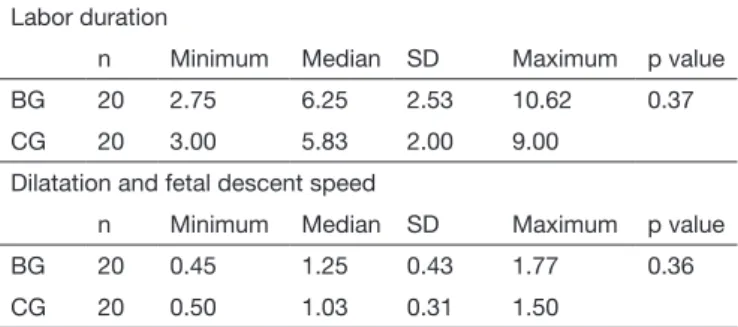
Labor duration was not diferent between groups (p=0.37), as well as dilatation and fetal descent speed (p=0.36) (Table 1).
Table 1. Analysis of labor duration and dilatation and fetal descent speed for both groups
Labor duration
n Minimum Median SD Maximum p value
BG 20 2.75 6.25 2.53 10.62 0.37
CG 20 3.00 5.83 2.00 9.00
Dilatation and fetal descent speed
n Minimum Median SD Maximum p value
BG 20 0.45 1.25 0.43 1.77 0.36
CG 20 0.50 1.03 0.31 1.50
CG: control group; BG: ball group; Wilcoxon Test.
In this sample, 80% of CG and 100% of BG had normal childbirth (p=0.47). As to Apgar score, 90% of neonates of both groups had Apgar>7 both in the irst and ifth minute, with no diferences between groups (p=0.63).
DISCUSSION
Some studies have shown that Swiss ball exercises are efective for dilatation evolution, pain relief and easier fetal descent. However, such information is still empirical sincepublished studies are scarce. Adding to this, freedom of movement al-lows women to instinctively adopt positions that help fetal accommodation, decrease vessels and nerves pressure, and decrease pain and stress levels. In the current model of de-livery assistance, present in most Brazilian maternities, this approach is made diicult. Parturients are kept in bed under oxytocites, which negatively inluence women’s posture dur-ing parturition.
Our study has observed that the ball was efective auxiliary tool for the adoption of vertical positions and to relieve labor pain (p<0.001). Leung et al.9 have evaluated a delivery room of the KwongWah hospital in Hong Kong, China, with 203 women, and have shown statistically signiicant diferences
CG BG
7.5
8.5 7.9
Before
5.5
After
Figure 1. Pain intensity by the numeric categorical scale: comparison between studied groups
255
Swiss ball to relieve pain of primiparous in active labor Rev Dor. São Paulo, 2014 oct-dec;15(4):253-5
in low back pain and lower abdominal pressure levels before and after birth ball exercises (p<0.05), as well as in stress and anxiety relief with high level of satisfaction and 6.4% decrease in the use of analgesics, as compared to two previous years of assistance in that maternity.
Still in China, Taiwan, a study carried out by Gau et al.10 has shown similar evidences added to labor duration reduction with the Swiss ball. An exercise program was recommended via a 26-page booklet and a 19-minute video and was pe-riodically followed-up during pre-natal consultations, being that women from the experimental group have received the ball. hey were encouraged to choose the most comfortable positions and to perform movements and exercises. here has been labor pain decrease, less need for epidural analgesia, de-creased duration of irst labor stage and fewer indications for Cesarean-section as compared to control group.
In our study, although the use of the ball has not changed labor dilatation duration and speed, this is in line with what was found by Lopes, Madeira & Coelho2 and by Taavone et al.11; labor pain relief (p<0.05) and no inluence on labor duration. he use of additional resources for pain relief is a very com-mon practice in Eastern countries. In Brazil, in spite of the implementation of the National Policy for Labor and Birth Humanization, there is still a high number of C-sections, es-pecially in the supplementary chain. Silva et al.7 have charac-terized the use of the Swiss ball in obstetric attention services linked to the Single Health System: it was used by 40.9% of Obstetric Centers with the following objectives: to promote fetal presentation descent (32.4%), relaxation (19.7%), de-livery progression (17.1%), perineal exercise (14.5%), pain relief (11.8%), psychological beneits and maternal move-ment. However, almost all visited institutions (96.8%) had no protocol for its use, pointing to the need of clinical trials
to evaluate its efects and to support the development of guid-ance for its use.
Interfering with normal physiological labor process increases the risk of maternal and fetal complications12. So, the Swiss ball, in addition to helping pelvic mobility and the adoption of vertical posture, may give support to other techniques during labor.
CONCLUSION
he Swiss ball was an efective resource for parturients’ pain relief in the beginning of this period, and should be encour-aged by health professionals assisting parturients.
REFERENCES
1. Carrière B. Bola Suíça. 2ª ed. São Paulo: Manole; 1999. 383p.
2. Lopes CT, Madeira ML, Coelho S. O uso da bola do nascimento na promoção da posição vertical em primíparas durante o trabalho de parto. Rev Min Enfermagem. 2003;7(2):134-9.
3. Bio E, Bittar RE, Zugaib M. Inluência da mobilidade materna na duração da fase ativa do trabalho de parto. Rev Bras Ginecol Obstet. 2006;28(11):671-9.
4. Brasil. Ministério da Saúde. Secretaria de Políticas de Saúde. Área Técnica de Saúde da Mulher. Parto, aborto e puerpério: assistência humanizada à mulher. Brasília: Ministé-rio da Saúde; 2001.
5. Canesin KF, Amaral WN. Atuação isioterapêutica para diminuição do tempo de tra-balho de parto: revisão da literatura. Femina. 2010;38(8):429-33.
6. Gallo RB, Santana LS, Marcolin AC, Ferreira, CH, Duarte, G, et al. Recursos não farmacológicos no trabalho de parto: protocolo assistencial. Femina. 2011;39(1):41-8. 7. Silva LM, Oliveira SM, Silva FM, Alvarenga MB. Uso da bola suíça no trabalho de
parto. Acta Paul Enferm. 2011;24(5):656-62.
8. Baracho E. Fisioterapia aplicada à obstetrícia, uroginecologia e aspectos da mastalgia. 4ª ed. Rio de Janeiro: Guanabara Koogan; 2007. 216p.
9. Leung RW, Li JF, Leung MK, Fung BK, Fung LC, Tai SM, et al. Eicacy of birth ball exercises on labour pain management. Hong Kong Med J. 2013;19(5):393-9. 10. Gau ML, Chang CY, Tian SH, Lin KC. Efects of birth ball exercise on pain and
self-eicacy during childbirth: a randomised controlled trial in Taiwan. Midwifery. 2011;27(6):293-300.
11. Taavoni S, Abdolahian S, Haghani H, Neysani L. Efect of birth ball usage on pain in the active phase of labor: a randomized controlled trial. J Midwifery Womens Health. 2011;56(2):137-40.