ABSTRACT
BACKGROUND AND OBJECTIVES: his study aimed at evaluating the prevalence of urinary tract infection (UTI) during pregnancy and its correlation with low back pain, as well as at analyzing prenatal assistance and orientations provided by two nurses during pregnant women assistance.
METHOD: his was a transversal, exploratory and descriptive study carried out with 124 pregnant women divided in 2 com-parative groups (GI and GII), who received prenatal assistance in diferent moments by diferent professionals in a Family Health Unit between June 2009 and June 2010. Data were collected through perinatal records and semi-structured questionnaire. RESULTS: Data analysis has shown that most pregnant women were aged between 20 and 29 years (67%), education has varied from no education (42%) to elementary school (33%). GI had 42% prevalence of UTI and GII 33%. As to genital hygiene habits, it has been observed that 17% of GI patients would not carry out any genital hygiene after vesical and intestinal eliminations and in-tercourse during pregnancy. In GII, 66% would carry out genital hygiene. Other study data have shown that 100% of GI patients have reported not having attended orientation groups during prena-tal assistance versus 100% attendance of GII. As to low back pain, 85% of GI women and 84% of GII women with UTI have referred low back pain, being this association statistically signiicant. CONCLUSION: he prevalence of UTI during gestation was 42% for GI and 33% for GII. Low back pain was the primary symptom reported by patients with conirmed UTI. here has been progressive spread of health and education knowledge dur-ing prenatal assistance provided by the GII professional with possible association with decreased incidence of UTI. his study proposes a topographic low back pain evaluation during patient’s history for early UTI diagnosis and its potential association with low back pain; and suggests more emphasis on educational
ac-Urinary tract infection during gestation and its correlation with low back
pain versus nursing interventions*
Infecção urinária na gestação e sua correlação com a dor lombar versus intervenções de enfermagem
Simone Regina Alves de Freitas Barros1
*Received from the Professional Improvement Center – Nursing Space. Recife, PE.
1. Nurse. Specialist in Public Health and Management, State University of Pernambuco; Post-graduate in Obstetric Nursing, Nursing Space; Master in Administration Health Orga-nization, Higher Open School of Brazil; and Master Student in Public Health and Hospital Management, School of North Paraná, Buíque, PE Brazil.
Submitted in January 28, 2013. Accepted for publication in May 06, 2013.
Correspondence to:
Simone Regina Alves de Freitas Barros Av. Jonas Camelo, 316 – Centro 56520-000 Buíque, PE.
E-mail: [email protected]
tions during prenatal assistance as a possible determining factor to decrease UTI during gestation.
Keywords: Pregnant women, Prevalence of urinary tract infec-tion, Urinary tract infection.
RESUMO
JUSTIFICATIVA E OBJETIVOS: O objetivo deste estudo foi veriicar a prevalência de infecção urinária (ITU) na gravidez e sua correlação com a dor lombar, bem como analisar a assistência pré-natal e orientações prestadas por duas enfermeiras durante o atendimento à gestante.
MÉTODO: Estudo transversal, exploratório e com abordagem de-scritiva realizado com 124 gestantes – divididas em 2 grupos compara-tivos (GI e GII) que receberam assistência pré-natal em momentos distintos por proissionais diferentes em uma Unidade de Saúde da Família entre junho de 2009 e junho de 2010. Os dados foram coleta-dos por meio de icha perinatal e questionário semiestruturado. RESULTADOS: A análise dos dados demonstrou que a maior proporção das gestantes estava entre 20 e 29 anos (67%), a es-colaridade variou entre nenhuma (42%) ao ensino fundamental (33%). O GI apresentou ocorrência de ITU em 42% e o GII, em 33%. Quanto aos hábitos de higiene genital, evidenciou-se no GI que 17% não realizavam nenhuma higiene genital após eliminações vesicointestinais e coito na gravidez. Já no GII, 66% realizavam higiene da região genital. Outro dado da pesquisa mostrou que 100% das gestantes do GI relataram não ter partici-pado de grupos de orientação durante assistência pré-natal versus
100% de participação do GII. Quanto à dor lombar, veriicou-se que 85% das mulheres que apresentaram ITU no GI referiram dor lombar e 84% do GII também relataram a mesma queixa, sendo essa associação estatisticamente signiicante.
CONCLUSÃO: A prevalência de ITU na gestação foi de 42% para o GI e 33% para o GII. A lombalgia foi a principal sinto-matologia referida pelas gestantes com diagnóstico conirmado de ITU. Observou-se progressiva difusão dos conhecimentos em saúde e educação durante a assistência pré-natal prestada pelo pro-issional do GII com possível associação de redução de incidência de ITU. O estudo traz como proposta a investigação topográica da dor lombar durante anamnese para o diagnóstico precoce de ITU e sua possível associação com a lombalgia e maior ênfase às ações educativas durante assistência pré-natal como possível fator determinante de redução de ITU na gestação.
INTRODUCTION
Urinary tract infection (UTI) is a very frequent and common disease which may be present at any age. In adulthood, 48% of women have at least one UTI episode, and higher suscep-tibility is due to shorter urethra, more closeness of the anus to the vaginal vestibule and urethra and beginning of sexual activity1.
Speciically during gestation, women go through many emo-tional, physical and physiological changes which make them more vulnerable to UTI. his is the third more common clin-ical intercurrence during gestation, afecting 10% to 12% of pregnant women. Urinary tract infection in pregnant women is even more concerning when asymptomatic because exactly for going unnoticed, this condition may lead to premature delivery and hospitalization of the mother. Asymptomatic bacteriuria (AB) in early pregnancy is also a risk for subse-quent pyelonephritis. When symptomatic, the infection is also important however its diagnosis is faster due to the pres-ence of symptoms which are deined according to the type of urinary tract infection. In some types of infections, low back pain may be the most reported clinical manifestation2-5.
Among bacterial strains able to cause UTI in pregnant wom-en, Escherichia coli is the most common urinary pathogen,
re-sponsible for approximately 80% of cases. To clinically diag-nose UTI during pregnancy, it is necessary to remember that some symptoms are diicult to be characterized since during pregnancy some of them might be present, such as urinary frequency and dysuria. Micturition urgency may be present but in a lower scale, afecting approximately 1% to 5% of pregnant women. However, such manifestations may also be present in cystitis and pyelonephritis by urethral epithelium irritation or as irradiated pain of a higher urinary tract infec-tion process3.
Topographic infection history should be added to the diagno-sis since, pedagogically, signs and symptoms are characteristic of each clinical presentation, but in practice such manifesta-tions may confuse health professionals3.
UTI is a relevant source of maternal complications (cellulitis and perinephric abscess, urinary obstruction, pre-term labor, premature chorioamniorhexis, anemia, chorioamnionitis, en-dometritis, preeclampsia, septic shock, multiple organs fail-ure and death) and perinatal complications (prematurity, in-fection, periventricular leukomalacia, multiple organs failure and death)4.
here are evidences that history during prenatal visits allow the identiication of pregnant women at higher risk for UTI. So, the Department of Health (DH) has implemented in 2002 the Prenatal and Birth Humanization Program (PHPN). his program emphasizes clinical and laboratory procedures preg-nant women should go through during the prenatal period, focusing also on the identiication of risk situations requiring immediate clinical care4. PHPN also aims at the progressive
spread of health and education knowledge during the pre-natal period. However, little is known about the knowledge pregnant women really have about this process4. For such,
the investigation about nursing guidance during the prenatal period was included in this study.
Low back pain is common in general population and is a fre-quent symptom in pregnant women with asymptomatic and symptomatic bacteriuria. Low back pain is considered one of the ive commonest symptoms during pregnancy, especially as from the 3rd trimester. he prevalence of low back pain during
pregnancy varies from 48% to 83%, according to some stud-ies. World low back pain incidence in pregnant women is ap-proximately 50%. Notwithstanding this high incidence, few data are reported by the literature about the pathophysiology and speciic clinical manifestation of low back pain during pregnancy, probably because most health professionals con-sider it a normal and expected complaint during gestation. Low back pain etiology is multifactorial during gestation5-19.
Low back pain afects from the last costal arch area to gluteal folds, and may unilaterally or bilaterally impair lower limbs by pain irradiation to that region. It has to be stressed that low back pain during pregnancy may be indicative of urinary tract infection. It may also be related to musculoskeletal sys-tem adaptations, inluenced by the action of relaxin, which induces sacroiliac joint and pubic symphysis hypermotility making the pelvis unstable and contributing for low back pain. Conversely, low back pain may also be the single clini-cal manifestation of UTI5-18.
Prenatal assistance is a relevant moment to convey informa-tion to women and to look for important clinical manifes-tations during gestation. In countries such as Brazil, due to medical assistance precariousness, systematized tracking of health conditions of pregnant women and the adequate meet-ing of their heath needs are very important aspects for the nursing team6.
he Brazilian DH, in its “Technical prenatal and puerperium manual”, as well as in other PHPN-related publications, es-tablishes that type I urinalysis and urine culture should be routinely requested in the irst prenatal visit and that urine summary should be repeated in the third trimester of gesta-tion. It is also mandatory that urine collection for the exam is done under judicious antisepsis6,7.
So, the knowledge of the prevalence of UTI in pregnant women is closely related to PHPN essence, since it is the basis to assure minimum assistance parameters for pregnant wom-en, educating and making women more participative of the prenatal, delivery and puerperium follow-up process.
Considering literature data about UTI as risk factor for ma-ternal and perinatal morbidity and mortality, we have evalu-ated the relevance of answering the question of the research: which is the prevalence of urinary tract infection during preg-nancy and its correlation with low back pain? In addition to analyzing the activities developed by two nurses during pre-natal assistance.
METHOD
(2009-2010) during prenatal assistance8. he study was
car-ried out in a Family Health Unit of the Cabo do Campo vil-lage, located in the municipality of Tupanatinga, PE. Participated in this study 124 pregnant women (census sam-ple) who entered prenatal assistance between June 2009 and June 2010. Studied population was divided in two groups: Group I (GI) – 62 pregnant women who started prenatal as-sistance in the second semester of 2009 and were assisted for six months by nurse I; and Group II (GII) – 62 pregnant women who started prenatal assistance in the irst semester of 2010 and were assisted by nurse II.
After signing the Free and Informed Consent Term (FICT), the perinatal records of participants were analyzed, in addi-tion to interviews with the groups who have answered a ques-tionnaire with closed and open questions on guidelines given by nurses I and II during the prenatal period about: self-care, identiication of risk situations for UTI, correlation of UTI and low back pain and understanding the importance of uri-nalysis and culture, results, and their participation in prenatal guidance groups, among other variables.
Microsoft Excel electronic spreadsheet was used to develop a database, which allowed the organization of data in tables. SPSS (Statistical Package for the Social Sciences 13.0) was used for statistical analysis, with 95% statistical reliability. Chi-square test was used to evaluate the association between low back pain and UTI, considering statistically signiicant p < 0.05.
his study was approved by the Research Ethics Committee, School of the Caruaruense Association of Higher Education, Caruaru, Pernambuco, process 0065.0.217.000-2010.
RESULTS
Using information obtained from used tools and after treat-ing data, most relevant statements to understand the ques-tions orienting the objectives of this study were selected. Table 1 shows major socioeconomic and demographic char-acteristics of pregnant women of this study. Most patients (67%) were aged from 20 to 29 years. A signiicant number of pregnant women had no education (42%). With regard to occupation, most pregnant women (58%) have reported working in agriculture.
Table 2 shows characteristics of prenatal assistance, parity, types of previous deliveries and abortion. It was observed that most pregnant women had six or more consultations in a total of 88%.
With regard to previous deliveries, this study has shown that 72% had vaginal delivery and 28% Cesarean sections. As to abortions, the study has shown that 80% of patients have not referred abortions and 12% have reported two or more abortions.
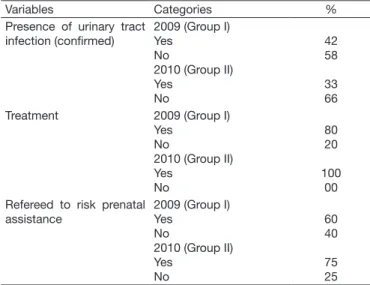
Table 3 summarizes the incidence of UTI during pregnancy, treatment and referral of these patients to risk prenatal as-sistance. In our research, the incidence of UTI conirmed by simple urinalysis and urine culture was 42% for GI and 33% for GII. here has been 0.9% decrease in UTI incidence from
GI to GII. he study has also concluded that 80% of preg-nant women (Group I) with UTI and assisted by nurse I were treated, while 100% of GII patients developing UTI during gestation were treated. It was also observed that 60% of GI patients with UTI were referred to risk prenatal assistance. In GII, 75% of patients were referred.
With regard to hygiene habits after vesical and intestinal eliminations and intercourse during pregnancy, most GI pa-tients (50%) would use toilet paper cleaning from front to
Table 1 – Distribution of studied pregnant women according to socio-economic and demographic variables.
Variables Categories %
Age (years) Up to 19
20-29 30 or above
12 67 21
Education None
Basic education High school College
42 33 25 00
Occupation Housewife
Agriculture Paid job Others
25 58 08 09
Table 2 – Distribution of obstetric, gynecologic and prenatal as-sistance variables.
Variables Categories %
Prenatal ≤ 05 consultations
≥ 06 consultations + 07 consultations
12 46 42
Parity 0
1 2 3 or more
25 21 29 25
Previous delivery Vaginal delivery
C-section
72 28
Abortion 0
1 2 or more
80 08 12
Table 3 – Distribution of symptom characteristics for the presence of urinary tract infection during pregnancy and treatment of patients.
Variables Categories %
Presence of urinary tract infection (conirmed)
2009 (Group I) Yes
No
2010 (Group II) Yes
No
42 58
33 66
Treatment 2009 (Group I)
Yes No
2010 (Group II) Yes
No
80 20
100 00 Refereed to risk prenatal
assistance
2009 (Group I) Yes
No
2010 (Group II) Yes
No
60 40
back, 33% from back to front and 17% would not do any hygiene. In GII, 83% used toilet paper from front to back, 17% from back to front and 66% would wash the genital region, according to guidelines of nurse II during prenatal visits.
It was also observed that behavior was diferent after evacua-tions and micturievacua-tions in GI, with reversed direction of 33% to front to back and 50% to back to front. Only 16% of pregnant women would wash the genital region. In GII, how-ever, micturition hygiene direction was preserved and there has been signiicant increase in genital region washing after evacuation (66%). With regard to hygiene habits before and after intercourse, 83% of GI patients have reported no genital hygiene, while 66% of GII patients did it.
Table 4 shows the level of guidance about the importance of urinalysis, collection, results and professional guidance during prenatal assistance. It was observed that GI had 92% deicit with regard to the importance of the exam and urine collection techniques, while GII had a higher level of infor-mation about the subject (83%).
As to results, GI has reported not knowing the result of the exam although having presented it to the professional. In GII, 66% stated having received information with interpre-tation of results. Another important data was that 100% of GI patients have not participated in guidance groups during prenatal assistance, while 100% of GII patients have par-ticipated.
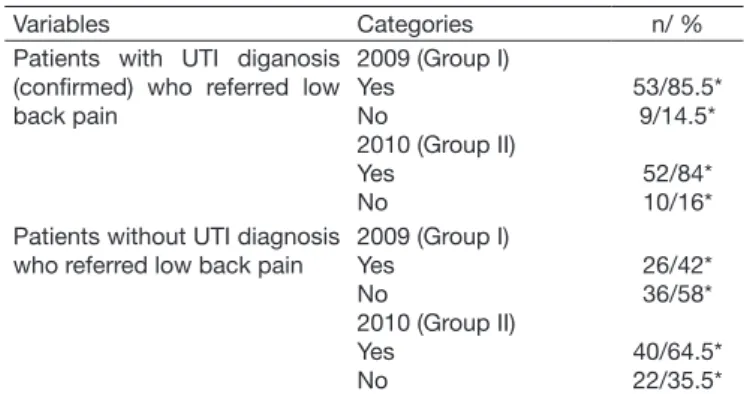
Table 5 shows that 85.5% of GI patients with confirmed UTI diagnosis have referred low back pain. In GII the per-centage was 84% and a small perper-centage (from 14.5% to 16%) of patients with confirmed UTI diagnosis has not re-ferred low back pain in both groups. There has been statisti-cally significant association between UTI and low back pain (p < 0.001).
Table 5 – Distribution of patients who referred low back pain as major complaint.
Variables Categories n/ %
Patients with UTI diganosis (conirmed) who referred low back pain
2009 (Group I) Yes
No
2010 (Group II) Yes
No
53/85.5* 9/14.5*
52/84* 10/16* Patients without UTI diagnosis
who referred low back pain
2009 (Group I) Yes
No
2010 (Group II) Yes
No
26/42* 36/58*
40/64.5* 22/35.5*
*Chi-square test (p < 0.001).
DISCUSSION
UTI frequency and severity during pregnancy have been rec-ognized for more than one century. In addition to being a rel-atively common problem during gestation, several questions about the subject still remain controversial and are reasons for clinical investigations. he subject becomes relevant due to its association with worse maternal and perinatal progno-ses and indings scarcely discussed in the literature, such as a Turkish study which has shown the prevalence of UTI in women with eight years of education or less3. hese data are
in line with our study where a signiicant number of pregnant women were illiterate or had incomplete basic education. For many years, pregnancy was seen as a predisposing factor for all types of UTI. Currently it is known that pregnancy, as isolated event, is not responsible for a higher incidence of UTI8.
he DH recommends at least six medical visits during pregnan-cy. In Brazil, it has been observed that 77% of pregnant women had followed this guideline. In the case of Single Health System (SUS) users, the proportion was 74%. In our study, 42% of patients have attended seven or more consultations.
The World Health Organization (WHO) has considered that C-section rates above 15% are not justifiable12. Face to
high C-section rates in Brazil, the DH has established limits for the payment of C-sections by SUS in up to 30%. Nev-ertheless, Brazil has presented in 2002 a total of 39.9% C-sections, with regional differences. Data from the National Demographics and Health Research from 2006 have shown C-section rates, in SUS-paid deliveries, between 33.6% and 44% in different Brazilian regions10. Our study has shown
C-section rate of 28%.
According to WHO data, six million abortions are made every year in Latin America, being 1.4 million just in Brazil. According to DH data, every year, 250 thousand women are admitted to SUS hospitals due to complications after illegal or spontaneous abortions. The abortion rate in Brazil is 35 to 40 abortions for every one thousand women11. Our data
have shown abortion rate of 20%. From 13% to 15% of maternal deaths as a consequence of pregnancy are related to abortion11.
Table 4 – Distribution of pregnant women with regard to laboratory tests, their results and participation in guidance groups.
Variables Categories %
Have received guidance about the importance and collection for urinalysis
2009 (Group I) Yes
No
2010 (Group II) Yes
No
08 92
83 17 Were informed about exam
results
2009 (Group I) Yes
No
2010 (Group II) Yes
No
25 75
66 33 Have participated in
Guidan-ce Groups during the prenatal period
2009 (Group I) Yes
No
2010 (Group II) Yes
No
00 100
A recent study in São Paulo with puerperal women has ob-served that 66.8% had no UTI during pregnancy; however 33.2% have reported the disease12. he incidence of UTI in
our research has varied between both groups with 42% for GI and 33% for GII.
A study with British women has shown that 48% had the habit of cleaning the genital region after micturition in the anteroposterior sense and 44% would do it in the reverse sense. he study has concluded that the habit of cleaning ex-ternal genital organs in the posteroanterior sense had a higher correlation with the incidence of UTI during gestation12,
which conirms the observations of our study.
Another national study about genital hygiene habits of preg-nant women has shown that 50.5% of them would do geni-tal hygiene after evacuations, cleaning with toilet paper or wet wipes with front to back movements; 7.7% would do it in the opposite direction and 0.9% would do no genital hygiene. he two latter habits favor vaginal and urethral re-gion colonization by micro-organisms of the enteral lora and are determining factors for UTI and vulvovaginitis10.
Inves-tigators studying genital hygiene after vesical eliminations were unanimous about the recommendation of cleaning the genital region after vesical and intestinal eliminations in the anteroposterior sense, in unidirectional movements from the perineum to the anus and coccyx10.
Genital hygiene before intercourse is due to poor male hy-giene which, in addition to including the inadequate penile washing before intercourse, may be related to intercourses in the presence of urethritis, condylomas and herpes. hese dis-eases may bring severe early or late consequences for women. Early complications refer to the contamination by sexually transmitted disease agents and late for the possibility of evolv-ing to cervical cancer13.
Our study has shown in both groups (GI 83% and GII 66%) a signiicant number of no genital hygiene before intercourse. It is believed that sexual practice increases in 40% the risk of developing UTI and is one of the commonest means of me-chanical transportation of bacteria from the skin around the anus to vagina and urethra10-14.
It is important to orient pregnant women about healthy micturition practices such as: avoid delaying micturition and acquiring the habit of micturition before sleep and af-ter inaf-tercourse because these practices may decrease bacaf-terial multiplication time. Patients should also be oriented about increasing luid ingestion and daily hygienic care, during bath, after micturition and evacuation and sexual practices, of low back pain investigation. hese guidelines should be the focus of attention of health professionals along prenatal assistance6,7.
Our study has shown that guidance deicit might be associ-ated to the high prevalence of UTI during pregnancy. It was observed that GI and GII patients made their prenatal as-sistance according to DH recommendations, but only group II has received basic information. It is necessary to reinforce current recommendations for prenatal assistance, giving more emphasis to educational actions thus aiming at promoting
education and health during pregnancy10.
Data of our study about low back pain are in line with pub-lished studies which have shown that the prevalence of low back pain during gestation varies from 48% to 83%5. Another
study on the prevalence of low back pain in pregnant women assisted in a clinic-school has also shown that 83.3% of pa-tients had low back pain. he same study has evaluated pain intensity which, in 40% of pregnant women, was severe18.
Another recent study on the prevalence of low back pain in pregnant women has shown that 73% of them had this symptom. Complaints start as from the second trimester with a prevalence of 43% and worsen in the third trimes-ter in 48% of patients, contributing for the incapacity to perform daily life activities19. Our study has shown a
sta-tistically significant association between low back pain and UTI. Low back pain may be a UTI symptom and may also be the single clinic manifestation of an upper UTI, such as pyelonephritis. However, we have not found studies observ-ing a positive correlation between low back pain intensity and urinary tract infection.
Nursing teams still lack more knowledge about pain as clini-cal sign of diseases such as UTI. It is known that the responsi-bility given to nurses to deal with pain and the several aspects depending on them for quality assistance might help under-standing the reason for the high valuation and concern with technical precision in pain16. he study has shown that the
major UTI complaint was low back pain. In the light of this inding, several complications may be prevented if nurses un-derstand pain as a major vital sign during gestation. he assis-tance to pain is complex, requiring both knowledge and skills to adequately perceive and treat pain18. So, the participation
of nurses in prenatal programs implies their clinical qualiica-tion to identify real and potential problems during gestaqualiica-tion.
CONCLUSION
Our study has shown that the prevalence of UTI during gesta-tion was 42% for GI and 33% for GII. Low back pain was the major symptom referred by pregnant women with conirmed UTI. It was also observed that the progressive spread of health and education knowledge during the prenatal program car-ried out by nurse II could have been a determining factor for the decreased incidence of UTI in GII as compared to GI. Some facts deserve health professionals’ special attention, es-pecially from nurses who are responsible, as Family Health Strategy team members, for low risk prenatal programs. One of them is genital and post-intercourse hygiene during gesta-tion. he other fact is the recognition of UTI symptoms, such as low back pain, since data suggest signiicant correlation between UTI and low back pain.
process. However, it is important to add that just guidance is not a guarantee for the absence of UTI during pregnancy. A qualitative history, including topographic pain evaluation, may cooperate for the early UTI diagnosis and prevent peri-natal complications. Low back pain has to be valued since it is considered by health professionals a normal sign during preg-nancy, who neglect prophylactic measures, which generates low back pain trivialization during gestation. Low back pain should be considered a disease which has to be duly evalu-ated and treevalu-ated and attention is called for its association to urinary tract infections.
REFERENCES
1. Feitosa DCA, Silva MG, Parada CMGL. Acurácia do exame de urina simples para diagnóstico de infecções do trato urinário em gestantes de baixo risco.Rev Latino-Am Enfermagem. 2009;17(4):1104-69.
2. Jacociunas LV, Picoli SU. Avaliação de infecção urinária em gestantes no primeiro trimestre de gravidez. Rev Bras Anal Clin. 2007;39(7):55-7.
3. Duarte G, Marcolin AC, Quintana SM, et al. Infecção urinária na gravidez.Rev Bras Ginecol Obstet. 2008;30(2):93-100.
4. Mendoza-Sassi RA, Cesar JA, Ulmi EF, et al. Avaliando o conhecimento sobre pré--natal e situações de risco à gravidez entre gestantes residentes na periferia da cidade de Rio Grande, Rio Grande do Sul. Cad Saúde Pública. 2007;23(9):2157-66. 5. Assis RG, Tibúrcio RES. Prevalência e características da lombalgia na gestação: um
es-tudo entre gestantes assistidas no programa de pré-natal da maternidade Dona Íris em Goiânia. Trabalho de Conclusão de Curso - Universidade Católica de Goiás. Goiâna,
2004. 31 p.
6. Barros SMO, Paula CAD, Rodrigues SSMW. Infecção urinária entre gestan-tes – intervenção de enfermagem para sua prevenção e tratamento. Acta Paul Enf. 1997;93(10):93-9.
7. Silveira MF, Barros AJD, Santos IS, et al. Exame de urina no pré-natal. Rev Saúde Pública. 2008;42(3):389-95.
8. Gunes G, Gunes A, Tekiner S, et al. Bacteriúria and socioeconomic associations among pregnant women in Malatya, Turkey. Public Health. 2005;119(11):1039-41. 9. Duarte G, Marcolin AC, Quintana SM, et al. Infecção urinária na gravidez.
Aná-lise dos métodos para diagnóstico e do tratamento. Rev Bras Ginecol Obstet. 2002;24(7):471-7.
10. Brasil. Ministério da Saúde. Programa de Humanização do Pré-Natal e Nascimento. Informações para gestores e técnicos. Brasília, 2007.
11. Batista CS. Infecção do trato urinário na gestação: conduta. Femina. 2002;30(8):553-5. 12. Ginecologia/Mulher. Taxa de aborto no Brasil é maior do que em países onde a
prática é legalizada. Disponível em:<http://www.drashirleydecampos. com.br/noti-cias/17391>. Acesso em: 02 de dezembro de 2010.
13. Persad A, Wiechula R, Court A, et al. he JBI Model of evidence based healthcare. Int JEB Health Care. 2005;3(8):2-94.
14. Soares LA, Nishi CYM, Wagner HL. Isolamento das bactérias causadoras de infecções urinárias e seu peril de resistência aos antimicrobianos. Rev Bras Med Fam Com. 2006;2(6):84-92.
15. Girão MJBC, Bacarat EC, Lima GR. Tract infections during pregnancy. Obstet Gyne-col Clin North Am. 2002;28(3):454-8.
16. Barros SRAF, Pereira SSL, Almeida NA. A formação de acadêmicos de enferma-gem quanto à percepção da dor em duas instituições de ensino superior. Rev Dor. 2011;12(2):131-7.
17. Ruviaro LF, Filippin LI. Prevalência de dor crônica em uma Unidade Básica de Saúde de cidade de médio porte.Rev Dor. 2012;13(2):128-31.
18. Silva DRR, Alves AT et al. Caracterização da dor lombar em gestantes atendidas no hospital universitário de Brasília. Universilas: Ciências da Saúde. 2006;1-2(4):37-48. 19. Santos MM, Gallo AP. Lombalgia gestacional: prevalência e características de um