CERN-PH-EP/2015-287 2016/04/14
CMS-TOP-14-003
Search for anomalous single top quark production in
association with a photon in pp collisions at
√
s
=
8 TeV
The CMS Collaboration
∗Abstract
The result of a search for flavor changing neutral currents (FCNC) through single top quark production in association with a photon is presented. The study is based on proton-proton collisions at a center-of-mass energy of 8 TeV using data collected with the CMS detector at the LHC, corresponding to an integrated luminosity of 19.8 fb−1. The search for tγ events where t→Wb and W→µνis conducted in final states with
a muon, a photon, at least one hadronic jet with at most one being consistent with originating from a bottom quark, and missing transverse momentum. No evidence of single top quark production in association with a photon through a FCNC is ob-served. Upper limits at the 95% confidence level are set on the tuγ and tcγ anomalous couplings and translated into upper limits on the branching fraction of the FCNC top quark decays: B(t → uγ) < 1.3×10⁻⁴andB(t → cγ) < 1.7×10⁻³. Upper limits are also set on the cross section of associated tγ production in a restricted phase-space region. These are the most stringent limits currently available.
Published in the Journal of High Energy Physics as doi:10.1007/JHEP04(2016)035.
c
2016 CERN for the benefit of the CMS Collaboration. CC-BY-3.0 license ∗See Appendix A for the list of collaboration members
1
Introduction
Evidence of physics beyond the standard model (SM) can be sought in measurements of the rates of flavor changing neutral currents (FCNC) in the top quark sector. Within the SM, top quark FCNC transitions are extremely suppressed by the GIM mechanism [1]. The predicted branching fraction (B) for t→uγ and t→cγ decays are approximately 10−14[2]. However, an enhancement of several orders of magnitude is predicted in some extensions of the SM, result-ing in branchresult-ing fractions observable at the LHC in some cases [3, 4]. Therefore, observation of these rare top quark decay modes would be indicative of physics beyond the SM.
Searches for FCNC tuγ and tcγ interactions have been carried out by several experiments, with as yet no indication of a signal. The measured upper limits at the 95% confidence level (CL) on the branching fraction of t→qγ, with q representing an up or charm quark, through single top quark production are 4.1% (L3) [5], 0.29% (ZEUS) [6], and 0.64% (H1) [7] . The 95% CL limit set by the CDF experiment through top quark pair production isB(t →qγ) <3.2% [8].
The most general effective Lagrangian up to dimension-six operators,Leff, used to describe the FCNC tqγ vertex has the following form [9]:
Leff = −eQt
∑
q=u,c qiσ µνq ν Λ (κLtqγPL+κtqγR PR)tAµ+h.c., (1)where e and Qt are the electric charges of the electron and top quark, respectively, qν is the
four-momentum of the photon, Λ is an effective cutoff, which conventionally is taken as the top quark mass, σµν = 1
2[γµ, γν], and PLand PRreflect, respectively, the left- and right-handed projection operators. The strengths of the anomalous couplings are denoted by κL,Rtqγ. No spe-cific chirality is assumed for the FCNC interaction of tqγ, i.e., κLtqγ = κtqγR = κtqγ. In the SM, the values of κtuγ and κtcγ vanish at the lowest tree level. A fully gauge-invariant effective-Lagrangian approach for parametrizing the top quark FCNC interactions has been studied in Ref. [10]. The FCNC effective Lagrangian can be used to calculate both the branching fractions of the t → qγ decays and the cross sections for the production of a top quark in association with a photon.
The top quark FCNC processes can be probed through either top quark production or decay. In this paper, we examine the associated production of a single top quark and a photon, which is sensitive to the anomalous tqγ FCNC coupling. The difference between quarks and antiquarks in the parton distribution functions (PDF) of the proton in the presence of a finite tuγ coupling leads to an asymmetry between top and anti-top quark production rates. No asymmetry is expected for tcγ, because of the similar charm and anti-charm quark contents in the proton. This would allow a distinction between the tuγ and tcγ signal scenarios if these processes were observed [11]. Better sensitivity to the tuγ coupling is expected because the up quark PDF in the proton is larger than that of the charm quark.
Within the SM, top quarks can also be produced in association with a photon. This proceeds through the radiation of a photon from the initial- or final-state particles in t-channel, s-channel, and W-associated production of single top quarks. These processes are treated as backgrounds in this analysis.
We search for FCNC interactions at the tuγ and tcγ vertices by looking for events with a single top quark and a photon in the final state, where the top quark decays into a W boson and a bottom quark, followed by the decay of the W boson to a muon and a neutrino. The final state includes W± → τ±ντ events in which the τ lepton decays to µν. We focus on this particular
dia-2 2 The CMS detector
gram for this tγ process including the muonic decay of the W boson from the top quark decay. The FCNC vertex is identified by a filled circle.
One of the distinctive signatures of the signal is the presence of a high transverse momentum (pT) photon in the final state. The photon is expected to have large transverse momentum, ow-ing to its recoil from the heavy top quark. The analysis is performed usow-ing events with a muon, a photon, at least one hadronic jet, with at most one being consistent with originating from a bottom quark, and missing transverse momentum. The results are compared with leading-order (LO) and next-to-leading-leading-order (NLO) calculations of the FCNC signal production cross section based on perturbative quantum chromodynamics (QCD) [12].
g
u/c
u/c
γ
t
b
+W
µ
+ µν
Figure 1: Lowest-order Feynman diagram for single top quark production in association with a photon via a FCNC, including the muonic decay of the W boson from the top quark decay. The FCNC vertex is marked as a filled circle.
2
The CMS detector
The central feature of the CMS apparatus is a superconducting solenoid of 6 m internal diame-ter, providing a magnetic field of 3.8 T. A silicon pixel and strip tracker, a lead tungstate crystal electromagnetic calorimeter (ECAL), and a brass and scintillator hadron calorimeter (HCAL), each composed of a barrel and two endcap sections are contained within the superconducting solenoid volume. Extensive forward calorimetry complements the coverage provided by the barrel and endcap detectors. Muons are measured in gas-ionization detectors embedded in the steel flux-return yoke outside the solenoid.
The first level of the trigger system, composed of custom hardware processors, is designed to select the most interesting events in less than 4 µs, using information from the calorimeters and muon detectors. The high-level trigger processor farm further decreases the event rate from about 100 kHz to less than 1 kHz, before data storage.
A more detailed description of the CMS detector, together with a definition of the coordinate system and kinematic variables used in this analysis, can be found in Ref. [13].
3
Data and simulation samples
The analysis is based on a data sample of proton-proton collisions at a center-of-mass energy of 8 TeV, corresponding to an integrated luminosity of 19.8 fb−1, collected with the CMS detector at the CERN LHC.
Monte Carlo (MC) simulated signal samples of pp → tγ → W±bγ → `±ν`bγ, with `
repre-senting e, µ, or τ leptons, are generated with the PROTOS 2.0 generator [14], with a minimum pT requirement of 30 GeV for the associated photon. PROTOS is a LO generator for single top quark and tt production that includes anomalous top quark couplings.
To study the response of the analysis to the signal and to processes with potentially similar final-state signatures, simulated event samples of t+γ, tt, tt+γ, Wγ+jets, Zγ+jets, Drell–
Yan, W+jets, and WWγ+jets events are generated using the LO MADGRAPH5 generator [15].
Diboson samples (WW, WZ, and ZZ) are generated using PYTHIA 6 [16]. Single top quark
events from tq-, tb-, and tW-channel are generated with the NLOPOWHEG 1.0 [17–20] event generator. The NLO predictions for the main irreducible Wγ+jets background and the Zγ+ jets process are calculated using the BAUR generator [21].
For all simulated samples, showering and hadronization are implemented withPYTHIA6, and
τlepton decays with theTAUOLA2.7 program [22]. The CTEQ6L [23] PDFs are used to model the proton PDFs for the LO generators, while CT10 [24] is used for the NLO generators. The top quark mass is set to 172.5 GeV.
The response of the CMS detector is simulated with GEANT4 [25], and all simulated events are reconstructed and analyzed using the standard CMS software. The MC simulated events are weighted to reproduce the trigger and reconstruction efficiencies measured in data. The
PYTHIA6 generator is used to simulate the presence of additional proton-proton interactions in
the same or nearby proton bunch crossings (pileup). The distribution of the number of pileup events in the simulation is weighted to match that in data.
4
Event selection and reconstruction of signal
The signal events are generally characterized by the presence of an isolated energetic photon, a muon, significant missing transverse momentum, and one b quark jet (b jet). The presence of an isolated muon and an isolated photon provides a clean signature for the signal. Events are initially selected with a single-muon trigger, requiring a muon with a minimum pT of 24 GeV within the pseudorapidity range|η| < 2.1. Events are also required to have at least one well
reconstructed pp interaction vertex candidate [26]. When more than one interaction vertex is found in an event, the one with the highest ∑ p2T of its associated charged-particle tracks is called the primary vertex and selected for further analysis. The track associated with the muon candidate is required to be consistent with a particle coming from the primary vertex.
A particle-flow algorithm (PF) is used to reconstruct single-particle candidates, combining in-formation from all subdetectors [27, 28]. The muon candidates are reconstructed by matching the information for tracks in the silicon tracker and the muon system. The muon candidates are required to have pT > 26 GeV and |η| < 2.1. An accepted muon is required to have a relative
isolation Irel < 0.12, where Irelis defined as the sum of the scalar pTof all charged (except the muon candidate) and neutral PF candidates inside a cone of size∆R=
√
(∆η)2+ (∆φ)2< 0.4 around the muon direction, divided by the muon pT, where∆η and ∆φ are the differences in the pseudorapidity and azimuthal angle between the directions of the PF candidate and the muon. To remove the contribution from pileup, the charged particles included in the
calcula-4 4 Event selection and reconstruction of signal
tion of Irel are required to originate from the same vertex as the muon. Based on the average deposited energy density of neutral particles from pileup, a correction is applied to the neutral component in the isolation cone. One muon candidate is required in each event, and events with additional muon candidates with pT>10 GeV,|η| <2.5, and Irel <0.2 are discarded.
Photon candidates with significant energy deposition in the ECAL are required to have a pT > 50 GeV, with|η| < 2.5, but be outside of the transition region between the ECAL barrel and
endcaps, 1.44< |η| <1.56.
The isolation of photon candidates is defined using the following criteria: the ratio of the hadronic energy H to the total electromagnetic energy E (H/E) inside a cone of size∆R<0.15 around the crystal containing the largest energy is required to be less than 0.05; the second mo-ment of the electromagnetic shower in η (σηη) [29] is required to be less than 0.011 (0.031) in the
barrel (endcaps). Separate charged- and neutral-hadron isolation criteria, defined as the scalar sum of the pT of all charged- or neutral-hadron PF candidates inside a cone of size∆R < 0.3 around the photon candidate, are applied. For the barrel, charged- and neutral-hadron isola-tion values are required to be less than 0.7 GeV and 0.4+0.04 pγ
T, while for the endcaps they are required to be less than 0.5 GeV and 1.5+0.04 pγ
TGeV, respectively, where p
γ
Tis the transverse momentum of the photon candidate. The isolation criteria are corrected for additional inter-actions in the same bunch crossing [30]. A pixel detector track veto is employed to minimize the misidentification of an electron as a photon. Events with exactly one photon candidate are selected for further analysis.
Events with one or more electron candidates that pass loose selection requirements of pT > 20 GeV,|η| <2.5, and Irel<0.15 are rejected. The electron Irelis defined in a manner similar to that for muons, using an isolation cone size of∆R<0.3.
Jets are clustered from the reconstructed PF candidates, using the infrared- and collinear-safe anti-kT algorithm with a distance parameter of 0.5 [31]. The charged hadrons originating from pileup interactions are excluded from the clustered PF candidates, and the remaining contri-butions from neutral particles are taken into account using a jet-area-based correction [30]. The momentum of a jet is defined as the vector sum of the momenta of all particles in the jet, and corrections to the jet energy are applied as a function of the jet pT and η [32]. Only jets with pT >30 GeV and|η| <2.5 are considered in the analysis.
The combined secondary vertex (CSV) algorithm [33, 34] is used to identify jets originating from the hadronization of b quarks. The algorithm combines the information from the sec-ondary vertex and track impact parameters into a likelihood discriminant, whose output dis-tinguishes between b jets and light-flavor jets. The chosen cutoff on the value of the discrimi-nant corresponds to a b tagging efficiency of about 70%, while the misidentification probability is≈18% for c jets, and≈1.5% for other jets [33, 34].
To reduce the background from tt and tt+γprocesses, events with more than one identified
b jet are rejected. In events with no b-tagged jet, the jet with the largest value of the b tag discriminant is chosen as the b jet candidate. The missing transverse momentum vector,~pmiss
T ,
is defined as the negative vectorial sum of the momentum in the transverse plane of all PF objects. Its magnitude, pmissT , is required to be greater than 30 GeV. The direction of the photon candidate is required to be separated from the directions of the muon and b jet candidates by ∆R(µ, γ) >0.7 and∆R(b jet, γ) >0.7.
The top quark kinematic properties are reconstructed using the muon and b jet four-momenta and~pmiss
T . The pTof the undetected neutrino is assumed to be equal to the magnitude of~pTmiss, while its longitudinal component is obtained by constraining the invariant mass of the neutrino
and muon to the world-average value of the W boson mass [35]. When the resulting quadratic equation has two real solutions, the one with the smaller absolute value of the longitudinal component of the neutrino momentum is taken [36]. When the solution is complex, the real part is considered as the longitudinal z component of the neutrino momentum. The top quark candidate is reconstructed by combining the reconstructed W boson and the b jet candidate. Events with a reconstructed top quark invariant mass mµνbwithin 130 to 220 GeV are selected
for further analysis. After all the selection criteria, signal efficiencies of 1.8% and 2.4% are achieved from simulation for tuγ and tcγ signal events, respectively.
5
Background estimation
The main background contributions arise from Wγ+jets and W+jets events, where the W+ jets background can mimic the signal when a jet is misidentified as a photon. The Wγ+jets and W+jets backgrounds are estimated from data, while estimates for the backgrounds from single top quark (tq-, tb-, and tW-channel), t+γ, tt, tt +γ, Z+γ+jets, Drell–Yan, WWγ+jets,
and diboson backgrounds are calculated from the numbers of simulated events passing the event selection, scaled to their theoretical cross sections.
The contributions from the W+jets and Wγ+jets backgrounds are estimated from data using a neural network (NN) discriminant formed from a combination of several variables: the pTof the photon and jet candidates, the cosine of the angle between the momenta of the W boson and photon candidate, the azimuthal angle between the momentum of the photon candidate and the missing transverse momentum, and H/E. The NN is trained to distinguish these two sources of background and its output is parametrized as:
F(xNN) =cWjSWj(xNN) +cWγjSWγj(xNN) +bB(xNN), (2) where xNNis the neural network output, SWj(xNN), SWγj(xNN), and B(xNN)are, respectively, the normalized distributions for W+jets, Wγ+jets, and the sum of all other backgrounds, and cWj, cWγj, and b are the corresponding fractions of each distribution. From previous limits, it is known that any signal contribution will be small and is not included in Eq. 2. The effect of its possible presence is accounted for as a systematic uncertainty. The parametrization in Eq. 2 is fit to the data, leaving the W+jets and Wγ+jets normalizations as free parameters. Both the normalization and the distribution in the sum of all other backgrounds, i.e., the b and B(xNN)terms, are obtained from simulation. The distribution for W+jets, SWj(xNN), is obtained from data in a control region defined by requiring photons with wide electromagnetic showers (σηη > 0.011 for the barrel and σηη > 0.031 for the endcap), and no b-tagged jets,
while keeping all other selection criteria the same as in the signal region. The requirement of no b-tagged jets ensures a high content of W+jets, suppressing thereby the tt and single top quark contribution. The distribution for Wγ+jets, SWγj(xNN), is obtained from simulation. The numbers of W+jets and Wγ+jets events are determined from the fit to the NN output distribution.
The fit results are taken as central values for the analysis, and are assigned uncertainties that reflect the differences obtained when varying the control region definition. Additionally, an uncertainty is assigned accounting for the limited knowledge of the contaminations from other SM backgrounds in the control sample, estimated through a comparison with the results after subtracting their expectations from simulation. To take into account the uncertainties coming from the theoretical predictions of the cross sections for the simulated backgrounds, the indi-vidual cross sections are each varied by±30% [37–39] and the differences in the fitted results with respect to the nominal fit are added in quadrature.
6 7 Systematic uncertainties
A total of 1794 events are selected in data and, assuming no contribution from FCNC, 1805±80 events are expected, where the uncertainty is statistical. The expected amount of SM back-ground is dominated by the Wγ+jets process, amounting to 57% of the total. The contribu-tions of W+jets, tt, and Zγ+jets events are 16%, 8%, and 7% of the total background events, respectively. The remaining background events originate from t+γ, tt +γ, single top quark (tq+tb+tW), WWγ+jets, and diboson production.
6
Signal extraction
Several discriminant variables are used to distinguish the signal from the SM backgrounds. To achieve the best discriminating power, a multivariate classification, based on boosted decision trees (BDT) [40, 41], is used. One BDT is used for the tuγ channel and another for the tcγ channel to take advantage of the slight differences in their production. For the tuγ signal, the asymmetry between the top and anti-top quark rates translates into a lepton charge asymmetry. The lepton charge is therefore used as an input in training the BDT for the tuγ signal. Eight variables are chosen to construct the two BDTs. The BDT input variables are: (i) pT of the photon candidate, (ii) b tagging discriminant, (iii) pT of the b jet, (iv) pT of the muon (only for tcγ), (v) cos(~pt,~pγ), the cosine of the angle between the direction of the reconstructed top
quark and photon, (vi)∆R(b jet, γ), (vii)∆R(µ, γ), (viii) lepton charge (only for tuγ), and (ix)
jet multiplicity.
The pTof the photon candidate is the most important variable for separating signal from back-ground. The pT of the muon does not contribute significantly to the discrimination of the tuγ signal, and is therefore not used in this case. Each BDT is trained using simulated signal (either tuγ or tcγ) and Wγ+jets, tt, and diboson background events. The distributions used as in-put to the BDT are obtained from data for Wγ+jets and W+jets and from simulation for the remaining background contributions. The W+jets distributions are obtained from the same control region as used for the NN inputs. Events with a reconstructed top quark mass in the sideband region defined as mµνb>220 GeV or mµνb<130 GeV are used to obtain the Wγ+jets
distributions. The sideband region is enriched in Wγ+jets, with about 35% contamination from other background sources. This contamination is subtracted using an estimate from data for the W+jets contribution and MC predictions for the remaining background sources. Figure 2 shows the distributions of some of the BDT input variables for the tuγ signal and SM background. Figure 3 shows the BDT output distributions for data, the estimated background, and the tuγ and tcγ signals. As described above, the Wγ+jets and W+jets distributions and their normalizations are estimated from data, while the remaining background contributions are obtained from simulation. The signal shapes are normalized to a cross section of 1 pb for showing the expected signal distributions in the figures. The vertical bars indicate the statis-tical uncertainty. The hatched band shows the contribution of the statisstatis-tical and systematic uncertainties added in quadrature, with the dominant source being the statistical uncertainty in the estimation of the number of W+jets and Wγ+jets events in data.
7
Systematic uncertainties
The effect on the signal and SM background expectations from different systematic sources is discussed below.
Instrumental uncertainties: The uncertainties in the trigger efficiency [42], photon [43] and
mo-(GeV) T Photon p 0 50 100 150 200 250 300 Events / 10 GeV 0 100 200 300 400 500 600 700 BDT output CMS (a) (8 TeV) -1 19.8 fb Data ) 1 pb γ Signal(tu Uncertainty Other W+jets +jets γ W ,b) γ R ( ∆ 0 1 2 3 4 5 6 Events / 0.4 0 100 200 300 400 500 600 BDT output CMS (b) (8 TeV) -1 19.8 fb Data ) 1 pb γ Signal(tu Uncertainty Other W+jets +jets γ W ) γ cos(t, -1 -0.8 -0.6 -0.4 -0.2 0 0.2 0.4 0.6 0.8 1 Events / 0.1 0 50 100 150 200 250 300 350 BDT output CMS (c) (8 TeV) -1 19.8 fb Data ) 1 pb γ Signal(tu Uncertainty Other W+jets +jets γ W Muon charge -1 0 1 Events 0 200 400 600 800 1000 1200 1400 BDT output CMS (d) (8 TeV) -1 19.8 fb Data ) 1 pb γ Signal(tu Uncertainty Other W+jets +jets γ W
Figure 2: Distributions of some of the input variables to the BDT: (a) pT of the photon, (b) ∆R(γ, b), (c) cos(t, γ), and (d) muon charge after the final event selection for data (points), the
expected tuγ signal (solid line), and background (histograms). The tuγ signal distributions are normalized to a cross section of 1 pb. The vertical bars on the points show the statistical uncertainties in the data. The hatched band shows the sum of the statistical and systematic uncertainties in the estimated background combined in quadrature.
mentum [32], and the modeling of pileup are propagated to the uncertainties in the sig-nal and SM background expectations. The uncertainty in modeling the pileup is esti-mated by changing the total inelastic proton-proton cross section by±5% [45]. The un-certainty coming from the photon energy scale is estimated by changing the photon en-ergy in simulation by ±1% in the ECAL barrel and ±3% in the endcaps [43]. The pT -and η-dependent uncertainties in the b jet identification efficiencies -and misidentifica-tion (mistag) rates are implemented as in Ref. [33]. The systematic uncertainty in the measured integrated luminosity is estimated to be 2.6% [46]. Among the instrumental uncertainties, the luminosity uncertainty only affects the normalization, while the uncer-tainties from the trigger, lepton and photon selection efficiencies, b tagging, jet energy scale and resolution, and pileup also affect the BDT discriminant output distributions for signal and background.
Theoretical uncertainties: The uncertainty from the choice of PDF is determined according to
the PDF4LHC prescription [47, 48] using the MSTW2008 [49] and NNPDF [50] PDFs. The uncertainty from the factorization and renormalization scales is evaluated by comparing simulated samples, produced using factorization and renormalization scales multiplied and divided by a factor of two relative to their standard values (top quark mass). A con-servative estimate of the uncertainty owing to the top quark mass used in the simulation is obtained by producing simulated samples with the top quark mass shifted by±2 GeV. The uncertainties in the PDF, renormalization and factorization scales, and top quark mass affect both the predicted BDT distributions and the normalizations. An uncertainty
8 8 Upper limits on anomalous couplings h_copy Entries 114 Mean 0.04782 RMS 0.1832 γ BDT output for tu -0.3 -0.2 -0.1 0 0.1 0.2 0.3 0.4 0.5 0.6 Data/Pred 0 0.51 1.52 h_copy Entries 114 Mean 0.04782 RMS 0.1832 mu_BDT__DATA Events / 0.1 0 200 400 600 800 1000 BDT output CMS (a) (8 TeV) -1 19.8 fb Data Other W+jets +jets γ W ) 1 pb γ Signal(tu Uncertainty h_copy Entries 9 Mean -0.01224 RMS 0.2643 γ BDT output for tc -0.4 -0.3 -0.2 -0.1 0 0.1 0.2 0.3 0.4 0.5 0.6 Data/Pred 0 0.51 1.52 h_copy Entries 9 Mean -0.01224 RMS 0.2643 mu_BDT__DATA Events / 0.1 0 100 200 300 400 500 600 700 800 900 BDT output CMS (b) (8 TeV) -1 19.8 fb Data Other W+jets +jets γ W ) 1 pb γ Signal(tc Uncertainty mu_BDT__zjethist Entries 3864 Mean -0.00445 RMS 0.1076
Figure 3: The BDT output distributions for the data (points), the backgrounds (histograms), and the expected tuγ (a) and tcγ (b) signals (solid lines). The tuγ and tcγ signal distributions are normalized to a cross section of 1 pb. The vertical bars on the points give the statistical uncertainties. The hatched band shows the sum of the statistical and systematic uncertainties in the predicted background distributions combined in quadrature. The lower plots show the ratio of the data to the SM prediction.
of 5% in the signal rate is estimated from the NLO QCD corrections [12]. This uncertainty is assumed not to affect the signal distributions.
Normalization of the background: The uncertainties described in Section 5 for the estimated
Wγ+jets and W+jets backgrounds are found to be 17% and 23%, respectively. The uncertainties in the normalization of all other backgrounds are found to be 30% [37–39].
8
Upper limits on anomalous couplings
No evidence is observed for anomalous single top quark production in association with a pho-ton in the BDT output distributions shown in Fig. 3. These results are used to set an upper limit on this process, as well as on the anomalous couplings κtuγand κtcγ. The limits are cal-culated using the modified frequentist approach [51, 52] that is implemented in the THETA
package [53]. In this approach, a binned maximum-likelihood method is used for the BDT out-put distribution, which includes all systematic uncertainties described in the previous section as nuisance parameters. The NLO QCD corrections to the production of a single top quark plus a photon through FCNC processes are sizable and depend on the photon pT requirement [12]. Upper limits on the cross sections are presented both with and without NLO QCD corrections. We use a k factor k = σNLO/σLO =1.375 to go from LO to NLO, corresponding to a minimum photon pTof 50 GeV [12].
The 95% CL upper limits on the number of events observed are 9.1 and 16.0 for the tuγ and tcγ signals, respectively. The 95% CL upper limits on the product of the LO signal cross sections and the leptonic branching fraction of the W boson are σtuγB(t → Wb → b`ν`) < 25 fb and
σtcγB(t →Wb →b`ν`) < 34 fb. The corresponding upper limits for the NLO calculations are
σtuγB(t → Wb → b`ν`) < 26 fb and σtcγB(t → Wb → b`ν`) < 37 fb. The expected limits
and the one and two standard deviation limits on σtuγB(t → Wb → b`ν`) and σtcγB(t → Wb → b`ν`) at LO and NLO are presented in Table 1. These results can be translated into
upper limits on the anomalous couplings κtuγand κtcγand on the branching fractionsB(t → u+γ)and B(t → c+γ)using the theoretical expectations [54]. The 95% CL upper bounds
on the anomalous couplings and branching fractions with and without including the NLO QCD corrections to the signal cross section are presented in Table 1, along with the expected limits. The one and two standard deviation ranges of the LO and NLO expected limits on the
Table 1: The expected and observed 95% CL upper limits on the FCNC tuγ and tcγ cross sections times branching fractionB(t → Wb → b`ν`), the anomalous couplings κtuγand κtcγ, and the corresponding branching fractions B(t → uγ)and B(t → cγ) at LO and NLO are given. The one and two standard deviation (σ) ranges on the LO and NLO expected limits are also presented.
Exp. limit (LO) ±1σ (exp. limit) ±2σ (exp. limit) Obs. limit (LO)
σtuγB(fb) 40 30–56 23–78 25 σtcγB(fb) 39 30–55 24–76 34 κtuγ 0.036 0.032–0.043 0.028–0.051 0.029 κtcγ 0.111 0.098–0.132 0.087–0.16 0.10 B(t→uγ) 2.7×10⁻⁴ (2.0−3.8) ×10−4 (1.6−5.4) ×10−4 1.7×10⁻⁴ B(t→cγ) 2.5×10⁻³ (1.9−3.6) ×10−3 (1.5−4.9) ×10−3 2.2×10⁻³
Exp. limit (NLO) ±1σ (exp. limit) ±2σ (exp. limit) Obs. limit (NLO)
σtuγB(fb) 39 30–58 25–84 26 σtcγB(fb) 42 29–59 22–86 37 κtuγ 0.031 0.026–0.037 0.024–0.086 0.025 κtcγ 0.098 0.082–0.12 0.071–0.140 0.091 B(t→uγ) 1.9×10⁻⁴ (1.4−2.9) ×10−4 (1.2−4.2) ×10−4 1.3×10⁻⁴ B(t→cγ) 2.0×10⁻³ (1.3−2.7) ×10−3 (1.0−4.0) ×10−3 1.7×10⁻³ anomalous couplings and branching fractions are also shown in Table 1. The measured 95% CL upper limits on B(t → qZ)versusB(t → qγ)from the L3 [5], ZEUS [6], H1 [7], D0 [55], CDF [56], ATLAS [57], and CMS [58] experiments, as well as the results of this analysis, are presented in Fig. 4. ) γ q → B(t -5 10 10-4 10-3 10-2 10-1 1 qZ) → B(t -5 10 -4 10 -3 10 -2 10 -1 10 1 CDF D0 L3 ATLAS CMS (q=u) (q=c) CMS ZEUS (q=u) H1 (q=u) excluded region 95% CL =172.5 GeV t m =172 GeV t m =175 GeV t m =175 GeV t m =175 GeV t m =172.5 GeV t m =172.5 GeV t m =175 GeV t m Graph
Figure 4: The measured 95% CL upper limits onB(t→qZ)versusB(t →qγ)from the L3 [5], ZEUS [6], H1 [7], D0 [55], CDF [8, 56], ATLAS [57], and CMS experiments [58]. The two vertical dashed lines show the results of this analysis.
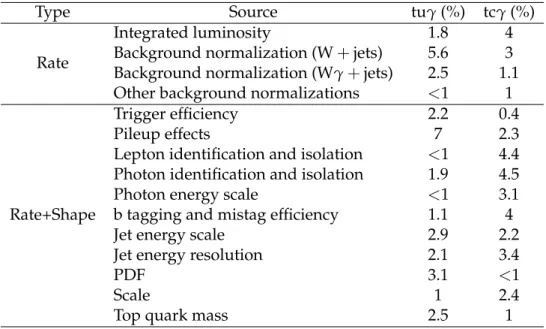
Table 2 summarizes the sources of the systematic uncertainties in the expected upper limits on the signal cross sections. These are calculated as the ratio of the difference of the shifted expected limit coming from the related systematic source and the nominal expected limit.
10 9 Upper limits on the FCNC cross sections for a restricted phase space
Table 2: The sources and values of systematic uncertainties used to determine the observed and expected upper limits on the tuγ and tcγ cross sections. The values are given as a percentage of the expected upper limits. The sources are broken up into those that only affect the overall rate of signal events and those that affect both the rate and the shape of the BDT distributions.
Type Source tuγ (%) tcγ (%)
Rate
Integrated luminosity
Background normalization (W+jets) Background normalization (Wγ+jets) Other background normalizations
1.8 5.6 2.5 <1 4 3 1.1 1 Rate+Shape Trigger efficiency Pileup effects
Lepton identification and isolation Photon identification and isolation Photon energy scale
b tagging and mistag efficiency Jet energy scale
Jet energy resolution PDF
Scale
Top quark mass
2.2 7 <1 1.9 <1 1.1 2.9 2.1 3.1 1 2.5 0.4 2.3 4.4 4.5 3.1 4 2.2 3.4 <1 2.4 1
9
Upper limits on the FCNC cross sections for a restricted phase
space
Upper limits on the signal cross sections are also determined for a restricted phase-space re-gion in which the detector is fully efficient. This removes the need to extrapolate to phase-space regions where the analysis has little or no sensitivity. The results are especially useful for comparing with theoretical models that predict enhancements in a particular phase-space region [10].
The measurement uses a simpler event-counting procedure instead of a fit to the BDT distri-bution. We define the fiducial cross section, σfid, in a volume defined for stable particles at the generator level before any interaction with the detector. This can be related to the total cross section, σ, through σfid=σ A, where A is the acceptance in the fiducial volume. Stable particles are characterized as particles with mean lifetimes exceeding 30 ps. The upper limit on σfid is obtained from the limit on σ A e, where e accounts for detector resolution, trigger efficiencies, and identification and isolation requirements applied in the analysis.
The leptons at the particle level are the electrons or muons originating from the decay of W bosons. The charged leptons from hadron decays are discarded, while electrons or muons from direct decays of τ leptons are included.
Stable particles, except muons, electrons, photons and neutrinos, are used to reconstruct particle-level jets in the simulation. Jet reconstruction at the particle particle-level is based on the anti-kT algo-rithm [31] with a distance parameter of 0.5. When a reconstructed jet contains a B hadron, the jet is tagged as a b jet. In events without a matched b jet, the jet with the largest pT is used to reconstruct the decayed top quark. The pT of the neutrinos is calculated as the magnitude of the vector sum of the pT of each neutrino in the event, except those originating from hadron decays. From these objects, the top quark mass is calculated in order to make kinematical cuts used in the definition of the fiducial region. The fiducial region is introduced at particle level, similar to the event selection requirements, and is summarized in Table 3.
Table 3: Definition of the fiducial region.
Object Requirement
Single muon pT >26 GeV,|η| <2.1
Veto for additional muons pT >10 GeV,|η| <2.5
Electron veto pT >20 GeV,|η| <2.5
Single photon pT >50 GeV,|η| <2.5 (1.44< |η| <1.56 excluded)
At least one jet (Nb jet<2) pT >30 GeV,|η| <2.5
Missing pT pmissT >30 GeV
Muon, jets, and photons ∆R(µ, γ)and∆R(jet, γ) >0.7
Reconstructed top quark mass 130<mµνb<220 GeV
The efficiency e is found to be 16% and 19% from simulation for the respective tuγ and tcγ events in the fiducial region. An additional fiducial region is defined by also requiring exactly one b-tagged jet in the event. The values of e are thereby reduced to 11% and 14% for the two signals, respectively.
Table 4 shows the 95% CL upper limits on the signal cross sections in the two fiducial regions for the tuγ and tcγ processes. These are calculated from the total number of selected events in data (Nobs), the SM expectation (NSM), both at detector level, and the efficiency for a sig-nal event in the fiducial region to be reconstructed at detector level. The uncertainties in the SM expectation include statistical and systematic uncertainties. The total number of observed events is decreased by a factor of approximately 6.5 after requiring exactly one identified b jet in an event, while the expected number of SM events decreases by a factor of 7. The combined relative uncertainty in the number of expected SM events increases from 12% to 19% when this b jet requirement is included.
The upper limits are calculated including a total systematic uncertainty in the signal selection efficiencies of 10%, estimated using a method similar to that described in Section 7. These are the first limits set on the anomalous tγ production within a restricted phase-space region. Table 4: The total number of observed selected events at detector level in the data (Nobs), the SM expectations (NSM), the efficiencies (e), and the upper limits on the cross sections σfidat the 95% CL in the fiducial region for the two signal channels, without and with a requirement on the presence of a single accompanying b jet.
Fiducial region Channel Nobs NSM e σfid95%(fb)
Basic selection (Table 3) tuγ 1794 1805±215 0.16 122
tcγ 0.19 103
Basic selection and Nb jet =1 tuγ 275 258±49 0.11 47
tcγ 0.14 39
10
Summary
The result of a search for flavor changing neutral currents (FCNC) through single top quark production in association with a photon has been presented. The search is performed using proton-proton collisions at a center-of-mass energy of 8 TeV, corresponding to an integrated luminosity of 19.8 fb−1, collected by the CMS detector at the LHC. The number of observed events is consistent with the SM prediction. Upper limits are set at 95% CL on the anoma-lous FCNC couplings of κtuγ < 0.025 and κtcγ < 0.091 using NLO QCD calculations. The corresponding upper limits on the branching fractions are B(t → uγ) < 1.3×10⁻⁴ and B(t → cγ) < 1.7×10⁻³, which are the most restrictive bounds to date. Observed upper
12 References
limits on the cross section in a restricted phase space are found to be 47 fb and 39 fb at 95% CL for tuγ and tcγ production, respectively, when exactly one identified b jet is required in the data. These are the first results on anomalous tγ production within a restricted phase-space region.
Acknowledgments
We congratulate our colleagues in the CERN accelerator departments for the excellent perfor-mance of the LHC and thank the technical and administrative staffs at CERN and at other CMS institutes for their contributions to the success of the CMS effort. In addition, we gratefully acknowledge the computing centers and personnel of the Worldwide LHC Computing Grid for delivering so effectively the computing infrastructure essential to our analyses. Finally, we acknowledge the enduring support for the construction and operation of the LHC and the CMS detector provided by the following funding agencies: BMWFW and FWF (Austria); FNRS and FWO (Belgium); CNPq, CAPES, FAPERJ, and FAPESP (Brazil); MES (Bulgaria); CERN; CAS, MoST, and NSFC (China); COLCIENCIAS (Colombia); MSES and CSF (Croatia); RPF (Cyprus); MoER, ERC IUT and ERDF (Estonia); Academy of Finland, MEC, and HIP (Finland); CEA and CNRS/IN2P3 (France); BMBF, DFG, and HGF (Germany); GSRT (Greece); OTKA and NIH (Hungary); DAE and DST (India); IPM (Iran); SFI (Ireland); INFN (Italy); MSIP and NRF (Re-public of Korea); LAS (Lithuania); MOE and UM (Malaysia); CINVESTAV, CONACYT, SEP, and UASLP-FAI (Mexico); MBIE (New Zealand); PAEC (Pakistan); MSHE and NSC (Poland); FCT (Portugal); JINR (Dubna); MON, RosAtom, RAS and RFBR (Russia); MESTD (Serbia); SEIDI and CPAN (Spain); Swiss Funding Agencies (Switzerland); MST (Taipei); ThEPCenter, IPST, STAR and NSTDA (Thailand); TUBITAK and TAEK (Turkey); NASU and SFFR (Ukraine); STFC (United Kingdom); DOE and NSF (USA).
Individuals have received support from the Marie-Curie program and the European Research Council and EPLANET (European Union); the Leventis Foundation; the A. P. Sloan Foun-dation; the Alexander von Humboldt FounFoun-dation; the Belgian Federal Science Policy Office; the Fonds pour la Formation `a la Recherche dans l’Industrie et dans l’Agriculture (FRIA-Belgium); the Agentschap voor Innovatie door Wetenschap en Technologie (IWT-(FRIA-Belgium); the Ministry of Education, Youth and Sports (MEYS) of the Czech Republic; the Council of Science and Industrial Research, India; the HOMING PLUS program of the Foundation for Polish Science, cofinanced from European Union, Regional Development Fund; the OPUS pro-gram of the National Science Center (Poland); the Compagnia di San Paolo (Torino); MIUR project 20108T4XTM (Italy); the Thalis and Aristeia programs cofinanced by EU-ESF and the Greek NSRF; the National Priorities Research Program by Qatar National Research Fund; the Rachadapisek Sompot Fund for Postdoctoral Fellowship, Chulalongkorn University (Thailand); and the Welch Foundation, contract C-1845.
References
[1] S. L. Glashow, J. Iliopoulos, and L. Maiani, “Weak Interactions with Lepton Hadron Symmetry”, Phys. Rev. D 2 (1970) 1285, doi:10.1103/PhysRevD.2.1285. [2] J. A. Aguilar-Saavedra and B. M. Nobre, “Rare top decays t→cγ, t→cg and CKM
unitarity”, Phys. Lett. B 553 (2003) 251, doi:10.1016/S0370-2693(02)03230-6, arXiv:hep-ph/0210360.
[3] G. Couture, M. Frank, and H. Konig, “Supersymmetric QCD flavor changing top quark decay”, Phys. Rev. D 56 (1997) 4213, doi:10.1103/PhysRevD.56.4213,
arXiv:hep-ph/9704305.
[4] G. R. Lu, F. R. Yin, X. L. Wang, and L. D. Wan, “Rare top quark decays t→cV in the topcolor assisted technicolor model”, Phys. Rev. D 68 (2003) 015002,
doi:10.1103/PhysRevD.68.015002, arXiv:hep-ph/0303122.
[5] L3 Collaboration, “Search for Single Top Production at LEP”, Phys. Lett. B 549 (2002) 290,
doi:10.1016/S0370-2693(02)02933-7, arXiv:hep-ex/0210041.
[6] ZEUS Collaboration, “Search for single-top production in ep collisions at HERA”, Phys. Lett. B 708 (2012) 27, doi:10.1016/j.physletb.2012.01.025, arXiv:1111.3901. [7] H1 Collaboration, “Search for Single Top Quark Production at HERA”, Phys. Lett. B 678
(2009) 450, doi:10.1016/j.physletb.2009.06.057, arXiv:0904.3876. [8] CDF Collaboration, “Search for Flavor-Changing Neutral Current Decays of the Top
Quark in p ¯p Collisions at√s=1.8 TeV”, Phys. Rev. Lett. 80 (1998) 2525,
doi:10.1103/PhysRevLett.80.2525.
[9] J. A. Aguilar-Saavedra, “A minimal set of top anomalous couplings”, Nucl. Phys. B 812 (2009) 181, doi:10.1016/j.nuclphysb.2008.12.012, arXiv:0811.3842. [10] G. Duriex, F. Maltoni, and C. Zhang, “A global approach to top-quark flavor-changing
interactions”, Phys. Rev. D 91 (2015) 074017, doi:10.1103/PhysRevD.91.074017, arXiv:1412.7166.
[11] S. Khatibi and M. Mohammadi Najafabadi, “Probing the anomalous FCNC interactions in a top-Higgs final state and the charge ratio approach”, Phys. Rev. D 89 (2014) 054011, doi:10.1103/PhysRevD.89.054011, arXiv:1402.3073.
[12] Y. Zhang et al., “Next-to-leading order QCD corrections to the top quark associated with
γproduction via model-independent flavor-changing neutral-current couplings at
hadron colliders”, Phys. Rev. D 83 (2011) 094003,
doi:10.1103/PhysRevD.83.094003, arXiv:1101.5346.
[13] CMS Collaboration, “The CMS experiment at the CERN LHC”, JINST 3 (2008) S08004,
doi:10.1088/1748-0221/3/08/S08004.
[14] J. A. Aguilar-Saavedra, “Zt, γt and t production at hadron colliders via strong flavour-changing neutral couplings”, Nucl. Phys. B 837 (2010) 122,
doi:10.1016/j.nuclphysb.2010.05.005, arXiv:1003.3173.
[15] F. Maltoni and T. Stelzer, “MadEvent: automatic event generation with MadGraph”, JHEP 02 (2003) 027, doi:10.1088/1126-6708/2003/02/027,
arXiv:hep-ph/0208156.
[16] T. Sj ¨ostrand, S. Mrenna, and P. Skands, “PYTHIA 6.4 physics and manual”, JHEP 05 (2006) 026, doi:10.1088/1126-6708/2006/05/026, arXiv:hep-ph/0603175. [17] S. Alioli, P. Nanson, C. Oleari, and E. Re, “A general framework for implementing NLO
calculations in shower Monte Carlo programs: the POWHEG BOX”, JHEP 06 (2010) 043, doi:10.1007/JHEP06(2010)043, arXiv:1002.2581.
14 References
[18] P. Nason, “A New method for combining NLO QCD with shower Monte Carlo algorithms”, JHEP 11 (2004) 040, doi:10.1088/1126-6708/2004/11/040, arXiv:hep-ph/0409146.
[19] S. Frixione, P. Nason, and C. Oleari, “Matching NLO QCD computations with Parton Shower simulations: the POWHEG method”, JHEP 11 (2007) 070,
doi:10.1088/1126-6708/2007/11/070, arXiv:0709.2092.
[20] P. Nason, “NLO single-top production matched with shower in POWHEG: s- and t-channel contributions”, JHEP 09 (2009) 111,
doi:10.1088/1126-6708/2009/09/111, arXiv:0907.4076.
[21] U. Baur, T. Han, and J. Ohnemus, “QCD corrections to hadronic Wγ production with nonstandard WWγ couplings”, Phys. Rev. D 48 (1993) 5140,
doi:10.1103/PhysRevD.48.5140.
[22] S. Jadach, J. H. Kuhn, and Z. Wa¸s, “TAUOLA: A Library of Monte Carlo programs to simulate decays of polarized tau leptons”, Comput. Phys. Commun. 64 (1990) 275,
doi:10.1016/0010-4655(91)90038-M.
[23] J. Pumplin et al., “New generation of parton distributions with uncertainties from global QCD analysis”, JHEP 07 (2002) 012, doi:10.1088/1126-6708/2002/07/012, arXiv:hep-ph/0201195.
[24] H.-L. Lai et al., “New parton distributions for collider physics”, Phys. Rev. D 82 (2010) 074024, doi:10.1103/PhysRevD.82.074024, arXiv:1007.2241.
[25] GEANT4 Collaboration, “GEANT4—a simulation toolkit”, Nucl. Instrum. Meth. A 506 (2003) 250, doi:10.1016/S0168-9002(03)01368-8.
[26] CMS Collaboration, “Description and performance of track and primary-vertex reconstruction with the CMS tracker”, J. Instrum. 9 (2014) P10009,
doi:10.1088/1748-0221/9/10/P10009.
[27] CMS Collaboration, “Commissioning of the Particle-flow Event Reconstruction with the first LHC collisions recorded in the CMS detector”, CMS Physics Analysis Summary CMS-PAS-PFT-10-001, 2010.
[28] CMS Collaboration, “Particle–Flow Event Reconstruction in CMS and Performance for Jets, Taus, and EmissT ”, CMS Physics Analysis Summary CMS-PAS-PFT-09-001, 2009. [29] CMS Collaboration, “Isolated Photon Reconstruction and Identification at√s=7 TeV”,
CMS Physics Analysis Summary CMS-PAS-EGM-10-006, 2010.
[30] M. Cacciari and G. P. Salam, “Pileup subtraction using jet areas”, Phys. Lett. B 659 (2008) 119, doi:10.1016/j.physletb.2007.09.077, arXiv:0707.1378.
[31] M. Cacciari, G. P. Salam, and G. Soyez, “The anti-ktjet clustering algorithm”, JHEP 04 (2008) 063, doi:10.1088/1126-6708/2008/04/063, arXiv:0802.1189.
[32] CMS Collaboration, “Determination of jet energy calibration and transverse momentum resolution in CMS”, J. Instrum. 6 (2011) P11002,
[33] CMS Collaboration, “Identification of b-quark jets with the CMS experiment”, J. Instrum.
8(2013) P04013, doi:10.1088/1748-0221/8/04/P04013.
[34] CMS Collaboration, “Performance of b tagging at√s=8 TeV in multijet, tt and boosted topology events”, CMS Physics Analysis Summary CMS-PAS-BTV-13-001, 2013.
[35] Particle Data Group, K. A. Olive et al., “Review of Particle Physics”, Chin. Phys. C 38 (2014) 090001, doi:10.1088/1674-1137/38/9/090001.
[36] CMS Collaboration, “Measurement of the t-channel single top quark production cross section in pp collisions at√s=7 TeV”, Phys. Rev. Lett. 107 (2011) 091802,
doi:10.1103/PhysRevLett.107.091802.
[37] N. Kidonakis, “Differential and total cross sections for top pair and single top production”, DESY-PROC-2012-02 (2012) 1,
doi:10.3204/DESY-PROC-2012-02/251, arXiv:1205.3453.
[38] M. Cacciari et al., “Top-pair production at hadron colliders with next-to-next-to-leading logarithmic soft-gluon resummation”, Phys. Lett. B 710 (2012) 612,
doi:10.1016/j.physletb.2012.03.013, arXiv:1111.5869.
[39] J. M. Campbell and R. K. Ellis, “MCFM for the Tevatron and the LHC”, Nucl. Phys. Proc. Suppl. 205 (2010) 10, doi:10.1016/j.nuclphysbps.2010.08.011,
arXiv:1007.3492.
[40] B. P. Roe et al., “Boosted decision trees, an alternative to artificial neural networks”, Nucl. Instrum. Meth. A 543 (2005) 577, doi:10.1016/j.nima.2004.12.018,
arXiv:physics/0408124.
[41] H. Voss, A. H ¨ocker, J. Stelzer, and F. Tegenfeldt, “TMVA, the Toolkit for Multivariate Data Analysis with ROOT”, in XIth International Workshop on Advanced Computing and Analysis Techniques in Physics Research (ACAT), p. 40. 2007. arXiv:physics/0703039.
[42] CMS Collaboration, “Measurements of inclusive W and Z cross sections in pp collisions at√s = 7 TeV”, J. High Energy Phys. 01 (2011) 080, doi:10.1007/JHEP01(2011)080. [43] CMS Collaboration, “Measurement of the Wγ and Zγ inclusive cross sections in pp
collisions at√s=7 TeV and limits on anomalous triple gauge boson couplings”, Phys. Rev. D 89 (2014) 092005, doi:10.1103/PhysRevD.89.092005.
[44] CMS Collaboration, “The performance of the CMS muon detector in proton–proton collisions at√s=7 TeV at the LHC”, J. Instrum. 8 (2013) P11002,
doi:10.1088/1748-0221/8/11/P11002.
[45] CMS Collaboration, “Measurement of the inelastic proton-proton cross section at√
s =7 TeV”, Phys. Lett. B 722 (2013) 5, doi:10.1016/j.physletb.2013.03.024.
[46] CMS Collaboration, “CMS Luminosity Based on Pixel Cluster Counting - Summer 2013 Update”, CMS Physics Analysis Summary CMS-PAS-LUM-13-001, 2013.
[47] M. Botje et al., “The PDF4LHC Working Group Interim Recommendations”, (2011). arXiv:1101.0538.
[48] S. Alekhin et al., “The PDF4LHC Working Group Interim Report”, (2011).
16 References
[49] A. D. Martin, W. J. Stirling, R. S. Thorne, and G. Watt, “Parton distributions for the LHC”, Eur. Phys. J. C 63 (2009) 189, doi:10.1140/epjc/s10052-009-1072-5,
arXiv:0901.0002.
[50] NNPDF Collaboration, “Parton distributions with LHC data”, Nucl. Phys. B 867 (2013) 244, doi:10.1016/j.nuclphysb.2012.10.003, arXiv:1207.1303.
[51] A. L. Read, “Presentation of search results: the CLstechnique”, J. Phys. G 28 (2002) 2693,
doi:10.1088/0954-3899/28/10/313.
[52] T. Junk, “Confidence level computation for combining searches with small statistics”, Nucl. Instrum. Meth. A 434 (1999) 435, doi:10.1016/S0168-9002(99)00498-2. [53] T. M ¨uller, J. Ott, and J. Wagner-Kuhr, “Theta - a framework for template based modelling
and inference”.
[54] J. A. Aguilar-Saavedra, “Top flavor-changing neutral interactions: Theoretical expectations and experimental detection”, Acta Phys. Polon. B 35 (2004) 2695,
arXiv:hep-ph/0409342.
[55] D0 Collaboration, “Search for flavor changing neutral currents in decays of top quarks”, Phys. Lett. B 701 (2011) 313, doi:10.1016/j.physletb.2011.06.014,
arXiv:1103.4574.
[56] CDF Collaboration, “Search for the Flavor Changing Neutral Current Decay t→Zq in p ¯p Collisions at√s = 1.96 TeV”, Phys. Rev. Lett. 101 (2008) 192002,
doi:10.1103/PhysRevLett.101.192002, arXiv:0805.2109.
[57] ATLAS Collaboration, “Search for flavour-changing neutral current top-quark decays to qZ in pp collision data collected with the ATLAS detector at√s=8 TeV”, (2015). arXiv:1508.05796. Submitted to Eur. Phys. J. C.
[58] CMS Collaboration, “Search for Flavor-Changing Neutral Currents in Top-Quark Decays t →Zq in pp Collisions at√s=8 TeV”, Phys. Rev. Lett. 112 (2014) 171802,
A
The CMS Collaboration
Yerevan Physics Institute, Yerevan, Armenia V. Khachatryan, A.M. Sirunyan, A. Tumasyan
Institut f ¨ur Hochenergiephysik der OeAW, Wien, Austria
W. Adam, E. Asilar, T. Bergauer, J. Brandstetter, E. Brondolin, M. Dragicevic, J. Er ¨o, M. Flechl, M. Friedl, R. Fr ¨uhwirth1, V.M. Ghete, C. Hartl, N. H ¨ormann, J. Hrubec, M. Jeitler1, V. Kn ¨unz, A. K ¨onig, M. Krammer1, I. Kr¨atschmer, D. Liko, T. Matsushita, I. Mikulec, D. Rabady2, B. Rahbaran, H. Rohringer, J. Schieck1, R. Sch ¨ofbeck, J. Strauss, W. Treberer-Treberspurg, W. Waltenberger, C.-E. Wulz1
National Centre for Particle and High Energy Physics, Minsk, Belarus V. Mossolov, N. Shumeiko, J. Suarez Gonzalez
Universiteit Antwerpen, Antwerpen, Belgium
S. Alderweireldt, T. Cornelis, E.A. De Wolf, X. Janssen, A. Knutsson, J. Lauwers, S. Luyckx, R. Rougny, M. Van De Klundert, H. Van Haevermaet, P. Van Mechelen, N. Van Remortel, A. Van Spilbeeck
Vrije Universiteit Brussel, Brussel, Belgium
S. Abu Zeid, F. Blekman, J. D’Hondt, N. Daci, I. De Bruyn, K. Deroover, N. Heracleous, J. Keaveney, S. Lowette, L. Moreels, A. Olbrechts, Q. Python, D. Strom, S. Tavernier, W. Van Doninck, P. Van Mulders, G.P. Van Onsem, I. Van Parijs
Universit´e Libre de Bruxelles, Bruxelles, Belgium
P. Barria, H. Brun, C. Caillol, B. Clerbaux, G. De Lentdecker, G. Fasanella, L. Favart, A. Grebenyuk, G. Karapostoli, T. Lenzi, A. L´eonard, T. Maerschalk, A. Marinov, L. Perni`e, A. Randle-conde, T. Reis, T. Seva, C. Vander Velde, P. Vanlaer, R. Yonamine, F. Zenoni, F. Zhang3 Ghent University, Ghent, Belgium
K. Beernaert, L. Benucci, A. Cimmino, S. Crucy, D. Dobur, A. Fagot, G. Garcia, M. Gul, J. Mccartin, A.A. Ocampo Rios, D. Poyraz, D. Ryckbosch, S. Salva, M. Sigamani, N. Strobbe, M. Tytgat, W. Van Driessche, E. Yazgan, N. Zaganidis
Universit´e Catholique de Louvain, Louvain-la-Neuve, Belgium
S. Basegmez, C. Beluffi4, O. Bondu, S. Brochet, G. Bruno, A. Caudron, L. Ceard, G.G. Da Silveira, C. Delaere, D. Favart, L. Forthomme, A. Giammanco5, J. Hollar, A. Jafari, P. Jez, M. Komm, V. Lemaitre, A. Mertens, C. Nuttens, L. Perrini, A. Pin, K. Piotrzkowski, A. Popov6, L. Quertenmont, M. Selvaggi, M. Vidal Marono
Universit´e de Mons, Mons, Belgium N. Beliy, G.H. Hammad
Centro Brasileiro de Pesquisas Fisicas, Rio de Janeiro, Brazil
W.L. Ald´a J ´unior, G.A. Alves, L. Brito, M. Correa Martins Junior, M. Hamer, C. Hensel, C. Mora Herrera, A. Moraes, M.E. Pol, P. Rebello Teles
Universidade do Estado do Rio de Janeiro, Rio de Janeiro, Brazil
E. Belchior Batista Das Chagas, W. Carvalho, J. Chinellato7, A. Cust ´odio, E.M. Da Costa, D. De Jesus Damiao, C. De Oliveira Martins, S. Fonseca De Souza, L.M. Huertas Guativa, H. Malbouisson, D. Matos Figueiredo, L. Mundim, H. Nogima, W.L. Prado Da Silva, A. Santoro, A. Sznajder, E.J. Tonelli Manganote7, A. Vilela Pereira
18 A The CMS Collaboration
Universidade Estadual Paulistaa, Universidade Federal do ABCb, S˜ao Paulo, Brazil
S. Ahujaa, C.A. Bernardesb, A. De Souza Santosb, S. Dograa, T.R. Fernandez Perez Tomeia, E.M. Gregoresb, P.G. Mercadanteb, C.S. Moona,8, S.F. Novaesa, Sandra S. Padulaa, D. Romero Abad, J.C. Ruiz Vargas
Institute for Nuclear Research and Nuclear Energy, Sofia, Bulgaria
A. Aleksandrov, R. Hadjiiska, P. Iaydjiev, M. Rodozov, S. Stoykova, G. Sultanov, M. Vutova University of Sofia, Sofia, Bulgaria
A. Dimitrov, I. Glushkov, L. Litov, B. Pavlov, P. Petkov Institute of High Energy Physics, Beijing, China
M. Ahmad, J.G. Bian, G.M. Chen, H.S. Chen, M. Chen, T. Cheng, R. Du, C.H. Jiang, R. Plestina9, F. Romeo, S.M. Shaheen, J. Tao, C. Wang, Z. Wang, H. Zhang
State Key Laboratory of Nuclear Physics and Technology, Peking University, Beijing, China C. Asawatangtrakuldee, Y. Ban, Q. Li, S. Liu, Y. Mao, S.J. Qian, D. Wang, Z. Xu
Universidad de Los Andes, Bogota, Colombia
C. Avila, A. Cabrera, L.F. Chaparro Sierra, C. Florez, J.P. Gomez, B. Gomez Moreno, J.C. Sanabria
University of Split, Faculty of Electrical Engineering, Mechanical Engineering and Naval Architecture, Split, Croatia
N. Godinovic, D. Lelas, I. Puljak, P.M. Ribeiro Cipriano University of Split, Faculty of Science, Split, Croatia Z. Antunovic, M. Kovac
Institute Rudjer Boskovic, Zagreb, Croatia
V. Brigljevic, K. Kadija, J. Luetic, S. Micanovic, L. Sudic University of Cyprus, Nicosia, Cyprus
A. Attikis, G. Mavromanolakis, J. Mousa, C. Nicolaou, F. Ptochos, P.A. Razis, H. Rykaczewski Charles University, Prague, Czech Republic
M. Bodlak, M. Finger10, M. Finger Jr.10
Academy of Scientific Research and Technology of the Arab Republic of Egypt, Egyptian Network of High Energy Physics, Cairo, Egypt
M. El Sawy11,12, E. El-khateeb13,13, T. Elkafrawy13, A. Mohamed14, E. Salama12,13
National Institute of Chemical Physics and Biophysics, Tallinn, Estonia B. Calpas, M. Kadastik, M. Murumaa, M. Raidal, A. Tiko, C. Veelken Department of Physics, University of Helsinki, Helsinki, Finland P. Eerola, J. Pekkanen, M. Voutilainen
Helsinki Institute of Physics, Helsinki, Finland
J. H¨ark ¨onen, V. Karim¨aki, R. Kinnunen, T. Lamp´en, K. Lassila-Perini, S. Lehti, T. Lind´en, P. Luukka, T. M¨aenp¨a¨a, T. Peltola, E. Tuominen, J. Tuominiemi, E. Tuovinen, L. Wendland Lappeenranta University of Technology, Lappeenranta, Finland
J. Talvitie, T. Tuuva
DSM/IRFU, CEA/Saclay, Gif-sur-Yvette, France
S. Ganjour, A. Givernaud, P. Gras, G. Hamel de Monchenault, P. Jarry, E. Locci, M. Machet, J. Malcles, J. Rander, A. Rosowsky, M. Titov, A. Zghiche
Laboratoire Leprince-Ringuet, Ecole Polytechnique, IN2P3-CNRS, Palaiseau, France
I. Antropov, S. Baffioni, F. Beaudette, P. Busson, L. Cadamuro, E. Chapon, C. Charlot, T. Dahms, O. Davignon, N. Filipovic, A. Florent, R. Granier de Cassagnac, S. Lisniak, L. Mastrolorenzo, P. Min´e, I.N. Naranjo, M. Nguyen, C. Ochando, G. Ortona, P. Paganini, P. Pigard, S. Regnard, R. Salerno, J.B. Sauvan, Y. Sirois, T. Strebler, Y. Yilmaz, A. Zabi
Institut Pluridisciplinaire Hubert Curien, Universit´e de Strasbourg, Universit´e de Haute Alsace Mulhouse, CNRS/IN2P3, Strasbourg, France
J.-L. Agram15, J. Andrea, A. Aubin, D. Bloch, J.-M. Brom, M. Buttignol, E.C. Chabert, N. Chanon, C. Collard, E. Conte15, X. Coubez, J.-C. Fontaine15, D. Gel´e, U. Goerlach, C. Goetzmann, A.-C. Le Bihan, J.A. Merlin2, K. Skovpen, P. Van Hove
Centre de Calcul de l’Institut National de Physique Nucleaire et de Physique des Particules, CNRS/IN2P3, Villeurbanne, France
S. Gadrat
Universit´e de Lyon, Universit´e Claude Bernard Lyon 1, CNRS-IN2P3, Institut de Physique Nucl´eaire de Lyon, Villeurbanne, France
S. Beauceron, C. Bernet, G. Boudoul, E. Bouvier, C.A. Carrillo Montoya, R. Chierici, D. Contardo, B. Courbon, P. Depasse, H. El Mamouni, J. Fan, J. Fay, S. Gascon, M. Gouzevitch, B. Ille, F. Lagarde, I.B. Laktineh, M. Lethuillier, L. Mirabito, A.L. Pequegnot, S. Perries, J.D. Ruiz Alvarez, D. Sabes, L. Sgandurra, V. Sordini, M. Vander Donckt, P. Verdier, S. Viret
Georgian Technical University, Tbilisi, Georgia T. Toriashvili16
Tbilisi State University, Tbilisi, Georgia D. Lomidze
RWTH Aachen University, I. Physikalisches Institut, Aachen, Germany
C. Autermann, S. Beranek, M. Edelhoff, L. Feld, A. Heister, M.K. Kiesel, K. Klein, M. Lipinski, A. Ostapchuk, M. Preuten, F. Raupach, S. Schael, J.F. Schulte, T. Verlage, H. Weber, B. Wittmer, V. Zhukov6
RWTH Aachen University, III. Physikalisches Institut A, Aachen, Germany
M. Ata, M. Brodski, E. Dietz-Laursonn, D. Duchardt, M. Endres, M. Erdmann, S. Erdweg, T. Esch, R. Fischer, A. G ¨uth, T. Hebbeker, C. Heidemann, K. Hoepfner, D. Klingebiel, S. Knutzen, P. Kreuzer, M. Merschmeyer, A. Meyer, P. Millet, M. Olschewski, K. Padeken, P. Papacz, T. Pook, M. Radziej, H. Reithler, M. Rieger, F. Scheuch, L. Sonnenschein, D. Teyssier, S. Th ¨uer
RWTH Aachen University, III. Physikalisches Institut B, Aachen, Germany
V. Cherepanov, Y. Erdogan, G. Fl ¨ugge, H. Geenen, M. Geisler, F. Hoehle, B. Kargoll, T. Kress, Y. Kuessel, A. K ¨unsken, J. Lingemann2, A. Nehrkorn, A. Nowack, I.M. Nugent, C. Pistone, O. Pooth, A. Stahl
Deutsches Elektronen-Synchrotron, Hamburg, Germany
M. Aldaya Martin, I. Asin, N. Bartosik, O. Behnke, U. Behrens, A.J. Bell, K. Borras17, A. Burgmeier, A. Cakir, L. Calligaris, A. Campbell, S. Choudhury, F. Costanza, C. Diez Pardos, G. Dolinska, S. Dooling, T. Dorland, G. Eckerlin, D. Eckstein, T. Eichhorn, G. Flucke, E. Gallo18, J. Garay Garcia, A. Geiser, A. Gizhko, P. Gunnellini, J. Hauk, M. Hempel19, H. Jung,
20 A The CMS Collaboration
A. Kalogeropoulos, O. Karacheban19, M. Kasemann, P. Katsas, J. Kieseler, C. Kleinwort, I. Korol, W. Lange, J. Leonard, K. Lipka, A. Lobanov, W. Lohmann19, R. Mankel, I. Marfin19, I.-A. Melzer-Pellmann, A.B. Meyer, G. Mittag, J. Mnich, A. Mussgiller, S. Naumann-Emme, A. Nayak, E. Ntomari, H. Perrey, D. Pitzl, R. Placakyte, A. Raspereza, B. Roland, M. ¨O. Sahin, P. Saxena, T. Schoerner-Sadenius, M. Schr ¨oder, C. Seitz, S. Spannagel, K.D. Trippkewitz, R. Walsh, C. Wissing
University of Hamburg, Hamburg, Germany
V. Blobel, M. Centis Vignali, A.R. Draeger, J. Erfle, E. Garutti, K. Goebel, D. Gonzalez, M. G ¨orner, J. Haller, M. Hoffmann, R.S. H ¨oing, A. Junkes, R. Klanner, R. Kogler, T. Lapsien, T. Lenz, I. Marchesini, D. Marconi, M. Meyer, D. Nowatschin, J. Ott, F. Pantaleo2, T. Peiffer, A. Perieanu, N. Pietsch, J. Poehlsen, D. Rathjens, C. Sander, H. Schettler, P. Schleper, E. Schlieckau, A. Schmidt, J. Schwandt, M. Seidel, V. Sola, H. Stadie, G. Steinbr ¨uck, H. Tholen, D. Troendle, E. Usai, L. Vanelderen, A. Vanhoefer, B. Vormwald
Institut f ¨ur Experimentelle Kernphysik, Karlsruhe, Germany
M. Akbiyik, C. Barth, C. Baus, J. Berger, C. B ¨oser, E. Butz, T. Chwalek, F. Colombo, W. De Boer, A. Descroix, A. Dierlamm, S. Fink, F. Frensch, M. Giffels, A. Gilbert, F. Hartmann2, S.M. Heindl, U. Husemann, I. Katkov6, A. Kornmayer2, P. Lobelle Pardo, B. Maier, H. Mildner, M.U. Mozer, T. M ¨uller, Th. M ¨uller, M. Plagge, G. Quast, K. Rabbertz, S. R ¨ocker, F. Roscher, H.J. Simonis, F.M. Stober, R. Ulrich, J. Wagner-Kuhr, S. Wayand, M. Weber, T. Weiler, C. W ¨ohrmann, R. Wolf Institute of Nuclear and Particle Physics (INPP), NCSR Demokritos, Aghia Paraskevi, Greece
G. Anagnostou, G. Daskalakis, T. Geralis, V.A. Giakoumopoulou, A. Kyriakis, D. Loukas, A. Psallidas, I. Topsis-Giotis
University of Athens, Athens, Greece
A. Agapitos, S. Kesisoglou, A. Panagiotou, N. Saoulidou, E. Tziaferi University of Io´annina, Io´annina, Greece
I. Evangelou, G. Flouris, C. Foudas, P. Kokkas, N. Loukas, N. Manthos, I. Papadopoulos, E. Paradas, J. Strologas
Wigner Research Centre for Physics, Budapest, Hungary
G. Bencze, C. Hajdu, A. Hazi, P. Hidas, D. Horvath20, F. Sikler, V. Veszpremi, G. Vesztergombi21, A.J. Zsigmond
Institute of Nuclear Research ATOMKI, Debrecen, Hungary N. Beni, S. Czellar, J. Karancsi22, J. Molnar, Z. Szillasi
University of Debrecen, Debrecen, Hungary
M. Bart ´ok23, A. Makovec, P. Raics, Z.L. Trocsanyi, B. Ujvari
National Institute of Science Education and Research, Bhubaneswar, India P. Mal, K. Mandal, D.K. Sahoo, N. Sahoo, S.K. Swain
Panjab University, Chandigarh, India
S. Bansal, S.B. Beri, V. Bhatnagar, R. Chawla, R. Gupta, U.Bhawandeep, A.K. Kalsi, A. Kaur, M. Kaur, R. Kumar, A. Mehta, M. Mittal, J.B. Singh, G. Walia
University of Delhi, Delhi, India
Ashok Kumar, A. Bhardwaj, B.C. Choudhary, R.B. Garg, A. Kumar, S. Malhotra, M. Naimuddin, N. Nishu, K. Ranjan, R. Sharma, V. Sharma
Saha Institute of Nuclear Physics, Kolkata, India
S. Bhattacharya, K. Chatterjee, S. Dey, S. Dutta, Sa. Jain, N. Majumdar, A. Modak, K. Mondal, S. Mukherjee, S. Mukhopadhyay, A. Roy, D. Roy, S. Roy Chowdhury, S. Sarkar, M. Sharan Bhabha Atomic Research Centre, Mumbai, India
A. Abdulsalam, R. Chudasama, D. Dutta, V. Jha, V. Kumar, A.K. Mohanty2, L.M. Pant,
P. Shukla, A. Topkar
Tata Institute of Fundamental Research, Mumbai, India
T. Aziz, S. Banerjee, S. Bhowmik24, R.M. Chatterjee, R.K. Dewanjee, S. Dugad, S. Ganguly, S. Ghosh, M. Guchait, A. Gurtu25, G. Kole, S. Kumar, B. Mahakud, M. Maity24, G. Majumder, K. Mazumdar, S. Mitra, G.B. Mohanty, B. Parida, T. Sarkar24, N. Sur, B. Sutar, N. Wickramage26
Indian Institute of Science Education and Research (IISER), Pune, India S. Chauhan, S. Dube, S. Sharma
Institute for Research in Fundamental Sciences (IPM), Tehran, Iran
H. Bakhshiansohi, H. Behnamian, S.M. Etesami27, A. Fahim28, R. Goldouzian, M. Khakzad, M. Mohammadi Najafabadi, M. Naseri, S. Paktinat Mehdiabadi, F. Rezaei Hosseinabadi, B. Safarzadeh29, M. Zeinali
University College Dublin, Dublin, Ireland M. Felcini, M. Grunewald
INFN Sezione di Baria, Universit`a di Barib, Politecnico di Baric, Bari, Italy
M. Abbresciaa,b, C. Calabriaa,b, C. Caputoa,b, A. Colaleoa, D. Creanzaa,c, L. Cristellaa,b, N. De Filippisa,c, M. De Palmaa,b, L. Fiorea, G. Iasellia,c, G. Maggia,c, M. Maggia, G. Minielloa,b, S. Mya,c, S. Nuzzoa,b, A. Pompilia,b, G. Pugliesea,c, R. Radognaa,b, A. Ranieria, G. Selvaggia,b, L. Silvestrisa,2, R. Vendittia,b, P. Verwilligena
INFN Sezione di Bolognaa, Universit`a di Bolognab, Bologna, Italy
G. Abbiendia, C. Battilana2, A.C. Benvenutia, D. Bonacorsia,b, S. Braibant-Giacomellia,b, L. Brigliadoria,b, R. Campaninia,b, P. Capiluppia,b, A. Castroa,b, F.R. Cavalloa, S.S. Chhibraa,b, G. Codispotia,b, M. Cuffiania,b, G.M. Dallavallea, F. Fabbria, A. Fanfania,b, D. Fasanellaa,b, P. Giacomellia, C. Grandia, L. Guiduccia,b, S. Marcellinia, G. Masettia, A. Montanaria, F.L. Navarriaa,b, A. Perrottaa, A.M. Rossia,b, T. Rovellia,b, G.P. Sirolia,b, N. Tosia,b, R. Travaglinia,b
INFN Sezione di Cataniaa, Universit`a di Cataniab, Catania, Italy
G. Cappelloa, M. Chiorbolia,b, S. Costaa,b, F. Giordanoa,b, R. Potenzaa,b, A. Tricomia,b, C. Tuvea,b
INFN Sezione di Firenzea, Universit`a di Firenzeb, Firenze, Italy
G. Barbaglia, V. Ciullia,b, C. Civininia, R. D’Alessandroa,b, E. Focardia,b, S. Gonzia,b, V. Goria,b, P. Lenzia,b, M. Meschinia, S. Paolettia, G. Sguazzonia, A. Tropianoa,b, L. Viliania,b
INFN Laboratori Nazionali di Frascati, Frascati, Italy L. Benussi, S. Bianco, F. Fabbri, D. Piccolo, F. Primavera
INFN Sezione di Genovaa, Universit`a di Genovab, Genova, Italy
V. Calvellia,b, F. Ferroa, M. Lo Veterea,b, M.R. Mongea,b, E. Robuttia, S. Tosia,b
INFN Sezione di Milano-Bicoccaa, Universit`a di Milano-Bicoccab, Milano, Italy
L. Brianza, M.E. Dinardoa,b, S. Fiorendia,b, S. Gennaia, R. Gerosaa,b, A. Ghezzia,b, P. Govonia,b, S. Malvezzia, R.A. Manzonia,b, B. Marzocchia,b,2, D. Menascea, L. Moronia, M. Paganonia,b, D. Pedrinia, S. Ragazzia,b, N. Redaellia, T. Tabarelli de Fatisa,b
22 A The CMS Collaboration
INFN Sezione di Napolia, Universit`a di Napoli ’Federico II’b, Napoli, Italy, Universit`a della
Basilicatac, Potenza, Italy, Universit`a G. Marconid, Roma, Italy
S. Buontempoa, N. Cavalloa,c, S. Di Guidaa,d,2, M. Espositoa,b, F. Fabozzia,c, A.O.M. Iorioa,b, G. Lanzaa, L. Listaa, S. Meolaa,d,2, M. Merolaa, P. Paoluccia,2, C. Sciaccaa,b, F. Thyssen
INFN Sezione di Padova a, Universit`a di Padova b, Padova, Italy, Universit`a di Trento c,
Trento, Italy
P. Azzia,2, N. Bacchettaa, L. Benatoa,b, D. Biselloa,b, A. Bolettia,b, A. Brancaa,b, R. Carlina,b, P. Checchiaa, M. Dall’Ossoa,b,2, T. Dorigoa, U. Dossellia, F. Gasparinia,b, U. Gasparinia,b, A. Gozzelinoa, S. Lacapraraa, M. Margonia,b, A.T. Meneguzzoa,b, M. Passaseoa, J. Pazzinia,b, M. Pegoraroa, N. Pozzobona,b, P. Ronchesea,b, F. Simonettoa,b, E. Torassaa, M. Tosia,b, M. Zanetti, P. Zottoa,b, A. Zucchettaa,b,2, G. Zumerlea,b
INFN Sezione di Paviaa, Universit`a di Paviab, Pavia, Italy
A. Braghieria, A. Magnania, P. Montagnaa,b, S.P. Rattia,b, V. Rea, C. Riccardia,b, P. Salvinia, I. Vaia, P. Vituloa,b
INFN Sezione di Perugiaa, Universit`a di Perugiab, Perugia, Italy
L. Alunni Solestizia,b, M. Biasinia,b, G.M. Bileia, D. Ciangottinia,b,2, L. Fan `oa,b, P. Laricciaa,b, G. Mantovania,b, M. Menichellia, A. Sahaa, A. Santocchiaa,b, A. Spieziaa,b
INFN Sezione di Pisaa, Universit`a di Pisab, Scuola Normale Superiore di Pisac, Pisa, Italy
K. Androsova,30, P. Azzurria, G. Bagliesia, J. Bernardinia, T. Boccalia, G. Broccoloa,c, R. Castaldia, M.A. Cioccia,30, R. Dell’Orsoa, S. Donatoa,c,2, G. Fedi, L. Fo`aa,c†, A. Giassia, M.T. Grippoa,30, F. Ligabuea,c, T. Lomtadzea, L. Martinia,b, A. Messineoa,b, F. Pallaa, A. Rizzia,b, A. Savoy-Navarroa,31, A.T. Serbana, P. Spagnoloa, P. Squillaciotia,30, R. Tenchinia, G. Tonellia,b, A. Venturia, P.G. Verdinia
INFN Sezione di Romaa, Universit`a di Romab, Roma, Italy
L. Baronea,b, F. Cavallaria, G. D’imperioa,b,2, D. Del Rea,b, M. Diemoza, S. Gellia,b, C. Jordaa, E. Longoa,b, F. Margarolia,b, P. Meridiania, G. Organtinia,b, R. Paramattia, F. Preiatoa,b, S. Rahatloua,b, C. Rovellia, F. Santanastasioa,b, P. Traczyka,b,2
INFN Sezione di Torino a, Universit`a di Torino b, Torino, Italy, Universit`a del Piemonte
Orientalec, Novara, Italy
N. Amapanea,b, R. Arcidiaconoa,c,2, S. Argiroa,b, M. Arneodoa,c, R. Bellana,b, C. Biinoa, N. Cartigliaa, M. Costaa,b, R. Covarellia,b, A. Deganoa,b, N. Demariaa, L. Fincoa,b,2, B. Kiania,b, C. Mariottia, S. Masellia, E. Migliorea,b, V. Monacoa,b, E. Monteila,b, M. Musicha, M.M. Obertinoa,b, L. Pachera,b, N. Pastronea, M. Pelliccionia, G.L. Pinna Angionia,b, F. Raveraa,b, A. Romeroa,b, M. Ruspaa,c, R. Sacchia,b, A. Solanoa,b, A. Staianoa, U. Tamponia
INFN Sezione di Triestea, Universit`a di Triesteb, Trieste, Italy
S. Belfortea, V. Candelisea,b,2, M. Casarsaa, F. Cossuttia, G. Della Riccaa,b, B. Gobboa, C. La Licataa,b, M. Maronea,b, A. Schizzia,b, A. Zanettia
Kangwon National University, Chunchon, Korea A. Kropivnitskaya, S.K. Nam
Kyungpook National University, Daegu, Korea
D.H. Kim, G.N. Kim, M.S. Kim, D.J. Kong, S. Lee, Y.D. Oh, A. Sakharov, D.C. Son Chonbuk National University, Jeonju, Korea



![Figure 4: The measured 95% CL upper limits on B( t → qZ ) versus B ( t → qγ ) from the L3 [5], ZEUS [6], H1 [7], D0 [55], CDF [8, 56], ATLAS [57], and CMS experiments [58]](https://thumb-eu.123doks.com/thumbv2/123dok_br/16048452.1105444/11.892.240.631.689.937/figure-measured-upper-limits-versus-zeus-atlas-experiments.webp)