advantage. In order to gain confidence regarding the successful implementation of knowledge management in a corporation, the first thing to consider would be selecting and evaluating suitable knowledge management strategies that have been established on proper frameworks and consider for various corporate factors and criterions. Identification of the former factors can help organizations with the designing, planning and implementation of knowledge management. Selecting a suitable knowledge management strategy requires the identification and analysis of several corporate factors. The present study was an attempt to use the balanced Score Card approach in order to codify the knowledge management strategies suitable for the Shouder Faucets Corporation. Using the BSC approach, the present paper also develops an effective framework helping the Shouder Faucets Corporation in its pursuit of evaluation and selection of proper knowledge.
Keywords: Strategy; knowledge management; BSC. Resumo: Atualmente, o conhecimento é considerado
como um dos recursos corporativos mais importantes, cuja gestão e exploração adequadas podem proporcionar a qualquer corporação uma vantagem competitiva sustentável. A fim de ganhar confiança em relação à implementação bem-sucedida da gestão do conhecimento em uma corporação, a primeira coisa a considerar seria selecionar e avaliar estratégias de gerenciamento de conhecimento adequadas que foram estabelecidas em estruturas apropriadas e consideradas para vários fatores e critérios corporativos. A
identificação dos fatores anteriores pode ajudar as organizações na concepção, planejamento e implementação da gestão do conhecimento. Selecionar uma estratégia adequada de gestão do conhecimento requer a identificação e análise de vários fatores corporativos. O presente estudo foi uma tentativa de usar a abordagem balanced Score Card para codificar as estratégias de gestão do conhecimento adequadas para a Shouder Faucets Corporation. Usando a abordagem BSC, o presente documento também desenvolve uma estrutura eficaz ajudando a Shouder Faucets Corporation na sua busca de avaliação e seleção de conhecimento adequado.
Palavras-chave: Estratégia; Gestão do conhecimento;
BSC.
Master’s Degree in Management of MBA Strategic Orientation, University of Mehr Alborz, Iran.
Email: [email protected] Professor and Faculty Member, Faculty of Management, Tehran
University, Tehran, Iran. Mitra Hashemi Abbas Monavarian
USANDO UMA ABORDAGEM DE
CARTÃO DE PONTUAÇÃO EQUILIBRADA
PARA A CODIFICAÇÃO DA ESTRATÉGIA
DE GESTÃO DO CONHECIMENTO NA
SHOUDER FAUCETS CORPORATION
OF KNOWLEDGE MANAGEMENT
STRATEGY IN THE SHOUDER
FAUCETS CORPORATION
1
2
1
Introduction
Corporations need various resources and assets in order to be able to fulfill their missions and obtain their goals. Some of these resources and assets are of high strategic values and play axial roles towards the obtaining of competitive advantages [1]. For every corporation, knowledge is considered to be one of the formerly mentioned utmost needed resources in a way that, the scholars of the science of management view knowledge as the ultimate substitute for production, wealth, and monetary capitals (Toffler, 1990) [2].
In addition, Peter Drucker [2] believes that in the current global economy, knowledge is not a source similar to any other production resources such as labor, capital, or land; rather it is considered as the only meaningful resource in the current era. In fact, knowledge is the only corporate resource that not only would not decline if it’s put to use, but also it would become more valuable [2]. Glazer (1998) maintains: knowledge is embedded in corporate procedures, instructions, views, measures and decisions and it would become valuable when it is transferred to advantageous products or services. Strategic knowledge management on the other hand elaborates on those processes and infrastructures that firms use for sharing of knowledge for the adjustment of strategies and making business decisions. In other words, corporate knowledge strategy scrutinizes the overall approach of corporations that tend to align their knowledge resources and abilities with the requirements of their strategies. Hence the gap between what companies should know in order to be able to implement its strategy and what they already know.
Knowledge management helps organizations with their missions while they make progress towards their outlook and objectives. In this regard, the concept of strategy has come to existence in the literature of knowledge management with the purpose of identification of existing gaps and the required knowledge for the corporation along with its strategic importance.
Before establishing the knowledge management systems, the corporation’s knowledge strategy must be codified so that based on it, in the process of knowledge management the corporation knows under what specific strategy it is going to work.
Corporate knowledge strategy specifies that what type of knowledge, and what extent of that knowledge is required for a corporation to be able to fulfill its missions and to implement its strategies. On this basis, the present study tries to first of all review the literature of the subject of knowledge strategy, and secondly it tries to investigate the necessities, functions and dynamics of codification of knowledge strategy.
In knowledge management studies, the concept of knowledge strategy is a rather new and innovative concept that has not been subjected to much scientific attentions in the country of Iran. Hence, the present study has been conducted with the aim of investigation of previous studies in the context of codification of knowledge strategy and, provision of a suitable model for codification of knowledge strategy in the Shouder Faucets Corporation. The former corporation has been active in the field of production of sanitary faucets since 1991. Its founder Mr. Reza Gharedaaghi and its senior managers have long been making their efforts towards preservation of their products’ globally acknowledged quality while relying on the cutting edge engineering knowledge, resulting in the superiority of the products of this company.
Nowadays the real value of a corporation is something more than just the sum of its physical values and assets. In fact knowledge is adds up to the value of corporations’ assets. Knowledge not only plays roles in the manner of formation of services and products, but also it determines what can be produced and, for what there is enough production potential. Considering the highly accelerated current technological changes and the added complexity of corporate decisions, the necessity of implementation of a comprehensive plan against these issues is felt more than ever before. This plan isn’t anything except a strategic plan [3].
The primary issues in this context are the barriers of formation and development of the process of strategic knowledge management. There several reasons why most companies are not tending to form and develop strategic knowledge management processes, and among them the most important ones are as follows:
• Lack of managers’ awareness of the real conditions • Collective self-deceit of managers regarding the conditions • Managers tendency towards maintain the current conditions
• Entanglement of the mutual difficulties of the senior management and the difficulties of daily functions
• Adoption of negative attitudes towards all types of changes
In the present study it is tried to propose a corporate strategic knowledge management model through reviewing the related literature and linking the theories of knowledge management in addition to proposing a model for the codification of knowledge management strategy with a BSC approach.
Methods
In terms of purpose, the present study is considered as developmental-applied study and in terms of data collection methods, it is considered as a descriptive-survey study. In order to obtain the goals of the study, first of all the related literature of the subject matter was reviewed and next, the structural equations model was used for the scrutiny of the effects and relationships between the research variables.
Population and sampling
The population of the present study includes the managers and experts of the Shouder Faucets Corporation. In addition, the views and ideas of academic elites, managers and experts have been incorporated in the validity confirmation of research methods and surveys. After explaining the research problem, the most important previous studies in the field of knowledge strategy are reviewed in order to design and or select a suitable model for the codification of knowledge strategy in the Shouder Faucets Corporation.
Balanced Score Card
Balanced score card (BSC) is both a tool for the measurement of integrated performance and a managerial system with the new approach of strategic management introduced in 1990s. BSC is a diverse set of performance indices in four categories including the indices of financial performance, the indices of customer relationship, the indices of internal business processes and, the indices of growth and learning [4].
Results
Analysis of the 3rd Generation model of balanced score card in the Shouder Faucets
Corporation:
Table 1, analysis of the 3rd generation model of BSC from a customer perspective
Goals Measures Quantitative goals Actions Responsible
Pioneering the market through providing the newest products. Supplication for customers’ demands Providing customers’ needed products (that were used to be imported) Number of pioneering products in domestic markets
Gaining the ability to produce smart faucets of AVA KWC series until 2021 Gaining the ability to produce KWC kitchen faucets until 2021 Gaining the ability to produce the AIO series of KWC kitchen faucets until 2021 Gaining the ability to produce KWC fit air faucets until 2021 Execution of determined lines regarding the gaining of abilities for production of faucets proportional to the operational plans stated in quantitative goals using the cutting edge technologies
Reduction of customers’ expenses while increasing their benefits Prices in comparison to customers Benefaction of customers from goods or services
Among the top three corporations in terms of prices
Realization of the 1% ratio between dividends and net profits
Realization of predetermined profit margins for each product group
Implementation of accountings based on the activities and the final prices of products Identification of the percentage of margins of profits of each product group with the aim of coverage of direct and indirect costs in addition to stakeholders’ profits. Proper monitoring of organizational efficiency Proper delivery of goods to the customers High desirability of the products in technical tests Percentage of in time delivery
Full and desirable realization of expectation in technical tests with technical specifications specified by customers In time delivery of at least 90% of products in the first year In time delivery of at least 90% of products in the second year In time delivery of at least 90% of products in the third year
Development and preservation of a maintenance system Implementation of the system of management and control of quality of systems and products Precise execution of project management for each received order Increasing the number of distributors
Table 2, analysis of the 3rd generation model of BSC from financial perspective
Goals Measures Quantitative
goals Actions Responsible
Return of research and development investments Return of technology expenses In a maximum of two years after investment Execution of instructions on transfer and development of strategy in operational plans Through quality and innovation products and proper advertising
Growth of the income resulting from current and new customers Specification of the income and profit margins of new and current customers of product basket of the company Specification of the income and profit margins of new and current customers of new products Selling 2 billion Tomans of faucets of Sigmund Chrome, Sigmund Gold, Matte Sigmund gold, Rugen Chrome , Roomer Chrome and Walther Chrome
Gaining the ability to sell products proportional to the instructions of the operational plan Selling the products proportional to the foreseen lines in the operational budget plan Customer satisfaction and supplication for customers’ interests
Low costs Maintenance costs
as percentage of total costs The cost of each unit in comparison to the opponents The percentage of declination of each unit’s costs per every order
Annual 2% reduction of storage cost One of the top three corporation in terms of costs 3% reduction of production costs per each order
Enhancement of the production planning system and moving towards real-time systems Implementation of activity based accounting Implementation of value engineering in production Identification of the target market Maximization of usage of existing assets Ratio between sales and assets Ratio between long term debts and capitals
1% increase in the ratio between sales and assets in the first three years
Reduction of the ratio between long term debts and capital from 9.20 to 5.70 Making use of supplementary production plans Making use of expert forces and maintaining the key employees of the organization
Table 3, analysis of the 3rd generation model of BSC from the perspective of internal processes
Goals Measures Quantitative
Development of product variety Number of licensed products Number of common projects in new markets Number of technology or production partners Signing an agreement with the Hans Corporation regarding the supplication of faucets until 2019 Signing an agreement with the Cloudy Corporation regarding the supplication of faucets until 2020 Enforcement of the relationships with the German technology owner companies in order to gain production licenses Providing the market with green products and activity in the field of environmental safety and security Rapid delivery of new products The average development, testing and delivery times for new products The number of new products introduced to the market Execution of all product group’s technology transfer projects in 8 months Annual addition of a new product group execution of the instructions cited regarding the transfer of technology according to the operational plan Introducing the products to the market through domestic media ads and rapid distribution of products to provincial agencies Enhancement
of supplication Supplier advantages (quality, delivery time, costs) Percentage or procuring from high score suppliers The delay between ordering and delivery Percentage of in time receiving Percentage of defections working with suppliers who have at least 80% of the total scores the maximum approved
supplication delay is seven days in the first year the maximum approved
supplication delay is five days in the second year the maximum percentage of approved inconsistency of suppliers is 10% for the first year the maximum percentage of approved inconsistency of suppliers is 5% for the second year no inconsistency tolerance in the third year improvement of the system of evaluation of suppliers development and management of relationships with suppliers amplification of relationships with the suppliers of forged and casted parts Establishment of fruitful relationships with the suppliers
Reduction of production costs reduction of costs of wastes reduction of rework costs reduction of maintenance costs reduction of overhead costs metal wastes of the first year: 10% of production metal wastes of the second year: 8% of production non-metal wastes of the first year: 5% of production non-metal wastes of the second year: 4% of production holding proper training courses for the employees upgrading the maintenance system development of management of internal installations Reduction of wastes Continuous improvement of processes a number of inefficient processes must eb eliminated the rate of breakdowns rate of halts percentage of wastes elimination of 95% of inefficient processes and activities by the end of 2021 reduction of unexpected stops and halts to 5% of the working time by the end of 2021 reduction of rates of unexpected breakdowns of machinery to 5% of the working time by the end of 2021 Implementation of value management in workshops Upgrading the maintenance systems Monitoring the implementation of the strategic plans at different levels
Table 4, analysis of the 3rd generation model of BSC from the perspective of growth and learning
Goals Measures Quantitative goals Actions Responsible
Gaining new knowledge from scientific and technical communities Number of technology suppliers Number of groups of new products through transfer of technology or reverse engineering Annual 5% increase in number of potential technology suppliers Transfer of technology or reverse engineering of at least one new product group per year Identification of technology suppliers and development of relationships with them Upgrading and managing the reverse engineering system Execution of research and development programs
Development of strategic competencies of the human resources Preparedness of human resources Attracting and maintaining superior talents Percentage of trained employees in technics of quality management Percentage of trained and skilled employees in the management based on activities and in time delivery Reviewing and amending the entire conditions of competency of employees by the end of 2019 Attraction of personnel according to the predetermined precise competencies Taking part in in-service training courses by 70% of the personnel by the end of May 2021
Taking part in in-service training courses by the entire employees by the end of 2021 Holding at least two monthly courses of supplementary in-service training In service training for the entire working groups Knowledge management in the company Development of information systems Development of a set of systems of managerial and customer information Development of a set of systems of management of suppliers information Using information systems for the internal affairs of the corporation Completion of up to 90% of customers database by the march of 2021 Completion of up to 90% of suppliers database by the end of May 2021 Coverage of the entire agencies by bureaucratic automation system by the end of 2019 Development of corporate information systems Improvement of corporate data banks and updating them
Development of organizational culture Creation of a customer-oriented culture Creation of the culture of continuous learning Development of the culture of collaboration and team work Formation of various work teams by the end of 2020 Holding training courses Payment of rewards based on team work Amplification of domestic production and emphasis on national Iranian Brands and the culture of national consumption
Testing research hypotheses using the structural equations:
• Components of BSC are effective on the efficiency of corporate objectives
• There exist statistically significant and positive relationships between the components of BSC
Path Analysis
Figure 1, path analysis
Table 5, testing the effects of components of BSC on corporate goals
variables Factor load T Value R2 P Value Result
Customer
aspect goals 0.18 3.06 0.38 0.000 Approved
Financial
aspect goals 0.26 3.61 0.35 0.000 Approved
Growth and learning
aspect
I n t e r n a l p r o c e s s e s aspect
goals 0.15 3.14 0.32 0.000 Approved
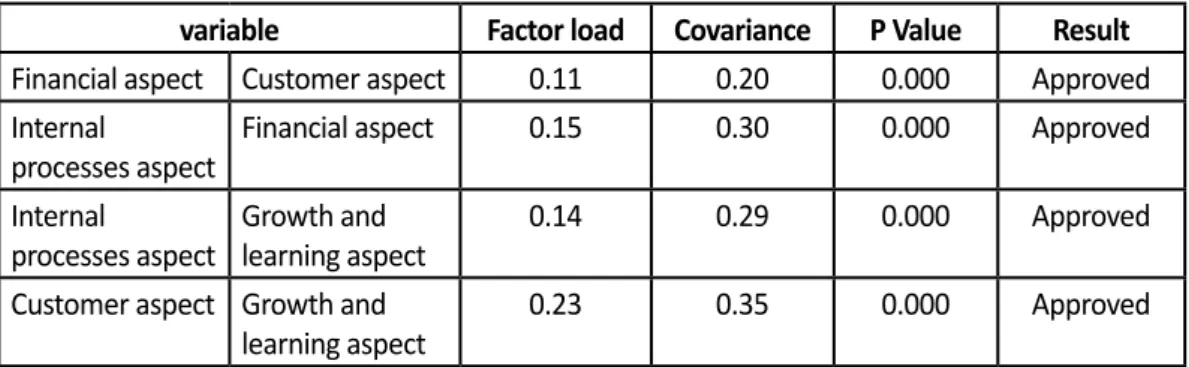
Table 6, testing the interconnectivity of components of BSC
variable Factor load Covariance P Value Result
Financial aspect Customer aspect 0.11 0.20 0.000 Approved
Internal
processes aspect Financial aspect 0.15 0.30 0.000 Approved
Internal
processes aspect Growth and learning aspect 0.14 0.29 0.000 Approved
Customer aspect Growth and
learning aspect 0.23 0.35 0.000 Approved
Table 5 shows the significance coefficients of the effects of dependent and independent variables of the structural model of the study. For the entire questions, the factor load is calculated above 0.3 and this shows the significance of questions and variables. In addition the T value significance coefficients of research variables are all above 1.96. In more specific words, the effect of the component of customer on the goals has a path coefficient of 3.06 while for the effects of customer on goals, the effects of growth and development on goals and the effects of internal processes on goals respectively have the path coefficients of 3.61, 3.32 and, 3.14. Therefore it can be inferred that the variables have statistically significant effects in each other. Nevertheless, the P value obtained by the structural equations test shows the significance and effectiveness of implementation of BSC on the realization of goals in the corporation of Shouder Faucets.
Table 6 shows the covariance value of the relationship between the dependent and independent variables of the structural model of the study. The factor loads of the entire questions are above 0.3 and this shows that the questions in each component are totally significant. In addition this positive and statistically significant value of covariance is a sign of an effective and robust relationship between the components of BSC. This shows that the former components are required as a set for the successful implementation of strategies in every organization.
Table 7, fitness indices of the structural model of the study
Model fitness indices Values Acceptable range Result
Relative Chi-Do 2.65 <3 Very good
RMSEA 0.071 <0.08 Very good
PGFI 0.61 <0.05 Very good
AGFI 0.87 >0.08 Very good
GFI 0.85 >0.08 Very good
NFI 0.94 >0.09 Good
NNFI 0.95 >0.09 Very good
IFI 0.92 >0.09 Good
CFI 0.96 >0.09 Very good
Chi-do per freedom degree is aimed at evaluation of the total fitness of the model. In terms of this statistic the hypothesis 0 maintains that the model is fully fit with the data of the population. When the Chi-Do value is statistically significant, this assumption is rejected showing that the model of interest is not a complete fitness. In order to reject the hypothesis 0, the relative Chi-Do is used too. If the value of this criterion was smaller than 3, the hypothesis 0 would be accepted. Since the relative Chi-Do calculated for the constructs of BSC and goals is equal to 0.00, therefore the hypothesis 0 is accepted and it is claimed that the model is perfectly fit.
The indices of GFI and AGFI are also other known fit indices and their values must be above 0.8 so that the model is considered as fit. Among other indices, it can be referred to NFI, NNFI, IFI and, CFI. The more the values of these criterions exceed from 0.9, the better the model fits the data. The calculated values how that the model of the study is well fitted to the data.
Conclusion and Suggestions
Nowadays knowledge management is considered as one of the most up to date and key issues in the field of management. In fact knowledge management is considered as a reaction against the increasing changes of the surrounding environments of the current organizations. Changing the functions of management is inevitable and all kinds of organizations must conform themselves with the changes and need to put strategic knowledge management into use in their surrounding competitive environment in order to be able to survive. Sine knowledge and its processes are in a tight entanglement with the operations, structures, cultures and goals of corporations, an efficient knowledge management strategy requires people who have a deep understanding of the territory of knowledge and about how to put it to use in their rather large organizations. Nevertheless, the employees must go beyond their roles and move towards the formation and management of knowledge management. The new business conditions have turned knowledge into the utmost strategic corporate resource and therefore, companies’ emphasis of knowledge management is taken into accounts more than before. Since the comprehensive system of knowledge management must be in service of corporate strategic goals and must result in the optimization of missionary performance of the organization, the strategic management of knowledge has been taken into account as an undeniable issue. Therefore a great deal of scientific attention has been paid to the development of a model that proposes a comprehensive framework for the strategic management of knowledge.
References
[1] Esmaeilzadeh, Ali; Karsmoodi Zahra; “Knowledge Application in Improving Business Activities and Identifying Opportunities”; National Conference on Entrepreneurship and Knowledge Management; Nov. 2012.
[2] Tuliyai, Ruhollah; “The Necessities and Functions of Knowledge Management in Cultural Companies”; Academic Manuals; 2009;
[3] O.Dincer, (2004), “strategy management and organization Policy”, Beta Publication Istanbul. [4] S.F.Lee, Andrew Sai On Ko, (2000),” Implementing the strategic formulation framework for the banking industry of Hong Kong”, Managerial Auditing Journal, 469-477.
[5] J. Kangas, M. Kurtila, M. Kajanus, A. Kangas, (2003), “Evaluating the management strategies of a forestland estate-the S-O-S approach”, Journal of Environmental Management, 349–358.
[6] Robert S.Kaplan and David P.Norton, (2004),” The Balanced Scorecard: Translating Strategy into Action.Boston”, Harvard Business School Press.
[7] Saaty T.L., Takizawa, (1986), “Dependence and Independence: From Linear Hierarchy to Nonlinear Networks”, European Journal of Operational Research, Vol. 26, No. 3, pp. 105-118.
Recebido em 8 de fevereiro de 2019. Aceito em 22 de fevereiro de 2019.