WHY HAVE A FRONTISPIECE?
EXAMPLES FROM THE MICHALOWICZ COLLECTION AT AMERICAN UNIVERSITY Florence D. Fasanelli
American Association for the Advancement of Science V. Frederick Rickey
United States Military Academy
Aristippus philosophus Socraticus, naufragio cum eiectus ad Rhodiensium litus animadvertisset geometrica schemata descripta, exclamavisse ad comites ita dicitur: ‘Bene speremus! Hominum enim vestigia video.’1
Introduction
When Henry Savile, who was noted for his mathematical breadth and knowledge of ancient texts, initiated a series of lectures at Oxford on the Almagest of Ptolemy on October 10, 1570, he began with these words of the Roman architect Vitruvius:
Aristippus, a Socratic philosopher, having been cast by shipwreck on the Rhodian shore, and having noticed the drawing of a geometrical design, is said to have exclaimed to hiscompanions: Be of good hope, for I see the footprints of men.2 Savile began his lecture with this quotation so that his students, who were as turned off to mathematics as ours are today, would see that mathematics is important to the education of a humanist, for mathematics is part of our civilized nature.
He began with what his students were most comfortable with, an exposition of the history of astronomy, crammed with investigations that were more truly philological than scientific, such as the dating of ancient figures and the authenticity of their works, and only then introduced them to the technicalities of the subject. [12, p. 54]
1 Marcus Vitruvius Pollio (fl. first century B.C.E.), De architectura, Liber VI, Praefatio, paragraph 1. Available online at http://www.intratext.com/IXT/LAT0188/p1D.HTM.
2
The translation is from the frontispiece of J. F. Scott, A History of Mathematics (1969). The first page of Savile’s manuscript is reproduced in [12, p. 53].
Especial n 1 – Festschrift Ubiratan D’Ambrosio – (dezembro/2007)
Publicação Oficial da Sociedade Brasileira de História da Matemática
o
This historical approach to learning is one that our dear friend Ubi D’Ambrosio has long advocated and so we wish here to reflect on this passage of Vitruvius, one of his favorite authors, by commenting on illustrations of this passage, especially the diagrams in the sand — of which we have identified eight3— and to discuss its enduring appeal.
It is not unusual for a frontispiece to be reused in several works. Everyone interested in the history of mathematics is familiar with the frontispiece on the first English Euclid, the Billingsley Euclid (1570) with woodcuts of Ptolemy, Marinus, Aratus, Strabo, Hipparcus, and Polibus. But what are these geographers doing on the frontispiece of a mathematics book? The answer is that this frontispiece was not created for the Billingsley work, but first appeared in the Cosmographical Glasse (1559) of William Cunningham [4, p. 6], a work for which it was much more appropriate. It was designed for the publisher, John Day[e], possibly by the woodcut artist John Bettes (for it is signed I.B.) and was used at least a dozen times [14].
Another instance is the reuse of a printer’s device in the Belgian school of mathematics in the seventeenth-century. This vignette shows a hen sitting on some eggs with the inscription “Noctu incubando diuque.” Just as eggs are incubated by hens sitting on them day and night, ideas are hatched by thinking of them continually (a sentiment that Newton expressed later). This became an emblem for the Belgian Jesuits. The image is by Peter Paul Rubens (1577–1640) [11] and was engraved by Cornelius Galle the Elder. It appears in the Opus geometricum of Gregorius Saint Vincent, p. [525], in some of Tacquet’s books, and in a polemical work of de Sarasa defending Saint Vincent. All of these individuals will reappear below [11, p. 204].
Why are these frontispieces and printer’s devices reused from work to work? The best explanation is that they were appropriate to the new edition. Remmert [16] has tentatively suggested, and Barrow-Green [4, p. 6] has accepted, that cost was an issue.4 Now it is certainly cheaper to reuse a woodcut or engraving rather than create a new one, but what about title pages, where part of the image must be changed? Rather than produce an entirely new title page, it is certainly cheaper to cut out the title in the cartouche of, say, Day[e]’s frontispiece, and replace it in the press with a properly-sized new woodcut for the new title. But copper engravings are a different issue. One can scrape off the portion to be changed, but before the plate is re-engraved the artist must push up on the back of the plate with careful calibration so that the the top surface is at a uniform level. One might argue that this is cheaper, but it was done to only two of our frontispieces. The copper plate from the Gregory Euclid (Fig. 4) has been scraped and calibrated to accommodate the geometric diagrams appropriate to Apollonius (Fig. 5) and Archimedes (Fig. 8).
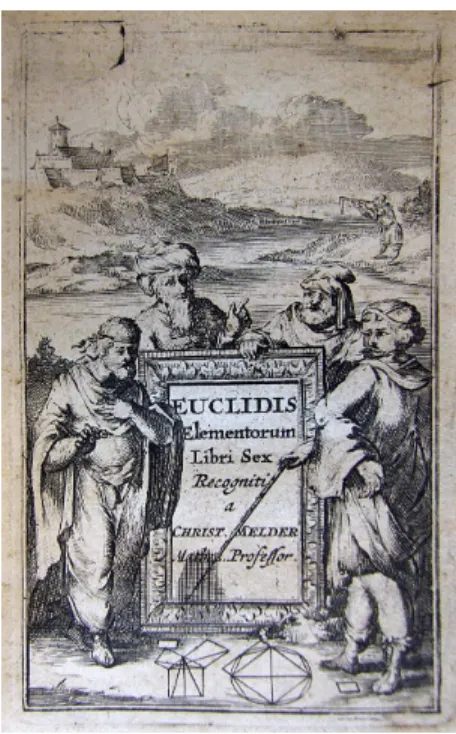
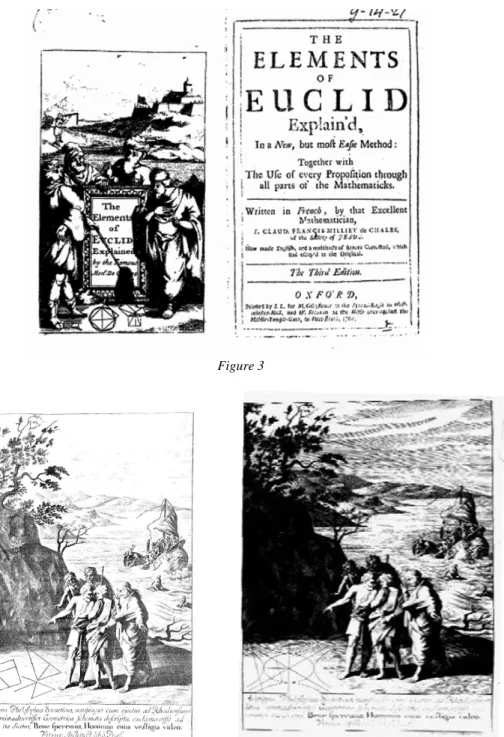
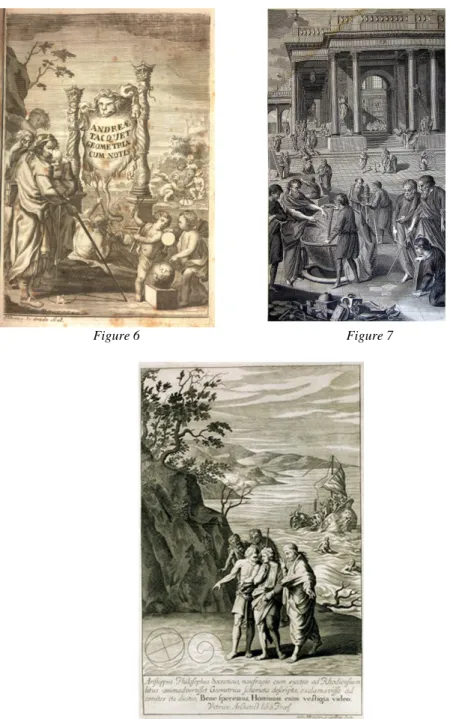
The frontispieces we discuss here fall into two related groups. The Saint Vincent, Melder, Hallifax, Whiston and Rees (Figures 1, 2, 3, 6, 7) focus on a group of three or four men studying diagrams in the sand that one of them has drawn. In the others, Gregory, Halley,
3They are listed at the end of the paper.
4
Note added in proof: When we sent copies of an earlier version of this paper to several colleagues, Volkert Remmert sent a paper that presents his nuanced view of why frontispieces are reused. See “ ‘Docet parva picture, quod multae scripturae non dicunt.’ Frontispieces, their functions, and their audiences in seventeenth-century mathematical science,” pp. 241–270 in Transmitting Knowledge: Words, Images, and Instruments in Early
and Torelli (Figures 4, 5, 8), the five shipwrecked men have come across diagrams that have already been drawn. In each of these frontispieces one of the men is holding a staff. In the Saint Vincent group, the man has drawn the diagrams with his staff; in the Gregory group, one of the men in the back is leaning on his walking staff while the man in the left front is exclaiming — with outstretched hands — that the diagrams exist. In both cases the opening quotation from Vitruvius is apt. Mathematics is a hallmark of civilized peoples. As to the purposes of the frontispiece there seems to be some agreement:
Since the seventeenth century, the standard relation of frontispiece to text had been like that of façade to building interior: one contemplated the frontispiece before entering the text. Indeed, the French word ‘frontispice’ is etymologically related to ‘façade’. As an architectural term,‘frontispice’ denotes the main façade of a monumental building, while in typography the term indicates either the large title page of a book, or an illustrated plate placed before or facing the title page. The frontispiece prepares readers for what they will find in the chapers arrayed behind it. [17, p. 159]
1. Gregorius Saint Vincent, 1647
The most elaborate frontispiece discussed here is that of the Opus geometricum (1647) of Gregorius Saint Vincent (1584–1667). He was born in Belgium, studied theology, philosophy, and mathematics in Rome with Christoph Clavius (1537–1612), and was ordained a Jesuit priest in 1613. After Galileo announced his telescopic discoveries of the moons of Jupiter in his Siderius nuncius (1610), and after Saint Vincent being present when Galileo explained them at the Collegio Romano [11, p. 202], Saint Vincent hinted that he supported the heliocentric system. This made him suspect to his Catholic superiors, and so he was forced to teach Greek and mathematics in various seminaries around Europe [10][20].
His famous work, the Opus geometricum quadraturae circuli et sectionum coni (Geometrical work on the quadrature of the circle and the conic sections) was written in the 1620s, but the Jesuits refused to let him publish it then; they were not convinced that he had solved the quadrature problem. He was forced to leave the manuscript behind when he fled Prague in 1631 just ahead of the warring Swedes. He did not see it again until 1641. Finally, with the help of several of his students, including Alphonse Antonio de Sarasa (1618–1667), it was published in 1647.
The volume is huge — containing more than 1250 large pages. It contains the first presentation of the summation of infinite geometric series, a method of trisecting angles using infinite series, and a result which is most important to us today, viz., the surprising connection between the natural logarithm and the rectangular hyperbola.
Not surprisingly, its first readers concentrated on the subtitle of the book, quadraturae circuli. Saint Vincent considered the quadrature of the circle his most important result. Unfortunately, this result was incorrect, as Huygens first pointed out in 1651. Although this error destroyed his reputation, the work contains much of value which influenced the thinking of Leibniz, Wallace, and Wren.
o
The frontispiece (Fig. 1) of the Opus geometricum is one of the more magnificent allegories in all of mathematical publishing. In the foreground, Archimedes, who was killed by a Roman soldier in 212 B.C. during the sack of Syracuse, is drawing the diagram for the first proposition of his Measurement of a Circle: “The area of any circle is equal to a right-angled triangle in which one of the sides about the right angle is equal to the radius, and the other to the circumference, of the circle,” which provides us with a formula for the area of a circle. Cowering attentively behind him is Euclid, looking on in awe. The character anachronistically wearing eye glasses may well be Aristippus (even though they were not contemporaries). Wading in the estuary is Neptune, whose banner carries the slogan “Plus ultra” which tells the viewer that there is more beyond this ancient geometry, yet the ancients are prevented from getting there by the Pillars of Hercules. But Saint Vincent has discovered this new land of mathematics — at least, his frontispiece claims so. In the background the sunbeam paraphrases the words of Horace, “Mutat quadrata rotundis” (the square is changed into a circle), which are illustrated by the putto holding the square frame which focuses the sunbeam into a circle on the ground5.Note that the putti are tracing it out with a compass, and that the circle is correctly drawn in perspective as an ellipse; a lovely illustration of squaring the circle6.
The delay in publishing the Opus geometricum robbed Saint Vincent of the stature he deserved in the development of the calculus, and it is understandable that he harbored some resentment. But, as a Jesuit, he had to be careful about how he expressed it. Here is Dhombre’s view of the matter:
Because of this painful situation, some images used by the school of mathematicians that we have examined turned from being a frame of reference to a frame of connivance. Is it possible for the reader of the frontispiece to Opus geometricum not to connect the paradoxical quadrature of the circle to the strong and strange assertion written on the globe: “Volvitur non decidi” (We will not teach the Earth’s movement)! But it contradicts the inscription at the bottom mobile, while on a cube is written: “Fit fixum.” If one tries to argue, the image can be explained, as there are some hidden signs on the globe, stars in fact, which prove by some alignment that it is not the Earth that is represented, but the celestial globe. What reality did such images provide? A reality of contradiction, and this is why we may use the word baroque. A baroque mentality was even within the meaning of mathematics and its teaching in a Jesuit college. As a sign of connivance the man to the left in the frontispiece uses spectacles to focus on the purely geometrical, Archimedian drawing on the floor. [11, p. 205-206]
5This line appears in the work of the Roman lyric poet and satirist, Quintus Horatius Flaccus (65–8 BCE): Horatii Flacci epistularum liber primus, line 100.
6The interpretation of this engraving is primarily ours. The only description of this frontispiece that we are aware of is by Florian Cajori [7], except for that quoted by Dhombres immediately below. Note added in proof: Remmert reports that there is an excellent discussion of the Saint Vincent frontispiece by William B. Ashworth, “The Habsburg Circle,” 137–167 in: Patronage and Institutions. Science, Technology, and Medicine at the European
Court 1500-1700, Rochester: Woodbridge, 1991, edited by Bruce T. Moran. Remmert also sent “Die Quadratur
des Kreises ins Bild gesetz: Das Frontispiz des Opus geometricum des Gregorie de St. Vincent,” that will be published later this year in the Mathematische Semesterberichte – a journal for mathematics instructors in high schools and universities. We thank Professor Remmert for these references.
There is no doubt that this frontispiece was designed to be a summary of the results in the Opus geometricum that Gregorious felt were most significant.
The frontispiece and vignette on the title page are drawn (‘delin.’) by Abraham Jansz. van Diepenbeeck (1596–1675) and engraved (‘sculpsit’) by Cornelius Galle the Younger (1615–1687). Diepenbeeck was the son of a glass painter and he learned the trade from him. Realizing the fragility of glass, he joined the studio of Rubens and became his pupil and friend, reproducing several of his works on copper. Diepenbeeck was a supporter and later a member of the Jesuits; this explains why he was asked to do this frontispiece. His work eventually took on a mystical, superstitious character, which reflected his own beliefs, but that is after this frontispiece was produced [18]. Galle was born and died in Antwerp. Both his father and son were engravers, also named Cornelius. Hewas accepted into the Guild of St. Luke in Antwerp in 1638.
2. Christiani Melder, 1673
At first glance the frontispiece to Melder’s Euclid (Fig. 2) seems to have nothing to do with that of the Opus geometricum, but there is one unmistakable clue that it is related. The man on the left is holding his spectacles in his left hand; in the Saint Vincent, the man on the left is wearing his. The man on the right who has drawn the diagrams with his staff is resting his left hand in a very awkward way (no wonder he looks angry). It is curious too that he is the youngest in the group. Could this be Melder himself, showing his erudition to the elder sages? Other links between Figures 1 and 2 are the geometric diagrams and the water in the background. The hunched over man in the background appears to be using a type of Jacob’s staff to measure the height of the castle across the water. This is out of place on this frontispiece as there is no trigonometry in the book (but, perhaps, it is a reference to similar triangles).
The diagram at the left is, of course, that for the Pythagorean Theorem, Euclid I.47. That on the right is for Euclid XII.2: Circles are to one another as the squares on their diameters, a proposition which led to our formula for the area of a circle. But what about the two small rectangles? They are puzzling because we are not so familiar with the proof of Euclid XII.2. Euclid proves this by a double reductio ad absurdum argument and thus needs to refer to the area of the inscribed (and later circumscribed) polygon. The rectangles fill this role. This frontispiece is a brief summary of what is to be found in Euclid. The Pythagorean Theorem and the area of circles are two important results in the Elements. The frontispiece not only serves as prolog to the contents, but also serves as a reminder of the contents to any reader who picks the book up again after many years.
3. William Hallifax, 1696, 1700
Two English editions of Euclid were published in 1685. Both are translations of the French edition of Claude-François Milliet Dechales (1621–1678), Huict livres des Eléments d’Euclide rendus plus faciles. The one that interests us is by William Hallifax (1655– 1721/2) an Oxford graduate and Church of England clergyman [4, p. 9]. From 1688 to 1695 Hallifax served as chaplain of the Levant Company in Aleppo and, in 1695, published Palmyrene inscriptions in the Royal Society Transactions; this was the first dead language
o
to be deciphered. While in Aleppo he was commissioned to purchase manuscripts in oriental languages, but he was not very successful at this [19].
His first English edition (1685) does not contain a frontispiece. But the second edition of The Elements of Euclid Explain’d (1696) and the third in 1700 have identical frontispieces (Fig. 3)7. Clearly this is the same image as in the Melder (Fig 2), but the image has been reversed by the engraver. Does this indicate a less skilled engraver since he did not sign the piece? The castle has beenchanged somewhat and the measurer is standing in a more natural position.
No additional information is known about the works of Melder and Hallifax, so further research is warranted.
4. David Gregory, 1703
The frontispiece of Gregory’s Euclid tells the story from Vitruvius (Fig. 4). We see the ship aground with water washing over its deck with its torn sails and broken sheets flapping in the wind. The sailors still aboard are in distress; two are in the water; and five have managed to get ashore (how they remained dry is a mystery). They see three diagrams drawn in the sand, diagrams that every good student of Euclid would recognize.8 Aristippus, who is pointing to the diagrams with both hands, is saying to his companions: Bene speremus, Hominum enim vestigio video.
More important than the Vitruvian story, this frontispiece tells us about the book at hand. The Elements is something that civilized people need to know. Geometry is a human creation, one to be respected and encouraged. This is what we can tell our students when we show them thisimage.
The Gregory (1661–1708) edition of Euclid (it is known that five hundred copies were printed) was reviewed in 1705 in the Philosophical Transactions of the Royal Society of London soon after it appeared. Sadly, there is no comment about the frontispiece in the review — this could show how common elaborate frontispieces were and how well they were understood or that the reviewer did not see fit to make reference to the frontispiece. We do learn that “The University of Oxford intending to publish all the Greek Mathematicians, have begun with Euclid as the standard Writer of the Elements of Geometry and Arithmetic.”9 That this work is the first of a series explains why the Apollonius (1710) and Archimedes (1792) contain similar frontispieces (compare Fig. 4, 5,
7The sixth English edition (1720) has no frontispiece. We have not seen other editions.
8 J. L. Heilbron, in his Geometry Civilized: History, Culture and Technique, Oxford University Press, 1998 has identified the diagrams; from left to right they are Euclid II.11, I.32, and I.20, respectively. Proposition II.11 states: To cut a given straight line so that the rectangle contained by the whole and one of its segments is equal to the square on the remaining segment. Euclid I.31 is: In any triangle, if one of the sides be produced, the exterior angle is equal to two interior and opposite angles, and the three interior angles of the triangle are equal to two right angles. Euclid I.20 is: In any triangle two sides taken together in any manner are greater than the remaining one. Artistic license allows the diagrams to be drawn with differnet orientations than in our standard edition of Heath. 9 It is interesting that the reviewer knows this, for in 1672, John Fell, who managed the press, drew up a publishing program that included “The ancient Mathematicians Greek & latin [sic] in one and twenty Volumes; part not yet Extant, the rest collated with MS. perfected from the Arabick versions, where the originals are lost, with their Scholia & comments; & and illustrated with annotations.” [19, pp. 231-232]
8). Gregory’s preface to the work enumerates the contents and “also his opinion whether it be truly Euclid’s or not, with his Reasons.” After mentioning Euclid’s Opticks and Catoptricks the reviewer remarks:
To these are added the Notes of the Noble and Learned Sir Henry Savirl [sic], Founder of the two Mathematical Chairs in the University of Oxford, which he wrote in the Margin of his own Book, and which shew that he was as great a Master in Mathematicks as he was a Patron of them. [3]
The “two Mathematical Chairs” are, of course, the Savilian Chair of Geometry and the Savilian Chair of Astronomy, both founded by Henry Savile in 1619, the same Savile who introduced the Vitruvius story to the Oxford mathematical community in 1570. The title page of this Euclid indicates that David Gregory (1659-1708) held the chair in astronomy (from 1691 until his deathin 1708).
Below the frame of the Gregory frontispiece are the words “delin. MBurghers sculpt. Univ. Oxon.” On the engraving the ‘MB’ is a ligature. Michael Burghers (1640–1723) was an engraver and draftsman from Holland, who came to England and settled in Oxford in 1673. He worked under David Loggan and succeeded him as Engraver to the University.
He worked almost wholly with the graver, in a stiff, tasteless style. He has the merit, however, of having preserved to us many remains of antiquity which would otherwise have been lost. He engraved the plates for the Almanacs of the University, the first of which, by him, was in the year 1676. His most esteemed prints are his antiquities, ruins of abbeys, and other curiosities. He engraved also several portraits and plates for the classics. [5]
The Oxford Almanacks are large single sheets. The first was published in 1674, there was none in 1675, and then the series continues for three centuries; all contain lovely images related to Oxford. Burghers engraved his first Almanack in 1676 and he continued to engrave most of them for the next 43 years. Only the 1755 almanac resembles our frontispieces: Five allegorical figures standing in the courtyard of Christ Church College are examining geometrical diagrams on the sand. It appears to be an Archimedian diagram [15].
Among the portraits engraved by Burghers is one of John Wallis (1616–1703). In Wallis’s three volume Opera mathematica, the first volume has as frontispiece a portrait of Wallis by David Loggan [1, figure 7], Burghers predecessor as engraver for the university press, and the third has one by Burghers [1, figure 6]. Wallis looks so different in the two images that it is hard to believe that it is the same man.
5. Edmund Halley, 1710
The 1710 edition of Apollonius was translated and edited by Wallis’s successor in the Savilian Chair of Geometry, Edmund Halley, who served from 1704 until his death in 1742. When Halley became Savilian Professor, he published this work to establish his credentials as a classicist [8]. Apollonius wrote his Conics in eight books about 200 B.C.E. Books I-IV are a systematic treatise on the conic sections and were extant in Greek. Books V-VII were
o
only available in Arabic. Halley learned Arabic and then translated these seven books into Latin and published them.
Apart from the fact that his edition did not include the Arabic text, Halley was such a good mathematican that he frequently altered the text as edited by
a s u M u
Ban towhat he realized Apollonius must have written. [6]
Halley also published his reconstruction of the lost book VIII. This work became the standard edition for two centuries.
The history of the publication of Apollonius is quite complicated. Although Hallifax had looked for a manuscript of Apollonius, he was unsuccessful. John Pell (1611–1685), while in Holland, prepared a (now lost) translation from the Arabic in the 1640s but it was not published. Eventuallythe manuscript he used came to Oxford, and it is what Halley used [19].
The copper plate for the frontispiece of the Gregory Euclid was carefully reworked by Burghers with a new diagram. It pictures an ellipse and a pair of conjugate hyperbolas but has not been be identified with any specific proposition in Apollonius (Fig. 5).
6. William Whiston, 1744
Andreas Tacquet (1612–1660) studied mathematics with Saint Vincent and later became his secretary. Thus it is not surprising that the frontispiece of Tacquet’s Latin edition of Euclid’s Geometria (Fig. 6) resembles that of the Opus geometricum (1647). But the differences are substantial and significant. The sun, the eagle, the coat of arms, the putto holding the square frame, and the quotation from Horace have disappeared. None of them fit the Euclidean subject matter. Of mathematical interest the perspective of the circle has diminished, being more circular, and the point of the compass is nowhere near the center. The putti in the foreground are no longer holding medallions, but one is holding a pair of compasses and a T-square; items which fit within the nature of the book. The sphere has lost its stars and is decorated like a globe (geometry is terrestrial measurement) and the phrase ‘Fit fixit’ has disappeared from the cube.
Whiston’s Elements “became an 18th-century lightning rod” [13, p. 37] for criticism because he used algebra in explaining and justifying the propositions and thus moved away from the purely geometric tradition.
Another version of the Saint Vincent frontispiece appears in the second edition of the Opera mathematica (1707) of Tacquet, but we have not seen this work [11, p. 205]. 7. Abraham Rees, 1786
In Figure 7, the drawing is not in the sand, but on the pavement, yet the staff the mathematician uses to point at his drawing is the same as in Figures 1, 2, 3, and 6. The diagram is again that for the Pythagorean Theorem, but it is incorrectly drawn. This frontispiece comes from the 1786–88 edition Cyclopædia: or, an universal dictionary of arts and sciences.
There were numerous editions of this work. Ephriam Chambers (1680?–1740) was a prolific popularizer of science. He translated several works into English; they include Sebastian Le Clerc’s A Treatise of Architecture (1724), Jean Debreuil’s The Practice of
Perspective (1726), and Herman Boerhaave’s New Method of Chemistry (1727). Next he published the two volume work that became known as Chamber’s Cyclopædia in 1728. His English translation of the Histoire of the Académie des Sciences was published posthumously in 1742.
Since Chambers had translated Le Clerc’s Architecture it is not surprising that Le Clerc’s engraving L’Académie des sciences et des beaux-arts (1698) was used as the basis for the frontispiece for the Cyclopædia. It was carefully copied and somewhat amended by John Sturt to become a magnificent fold out frontispiece. Atop the building in the picture there are busts of Pythagoras, Descartes and Newton; at the bottom there are clumps of coins bearing the names of Euclid, Archimedes, Diophantus, and Leibniz.
Abraham Rees (1743–1825) revised the Cyclopædia of Chambers, adding hundreds of new entries, and published it in four volumes in 1783–1786. The Chambers/Rees volume no longer has the elaborate frontispiece; Figure 7. The new frontispiece has been drawnby Dodd and engraved by J. Cook (who also did a portrait of Benjamin Franklin).
One further detail of this frontispiece that must be mentioned is the magic lantern in the foreground, a device which was invented by Johann Lieberkühn in 1738/9. “The Swiss mathematician, Leonhard Euler (1707–83) . . . concerned himself with the magic lantern and camera obscura technologies, making improvements to both late in the century.”10
8. Giovanni Torelli, 1792
Although almost unknown today, Giuseppe Torelli (1721–1784), in his day, was an outstanding mathematician from Verona. He criticized Leibniz’s concept of differential, siding with Nieuwentijt [9]. In 1792 Torelli published an edition of Archimedes in both Greek and Latin that was very important and typographically splendid.
In Figure 8, the diagram at the left is for Proposition IV in On Conoids and Spheroids: The area of any ellipse is to that of the auxiliary (circumscribing) circle as the minor axis to the major. The diagram on the right is a Spiral of Archimedes, but it does not appear to correspond to any specificproposition in his On Spirals.
At the bottom of this frontispiece we can see the name of M. Burghers. Since he died in 1723, it must be the case that the frontispiece of Halley’s edition of Apollonius has been reworked by another engraver. This is the only example of a frontispiece which we have which has been reworked two times.
Conclusion
Each of the frontispieces described here played an important role in the design of the mathematics texts that accompanied them by portraying images of the works that followed. They continue to play a role in our understanding of the text. These frontispieces were intended to exhibit the philosophy of the author or editor. Today they help us to understand the culture of the period in which they were published. Some have fanciful images drawn by artists and then copied by engravers. Some of the images came from artists of greater
o
fame than those making the drawings for the text. Tracing the common iconography of these images helps place the writing in the book within its geographical location and its time in history and hence increases our understanding of the historyof mathematics and the history of art. Sadly, we lack information about what input the authors had in the creation of these images.
These eight frontispieces are in texts dating from 1647 to 1792, but from only five locations: Antwerp (Fig. 1), Amsterdam (Fig. 2), Oxford (Figs. 3–5, 8), London (Fig. 7) and Naples (Fig. 6). Questions arise as to how and why the images were passed from artist to artist over 145 years and in each case what was the inspiration to use these particular images for these particular books. In some cases the connections are clear. We bring together these images here as we seek explanations over time and culture.
There is little doubt that the Saint Vincent frontispiece (Fig. 1) was designed for that work. Because Saint Vincent and Tacquet were both Jesuits, we believe the image was used by Whiston to honor Saint Vincent (Fig. 6).
The three images in the David Gregory group are more tightly related (Figs. 4, 5, 8).11 All are published by Oxford University Press and were part of a series of classical mathematicians. Clearly the centuries-long impact of Henry Savile’s use of the Vitruvius story as a motivational device was still felt when thesefrontispieces were designed. Thus, although the two groups of images have similar features, they are distinctly different in what they portray and how they portray it. It is not so much that the image has been reused, but that the iconography has.
We want to acknowledge the fine assistance of Susan McElrath, Team Leader for University Archives and Special Collections at the American University Library without whom we would not have had access to three of the books whose frontispieces are published here (Figs. 2, 6, 7; images courtesy of University Archives and Special Collections, American University Library). We would also like to thank Elaine McConnell for access to the Saint Vincent and Gregory (Figs. 1, 4); we thank her, Ed Dacey and Laura Mosher, all librarians at the United States Military Academy, for helpful conversations. Two databases, Early English Books Online and Eighteenth Century Books, have been invaluable in our (frustrating) search for additional title pages fitting our theme. We anticipate that more related frontispieces will be found. Finally we would like to thank historians June Barrow-Green and Volker Remmert for their helpful comments on an earlier draft of this paper.
Dedication
This paper was written in honor of Ubi d’Ambrosio as a celebration of his life and work in mathematics and accomplishments in broadening the understanding of everyone he meets. We thank Ubi for his longstanding interest in the pedagogical use of history of mathematics and his fondness for Vitruvius. Our choice of these particular images was inspired by a resource which first became available to the public in the spring of 2007 when Michael
11
We would like to thank Delinda S. Buie, Curator of Rare Books at the University of Louisville library for comparing the Euclid (Fig. 4) and Apollonius (Fig. 8) and verifying that the plate was reworked; only the diagrams have been redrawn.
Michalowicz donated his late mother’s collection of 600 old mathematics books to the American University Library in Washington, DC12.Karen Michalowicz(1942–2006) shared with Ubi a passionate love of the history of mathematics and its use in teaching.
The Illustrations
Figure 1 Figure 2
12 Due to the efforts of Artemas Martin (1835–1918), American University already had a strong collection of textbooks and other rare mathematics works [2].
o Figure 3
Figure 6 Figure 7
o Figures
1. P. Gregorii a Sto Vincentio opus geometricum quadraturae circuli et sectionum coni decem libris comprehensum, Antverpiae: Apud Ioannem et Iocabum Mevrsios, 1647. 2. Evclidis elementorvm sex priores libri recogniti opera Christiani Melder, Ludg. Batav. Amst.: Apud Danielem, Abrahamum & Adrianum `a Gaesbeeck, 1673. In Michalowicz collection.
3. The elements of Euclid explain’d, in a new, but most easie method: together with the use of every proposition through all parts of the mathematicks, translated and edited by William Hallifax, second edition, Oxford University Press, 1696. [The third edition, 1700, has the same frontispiece.]
4. Eukleidou ta sozomena. Euclidis quae supersunt omnia. Ex recensione Davidis Gregorii. David Gregory’s Latin edition of The Elements of Euclid, Oxford University Press, 1703.
5. Apollonii Pergæi Conicorum libri octo, et Sereni Antissensis De sectione cylindri & coni libri duo, Oxoniæ: e Theatro Sheldoniano, an. Dom, 1710.
6. Elementa Euclidea geometriæ, planæac solidæ; et selecta ex Archimede theoremata, quibus accedit trigonometria, auctore Andrea Tacquet, Soc. Jesu Sacerdote, & Matheseos Professore. Cum notis, et additamentis Gulielmi Whiston. A.M. matheseos Professoris Lucasiani. Postrema Editio. Cui in aliena manu juventutis accessit ab aliena manu brevis de sectionibus conicis tractatus. Neapoli: Benedicti Gessari, 1744. In Michalowicz collection.
7. Cyclopædia: or, an universal dictionary of arts and sciences. . . . By E. Chambers, F.R.S. With the supplement and modern improvements, incorporated in one alphabet. By Abraham Rees, . . . In four volumes. . . London: printed for J. F. and C. Rivington, A. Hamilton, T. Payne and Son, W. Owen, B. White and Son [and 24 others in London], 1786-88. Volume 1 only is in the Michalowicz collection.
8. Archimedous ta sozomena meta ton Eutokiou Askalonitou hypomnematon. Archimedis quæ supersunt omnia cum Eutocii Ascalonitae commentariis. Ex recensione Josephi Torelli, Veronensis, cum nova versione latina. Accedunt lectiones variantes ex codd. mediceo et parisien sibus. Oxford University Press, 1792.
References
[1] Albree, Joe; Arney, David C. and Rickey, V. Frederick, A station favorable to the pursuits of science: primary materials in the history of mathematics at the United States Military Academy, Providence, R.I.: American Mathematical Society; London: London MathematicalSociety, 2000.
[2] Allaire, P. R. and Cupillari, A., “Artemas Martin: an amateur mathematician of the nineteenth century and his contribution to mathematics,” The College Mathematics Journal, 31 (1) (2000), 22–34.
[3] Anonymous, “An account of a book, viz. Euclidis quæ supersunt omnia . . . ,” Philosophical Transactions of the Royal Society of London, vol. 24 (1704–1705), pp. 1558– 1560.
[4] Barrow-Green, June, “ ‘Much necessary for all sortes of men’: 450 years of Euclid’s Elements in English,” BSHM Bulletin, 21 (1), 2006, 2–25.
[5] Bryan, Michael (1757-1821), Bryan’s dictionary of painters and engravers. New ed., rev. and enl. under the supervision of George C. Williamson. London, G. Bell, 1903–1905. See vol. 1,p. 216.
[6] Bulmer-Thomas, Ivor, “Apollonius from the Arabic,” The Classical Review, n.s., vol. 41, no. 2, pp. 313–314, 1991.
[7] Cajori, Florian, “A curious mathematical title-page,” The Scientific Monthly, 14 (1922), 293–295.
[8] Chapman, Allan, “Edmund Halley’s Use of Historical Evidence in the Advancement of Science,” Notes and Records of the Royal Society of London, Vol. 48, No. 2. (July, 1994), pp. 167–191.
[9] Cicenia, Salvatore, “The mathematical writings of Giuseppe Torelli” [in Italian], Physis, 35(1998), 85–124. Reviewed by Umberto Bottazzini, MR 2001c:01015.
[10] Dhombres, Jean, “Is one proof enough? Travels with a mathematician of the Baroque period,” Educational Studies in Mathematics, vol. 24, no. 4, Aspects of Proof, pp. 401-419, 1993.
[11] Dhombres, Jean, “Shadows of a circle, or what is there to be seen? Some figurative discourses in the mathematical sciences during the seventeenth century,” pp. 176–211 in The Treatise on Perspective: Published and Unpublished, National Gallery of Art, Washington, D.C., edited byLyle Massey, 2003.
[12] Fauvel, John; Flood, R.; and Wilson, R., Oxford Figures: 800 Years of Oxford Mathematics, Oxford University Press, 2000.
[13] Goldstein, Joel A., “A matter of great magnitude: The conflict over arithmetication in 16th-, 17th-, and 18th-century English editions of Euclid’s Elements books I through VI (1561–1795),” Historia Mathematica, 27 (2000), 36–53.
o
Renaissance Computer. Knowlege Technology in the first Age of Print, edited by Neil Rhodes and Jonathan Sawday, London and New York: Routledge, 2000.
[15] Petter, Helen Mary, The Oxford Almanacks, Oxford: Clarendon Press, 1974.
[16] Remmert, Volker, Widmung, Welterklärung und Wissenschaftslegitimierung: Titelbilder und ihre Funktionen in der Wissenschaftlichen Revolution, Wiesbaden: Harrassowitz in Kommission, 2005.
[17] Sheriff, Mary, “Decorating knowledge: the ornamental book, the philosophical image and the naked truth,” Art History, vol. 28, no. 2, April 2005, 151–173.
[18] Steadman, David W., Abraham Van Diepenbeeck: seventeenth century Flemish painter, Studies in Baroque Art History; no. 5, Ann Arbor, Michigan: UMI Research Press, c1982.
[19] Toomer, G. J., Eastern wisedome and learning: The study of Arabic in seventeenth-century England, Oxford: Clarendon Press; New York: Oxford University Press, 1996. [20] Van Looy, Herman, “A chronology and historical analysis of the mathematical manuscripts of Gregorius a Sancto Vincentio (1584–1667),” Historia Mathematica, 11 (1984), 57–75.
Florence D. Fasanelli American Association for the Advancement of Science 1200 New York Avenue, NW Washington, DC 20005, USA E-mail: [email protected]
V. Frederick Rickey
Department of Mathematical Sciences United States Military Academy West Point, NY, 10996, USA E-mail: [email protected]