Simula on models for implementa on of lean
produc on concepts in earthmoving and paving
Levy Sarmento de Matos1, Bruno de Athayde Prata2, Ernesto Ferreira Nobre Júnior3, Francisco Heber Lacerda de Oliveira41Universidade Federal do Ceará, [email protected] 2Universidade Federal do Ceará, [email protected]
3Universidade Federal do Ceará, [email protected] 4Universidade Federal do Ceará, [email protected] Recebido:
18 de junho de 2016
Aceito para publicação:
12 de janeiro de 2018 Publicado: 30 de abril de 2018 Editor de área: Kamilla Vanconcelos ABSTRACT
Studies show that, despite the resistance of professionals to new modes of produc on, the applica on of Lean Construc on philosophy improves the opera ons produc vity, reducing costs and improving the quality of the final product. However, methodologies which evaluate the impacts of the implementa on of this philosophy to road
construc-on opera construc-ons are scarce. This study aims to verify the improvements that the applica-on of the Lean Capplica-onstruc applica-on Philosophy can bring to earthwork and paving opera applica-ons in a ma7er of execu on me and overall cost by developing a computa onal model and simula ng different applica on scenarios and checking their benefits through a compar-ison of ac vity dura ons and equipment costs. A;er model development and data anal-ysis, it was found that the models that incorporated the guidelines of the Lean philoso-phy got faster (up to 30% reduc on in run me) and cheaper (reduc on of up to 28% on cost) results in terms of use of equipment’s.
RESUMO
Estudos mostram que, apesar da resistência de profissionais a novos modos de produ-ção, a aplicação da filosofia Construção Enxuta melhora a produ vidade das operações, reduzindo custos e melhorando a qualidade do produto final. No entanto, metodologias que avaliam os impactos da implementação desta filosofia para a construção de estra-das são escassas. Este estudo tem como obje vo verificar as melhorias que a aplicação da Filosofia Construção Enxuta pode trazer para terraplenagem e operações de pavi-mentação em matéria de tempo de execução e custo total pelo desenvolvimento de um modelo computacional e simulação de diferentes cenários de aplicação e verificação de seus beneGcios através de uma comparação de duração de a vidades e custos de equi-pamentos. Após o desenvolvimento do modelo e análise dos dados, descobriu-se que os modelos que incorporavam as diretrizes da filosofia Enxuta ficaram mais rápidos (até 30% de redução na execução) e mais baratas (redução de até 28% nos custos), resulta-dos em termos de uso de equipamentos.
Keywords:
Lean construc on, Decision support systems, Earthmoving,
Paving.
Palavras-chaves:
Construção enxuta,
Sistema de suporte à decisão, Terraplenagem, Pavimentação. DOI:10.14295/transportes.v26i1.1405
1. INTRODUCTION
Earthmoving and paving services are related to the movement of thousands of tons of materials, using a great amount of heavy machines and requiring a special attention from construction companies and contractors. Therefore, the rationalization in the selection of equipment, as well as the leet sizing, are actions of great importance, enabling the reduction of the related costs and times. Modeling a system allows a better comprehension of the real process, enabling the planners to forecast their behavior and to determine interventions for the mitigation of failures and losses. The operation of heavy machines in earthmoving and paving services can be representedby Discrete Event Systems Theory, allowing some computational modeling like the simulation, for instance.
The Lean Construction philosophy is based on the study of the processes, aiming the mitiga-tion of the discontinuities and removing the activities which do not add value to the inal prod-uct. In some situations, the managers can propose a rebuilding of the productive processes, modifying completely the original process (Koskela, 1992). Heavy civil construction, such as earthmoving and paving services, is a prominent area for application of lean concepts. Regarding the discrete event simulation in earthmoving projects, several works have been reported in the literature. Several simulation approaches are presented by Jayawardane & Price (1994a, 1994b), Marzouk and Moselhi (2000), Marzouk (2002), Alkass et al. (2003), Yang et al. (2003), Bargstädt & Blickling (2005), Moselhi & Alshibani (2007), Prata et al. (2008), Zhang (2008) and Cheng et al. (2011). Concerning the application of simulation models for implement- ing lean concepts, some papers have been reported in the literature: Tommelein (1998), Al-Su-dairi et al. (1999), Halpin & Kueckmann (2002), Farrar et al. (2004), Hosseini et al. (2012) and Hosseini et al. (2014). Although the literature on earthmoving simulation is vast, the proposition of models for im-plementation of lean concepts in earthmoving and paving is very limited. Farrar et al. (2004) was the only study in the specialized literature to approach the implementation of Lean Construction philosophy in earthmoving and paving services. These authors do not consider the construction costs, only the activities durations. In addition, such authors consider a varia-ble productivity that is measured through the simulations. This paper aims at presenting discrete event simulation models for implementation of Lean Construction concepts in earthmoving and paving services, in an integrated model. Three simulation models were proposed: one without lean concepts and two applying lean concepts. The models consider the following activities: earthmoving, sub-base, base and asphalt surfacing. The proposed models in this paper consider: (i) a ixed productivity that is taken from a service cost elaboration; (ii) construction costs; and (iii) construction duration. Real data was gathered, enabling the validation of the proposed approaches as well as the comparison between the real system and the suggested operational policies.
2. PROBLEM DESCRIPTION
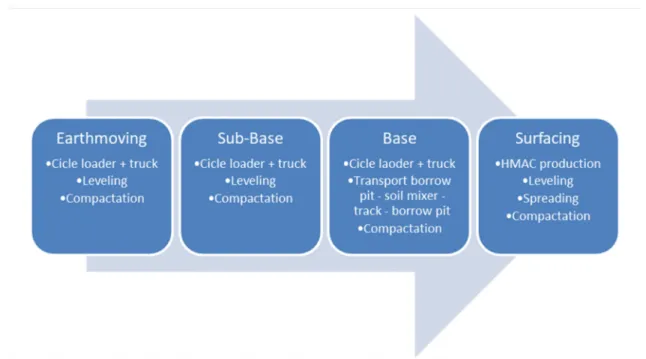
Earthmoving and paving activities consist in a promising area for the application of Lean Pro-duction concepts because these operations are related with movement and handling of large amounts of materials, using a great quantity of expensive resources (Mitoso, 2007). The appli-cation of the Lean Philosophy in heavy civil construction can avoid several problems such as losses of materials, reworks and the rates of equipment inactivity. The problem under study consists in the development of a methodology which allows the testing of the implementation of Lean Production policies in earthmoving and paving services, aiming the quanti ication of the impacts of these practices. In the Figure 1, one can observe the operations considered in the modeling process. The proposed models are composed of four blocks of activities, considered in a sequential manner: Earthmoving, Sub-base, Base and Asphalt Surfacing. For the development of the dis-crete event simulation model for earthworks, it was used the software Simul8 (Hauge e Paige (2004), Chwif et al. (2015)), which is a well-known simulator in the corporate business. With the Simul8, one can obtain several performance indicators of the modeled system, such as cycletimes, equipment utilization rates, resource utilization rates and queues formation, among oth-ers.
Figure 1. General scheme of the modeled activities
3. METHODOLOGY
In this work, three models are proposed: one modeled the reality and the others consider lean concepts. In the irst model (named Model 1), the lean concepts are not considered. In this model, does not occur the overlapping of the activities, that is, the operations are performed in a sequential manner. For example, the sub-base operations start after the end of the earthmov-ing operations, and so on. In the second model (named Model 2), some operations are considered with overlapping, facilitating the execution of the activities as well as maximizing the utilization of the loaders and reducing the idleness of the dump trucks. In the third model, it was proposed a new scheduling for the execution of the base layer. In the proposed schedule, the base operations are performed concomitantly with the earthmoving and sub-base operations. Thus, it is needed a second work front, increasing the amount of equipment, but reducing substantially the constructions total duration.
3.1 Lean concepts adopted in the models
Aiming to verify the ef iciency improvement of earthmoving and paving services, in comparison with the current operation of these systems, some strategies were implemented in the proposed models. The Lean Construction concepts utilized in the modeling are described as follow: a) Specify value: value can be viewed by the difference between the bene its and costs of a given process. The value of the processes needs to be speci ied, aiming their fur-ther optimization. b) Map the value stream: This mapping consists in the determination of all the steps performed in the value stream, removing, whenever feasible, those steps that do not add value.
c) Make value low: This concept consists in the making the value-addition steps arise in narrow sequence so the goods will low smoothly in the process. d) Pull value: The activities must pull value from the next step in the process. In the Figures 2 and 3, the lean concepts adopted in the Models 2 and 3, which are based in the conceptual framework of Lean Production Theory proposed by Al-Sudairi et al. (1999) are illustrated.
Figure 2. Lean concepts considered in the Model 2
Figure 3. Lean concepts considered in the Model 3
3.2 Ac7vi7es considered in the models
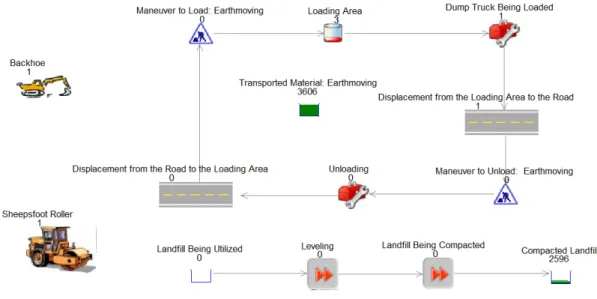
The developed models have four distinct and independent blocks of activities, which can be op-timized in relation to the equipment leet and the simultaneity of operations. The irst block represents the earthmoving activities, considering cut, ill, hauling and compaction, in the ana-lyzed area. The second represents the sub-base operations, in which are modeled cut, ill, haul-ing, compaction and leveling. The above mentioned processes are illustrated in Figure 4.
Figure 4. Simplified cycle for Earthmoving and Sub-base
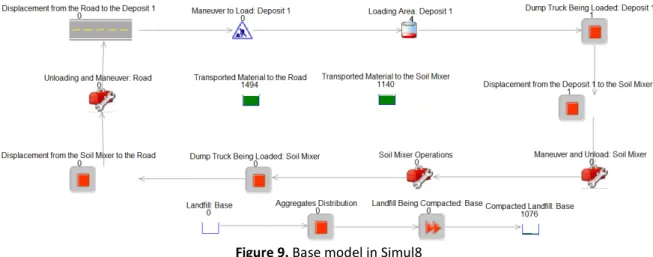
In the third block of the model, are represented the inherent operations to the pavement base. In the proposed models, the base is a sand-gravel mix composed of 70% of soil and 30% of gravel. Therefore, the model considers the haulage of materials from the borrow pits to the soil mixers, in which is assumed that a third-party company has transported the rocks. After the crushing and mixing of the materials, the stabilized soil is transported to the centroid of the considered section, where the material is unloaded and compacted. The base process is illus-trated in the Figure 5.
Figure 5. Simplified cycle for Base
Finally, the last block of the simulation model consists in the application of a layer of Hot Mix Asphalt (HMA), with a thickness of 5cm. Subsequently is performed the spreading, inishing and compacting of the layer. It can be observed that the HMA production is admitted as performed by a third-party company, being the material received on the track. The asphalt surfacing pro-cess is illustrated in the Figure 6.
3.3 Proposed simula7on models
The above mentioned subsystems were modeled in the Simul8, an important discrete event simulator in the engineering sector. Simul8 has a graphical interface that enables the user to construct models in a simple way. The processes of data input analysis, as well as of simulation analysis are facilitated by the robust interface of Simul8.
The earthmoving process is illustrated in the Figure 7. In this model, the backhoe -dump truck cycle is represented like a discrete event system, with this dynamic nature. Firstly, the backhoe gets material in an embankment and loads the dump truck while its capacity is availa-ble. After that, the dump truck performs the transportation of the materials to the ill, perform-ing the unloadill, perform-ing operation. In addition, the operations of levelill, perform-ing and compaction are per-formed for the conclusion of earthmoving process.
Figure 7. Earthmoving model in Simul8
The sub-base process is illustrated in the Figure 8. In general terms, the sub-base process is roughly equal to the earthmoving process. The key distinction between them is that in the sub-base process, the materials must have rolling resistance characteristics, which is not the case with earthmoving process.
The base process is illustrated in the Figure 9. In the proposed model is considered the fol-lowing combination of parameters: the base is composed by 70 per cent gravel and 30 per cent soil. The dump truck transports the material from deposit to the soil mixer. It is considered that the outsourced company has already delivered the stones. After stone crushing, the soil is sta-bilized, deposited, distributed and compacted.
Figure 9. Base model in Simul8
Finally, the last stage of the simulation is the asphalt surfacing model, as illustrated in the Figure 10. In this subsystem, the activities are performed in a linear way for the application of HMA, with a thickness of 5cm. Firstly, the HMA is produced. It is important to observe that in present model this production is considered outsourced and the material is received in the track. After, the HMA is spread and inished. Finally, the mixture receives the inal compaction.
Figure 10. Asphalt surfacing model in Simul8
For the veri ication of the bene its of the proposed approach in comparison with the real oper- ation, it was proposed a cost function, which was based on the cycle time obtained by the sim-ulation model. The unit costs of earthmoving and paving services are multiplied by the cycle time, giving the cost of each scenario. Having the costs of the proposed scenarios, one can com-pare the bene its of the lean strategies with the current operation of the modeled system.
4. CASE STUDY
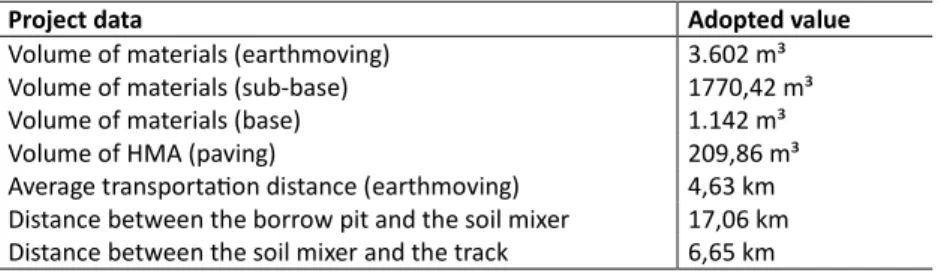
Aiming to perform a validation of the developed model as well as measure the bene its of the proposed approach, real data was gathered form a real case. The case study is related to a high-way construction, located in the Northeast region of Brazil, with a total extension of 32,1Km. For the paving execution, it was considered a sub-base with natural material of borrow pits near the track. In the base execution, it was used material from a borrow pit located 6.6km away from the axis of the track, with a mixture of 30% of gravel. The execution of the mixture must be performed in a soil mixer. The pavement layers have the following thickness: surface of 5cm (HMA), base of 15cm and sub-base of 20cm. The main data used in the modeling is presented in the Table 1.Table 1: Main volumes and distances adopted in the models
Project data Adopted value
Volume of materials (earthmoving) 3.602 m³
Volume of materials (sub-base) 1770,42 m³
Volume of materials (base) 1.142 m³
Volume of HMA (paving) 209,86 m³
Average transporta on distance (earthmoving) 4,63 km Distance between the borrow pit and the soil mixer 17,06 km Distance between the soil mixer and the track 6,65 km In these simulations, some assumptions were made. Taking into consideration that the activ-ity of processing the materials in the soil mixer is continuous, the irst assumption is that at the moment a truck needs to be loaded, the material is available. The production of HMA is consid-ered continuous for the same reason, therefore the second assumption is that the HMA is always available for a given truck. The third assumption is regarding the loaders. It is considered that the loaders are governing the production, in order to verify if there is the queues formation of the trucks. Aiming to evaluate the system performance, we proposed six indicators, which are described as follows: a) Total cost (R$): total cost for earthmoving and paving services. b) Total time (days): total work time required for the execution of earthmoving and pav-ing services; c) T1: minimum wait time in the queues; d) T2: average wait time in the queues; e) T3: maximum wait time in the queues. f) Total time (h): total time for the execution of surfacing services. It can be observed that U$ 1,00 is approximately R$ 2,20 (base-year 2014). After the development of the model for the current system, were applied some concepts of lean construction, such as process optimization and minimization of the set-up activities. The initial model has performed the activities in a linear manner, so that the block of activities for the ill compaction only could be started when the transport of materials have been inished. Similarly, the block of activities of transport of sub-base materials only could be started when the ill compaction has been inished and so on.
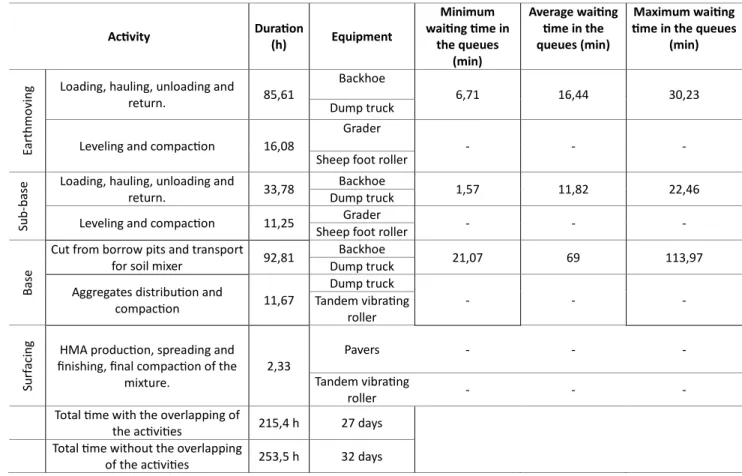
The simultaneity of the activities was modeled in the following manner: the block of activities for the sub-base systems only can begin when the earthmoving block is inished. In the model, it was enabled that subsequent activities can be performed in parallel when a given percentage value of the predecessor activity was performed. Reducing these delays between the activities, the cycle time could be reduced with the maintenance of the same pool of machines. In the Table 2 and 3 are presented the minimum, average and maximal waiting times for the dump trucks in the queues, as well as the duration of each stage considered in the modeled processes, in the models 2 and 3, respectively. The models were run 20 times for the obtaining of the presented results. The main difference between models 2 and 3 consists in the fact that in the model 3 the base activity was divided into two independent parts. Therefore, it is possible the execution of a part of the base concomitantly with other processes, reducing the total exe-cution time.
Table 2: Waiting times in the queues obtained by the Model 2 Ac7vity Dura7on (h) Equipment Minimum wai7ng 7me in the queues (min) Average wai7ng 7me in the queues (min) Maximum wai7ng 7me in the queues
(min) E a rt h m o vi n
g Loading, hauling, unloading and
return. 85,61
Backhoe
6,71 16,44 30,23
Dump truck Leveling and compac on 16,08
Grader
- - -
Sheep foot roller
Su
b
-b
a
se Loading, hauling, unloading and
return. 33,78
Backhoe
1,57 11,82 22,46
Dump truck
Leveling and compac on 11,25 Grader - - -
Sheep foot roller
B
a
se
Cut from borrow pits and transport
for soil mixer 92,81
Backhoe
21,07 69 113,97
Dump truck Aggregates distribu on and
compac on 11,67 Dump truck - - - Tandem vibra ng roller Su rf a ci n g
HMA produc on, spreading and finishing, final compac on of the
mixture.
2,33
Pavers - - -
Tandem vibra ng
roller - - -
Total me with the overlapping of
the ac vi es 215,4 h 27 days
Total me without the overlapping
of the ac vi es 253,5 h 32 days
Table 3: Waiting times in the queues obtained by the Model 3
Ac7vity Dura7on (h) Equipment Minimum wai7ng 7me in the queues (min) Average wai7ng 7me in the queues (min) Maximum wai7ng 7me in the queues
(min) E a rt h m o vi n
g Loading, hauling, unloading and
return. 85,61
Backhoe
6,71 16,44 30,23
Dump truck
Leveling and compac on 16,08 Grader - - -
Sheep foot roller
Su
b
-b
a
se Loading, hauling, unloading and
return. 33,78
Backhoe
1,57 11,82 22,46
Dump truck
Leveling and compac on 11,25 Grader - - -
Sheep foot roller
B
a
se
Cut from borrow pits and transport
for soil mixer 93,03
Backhoe
21,07 69 113,97
Dump truck Load in soil mixer, transport and
unload 49,70 Dump truck 0,7 15,29 30,58
Aggregates distribu on and
compac on 11,67 Dump truck - - - Tandem vibra ng roller Su rf a ci n g
HMA produc on, spreading and finishing, final compac on of the
mixture.
2,33
Pavers - - -
Tandem vibra ng
roller - - -
Total me with the overlapping of
the ac vi es 137,7 h 22 days
Total me without the overlapping
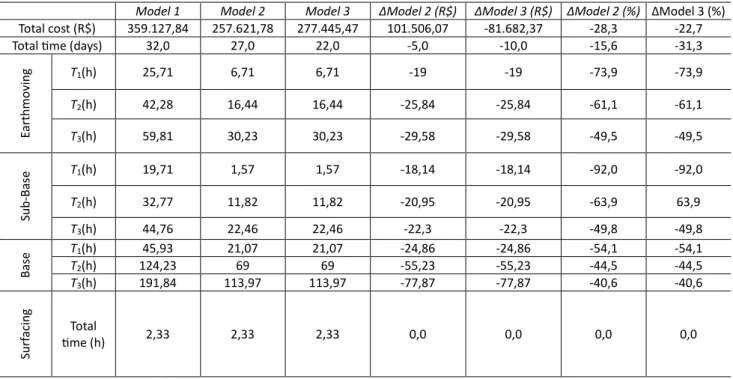
The simulation results are presented in Table 4. Analyzing the above mentioned results, one can observe that there is a clear advantage in the employment of rationalization tools, such as the lean concepts, in earthmoving and paving services.
Table 4: Simulation results
Model 1 Model 2 Model 3 ΔModel 2 (R$) ΔModel 3 (R$) ΔModel 2 (%) ΔModel 3 (%)
Total cost (R$) 359.127,84 257.621,78 277.445,47 101.506,07 -81.682,37 -28,3 -22,7 Total me (days) 32,0 27,0 22,0 -5,0 -10,0 -15,6 -31,3 E a rt h m o vi n g T1(h) 25,71 6,71 6,71 -19 -19 -73,9 -73,9 T2(h) 42,28 16,44 16,44 -25,84 -25,84 -61,1 -61,1 T3(h) 59,81 30,23 30,23 -29,58 -29,58 -49,5 -49,5 Su b -B a se T1(h) 19,71 1,57 1,57 -18,14 -18,14 -92,0 -92,0 T2(h) 32,77 11,82 11,82 -20,95 -20,95 -63,9 63,9 T3(h) 44,76 22,46 22,46 -22,3 -22,3 -49,8 -49,8 B a se TT1(h) 45,93 21,07 21,07 -24,86 -24,86 -54,1 -54,1 2(h) 124,23 69 69 -55,23 -55,23 -44,5 -44,5 T3(h) 191,84 113,97 113,97 -77,87 -77,87 -40,6 -40,6 Su rf a ci n g Total me (h) 2,33 2,33 2,33 0,0 0,0 0,0 0,0 Taking into account the results obtained in the simulations, it should be highlighted the dif- ferences between the Model 1 (without lean concepts) and the Models 2 and 3 (with lean con-cepts). The Model 2 presented a reduction of 15.6% in the construction execution time and a reduction of 28.3% in the total cost, in comparison with the Model 1. The Model 3 presented reduction of 31.3% in the construction execution time and a reduction of 22.7% in the total cost, in comparison with the Model 1.
Regarding the asphalt surfacing, one can observe that the Models 2 and 3 do not incur in improvement in terms of construction times. This is due to the fact that this process is essen-tially sequential, as well as the fact that the production of HMA was not modeled. Thus, there are no inef iciencies that could be mitigated by the lean concepts.
It is clear that the proposed approach is a powerful decision support tool, being valuable for the planners in the decision-making process. With the discrete event models proposed, several scenarios and operational policies can be previously tested, enabling the decision makers to develop ef icient strategies for the earthmoving and paving activities.
5. CONCLUSIONS
The simulation model described in this paper is a powerful technique for planning the opera-tions of earthmoving and paving services, enabling the implementation of lean concepts in the productive processes. The proposed model allows the obtaining of rationalized operational pol-icies, incurring in reductions of cycle times, equipment utilization rates, resource utilization rates and queues formation, among others performance indicators.
with cost reductions, these cost values does not represent the real cost of the construction, be-cause they do not consider the labor costs. In the applied unit costs for each service, only the equipment costs are considered. It is worthy of note that the stretch adopted in the case study is an almost plain terrain, with little variation in the cross section. Another feature of the case study is regarding the distance between the analyzed stretch and the borrow pits and soil mixer, which are virtually identical. This means that the obtained results are speci ic for this situation. There is no guarantee that other topographical or geotechnical features can lead to reductions of this same magnitude or lead to reductions at all. Each situation needs to be modeled and simulated. A limitation of the study is the lack of real data on the performed operational times in the studied construction. Without these data, the authors were not able to validate statistically the proposed model. However, according to authors’ experience, the proposed model re lects well the real system. In the proposed modeling, could be simulated different locations and sizes of the soil mixer, as well as different cutting places for base depending of the section of the road. Other services necessary for the highway construction, such as drainage, special artworks and horizontal road markings, enabling a better evaluation of the improvements obtained by the lean concepts ap-plication. In the proposed approach, there is no consideration of quality and safety when comparing the lean and non-lean models. Other performance indicators which re lect these aspects need to be developed and embedded in the simulation model. As a further development of the work presented in this paper, the authors are currently work- ing in the integration of discrete event simulation models and mixed integer programming mod- els, aiming the evaluation of the lean policies integrated with the optimal distribution of mate- rials, as well as in the extension of the proposed approach in drainage and maintenance ser-vices. In addition, the consideration of tank truck and aerator for correcting the soil moisture, the application of asphalt priming on base and sub-base, as well as the consideration of climatic aspects could be added in the proposed model. ACKNOWLEDGEMENTS The support of the National Council for Scienti ic and Technological Development (CNPq) is acknowledged and appreciated. REFERENCES Al-Sudairi, A. A.; H. M. Brown; J. E. Diekmann; A. D. Songer (1999) Simulation of Construction Processes: Traditional Practices versus Lean Principles. Proceedings IGLC-7. Alkass, S.; K. El-Moslmani; M. AlHussein (2003) A Computer Model for Selecting Equipment for Earthmoving Operations Using Queuing Theory. CIB REPORT, vol. 284, 1– 7. Bargstädt, H. J. e A. Blickling (2005) Implementation of Logic for Earthmoving Processes with a Game Development Engine. 22nd. International Conference on Information Technology in Construction. Dresden, Germany. Cheng, F.F.; Y.W. Wang; X.Z. Zing e Y. Bai (2011) A Petri net simulation model for virtual construction of earthmoving opera-tions. Automation in Construction, v. 20, N. 2, p. 181–188. DOI: 10.1016/j.autcon.2010.09.015. Chwif, L.;, A. C. Medina;, W. I. Pereira; D. R. Vieira e J. E. Pécora Jr (2015) Introdução ao Simul8: um guia prático. São Paulo: Ed. dos Autores. Disponı́vel em: <http://livrosimulacao.eng.br/introducao-ao-simul8-download-gratuito/>. Acesso em <05 nov 2017>. Farrar, J. M; S. M. Abourizk; X. Mao (2004) Generic Implementation of Lean Concepts in Simulation Models. Lean Construction Journal, vol. 1, n. 1, p. 1-23. Halpin, D. W.; M. Kueckmann (2002) Lean Construction and Simulation. Proceedings of the 2002 Winter Simulation Conference. DOI: 10.1109/WSC.2002.1166453. Hauge, J. W. e K. N. Paige (2004) Learning SIMUL8: The Complete Guide. Plain Vu Publishers; 2nd edition. 1013 p. Boston.
Hosseini, S.A.A.; A. Nikakhtar e P. Ghoddousi (2012) Flow production of construction processes through implementing lean construction principles and simulations. International Journal of Engineering and Technology, vol. 4, n. 4, p. 475-479. DOI: 10.7763/ijet.2012.v4.414.
Hosseini, S.A.A.; A. Nikakhtar e P. Ghoddousi (2014) Veri ication of Lean Construction bene its through simulation modeling: a case study of bricklaying process. KSCE Journal of Civil Engineering, vol. 18, n.5, p. 1248-1260. DOI: 10.1007/s12205-014-0305-9. Jayawardane, A. K. W. e A. D. F. Price (1994a) A new approach for optimizing earth moving operations - Part I. Proceedings of Institution of Civil Engineers - Transport, v. 105, n. 8, p. 195-207. Jayawardane, A. K. W. e A. D. F. Price (1994b) A new approach for optimizing earth moving operations - Part II. Proceedings of Institution of Civil Engineers - Transport, v. 105, n. 9, p. 249-258. DOI: 10.1680/itran.1994.27136. Koskela, L. (1992) Application of the New Production Philosophy to Construction. Technical Report 72, CIFE, Stanford Univer-sity, Stanford. Marzouk, M. e O. Moselhi (2000) Optimizing earthmoving operation using object-oriented simulation. Proceedings of the 2000 Winter Simulation Conference, Orlando. Marzouk, M. (2002) Optimizing Earthmoving Operations Using Computer Simulation. Department of Building, Civil and Envi-ronmental Engineering, Concordia University, Montreal. DOI: 10.1109/wsc.2000.899188. Moselhi, O. e A. Alshibani (2007) Crew optimization in planning and control of earthmoving operation using spatial technolo-gies. Journal of Information Technology in Construction - ITcon, v. 12, p. 121 – 137. Prata, B. A.; E. F. Nobre Jr; G. C. Barroso (2008) A stochastic colored petri net model to allocate equipments for earth moving operations. Journal of Information Technology in Construction, v. 13, p. 476-490. Tommelein, I.D. (1998) Pull-driven scheduling for pipe-spool installation simulation of a lean construction technique. Journal of Construction Engineering and Management, v. 124, n. 4, p. 279–288. DOI: 10.1061/(asce)0733-9364(1998)124:4(279). Yang, J.; D. J. Edwardsa; P. E.D. Loveb (2003) A computational intelligent fuzzy model approach for excavator cycle time simu-lation. Automation in Construction, v. 12, p. 725-735. DOI: 10.1016/s0926-5805(03)00056-6. Zhang, H. (2008) Multi-objective simulation-optimization for earthmoving operations. Automation in Construction, v. 18, p. 79–86. DOI: 10.1016/j.autcon.2008.05.002.