Manuals of
Romance Linguistics
Manuels de linguistique romane
Manuali di linguistica romanza
Manuales de lingüística románica
Edited by
Günter Holtus and Fernando Sánchez Miret
Manual of
Deixis in Romance
Languages
Edited by
ISBN 978-3-11-031767-1 e-ISBN (PDF) 978-3-11-031773-2 e-ISBN (EPUB) 978-3-11-039356-9
Library of Congress Cataloging-in-Publication Data
A CIP catalog record for this book has been applied for at the Library of Congress.
Bibliographic information published by the Deutsche Nationalbibliothek
The Deutsche Nationalbibliothek lists this publication in the Deutsche Nationalbibliografie; detailed bibliographic data are available on the Internet at http://dnb.dnb.de.
© 2015 Walter de Gruyter GmbH, Berlin/Boston Cover-Bildnachweis: © Marco2811/fotolia
Typesetting: jürgen ullrich typosatz, Nördlingen Printing and binding: CPI books GmbH, Leck ♾Printed on acid-free paper
Printed in Germany
The new international handbook series Manuals of Romance Linguistics (MRL) will
offer an extensive, systematic and state-of-the-art overview of linguistic research in
the entire field of present-day Romance Studies.
MRL aims to update and expand the contents of the two major reference works
available to date: Lexikon der Romanistischen Linguistik (LRL) (1988–2005, vol.
1–8)
and Romanische Sprachgeschichte (RSG) (2003–2008, vol.
1–3). It will also seek to
integrate new research trends as well as topics that have not yet been explored
system-atically.
Given that a complete revision of LRL and RSG would not be feasible, at least not
in a sensible timeframe, the MRL editors have opted for a modular approach that is
much more flexible:
The series will include approximately 60
volumes (each comprised of approx.
400–600 pages and 15–30 chapters). Each volume will focus on the most central
aspects of its topic in a clear and structured manner. As a series, the volumes will
cover the entire field of present-day Romance Linguistics, but they can also be used
individually. Given that the work on individual MRL volumes will be nowhere near as
time-consuming as that on a major reference work in the style of LRL, it will be much
easier to take into account even the most recent trends and developments in linguistic
research.
MRL’s languages of publication are French, Spanish, Italian, English and, in
exceptional cases, Portuguese. Each volume will consistently be written in only one of
these languages. In each case, the choice of language will depend on the specific
topic. English will be used for topics that are of more general relevance beyond the
field of Romance Studies (for example Manual of Language Acquisition or Manual of
Romance Languages in the Media).
The focus of each volume will be either (1) on one specific language or (2) on one
specific research field. Concerning volumes of the first type, each of the Romance
Languages
– including Romance-based creoles – will be discussed in a separate
volume. A particularly strong focus will be placed on the smaller languages (linguae
minores) that other reference works have not treated extensively. MRL will comprise
volumes on Friulian, Corsican, Galician, Vulgar Latin, among others, as well as a
Manual of Judaeo-Romance Linguistics and Philology. Volumes of the second type will
be devoted to the systematic presentation of all traditional and new fields of Romance
Linguistics, with the research methods of Romance Linguistics being discussed in a
separate volume. Dynamic new research fields and trends will yet again be of
parti-cular interest, because although they have become increasingly important in both
research and teaching, older reference works have not dealt with them at all or
touched upon them only tangentially. MRL will feature volumes dedicated to research
fields such as Grammatical Interfaces, Youth Language Research, Urban Varieties,
Computational Linguistics, Neurolinguistics, Sign Languages or Forensic Linguistics.
Each volume will offer a structured and informative, easy-to-read overview of the
history of research as well as of recent research trends.
We are delighted that internationally-renowned colleagues from a variety of
Romance-speaking countries and beyond have agreed to collaborate on this series
and take on the editorship of individual MRL volumes. Thanks to the expertise of the
volume editors responsible for the concept and structure of their volumes, as well as
for the selection of suitable authors, MRL will not only summarize the current state of
knowledge in Romance Linguistics, but will also present much new information and
recent research results.
As a whole, the MRL series will present a panorama of the discipline that is both
extensive and up-to-date, providing interesting and relevant information and useful
orientation for every reader, with detailed coverage of specific topics as well as
general overviews of present-day Romance Linguistics. We believe that the series will
offer a fresh, innovative approach, suited to adequately map the constant
advance-ment of our discipline.
Günter Holtus (Lohra/Göttingen)
Fernando Sánchez Miret (Salamanca)
June 2015
The editors, together with the 32
authors, are very happy to share the
outstand-ing result of this collective effort. Actually, the group of contributoutstand-ing people was
much larger. We gratefully recognize the valuable contributions of several
anony-mous reviewers who formed part of our external review process, along with the
contribution of nearly all of the authors themselves to the internal review
pro-cess.
We should also recognize the names of several other colleagues involved in the
writing process, and of English experts who found the correct idiomatic expressions
in different far-flung areas:
Núria Alturo (Universitat de Barcelona)
Lídia Amélia de Barros Cardoso (Universidade Federal do Ceará)
Alena Ciulla (Universidade Federal do Rio Grande do Sul)
Barbara De Cock (Université Catholique de Louvain)
Rita Franceschini (Freie Universität Bozen)
Klaus Grübl (Ludwig Maximilian Universität München)
Sergio Murias (Universidad de Buenos Aires)
Lluís Payrató (Universitat de Barcelona)
Eulàlia Salvat (Universitat de Barcelona)
During the editing process, we received strong support from our two lecturers, Ulrike
Krauß and Christine Henschel, and great feedback from the editors of our series,
Günter Holtus and Fernando Sánchez Miret, who constantly encouraged us during the
whole process of editing our manual.
Without our student assistants, it would have been very difficult
– if not
impossi-ble
– to shoulder the time-consuming, sometimes monotonous tasks which form part
of the preparation of a manuscript for a handbook like ours
– not to mention meeting
all the deadlines. We are happy that the following highly motivated and committed
students were engaged in our team based at the Europa-Universität Viadrina in
Frank-furt (Oder) at different stages of our endeavour:
Dominik Gerst
Ariane Kolb
Friederike Schütte
Layla Cristina Iapechino Souto
Lukas Wegenast
Tininiska Zanger Montoya
We also want to emphasize the incredible work of Todd Ehresmann, our English
proofreader. He edited the texts so readers could accurately understand linguistic
frameworks; he worked with Englishes from multiple areas of the world, and reliably
completed the texts even on short deadlines.
Finally, we would like to cordially thank our contributors for their patience and
enduring commitment to our manual, which certainly demanded more dedication
than the average publication. By means of their work, effort and persistence, the
publication of our Manual on Deixis in Romance Languages has been achieved in
time.
Konstanze Jungbluth (Frankfurt an der Oder)
Federica Da Milano (Milano)
August 2015
List of Abbreviations
XII
Konstanze Jungbluth and Federica Da Milano
0
Introduction
1
Deixis in Romance Languages
Alexandra Corina Stavinschi
1
Romanian
17
Ignazio Putzu
2
Sardinian
45
Federica Da Milano
3
Italian
59
4
Varieties in Italy
Adam Ledgeway
4.1 Varieties in Italy 1
75
Michele Prandi
4.2 Varieties in Italy 2: Alpine Varieties
114
Martina Irsara
5
Ladin
140
Claire Beyssade
6
French
167
Carolin Patzelt
7
French Varieties outside of France
189
Neus Nogué-Serrano
8
Catalan
206
Mª Elena Gómez Sánchez and Konstanze Jungbluth
10
Spanish Varieties of Latin America
Laura D. Ferrari
10.1 Spanish Varieties of Latin America 1: South America
258
Karolin Moser
10.2 Spanish Varieties of Latin America 2: Mexico and Central America
279
Helena Topa Valentim
11
European Portuguese
297
Konstanze Jungbluth and Rita Vallentin
12
Brazilian Portuguese
315
Konstanze Jungbluth
13
Creoles
332
Theoretical Frameworks
Andreas Dufter
14
Semantics
359
Johanne Peemöller
15
Structuralism
381
Kasia M. Jaszczolt
16
Contextualism
407
Rita Finkbeiner and Jörg Meibauer
17
Indexicalism
425
Javier Gutiérrez-Rexach
18
Minimalism
441
Wiltrud Mihatsch
19
Cognitive Linguistics
467
Mônica Cavalcante
20
Referentiality
493
X
Table of ContentsFrançois Jacquesson
21
Typology
511
Comparative Aspects: Language Change and Language Contact
Jens Lüdtke
22
From Latin and Vulgar Latin to Romance Languages
537
Céline Guillot
23
From Old French and Middle French to Contemporary French
558
Paolo Ramat
24
Language Change and Language Contact
581
Martina Ebi
25
Encoding Deictic Relations in Japanese
597
Maurizio Gnerre
26
Encoding Deictic Relations in Mesoamerican Languages
611
Interfaces to Neighboring Fields of Interest
Lorenza Mondada
27
Social Interaction
661
Nicole Richter and Dagna Zinkhahn Rhobodes
28
Corpus Linguistics
684
Ellen Fricke
29
Gesture
708
Friedrich Lenz
30
Discourse Deixis
729
Index
740
List of Abbreviations
Abr. Abruzzese acc. accusative adj. adjective adn. adnominal adv. adverbAgrP agreement projection AP adjectival phrase ART article Bas. Basilicatese Bol. Bolognese BP Brazilian Portuguese ca. circa Cal. Calabrian Cast. Castillian Cat. Catalan cf. see/compare ch. chapter CL Cognitive Linguistics Cmp. Campanian CN compound nominals ČNK Czech national corpus COMP compound CP complementizer phrase CT coding time dat. dative DEF definite Deic deictic DEM demonstrative
DES Dizionario etimologico sardo DET determiner DIR direct dist distal DP determiner-phrase DS Default Semantics E event
EAbr. Eastern Abruzzese edd. editors
e.g. for example Eml. Emilian Eng. English
EP European Portuguese et al. and others
etc. and so forth Ex. example f./fem. feminine fig. figure fn. footnote
FP functional projection Fr. French Frl. Friulian FV Français Vaudois Gal. Galician gen. genitive Gen. Genoese Ger. German GOAL target H hearer
ibid. in the same place ICM Idealized Cognitive Model i.e. that is
INDEF indefinite INDIR indirect
IPA International Phonetic Alphabet Istr. Istroromanian It. Italian Lat. Latin Laz. Laziale LF logical form lh. left hand Lig. Ligurian lit. literal Lmb. Lombard LOC locative Log. Logudorese L2 second language m./m(a)sc. masculine MA Mesoamerican MED Medial Megl. Meglenoromanian Mil. Milanese Mol. Molisano Mold. Moldave N noun n. number Nap. Neapolitan NCal Northern Calabrian
NKJP Narodowy Korpus Języka Polskiego nom. nominative
NONPAST non past (a verbal form in Japanese) NP noun-phrase
NumP number-phrase Occ. Occitan OLmd. Old Lombard ONap Old Neapolitan OPdm. Old Piedmontese p.c. personal communication
Pdm. Piedmontese PERS personal Pgl. Pugliese Pl./plur. plural Pmg. Parmigiano
PLOH palm lateral open hand pp. pages
PREP preposition PRO/pron pronoun prox proximal Pt. Portuguese
p1/p2/p3 first/second/third person plural QP quantifier-phrase ref. referential Rel. relative rh. right hand RL(s) Romance Language(s) Rml. Romagnol Rom. Romanian Rus. Russian S speaker s. sequens Sal. Salentino
SAP Speech Act Participant(s) SBas. Southern Basilicatese SCal. Southern Calabrian sect. section
SF Standard French Sg./Sing. singular Sic. Sicilian
SIL Summer Institute of Linguistics Sp. Spanish Spec specifier SPK speaker sq. sequens ss. sequentes SUBJ subject Subst. noun
s.v. under the word
SWPdm. South Western Piedmontese s1/s2/s3 first/second/third person singular TAG tag-question TAM temporal-aspectual-modal TOP topic Transilv. Transilvan Tsc. Tuscan u utterance Umb. Umbrian v verb
Var. variation Ven. Venetian viz. namely vol. volume VP verbal-phrase vs. versus V2 verb second WAbr. Western-Abruzzese XP x-phrase
1PL first person plural 1SG first person singular 2PL second person plural 2SG second person singular 3PL third person plural 3SG third person singular
Helena Topa Valentim
11 European Portuguese
Abstract:
Focusing on European Portuguese, throughout this chapter deixis will be
considered as a phenomenon within language conceived as an activity of
representa-tion, of reference construction and subjective adjustment. Deixis implies a particular
type of linguistic referential construction that includes perceptual and cognitive
processes. Deictic values are constructed as referential values based in the
enuncia-tor/speaker and her/his coenunciator/interlocutor, both embedded in their subjective
and spatial-temporal context. This chapter shows the deictic markers in European
Portuguese, their forms, constructions and use.
Keywords: Romance Languages, European Portuguese, pragmatics, deixis, referential
values, personal deixis, spatial deixis, temporal deixis, enunciator, coenunciator,
subjective adjustment
1 Deixis: representation and construction of
reference values
This chapter is built upon the understanding of language as an activity of
representa-tion, of reference construction and subjective adjustment, thus including perceptual
and cognitive processes. This conception of language is determined in what concerns
the way we describe the deictic phenomenon. It is considered within the theoretical and
methodological model, proposed and developed by the French linguist Antoine Culioli
(1973; 1977; 1999a; 1999b), which is usually designated as Enunciative Operations and
Predicative Theory (EOPT). Culioli introduces a trans-categorial model of description
and explanation of how signification is constructed through and by enunciation.
This approach results in a system that concerns the diversity of specific
configura-tions, which represents an epistemological rupture with the principle of truth values
dependence (see below). This rupture affects the interpretation of meaning
construc-tion, and in particular the construction of linguistic representation and reference. The
latter is highly relevant for deixis.
In order to understand the differences to earlier approaches, we briefly sketch
their either semantic or pragmatic perspectives, the latter being different from ours. In
the study of the functioning of natural languages, the context-dependence principle is
considered as the decisive factor underlying any strict form of the principle of
compositionality. According to this understanding, the study of natural languages is
regarded as a study of interpretation. In doing so, the user cannot project exclusively
from the words of the sentence and their mode of combination, but has to regard
systematically the context in which they occur.
When working within the context-dependence principle, the problem of
truth-values dependence may arise (for the theoretical truth truth-values dependence account of
meaning cf. Partee 1984), since we cannot evaluate a sentence as true without
know-ing the speaker of the expression we examine. Ambiguity and underdetermination
arise, which is for example the case when the expression includes personal pronouns,
demonstrative pronouns and determinants, as well as tense markers. As Kempson
(1997, 566) states, there are several choices available. An analysis in critique of the
general phenomenon of context-dependence to the particular case would raise the
question of whether these observable linguistic forms should be explained in terms of
ambiguity. Thus, it would pose different interpretations for the expression itself, with
no role assigned to the discourse context other than that of disambiguation. A formal
semantic explanation suggests that it should be characterized as stemming from an
underdetermined input, with a process of interpretation reconstructed solely in the
semantic algebra. A pragmatic perspective proposes that it should be explained in
structural terms
– as the substitution of one logical expression for another, while
some representation of content for the string is built upon.
As said already at the beginning, this chapter follows the Enunciative Operations
and Predicative Theory considering deixis within the conception of language as an
activity of representation, of reference construction and subjective adjustment. The
enunciator begins by constructing notions of different categories (lexical,
gramma-tical and predicative), which are located within a reference system composed of
primitive and abstract subjective and spatiotemporal coordinates. This, in turn, is
the absolute locator of all values of determination built on utterances. To enunciate,
i.e. to produce well-formed linguistic utterances, involves the construction of
ab-stract objects with theoretical status which are arranged in relation to the reference
system.
This understanding of the functioning of language in general and of natural
languages in particular, follows a conception whereby the utterance is considered as
a process of abstraction. Thus, linguistic referentiality can be explained as a
construc-tion of referential values of different grammatical categories. Forms and construcconstruc-tions
are the linguistic markers of such constructions, as they point to entities and states of
affairs that are not by themselves extra-linguistic entities and states of affairs.
Through linguistic activity, we are always building a certain type of object that is
endowed with formal properties. This object is anchored to a referential space and
subjected to a permanent inter-subjective pattern which is negotiated again and again
between enunciator and coenunciator.
The advantage of this approach lies in the fact that it describes language as more
complex than a compositional analysis proposes. In order to create utterances, one
starts from the principle that we all possess the same construction-deconstruction
device that allows us to identify linguistic units as traces of operations. This approach
also shows that we all have a stock of common operations at our disposal, and that is
why we can re-construct what others have produced.
According to this view, deixis can be described as the construction of linguistic
values, which result from a location operation of a linguistic occurrence in relation to
a referential system. This absolute referential site consists of the subjective and
spatiotemporal coordinates. In this sense, the linguistic forms and constructions we
identify as deictic are merely linguistic markers of that localization operation. In other
words, they are linguistic indices whose occurrence displays an interpretative
reason-ing at the levels of both lreason-inguistic production and reproduction/reception.
Throughout this inter-subjective complex system, linguistic forms and their
con-structions such as personal pronouns, demonstrative pronouns and determinants as
well as adverbs of time and space and tense markers, play a key role in the
representa-tion and the referential double activity of deictic values as part of the construcrepresenta-tion-
construction-reconstruction process. They are linguistic markers of cognitive and linguistic
opera-tions of the enunciator and the co-enunciator and are externalized in the form of their
utterances.
2 Personal deixis and the determination of the
subject
Generally speaking, the fundamental concept of the subject is based on the concept of
enunciation, not considered as an act (see un acte individuel d’utilisation, Benveniste
1966, 80; 1974) or practice, but rather as a process that is part of a theoretical necessity
(compare système de repérage Culioli 1973, 87). Therefore, we have a theory of
determi-nation, which defines an enunciate as an assemblage of markers of abstract operations,
being the concept of the subject itself inscribed in the linguistic system as a theoretical
and metalinguistic parameter
“une situation d’énonciation, qui est définie par rapport
à un sujet énonciateur (S
0) […] et à un temps d’énonciation (T
0)” (Culioli 1977, 44). From
here ongoing we shall use the term utterance apparently more common in English
instead of enunciate. Due to the location of a propositional content in relation to this
primitive theoretical subjective parameter, represented by le sujet énonciateur, a class
of subjects with different theoretical status is established. They are linked to each
other, resulting, as mentioned above, in different referential values. Both subject and
spatiotemporal parameters together define the absolute referential system that is the
locator of any utterance. The dissociation of the two parameters is merely due to the
methodological necessity of description. Both these theoretical parameters, identified
with the locutor (or speaker from here on) and with the contextual space-time
char-acterize the enunciation act including all its deixis phenomena
1. In the next step we
1 Already recognized at the very beginning of grammar descriptions (see for example la grammaire de Denys le Thrace; Lallot 1989).
focus on personal deixis. The table below shows the complete paradigm of the personal
pronouns in European Portuguese which assign a deictic reference to the subject:
Table 1: Personal pronouns with deictic values in European Portuguese
S
SUBJECTUBJECT DDIRECTIRECT
O OBJECTBJECT IINDIRECTNDIRECT O OBJECTBJECT O OBLIQUEBLIQUE O OBJECTBJECT PPASSIVEASSIVE A
AGENTGENTOOBJECTBJECT
S
SINGULARINGULAR 1st person eu me me mim, comigo mim
2nd person tu te te ti, contigo ti
PPLURALLURAL 1st person nós nos nos nós, connosco nós
2nd person vós vos vos vós, convosco vós
The Portuguese personal pronouns, as in the remaining Romance Languages, may
morphologically vary in number (singular or plural), in gender (masculine and
feminine), and according to grammatical person (first, second and third person). They
may also present distinctive forms depending upon the syntactic function performed
in the sentence.
First and second person are the only forms among all the pronominal forms
mentioned above that have deictic values, since both function as subjective linguistic
indices. In enunciative terms, the first person results from the process of identification
that may occur between the enunciator subject/speaker and the enunciation subject
(which coincides with the syntactic subject). In turn, the second person arises from
the differentiation between the enunciator subject/speaker and the enunciation
sub-ject. However, in this case the enunciation subject (or syntactic subject) identifies
itself with the co-enunciator subject/interlocutor. The third person does not assume
any deictic value.
Due to the fact, that the person category can be exclusively marked by verbal
inflection, without using a pronoun, Portuguese (mainly the European Portuguese) is
considered a pro-drop language. The lack of the overt subject in the sentence or
subject drop is also discussed as the famous null-subject phenomenon. In case of the
use of pronouns in these contexts, the verbal inflection of the person grammatical
category doubles the information introduced by the personal pronoun. As will be
further explained below, whenever the subject related to the first and the second
person is not overtly expressed, the verbal inflection is sufficient as the only linguistic
sign of this grammatical category.
1.1 Adoro gelados de chocolate. I love chocolate icecreams.
1.2 Verás um filme de que nunca mais te vais esquecer. You will watch a movie that you never shall forget. Data 1: The subject expressed by verbal inflection alone
In utterance 1.1, the first person corresponds to an enunciative identification
opera-tion, which occurs between the enunciator subject/speaker and the enunciation
subject. It is linguistically marked by the first person inflection of the verb adorar, the
singular form ador-o. In utterance 1.2, the enunciative differentiation operation
between the enunciator subject/speaker and the enunciation subject results in the
grammatical second person, and it is marked by the inflection of the second person of
the verb ver, the singular form ver-ás.
Both first person personal pronouns and the resulting verbal inflection of the first
person not only clarify the subjective instance of the utterance (or enunciation
subject) regardless of its performed syntactic function, but also distinguish the
sub-jective instance of the enunciation act (or enunciator subject/speaker). They are
linguistic features contained within the enunciator subject, in a way that it can
establish itself in support of predication, and thus is responsible for any value
constructed. Consequently, the identification value is found throughout this
appro-priation or subjective commitment, whose assumption results from the location
between the enunciator subject/locator and the enunciation subject (“the first person
is when the one who speaks speaks about himself” by Priscian, a Latin grammarian of
the 6th century; see the difference between
“predicative act” and “referential act”,
Joly 1994; O’Kelly 1996; 1997).
3 Spatiotemporal deixis and the determination of
linguistic occurrences
In spite of its lexical meaning, nominal expressions reflect the location that is
determined by contextual information. More specifically, they assume a referential
value by means of a location in relation to the coordinates that define the enunciation
reference
– an absolute reference site, implemented by a nonsymmetrical relation
between two different subjects that are involved in the interaction:
enunciator/speak-er and coenunciator/intenunciator/speak-erlocutor and their space-time refenunciator/speak-erential coordinates. We can
see that the same reference holds for the construction of the deictic value system. The
enunciator/speaker and coenunciator/interlocutor space-time coincidence is
conse-quently a fundamental prerequisite for building a deictic reference scheme.
This scheme is filled by demonstrative determiners and their morphological
variants, as well as by demonstrative pronouns and by space and time adverbs.
3.1 Demonstrative determiners and pronouns
The demonstrative determiners in Portuguese are este
‘this’, esse ‘that’ and aquele
‘that’ (Cunha/Cintra 1984; Mateus et al. 1989). They are major forms in the deictic
system that mark the location of the linguistic occurrence. It is fixed according to the
spatiotemporal absolute reference defined by the enunciator/speaker, who in turn
builds another subject, the coenunciator/interlocutor. In every noun phrase with a
demonstrative determiner, the linguistic occurrence lexicalized through a noun is,
thus, located in relation to the enunciation act, which functions as the referential
source defined by subjective and space-time coordinates (Correia 2002).
According to the examples 2.1, 2.2 and 2.3, demonstrative determiners
– este ‘this’,
esse
‘that’ and aquele ‘that’ – identify the noun livro ‘book’ as spatially close in
relation to the enunciator/speaker (2.1) or to the coenunciator/interlocutor (2.2); or as
spatially distant in relation to both (2.3).
2.1 Este livro é do João. This book is John’s book. 2.2 Esse livro é do João.
That book is John’s book. 2.3 Aquele livro é do João.
That book is John’s book.
Data 2: Three demonstratives referring to three spaces
These utterances show the spatial location of the book referred to by the linguistic
occurrence of the noun livro, built in a specific order of proximity according to the
spatiotemporal absolute enunciative reference defined by the enunciator. Thus in
European Portuguese the coenunciator/interlocutor as an enunciative reference
to-ward which some deictic values are constructed should be considered as important,
too.
Furthermore, the location of a linguistic occurrence, which is built according to
the referential system, can assume a non-spatial value expressing a subjective value,
as will be further explained.
3.1 Esta ideia foi-me inspirada por um livro que li. This idea has been inspired by a book I read. 3.2 Essa ideia é incoerente.
That idea is completely incoherent. 3.3 Aquela ideia é mais razoável.
That idea is reasonable.
Data 3: Demonstratives representing subjective values
On the one hand, when we determine, by the use of a demonstrative form, a noun
such as ideia, the deictic value of the nominal expressions esta ideia
‘this idea’, essa
ideia
‘that idea’ and aquela ideia ‘that idea’ is no longer strictly associated with space
meaning. Esta ideia (3.1) may refer to an idea attributed to the enunciator since it may
be added the possessive pronoun minha [mine], also a deictic form: esta minha ideia
‘this idea of mine’. On the other hand, the nominal expression essa ideia ‘that idea’
(3.2) may be interpreted as an idea attributable to the coenunciator/interlocutor (it
may occur with the possessive pronoun tua
‘yours’: essa tua ideia ‘that idea of yours’.
Furthermore, aquela ideia
‘that idea’ (3.3) may be interpreted as an idea attributable
to others, but the enunciator/coenunciator. In this case, it can be paraphrased by the
possessive expression aquela ideia dele/dela
‘the idea of his/hers’.
The notional properties of the nouns, in this case the lexical notions of livro
‘book’
and ideia
‘idea’, are crucial in defining the type of location that results between the
linguistic occurrence and the subjective and spatio-temporal absolute reference. As
we saw in the utterances from 2.1 to 3.3, a noun such as livro determines a spatial
location; a noun such as ideia determines a subjective location.
This fact confirms the relevance of a constructivist conception of natural
lan-guages functioning. It is through the interaction between the linguistic forms and
constructions that the several determination values arise.
As proposed in the above examples, the deictic value can either be spatial
(utterances 2.1 to 2.3) or subjective (utterances 3.1 to 3.3). But it can also assume a
temporal feature, since
– according to Einstein’s Theory of Relativity – time and space
are no longer dissociated concepts. Space has to be considered as determined by time
and vice-versa.
4.1 Aquele verão em que passaste as férias no Algarve. That summer when we spent our holidays at the Algarve. Data 4: Demonstratives may assume a temporal deictic value
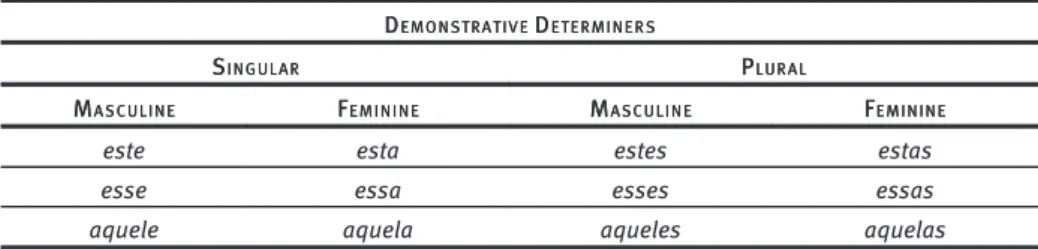
What concerns morphology (see Data 6 below, especially 6.2), Portuguese
demonstra-tive determiners may vary in gender (masculine and feminine) and in number
(singu-lar and plural), always regarding the linguistic agreement according to the noun that
they determine.
Table 2: Variation according to number and gender of the demonstrative determiners
D
DEMONSTRATIVEEMONSTRATIVEDDETERMINERSETERMINERS
S
SINGULARINGULAR PPLURALLURAL
M
MASCULINEASCULINE FFEMININEEMININE MMASCULINEASCULINE FFEMININEEMININE
este esta estes estas
esse essa esses essas
aquele aquela aqueles aquelas
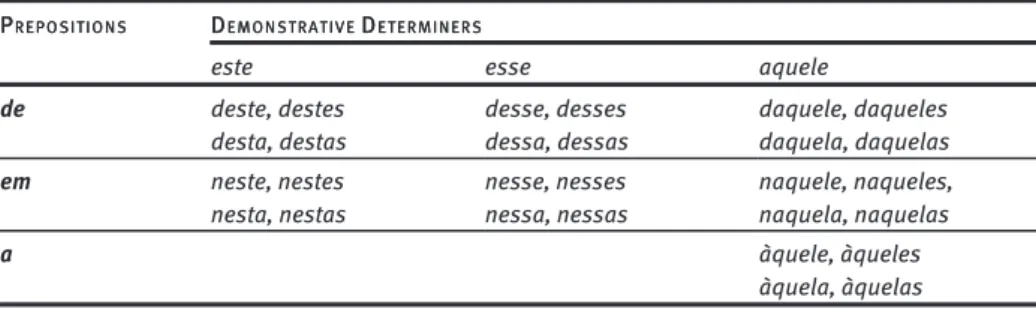
Whenever the determiners este
‘this’, esse ‘that’ and aquele ‘that’ are preceded by the
prepositions de, em and a (approximately
‘from/of’, ‘in/on’ and ‘to’), a contracted
form results.
Table 3: Contracted forms of demonstrative determiners with prepositions
PPREPOSITIONSREPOSITIONS DDEMONSTRATIVEEMONSTRATIVEDDETERMINERSETERMINERS
este esse aquele
de deste, destes desta, destas desse, desses dessa, dessas daquele, daqueles daquela, daquelas em neste, nestes nesta, nestas nesse, nesses nessa, nessas naquele, naqueles, naquela, naquelas a àquele, àqueles àquela, àquelas
Additionally, all three of these demonstrative forms, este, esse and aquele may occur
pronominally and have the same deictic value as when they occur on the left side of a
noun
– that is, as determiners.
5.1 Estou hesitante entre comprar aquele livro ou este. I’m hesitating between buying that book or this one. 5.2 Estou hesitante entre comprar aquele livro ou esse.
I’m hesitating between buying that book or that one. 5.3 Estou hesitante entre comprar esse livro ou aquele.
I’m hesitating between buying that book or that one. Data 5: Pronominal use of demonstratives
The demonstrative pronouns este (5.1), esse (5.2) and aquele (5.3) determine the noun
livro
‘book’ as being spatially close to the enunciator (5.1), or to the coenunciator (5.2),
or even as spatially distant from both the enunciator/ and her or his coenunciator (5.3).
According to its occurrence context, demonstrative determiners may also signal
an anaphorical reference construction, since they mark the identification of a
viously constructed linguistic occurrence (6.1); or the identification operation of a
pre-constructed occurrence recognized by the interlocutors as belonging to their shared
knowledge, thus non-verbalized within the ongoing utterance (6.2).
6.1 O bacalhau-do-Atlântico distribui-se por vários habitats do Oceano. Durante o dia, este peixe nada em cardumes para melhor se proteger dos predadores. The Atlantic cod is distributed in various habitats of the ocean. During the day, this fish swims in shoals to better protect themselves from predators.
6.2 Encontrei na praia aquela nossa colega. I met in the beachthat colleague of ours. Data 6: Anaphoric use of demonstratives
In spite of the determiners este, esse and aquele functioning either as demonstrative
determiners or as demonstrative pronouns, the demonstrative pronouns isto
‘this/
these’, isso ‘that/those’ and aquilo ‘that/those’ may also mark deictic values. These
linguistic units are invariable forms according to number inflection, also pointing out
the contraction with the prepositions de, em and a (approximately
‘from/of’, ‘in/on’
and
‘to’).
Table 4: Contracted forms – Demonstrative Pronouns with Prepositions
PPREPOSITIONSREPOSITIONS DDEMONSTRATIVEEMONSTRATIVEPPRONOUNSRONOUNS
isto isso aquilo
de disto disso daquilo
em nisto nisso naquilo
a àquilo
7.1 Isto são células vegetais da planta aquática Elodea.
These are plant cells which belong to the aquatic plant Elodea. 7.2 Isso são células vegetais da planta aquática Elodea.
Those are plant cells which belong to the aquatic plant Elodea. 7.3 Aquilo são células vegetais da planta aquática Elodea.
Those are plant cells which belong to the aquatic plant Elodea. Data 7: Invariable forms of the demonstratives
The referential values, which are marked by demonstrative pronouns such as isto (7.1)
and isso (7.2), are defined according to the scheme of spatially close location in
relation to the enunciator/speaker (7.1) or to the coenunciator/interlocutor (7.2). The
referential value marked by the demonstrative pronoun aquilo is defined according to
the scheme of spatially distant location in relation to both the enunciator/speaker and
to the coenunciator/interlocutor (7.3).
3.2 A brief diachronic survey on demonstrative forms
The system of European Portuguese demonstrative forms derives, similarly to the
definite articles system, from the Classical Latin three-part demonstrative system (↗22
From Latin and Vulgar Latin to Romance Languages). According to the perspective of
traditional grammar, the Portuguese definite article forms (o, a, os, as
‘the’) settled in
elliptical nominal phrases are considered as demonstrative pronouns. That’s the case
of o in the next example: Tinha que ler um livro e decidi ler o que me ofereceste.
‘I had to
read a book and decided to read the one you offered me’. In these cases, we are no
longer in the presence of a deictic form, since its antecedent is linguistically verbalized
(um livro
‘a book’) (cf. Raposo et al. 2013, 861). Classical Latin had three distinctive sets
of deictic demonstratives with similar values to the modern Portuguese language.
Each set had a masculine form, a feminine form and a neutral form (Raposo et al. 2013,
860s.).
(i) hic, haec, hoc, determined the deictic proximal location to the enunciator/speaker;
(ii) iste, ista, istud, determined the deictic proximal location to the coenunciator/
interlocutor;
(iii) ille, illa, illud, determined the deictic distal location both to the
enunciator/speak-er and to the coenunciator/intenunciator/speak-erlocutor.
Only the nominative forms have been mentioned here. Latin did not only have these
demonstrative determiners, but also a demonstrative, which had an exclusive
ana-phorical use: is, ea, id.
As the Portuguese demonstratives began to develop, there were a set of changes
which Vulgar Latin (or spoken Latin) had undergone during the imperial era and
which were crucial to the emergence of the demonstrative determiners system and to
the article system in all Romance Languages. This development in turn had a direct
effect on the development of definite article system in modern Portuguese. The use of
the demonstrative ille was intensified in Vulgar Latin, either when occurring by itself
or when combined with a noun. Therefore, it has gradually lost its deictic meaning,
and no longer has a fixed referential location value distal to the enunciator/speaker
and to the coenunciator/interlocutor.
With the loss of deictic meaning, ille separated itself from the deictic system. The
same meaning, distal to the enunciator/speaker and to the coenunciator/interlocutor
locational deictic, is now marked by the combination of ille with accu, which, in turn,
is the contraction of the conjunction atque with the sequence ecce eum (which means
‘here it is’).
As the Latin demonstrative hic had fallen into disuse, its place in the deictic
system was replaced by the second person demonstrative iste, which turns out to refer
to a proximal deictic value in relation to the first person. Thus, the second person,
which was expressed in Classical Latin by this demonstrative, is now a vacated space
filled by ipse in Vulgar Latin. In Classical Latin, ipse was an emphatic form of identity
(equivalently near to the Portuguese forms mesmo
‘exactly’ or próprio ‘himself/
herself’ expressions, such as é ele mesmo/próprio ‘that’s exactly him / that’s himself/
herself’).
Following these developments, a new system of Vulgar Latin demonstratives
emerges, which is directly linked with the development of the Portuguese
demonstra-tive system, as shown in table
5:
Table 5: Pronominal Forms of European Portuguese Personal Pronouns (cf. Raposo et al. 2013, 861)
M
MASCULINEASCULINE FFEMININEEMININE NNEUTRALEUTRAL
ISTE > este ISTA > esta ISTUD > esto > isto IPSE > esse IPSA > essa IPSUM > esso > isso
ACCU + ILLE > aquele ACCU +ILLA > aquela ACCU + ILLUD > aquelo > aquilo
3.3 Time and space adverbials
Other linguistic forms of Portuguese allow the location of a linguistic occurrence or a
linguistic event in space and time, contextually determined with relation to the
enunciation act. This set of forms includes, for instance the adverbs agora
‘now’, hoje
‘today’, amanhã ‘tomorrow’, ontem ‘yesterday’ and anteontem ‘the day before
yester-day’ and the adverbial expression neste momento ‘at this moment’, whose value is
exclusively temporal; and adverbs aqui
‘here’, aí ‘there’, ali ‘there’ and cá ‘here’, lá
‘there’ and acolá ‘there’, concerning a locative value.
The time adverb hoje
‘today’ refers to the day in which the utterance takes place,
amanhã
‘tomorrow’ concerns the day after which the utterance takes place, and ontem
‘yesterday’ regards the day before which the utterance takes place. The temporal
deictic expression neste momento
‘at this time’ indicates a temporal coincidence
between the linguistic event of the utterance and the enunciation act.
Among the deictic spatial (or locative) forms, adverbs such as aqui
‘here’ and cá
‘here’ mark the location of a linguistic occurrence in proximity of the enunciator/
speaker; aí
‘there’ indicates the location of a linguistic occurrence in the proximity to
the coenunciator/interlocutor; ali
‘there’, lá ‘there’ and acolá ‘there’ mark the location
of a linguistic occurrence as being distant from both the enunciator/speaker and the
coenunciator/interlocutor.
This contextual space-time that the enunciator subject takes on as the locator of
the linguistic event can assume several dimensions depending on the way the
enun-ciator/speaker perceives it. In the example Aqui come-se mais bacalhau do que aí
‘Here people eat more cod than there’, the adverbial aqui ‘here’ can allude to a
country (such as Portugal) or to a continent (such as Europe), and aí
‘there’ to another
country or to another continent; however, aqui
‘here’ and aí ‘there’ can also be related
to more delimited spaces such as different cities or even different houses.
This vagueness of referential space is a quality of certain deictic locatives.
Connected to these forms, the so-called vague referential interpretation (cf. Raposo
et al. 2013, 396) can merely be specified in matters of delimitation of the situational
context constructed by the enunciator/speaker. Very often, this delimitation is
verbally clarified, as presented in the following utterances, by means of the
situa-tional locators na minha cidade
‘in my town’ (8.1) and no universo conhecido ‘in the
known universe’ (8.2). In other occurrences it may be clarified with a gesture. For
example utterances in which the spatial deictic ali occurs, can be accompanied by
an ostensive gesture of the enunciator. By following the pointing gesture, the
coenunciator may be able to fill the lack of specification left by the vagueness of the
referential value.
8.1 Aqui, na minha cidade, as pessoas visitam-se regularmente. Here in my town, people visit regularly.
8.2 Sabemos pouco mas, pelo menos aqui, no universo conhecido, nada pode viajar mais depressa do que a luz. (adapted example from Raposo et al. 2013, 396) We know little but at leasthere in the known universe, nothing can travel faster than light.
Data 8: Forms of clarifying vagueness of deictic values.
It is also common to refer to the indetermination of temporal value associated to the
deictic agora (cf. Raposo et al. 2013, 396). In the case of the utterances below, the
temporal reference is verbally specified by reference to the restriction of the
situa-tional context constructed by the enunciators through the phrases that I just finished
studying (9.1) and at a time when ideologies are declining (9.2).
9.1 Agora, que acabei de estudar, posso ir ao cinema. Now that I just finished studying, I can go to the movies.
9.2 Agora, num tempo em que as ideologias estão em declínio, surgem novas conceções de sociedade.
Nowadays, at a time when ideologies are declining, new conceptions of society arise.
Data 9: Use of the temporal deictic form agora ‘now’
In utterance 9.1, the fact that the linguistically constructed event coincides with the
enunciation act allows an interpretation under which there is the construction of an
instant, i.e. the transition or the passage to the complementary. In this way, the
construction of a complementary value is confirmed, for example through the
possibi-lity of the paraphrase eu não podia [ir ao cinema] e agora já posso
‘I couldn’t [go to the
movies], but now I can’. The instantaneous character of the linguistic event is related
to the first person, grammatically marked in verbal inflexion (acabei). The temporal
localization is therefore subjectively bounded by identification with the exact moment
of the enunciation act.
In utterance 9.2, the temporal duration includes the moment of the enunciation
act, yet without a temporal coincidence between both linguistic temporal value and
moment of the enunciation act. In this case, no instantaneous linguistic event is built,
but rather a linguistic event with generic value.
Once again, it seems impossible to ascribe any of the constructed linguistic values
exclusively to a linguistic form, in this case the deictic agora. All co-occurring
linguistic forms and constructions in the utterances converge by way of interactions
weaving among themselves in favor of constructing values of meaning.
If, on the one hand, European Portuguese has preserved the three-term
distance-oriented system, on the other hand Brazilian Portuguese is assumed to have
devel-oped into a two-term distance-oriented system (using only the linguistic forms esse
and aquele), as the third term has apparently been dropped (cf. Meira 2003; Jungbluth
2005; ↗12
Brazilian Portuguese; ↗15 Structuralism).
3.4 Verbal inflexion and tense grammatical category
Time in Portuguese is not only marked by temporal adverbs, but also by verbal
inflection. Simply put, the Portuguese word tempo is ambiguous because it can have a
meteorological, chronological or grammatical meaning. These three meanings are
lexically signified in English by the distinct words weather, time and tense. Lyons
(1977) refers to the relevance of the chronological time criterion to describe the
construction of semantic values, claiming that it is a deictic category.
With respect to the moment where the enunciator is situated, what is at stake is
time in its chronological meaning. However, observing the construction of
temporal-ity, the grammatical tense, which is marked through verbal inflection, and the
chronological time, which corresponds to the value of temporal reference of
utter-ances, have to be clearly distinguished. Taken as a whole, chronological time
repre-sented linguistically in natural languages alludes to the way linguistic events are
projected in an imaginary axis. This imaginary axis or time scale is linear, and
includes a reference point in relation to which the linguistic events are located. The
reference point is defined by the situation of the enunciation, more precisely the
moment of the enunciation act. Thus, a linguistic event is conceived as a temporal
sub-interval or an interval of instants, and can be constructed as prior to,
simulta-neous to, or posterior to the moment of the enunciation act. Therefore, the temporal
interpretation of each of these situations either as events of the past (or preterit),
present or future, depends on an absolute referential, which is the moment when the
enunciator constructs these linguistic events.
Also similar to other occidental languages, the three values of temporal reference
in Portuguese
– anteriority, simultaneity and posteriority – are marked by verbal
tense and may co-occur with temporal adverbs, which contribute to specifying the
time references. Exactly as chronological time values and grammatical tense forms
are not coincident, the Portuguese language integrates verbal tense forms, to which
several chronological, or referential, time values are associated.
Furthermore, besides the time values determination, the grammatical tenses and
verbal modes of the verbs mark the construction of aspectual values according to
the way the linguistic event is put into perspective. The linguistic event, situated
chronologically, can be seen as being or not being completed. The Portuguese
language has a system of verbal inflection which is related closer to the tense
category. Aspectual values are mainly the result of the interaction of the verbal
forms (of its semantic and grammatical proprieties) with the other elements of the
utterance (Fonseca 2006).
The construction of linguistic events in the past, namely as prior to the moment of
the enunciation act, is marked by the so-called preterit grammatical tenses. There are
the pretérito perfeito simples (10.1) and the pretérito perfeito composto (10.2), and the
pretérito mais-que-perfeito simples (10.3) and mais-que-perfeito composto (10.4) as well
as the pretérito imperfeito (10.5).
10.1 O Luís viu dois filmes. Luiswatched two movies. 10.2 O Luís tem visto filmes.
Luishas watched and goes on watching movies. 10.3 O Luís vira o filme.
Luishad watched the movie. 10.4 O Luís tinha visto o filme.
Luishad watched the movie.
10.5 O Luís via dois filmes por semana.
Luisused to watch two movies every week. Data 10: Preterit grammatical tenses in EP.
In the case of the pretérito perfeito composto (10.2), despite the temporal value of
anteriority, the linguistic event extends to the present time. In utterance 10.2 the
linguistic event is multiple iterative and quantitatively underterminated (paraphrased
by Luís viu e continua a ver filmes
ʿhe watched and he goes on watching moviesʾ). The
predicate signs the multiple iterative value underlined by the indefinite plural of the
direct object (filmes
ʿmoviesʾ (see Campos 1997)).
About the pretérito mais-que-perfeito simples, Campos (1997) mentions that it
marks an anaphorical time:
‘a time before another time of the utterance’. That is a
grammatical tense, nowadays not productive, which is maintained especially in
certain fixed forms with a modal and non- temporal value (e.g. Fora eu rica e dava a
volta ao mundo.
‘If I were rich I would go around the world’; Pudera (eu/ele/ela)! ‘If I/
he/she could!’; Quem me dera! ‘I wish I could!’; Tomara que chova! ‘I hope it rains!’).
Its value is preferably built using the pretérito mais-que-perfeito simples (cf. Brocardo
2006).
The temporal anteriority value can also be marked by the presente grammatical
tense. That is the specific case of the so called presente histórico, used to refer to
linguistic events in the remote past that have an historical, cultural and collectively
recognized status (11.1). We can ask for the deictic value of this construction with the
historical present, since it is a linguistic event whose temporal location can be
explained not in relation to the moment of the enunciation act, but as the result of a
disjunction of enunciative levels. Therefore, there is a possible proximity between this
temporal value and the one signed by the ancient aoristic.
11.1 Em 1109, nasce em Guimarães, Afonso Henriques, primeiro rei de Portugal. Afonso Henriques, the first king of Portugal,was born in Guimarães in 1109. Data 11: Temporal anteriority marked by the present tense
The chronological present, i.e. the construction of linguistic events by means of
temporal simultaneity with relation to the moment of the enunciation act, is
princi-pally marked through periphrastic constructions
– in other words, through linguistic
constructions which associate a verb (estar) to the preposition a and to the infinitive
of the main verb (12.1).
12.1 Não posso atender o telefone porque estou a ler. I cannot answer the phone because I’m reading. Data 12: Periphrastic constructions expressing simultaneity.
The use of presente grammatical tense with simultaneous temporal value is exclusive
to certain constructions with verbs whose value is subjectively located in relation to
the enunciator/ speaker, i.e. perceptive verbs, such as sentir (‘to feel’) and ver (‘to see’)
(13.1) and psychological verbs such as achar, pensar, crer, acreditar (‘to find’, ‘to
think’, ‘to believe’) (13.2).
13.1 Sinto que vai chover.
I’m feeling that it is going to rain. 13.2 Acredito que o mundo vai mudar.
I do believe that the world is going to change.
Data 13: Presente tense, temporal value and perceptive verbs
Also, when the events are described or reported at the same time they are occurring,
the presente grammatical tense is the resource that allows the construction of
simulta-neity. That’s the so-called report present, very frequently used in football match
reports or in any other kind of journalistic reports (14.1).
14.1 A multidão reclama por justiça. The crowdclaims for justice.
Data 14: Constructing simultaneity with presente tense
In Portuguese, the temporal value of chronological future is linguistically marked
either through the futuro grammatical tense forms or through the presente
grammati-cal tense forms
– in the latter case, as long as these forms co-occur with other
linguistic forms that specify that future temporal value. These other forms may be
time adverbs such as amanhã (‘tomorrow’), and adverbial expressions such as daqui a
duas horas (‘in two hours’), dentro de um ano (‘one year from now’) (15.1). The future
grammatical tense forms are the futuro simples (or futuro sintético) (15.2) and the futuro
composto (or futuro analítico), the last one being composed by the verb ir (‘to go’) in
the presente grammatical tense attached to the infinitive of the main verb (15.3).
15.1 Daqui a um mês celebro o meu aniversário. In a month,I will celebrate my birthday. 15.2 Construiremos um mundo mais justo.
We will build a fairer world. 15.3 Vamos construir um mundo mais justo.
We will build a fairer world.
Data 15: The use of different forms to express future
Even if both futuro sintético (15.2) and futuro analítico (15.3) mark a posteriority
temporal reference value, these grammatical tenses are not interchangeable: in
con-trast to the futuro sintético, the futuro analítico marks a modal value since, through it,
the enunciator subject
“constructs a modal value from a validation point of
almost-certain on the linguistic event” (cf. Correia 2012, 253).
4 Final remarks
Among the different types of linguistic forms that mark the construction of deictic
values in European Portuguese, we find two distinct characterizations regarding the
poles of reference. On one hand, we have the personal pronouns, the demonstrative
determiners, pronouns, and even the space adverbs, which mark those values
con-structed by reference to one of the two poles, enunciator/speaker, coenunciator/
interlocutor, or even by reference to neither the enunciator nor coenunciator. On the
other hand, we have the time adverbs and the morphological verbal tense inflection
forms, which mark those values constructed by reference to the moment of the
enunciation act.
In this way, personal pronouns, demonstrative determiners, pronouns, and space
adverbs, are linguistically defined by their subjective and spatial deictic values. In the
case of verbal tense inflection, they are linguistically defined by their temporal deictic
values. As a consequence, we can easily recognize the correlation between personal
pronouns, demonstrative determiners and pronouns, as well as locative adverbials.
This correlation can be organized in a table:
Table 6: Correlation between personal pronouns, demonstrative determiners and pronouns, and
locative adverbials
PPERSONALERSONALPPRONOUNSRONOUNS DDEMONSTRATIVEEMONSTRATIVE ANDANDPPRONOUNSRONOUNS
D
DETERMINERSETERMINERS
LLOCATIVEOCATIVEAADVERBSDVERBS
eu este aqui
tu esse aí
ele / ela aquele ali
In any case of subjective, spatial and temporal deixis construction, the absolute
locator of the constructed values is found in the situation as a whole, including its
subjective and spatiotemporal coordinates. In this sense, a deictic description and
metalinguistic explanation take advantage of being inscribed in a framework that
allows one to understand the generality of the linguistic phenomena as related to the
enunciation act. Any utterance is the product of a series of location operations,
whose absolute locators are the enunciative subject and space-time parameters,
functioning in this chain of operations simultaneously as locator terms and as
localized terms.
As we have explained in relation to deixis, the complex reference construction
operations arise fundamentally from the intersubjective nature of linguistic activity,
attested by the fact that the enunciator subject always constructs a referential system
in relation to
– and including – the other subject, the coenunciator/interlocutor. The
constructed referential system must therefore be simultaneously stable and
adjusta-ble. Both, stability on one hand, and deformability on other hand, allow the
coenun-ciator/interlocutor to reconstruct the referential system when confronted with
contex-tually produced utterances.
Through and by the enunciation, any subject
– instantiated as an enunciator
subject
– defines an enunciative space and time, i.e. constructs a referential system.
Since the enunciator subject is the source of the referential system, he is not an
exterior observer but an integrant part of it. Consequently, as the referential system is
constructed through the enunciation act by the enunciator subject, this subjective
entity is simultaneously a consequence and a condition of the enunciation itself.
5 References
Benveniste, Émile (1966), Problèmes de linguistique générale, vol. 1, Paris, Gallimard.
Benveniste, Émile (1974), Problèmes de linguistique générale, vol. 2, Paris, Gallimard.
Brocardo, Maria Teresa (2006), “Haver” e “ter” em português medieval. Dados de textos dos séculos XIV e XV, Revue de Linguistique Romane 70, 95–122.
Campos, Maria Henriqueta Costa (1997), Tempo, aspecto e modalidade. Estudos de linguística portuguesa, Porto, Porto Editora.
Correia, Clara Nunes (2002), Estudos de Determinação: a operação de quantificação e qualificação em Sintagmas Nominais, Lisboa, Fundação Calouste Gulbenkian.
Correia, Clara Nunes (2012), Os tempos gramáticos em portugués europeu: as formas verbais e os valores de tempo, aspeto e modo(s), Verba Hispanica 20/1, Universidade de Ljubliana, Faculdade de Filosofia y Letras, 245–257.
Culioli, Antoine (1973), Sur quelques contradictions en linguistique, Communications 20, 83–91. Culioli, Antoine (1977), Notes sur détermination et quantification: définitions des opérations
d’extrac-tion et de fléchage, in: Projet interdisciplinaire de traitement formel et automatique des langues naturelles, Université Paris VII, DRL, 37–48.
Culioli, Antoine (1999a), Pour une linguistique de l’énonciation. Opérations et représentations, vol. 2,
Paris, Ophrys.
Culioli, Antoine (1999b), Pour une linguistique de l’énonciation. Opérations et représentations, vol. 3,
Paris, Ophrys.
Cunha, Celso/Cintra, Lindley (1984), Nova gramática do português contemporâneo, Lisboa, Edições Sá da Costa.
Fonseca, Fernanda Irene (2006), Deixis, Tempo e Narração, Porto, Fundação Engenheiro António de Almeida.
Joly, André (1994), Pour une théorie générale de la personne, Faits de Langues 3, 45–54.
Jungbluth, Konstanze (2005), Pragmatik der Demonstrativpronomina in den iberoromanischen Spra-chen, Tübingen, Niemeyer.
Kempson, Ruth (1997), Semantics, Pragmatics and Deduction, in: Shalom Lappin (ed.), The Handbook of Contemporary Semantic Theory, Oxford, Blackwell, 561–598.
Lallot, Jean (1989), La grammaire de Denys le Thrace, traduction annotée, Paris, CNRS.
Lopes, Óscar (‘1991,11972), Gramática simbólica do Português, Lisboa, Fundação Calouste Gulbenkian.
Lyons, John ([1977]21978), Semantics 1–2, Cambridge, Cambridge University Press.
Mateus, Maria Helena Mira, et al. ([1989]52003), Gramática da Língua Portuguesa, Lisboa, Caminho.
Meira, Sérgio (2003), “Addressee effects” in demonstrative systems: The cases of Tiriyó and Brazilian Portuguese, in: Friedrich Lenz (ed.), Deictic Conceptualisation of Space, Time and Person, Amsterdam/Philadelphia, Benjamins, 3–11.
O’Kelly, Dairine (1996), À la Recherche d’une valeur fondamentale: le cas de la personne, Modèles Linguistiques 33, tome 17, fasc. 1, 177–185.
O’Kelly, Dairine (1997), Autour de la notion de personne, in: Claude Rivière/Marie-Line Groussier (edd.), La Notion, Paris, Ophrys, 296–307.
Partee, Barbara Hall (1984), Compositionality, in: Fred Landman/Frank Veltman (edd.), Varieties of Formal Semantics: Proceedings of the 4th Amsterdam Colloquium, Dordrecht, Foris, 281–311. Raposo, Eduardo Bozaglo Paiva, et al. (2013), Gramática do Português, Lisboa, Fundação Calouste
Index
Abaza (Northwest Caucasian language) 584 Abidjan French 197–199
Abruzzese 83, 92, 94–95, 98–99, 104, 588 (see also: Neapolitan; dialect/Italoromance dia-lects; Romania; Italy/Varieties in Italy; ↗4.1 Varieties in Italy 1)
– Eastern Abruzzese 83–84, 95 (see also: Molisano) – Western Abruzzese 82, 97 (see also: Molisano) absentia
– deixis in absentia 167 (see also: praesentia) Acadian French 201 (see also: Canadian French) accent 141, 159, 161–162, 190, 242, 540–541, 546,
551–552, 569, 580 (see also: pronunciation; stress)
act 243, 288, 299, 481, 500, 606, 614, 664, 665, 669
– allocating act 714 (see also: origo) – deictic act 359
– act of communication 503, 506, 508 – act of demonstration 369
– act of reference/act of referentiality 373, 508 (↗20 Referentiality)
– act of deictic reference 360 (see also: refer-ence/deictic reference)
– enunciative act 250, 261, 299, 301–302, 306– 313, 501
– listener’s act 144 – ostensive act 440
– predicative act 301 (see also: predicate) – referential act 301 see also: reference) – speech act (see: speech/speech act)
– utterance act 538 (see also: turn; sentence/non-sentential constituent)
– verbal act 251 (see also: expression/verbal ex-pression)
actant 198, 583 (see also: speaker; hearer; addres-see; speech act participant; interaction/social interaction)
action 3, 20, 30, 69, 129, 156, 201–202, 246, 317, 335, 584, 612, 650, 661–680, 737 (see also: interaction; motion/motion verb/movement) addressee 2, 38, 41, 49, 50, 59, 61, 66, 70, 76–96, 105–106, 130, 131, 134, 143–147, 150–153, 159–163, 207, 251, 282, 360–364, 368, 373, 411–412, 416, 459, 470, 477, 481, 485, 516, 541, 544, 551, 564–567, 572, 575, 582, 586, 600, 607, 614, 632, 645–647, 711–719, 724, 733 (see also: hearer; speaker; form of ad-dress; pragmatic/pragmatic process of the hearer; dyad/conversational dyad; spatial deixis)
– addressee-oriented 77, 79–80, 86, 88–91, 94–96
– dyad-oriented 247
– face-to-back [of addressee] 48, 50, 56–57, 246, 319 (see also: orientation/face-to-face orienta-tion; orientation/side-by-side orientaorienta-tion; positioning)
– hearer-oriented 339
– hearer-side space 246, 318 (see also: spatial deixis; speaker/speaker side)
adjective 5, 19, 23, 33, 35, 38–41, 47, 59, 60, 65– 66, 102, 162, 167–168, 173, 184, 222, 233, 243, 259, 324, 341, 375, 391–396, 408, 417, 428, 430–431, 443, 446–457, 463, 516, 526, 528, 538–541, 545–547, 550, 552, 575, 617, 673, 686
– comparative adjective 425, 430 (see also: quanti-fier) – possessive adjective 38, 66, 102, 396, 540, 546, 552 – postcopular adjective 41 – relative adjective 417 adjustment 297–298, 538, 563, 664 – subjective adjustment 297–298 adnominal (see: nominal/adnominal) adposition 581, 584, 644 (see also: nominal/
adnominal) – endophoric adposition 581 – exophoric adposition 581 adverb 5, 17–23, 30, 38, 40–42, 45–52, 59, 61, 63, 65, 75, 77–78, 81, 83–85, 88, 92–97, 101, 114–137, 140–163, 167–175, 179–180, 182, 189, 191, 198, 200–214, 219, 235, 240–242, 247–250, 258, 260, 299, 301, 306–312, 317, 320, 326–328, 332, 335–338, 341–346, 360, 364, 372–373, 376, 384–390, 396, 408, 442, 449, 455–456, 470, 472, 475, 478, 486, 494, 496, 527–528, 537, 539, 543–547, 553–561, 569–578, 581–589, 597–598, 603–604, 612– 614, 625–626, 640, 644–646, 686, 698, 700, 722, 734–737 – aspectual adverb 646 – deictic adverb 20, 22, 49, 59, 61, 114, 125–130, 136, 146–154, 157, 170, 175, 180, 210, 214, 306–308, 537, 544, 558, 734–737 (see also: particle/deictic particle) – demonstrative adverb 17, 20, 49–51, 61, 376, 384, 386, 390, 475, 738 (see also: pronoun/ pronominal demonstrative; particle/locative particle/positional particle)
– local/locative adverb 20, 127, 140, 146, 149, 152, 154, 156, 163, 312, 346, 384, 417, 455, 569, 573, 577–578, 585, 735 (see also: spatial ad-verb; positional adverb)