5th
European Conference on African Studies African Dynamics in a Multipolar World
©2014 Centro de Estudos Internacionais do Instituto Universitário de Lisboa (ISCTE-IUL) ISBN: 978-989-732-364-5
TRUST AND DEVELOPMENT: ROTATING SAVINGS AND CREDIT
ASSOCIATIONS IN RWANDA
Janviere Ntamazeze Gothenburg Universit, Faculty of Social Sciences, School of Global Studies
Abstract
Trust is a critical challenge that has faced Rwandans for many years due to the ethnic conflict, which disrupted people’ lives starting in 1959s between Hutu and Tutsi. Especially, after the Genocide of 1994, trust among people cannot be taken for granted. However, where trust is occurred, it changes everything; it promotes social order and stability through social exchanges and interactions. Moreover, trust reduces transactions cost and hence, it leads to development through people’s initiatives. Rotating Savings and Credit Associations (Roscs) are mutual aid associations where trust is viewed as a prerequisite for Roscas’ sustainability. Recently, research considers Roscas as a pro poor community development. This paper discusses the relationship between trust and development, and generates knowledge about Roscas, as well as its presence and involvement in the development of Rwanda aftermath of Genocide in 1994.
Participation and persistence of Roscas in development, is examined on the basis of the qualitative interviews. In addition, the connection between trust and development is framed according to the social and economic theories. In Roscas, trust is based on individual reputation, past experience (knowledge) and calculus. This research found that Roscas have facilitated in building trust among their members as well as their development.
‘Trust is a key for success”(Alesina and La Ferrara, 2000) Introduction
Roscas are informal financial, economic and social institutions in developing countries such as Rwanda. Being informal, these institutions do not exist without having trust among their members. This study aims to examine the influence of trust in development, particularly on the social dimensions. It discusses the trust mechanism on the basis of social values among Roscas’ members. Benda (2012) notes that trust is a key factor for Roscas success. This is further, supported by Biggart (2001), that Roscas’ membership is based on mutual trust. However, trust among Rwandans has been a critical challenge after the Civil War and the Genocide disrupted the lives of Rwandans in the 1990s. The recruitment process is operated and arranged by neighbourhoods, workmates, or communities (Ardener and Burman, 1995). Knowing about each other can serve as social collateral in Roscas. Biggart(2001) argues that reputation is an important part of social collateral in Roscas. Being a member of a Rosca, which in Kinyarwanda is called Ikimina, requires a person who has integrity and sincerity as well as being solvent and known to others, especially in post -genocide. We study the importance of trust mechanism in Roscas because being an informal and unregulated traditional financial institutions, one cannot rely on the existence of any legal contract and external enforcement of payments by participants; hence trust is viewed here as a prerequisite for its sustainability.
Recent studies reveal the role of Roscas in poverty reduction (Noah, 2009), economic growth (Alabi et al, 2007; Adeniyi, 2011), women’s development (Akingunola, 2010) and social networks, insurance (Sandsor, 2010; Kan, 2012), and well being (Benda, 2012). In my review of previous literature, the closest paper covering this topic was by Cecilia Benda (2012) that has
in the northern province of Rwanda. However, Benda did not discuss the trust mechanism of Roscas in depth, that is, the ways in which the desire of this study is based on how trust affects social development. Nonetheless, she discussed Roscas’ effect on social capital briefly and persuasively. Thus, my intention is to discuss the relationship between ‘trust’ and ‘social development’ in Roscas more widely, specifically, how does trust influence social development? It contributes to the knowledge of Roscas and trust in social development, particularly in the Northern Rwanda.
The paper proceeds in the following ways, first, it starts with a discussion of literature reviews on trust concepts and Roscas in social development in developing countries. Secondly, it discusses the Roscas’ participation in the socio-economic development of Rwanda. Thirdly, it discusses the influence of trust in social development. The concluding section reflects upon trust among members of Roscas for their social development. The discussion data are from the study conducted in the Gakenke District in the northern province of Rwanda (August 2012- September 2012), which is ranked at the end in poverty reduction in the northern province of Rwanda before Gicumbi District (NISR, 2012) and was disrupted by the Civil War of 1990s, the Genocide of 1994 and the Abacengezi war 1997-1999.
1. Literature review
1.1 Trust concept
Trust concept has been discussed by different scholars from different disciplines such as: Luhman (1979), Fukuyama (1995), Misztal (1996), Rousseau et al (1998), Uslaner (2000, 2002,2003, 2004), Hardin (2002), Covey and Merril (2008), and Casterfranchi (2008). Trust can be found in exchanges and everyday interaction in human life, both socially and economically.
This paper seeks to address the conceptualization of trust from economists and sociologists because rational trust is rooted in economic life that cannot be discussed without social dimensions. In defining trust, I also address social problems, which can impede trust to be occurred in social interactions. Social interaction is a source of economic activity (Hardin, 2002). And more importantly, social development is viewed in the broadest social terms as an upward directional movement of society from lesser to greater level of productivity and accomplishment in order to eradicate poverty and promotion of social cohesion in the society (Sakamoko, 2003).
Uslaner (2002) discusses trust as generalized trust that reflects on trust between the population and government, either society, organization, ethnic or religious group. Uslaner defines trust as a moral sense in social life. He considers moralistic trust as being generalized trust. That is, we can trust others without knowing them well beforehand. He also discusses trust as particularized trust. He sees particularized trust as a strategic trust because we trust others when we get to know them in particular situations such as in associations, club, cooperatives, etc. Uslaner shows grammatically that strategic trust is ‘A trust B to do X’ (Uslaner, 2002, p.5). Specifically, particularized trust is limited to trusting others over the time. In his statement about moralistic trust (generalized trust), Uslaner is somewhat too normative and optimistic that “people ought to trust each other”(Uslaner, 2002, p.6). He argues, ‘A trust’ in abstract occurrences. This can cause some confusion about the choice that rational human being has. In addition, Misztal (1996) argues that ‘to trust’ others means that there is a degree of freedom, i.e people can trust each other under certain circumstances and being able to predict uncertainty. Moreover, trust refers to three types of expectation as described by Barber:
that partner in interaction will carry fiduciary obligation and responsibility”(Barber, 1983 cited in Misztal, 1996, p.23).
Human beings in their rationality intend or expect to make good choices and increasing capacity to fulfil its choice by its own capacity and initiatives. They always depend on the behaviour/interests of others. If people believe that others will react in favour of their interest, then they will want them to do well too. When others respond positively to their interest they have confidence in them. This entails “encapsulated interest” of Hardin (2002) that to trust is to find in others your interests. Trust emerges in reciprocation of an action (Misztal, 1996) and expecting good result favour his/her interests. Conversely, they feel pain and distrust when others react negatively. Bengtsson (2000) states that trust is equal to distrust in an opposite sense. Trust requires people to reciprocate the action or be confident in others, that is, people become vulnerable to others’ interests and thus trust involves dependence on the others goals (Misztal, 1996; Luhman, 1979). This context of trust opposites to the generalized trust belief that trust carries moral values, which do not depend upon reciprocity but on the good will of the others (Uslaner, 2002).
Moreover, other research in the social context sees trust as a faith, belief, attitude, emotion and confidence (Putnam, 1993; Rousseau et al., 1998; Misztal, 1996; Gambetta, 1988; Jones and George, 1998). Another feature of trust in the sociology debate is that it involves contingency. The overall trust in the sociology debate is relation-based trust, which is dependence to the family tie and other social connections; identity-based- trust, which is an individual characteristic and attitude; knowledge-based trust, which is individual reputations and past experience (Rousseau et al, 1998). All those types of trust take place in strategic trust where Uslaner (2002) argues that we place our confidence in people we know. The complex matter of
trust in the social analysis is that a person may trust others that he/she doesn’t know well because trust carries moral values. And even, Rutherford (2000) argues that in this context, trust is a verb rather than a noun. He stresses that a person can trust a stranger rather than someone interacts with everyday. It is a matter of time and occurrences. Trust can be built and rebuilt.
In regard to economic debate, trust is viewed as being calculus- based trust. Trust emerges when truster perceives that the trustee intends to perform an action. Thus, trust can carry both risks and benefits in social life. Trust carries risks, when a person trusts another willing to be reciprocated, when a person defects, there is an emergence of risks. It carries benefits, when a person gets a positive result to his/her action. However, neo-classical economics reject trust in its theory, based on perfect market competition where everything is explicit - that is no reason to imply trust (Furlong, n.d). This is an opposite idea to the belief of the new institutional economics theory that trust can reduce transaction costs (North, 1995) such as, cost of enforcement, acquiring information and cost of negotiation. The view of trust in reduction of transaction costs, Uslaner (2002) consider it as strategic trust. He argues that such type of trust is based on expectation or performance of actors. Furthermore, trust is seen as a precondition for economic efficiency (Fukuyama, 1995). Other economist views trust as a disposition of individuals for doing something in favor of others and relying on others’ goals (Castelfranchi, 2008). In addition, Castelfranchi contrasts the definition of trust as always involving reciprocation. He concedes the decision to trust others motivations without involving reciprocation of action. Castelfranchi idea on trust is a moralistic trusts that no matter how people should behave. Insofar, he asserts that to trust others’ ability is to know whether they can accomplish their obligations. The famous approach in economic debate used to analyze ‘trust’ is
others will respond to his/her interest. This can be viewed as an appropriate definition of trust in economic behavior. When repetitiveness of an action or exchanges can generate trust through the performance of actors. The reciprocity from the two agents or more could enhance trust between them. However, trust ignores the fact that others should be guided by self-motivation, what Adam Smith stresses as ‘selfish rational human being’ (Smith, 1776).
From the socio-economic notion of trust, trust is seen as a public good (Misztal, 1996), which everyone is able to have and it is assessed through individual capacity in realization of an action. It involves individual determination for making a free choice (Castelfranchi, 2008). It is also considered being a social capital (Putnam, 1993; Fukuyama, 1979). If a person decides to trust another, the trustee may have certain values such as being honest, integrity, sincerity, credibility, accountability (Covey and Merril, 2008) and being able to fulfil his/her obligation; that is a person’s reputation and capability. To trust others depends on the background of the person we want to trust, which requires being tolerant and supportive (Luhman, 1979). Thus, everyone cannot be trustworthy (Fukuyama, 1995).
To sum up, trusting people means to place our confidence in them. This study analyses trust among members of Rosca in referring to the definitions from Uslaner, which trust, is a moral sense (generalized trust) where strangers can be trustworthy; “It is trust in people who are likely to be different from ourselves, rather than trust in people like ourselves” (Uslaner, 2004, p.3). Moreover, I also refer to the strategic trust (Uslaner, 2002) where Uslaner argue, “ strategic trust can only lead to cooperation among people you have gotten to know, so it can only resolve problems of trust among small numbers of people”(Uslaner, 2002, p.5). If social relations are established, Roscas can provide to its member means that lead to social development, which is driven by the subconscious aspiration of individuals for advancement or progress.
1.2. A socio-economic development of Roscas in developing countries
In referring to what social development is as World Summit describes, “… Men and women, especially those living in poverty may exercise the rights, utilize the resources and share the responsibilities that enable them to lead satisfying lives and to contribute to the well being of their families, their communities and human kind…”(United Nation, 1995, p.3).
A Roscas is a popular form of traditional financial intermediaries, known as informal finance (Chiteji, 2002; Bouman, 1995; Seibel, 2001), which allows the poor to save (Rutherfold, 2000; Gugerty, 2005) and improves the well being of the members as well as the community (Benda, 2012). Members of a Rosca are typically known about each other (Besley et al, 1993). Each member of a Rosca contributes regularly with an agreed amount, which can vary according to the structure of the Rosca in fixed period and given to the one who is predetermined or selected randomly or by auction. When each member receives the pot, a Rosca can start another cycle or come to an end. A Rosca can vary from a region to the region, a community to the community and even with between ‘neighbouring regions within a country’ (Bouman, 1995, p.2). Often, membership of a particular Rosca is based on gender, income, social standing, individual attitude or identity, or on the purpose for which it was formed (Kan, 2012).
Rosca is a source of capital assets with savings and lending as a primary function. Bouman (1995) stresses this by arguing, “ Roscas have been instrumental in accumulating capital to build enterprises of every size and shade”(Bouman, 1995, p.372). The capital is from the money saved; only the earliest receivers are considered as having a loan to be repaid during their contribution (Besley, 1993). Saving in Rosca is based on social pressure norms, embedded in the structure of a Rosca. The loan is automatic, as its repayment.
Rosca is also a financial mutual aid that it can help people to solve emergency expenses, which constitute a motive for participation, particularly among vulnerable people (Bouman, 1995; Ardener and Burman, 1995; Sandsor, 2010). Participation is voluntary so that everyone can choose a Rosca to belong to according to his/her ability to fulfil obligations and to achieve his/her objectives. The study Benda (2012) conducted in the Musanze district, she found that Rosca is inclusive so that they can include all categories of vulnerable people in a Rosca for improving their life conditions.
A Rosca can promote equality gender and empower women and young people by access to means. Women and young people are often excluded from formal credit due to lack of collateral (Akingunola, 2010). Social collateral in Roscas is based on individual socials and economic reputation in community (Benda, 2012). The ones that are excluded from Roscas group are the ones who can also be excluded from the community (Ardener and Burman, 1995) due to his/her behaviour. Sidman in the study conducted in Cameroun, found that “Thousands of women, young people and unemployed could not survive without their Tontines”(Sidman Steiner 1983:9 cited in Bouman, 1992, p.9). Benda (2012) emphasizes that Roscas represents an empowering tool for marginalized and vulnerability people. She stresses that the funds women receive, are used in solving household problems, and reduces dependence to their husbands. There is a lot of evidence in Ardener and Burman(1995)’s book “money go rounds, the importance of Roscas for women”. In addition, Roscas can enhance self-esteem and confidence as well as equality, which is a determinant of trust (Uslaner, 2004).
An economic function of Rosca that is revealed in different studies is an investment for purchasing indivisible durable goods, investment in human capital and investment in small household enterprises (Gugerty, 2005; Kan, 2012; Alabi et al, 2007, Besley et al, 1993; Adeniyi,
2011). Furthermore, consumption of durable goods has been considered as a microeconomic of Roscas because majority of members who receive the pot is used for consumptions (Andersson et al, 2008; sandsor, 2010; Agegnehu, 2012). A study conducted by Besley et al (1993) note that poor people are not only participants in informal finance, but also the people that are able having access to formal finance, because informal finance does serve a function of durable consumption. Moreover, Roscas are being seen as having moral and social mechanism. A researcher has revealed that Roscas promote in community ‘togetherness’ where members meet for sharing foods, drinks and information so that asymmetric information is reduced (Bouman, 1995). It enhances social values which trust is embodied (Benda, 2012) and social relationship. For maintaining Rosca’s sustainability, social sanctions are introduced in order to reduce defaulters (Adofu, 2010). Often, social pressure and social norms are introduced in order to maintain the reputation of the group in the community as well as of the individuals. As result, individual reputation is prerequisite for being a member of Roscas (Biggart, 2001).
Furthermore, Roscas had been participating in achieving certain objectives in societies; for example, in Ethiopia following the Italian war, Roscas had played a great role in reconstruction ( Arderner and Burman 1995, p5). In Indonesia, family planning organizations directed to providing contraceptives for women have set up Roscas to ensure that women present themselves regularly for medication (ibid, p4). In addition, in India Roscas have served a model to the Grameen Bank in Bangladesh. To sum up, for transformation of the lives of members of Roscas in community can contribute to social development objectives, that are ensuring poverty eradication, full employment, promoting equality and integration of marginal people.
2. Methodology
Overall, the research makes use of a qualitative method. It is focused on Roscas groups in the northern province of Rwanda, particularly in the Gakenke district. Semi-structured interviews have been conducted individually and in-group discussion. Twenty-one interviews have been conducted in the Gakenke district; three interviews took place in focused group discussions with three Roscas selected according to the time they were founded; eighteen others interviews took place with individuals from six Roscas selected randomly. In order to discuss the importance of trust in social development in these groups, I address the social and economic mechanism from Roscas in relation to its theories, which lead to social development theories. The trust issue in leading to social development is transitivity from social and economic theories that is discussed as a connection to social development, particularly how people change their life condition in good working relationship. Inclusion of the research from several different Roscas operating on developing countries and also the multiple sources of evidence such as focus group discussions, individual interviews and relevant research on trust contribute to the verification and confirmation of the information from the participants in this study.
The study area
Rwanda is one of the poorest areas in Africa, which has shown an improvement in development and social reconstruction after the Genocide of 1994. In the United Nations Development Programmer’s Human Development Index in 2013, Rwanda is ranked at 167 out of 187 countries (UNDP, 2013). Furthermore, the research conducted by Ansoms (2008) showed an improvement in economic trends and reconciliation in National Unity and Reconciliation Commission ((NURC), 2010). The research was conducted in the Gakenke district in the
northern province of Rwanda. The northern province of Rwanda is recognized as the highest in poverty reduction (NISR, 2012), even it is predominated by high hills and mountainous. The Gakenke district’s population density is 481per Km2
; with a population of 338,586 which 53% are women. In 81,367 households, 64% are headed by women and 12% headed by orphans (NISR, 2012). The Gakenke district is one of the latest in poverty reduction among five districts from northern province (Ibid). The Gakenke district is ranked at lowest level in social development, gender inequalities, and scarcity of land (NISR, 2010). The majority of subsistence is through farming. Employment and income is low, resulting in limited access to financial services and ability to access on basic needs such as food, clothes, health and education.
3. Results and discussion
This section covers the presentation of findings through interviews and group discussions. 3.1. Roscas’ nature and structure in the Gakenke district
A Rosca in the Gakenke district is a cultural, social, economical and financial intermediaries’ institution and bears a local name ‘ikimina’. Participation is voluntary. Each member may contribute regularly so that the money pooled is allocated to one or more. If a person finds that the money received is insufficient for his/her needs, he/she can belong to several Roscas. One participant says that: ‘I belong to two Roscas because the money I received from one Rosca cannot solve all my problems. I participate in another one because I want to receive more money’.
The contribution pooled together during the meetings is allocated equitably. In the group discussion, participants account that:
‘Each member contributes a fixed amount at an agreed time period and does so regularly. The money collected is allocated to one or two. The one who receives the pot (this term is used in referring to the money collected) may be predetermined or selected randomly. It can also be allocated according to prior agreement due to the urgent needs of any person in-the group’ (personal communication).
There is a supportive strategy and tolerance for the members who have an urgent need or have difficulty in contributing at a fixed time, and do so in transparency. No money kept aside, except, when members have decided to add a little money for social issues and insurance for cases where a member is unable to contribute. In that case, they use the money that was kept aside so that the one who is supposed to receive the pot gets the total amount without being affected by someone who violated the rules and did not contribute at this time. In addition, in order to reach a large number of members, many Rosca adopt a strategy to contribute daily, weekly or monthly. Many Roscas’ participants in this study stated that their meetings were organized twice per week.
Every member can recruit a new member, but they can only be accepted during the meeting. One participant accounts that:
‘Everyone can make a Rosca known to his/her friends, neighbors or workmates. When he/she finds a person who is interested, then he/she must introduce him/her during the meeting to other members in the Rosca. When members realize that he/she is a person of integrity, sincerity and well known, then that person is welcome in the next cycle if it is already in the middle of a cycle. When it is in the beginning of the cycle, she/he can be included in the cycle with others immediately. If the members are uncertain about his/her sincerity and honesty, then the
newcomer receives the pot at the end of the rotation in order for the members to be insured of his/her commitment’.
Each Rosca in the Gakenke district has its own internal rules. The common rules in many Roscas are to respect the time for contributing and participating in meetings or any activities organized by a Rosca. The person who violates the rules is sanctioned by having to pay penalties, which is a source of profit. One respondent highlights that ‘ without being strict or harsh, our Ikimina will not be sustainable or developed’. Moreover, there are rules, which are related to individual behavior both within ikimina and outside of ikimina. In one ikimina, they add two people to their committee who are in charge of discipline. The president or organizer is the one who is elected among members. Each member is a candidate. However, there are some Roscas where the organizer is the one who introduces the idea to form a Rosca. Five per cent of the Roscas participants in this study were youths where the organizers were the ones who brought the idea to form a Rosca forward. Accordingly, Roscas enhances a one’s social status (Agegnehu, 2012), for example when the organizer profits by showing the members his ability and accountability to lead in the community. This generates trust in the event when there is a need to elect a local leader1
in the community; the one who has a chance to be elected is the one who was a leader of a Rosca because he is known in the community. It is noteworthy that in some Roscas every member is responsible for taking care of others when it is his/her turn to receive the pot. One respondent reveals that:
1 In Rwandan policy election of parliament leader or local leader is done from village level to the province level. The candidates must be well known and have a good reputation in the community, particularly on the village
‘The one who is supposed to receive the pot for the next meeting, is responsible for organizing a meeting and collecting the money. The penalties are also kept by the one who will receive the pot for the next meeting (not being a part of the pot) and so on until the end of the cycle the totality is shared to all member equitably’.
In the Gakenke district, gender balance is recognized in a Rosca. Many Roscas participants in this study are of mixed genders. Women represent 70% of the participants. However, the single persons (i.e those who are not married, especially younger) are not viewed as being trustworthy; the respondents have stressed that: ‘single persons do not have a permanent address. They can move any time. They can only participate in Roscas if their parents agree to be their guarantor or bring the guarantee, which is accepted by all member of a Rosca’. Stenman (2006) supports this point by arguing that older people are considered to being more trustworthy than younger people. Accordingly, single people often do not participate in Roscas; only married people or widows are common participants in Roscas. However, there are also Roscas, which are formed by youth in the Gakenke community. In addition, there are Roscas, which are formed by women because of fear that the men will influence their decisions. During group discussions with women, they revealed that men want to dominate them and take responsibility for everything. They state, ‘it is our money so we do not need someone to dominate our ideas or decisions’ (personal communication).
A Rosca in the Gakenke district faces the same risk of defaulters as to other financial institutions. However, defaulters and enforcement are low due to severe social sanctions (Adofu, 2010) and peer pressure (Malaki, 2005). The social sanction has the result of depriving access to opportunities in the community. Sixty per cents of respondents account that ‘when a member of a Rosca defaults on a loan, he/she loses his/her reputation in the community’. They will often not
be trusted to participate in the future, thus, hurting their ability to achieve their goals in the community. As a result, people fear losing their reputation, which is a factor that holds them to honor their obligations.
Rosca serves as an empowerment tool for poor people, women and youth. In Roscas, poor people can participate in a Rosca where he/she will be able to honor their obligations. They can save money according to their abilities. When they are with others as human beings, seek to maximize his/her individual utility and strive to raise their self-esteem. They profit by competing with others and showing their capabilities. Human beings always struggle to never loose self-respect, which is a determinant of self-reliance and independency. Sen (1999) in his capability approach, he argues that ability for achieving self-respect is part of personal functionings. Thus, women join Rosca for reducing dependence on their husbands and contribute to the family advancement so that they can maintain self-esteem. One-woman participant reveals that she also participates in a Rosca that is formed by women only, because in its objective, is to buy mattress for each member in order to retain their husbands2
. When they close the first cycle, they can fixe another objectives and so on, thus allowing for everyone in their group to change their life for the better.
3.2. Trust among members of Roscas in the Gakenke district
Trust among Roscas member is studied on the basis of how it is experienced and perceived in the group; how members are recruited and integrated into the group; how they share opportunities; and how they interact. From participant’s account, trust is based on calculus and knowledge:
Trust that is based on calculus for Roscas’ members occurs when a member wants a loan or receives the pot early, he/she may bring a guarantee for securing the money received. When she/he is unable to pay, the member or committee that is selected sells the guarantee and repays the loan. For those who do not have a guarantee, they must have a guarantor (for example, your wife or husband, your parents or anyone who is a member of a Rosca). Consequently, anyone from outside of Roscas or your closest family will not be accepted as a guarantor. They trust each other willing that other members will fulfill their promises.
In some Roscas, a guarantor or guarantee is not required. However, in those Roscas, the loan must be equal to or be below to the amount he/she has contributed in (trust is based on calculus). In many Roscas that have even a larger number of participants, trust is absolutely used without any condition due to the information they have about each other. Therefore, ones’ reputation is the basis of determining whether one is trustworthy or not –that is, trust based knowledge.
Moreover, Trust is established when there is a strong kinship, social network and social relationship (Misztal, 1996). This is embedded in the process of recruiting new members because they know about each other’s social conditions and even some Roscas are formed on the basis of pre-existing social connection such as workmate or having common activities. Those who are members in a Rosca are well known to others. Had such information is helpful in finding a person of integrity, sincerity and recognition in the community. One respondent says that: ‘ we know each other, everyone must be known at least by one person from our group, otherwise he /she may bring a guarantee or a guarantor’. However, Roscas appear to only be formed among of people that have similarities and overlapping social attributes.
Apart from lacking integrity and good reputation, people who agree to fulfil all obligations, involved in Roscas groups. Forty per cent of interviewees stress, ‘ everyone is welcome’. Thus, moralistic trust is ironical occurred that everyone can be trustworthy (including strangers). However, a member may have at least one person that knows about him/her beforehand’. This was stressed during group discussions and in individuals’ interviews. Stating that ‘everyone is welcome’, emphasises that when a person wants to participate in a Rosca may bring a guarantor or a guarantee. Absence of one, a person may receive the pot at the end of cycle in order to be insured his/her commitment.
Due to the conflict having disrupted the lives of Rwandans, strategic trust is used in Roscas; specifically trust based on knowledge and calculus. In addition, trust among members is based on individual’s performance. Roscas are formed in order to remaining in the same community and maintain social relationship. Nowadays in Rwandan, it appears to be politically unacceptable to publicly use ‘ethnic’ labels in reference to people, such as Hutu, Tutsi, and Twa, without the risk of being treated as a divisionist or a genocide ideologist. However, people are divided into four groups: survivors, perpetrators, victims and returnees (Melverne, 2000). I have found that these people can participate in Roscas groups, but sometime they are mixed or each group forms their own group. As participants stressed, ‘everyone is welcome’ (personal communication with respondents). It seems that there is no exclusion based on ethnicity or those social groups because participation is voluntary but exclusion or self-exclusion is based on individual reputation in the community or Roscas’ groups’ reputation.
3.3. Roscas’ participation in socio-economic development of Gakenke
In the Gakenke district, most people live in rural areas without convenient access to urban banks, which are few and far between, often taking days to reach. A Rosca provides for its member a financial means that is either a loan or a saving; the fund is called a loan, when a member receives the money before the end of a cycle date, which is considered as gaining more profit than the one who receives the pot at the end. When a member receives the funds at the end of a cycle date, it is viewed as savings (Besley et al, 1993). Using the economic theory, it is well known that saving is harder than consumption. These institutions are succeeding in helping people to save; saving is supported by mainstream development as a source of wealth (Crossley, 2010).
Roscas have been known to provide capital assets to all members. It helps people to save the money and acquire a loan, and even the poorest can save (Rutherfold, 2000). The participants account that ‘everyone can choose a Rosca to belong to due to his/her ability to save’. Saving is a precondition in a Rosca because you receive the amount you have contributed or are willing to contribute during the whole period. Seventy-five per cent of participants in this study assert that they have learned to save from a Rosca rather than saving from a microfinance or at home. Pressure to save from Roscas urges members to save regularly from their own abilities (Biggart, 2001).
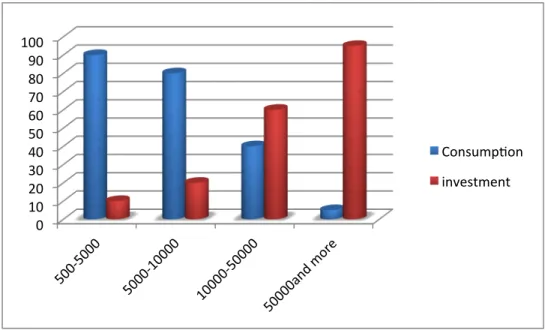
The utilization of funds received in a Rosca is grouped into two categories: funds for consumptions and investments. According to the participants’ statement in this research, the funds received in a Rosca for consumption, are used to resolve some problems in households, such as paying for: food, clothes, household equipment (mattress, chairs, TV, etc), medical insurance, school fees for their children, land leases, dowry and renovating the house or roof
repair. It is dependent on the quantity of money received; if the money collected is greater than 50000Rwf, most people who receive this money can use it for investments such as purchase land, purchase domestic animals (cows, pig, goats, etc), purchase sewing machines and invest in small business; in agriculture (purchase pesticide, seeds and fertilizer) as well as in commerce and in tailoring. The following figure shows how people use the money received.
Figure 1: Utilisation of Roscas funds according to the amount they contributed (from personal data collected in the Gakenke district)
The figure above shows the amount a member contributes (on horizontal axis); if they contribute a lot, then the pot will be large enough for investment. The vertical axis represents the percentage of participants in this study. As the figure shows, 58% of participants who contribute more than 10000Rwf spent their money on investments.
One respondent stresses that ‘he cannot survive without being a member of a Rosca’ because the money he gets from his ordinary activities, is spent them on buying drinks in a bar
0 10 20 30 40 50 60 70 80 90 100 Consump3on investment
adds: ‘When I am in a Rosca I can save these money and don’t spend it on unnecessary needs thinking that tomorrow I will contribute to a Rosca as I promised. I wait until I get my pot and invest it in agriculture’. This means that Rosca can facilitate people to plan for their future.
The preference of being a member of a Rosca rather than some other microcredit institutions is that Rosca is a simple form, flexible, provides a quick loan and easily accessible (see also in Seibel, 2001; Adeneyi, 2011). One participant says that:
‘I prefer to be in a Rosca rather than being a member of any other microfinance because when I want to solve my urgent problem, the microfinance have a long process and sometimes they charge some money for their services and also that the money comes late and is a lesser amount. If I want to pay the school fees for my children, they would risk being late at school by waiting for the money and there is a risk that more money will be added. For example, if each month they take 500Rwf, then I put my money in a savings account for five months, 2500Rwf is deducted, then what I have left to use becomes insufficient’.
In addition, microfinances in Rwanda have a bad reputation due to their failure in the 2006, when some microfinances did not manage to reimburse their clients after its failures, particularly in rural areas. Many participants mention this failure during discussions groups. Thus, the participants in a Rosca are not all incapable of using formal financial institutions. For instance, in the Gakenke district, some staff from the district formed a Rosca for enhancing solidarity and social relationship. As result, Roscas seem to be more popular than other kind of microfinances in the Gakenke district.
Regarding to the social function of a Rosca in the Gakenke district, people members of Rosca benefit by sharing information, advice and fostering friendships, relationships as well as solidarity among those in the community. In the meetings they share information about different
issues such as business and health. The following example is from a participant’s experience; one participant gives us an example of family planning by using contraceptives. Previously, she had incorrect information about contraceptives, thinking that contraceptives can cause harm in the next pregnancy or result in other complications. She learned from a friend in the Rosca the reality of contraceptives.
The cultural benefit from a Rosca is to learn how people help each other, as it was previously existed in Rwandan cultural such as, visiting a family that is going to have a baby or having a ceremony in order to give a hand. Those who are invited first are the ones from a Rosca in which one belongs (this was stressed by a participant during an interview). She stated: “ when you do not participate in a Rosca you are selfish, no one can visit you or help you in case you are in difficult situation”. This shows how a Rosca is like a cultural institution. Roscas urge people to behave appropriately not only in-group, but also in the broader community, consequently, a member behaves in inacceptable manner, risks being outcasted from a Rosca.
Furthermore, Roscas are used for achieving certain government objectives such as providing medical insurance for a large number of people. For instance, in the Gakenke district, local leader urges people to form a Rosca in order to be able to pay medical insurance; many people in the Gakenke district are not able to pay medical insurance on time, especially marginal people or people who have a large family. When they form a Rosca, they can save until they get the total amount required for medical insurance. The organizer collects the money instead so that it is allocated to the person whom medical insurance is to be paid if that person did not pay for it. If he/she has already paid for the medical insurance, he/she gets his/her pot as planned and spends in his/her needs.
3.4. Challenges in Roscas in the Gakenke district
Many Roscas are formed on the basis of income categories; I found that people are excluded from some Roscas (including self exclusion) due to their inability to fulfill their obligations. When a person does not honor his/her obligations, he/she becomes untrustworthy.
A Rosca can create conflict among its members; specifically, when the first receiver of the pot runs away without honoring his/her obligations as promised. However, there are social sanctions, which are embedded in social norms that can regulate misbehavior in the group. Nevertheless, Roscas have no legal contracts; thus, no remedies that can be pursued in any court. Sometimes members of a Rosca selected, went to the defaulter to listen his/her problem and gave an advice. If he/she resists, they enforce him/her to repay by taking his/her goods such as domestic animals or any other materials that are valued in equivalent to the loan. In turn, the ones who defaults can risk to being alone or socialize with other members, especially the ones who live nearby in times of he /she needs a hand, as a result of his/her actions. A culture of vising each other in Rwanda shows a good relationship between neighbours. In rural areas such Gakenke district is located, visiting or helping a neighbor, is a basic need. For instance, in case any family wants to take a pregnant woman to the hospital for giving a birth, neighbours may commit because they live in areas where an ambulance does not have easy access or there are only few available ambulances in the district. In such a case, there are some typical Roscas that are formed specifically for such purpose3
. When you do not commit, you are considered as selfish. Often the ones who do not belong to any Rosca is considered as selfish, thus, it is not easy to find someone to help him/her in difficult situation. Another challenge is when one of the
3 The participants revealed an appropriate name for such a Rosca, which is called ‘Guhekerana’ i.e solidarity. This
members who need a loan is favored because she/he has many friends in a Rosca or some members are corrupt. Other members can give up and change to another Rosca. This has been the case in the Gakenke district. Such those challenges make it difficulty for a Rosca to be sustainable.
3.5 The influence of trust in social development in the Gakenke district
Social development implies good working relationships (social inclusion), equality (distribution of social and economic opportunities) and integration of marginal or discriminated people (against social exclusion), where its principal objective is to eradicate poverty and promote social cohesion. Accordingly, this study analyses the influence of trust on social development on the basis of Amarty Sen’ s development theory called “Development as Freedom”(Sen, 1999). Sen argues that poverty needs to be seen as the “deprivation of basic capabilities rather than merely as a consequence of low income”(Sen, 1999, p.20). Rational human beings plan for their future by changing her/his behavior, which requires freedom of choice. Sen asserts that, “development consist of the removal of various types of unfreedoms that leave people with little choice and little opportunity of exercising their reasoned agency (ibid, p.xii). Sen identifies two different types of freedom: constitutive and instrumental freedom. Constitutive freedom in our context reflects on person’s freedom of participation in Roscas while instrumental freedom reflects on interdependence of distinctive features of development provided by Roscas. Trust in this study falls under both the category of freedom. That is being trustworthy means ability to participate in Roscas on the one hand. On the other hand, when you participate in Roscas you can consume the benefits and risks that are provided by Roscas. Trust
kind of financial choice, where everyone can exercise her/his ability to address economic and social problems (including vulnerable and marginalized people). Trust as a principal focus in those groups, influences social development in two different ways but leads to the same result.
When trust is established, it changes everything (Covey and Merril, 2008). Strategic trust defined by Uslaner (2002) seems to be pessimistic about wards the people whom they do not know. They exclude those people from their social interactions. Uslaner argues, “They avoid strangers and base their social circle upon family, close friends, and members of their own group”(Uslaner, 2002,p.5). Roscas often base on kinship and exclude people that are not well known. However, in Gakenke district, Roscas are different in settings so that some Roscas can include people that are not well known about each other. Trust among people in those groups is based on calculus. Normally, in strategic trust people do not trust beyond with their own community, which means that they can exclude the people they do not know beforehand. Roscas conversely, can include strangers with conditions such as to place a newcomer at the end of rotation in order to be assured of his/her commitment. With strategic trust, Sen (2000) calls this capability deprivation in human life, which is a direct relation feature of social exclusion that leads to poverty. According to Sen (1999) poverty is defined as “capability failure”. He argues, “ social exclusion can thus, be constitutive a part of capability deprivation as well as instrumentally a cause of diverse capability failures”(Sen, 2000, p.5). He explains to the statement that there are multiple consequences of social exclusion on human life. Some of the consequences are solitariness, marginalized and loneliness that can lead to severe poverty.
Social exclusion is constitutiving when a person is directly deprived of social and economic opportunities from social contact such as being unable to participate in-groups. In addition, in Roscas not only people who are not known excluded but also people who are known
for example, some Roscas with single person. These people are deprived from access to the benefits from social contact or relations that are provided by Roscas.
Social exclusion is instrumentally, when a person is deprived to access to social and economic opportunities through the causal consequences such as being unable to have access to the means (e.g. loan) which can result in lack of basic needs (food, education, medical insurance, etc). The strategic trust that is based on knowledge and calculus can only solve the problems of a small group of people in the community. Strategic trust can become a challenge in large community where people do not know well about each other. However, strategic trust reduces risk of uncertainty or contingency from lacking relevant information regarding the performance of individuals (Neilsen, 2004). In Roscas groups, not only the people who are not well known excluded, but also the people that are well known, can face a risk of exclusion from social interaction, particularly in the groups that involve monetary values because reputation is viewed as a source of legitimacy (ibid). Therefore, strategic trust can impede social development achievements for the people who are excluded from social interactions. For example, Single people often are excluded from some Roscas groups in the gakenke.
All the same, trust rubricates social life (Putnam, 1993). With moralistic trust, everyone is involved in social interaction. Uslaner argues, “People ought to trust others”(Uslaner, 2002, p.3). This influences social development positively, but it also creates a little confusion about the freedom of choice that a rational human beings has for trusting others. If all people are involved in social interactions, it means that they will know each other through the repetitiveness of interactions, which can facilitate individuals to exercise their capabilities for achieving functionings. Sen (2000) suggests “being able to be in a relationship with others and exchanges
part in the life of the community and having access to social and economic opportunities from social contact”(p.10). Moralistic trust has an optimistic view of the world. In this respect, Roscas in the Gakenke district do not encompass moralist trust but they can entail some features such as accepting strangers, promoting equality and including disadvantaged people in their interactions. Those strangers will be trusted with their performance. That is, people will know each other through repetition of interaction.
Generalized trust has been viewed as public good and a social capital (Putnam, 1993). When a person is able to be in a relationship with others including participation with their preferences and feel confident with them and see the goodwill of others. Had confidence with others that they will fulfil their promise boosts economic and social development directly from good working relationships. For example, being able to participate in a Rosca, you are able to share social and economic opportunities from social interactions and exchanges. The assets you accumulate can help you with consumption or investment in productive activities so that you can contribute to the well being of your family and development of the broader community. Thus, generalized trust also reflects personal well-being and a supportive community but are not much used in the Gakenke Roscas.
In addition, generalized trust enhances social cohesion such as integration of disadvantaged people, which it can solve common problems in the community, specifically an impoverished person’s life such as undernourishments, persistence of morbidity, widespread illiteracy, etc. However, as far as people interact and exchange goods and services, the problem with generalized trust is that people can distrust or trust due to other people’s performance (Bengtsson, 2000) which is to place someone at the end of rotation in order to be well known during the period of rotation in the Gakenke Roscas. The person is evaluated through his/her
performance and commitment. Furthermore, generalized trust lies in more equitable distribution of opportunities because it reflects concern for others, especially people who have faced discrimination and as result have fewer resources. It helps these people to overcome solitariness or loneliness in the community, which is found in Roscas’ objectives in the Gakenke district.
To summarize both strategic trust and generalized trust can influence social development positively and negatively but in different ways. Strategic trust favours people who are like themselves. The people are well known by others. Accordingly it positively influences social development of the people involved in-groups and negatively those who are excluded from the group and/or not involved in-groups. It reduces risk and transaction cost for those who are involved in- groups.
Generalized trust is a trust with the people who do not know each other means stranger. Trust is not based on conditions but moral. Trust tends to make people be more optimistic about their own ability to achieve development. Generalized trust is more political than social. Generalized trust like strategic trust can reduce transaction costs and facilitate people for exercising their capabilities for their advancement and progress. Negatively generalized trust can face risk from uncertainty or contingency that can impede development of others. In a Rosca when a person runs away, all members bear the risk and share responsibility to fill the gap. The strangers in Roscas are involved in conditions for mitigating risks from uncertainty. Therefore, strategic trust is more preferable than generalized trust in Gakenke Roscas, unless, they can entail some features of trust discussed with. Both generalized trust and strategic trust can shape a change in development, which defined as social change (Hettne, 2009).
5. Conclusion
This research paper discussed the relationship between trust and development in Rotating savings and credit associations in the Gakenke district in the northern province of Rwanda; the findings showed that strategic trust influences the social development of members of Roscas through economic and social opportunities from social contact. When a person is known, he /she can participate in a Rosca, due to his/her reputation. A Rosca is a typical financial choice, which can reduce transaction costs among its member. Strategic trust excludes the people one does not know well, which positively influences social development of people included into the group and negatively influences the social development of the people excluded from the group or not involved in the group. Generalized trust is ironically existed in the Gakenke Roscas when people said, “everyone is welcome to be a member of a Rosca”; as far as they interact generalized trust change to strategic trust where a person is evaluated through his/her performance and well known through the repetitive interaction.
The qualitative interviews are conducted among members in Roscas. I discussed strategic trust and generalized trust on the basis of the process of recruiting members as well as interaction on social and economic benefits from Roscas groups. The participants in this research, through individual experiences revealed that trust is built and rebuilt during the period of rotation. It can also sometime break due to defaulters. Accordingly, in the Gakenke district trust among members of Roscas, is a strategic trust rather than generalized trust. However, this study does not address whether the conflict in Rwanda had an effect on the strategic trust among Roscas members. This can be a topic of further research. The implication of these findings is to contribute to the knowledge of Rotating savings and credit associations in Rwanda, and increase knowledge regarding the influence of trust in social development.
References
ADENIYI, MUTAFFAU. I JAIYA (2011): Informal Microfinance and economic activities of
rural Dwellers in Kwara South Senatorial District of Nigeria, International Journal of Business and
Social Science, Vol2, No15; August2011
ADOFU, ANTAI, E, AND ALABI, O (2010): Informal Savings mobilization and investment: A case study of Rosca in Kogi State, Nigeria, Continental Journal, Social Sciences3: 7-17; 2010, ISSN2141-4265.
AGEGNEHU BISTRAT (2012): Why do members join Indigenous informal financial Institution-Rosca? An empirical evidence from equbs in Ethiopia, Swidish University of Agricultural sciences, Master’s programme degree thesis No710-ISSN 1401-4084.
AKINGUNOLA RICHARD.O, SERIFATO, ONAYEMI (2010): The role of Informal finance in the development of women Micro-businesses in Nigeria. A case study of Ogun and Oyo States, International Journal of Academic Research, vol2, No5, September 2010.
ALABI JOSHUA, GOSKI ALABI AND ANTHONY AHIAWODZI (2007): Effect of SUSU-A traditional micro-finance mechanism on organized and unorganized micro and small enterprises (MSEs) in Ghana, African Journal of Business Management vol 1(8), p 201-208, November2007, ISSN 1993-8233@Academic Journals.
ALESINA ALBERTO AND ELIANA LA FERRERA (2000): Who Trust Others, Discussion paper No2646, Centre for economic policy Research, ISSN 0265-8003, 90-98, Goswell Rd, London, EC1V7RR, UK.
ANDERSON. S, BALAND. JM & MOENE. K. O (2008): Enforcement in Informal Saving Groups, Journal of economic development 90(2009), pp 14-23, September2008, JEL Codes:017 012 016. Doi10.1016j.j deveco-2008.09.009
ANSOMS (2008): Rural Poverty and Livelihood profiles in post-genocide Rwanda, Discussion paper, Institute of development policy and management, University of Antwerp, Beligium.
ARDENER, SHIRLEY AND BURMAN. SANDRA (1995): Money-Go-Rounds, The Importance of Rotating savings and Credit associations for Women, Berg oxford/Washington D.C., USA.
BENDA.CECILIA (2012): Community rotating savings and credit associations as an agent of well-being: a case study from northern Rwanda, Community development Journal,
BENGTSSON. RIKARD (2000): Trust, Threat, and stable Peace, Swedish Great Power Perceptions 1905-1939, Sweden, ISBN91-88306-25-9
BESLEY TIMOTHY, STEPHEN COATE, AND GLENN LOURY (1993): The Economics of Rotating Savings and Credit Associations, The American Economic Review, Vol83, No 4 (sept 1993); 792-810.
BIGGART, N. W and CASTANIAS, R.P (2001): collateralized social relations: the social in economic calculation, American Journal of economics and sociology, co®, 471-500.
BOUMAN, F. J. A (1995): Rotating and Accumulating Savings and Credit Association:
A Development Perspective, World Development, Vol 23,N.3, pp371-384 online accessed on
10-12-2011
BOUMAN, F.J.A (1992): Roscas and Ascra-Beyond the financial landscape, Conference paper delivered in Wagenigen, November1992.
CASTERFRANCHI. CHRISTIANO (2008): trust and Reciprocity: Misunderstandings, international Review of Economics, Doi 10.1007/s 12232-008-0041-x
CHITEJI, N.S (2002): Promise Kept: Enforcement and the role of Rotating savings and Credit Associations in an economy, Journal of International development, DoI: 10.1002/jid.847.
CLARK, DAVID. A (2005): Sen’s Capability Approach and Many Spaces of Human well-being”, The Journal of Development Studies, Vol41, no8, November 2005, pp1339-1368, ISSN0022-0388, Doi10.1080/00220380500186853.
CROSSLEY.THOMAS CORMAC.O. D (2010): The Wealth and saving of Uk families on the eve of the crisis, The Institute for Fiscal Studies, July 2010, ISBN: 978-1-903274-74-3.
COVEY. STEPHEN M.R. AND REBECCA R. MERRILL (2008): The Speed of trust, the one thing that changes everything, Free Press, USA, ISBN-13: 978-0-7432-9730-1
FUKUYAMA FRANCIS (1995): Trust: The social virtues and the creation of prosperity, Hamish Hamilton LTD, London, ISBN0-241-13376-9.
FURLONG. DOMINIC (n.d): The Conceptualization of ’trust’ in Economic Thought.
GAMBETTA. Diego (1988): Making and Breaking Cooperative relations, Basil Blackwell ltd 1988, Oxford Ox41jf, Uk.
HARDIN. RUSSELL (2002): Trust and trustworthiness, a volume in the Russell sage foundation series on Trust, New York.
HETTNE. BJÖRN (2009): Thinking about development, development matters, Zed books London & NewYork.
IJR (2010): Rwanda reconciliation Bolometer
JONES. R AND GEORGE J.N (1998): The experience and evolution of trust: Implication for cooperation and Teamwork, Academy of Management review, vol23, No 3, p531-546, Texas A & M University.
KAN, MEDIHA (2012): ROSCA and Microfinance in Pakistan: Community and Culture, Thesis submitted for the degree of Doctor of philosophy at the University of Leicester.
LUHMAN, NIKLAS (1979): Trust and Power, John Wiley&Sons, ISBN 0471997587. MALAKI AKHIL (2005): Informal Finance and Microfinance in Jamaica and Trinidad & Tobago: An Institutional Study, Sweden, Stockholms Universitet, ISBN 91-85445-18-5
MISZTAL BARBARA A. (1996): Trust in Modern societies, UK, polity Press, ISBN0-7456-1248-2
MUSONI. PROTAIS, (2007): Rebuilding trust in Post conflict situation through Civic engagement: the experience of Rwanda, a paper presented at the 7th
global forum on reinventing Government, Vienna, Austria, 26-29 June 2007.
NISR (2012): The Evolution of poverty in Rwanda from 2000 to 2011: Results from the Household surveys (EICV2) and (EICV3), February 2012.
NISR (2010): EICV3 District profile: Gakenke
NIELSEN. BO BERNHARD (2004): The role of trust in collaborative relationship; A multi-Dimensional Approach, M@n@gement, vol7, no3, 239-256, ISSN1286-4892.
NOAH.Y. GAFAR.J. IJAIYA AND MUFTAU.A. IJAIYA (2009): Informal financial Institutions and Povery reduction in the Informal sector of Offa Town, Kwara State: A case study of rotating Savings and credit Associations (Roscas), Journal of social Sciences, 20(1): 71-81(2009), Nigeria.
NORTH DOUGLAS. C (1995): The New Institutional Economics and Development, in J. Hunter, J.Horniss and C. Lewis (eds), The new Institutional Economics and Third World development, London, Routledge.
PUTNAM. ROBERT D (1993): Making Democracy work, civic traditions in Modern Itary, Princeton University Press, New Jersey, ISBN 0-691-07889-0
ROTHSTEIN, BO AND USLANER, E (2005): All for all: Equality, corruption and social trust, World politics, Vol 58, Number1, October 2005, pp41-72 (article), University press, DOI: 10.1353/WP.2006.0022.
ROUSSEAU. DENISE M., SIM B.SITKIN, RONALD S. BURT AND COLIN CAMERER (1998): Introduction to special forum not so different after all: Across discipline view of trust, Academiy of Management review1998. Vol23, No3, 393-404.
RUTHERFORD. STUART (2000): The poor and their money, Oxford, University Press, New Delhi, ISBN 019 565790x
SAKAMOTO. KUMIKO (2003): Social development, Culture, and Participation; toward theorizing endogenous development in Tanzania, PhD thesis, Waseda University, June2003.
SANDSOR.A.M.J (2010): The Rotating Savings and Credit Associations: An economic, social and cultural institution, thesis for the degree master of economic theory and econometrics, University of Oslo, may 2010.
SEIBEL. H.D (2001): Mainstreaming informal financial institutions, published in Journal of developmental entrepreneurship, vol6, No1, April2001, 83-95.
SEN. AMARTYA (1999): Development as Freedom, Oxford University press, Oxford.
SEN. AMARTYA (2000): Social Exclusion: concept, application, and Scrutiny, Asian Development bank, June 2000.ISBN 971-561-274-1.
STENMAN. OLOF JOHANSSON (2006): Who are the Trustworthy, We think? Working papers in Economics n0 222,version Jurly22, 2006.
UNITED NATIONS (1995): World Summit for social development, Copenhagen, Denmark, 6-12 march1995.
UNDP (2013): The rise of the South; Human Progress in a Diverse World, Human development Report2013.
USLANER. ERIC M. (2002): The moral Foundation of Trust, Prepared for the Symposium, “Trust in the Knowledge Society,” University of Jyvaskyla, Jyvaskala, Finland, 20 September, 2002 and for presentation at Nuffield College, Oxford University, February 14, 2003. USLANER. ERIC (2003): Civic engagement and Particularized trust, the tie that bind people to their ethnic Communities, American Politics Research, Vol31, No 4,July
2003,p331-USLANER. ERIC. M (2004): Trust and Social Bonds: Faith in others and Policy Outcomes Reconsidered, Political Research Quarterly, Forthming, September 2004,V 37,3.
WILSON K. RICK AND CATHERIN C. ECKEL (n.d): Trust and social exchange, Department of Political science, Rice University, Houston, Tx 77005.
WOOLLLTHUIS ROSANDE KLEIN, BAS HILLLEBRAND AND BAR NOOTEBOOM (2005): Trust, Contract and relationship development, Organizational studies, DOI: 10-1177/0170840605054594.